

What Is a Drive-By Appraisal? How It Works and Why Lenders Use It
Table of Contents
- What's a Drive-By Appraisal?
- How a Drive-By Appraisal Works
- When Do Lenders Use Drive-By Appraisals?
- Drive-By Appraisal vs. Full Appraisal
- Pros and Cons of Drive-By Appraisals
- Cost of Drive-By Appraisals
- How Accurate Are Drive-By Appraisals?
- Alternatives to Drive-By Appraisals
- How to Prepare for a Drive-By Appraisal
- What If You Disagree With the Appraisal?
- Conclusion
- Frequently Asked Questions About Drive-By Appraisals
Your lender mentions a drive-by appraisal. You're refinancing or applying for a loan. Suddenly you're wondering: can someone really figure out what your home is worth just by driving past it? The short answer matters more than you might think. Understanding what's a drive-by appraisal helps you move through the mortgage process without getting blindsided at closing. You'll know what's realistic and what's not. This guide walks you through exactly how drive-by appraisals work, why lenders use them sometimes, how reliable they actually are, and what you can do to get the best result for your situation.
Wondering what selling will cost? Start with what sellers pay at closing. It breaks down every seller cost at closing, the surprises, and ways to pay less.
What's a Drive-By Appraisal?
Definition and Basic Concept
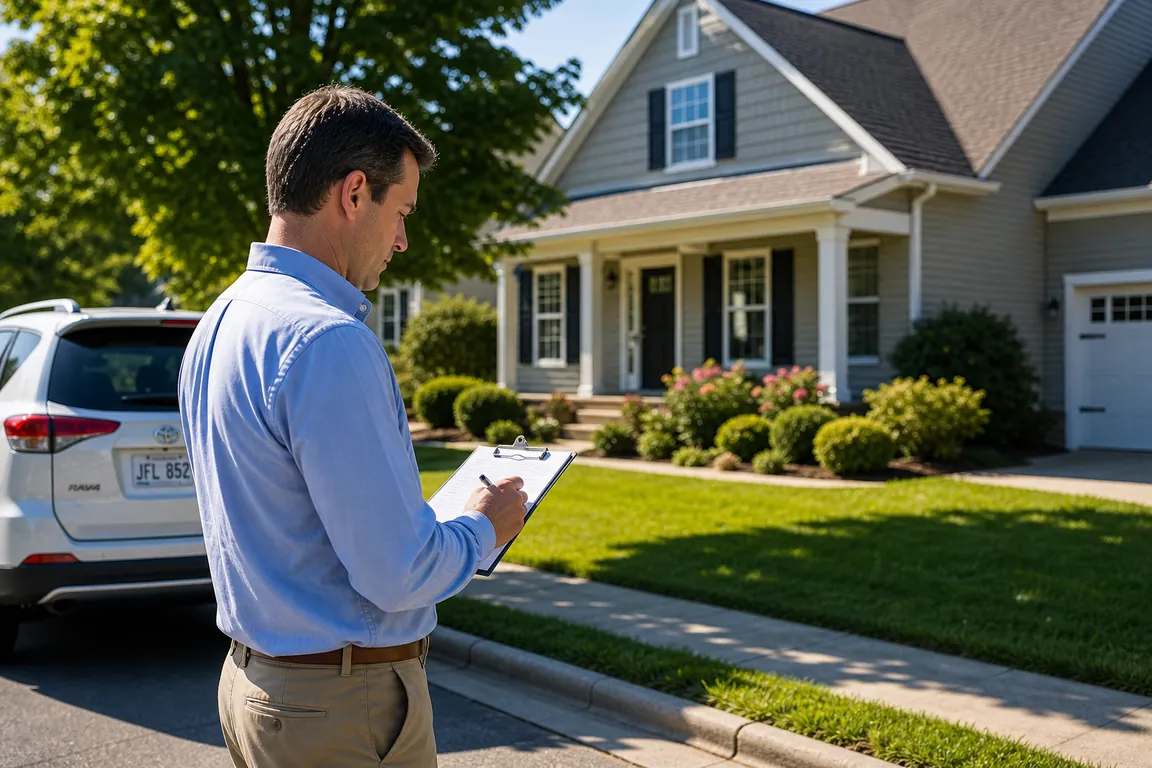
A drive-by appraisal — formally known as a Form 2055 exterior-only appraisal — is basically a quick property valuation. A licensed appraiser estimates your home's value by looking at the outside, checking public records, and comparing it to similar homes that sold recently. They literally drive by, snap some photos of the exterior, and note what they can see from the street. They never actually go inside.
Since there's no interior inspection, it's called a "limited scope" appraisal. The appraiser still uses their professional expertise and market knowledge, but they're working with less information about what's really going on inside your home — the layout, the condition of systems, any upgrades you've made.
And here's the thing: "drive-by" doesn't automatically mean cheap or unreliable. When it's the right fit — especially for straightforward loans on homes with solid documentation — a drive-by appraisal works just fine as a valuation method.
Key Differences from Traditional Appraisals
Walk through your entire house. Measure the square footage. Check the roof, the plumbing, the HVAC system. Note any upgrades or problems. That's what happens in a full appraisal. A drive-by appraisal? None of that. The appraiser instead pulls data from county records, earlier appraisals, MLS listings, and whatever they can see from outside to come up with a value.
There's a real risk here if your home's been heavily renovated or has problems you can't see from the street. But you also get speed, lower costs, and way less hassle — which matters enormously when you're in a tight loan situation and need answers fast.
Back to topHow a Drive-By Appraisal Works

Step-by-Step Process
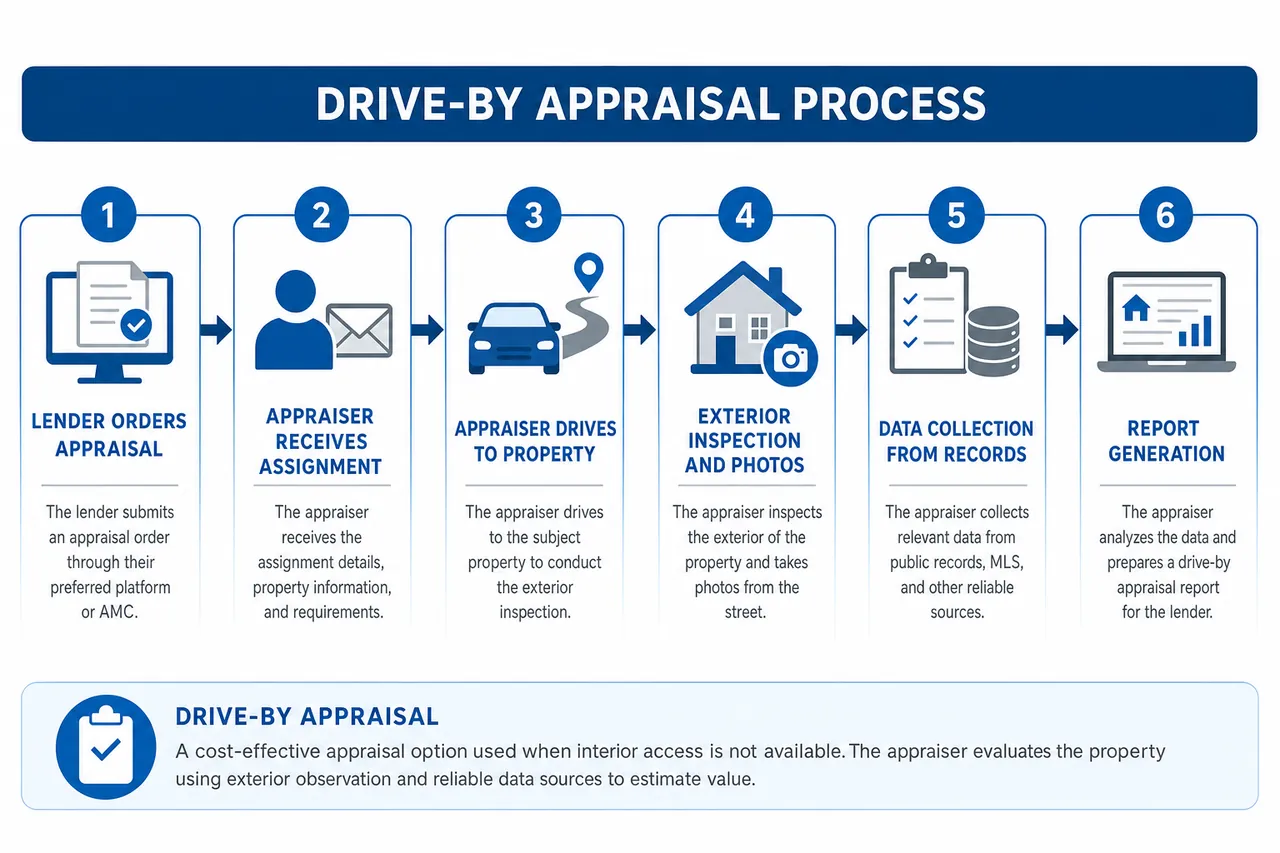
Want to know what actually happens when an appraiser does a drive-by? Here's how it works from beginning to end:
- Lender orders the appraisal: Your mortgage lender decides a drive-by appraisal fits your loan type and risk profile, then contacts a licensed appraiser or appraisal management company (AMC) to get the job done.
- Appraiser reviews property records: Before stepping foot on your property, the appraiser digs into public records—county assessor data, past appraisals, tax records, building permits, and any MLS history they can find.
- Exterior inspection and photography: The appraiser pulls up to your home and gets to work. They photograph the exterior from multiple angles, note the condition, check out the lot and neighborhood, and document anything concerning like deferred maintenance or structural issues.
- Comparable sales analysis: Now comes the number crunching. The appraiser finds recently sold homes similar to yours—same size, style, location, age—using local MLS data and market databases. They adjust for differences between those comps and your property.
- Report generation: The appraiser fills out the standardized Form 2055 report, documents everything they found and how they got there, and sends it to your lender. No interior access needed.
The Appraiser's Role and Qualifications
Here's what matters: a drive-by appraisal still requires a state-licensed or state-certified appraiser. There's no second-tier license for exterior-only work. And that appraiser is just as professionally and legally responsible as someone doing a full interior inspection. They must follow the Uniform Standards of Professional Appraisal Practice (USPAP). Same credentials. Same liability. Same professional standards.
Timeline and Turnaround
Speed is one of the real perks here. Since the appraiser doesn't need to schedule time inside your home or spend hours walking through rooms, you're looking at a turnaround of two to five business days from order to completed report. Compare that to five to ten business days for a full appraisal. And if you're in a fast market or racing against a refinance deadline? That difference actually matters.
Back to topWhen Do Lenders Use Drive-By Appraisals?

Ideal Scenarios
Drive-by appraisals aren't just handed out randomly. Your lender will only use one when they're confident that a quick exterior look gives them enough information to protect their money. Here's when that actually happens:
- Low loan-to-value (LTV) refinances: You've got serious equity in your home. That cushion means the lender's risk stays low even if the valuation is a bit off. Once your LTV drops below 80%, drive-by appraisals usually become an option.
- Recent full appraisals on file: Your house got a complete interior appraisal within the last year and nothing major has changed since then? A drive-by can work to confirm how the market's shifted.
- Rate-and-term refinances: You're just refinancing to get a better interest rate without cashing out equity. The lender's risk shrinks, and they may green-light a drive-by instead of paying for a full inspection.
- Stable market conditions: When real estate prices aren't bouncing all over the place, an exterior-only appraisal becomes more reliable because comparable homes tell a clearer story about your property's value.
- Certain government-backed loans: Some FHA streamline refinances and VA interest rate reduction refinance loans (IRRRLs) skip the full interior appraisal altogether.
Loan-To-Value Considerations
Your LTV ratio—that's the amount you're borrowing divided by your home's value—is the kingpin here. It's the number that actually decides whether a lender will accept a drive-by. The lower your LTV, the more equity you're sitting on. And the more equity you have, the less your lender loses if the valuation turns out wrong.
Most conventional lenders feel comfortable with drive-by appraisals somewhere around 80% LTV or lower. But every lender has different rules, so don't assume yours will match your neighbor's experience.
| Scenario | LTV Ratio | Drive-By Suitable? | Why / Why Not |
|---|---|---|---|
| Rate-and-term refinance, high equity | Under 70% | Yes | Low lender risk; strong equity cushion protects against valuation error |
| Rate-and-term refinance, moderate equity | 70–80% | Usually yes | Acceptable risk level; lender may accept with stable market conditions |
| Cash-out refinance, moderate equity | 75–80% | Sometimes | Depends on lender guidelines; risk is higher since borrower is pulling equity |
| Purchase transaction, standard down payment | 80–95% | Rarely | Higher risk exposure requires full interior appraisal in most cases |
| High-LTV purchase or cash-out refi | Over 95% | No | Too much lender exposure; full appraisal required to protect investment |
Drive-By Appraisal vs. Full Appraisal

Traditional Appraisal Process
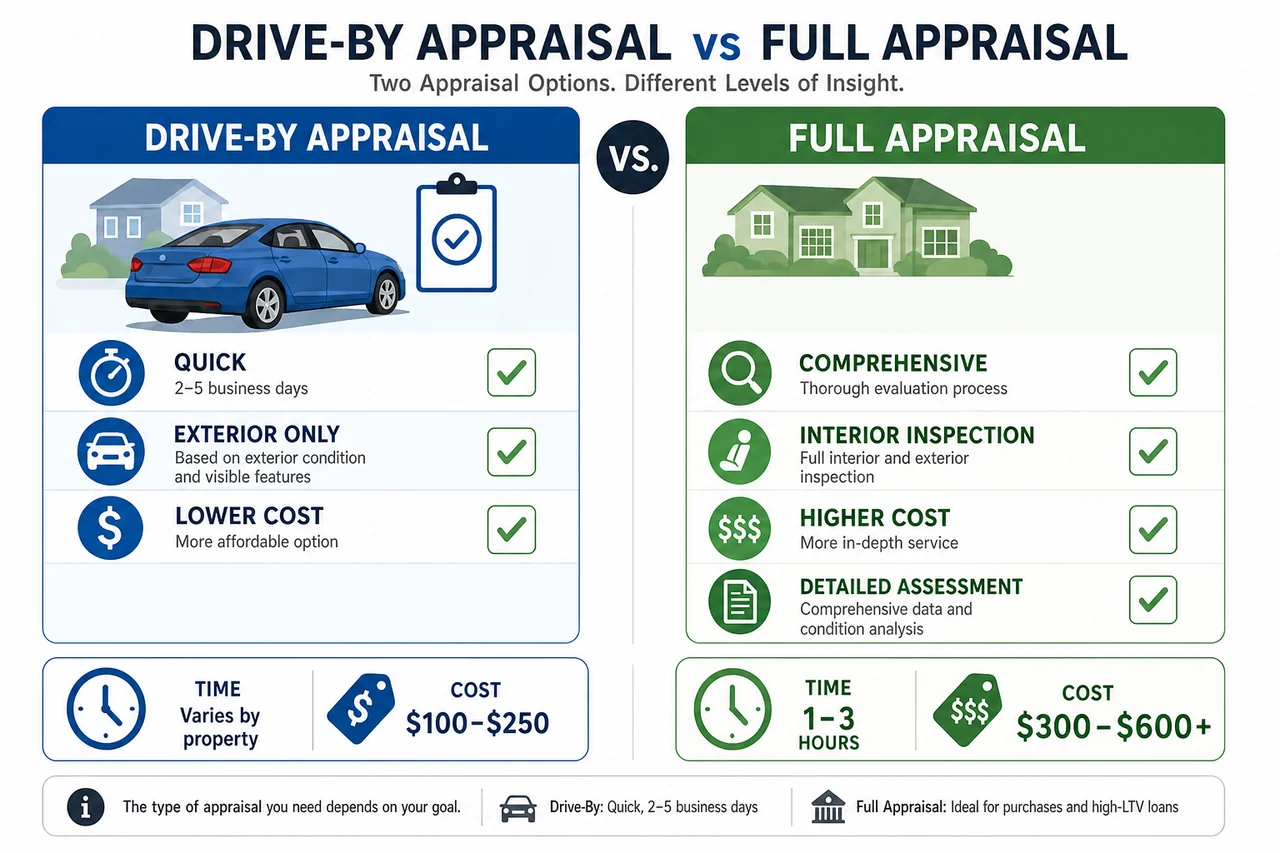
Here's what actually happens during a full appraisal. An appraiser shows up with Form 1004 for single-family homes and spends one to three hours inside your property. They're measuring every room, crawling through the attic, checking out your kitchen and bathrooms, inspecting the roof and mechanical systems, and snapping photos of everything. The result? A detailed, defensible valuation that holds up in court if needed.
Want the full picture of how this works? Check out our guide on how a home appraisal works and what to expect as a seller.
Comparison Table
| Factor | Drive-By Appraisal | Full / Traditional Appraisal |
|---|---|---|
| Interior inspection | No — exterior only | Yes — full interior and exterior |
| Typical cost | $100–$250 | $300–$600+ |
| Timeline | 2–5 business days | 5–10+ business days |
| Accuracy | Moderate — relies on records and comps | High — firsthand condition data included |
| Appraiser access | Exterior only, no homeowner scheduling needed | Full access required; owner must be present or arrange access |
| Form used | Form 2055 | Form 1004 |
| Licensing requirement | State-licensed appraiser required | State-licensed appraiser required |
| Best use case | Low-risk refinances, low LTV loans | Purchases, high-LTV loans, new lender relationships |
When Each Type Is Appropriate
Your transaction type matters. So does your lender's appetite for risk and what your property's history looks like. In California? Our state-specific resource on how a home appraisal works in California walks you through the details. Florida sellers can dig into our article on how a home appraisal works in Florida.
And here's the thing—regional market conditions drive which appraisal type your lender will actually request.
Back to topPros and Cons of Drive-By Appraisals
Advantages
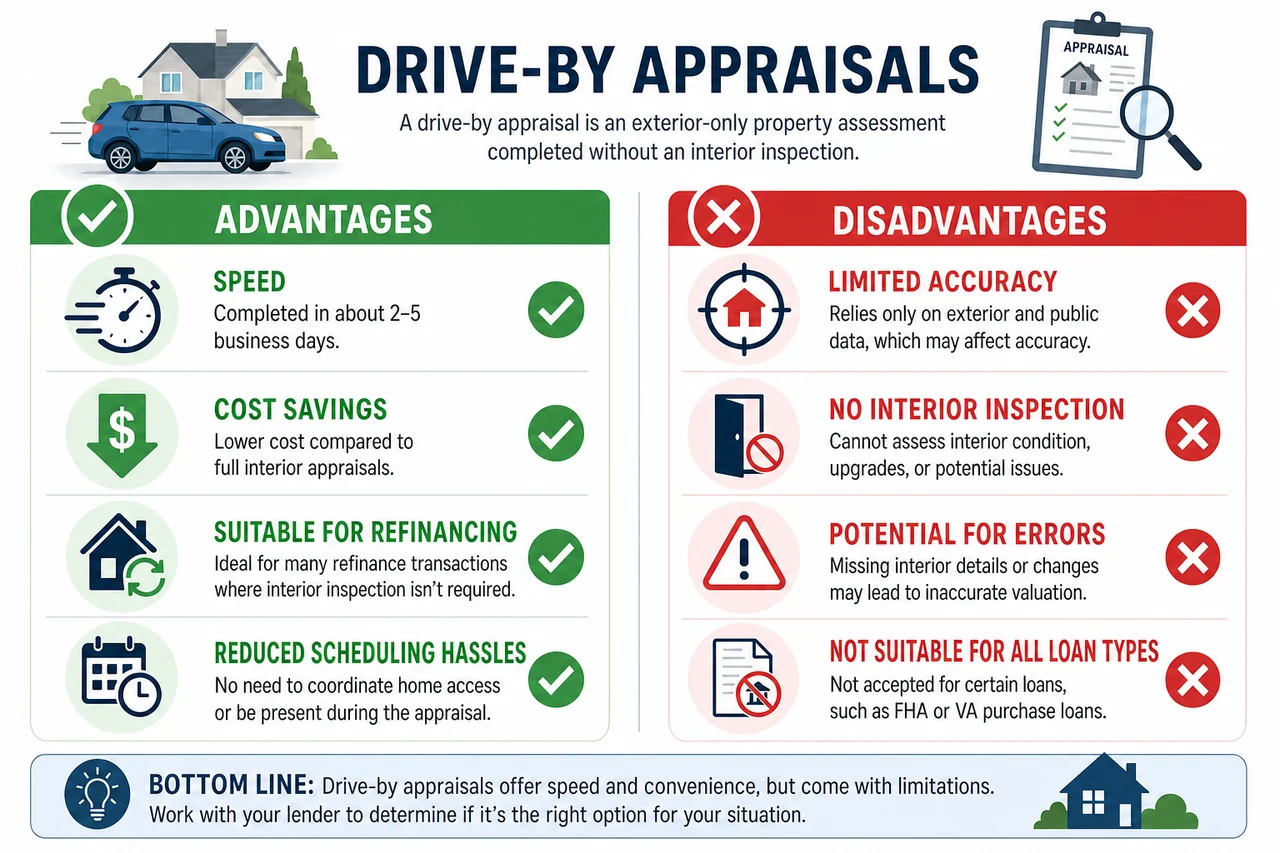
- Lower cost: You'll pay $100–$250 instead of what a full appraisal runs. That's 50–60% less in your pocket.
- Faster turnaround: Two to five business days. Compare that to five to ten days (or longer) for the full version. Your loan closes quicker.
- Convenience: No interior access to schedule. You don't need to scrub baseboards or clear clutter before someone walks through your home.
- Privacy: A stranger won't be photographing your bedroom or commenting on your decor. Many homeowners really value that.
- Sufficient for low-risk transactions: And if your equity's strong and the loan is straightforward? This method gets the job done.
Disadvantages
- Limited interior assessment: That brand-new kitchen you just finished? The appraiser won't see it. Your upgraded bathrooms and finished basement might get overlooked, which could hurt your home's valuation.
- Hidden defects go undetected: Structural problems, water damage, or a failing HVAC system won't show up on the appraisal if they're not visible from the street.
- Potential valuation inaccuracy: Without stepping inside, the appraiser leans heavily on comparable sales—and those comps might not match your situation perfectly.
- Limited appeal options: Think the valuation's too low? It's much harder to dispute when the appraiser never actually saw what you're working with inside.
- Not always accepted: Many lenders won't take a drive-by appraisal. This is especially true for purchase deals or government-backed loans with strict requirements, regardless of your LTV.
Cost of Drive-By Appraisals
Price Range and Fee Structure
You'll typically pay between $100 and $250 for a drive-by appraisal. But here's the thing — that price isn't fixed. Where you live matters. Your property type matters. Even which appraiser or AMC handles it matters. Urban areas with higher living costs tend to run closer to $250, while rural properties might come in cheaper. Got an unusual architectural style, a huge lot, or non-standard construction? Expect to pay a premium, even though they're only looking at the outside.
A traditional appraisal that includes an interior inspection runs $300 to $600 for a basic single-family home. Luxury properties or anything complicated? You could easily hit $1,000 or more. The math is simple: choosing a drive-by saves you 40–60% when your lender will accept one.
Who Pays?
In most situations, you do. The borrower covers the appraisal fee — it shows up in your closing costs or you pay it upfront before the appraiser even gets ordered. A few lenders will roll it into your loan or cover it as a special offer, but that's the exception, not the rule. And here's what matters most: that fee doesn't come back to you if the loan falls through. So talk to your lender first about what type of appraisal they actually want before you hand over any money.
Factors Affecting Cost
- Geographic location and market demand for appraisers
- Property size and complexity
- Rush or expedited turnaround requests
- Whether the lender uses an AMC (which may add a management fee)
- Local licensing and insurance requirements for appraisers
How Accurate Are Drive-By Appraisals?
Accuracy Factors and Reliability
Here's what the research shows: exterior-only appraisals and full interior appraisals tend to land on similar values in roughly 80–85% of cases. But that's only when your home is in average condition and your local market has plenty of comparable sales to work with. The accuracy drops fast once you add major upgrades or scarce comparable sales data into the mix — think rural properties or neighborhoods that don't have much turnover.
The biggest factor? Access to good comparable sales. An appraiser with five or more genuinely similar recent sales nearby can work with an exterior-only appraisal pretty confidently. Without those comps — or when the ones available are totally different from your property — skipping the interior becomes a real problem.
When Accuracy May Suffer
- Recent major renovations: A fully remodeled kitchen or added square footage won't show up in county records if permits weren't pulled or the records haven't caught up yet. The appraiser might undervalue your home significantly.
- Rapidly changing markets: In neighborhoods where prices are climbing fast or dropping quickly, older comparable sales won't reflect what's actually happening right now.
- Unique or non-conforming properties: Custom homes and properties with unusual features are tough to value without walking inside. Same goes for homes in neighborhoods where barely anything sells.
- Seasonal market variations: If your appraisal happens during a quiet selling season, the appraiser might rely on older comparables that don't match current market conditions.
- Interior condition extremes: A home that looks solid from the street but has water damage inside — or an older-looking place with luxury finishes hidden away — will get misvalued by a drive-by appraisal.
And if you've recently renovated? Pay close attention to this. Colorado and Tennessee homeowners especially should read our guides on how a home appraisal works in Colorado and how a home appraisal works in Tennessee to understand how appraisers document improvements in your state.
Back to topAlternatives to Drive-By Appraisals
Overview of Appraisal Types
Drive-by appraisals aren't your only option. There's actually a whole spectrum of property valuation methods out there, and knowing what's available helps you push back if your lender tries to use something that doesn't work for your situation.
| Appraisal Type | Typical Cost | Timeline | Interior Access | Best For |
|---|---|---|---|---|
| Drive-By (Exterior Only) | $100–$250 | 2–5 days | No | Low-LTV refinances; low-risk loans |
| Desktop Appraisal | $75–$200 | 1–3 days | No (no site visit) | Very low-risk refinances; lender portfolio use |
| Hybrid Appraisal | $150–$350 | 3–7 days | Yes (by a third-party inspector) | Moderate-risk loans needing interior data with faster turnaround |
| Automated Valuation Model (AVM) | $0–$50 | Instant to 24 hours | No | Pre-qualification estimates; lender internal use; not USPAP-compliant |
| Full Traditional Appraisal | $300–$600+ | 5–10+ days | Yes (licensed appraiser) | Purchases, high-LTV loans, complex properties |
Hybrid Appraisals
Here's where things get interesting. A hybrid appraisal uses two people: a trained property data collector who actually walks through your home, and a licensed appraiser who analyzes everything remotely and signs off on the report. You get interior condition data without paying the full cost of a traditional appraisal. The timeline is faster too. This is why it's becoming the go-to middle ground for lenders and homeowners alike.
Desktop Appraisals and AVMs
No site visit. No inspector. The appraiser just digs through public records, old photos, and data sitting in a database somewhere. Desktop appraisals are faster and cheaper than drive-by appraisals—but they carry real accuracy risk. Then there's Automated Valuation Models (AVMs), the algorithm-based estimates behind things like Zillow's Zestimate. These aren't actual USPAP-compliant appraisals. Lenders use them internally for quick decisions, not for formal loan underwriting.
Back to topHow to Prepare for a Drive-By Appraisal
Exterior Preparation Tips
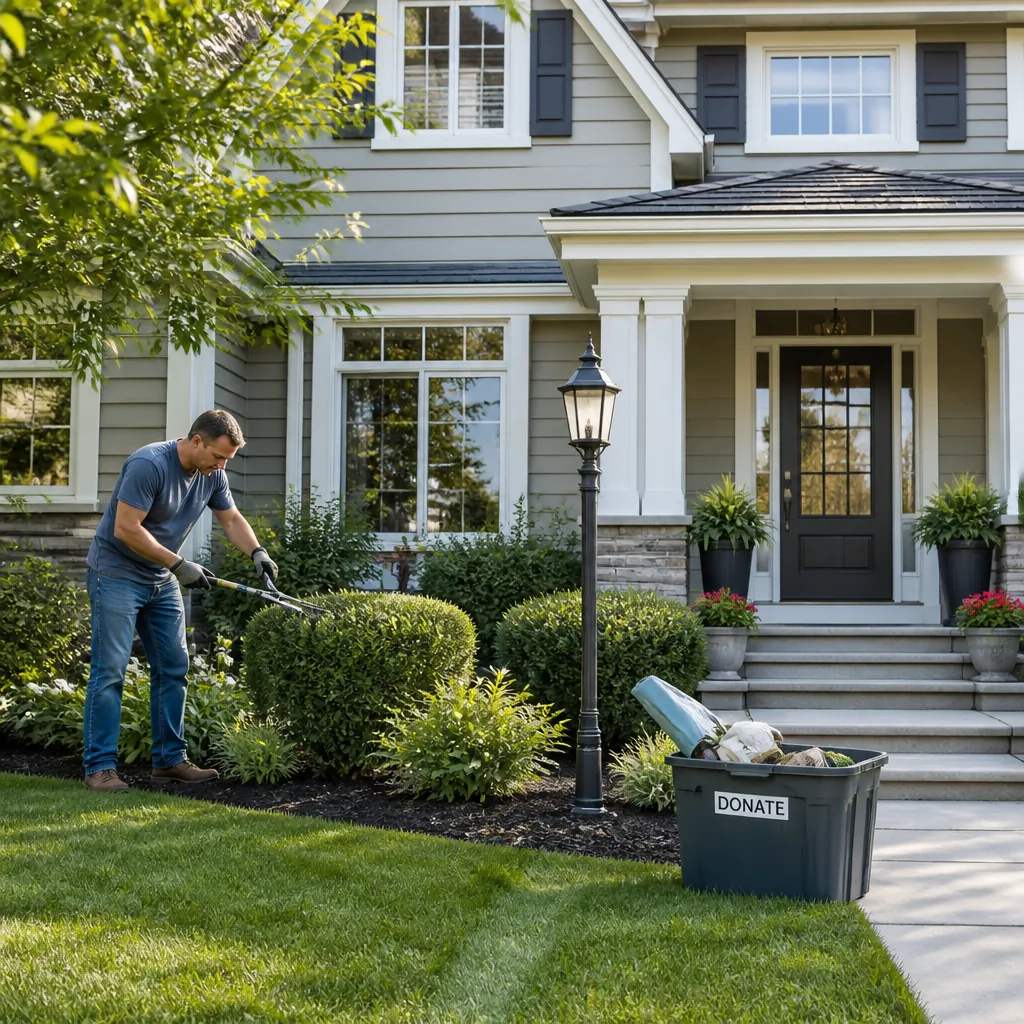
Here's the reality: the appraiser only sees the outside of your home, which means curb appeal matters more than you might think. Want to positively influence that exterior assessment? Here's what actually works:
- Mow and edge the lawn; remove dead plants or overgrown shrubs
- Clean the driveway, walkways, and exterior surfaces — power wash if needed
- Touch up peeling paint on the exterior, trim, and front door
- Repair or replace broken gutters, shutters, or visible roof damage
- Ensure house numbers are clearly visible from the street
- Remove clutter, vehicles, or equipment that detracts from the property's appearance
- Trim back trees or vegetation that obscures the home's exterior or appears neglected
Documentation and Records
The appraiser won't step inside your house. But you can still influence the outcome by getting your records straight. Did you add a bedroom, finish a basement, or replace your roof in the last five years? Contact your county assessor's office right now and confirm they've got your current square footage, bedroom count, and bathroom count on file. Pull all permits for any work you've done in that timeframe.
Hand those permits to your lender. They'll share them with the appraiser, and it could make a real difference.
And if you're in Indiana or Washington, pay attention — these states handle permit records differently. Our guides on how a home appraisal works in Indiana and how a home appraisal works in Washington walk you through the local record-keeping practices that might affect your drive-by appraisal.
What Not to Expect
Don't count on speaking with the appraiser. They might not even stop the car. Seriously — some appraisers slow down, snap a few photos, and keep moving. You won't get real-time feedback, and you definitely won't have a chance to mention that new kitchen you installed or the master bath renovation. Knowing this upfront helps you focus your prep work on what actually matters instead of waiting around for a conversation that probably won't happen.
Back to topWhat If You Disagree With the Appraisal?

Appeal Process and Options
Your drive-by appraisal came in low. Don't panic — you have options. Start by requesting a copy of the completed appraisal report. You're legally entitled to it under federal law (ECOA regulations). Now here's what to do next: read through it line by line, looking for factual errors. Wrong square footage? Incorrect bedroom count? Missing bathrooms? Outdated comparable sales listed?
Found a mistake? Submit a formal Reconsideration of Value (ROV) request to your lender. But don't just complain — bring receipts. Include documentation such as building permits that confirm your renovations, updated county assessor records, and a list of comparable sales that better match your property. The original appraiser has to review your ROV. And if they agree an error was made, they can issue a corrected report.
When to Request a Full Appraisal Instead
Sometimes a drive-by appraisal simply can't capture what's really inside your home. Maybe you've upgraded the kitchen, finished the basement, or replaced the roof. A full traditional appraisal lets the appraiser see all of that in person. Yes, it costs more and takes longer. But if the higher value changes your loan terms — or saves your deal — it's usually worth paying for. And if you're considering a short sale, accurate valuation becomes critical. A full appraisal is almost always the right call in that situation.
Success Rates and Realistic Expectations
Here's the reality: ROV requests succeed in changing appraisal values only about 20–30% of the time. When they do work, it's because the borrower shows hard evidence of actual errors or overlooked comparable sales — not because they think the home deserves more money. Your feelings about the property don't matter to an appraiser. What matters is data. Evidence. Concrete facts.
Back to topConclusion
A drive-by appraisal works. It's legitimate, cost-effective, and perfectly fine for certain situations — refinances with low risk, low-LTV loans, and cases where the inside of your home is already documented. You get speed, lower costs, and convenience. But there are real trade-offs. Interior upgrades, weird property features, or a shortage of comparable sales in your area? That's where drive-by appraisals start to break down.
Here's what you should actually do. Find out which appraisal type your lender ordered. Boost your curb appeal before the appraiser drives by — seriously, this matters. Call your county assessor's office and verify they've got your property's current details on file. And know what to do if that number comes in lower than you expected, because you have options.
Whether you're refinancing when rates are competitive or selling a home with complications, understanding the appraisal process gives you real leverage. Want more detail? Our full guide on how a home appraisal works covers everything, regardless of loan type.
Back to topFrequently Asked Questions About Drive-By Appraisals
Does an appraiser enter the home during a drive-by appraisal?
No. The appraiser stays outside. You won't have anyone walking through your rooms, checking your plumbing, HVAC, or electrical systems. A drive-by appraisal is exterior-only — that's the whole definition. What gets assessed comes from what's visible from the street, combined with public records and what comparable homes in your area have sold for.
How long does a drive-by appraisal take?
Thirty minutes or less for the actual inspection itself. Sometimes it's just a slow drive-by with some photos. But here's what matters to you: the full process from order to finished report typically takes two to five business days. That's much faster than a full interior appraisal, which can stretch to five to ten business days or longer. Need it quicker? Rush requests can sometimes get done in 24–48 hours, though you'll pay extra for that speed.
Can you refuse a drive-by appraisal and request a full appraisal instead?
Your lender calls this shot, not you. But here's what you can do: request an upgrade to a full appraisal if your home's interior improvements or condition won't show up in an exterior-only assessment. Your lender might say yes if you've got a solid reason — like a major renovation you just finished — and you're willing to cover the extra cost. And in some loan situations, lenders are actually required to use a specific appraisal type based on their program guidelines.
Are drive-by appraisals legally acceptable for mortgage transactions?
Yes, they are. Form 2055 drive-by appraisals work for many conventional loans when your lender approves them and your loan risk profile supports it. A state-licensed appraiser has to do the work following USPAP standards. But not every loan type accepts them — FHA purchase loans, VA purchase loans, and certain high-LTV conventional loans usually need that full interior inspection. What's allowed really depends on your specific loan program and your lender's guidelines.
What happens if a drive-by appraisal value comes in lower than expected?
A low value can hurt your loan terms, change how much you need to put down, or even tank the whole approval. Start by getting the actual appraisal report and reading it carefully for mistakes. Found errors? Submit a Reconsideration of Value (ROV) to your lender with proof supporting the higher value. If the appraisal's accurate but you know your interior work should count for more, ask about switching to a full appraisal instead. Sometimes, though, that lower number reflects real market conditions. In those cases, renegotiating the purchase price might be your best move.
Back to topMore in Appraisals and home value
- The Data Behind Online Appraisals: How AVM Tools Can Pump Up (or Down) Your Price
- Appraisal Definition: How Your Home Value Is Determined
- How to Prepare Your House for an Appraisal: Tips to Boost Your Home's Value
- What Is My Home Worth? Home Valuation Methods for Sellers
- What Is My Home Worth? How to Determine Your Home's Value
- Should You Pay for a Home Appraisal Before Listing? Pros, Cons, and Costs
See our guide: “Closing Costs for Sellers: What You'll Pay and How to Reduce Them” →

