

Should You Pay for a Home Appraisal Before Listing? Pros, Cons, and Costs

Table of Contents
- What's a Pre-Listing Appraisal?
- How Much Does a Pre-Listing Appraisal Cost?
- Should You Get a Pre-Listing Appraisal? The Cases For and Against
- When Should You Get a Pre-Listing Appraisal?
- Appraised Value vs. Market Value: What's the Difference?
- Alternatives to a Pre-Listing Appraisal
- How to Price Your Home Without a Pre-Listing Appraisal
- Can a Pre-Listing Appraisal Hurt Your Sale?
- Conclusion: Is a Pre-Listing Appraisal Worth It for You?
- Frequently Asked Questions About Pre-Listing Appraisals
Should you pay for a home appraisal before listing? It sounds straightforward, but it's not. A pre-listing appraisal feels smart and proactive — who doesn't want to know what their home is actually worth before putting it on the market? Here's the catch: most of the time, you don't need one. You'll spend $300–$600 out of pocket. And the buyer's lender might come back with a completely different number anyway. That said, there are real situations where one makes financial sense. Let's walk through what you need to know so you can decide whether you should pay for a home appraisal before selling.
Wondering what selling will cost? Start with every closing cost a seller pays, and how to cut them. It breaks down every seller cost at closing, the surprises, and ways to pay less.

What's a Pre-Listing Appraisal?
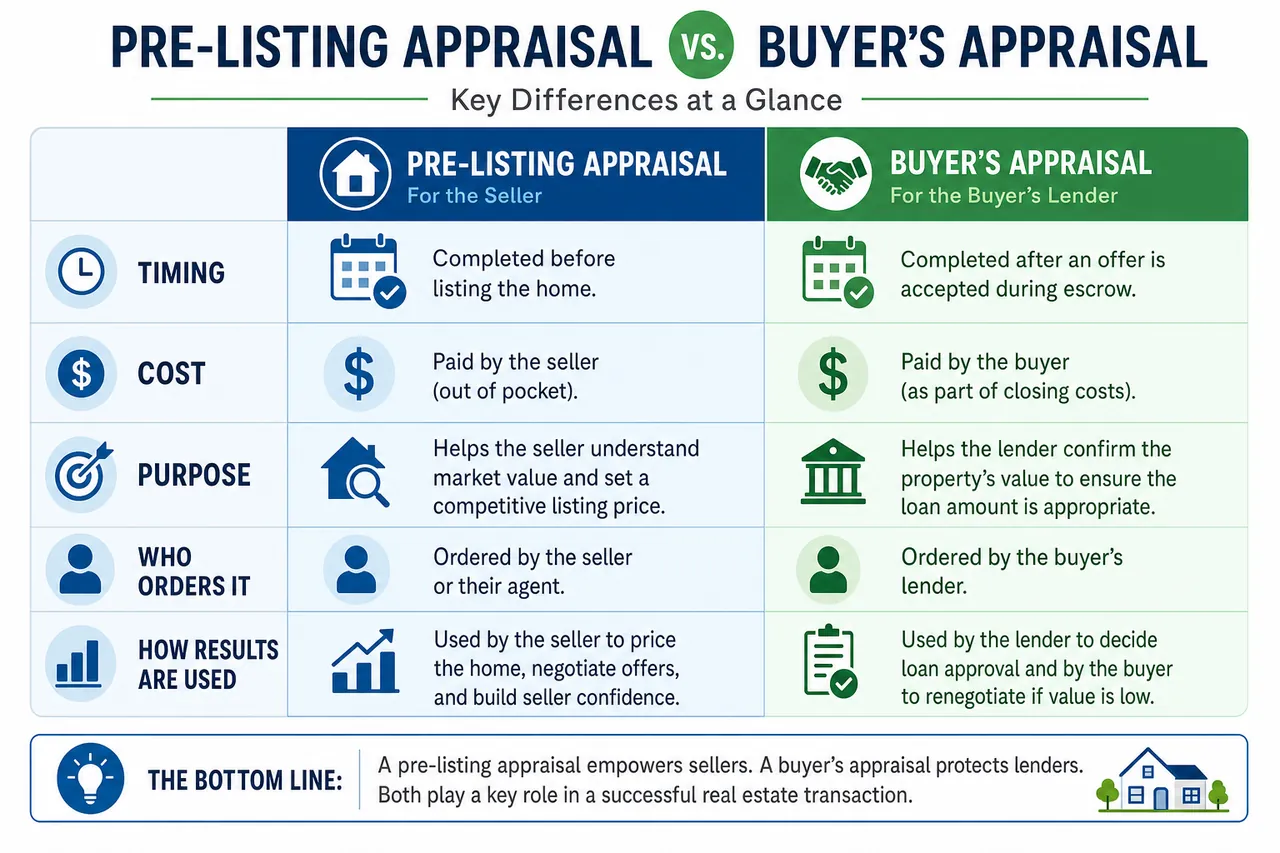
Before you list your home, you can hire a licensed or certified appraiser to value it. That's a pre-listing appraisal. It's completely optional—and you pay for it yourself. The buyer's lender will order their own appraisal later if they get a mortgage. Two different things.
Definition and Purpose
Here's what you need to know: a pre-listing appraisal gives you an independent, data-driven estimate of what your home is actually worth before you set a price. A licensed appraiser will come to your property, measure it, note its condition and features, and then pull recent comparable sales—called "comps"—from your neighborhood. They'll compare your home against those recent sales and produce a formal report, usually 15–30 pages long, with their value opinion included.
Why does this matter? You get real numbers before you commit to a listing price.
When Appraisals Typically Occur in the Selling Process
Most appraisals happen after a buyer makes an offer. The buyer's lender orders it to make sure the property's worth what they're lending. It protects their investment—they need proof you're not asking $500,000 for a $400,000 house.
A pre-listing appraisal is different. You order it weeks or months before any buyer shows up. It's just for you, so you can plan.
Pre-Listing Appraisal vs. Buyer's Appraisal
These are not the same. A buyer's lender appraisal goes through an Appraisal Management Company (AMC), gets assigned to a random appraiser, and follows the lender's rules. Your pre-listing appraisal might use a different appraiser, different comps, and slightly different methods. The two can easily come in at different values—sometimes very different.
But here's the catch: your pre-listing appraisal doesn't lock in your listing price. The buyer's lender appraisal could still come in lower, and that can create real problems later in the deal.
Back to topHow Much Does a Pre-Listing Appraisal Cost?

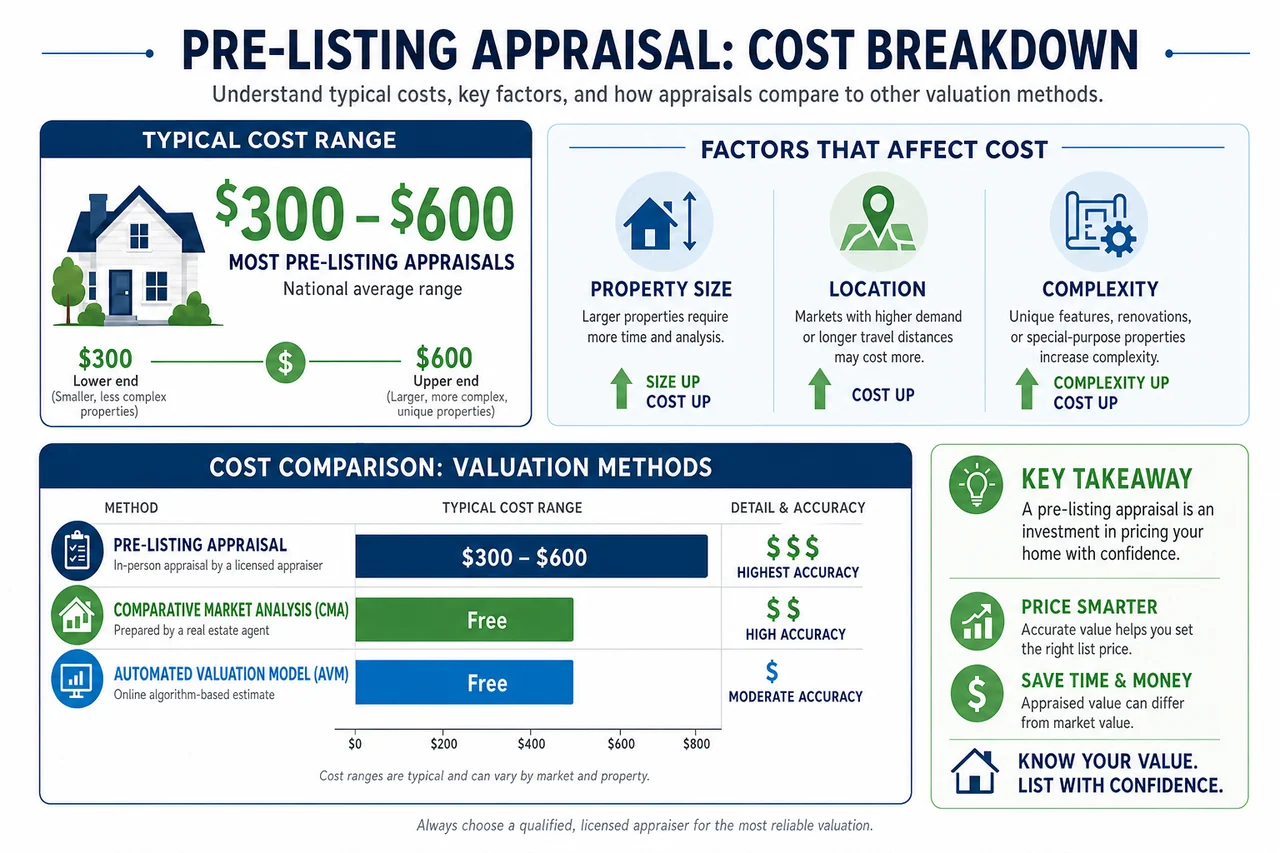
You'll want to know the cost first. And honestly, it varies way more than most sellers expect. But here's the good news: understanding what actually drives these prices means you can make a smarter decision about whether it makes sense for your home.
Typical Price Ranges
Most homeowners pay between $313 and $422 for a standard single-family home appraisal, according to HomeAdvisor and Angi data. The sweet spot? Usually $350–$500. Now, if your home's more complex — think larger, luxury properties, or you're way out in a rural area — you could be looking at $600–$1,500 or beyond.
| Property Type | Average Cost Range | Factors Affecting Price |
|---|---|---|
| Standard single-family home (urban/suburban) | $300–$500 | Size, age, local appraiser availability |
| Large or luxury home (3,000+ sq ft) | $500–$800 | Square footage, premium finishes, complexity |
| Rural or remote property | $500–$1,000+ | Distance, fewer comps, travel time for appraiser |
| Multi-family property (2–4 units) | $500–$900 | Income analysis, additional units, rental history |
| Unique or custom-built home | $600–$1,500+ | Limited comps, specialized expertise required |
| Properties with acreage | $500–$1,200+ | Land valuation, agricultural features, boundary surveys |
Factors That Affect Appraisal Costs
Property size matters. So does complexity. Your location plays a huge role too — if you're in a high-cost metro area, appraisers simply charge more because their time costs more. Rural properties? Those are pricier because your appraiser has to drive farther and hunt harder for comparable sales in a wider radius. You're also paying for the type of report you request. Limited appraiser supply in your area can bump things up as well.
Cost Comparison to Other Valuation Methods
Here's the reality check. A Comparative Market Analysis (CMA) from a licensed real estate agent won't cost you a dime. Same with online tools like Zillow's Zestimate or Redfin's estimate — they're free. But a pre-listing appraisal? That's money out of your pocket before you even list. And that's exactly why most real estate professionals say you don't need one in the first place.
Back to topShould You Get a Pre-Listing Appraisal? The Cases For and Against
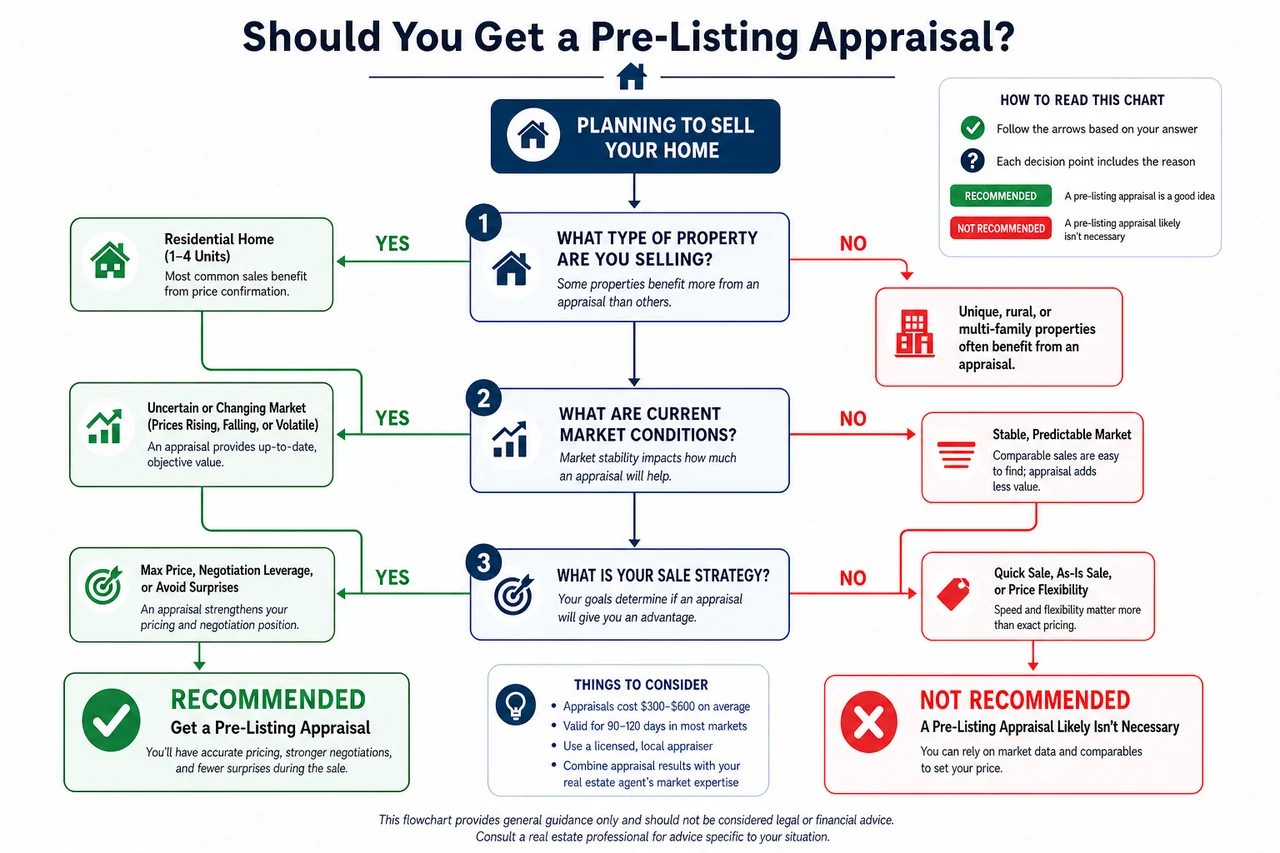
Here's the blunt truth: most sellers in most markets don't actually need one. But here's the thing — you might be different. Understanding what a pre-listing appraisal can and can't do for you is what matters.
Pros of Getting a Pre-Listing Appraisal
- Independent, unbiased valuation: An agent's CMA might have bias baked in (even unconsciously) because they want your listing. An appraiser? They don't care what price you list at — they have no skin in the game.
- Ammunition for negotiations: When a buyer lowballs you, a formal appraisal report gives you something concrete to point to. It's harder to argue with a professional document.
- You catch problems early: Appraisers spot things — deferred maintenance, unpermitted additions, structural concerns — that you might've missed. That gives you time to fix them before showing the house. Learn more about which repairs actually matter before you sell.
- Peace of mind: If you're losing sleep over whether you're pricing this thing right, an appraisal can settle your nerves.
- Essential for cash deals and FSBO sales: When no buyer's lender appraisal is coming, your appraisal becomes the official number both of you reference.
Cons of Getting a Pre-Listing Appraisal
- You're paying $300–$600+ with no guarantee it helps: That money's gone whether the appraisal moves the needle or not.
- The buyer's appraiser might disagree: Your appraisal says $400,000. Their lender's appraiser says $385,000. Guess which one controls the financing — and the actual sale price.
- They expire fast: Most lenders only trust appraisals from 90 to 120 days back. Your home sits on the market for six months? Your appraisal's now a paperweight.
- A low number can sabotage you: If it comes in below your expectations, you're now anchored to that lower figure. Your confidence takes a hit. So does your listing price.
- Disclosure can backfire: Some states require you to share a pre-listing appraisal with buyers. A low appraisal weakens your hand before negotiations even start.
When a Pre-Listing Appraisal Is Worth It
There are real situations where this makes sense. Your property's unusual — a converted barn, a fixer-upper, something without good comps. You're selling without an agent and need an objective price anchor. You're in a divorce, estate settlement, or other legal situation where documentation matters. Your market has almost no recent sales to compare against.
But a standard suburban house with an agent who knows the market and plenty of comparable sales nearby? Skip it.
Back to topWhen Should You Get a Pre-Listing Appraisal?

Skip the general question. The real one? Does your situation actually benefit from a pre-listing appraisal? Let's walk through when the answer is definitely yes — and when you're probably wasting money.
| Situation | Recommended Action | Why | Cost-Benefit Assessment |
|---|---|---|---|
| Unique or custom-built property | Get appraisal | Few comps make agent CMAs less reliable | High benefit — establishes defensible value |
| Rural property with acreage | Get appraisal | Land valuation requires specialized knowledge | High benefit — complex valuation needed |
| Inherited home | Consider appraisal | No recent pricing history; tax basis documentation | Moderate benefit — also useful for tax purposes |
| Divorce or property division | Get appraisal | Courts and attorneys need independent value | High benefit — legal requirement in many cases |
| Selling without an agent (FSBO) | Get appraisal | No CMA available; negotiating tool with buyers | High benefit — replaces professional guidance |
| Slow market / no offers received | Consider appraisal | Confirms if overpricing is the issue | Moderate benefit — diagnoses pricing problem |
| Standard suburban home with active comps | Use CMA instead | Agent CMA provides comparable accuracy for free | Low benefit — unnecessary expense |
| Accepting a cash offer | Consider appraisal | No lender appraisal coming; useful for negotiation | Moderate benefit — depends on offer strength |
Divorce and Property Division Situations
Here's where it gets serious. Going through a divorce? An appraisal isn't optional — it's often legally required. Courts and mediators won't split marital assets based on guesses. They need an independent professional appraiser's number on paper, something both parties can't argue around. And if you're selling before the divorce paperwork is done, you need to know the rules. Resources on selling your house before the divorce is final walk you through timing and what it means. Got questions specific to your state? Check out state-specific guidance for Washington, Florida, California, and Colorado.
Inherited Homes
You just inherited a house. There's no recent sales history to work with, which makes pricing tricky. But here's the real win: an appraisal does double duty. It sets your asking price — and it documents the "stepped-up" cost basis for the IRS, which can save you serious money on capital gains taxes down the road. That's why inherited properties are such a good case for getting one done.
Rental Properties
Selling a rental with tenants still living there? An appraisal documents the property's value independent of whoever's currently paying rent. You'll probably wonder if you should evict tenants before selling a rental. Address both questions together before you list.
Back to topAppraised Value vs. Market Value: What's the Difference?

Here's what trips up most sellers: treating appraised value and market value like they're the same thing. They're not. And if you mix them up, you'll likely misprice your home.
How Appraisers Determine Value
Most residential appraisals rely on the sales comparison approach. The appraiser pulls 3–6 recently sold homes that are similar to yours, then adjusts for differences in square footage, lot size, condition, age, features, and location. Sometimes they'll also calculate the cost approach (rebuilding from scratch) or the income approach (if it's a rental). What you get back? A value opinion for that specific moment in time. Not a guaranteed sale price.
What Appraisers Look for During Inspection
| Category | Items Inspected | Impact on Value |
|---|---|---|
| Property size and layout | Square footage, bedroom/bathroom count, floor plan | Direct — larger, functional layouts appraise higher |
| Condition and age | Roof, foundation, HVAC, plumbing, electrical | High — deferred maintenance reduces value significantly |
| Improvements and upgrades | Kitchen remodels, bath updates, additions, energy features | Moderate — improvements add value but rarely dollar-for-dollar |
| Curb appeal and exterior | Siding, landscaping, driveway, garage | Moderate — first impressions affect condition ratings |
| Location and lot | Neighborhood, lot size, views, flood zone | High — location is often the dominant value factor |
| Comparable sales | Recent sold prices of similar nearby homes | Very high — comps anchor the final value opinion |
| Permitted improvements | Permits pulled for additions, conversions, decks | High — unpermitted work can reduce or complicate value |
Why Appraised Value May Differ from Market Value
Market value? That's what an actual buyer will pay right now, in today's conditions. And here's the disconnect: in a hot market, buyers sometimes bid above what appraisers say the home is worth. Appraisers work with closed sales data. Problem is, that data's already 30–90 days old. When prices are climbing fast, comps haven't caught up yet, so appraisals come in low. The opposite happens in declining markets too — appraisals may still show values that nobody's actually willing to pay anymore.
Back to topAlternatives to a Pre-Listing Appraisal

You don't need to spend $300 to $1,500 on a pre-listing appraisal. Most sellers will get the same pricing insight — or close to it — from free alternatives that work just as well.
| Factor | Pre-Listing Appraisal | Agent CMA | AVM (Zillow, Redfin, etc.) |
|---|---|---|---|
| Cost | $300–$1,500+ | Free | Free |
| Accuracy | High (licensed professional) | High (local market knowledge) | Moderate (varies by location) |
| Interior inspection | Yes | Usually yes | No |
| Accounts for condition | Yes — detailed | Yes — with agent walkthrough | No |
| Legal/official standing | Yes — formal report | No | No |
| Useful for divorce/estate | Yes | Limited | No |
| Reflects current market speed | Moderate | High | Moderate |
| Best for | Unique properties, legal situations, FSBO | Most standard sales | Quick ballpark estimate only |
Comparative Market Analysis (CMA) from Agents
This is what agents actually use to price homes. They pull recent sold comps, look at what's currently on the market (your competition), and check expired listings — the homes that sat and didn't sell, usually because they were priced too high. Then they use their boots-on-the-ground knowledge to give you a real price range. In most neighborhoods with decent sales activity, a solid CMA is just about as accurate as paying for a formal appraisal. And it's free.
The catch? A CMA won't hold up in court or for legal purposes like a licensed appraisal will.
Automated Valuation Models (AVMs)
Zillow's Zestimate, Redfin Estimate — they're everywhere. These tools crunch public records, tax data, and recent sales through an algorithm to spit out an instant estimate. That's convenient for a rough number, but don't trust them for anything beyond that. Unique homes, recently renovated kitchens, or neighborhoods with thin sales data? AVMs fall apart.
Even Zillow admits their median error is around 2–3% for homes actively on the market. On a $400,000 house, that's an $8,000 to $12,000 mistake. Off-market properties? The error gets worse.
Think of AVMs as your starting line, not your strategy.
Back to topHow to Price Your Home Without a Pre-Listing Appraisal

Here's the thing: most successful home sales happen without a pre-listing appraisal. You don't need one either. Let me walk you through the free and low-cost tools that'll help you nail your listing price with confidence.
Working with a Real Estate Agent
Start by interviewing 2–3 local agents. Ask each one to pull together a CMA—that's a comparative market analysis—for your home. Then compare their price ranges side by side. What's the reasoning behind each one? An experienced local agent catches things algorithms miss: whether your street's the desirable side of town, how close you are to the school district line, or whether new construction nearby is pulling buyers away from resale homes. The best ones price based on where the market's heading, not where it's already been.
Researching Comparable Properties Yourself
You don't need an agent to do solid pricing research. Jump on Zillow, Redfin, and Realtor.com. Look for homes that actually sold—not just listed—within the last 90 days. Stay within a half-mile to one-mile radius of your place. Match them on square footage, bedrooms, bathrooms, and lot size. What matters most? The sold prices, not asking prices. Jot down the price per square foot and how many days each home spent on the market before it closed.
Setting the Right Listing Price
Overpricing is a costly mistake. And it's easier to make than you'd think. Homes that linger get labeled as problem properties—buyers start wondering what's actually wrong with them. A correctly priced home from day one gets more traffic, more showings, and sometimes multiple offers. Thinking about a cash sale instead? Understanding what to consider before accepting a cash offer changes the whole pricing conversation.
Back to topCan a Pre-Listing Appraisal Hurt Your Sale?
Yes. And honestly, this is a risk that doesn't get discussed enough. A pre-listing appraisal can create complications that wouldn't otherwise exist.
Low Appraisal Surprises
Here's the trap: your pre-listing appraisal comes in significantly below what you hoped to list at. Now you're stuck. Do you list at a price your own appraisal doesn't support? That's awkward if it comes up in negotiation. List at the appraised value instead? You could be leaving money on the table if the market supports more. Or ignore the appraisal entirely and pretend you never spent $400 on it? None of these options is ideal, and you're paying for the problem either way.
Disclosure Considerations
Many states require sellers to disclose material facts that affect property value. Whether a pre-listing appraisal counts as a disclosable document? That depends on your state and your specific situation. If it comes in low and you don't disclose it, you're exposing yourself to legal risk if the buyer discovers it later. Before you order a pre-listing appraisal in a legally complex situation, talk to a real estate attorney. That conversation could save you.
Anchoring Your Own Expectations
There's a surprising psychological risk here that most sellers don't see coming. Pre-listing appraisals can anchor your expectations in ways that sabotage your own negotiations. Your appraisal says $410,000. Multiple buyers are offering $395,000. You resist because you're emotionally locked to that appraisal number — even though market feedback from actual buyers is far more current and relevant than an appraisal conducted months ago.
How to Challenge a Low Appraisal
If your pre-listing appraisal seems too low, you do have options. Start by requesting the full report and reviewing the comparable sales the appraiser used. Were comps pulled from too wide a geographic area? Too old? Do they miss your home's improvements? If so, submit a written reconsideration of value with documentation of better comps. Appraisers must consider credible evidence, though they're not obligated to change their opinion. You can also just hire a second appraiser and get a fresh perspective.
Back to topConclusion: Is a Pre-Listing Appraisal Worth It for You?
Here's the truth: for most sellers in most markets, you don't need a pre-listing appraisal — a free agent CMA will do the job just fine and gets you answers faster. But if you've got a unique property, you're dealing with complex legal situations, you own a rural home, you inherited the place, or you're selling without an agent? That's when a pre-listing appraisal becomes money well spent. It can pay for itself many times over by helping you price confidently and negotiate from a stronger position.
So before you decide, sit with these three questions. First: does your property have unusual features that make it hard to find comparable sales? Second: are you selling without an agent, or are you involved in a legal proceeding that requires documented value? Third: do you have reason to think standard valuation tools won't capture what your home is actually worth?
If you answered yes to even one of those questions, a pre-listing appraisal is worth your serious consideration. No to all three? Start with a free CMA from a trusted local agent and go from there.
Back to topFrequently Asked Questions About Pre-Listing Appraisals
Do you've to get your house appraised before selling?
Nope. There's no legal requirement to get a pre-listing appraisal before you sell your home. The buyer's lender will order their own appraisal if they're financing the purchase — that happens as part of their underwriting process. A pre-listing appraisal? That's entirely optional, and it's always your call to make (and your bill to pay).
Is it worth getting a pre-listing appraisal?
That really depends on what you're selling. Your agent's CMA is free and works just fine for pricing if you're selling a standard home in a hot market with plenty of recent sales. But here's where it makes sense to pay for one: you've got a unique property, you inherited the home, you're going through a divorce, you're selling without an agent, or your house is in a rural area where comparable sales are hard to find. In those situations, a pre-listing appraisal ($300–$600+) can give you real leverage in negotiations and solid footing for your asking price.
How long does a home appraisal take?
The appraiser's time at your house? Usually 30 minutes to two hours, depending on how big your place is and how complicated it looks. Then comes the real work. They'll hunt down comparable sales and write up the formal report — that takes another 3–7 business days. Throw in scheduling delays or a really complex property, and you're looking at 1–2 weeks from start to finish.
What happens if the pre-listing appraisal comes in low?
You've got options here. List it at a higher price anyway and see what happens during negotiations. Drop your price to match the appraisal. Challenge the appraiser with better comparables. Or hire a second appraiser to get another opinion. But here's the kicker — check your state's disclosure laws first. You might be legally required to share that low appraisal with buyers, so it's worth calling a real estate attorney before you decide what to do.
How long is a pre-listing appraisal valid?
Lenders typically say appraisals are good for 90–120 days when it comes to financing. Your pre-listing appraisal isn't for a lender though — it's for you. So there's no official expiration date. That said, markets move fast. An appraisal that's older than 3–4 months might not reflect what's happening right now, which means it's less useful for pricing or negotiations. Time your appraisal for about 4–6 weeks before you list so the numbers stay sharp.
Back to topMore in Appraisals and home value
- The Data Behind Online Appraisals: How AVM Tools Can Pump Up (or Down) Your Price
- Appraisal Definition: How Your Home Value Is Determined
- How to Prepare Your House for an Appraisal: Tips to Boost Your Home's Value
- What Is My Home Worth? Home Valuation Methods for Sellers
- What Is My Home Worth? How to Determine Your Home's Value
- What Is a Drive-By Appraisal? How It Works and Why Lenders Use It
See our guide: “Closing Costs for Sellers: What You'll Pay and How to Reduce Them” →

