

What Is My Home Worth? Home Valuation Methods for Sellers

Table of Contents
- Why Knowing Your Home's Value Matters
- Valuation Method Comparison at a Glance
- How Online Home Valuation Tools Work
- What Online Tools Actually See — and What They Miss Completely
- Agent Comparative Market Analysis (CMA)
- Professional Appraisals: When You Need the Real Number
- What Home Value Means for Your Tax Picture
- Using Your Valuation to Prepare for the Sale
- Conclusion
- Frequently Asked Questions
You're thinking about selling your home. The first thing you need to know: what's it actually worth? Everything depends on getting this right. Your listing price. Your negotiating power. Even your taxes down the road. As of June 2026, the median existing-home sale price in the U.S. was $440,600—but that number? It means almost nothing for your specific property. Your home's value hinges on details the national average completely misses. This guide walks you through every valuation method out there, what each one actually tells you (and what it doesn't), and how to use that information with real confidence.
Wondering what selling will cost? Start with our guide to seller closing costs. It breaks down every seller cost at closing, the surprises, and ways to pay less.
Why Knowing Your Home's Value Matters
You need to know what your home's actually worth. It affects far more than just your listing price—it determines how much equity you've built, shapes how you'll handle closing costs as a seller, tells you whether a capital gains tax bill is coming, and reveals what options you've got if you're in a tight financial spot. Skip the valuation, and you'll likely make one of two costly mistakes. Price too high and your home gathers dust on the market. Price too low and you're literally handing money away. Getting the full picture before you list? That's one of the smartest moves you can make.
Back to topValuation Method Comparison at a Glance
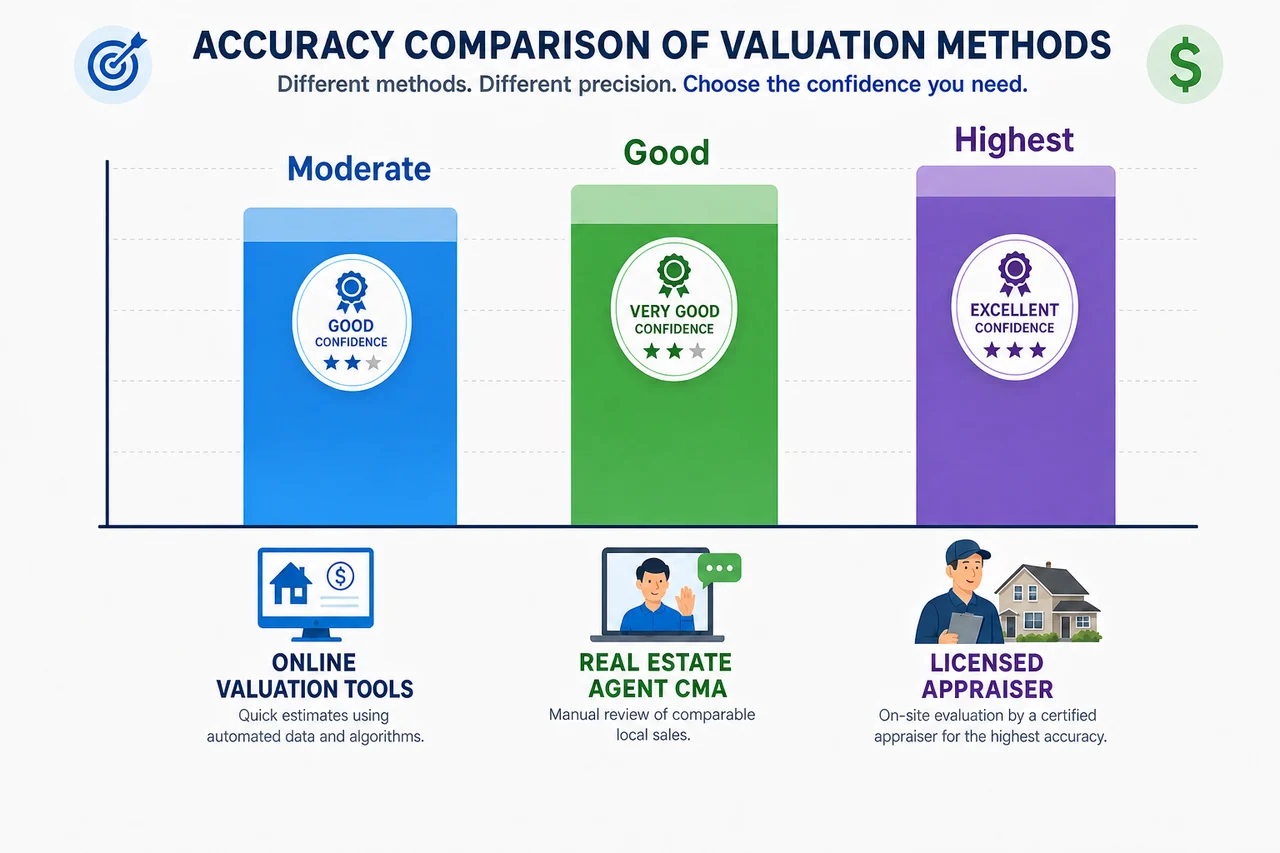
Want to know what your home is actually worth? You've got three main options, and each one trades speed, cost, and accuracy differently. Which one you pick depends on why you need the number in the first place.
| Method | Speed | Typical Cost | Accuracy | Best For |
|---|---|---|---|---|
| Online AVM (e.g., Zillow, Redfin) | Instant | Free | Moderate — may miss condition, updates | Quick ballpark, equity tracking |
| Real Estate Agent CMA | 1–3 days | Usually free | Good — accounts for local market nuance | Pre-listing strategy, pricing guidance |
| Licensed Appraiser | 1–2 weeks | $314–$425 (avg. ~$400) | Highest — required for most mortgages | Financing, divorce, estate, legal purposes |
Here's the breakdown. Online tools like Zillow give you a number instantly and won't cost you anything. But they're built on algorithms that don't know your kitchen renovation or that water stain in the basement. A real estate agent's comparative market analysis (CMA) takes a few days and is usually free. They'll look at similar homes in your neighborhood that actually sold, so you get real market context. And if you're dealing with something serious—a divorce settlement, a probate situation, or a mortgage application—you'll need a licensed appraiser. That'll run you around $400 and take 1–2 weeks, but it's the gold standard courts and lenders actually trust.
Back to topHow Online Home Valuation Tools Work
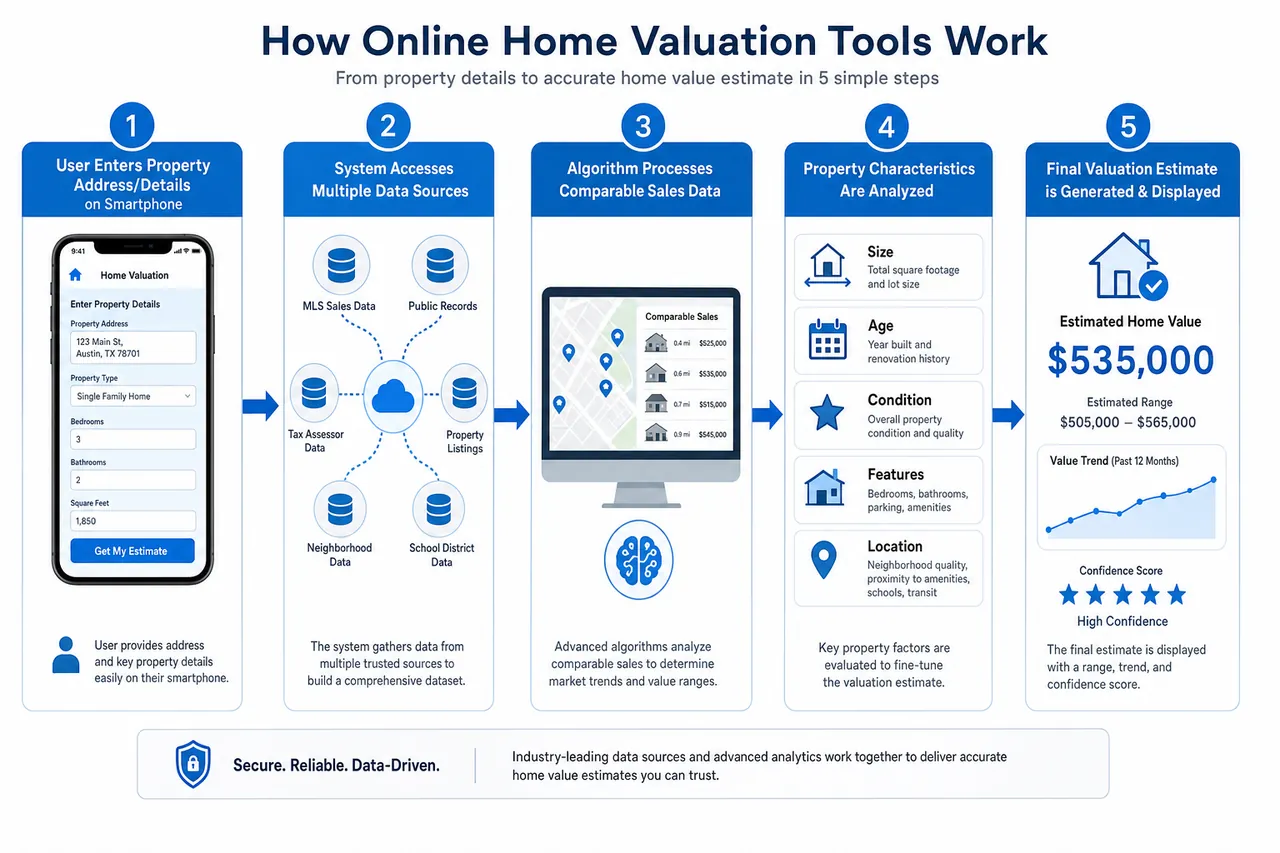
Type in your address. Confirm a few basic details about your property. Within seconds, you've got an estimate. That's how online automated valuation models (AVMs) work. They tap into publicly available data—county tax records, recent comparable sales, price trends in your neighborhood—and spit out a value range almost instantly.
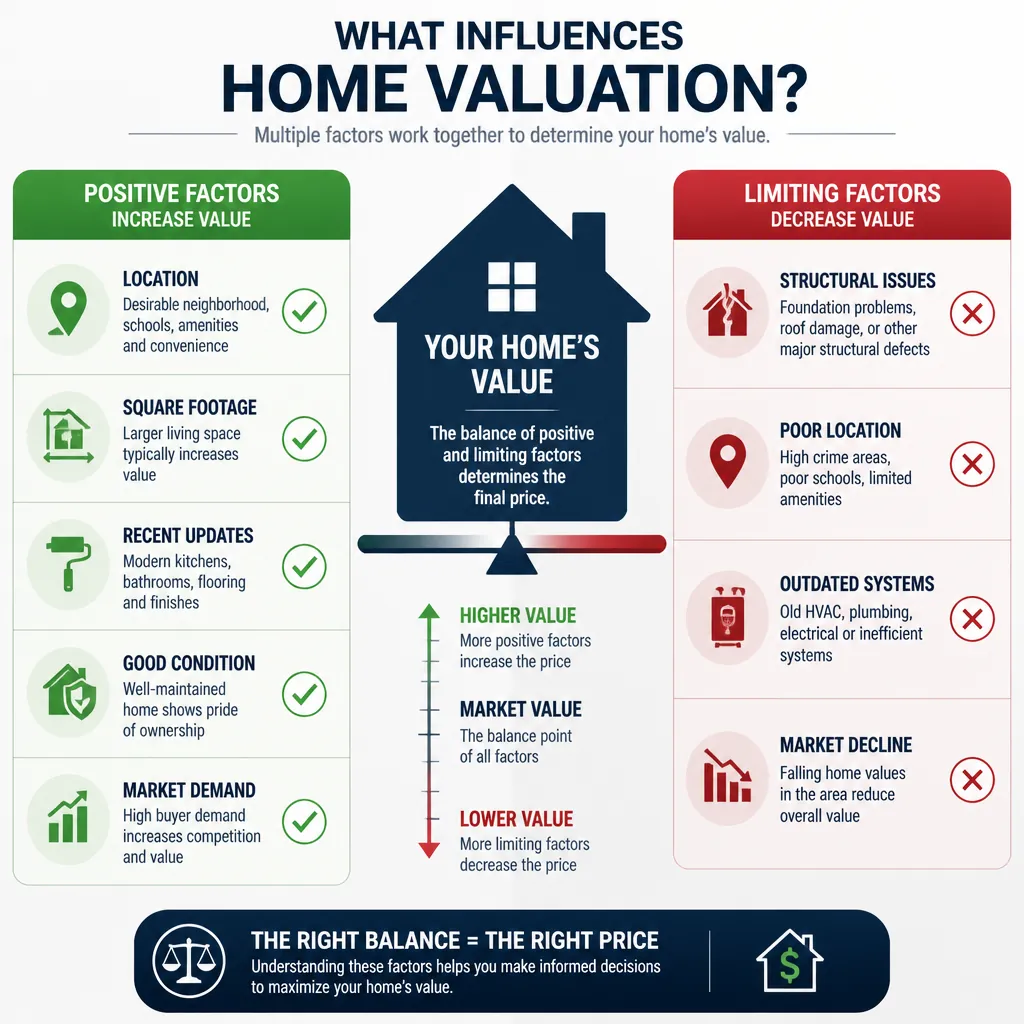
But here's the catch: AVMs can't actually see your home. That newly renovated kitchen? The finished basement you added last year? A brand-new roof? None of that shows up in the algorithm's calculations, even though it absolutely should boost your home's value. And the reverse is true too—if your roof's leaking or your floors are outdated, an AVM won't ding you the way a real buyer would during negotiations.
Want to know how these estimates stack up against reality? We've broken down the accuracy of tools like Zillow Zestimates in our article on whether Zillow Zestimates are accurate. We've also included state-specific data for Florida, California, and Colorado.
Back to topWhat Online Tools Actually See — and What They Miss Completely
| Typically Considered by Algorithms | Typically NOT Considered |
|---|---|
| Recent comparable sales nearby | Interior condition and finishes |
| Square footage and lot size | Recent renovations or upgrades |
| Number of bedrooms and bathrooms | Deferred maintenance or damage |
| Year built | Neighborhood amenities (walkability, schools) |
| Historical price trends in the area | Unique features (views, custom builds) |
| Tax assessed value | HOA restrictions or leasehold terms |
Agent Comparative Market Analysis (CMA)
Want something more reliable than an online estimate? A real estate agent's Comparative Market Analysis does exactly that. An experienced local agent manually reviews recent sales of similar homes in your neighborhood, adjusts for differences in size and condition, and factors in current market dynamics—like whether buyers are competing aggressively or sitting on the sidelines. You'll usually get this analysis within a few days, and it won't cost you anything since agents offer it as part of their pitch to list your home.

Here's the thing: a CMA doesn't have the legal standing of a licensed appraisal. But it's often the most practical tool for setting a realistic listing price. And it tells you something crucial—what buyers will actually pay right now. That's what matters when you're selling.
Back to topProfessional Appraisals: When You Need the Real Number
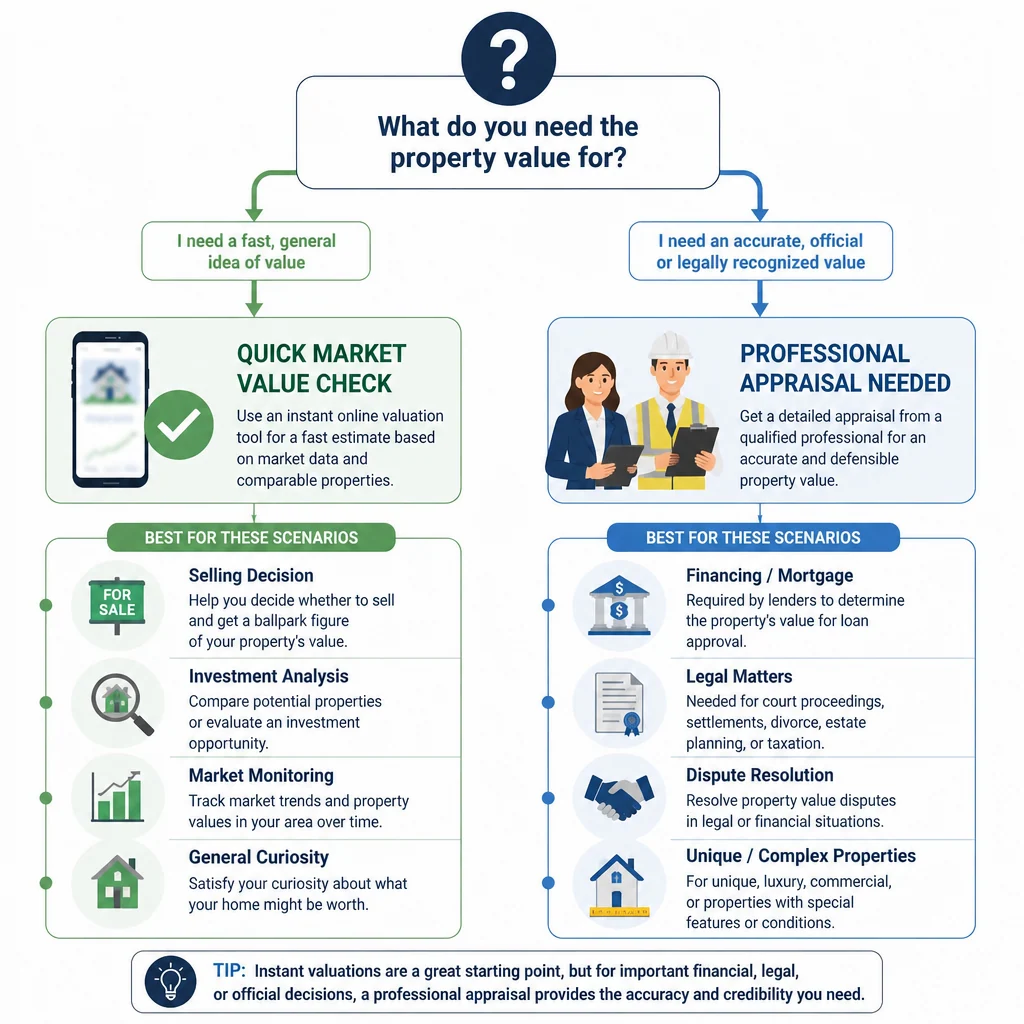
You need a licensed appraiser when the stakes are high. They produce a formal, defensible opinion of value—the kind of number that holds up in court, to a lender, or during divorce proceedings. Right now, expect to pay between $314 and $425 for a standard single-family home appraisal, with a national average around $400.

Here's the thing: if you're getting a mortgage, the buyer's lender will order an appraisal anyway. But that doesn't mean you shouldn't get your own. Smart sellers commission an appraisal upfront to nail down their asking price and walk into negotiations knowing exactly what they've got.
And when you're going through a divorce? Settling an estate? Refinancing? That's when a professional appraisal becomes essential. An online estimate won't cut it. You need something real.
Back to topWhat Home Value Means for Your Tax Picture
Your home's value matters way more than just the listing price. It directly impacts what you'll owe the IRS when you sell. Under IRS Section 121, you get some relief here. Single filers can exclude up to $250,000 in capital gains; married couples filing jointly get $500,000. These numbers have stayed the same since 1997 and won't change for 2026.

But here's where it gets real: if your profit goes above those caps, you're paying taxes. The amount over your exclusion gets hit with long-term capital gains rates—0%, 15%, or 20% depending on your income level. And that's not even the worst part. There's also a 3.8% Net Investment Income Tax surcharge that kicks in if your modified adjusted gross income tops $200,000 (single) or $250,000 (married filing jointly). Want to avoid surprise tax bills? Know your home's actual value and what you originally paid for it. That's how you estimate your tax hit before closing day.
Back to topUsing Your Valuation to Prepare for the Sale
Now you've got a real number. Time to figure out what you'll actually walk away with. Subtract three things from your sale price: your remaining mortgage balance, seller closing costs, and the agent commission. As of February 2026, agents are taking an average of 5.70% total—about 2.88% goes to your listing agent and 2.82% to the buyer's agent. But here's the thing: those numbers shift depending on where you live. Tennessee, Washington, and Indiana all have their own closing cost structures you'll want to check on. Don't assume the standard applies to you.
Planning an open house? Your valuation tells you something equally important. Which upgrades will actually move the needle—and which ones will just drain your wallet without paying you back? Check our open house tips for sellers so buyers see your home at its best when they walk in.
Back to topConclusion
Here's the thing: your home's value isn't one fixed number. It shifts depending on which method you're using and what you actually need it for. Start simple. Grab a free online tool to see what ballpark you're in. Then, before you list, talk to a local agent about getting a comparative market analysis—that CMA tells you what similar homes sold for in your neighborhood recently. And when you're making a big move? That's when a professional appraisal makes sense. The stakes are higher, so the investment pays off. Use all three together and you're not guessing anymore. You've got the real picture, you know where the risks are, and you can move forward without second-guessing your decisions.
Back to topFrequently Asked Questions
How accurate are online home valuation tools?
Here's the truth: online AVMs give you a starting point, not a final answer. They pull from public records and miss the stuff that actually matters—your kitchen renovation, that water damage in the basement, the fact that your neighborhood just got a new park. Market conditions and data gaps mean accuracy swings wildly depending on where you live. Want the full picture? Check out our breakdown of Zestimate accuracy for sellers.
Do I need a professional appraisal before listing my home?
You don't have to, but consider it. A licensed appraiser will give you a rock-solid number that holds up in negotiations—and it costs only around $314–$425 (as of July 2026). It's really worth doing if you're selling because of divorce, probate, or any legal issue.
How does my home's value affect my taxes?
Sell for a profit? The IRS wants a cut. Good news: Section 121 lets you skip taxes on up to $250,000 in gains if you're single, or $500,000 if you're married. Anything beyond that gets taxed between 0% and 20%—plus potentially a 3.8% NIIT surcharge if you're a higher earner.
What's the difference between an AVM and a CMA?
An AVM is fast. An algorithm crunches public data and spits out a number in seconds. A CMA? That's a real estate agent doing actual work. They look at comparable sales, adjust for condition, read the local market, and factor in deals that never hit the MLS. When you're pricing your home, the CMA wins every time.
Can I use an online valuation for refinancing or a home equity loan?
No. Lenders won't accept it. They demand a licensed appraisal for refinances, home equity loans, and any mortgage product. Your online estimate or agent CMA—no matter how solid it looks—won't cut it.
Back to topMore in Appraisals and home value
- The Data Behind Online Appraisals: How AVM Tools Can Pump Up (or Down) Your Price
- Appraisal Definition: How Your Home Value Is Determined
- How to Prepare Your House for an Appraisal: Tips to Boost Your Home's Value
- What Is My Home Worth? How to Determine Your Home's Value
- Should You Pay for a Home Appraisal Before Listing? Pros, Cons, and Costs
- What Is a Drive-By Appraisal? How It Works and Why Lenders Use It
See our guide: “Closing Costs for Sellers: What You'll Pay and How to Reduce Them” →

