

What Is My Home Worth? How to Determine Your Home's Value
Table of Contents
- Understanding Home Valuation Basics
- Before You Start: Gather Your Home Information
- What's a Home Value Estimator?
- The 5-Step Process to Find Your Home's Value
- Valuation Method Comparison
- Factors That Affect Your Home's Value
- Finding Real Estate Comps in Your Area
- How to Calculate Your Home Equity
- Tax Implications of Selling Based on Your Home's Value
- What to Do After Getting Your Home Value Estimate
- Conclusion: Turning a Number Into a Decision
- Frequently Asked Questions
You've probably typed "what's my home worth" into Google at some point. Maybe you're thinking about selling, refinancing, or tapping into your home's equity. Perhaps you're just curious. Whatever the reason, your home's value is crucial financial information—and it's harder to pin down than you'd think. Home valuation isn't one magic number. It's a range of estimates, each calculated differently, each with blind spots.
Wondering what selling will cost? Start with what sellers pay at closing. It breaks down every seller cost at closing, the surprises, and ways to pay less.
Consider the market right now. As of June 2026, the median existing-home sale price hit an all-time high of $440,600. That represents the 36th consecutive month of year-over-year price gains. And here's what matters: in a market like this, a small mistake in your valuation can cost you tens of thousands of dollars.
This guide cuts through the confusion. You'll learn exactly how to find your home's value, what actually drives that number, and what steps to take once you've got an estimate you can trust.

Understanding Home Valuation Basics
What's your home actually worth? Before you pull up any tools or calculators, you need to understand the fundamentals. At its core, your home's value comes down to this: what a ready, willing, and able buyer will pay for it under normal market conditions. Simple in theory. In reality? It's shaped by dozens of factors — location, condition, what similar homes sold for nearby, mortgage rates, and the broader economy.
Your home's value isn't fixed. It shifts with the market. And right now, with the 30-year fixed mortgage rate at 6.66% as of July 30, 2026, that matters. Higher rates mean buyers can afford less money. Even if your neighborhood is appreciating, constrained purchasing power puts real downward pressure on prices. When you get an estimate, this context changes how you should interpret it.
There's not one right way to value a home. An online estimator? That's your quick snapshot. A comparative market analysis (CMA) from a real estate agent gives you professional insight based on actual comps. A licensed appraisal gives you a number that holds up legally. And a cash offer from a home buyer gives you something concrete — what someone will actually pay you today. Each serves a different purpose. Use multiple methods together, and you'll get a clearer picture of where you really stand.
Back to topBefore You Start: Gather Your Home Information
Essential Property Details to Collect
Here's what'll make or break your valuation estimate: accurate information about your property. Get this wrong, and everything downstream gets wrong too. Both estimator algorithms and real appraisers depend on solid data. So before you run any numbers, pull together these basics:
- Square footage (heated/cooled living space only)
- Lot size in square feet or acres
- Year built
- Number of bedrooms and bathrooms (including half-baths)
- Garage type and capacity (attached, detached, carport)
- Foundation and construction type
- Zoning classification
Now cross-check everything against your county tax assessor's records — they're publicly available online in most places. Your home's records might have errors. If what you know doesn't match what's on file, the estimator will give you garbage results. And if you're planning to list or refinance? You'll need to call your local tax assessor's office and file a correction request first.
Recent Improvements and Upgrades
Write down every major improvement you've done. Kitchen remodels, bathroom updates, roof replacements, HVAC systems, new windows, additions, landscaping—get dates and costs for all of it. Not every dollar you spent comes back in value, that's true. But documented improvements definitely support a higher valuation and show appraisers and buyers you've maintained the place. Want more ideas? Check out our guide on 5 tips to increase the value of your home.
Condition Issues and Disclosures
Foundation cracks. Roof damage. Outdated wiring. Plumbing problems. Mold. Unpermitted additions. These things kill your home's value—and they'll surface fast once a professional appraiser or buyer inspector shows up. But you don't have to be blindsided. Know what's wrong with your place before you move forward. That way you can price accordingly or make strategic repairs before hitting the market.
Back to topWhat's a Home Value Estimator?
How Online Estimators Work
Online home value estimators pull from county tax records, recorded deeds, MLS sales data, and sometimes user-submitted information to spit out a price estimate in seconds. They're also called automated valuation models (AVMs). Zillow (Zestimate), Redfin, Realtor.com, and others use algorithms that crunch hundreds of data points — recent sales of nearby homes, property characteristics, neighborhood trends, listing price history — to calculate an estimated market value based on publicly available data.

Here's the catch: it's an estimate, not an appraisal. These tools can't walk through your home, spot the water damage in the basement, or assess whether that $50,000 kitchen renovation actually added value. They miss hyper-local features that only someone physically present would catch.
Accuracy of Online Tools
It depends heavily on where you live. In dense urban markets with frequent sales, estimators tend to nail it because the algorithm has plenty of comparable data to work with. But in rural areas, markets with few transactions, or neighborhoods with highly unique properties? Estimates can be off by 10–20% or more. Don't treat an online estimate as your final answer.
Run at least two or three different platforms and compare. If Zillow, Redfin, and Realtor.com all cluster within 5% of each other, you've got a reasonably defensible baseline. And if they diverge by more than 10%, that's your signal to get a professional appraisal before making any major financial decisions.
Back to topThe 5-Step Process to Find Your Home's Value
Step 1: Assemble Your Home's Basic Facts
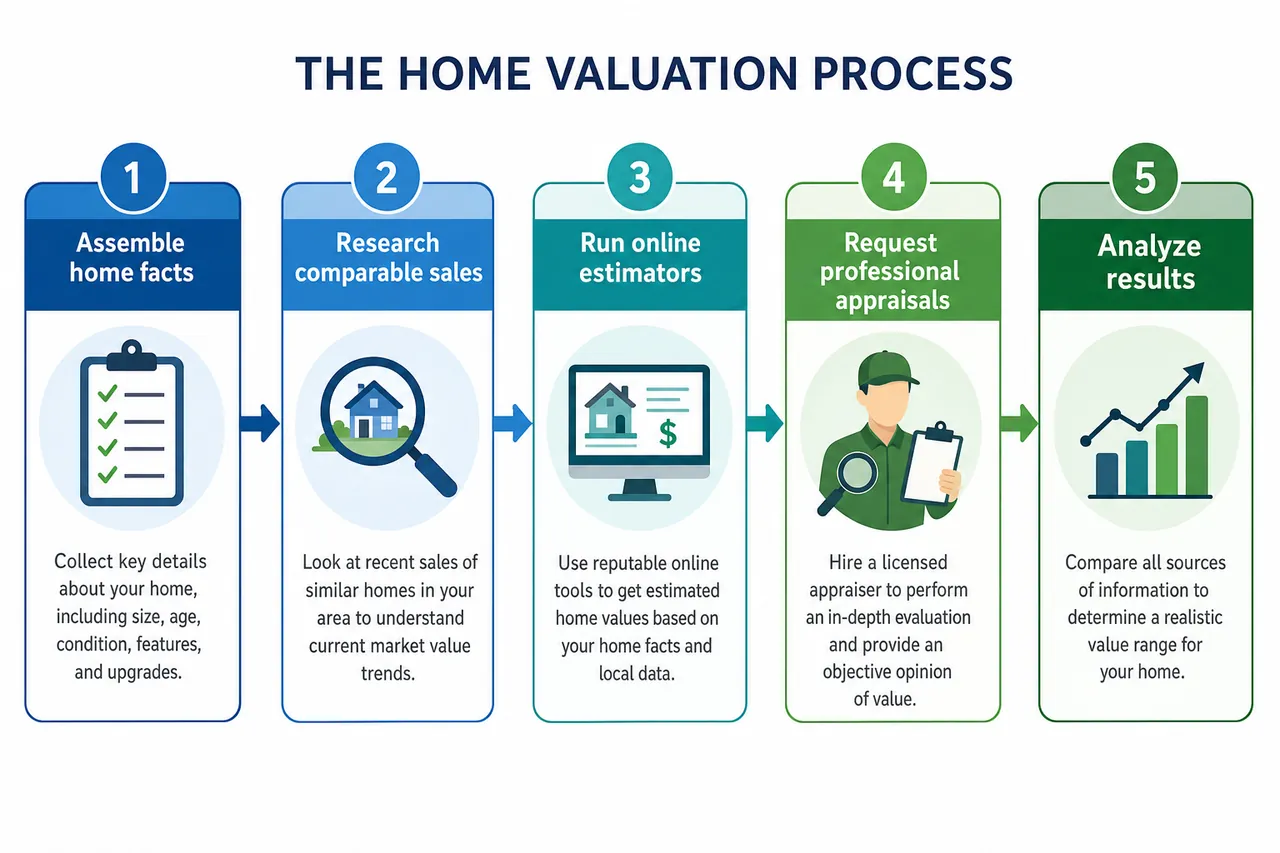
Start by pulling together all the property details you can find. Then verify each one against public records. If you spot errors, fix them now—they'll skew your estimates if you don't. Your inputs shape your outputs. Bad data in means bad numbers out.
Step 2: Research Comparable Sales
Search for homes like yours that sold in the last three to six months. Look within a half-mile to a mile of your address (further out if you're in a rural area). What matters? Square footage, bedrooms, bathrooms, lot size, age, condition. These similar homes are called "comps," and they're the backbone of any real valuation.
Don't just check MLS listings. Head to your county assessor or recorder's office—online or in person—for actual sale prices. List prices lie. Sale prices tell the truth.
Step 3: Run Multiple Online Estimators
Plug your property into at least two or three AVM platforms. Write down each estimate and the date you pulled it. Do they cluster together? If they're within 5% of each other, you've probably got a stable, well-documented market. When they're all over the place, you need to dig deeper.
Step 4: Request Professional Valuations
Call a local real estate agent and ask for a comparative market analysis—a CMA. Most agents do this for free as part of their listing consultation. It costs you nothing and gives you their professional take.
Now, if you need a number that actually holds weight—for estate planning, divorce court, tax purposes, or a refinance—you'll want a licensed appraisal. Expect to pay between $314 and $424 for a standard single-family home appraisal as of July 8, 2026, though trickier properties or tight markets can cost more.
And here's something to consider if you're in real trouble. Facing foreclosure? Going through a divorce? Needing to move fast? A cash offer from a reputable buyer gives you an actual number—what someone will hand you today—without the headaches of a traditional sale. For divorce situations specifically, the valuation piece matters enormously. Our guides on divorce and your mortgage, plus state breakdowns for California, Florida, and Colorado, spell out exactly how property value fits into the process.
Step 5: Analyze and Compare Results
Spread all your numbers out side by side. Where do they agree? Where do they clash? An AVM might miss that expensive kitchen you just put in. An agent's CMA might overweight a recent fire sale down the street. Neither one's lying—they're just seeing the picture differently.
Your job isn't to pick the highest number. It's to find the most defensible range you can actually support with real evidence. That's your anchor for whatever comes next.
Back to topValuation Method Comparison
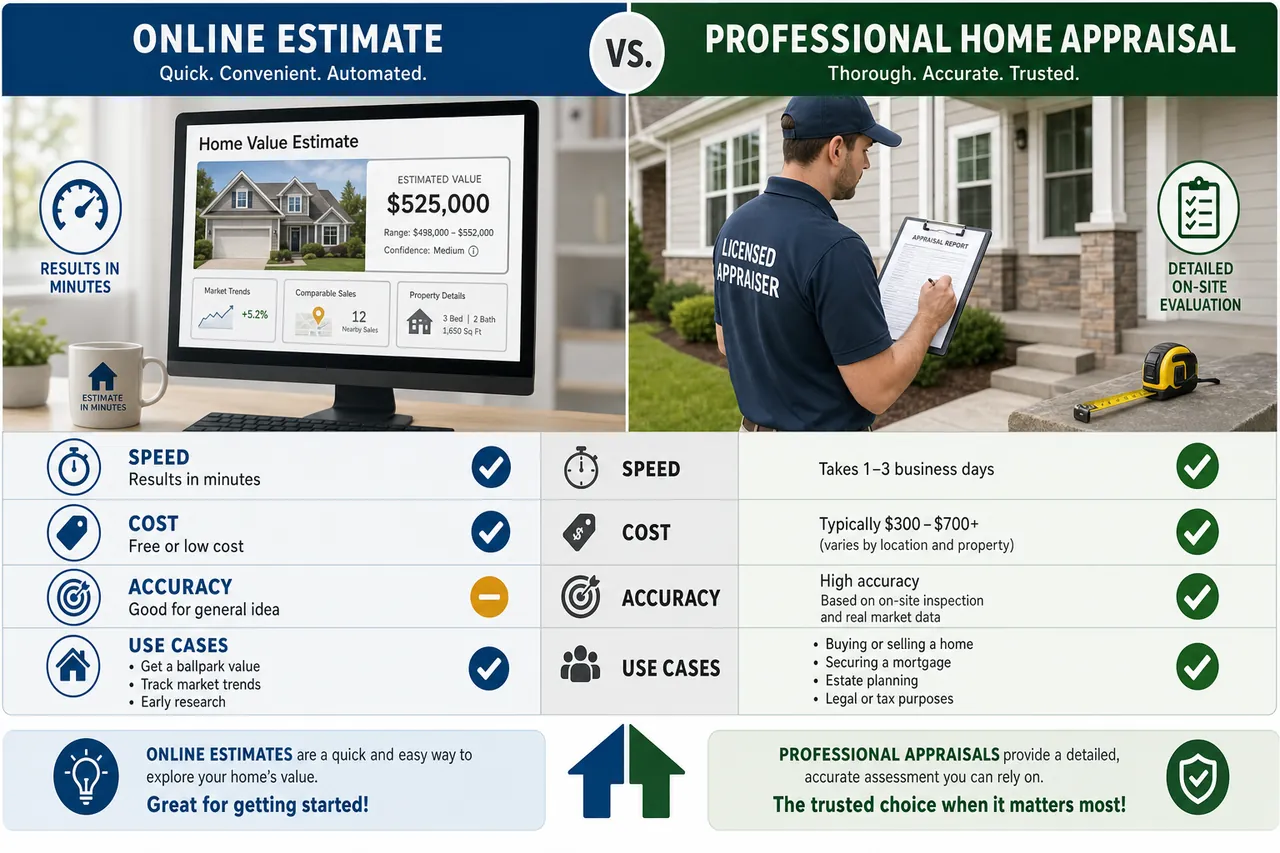
So you need to know what your house is worth. Here's the thing—there are three main ways to find out, and they're not all created equal. Each one costs differently, takes different amounts of time, and serves a different purpose depending on your situation.
| Aspect | Online Estimate (AVM) | Professional Appraisal | Cash Offer |
|---|---|---|---|
| Cost | Free | $314–$424 (national avg., July 2026) | Free |
| Speed | Instant | Several days to 1–2 weeks | 24–72 hours typically |
| Condition-aware? | No — algorithm-based only | Yes — licensed inspector/appraiser on-site | Yes — buyer accounts for condition |
| Legally recognized? | No | Yes — required for mortgage lending | No, but it's a real offer |
| Best for | Quick ballpark; initial research | Refinancing, estate, divorce, litigation | Speed, certainty, as-is sales |
| Accuracy risk | 10–20%+ off in thin markets | Highest accuracy for current market | May be below market to offset buyer risk |
An online estimate? It's free and you'll get it in seconds. But here's the catch—it's just an algorithm making a guess. It doesn't know if your roof leaks or if you've got foundation problems. Don't rely on this alone, especially if you're in a rural area or a market where homes don't sell often. The algorithm gets confused.
A professional appraisal costs you money. You're looking at $314–$424 on average, and you'll wait several days to two weeks for the report. But you get a licensed person who actually walks through your house and documents what they see. Banks require this before they'll lend. If you're in a divorce settlement, going through probate, or dealing with litigation, this is the only number that courts and lenders will accept. It's worth every penny if you need it.
And then there's the cash offer.
A buyer shows up, looks at the property, and gives you a number within 24–72 hours. No cost to you. They're accounting for your home's actual condition—the good and the bad. Just know this: that offer might be below what you'd get on the open market. They're building in a buffer because they're taking on risk. But if you need to sell fast and you can't afford to wait or negotiate endlessly, that certainty has real value.
Back to topFactors That Affect Your Home's Value
Location and Neighborhood Factors
Location is everything — and it's the one thing you can't change. School district quality, proximity to employment centers, walkability, crime rates, and whether the neighborhood is improving or declining all shape what buyers will actually pay. Here's the reality: two nearly identical homes can differ by 20% or more in value based solely on which side of a school district boundary they sit on.
Physical Home Characteristics
Your home's baseline value comes down to square footage, bedroom and bathroom count, lot size, age, and how well it was built. Bigger homes in the same neighborhood typically sell for more. But there's a catch — an oversized home that doesn't fit its neighborhood will often appraise below replacement cost. And don't assume newer is better. A well-maintained older home can easily outvalue a newer one built on the cheap.
Market Conditions and Trends
Your individual home's value doesn't exist in a vacuum — the broader real estate market shapes everything. Supply and demand in your local area, seasonal swings, mortgage rates, and whether people feel confident about the economy all influence what buyers will pay. Most U.S. markets see softer sales in winter and peak activity in spring and early summer. As of June 2026, existing home prices were up 1.8% year-over-year nationally, rising from $432,700 to $440,600 — but don't rely on national numbers. Your specific market may be moving in a completely different direction.
Recent Improvements and Condition
Not all renovations pay off equally. Kitchen and bathroom updates typically return the most value. Major systems work — replacing your roof, HVAC, or electrical panel — adds value mainly by removing red flags for buyers. Fresh paint, new landscaping, and updated flooring boost buyer appeal and can speed up your sale, even if they don't move the needle on appraisals. But here's what really hurts: deferred maintenance. It reduces your home's value dollar for dollar, and often more, because buyers will discount heavily for anything that's uncertain or broken.
Back to topFinding Real Estate Comps in Your Area

What Are Comparable Sales?
Comparable sales — "comps" — are homes that sold recently and look a lot like yours. Same size, same neighborhood, similar age and condition, matching features. Appraisers and agents lean on comps to figure out what your home's actually worth in today's market. They'll take a comp that's pretty close to yours, then adjust the price up or down depending on the differences. Say a comp has one fewer bathroom than yours? That sale price gets bumped up to account for what that extra bathroom adds to the value.

How to Find Comps Yourself
You don't need to hire an agent to dig up basic comp information. Start at your county recorder's office or assessor's office — they keep detailed public records of every property sale, and most let you search online for free. Zillow and Redfin work too. Their map views show you recent sale prices right there. Filter by your neighborhood and pull sales from the last three to six months. Stick to homes that are within 20% of your square footage so you're comparing apples to apples. Write down the sale price, how many days it sat on the market, and any big differences between that home and yours.
Using Professional Comp Analysis
Real estate agents have something you don't: MLS data. It's more detailed and up-to-date than what the public records show — sometimes weeks or even months fresher. An agent who knows their stuff will pull the comps, make smart adjustments, and hand you a CMA (comparative market analysis) that tells you what the market's actually doing right now, not just what happened in the past. And if your market's moving fast or your home's unusual in some way? Getting a pro to do this work could be well worth it, even if you end up deciding not to list with them.
Back to topHow to Calculate Your Home Equity
Understanding Home Equity
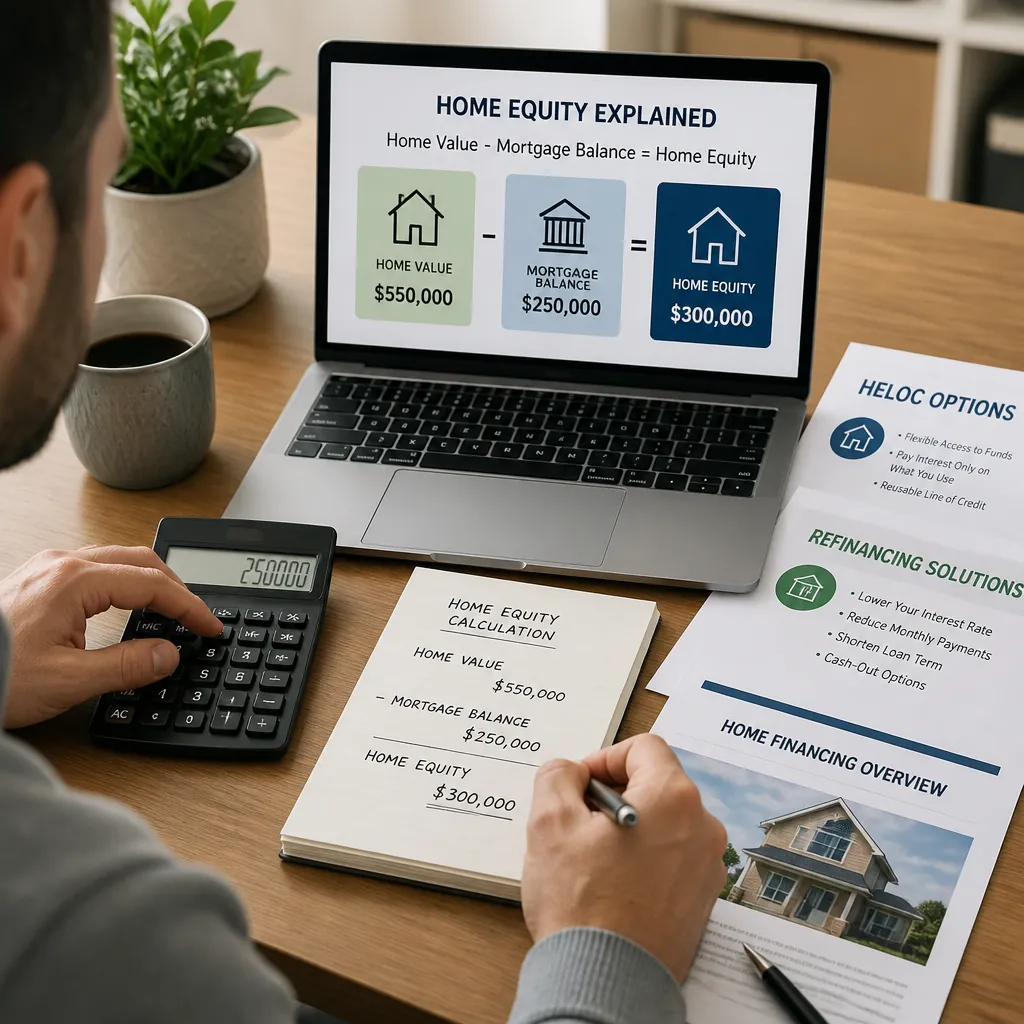
Here's what home equity actually is: the difference between what your home is worth right now and what you still owe on the mortgage. As you pay down that mortgage principal each month, you're building equity. Your home appreciating in value does the same thing. For most American families, this is where the real wealth sits — it's usually the biggest piece of your household net worth.
Simple Equity Calculation Formula
Home Equity = Estimated Home Value − Remaining Mortgage Balance
| Scenario | Home Value | Mortgage Balance | Home Equity |
|---|---|---|---|
| Strong equity position | $440,000 | $200,000 | $240,000 |
| Moderate equity | $350,000 | $280,000 | $70,000 |
| Break-even / near-zero equity | $310,000 | $305,000 | $5,000 |
| Underwater (negative equity) | $290,000 | $320,000 | −$30,000 |
Stuck owing more than your home's worth?
That's called negative equity, and it's stressful. But you're not without options. We've put together detailed guides on what to do when you owe more than your house is worth. We also have state-specific breakdowns for California, Florida, Indiana, Tennessee, and Washington that walk through your actual options.
Using Equity for HELOCs or Cash-Out Refinancing
Got solid equity built up? You can borrow against it. A home equity line of credit (HELOC) or a cash-out refinance are the two main ways to do this. People use that money for renovations, paying off credit card debt, or handling big expenses. And right now, the 15-year fixed mortgage rate is 6.04% as of July 30, 2026. That's not cheap. Before you tap your equity, make sure whatever you're borrowing for is actually worth paying that interest on.
Back to topTax Implications of Selling Based on Your Home's Value
Here's the reality: your home's value determines whether you'll pay capital gains tax when you sell. And here's the good news. Under IRS Section 121, you get to exclude a substantial amount of gain from taxes. Single filers can pocket up to $250,000 tax-free, while married couples filing jointly can exclude up to $500,000 as of the 2026 tax year. That's been the rule since the Taxpayer Relief Act of 1997 — over 25 years of consistent rules you can count on.
But what if you're selling a home with significant appreciation? If your gain exceeds the exclusion amount, the excess gets taxed. You're looking at long-term capital gains rates of 0%, 15%, or 20% depending on how much you earned that year. For 2026, here's what that means: 0% if you're a single filer making up to $49,450 (married filing jointly: $98,900), 15% up to $545,500 ($613,700 for couples), and 20% on anything above. But there's more. High earners need to watch out for the 3.8% Net Investment Income Tax — it hits you on gains above the exclusion if your modified adjusted gross income exceeds $200,000 (single) or $250,000 (married filing jointly). Talk to a tax professional who can walk you through your specific numbers.
Back to topWhat to Do After Getting Your Home Value Estimate
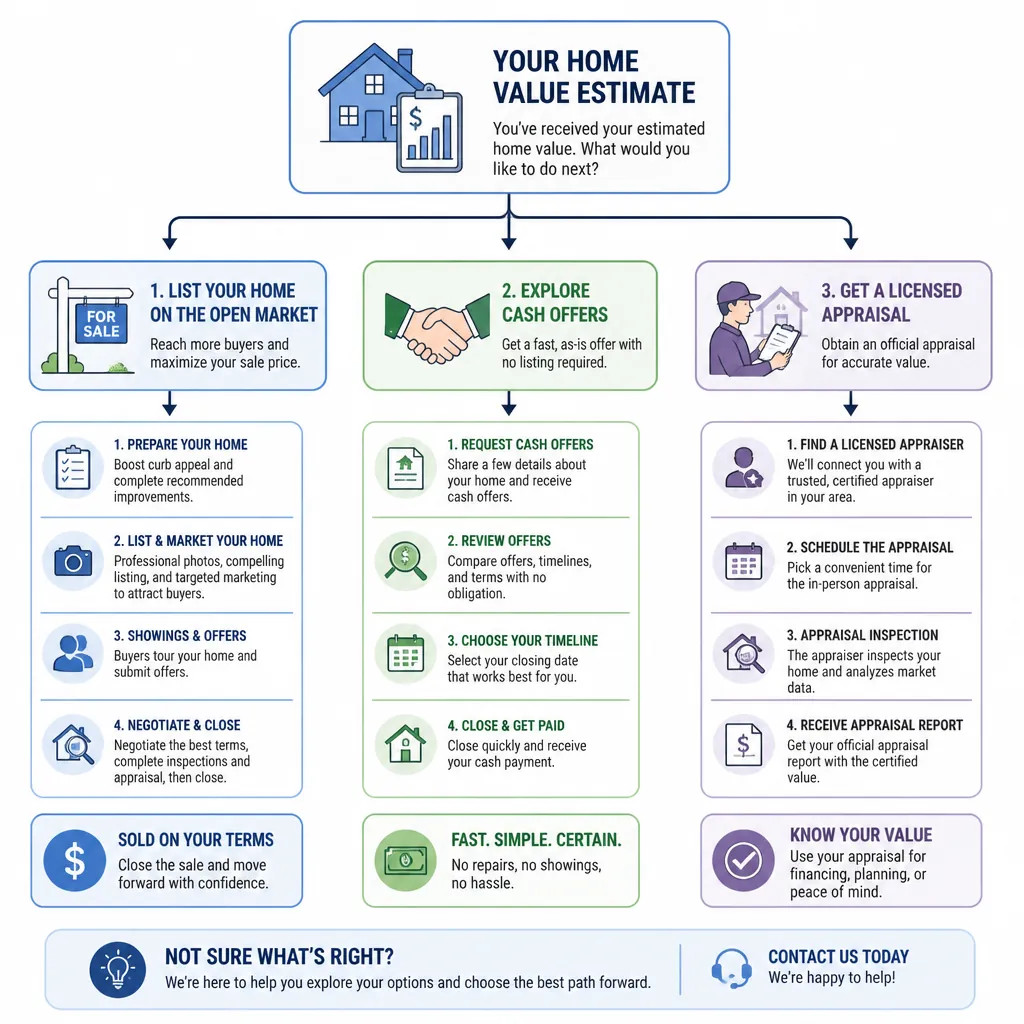
You've got your home value estimate. Now what? Your next move depends entirely on what you're trying to accomplish.
- Want to sell on the open market? Take your comp research and your agent's CMA and use those to set a competitive list price. But here's the thing — list price and what you actually sell for aren't the same. You'll need to leave room for negotiation and appraisal contingencies.
- Need a quick sale or want to sell as-is? A cash buyer from a reputable home buyer company will move fast. You won't get top dollar, that's true. But you avoid repairs, showings, and financing contingencies. Speed and certainty matter when you need them.
- Thinking about refinancing? Your home's appraised value directly affects your loan-to-value ratio. That number determines your interest rate and whether you even qualify for a conventional refinance. For 2026, the baseline conforming loan limit sits at $832,750 for one-unit properties across most of the U.S. High-cost areas? That jumps to $1,249,125.
- Planning to renovate before you list? Use your current estimate as your baseline. Then ask the hard question: will what I spend on renovations actually pay off in my market? Some upgrades give you dollar-for-dollar returns. Others don't.
- Dealing with foreclosure, divorce, or an inherited home? This changes everything. Getting an accurate value estimate fast isn't just helpful — it's essential. Knowing exactly how much equity you have determines which options you can actually pursue.
Conclusion: Turning a Number Into a Decision
You now know what your home is worth. But knowing the number? That's just the start. What matters is what you do with it next — whether that's selling, refinancing, making improvements, or holding tight. Here's the practical path forward: gather your property details. Run multiple online estimators. Research what similar homes sold for in your area. Get at least one professional appraisal. Then look for the overlap. You're hunting for a consistent range, not chasing a single perfect number.
And here's why this matters right now: median existing-home prices hit an all-time high of $440,600 in June 2026. The market's expensive. One mistake in your valuation can cost you thousands. Whether you've built up serious equity or you're in a tight spot, getting your home value right is the foundation for everything else.
Stuck on what comes next?
The KDS Homebuyers resource library has you covered. Find specific help on increasing your home's value. Navigate the complexity of divorce and mortgage decisions. Or learn how to handle selling when you're underwater on your mortgage.
Back to topFrequently Asked Questions
How accurate are online home value estimators?
It depends on where you live. Urban areas with lots of sales? Those AVMs can get pretty close to what houses actually sell for. But rural areas or markets where homes don't turn over much—those estimates might swing 10–20% or more in either direction. Here's what you should do: run the same address through multiple platforms and compare what you get back. When the numbers diverge by more than 10%, that's your signal to call in a professional. Get a CMA or licensed appraisal before you make any major financial moves.
How often should I check my home's value?
Once a year works for most people. But if you're actually considering selling, refinancing, or doing major renovations, check before you commit to anything. Markets that move fast—whether prices are climbing or dropping—deserve more attention. Check every six months in those situations so you can track where things are really headed.
Why is my tax-assessed value different from my market value?
Your county assessor sets that number strictly for property tax purposes. And it rarely lines up with what your house would actually sell for today. Most jurisdictions don't reassess every year—some wait one to three years between cycles. This means your assessed value can be seriously behind current market conditions. In some states, they calculate it as a percentage of market value anyway. Don't trust your tax bill to tell you what your home is worth. Instead, rely on recent comparable sales and professional appraisals.
Does my home value affect how much I'll owe in taxes when I sell?
Absolutely. Your taxable gain is your sale price minus what you originally paid (your adjusted cost basis). The IRS gives you some relief here: as of the 2026 tax year, Section 121 excludes up to $250,000 of gain if you're single, or $500,000 if you're married filing jointly. Anything above that gets hit with long-term capital gains rates. Higher-income sellers might also owe the 3.8% Net Investment Income Tax on top. You'll want to talk to a tax professional about your specific situation—don't guess on this one.
What if my home is worth less than I owe on my mortgage?
Being underwater is stressful. You can't just walk away cleanly. But you do have options, even if they're not ideal. Short sales, loan modifications, deeds in lieu of foreclosure—those are all real possibilities depending on your lender. Sometimes waiting for values to rebound makes sense. And in certain cases, cash buyers can step in and take the property off your hands. We've got a full breakdown of what you can actually do in our guide on what to do when you owe more than your house is worth.
Back to topMore in Appraisals and home value
- The Data Behind Online Appraisals: How AVM Tools Can Pump Up (or Down) Your Price
- Appraisal Definition: How Your Home Value Is Determined
- How to Prepare Your House for an Appraisal: Tips to Boost Your Home's Value
- What Is My Home Worth? Home Valuation Methods for Sellers
- Should You Pay for a Home Appraisal Before Listing? Pros, Cons, and Costs
- What Is a Drive-By Appraisal? How It Works and Why Lenders Use It
See our guide: “Closing Costs for Sellers: What You'll Pay and How to Reduce Them” →

