Selling a House with Termites: Disclosure, Treatment, and Buyer Impact

Table of Contents
- Active vs. Historical Termite Damage: Why the Distinction Matters
- How Termite Damage Affects Your Home's Value
- The Scale of the Problem: Why Buyers Take Termites Seriously
- Legal Disclosure Requirements
- FHA and VA Loan Requirements
- Getting a Professional Termite Inspection
- Five Strategies for Selling a House with Termites
- Deciding Whether to Repair: A Financial Framework
- Approximate Timeline: What to Expect from Each Approach
- Marketing a Home with Termite History to Overcome Buyer Hesitation
- Homeowner's Insurance: Don't Count on It
- Regional Considerations: Where Termite Risk Is Highest
- Working with Lenders on Termite Contingencies
- Conclusion: Selling with Termites Is Manageable with the Right Approach
- Frequently Asked Questions
You can sell a house with termites. But the disclosure rules, treatment costs, and hit to your sale price all depend on what you're dealing with — active infestation or old damage, minor cosmetic issues or structural rot. Your best move depends entirely on your situation. This guide covers every practical strategy so you can decide what actually makes sense financially. This article is for general informational purposes only and isn't legal, financial, or tax advice. Because disclosure rules are set by state law, consult a licensed real estate attorney in your state before making decisions.
Selling a house that needs work? Start with our guide to selling a house as-is. It explains what as-is means, how pricing works and every way to sell a house with problems.
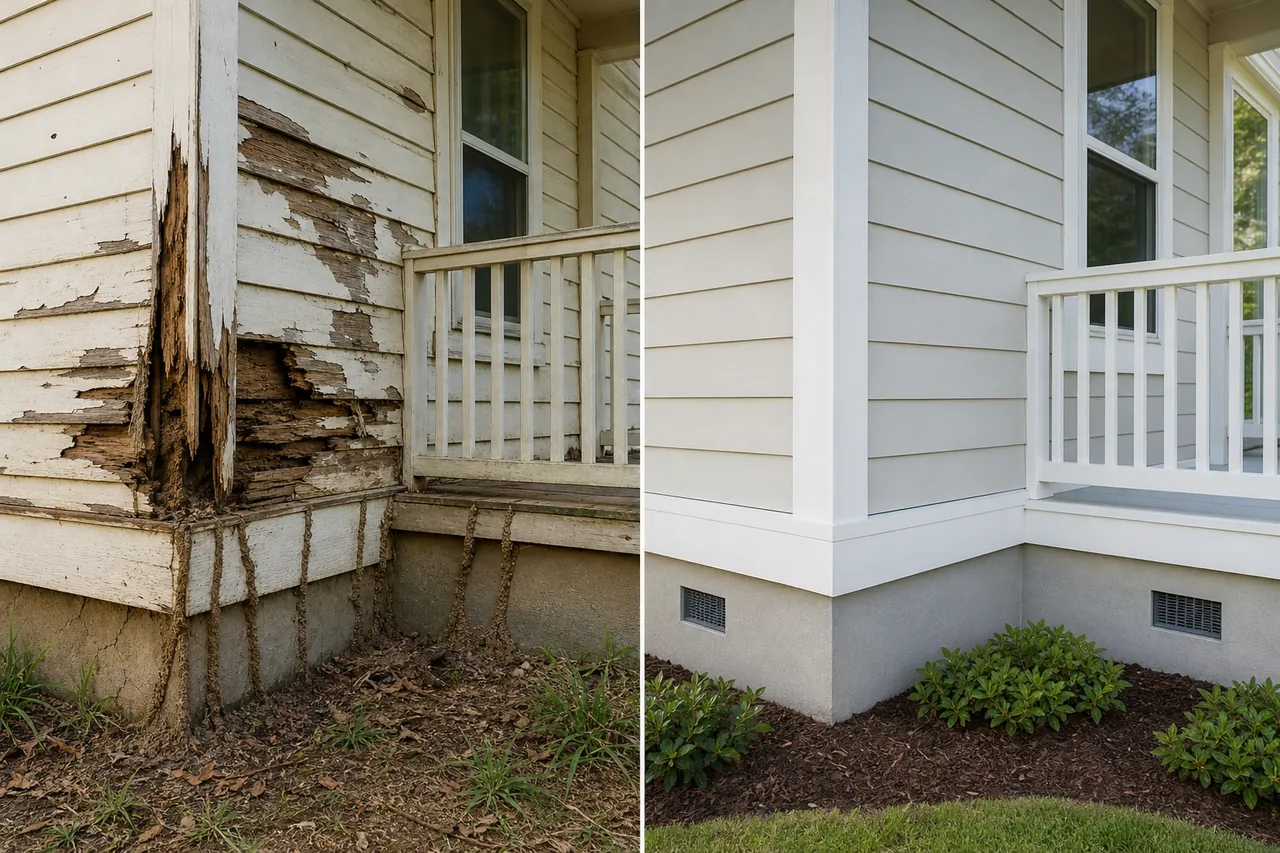
Active vs. Historical Termite Damage: Why the Distinction Matters
What's an Active Infestation?
Termites are actively feeding right now. That's what active infestation means — they're present and eating through your structure as we speak. This is the scenario that keeps buyers, lenders, and appraisers up at night because the damage won't stop until treatment happens. Nobody knows the true cost of repairs until a thorough inspection reveals what's actually been destroyed. Buyers see active infestations as open-ended problems. They can't predict remediation costs, and that uncertainty alone tanks interest in your home.

What's Historical Termite Damage?
A past infestation existed, but it's gone now. A licensed professional treated it and verified the termites were eliminated. The wood damage is still there — eaten studs, compromised drywall, weakened framing — but the threat itself is dead. And if you've got repair records and transferable warranties to prove the work was done right, you're in much better shape. Historical damage that's documented properly feels like a solved problem instead of a ticking bomb.
Why the Distinction Drives Every Decision
Active termites mean stricter lending standards. Buyers get nervous. Appraisers demand bigger price reductions. Historical damage handled correctly can be positioned as resolved — especially with good documentation and structural repairs in place. But you can't move forward with any strategy until you actually know what you're dealing with. Get a professional inspection first. That's your foundation for everything else.
Back to topHow Termite Damage Affects Your Home's Value
Structural vs. Cosmetic Damage
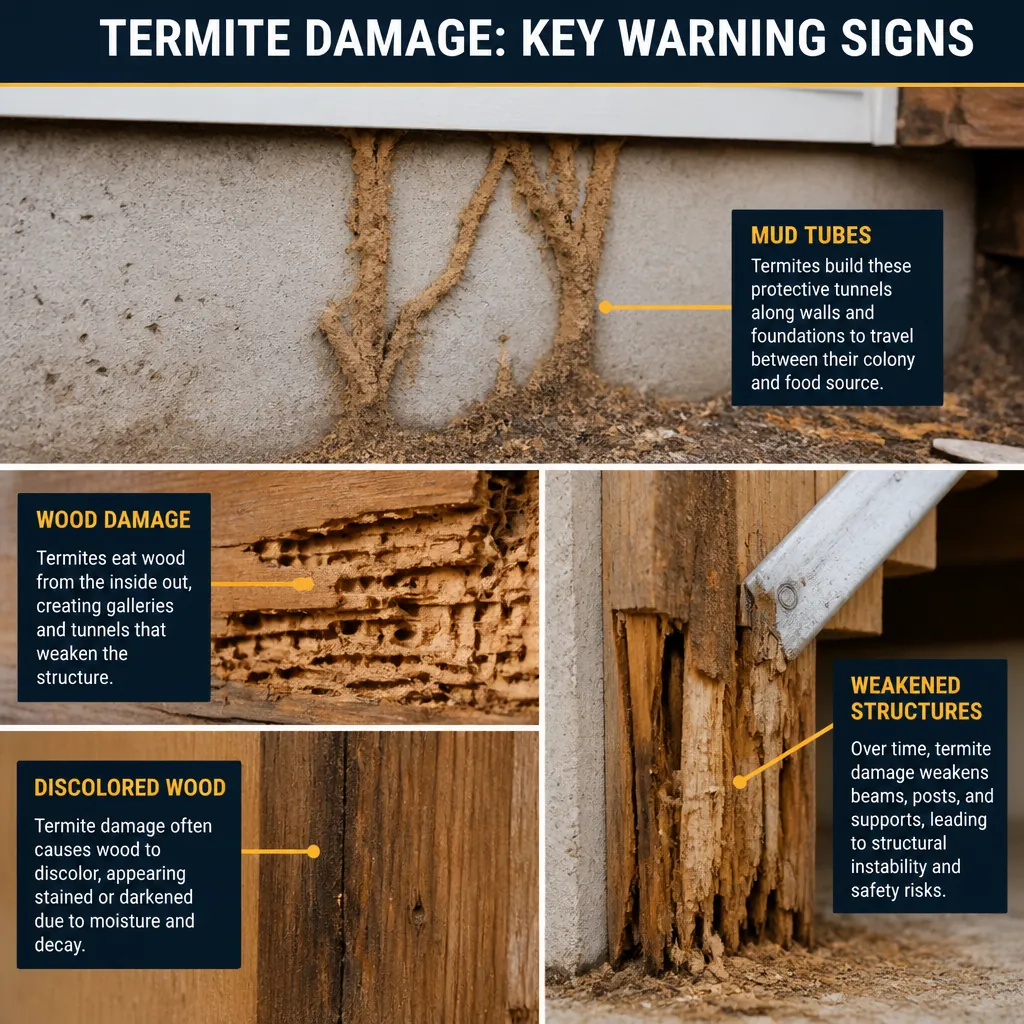
Not all termite damage hits your wallet the same way. Cosmetic damage—minor holes in drywall, surface discoloration, damaged trim or baseboards—won't break the bank to fix. Structural damage to load-bearing walls, floor joists, support beams, or the foundation? That's a different story entirely, and the repair bills reflect it. How you categorize the damage in your home is what makes or breaks an accurate price.
Watch for these red flags: drooping or discolored drywall, peeling paint that looks like water damage, tiny precise holes in drywall, buckling wood or laminate flooring, loosening tiles, floorboards that squeak or sound hollow when you walk on them, sagging floors, and warped walls or door frames that won't close right. Seeing several of these? You should order a structural engineer assessment before listing. That'll run you around $553 as of 2026 per Angi, but it's worth the investment upfront.
Typical Repair Cost Ranges
| Damage Category | Examples | Typical Repair Cost Range (2026) | Likely Value Impact |
|---|---|---|---|
| Cosmetic / Minor | Drywall patches, baseboard replacement, trim | $300–$2,000 | 3%–5% below comparables |
| Moderate Structural | Subfloor sections, non-load-bearing framing, joists | $5,000–$15,000+ | 5%–15% below comparables |
| Severe / Catastrophic | Foundation, load-bearing walls, catastrophic framing | $30,000–$50,000+ | Up to 20%–25% below comparables |
| Repaired and documented (residual stigma) | All damage repaired, treatment records provided | Repair costs already spent | 3%–10% below comparables |
The national average sits around $3,000, with most homeowners spending between $1,000–$10,000 as of 2026 per Angi. Severe foundation or framing damage can easily exceed that. And labor costs vary wildly by region, so you need to get quotes from contractors in your area—not national averages.
How Appraisers Handle Termite Damage
Appraisers don't use a cookie-cutter approach to termite damage. They document what they see, calculate repair costs relative to your home's total value, and flag structural concerns for the lender if needed. Active or unrepaired structural damage can tank your appraisal below the sale price. That kills a financed deal fast.
Industry professionals widely estimate that serious, active termite damage can push your home's appraised value 20%–25% below comparable termite-free properties. Keep in mind that's expert consensus, not hard science—your actual outcome depends on how extensive the damage is and what your local market looks like.
Back to topThe Scale of the Problem: Why Buyers Take Termites Seriously
Termites cost American homeowners $5 billion in property damage every year. That's not a minor pest problem — it's a genuine financial threat that the pest control industry and housing researchers track constantly. In Arkansas alone, termites destroy an estimated $47 million worth of property annually, making the state one of the higher-risk areas in the country. And that's exactly why buyers and lenders get nervous when they see a termite disclosure. They're not being paranoid. They're protecting themselves in a state where termite damage is a real possibility for any homeowner. Your own damage might be contained and manageable, but buyers know the numbers. They know the risks. That's why documentation and honest disclosure aren't just procedural steps — they're what keeps buyers trusting you and what keeps lenders willing to finance the sale.
Back to topLegal Disclosure Requirements
No Federal Mandate, But State Law Almost Always Requires Disclosure
There's no federal law requiring you to disclose termites. But your state? That's another story. State real estate law and the common-law duty to disclose material defects will almost certainly apply to you. In practice, nearly every state treats a known termite infestation or significant termite damage as a material defect that must be disclosed. Don't skip this. Failing to disclose can expose you to civil liability, deal rescission, and in some states may even constitute fraud. Since the specifics vary so much by state, the safest move is to disclose everything you know and consult a real estate attorney before closing.
State-Specific Forms and Requirements
Every state handles this differently. What you'll need to file depends entirely on where you're selling. The table below shows what several key states require. Always verify current requirements with a licensed real estate professional in your state — these laws are updated periodically.
| State | Required Form / Vehicle | What Must Be Disclosed | Statutory Basis |
|---|---|---|---|
| California | Transfer Disclosure Statement (TDS) | Known pest activity, whether or not a formal inspection was ordered | Mandatory for most 1–4 unit residential sales |
| Texas | Seller's Disclosure Notice | Known infestation history and current conditions | Texas Property Code §5.008 |
| Florida | FDACS Form 13645 | WDO report issued by licensed pest control operator; only form Florida recognizes for real estate transactions | Florida Dept. of Agriculture and Consumer Services |
| South Carolina | CL-100 Wood Infestation Report | Termites, wood-boring beetles, wood-decaying fungi | Mandated for real estate transactions |
| North Carolina | WDIR-100 Form | Wood-destroying insects in sale structures | Standard reporting requirement for sales |
| Pennsylvania | Seller Property Disclosure Statement | Known material defects including pest history | 68 P.S. §7301 et seq. |
Washington State uses a Form 17 Seller Disclosure Statement that includes questions about wood-destroying organisms. If your state isn't listed here, ask your real estate agent or attorney which form applies in your specific transaction. For issues beyond termites — such as other material defects — see our related guide on selling a house with an easement: disclosure and impact on value, which covers how to approach complex disclosure situations.
What "Known Damage" Means
You need to disclose anything you're actually aware of. That includes damage you noticed but hoped was minor, old inspection reports you received, and treatments you arranged. You're generally not required to find damage you didn't know about. But courts have found sellers liable when they clearly should have known — for instance, when obvious structural symptoms were visible during their ownership. The practical rule: if you've any reason to believe termites have been present, disclose it. Document that you disclosed it.
Documentation to Keep
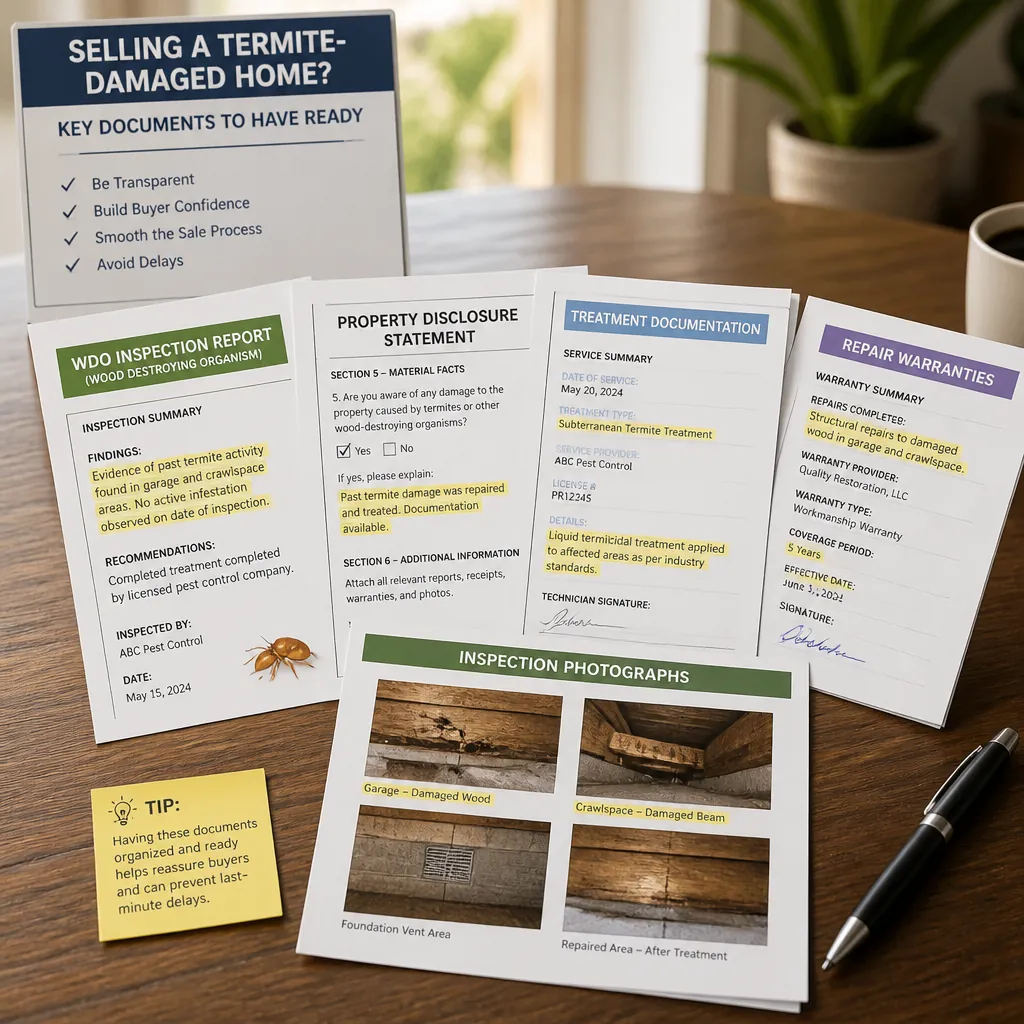
- All past termite inspection or WDO reports
- Treatment contracts, methods used, and dates of treatment
- Receipts and contractor records for any structural or cosmetic repairs
- Transferable warranties from pest control companies
- Any correspondence with pest control companies
Thorough documentation protects you legally and actively reassures buyers that the problem was handled professionally. This is one of the most effective tools for reducing buyer hesitation. For a broader look at how disclosed property issues affect marketability, the guide on selling a house with HOA problems: disclosure and buyer impact covers comparable disclosure dynamics.
Back to topFHA and VA Loan Requirements
FHA and VA financing comes with stricter rules than your state's disclosure law alone. Both require proof that every termite problem was fully remediated before closing, across all 50 states. That means you'll need treatment records, repair receipts, and usually a clearance letter from a licensed pest control operator. If your buyer's lender requires WDO clearance and you can't produce it, the deal falls apart. It's why many sellers tackle active infestations before they even accept offers backed by financing. The NPMA-33 form (also called a WDIR) typically gets required here. Expect to pay an extra $50–$100 for this form as of 2026 if it's not included with the inspection.
Back to topGetting a Professional Termite Inspection
Before you commit to any selling strategy, get a professional termite or Wood-Destroying Organism (WDO) inspection. WDO inspections cast a wider net than just termites — they also look for wood-boring beetles and fungi, which matters much more when you're selling. You're looking at roughly $150 for a standard WDO inspection, or around $165 for a home-sale inspection as of 2026 per Angi. The full range typically falls between $150–$300 for real estate transactions per HomeGuide. If you only want a basic termite check, expect $75–$325, with most homeowners paying around $100 as of 2026.
Here's what matters: order this inspection yourself before you list. Don't wait for the buyer's inspector to uncover problems mid-contract. When you get the report first, you know what you're dealing with. You can decide your next move and disclose honestly — instead of panicking when issues pop up after you're already locked into a contract. One important heads-up if you're in Florida: WDO reports expire after 30 days, so if your closing stretches out, you'll need to plan accordingly.
Want the full picture on how to handle pest issues during the sale? Check out our guide on selling a house with pests or termites: disclosure and fixes.
Back to topFive Strategies for Selling a House with Termites
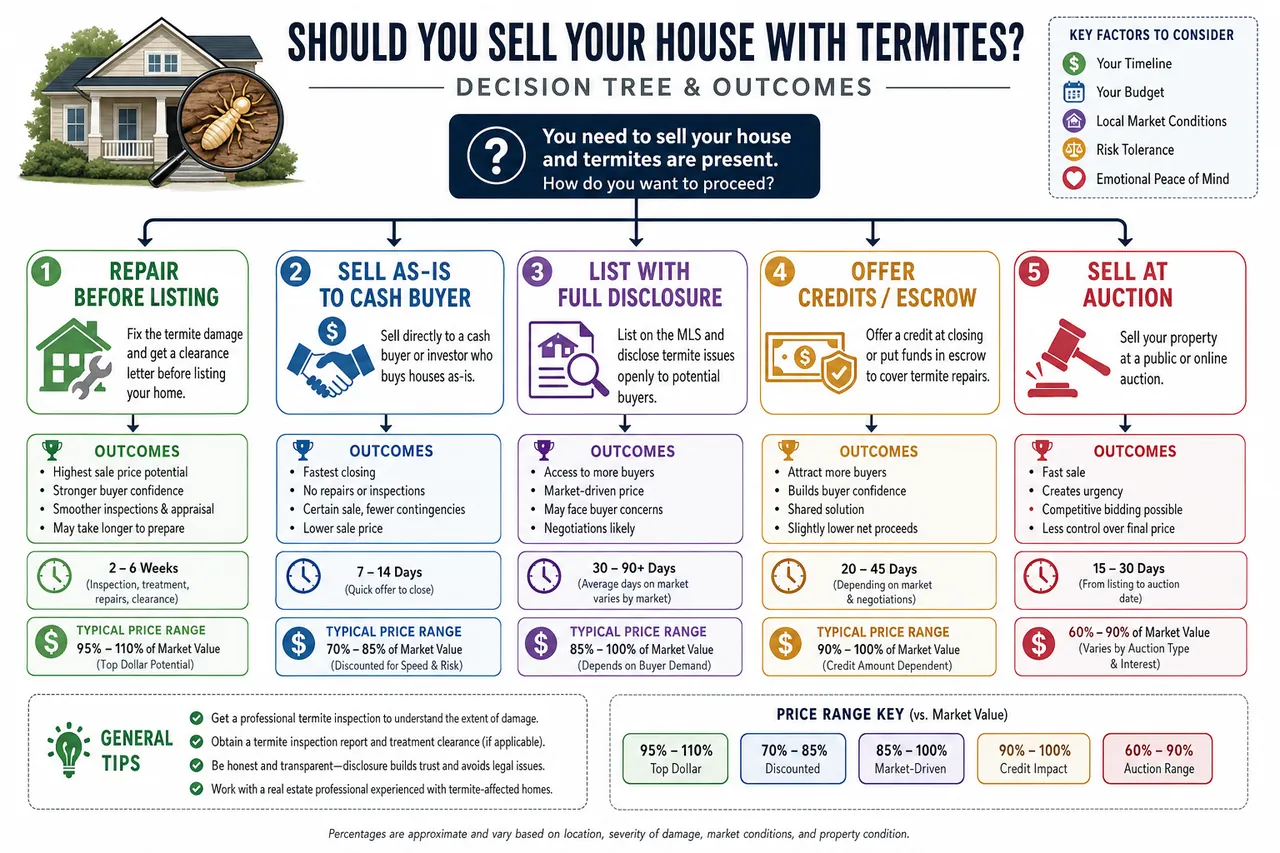
You've got five realistic paths forward once you understand the damage. Each one trades off price, timeline, and how much work you'll put in upfront. Your financial situation, your timeline, and how much negotiation you're willing to handle — that's what determines which path makes sense for you.
| Strategy | Typical Price Recovery | Timeline to Close | Upfront Effort/Cost | Best For |
|---|---|---|---|---|
| Repair before listing | Near full market value (minus 3%–10% residual stigma) | Weeks to months (repairs + standard listing) | High — treatment + repair costs upfront | Sellers with capital, time, and equity to absorb repair costs |
| Sell as-is to cash buyer | 15%–25% below market | Days to weeks | Low — no repairs required | Sellers who need fast closing and can't fund repairs |
| List with full disclosure at adjusted price | Market value minus 5%–25% depending on damage | Weeks to months (longer negotiation typical) | Medium — inspection and disclosure prep | Patient sellers with minor to moderate damage |
| Offer repair credit or escrow | Near market minus repair cost estimate | Standard listing timeline | Medium — must negotiate credit amount | Sellers who want to avoid doing repairs but attract financed buyers |
| Auction | Unpredictable — can be below or at market | Fast — set auction date | Medium — auction fees and prep | Sellers who need certainty of timeline over price optimization |
Strategy 1: Repair Before Listing
This is the path to the largest buyer pool. Financed buyers using FHA or VA loans can actually proceed. You'll also get closest to full market value. Professional termite treatment ranges widely depending on what you need: $225–$2,500 for liquid barrier or bait station treatment, and $2,000–$8,000 for full fumigation/tenting as of 2026 per HomeGuide. The national average across all treatment methods is $621 as of 2026 per Angi. Then add structural repairs on top of that.
Here's the real question: will the extra money you get from selling at a higher price actually cover what you spent on treatment and repairs? Only you can answer that with your specific numbers in front of you.
Strategy 2: Sell As-Is to a Cash Buyer or Investor
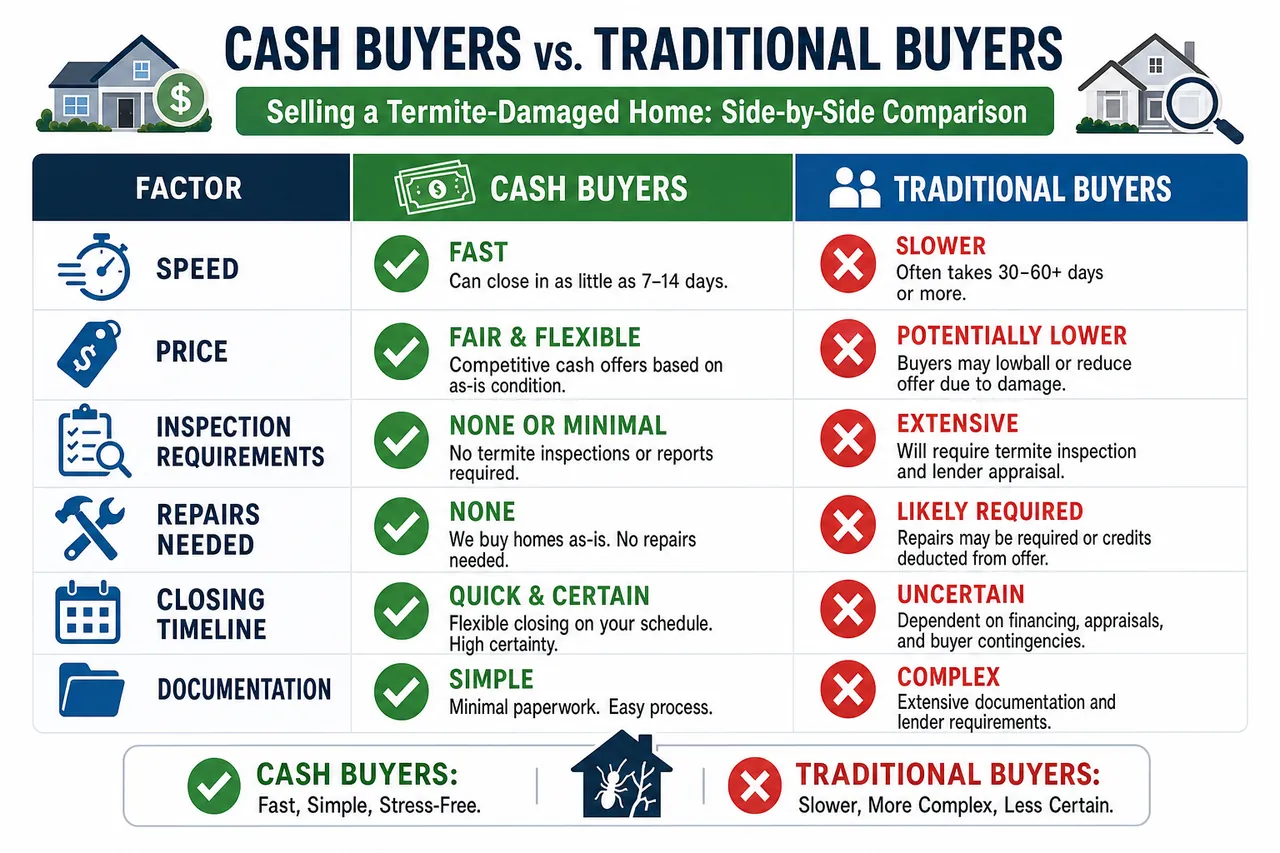
Cash buyers and real estate investors buy distressed properties because they plan to rehab and resell them. They don't care that your property can't get a traditional mortgage. Active infestations, unrepaired wood damage — none of that stops the deal. The catch is price. Expect offers in the 15%–25% below current market value range. What you gain is speed. These deals can close in days or weeks, not months. You also shed the risk of repair work going over budget or discovering hidden damage mid-project. This makes sense when the repair bill is huge relative to what your home is worth, or when you simply don't have the cash upfront to fix anything.
One critical thing: selling as-is doesn't let you off the hook for disclosure. You still need to disclose known defects in writing to whoever buys it.
Strategy 3: List with Full Disclosure at an Adjusted Price
Price the home to match the damage honestly. For moderate structural damage, that's typically 5%–15% below comparable properties. Severe cases warrant deeper cuts. Market it straight — include inspection reports and treatment history in your listing package. You'll reach more buyers this way than if you sold purely to investors, but expect the process to take longer and expect buyers to push back hard on price. Find a real estate agent who's handled distressed or as-is sales before. They know how to package the documentation so it's compelling and they'll anticipate what buyers will worry about. Buyers often demand price reductions of 100%–150% of the estimated repair cost when you're not doing repairs yourself. So price accurately from the start. You'll avoid those painful renegotiations later.
Strategy 4: Offer Repair Credits or Escrow Funds
You arrange with the buyer that at closing you'll credit them a specific dollar amount so they can hire contractors to fix things. Or the money goes into escrow and they pull it as repairs get done. You stay out of managing the repair work. The buyer gets the comfort of knowing the cost is covered. But here's the limitation: FHA and VA lenders often won't accept credits in place of actual finished repairs. This strategy works best with conventional loans or cash buyers who don't mind handling contractors themselves. Get actual contractor quotes. Don't guess at the credit amount. If it turns out to be short, the deal can fall apart.
Strategy 5: Auction
You know exactly when the sale closes. The auction happens on a set date. Investors and cash buyers show up ready to bid on as-is properties. The downside is you won't know the price until auction day — it could land below market or at market. Plus you'll pay auction house fees. This works if you need a guaranteed close date and you're okay with whatever price the market decides to offer.
Back to topDeciding Whether to Repair: A Financial Framework
Will the repair actually make you money? That's the core question. You need to know whether the extra cash you'll get from selling a repaired home beats what you'll spend fixing it—plus your time and the bills piling up while work happens.
- Get contractor quotes before deciding. National repair averages mean nothing. Your local labor rates and the actual damage on your property are what matter.
- Compare repair cost to expected price premium. Spending $20,000 to fix something that only adds $15,000 to your sale price is a losing trade. Do the math first.
- Account for carrying costs. Each month of repairs is another mortgage payment, property tax bill, insurance premium, and utility statement eating into what you'll net.
- Consider lender pool expansion. Fixed homes open the door to FHA and VA buyers. In some markets, that broader audience genuinely pushes your final sale price higher.
- Factor in warranty value. A warranty you can pass to the buyer—especially one that shows no current infestation—becomes a real selling point. It helps erase some of the damage from having a termite history at all.
Approximate Timeline: What to Expect from Each Approach
- Week 1: You'll want to order a professional WDO inspection—budget $150–$300 for this. A written report typically arrives within days.
- Weeks 1–2: If you're seeing signs of structural damage, get a structural engineer assessment ($553 average). Grab 2–3 contractor quotes for repairs and another 2–3 for treatment options.
- Week 2–3: Now you decide. Look at your numbers and pick a strategy. Repairs starting immediately? Treatment timelines vary wildly—liquid barriers work in days, but bait systems take weeks. Fumigation's different; you're looking at 3–4 days out of the house while it runs.
- Weeks 3–8 (if repairing): Structural repairs get done during this window. You'll get clearance documentation and a transferable warranty once everything's finished.
- Listing or closing: An as-is cash sale? You could close in 7–14 days after accepting an offer. Sell traditionally after repairs and expect 30–90 days to closing depending on your market. Escrow or credit deals follow standard financing timelines—30–45 days.
Marketing a Home with Termite History to Overcome Buyer Hesitation
Your best weapon here is transparency. Put together a "Termite History Packet" and hand it over before buyers even ask for it. Include the most recent WDO inspection report, all your historical treatment records, contractor receipts for repairs, and any active warranties you're holding. Frame this as proof the problem got professional attention—not as a sign trouble's still brewing. Before-and-after photos of the repairs themselves? Those build real confidence with buyers who might otherwise feel nervous.
An agent who's worked with distressed properties knows how to present this documentation positively in the listing remarks and during showings.
Other disclosed defects—asbestos, lead paint—call for the same documentation approach. Check out our guides on selling a house with asbestos: disclosure, removal, and options and selling a house with lead paint: federal rules and disclosure requirements to handle those the right way too.
Back to topHomeowner's Insurance: Don't Count on It
Your standard homeowner's insurance won't cover termite damage. Here's why: insurers treat termite infestation as a maintenance problem—something that builds up over time and could've been prevented—not a sudden disaster. That means the repair bill lands on you, not them. Call your insurance company and verify your exact policy, but don't structure your selling plan around money you're probably not going to get from insurance. Cash buyers and investors? They'll face the same dead end with their policies too.
Back to topRegional Considerations: Where Termite Risk Is Highest
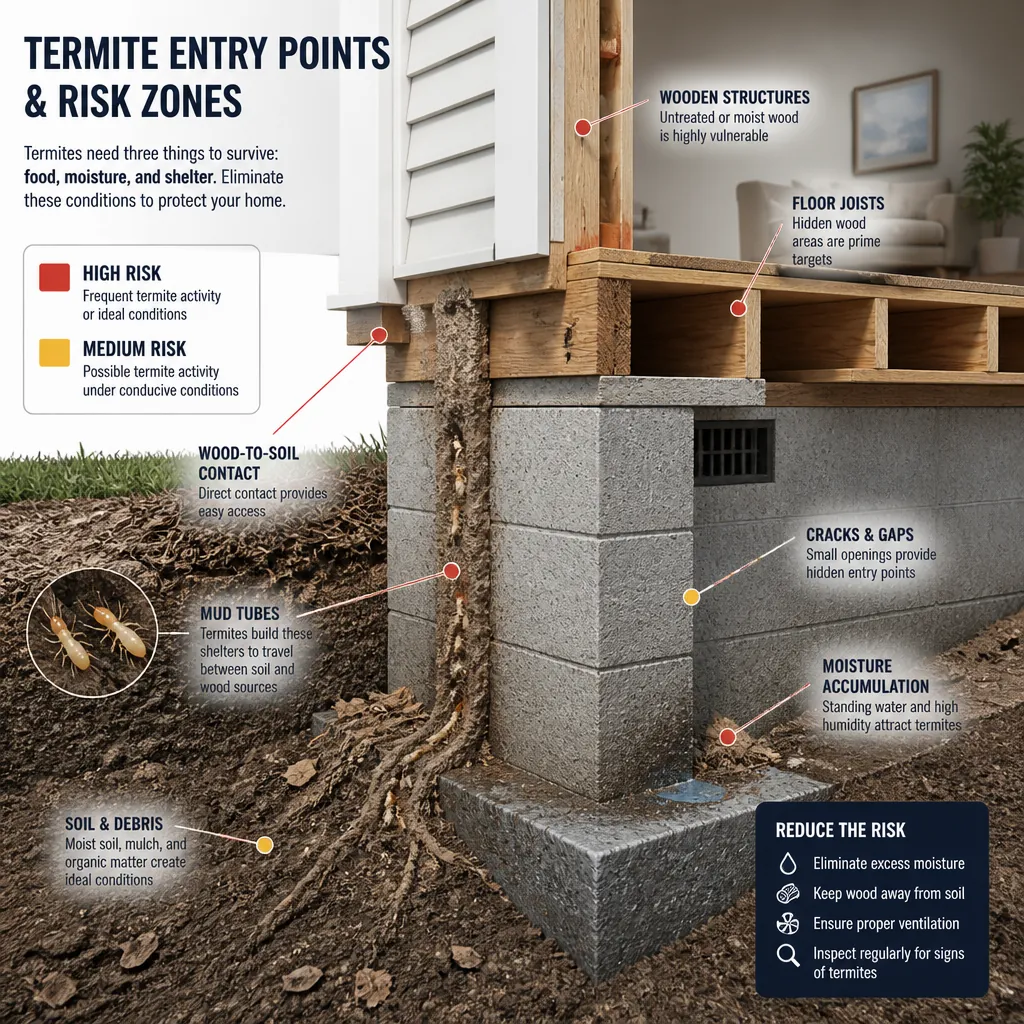
Termite pressure varies dramatically depending on where you live. The most destructive species — subterranean termites — love warm, damp conditions. That's why the Gulf Coast, Pacific Northwest (Seattle and Tacoma areas of Washington State especially), and much of the South see constant termite activity. If you're selling in one of these zones, expect buyers to read your inspection report with a magnifying glass.
Here's what the numbers look like: termites cause more than $6.8 billion in U.S. property damage annually according to the National Pest Management Association (2021 figures, still cited in 2026). These come from industry estimates rather than government data, but they show you the real scope of the problem. About 600,000 U.S. homes get infested each year. Living in a high-risk region? Buyers will scrutinize every detail of your termite disclosure and any documentation you have — so build that paper trail now.
Many high-risk zones have building codes that demand extra termite defenses. Soil treatment, physical barriers, borate-treated framing — these show up on new construction and sometimes on major renovations. If your home has any of these protections, document them and keep those records. Buyers will see this as real value.
Back to topWorking with Lenders on Termite Contingencies
Your buyer's lender will likely require a satisfactory WDO inspection and proof that any termite issues are fixed before they'll release the loan funds. This is a termite contingency, and it's non-negotiable with most lenders. Get proactive here—either you or your buyer should contact the lender's loan officer directly to find out what documentation will actually satisfy underwriting. Most lenders accept a clearance letter from a licensed pest control company plus repair receipts. That's usually enough. But don't assume. Ask for this in writing early, because last-minute surprises about what's acceptable can derail your closing date or sink the entire deal.
One more thing if you're selling in Florida: lenders there specifically require the FDACS Form 13645. A generic letter from your pest control company won't cut it. Get the right form.
Back to topConclusion: Selling with Termites Is Manageable with the Right Approach
Termite damage is real. It affects your price, spooks buyers, and can derail loan approvals. But it doesn't kill the deal. What you do next depends on three things: how bad the damage is, what money you have available, and whether you're in a rush. Active infestations? You need treatment now and honest disclosures. Old damage that's documented well and comes with transferable warranties? That's a much lighter lift. Pick your strategy — repair and relist, drop the price with full disclosure, offer a credit at closing, or sell as-is to a cash buyer — and you'll find they all start the same way: know what you're selling, tell buyers everything your state requires, and keep records of every professional step you take.
Stuck between a quick as-is sale and spending money on repairs? Use the financial breakdown in the "Deciding Whether to Repair" section above. Then talk to a licensed real estate attorney in your state about disclosure requirements. Get contractor estimates before you commit to fixing anything.
Back to topFrequently Asked Questions
Do I legally have to disclose termite damage to a buyer?
Yes — in virtually every state. There's no federal law, but state real estate statutes and common-law rules about material defects require you to disclose any known termite history or active infestations. Hide it, and you're looking at lawsuits, deal rescission, and in some states, fraud charges. The disclosure forms vary by state, so talk to a licensed real estate attorney or your agent about which specific form your transaction requires.
Can I sell a house with an active termite infestation?
You can, but your options shrink fast. Active infestations lock out FHA and VA buyers until you get a treatment report. Cash buyers and investors will buy termite-infested homes. They'll just demand a steep discount — 15%–25% below market value. If you can afford treatment before listing, do it. That move opens your buyer pool and cuts the price hit buyers will negotiate for.
How much will termite damage reduce my sale price?
The damage severity matters most. Cosmetic damage? Expect 3%–5% off the value. Moderate structural issues like damaged beams or subfloors typically cost you 5%–15%. Major structural rot or untreated active infestations can slash value by up to 20%–25%. And even after you repair and document everything, you'll probably still sell at 3%–10% below what a termite-free house would fetch. Buyers just get nervous.
What's a WDO inspection and do I need one?
WDO stands for Wood-Destroying Organism. It's broader than a termite-only inspection. You get termites checked, plus wood-boring beetles, wood-decaying fungi, and other wood-eating pests. For real estate deals, expect to pay $150–$300 as of 2026. FHA and VA lenders will require a formal WDO report before they'll approve financing on the property. Even if your state doesn't require it, getting one before you list protects you legally. It also gives buyers documented proof the property's been inspected and helps build confidence in your sale.
Will my homeowner's insurance cover termite damage repair costs?
No, almost certainly not. Your standard policy excludes termite damage outright because insurers classify it as maintenance, not a sudden peril. Repair costs are yours to handle. Call your insurer to double-check your specific policy, but don't count on a payout. Treatment and repair expenses come out of your pocket or get worked into the sale price negotiations.
Back to topMore in Inspections and disclosures
- Is It Illegal to Sell a House With Mold? Disclosure Laws and Liability
- Selling a House with Roof Damage: Disclosure, Repair, or Price Reduction
- Selling a House with Pests or Termites: Disclosure and Fixes
- Selling a House with Foundation Cracks: Disclosure and Repair Options
- Selling a House with Mold: Disclosure Requirements and Buyer Options
- Selling a House With Structural Damage: Disclosure and Buyer Options
See our guide: “How to Sell a House As-Is: What It Means and How It Works” →