

Selling a House With HOA Problems: Disclosure and Buyer Impact

Table of Contents
- Understanding HOA Issues That Impact Home Sales
- Disclosure and Transparency Requirements
- Resolving HOA Issues Before Selling
- Pricing and Marketing Strategies for Homes with HOA Issues
- Buyer Concerns and Inspection Red Flags
- Negotiation Strategies and the Sale Process
- Step-by-Step Action Plan for Sellers
- Summary
- Frequently Asked Questions
You're trying to figure out how to sell a house with HOA issues. Good news: you're not stuck. About 43.6% of U.S. home listings in 2025 have some kind of HOA fee, so you're definitely not alone. And violations? Delinquent dues? Liens? They happen constantly across roughly 373,000 HOA communities nationwide.
Maybe you've got an unresolved maintenance violation hanging over your head. Maybe there's a special assessment coming that'll terrify potential buyers. Or maybe you're staring down actual HOA debt with a lien attached to your title. Whatever the situation, this guide covers it all — the disclosures you're legally required to make, how to price your home realistically, what resolution timelines look like, and whether selling to a cash buyer might be your best move.

Understanding HOA Issues That Impact Home Sales
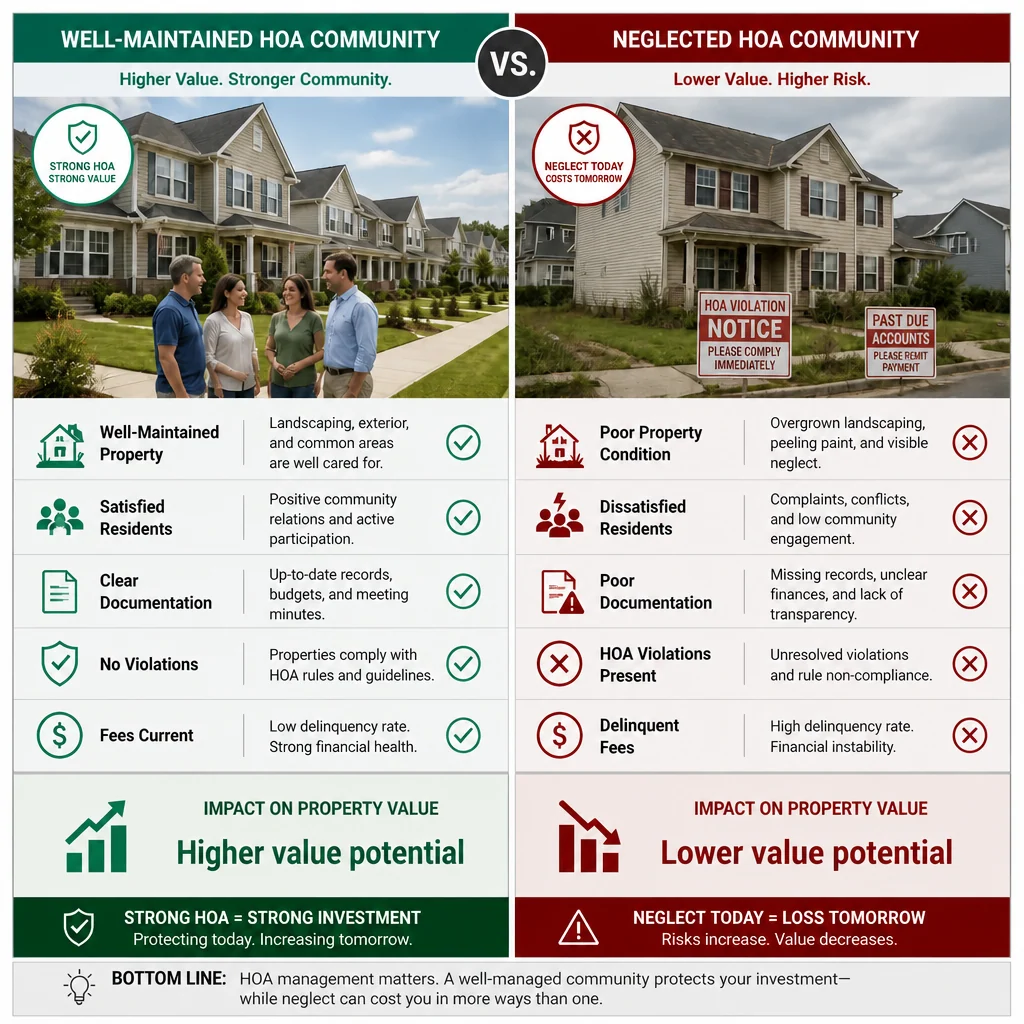
Common HOA Problems That Complicate Sales
A few broad categories of HOA problems exist, and each one hits your sale differently. Knowing which type you're facing? That determines what you do next.
- Open violations: You've made unapproved modifications, skipped exterior maintenance, or your landscaping doesn't match community standards. The HOA will require disclosure, and they'll often demand you fix it before handing over a clearance letter — which can push back your closing date.
- Delinquent dues: Monthly assessment payments you've missed. The national average HOA fee is $355/month as of May 2026, so even three or four months unpaid creates real debt. This has to be settled before or at closing.
- HOA liens: When you stop paying dues long enough, the HOA records a lien against your property. Any buyer's title search will catch it immediately — and you can't hand over clean title until it's gone. As we explain in our guide to selling a house with title issues, liens kill more closings than almost anything else.
- Special assessments: These are one-time charges the HOA levies for capital improvements or emergency repairs. About 10% of HOAs levied a special assessment in 2025 — up from 7.8% in 2021. The median special assessment hit a record $1,100 per unit in 2025. But major structural work? That can run $20,000–$50,000 or more per unit as of March 2026.
- Underfunded reserves: When an HOA's reserve fund is too thin to cover upcoming repairs, it signals financial trouble. Savvy buyers and their lenders will dig into this hard.
How HOA Issues Affect Property Value and Buyer Hesitation
A home isn't just a house — it comes with a community, and that community's finances matter to buyers. Open violations mean the HOA is watching. Pending special assessments mean the buyer inherits a bill they didn't create. Both reasons justify a lower offer or tougher negotiation. And underfunded reserves? They trigger extra scrutiny from lenders on FHA and VA loans, which have strict HOA financial requirements that conventional loans skip.
Legal Implications: Can an HOA Prevent Your Sale?
The HOA can't technically block a sale. But they can make it painful. California's especially strict — an HOA with an unpaid lien can start foreclosure once you've missed $1,800 in base assessments or haven't paid in 12 months under Cal. Civ. Code § 5720. Arizona just tightened things as of September 26, 2025. Now under the updated A.R.S. § 33-1807, foreclosure kicks in after 18 months of delinquency or $10,000 in unpaid assessments — whichever hits first. Texas gives you more breathing room — you get a 180-day right of redemption from when the sale notice is mailed under Tex. Prop. Code § 209.011. Still, none of this stops a willing buyer from purchasing your home. What it does mean? Any unpaid HOA debt surfaces at title and must be resolved — either you pay before closing or you negotiate it into the deal.
Back to topDisclosure and Transparency Requirements

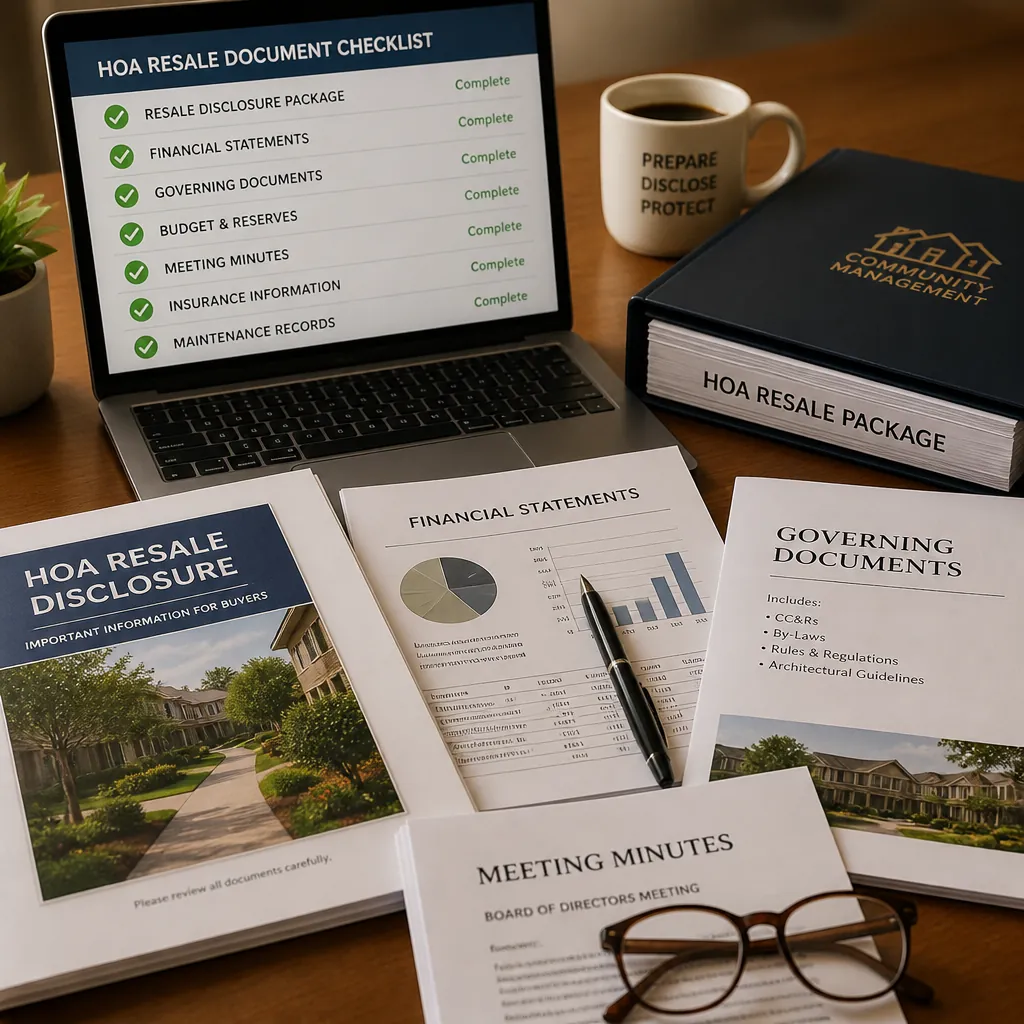
Required HOA Disclosures to Buyers
Most states with active HOAs require sellers to hand over a formal resale package or certificate to buyers. It's not optional — it's the law. So what exactly do buyers get to see?
- Declaration of Covenants, Conditions & Restrictions (CC&Rs)
- HOA bylaws and rules
- Current budget and most recent financial statements
- Reserve fund study or reserve balance disclosure
- Meeting minutes (commonly 12–24 months)
- Pending or recently levied special assessments
- Any outstanding violations against the property
- Pending litigation involving the HOA
That's the baseline. But California just raised the bar. Starting January 1, 2026, SB 410 requires the Davis-Stirling resale package to include the most recent SB 326 exterior elevated element inspection report — meaning balcony and structural inspection results go to every buyer, no exceptions.
Resale Certificates and State-Specific Timelines
The HOA or its management company puts together the resale certificate (also called the disclosure packet). Here's where it gets tricky: delivery rules and fees differ wildly by state.
| State | Delivery Window | Fee Cap / Notes | Buyer Rescission Window |
|---|---|---|---|
| California | Varies by association | SB 410 adds SB 326 inspection report (eff. Jan. 1, 2026) | 5 calendar days after receipt |
| Virginia | Varies; rush option available | $150 base + $50 rush + $50 electronic update (Va. Code § 55.1-1809) | Varies |
| Washington | 10 days (ESSB 5129, eff. Jan. 1, 2026) | $275 fee cap | Varies |
| Texas (condos) | Varies | Governed by Tex. Prop. Code § 82.156 | 6 calendar days after delivery |
That rescission window? Don't ignore it. In California you're looking at 5 days after the buyer gets the package — they can walk away for any reason, zero explanation needed. And here's the kicker: if you deliver incomplete documents, the clock restarts. That's the kind of mistake that tanks a deal. An experienced listing agent or HOA attorney knows how to avoid this.
Penalties for Incomplete or False Disclosures
Hiding things is dangerous. A pending special assessment you don't mention. A violation you know about but don't disclose. Active litigation the HOA's involved in.
Courts have ruled in favor of buyers suing for fraud or misrepresentation — sometimes awarding them the entire sale rescinded. Don't take that risk. Full transparency is always your safest move, even when it hurts to admit what you know.
Back to topResolving HOA Issues Before Selling
Addressing Outstanding Violations
Request a violation status letter from your HOA or management company right away. This tells you exactly what violations are on file for your property. Then get the cure requirements in writing for each one — what needs fixing, who does it, and when. Think overgrown landscaping or the wrong paint color? You're looking at days or weeks, maybe. But major structural work? That's a different story. You'll need permits, licensed contractors, and the board's formal approval. Plan on 30–90 days minimum, sometimes longer.
Paying Off Liens and Delinquent Fees
Your outstanding dues and any fines have to be paid in full before you get that clearance letter. And if an HOA lien's already recorded against your property, contact a title company or real estate attorney immediately. They'll confirm your exact payoff amount — because HOAs often tack on legal fees and collection costs that balloon past the original debt.
This matters more than you might think. In California, the HOA can exercise a nonjudicial foreclosure right of redemption for 90 days after sale under Cal. Civ. Code § 5715. Resolve liens before listing, and you eliminate that risk entirely. Colorado's even stricter — HOAs there can foreclose once total owed hits 6 months of common expense assessments under Colo. Rev. Stat. § 38-33.3-316(11). Don't let dues pile up.
Special Assessment Considerations for Sellers
Here's the thing: a pending special assessment isn't a deal-breaker. You actually have three solid options. Pay it yourself before closing. Credit the buyer the anticipated amount. Or negotiate a price reduction that covers what they'll owe.
If you're selling in California, know this — when a special assessment exceeds $1,800 per member, owners have the right to pay in installments over at least 12 months under Cal. Civ. Code § 5605. Your buyer might be able to structure it that way, which could make the whole thing less painful for everyone involved.
When to Involve a Real Estate Attorney
You need an HOA attorney — not just your real estate agent — if you've got a recorded lien, active foreclosure, or litigation tied to your name or property. They negotiate payoff amounts. They challenge improper fees. They make sure your clearance documentation is airtight for the title company at closing.
Back to topPricing and Marketing Strategies for Homes with HOA Issues

How to Price a Home with Outstanding HOA Problems
You need to be brutally honest about pricing. Buyers will uncover every problem during due diligence — there's no hiding it. An overpriced listing with known issues? That'll sit for months, sometimes longer. Here's what actually works:
- Resolved issues: Price at or near market value. Make sure you document exactly what you fixed and put it right in the listing.
- Minor open violations (cosmetic): A modest price reduction or seller credit that covers the cost to fix it usually keeps buyers interested.
- Pending special assessment: Drop the price by at least the full assessed amount. If lenders are going to flag it as buyer-assumed debt anyway, buyers will already be factoring it into their offer.
- Active lien or major violations: Expect real price pressure. Cash buyers are your best bet here — they can close without lender approval of HOA financials.
Marketing to the Right Buyers
Being transparent in your listing language builds trust. Say something like "seller has resolved all HOA violations — documentation available" and you're signaling that you're organized and honest. Hide known issues and hope buyers miss them? Every negotiation turns into a fight the second they find out. Target buyers who already live in HOAs. They understand how governance works and won't panic about management complexity. Real estate investors and cash buyers work too — they're not waiting for lender approval of HOA financials, which speeds everything up. Want to see all your options side by side? KDS Homebuyers' seller programs show you traditional listing, cash offer, and investor paths on one screen so you can compare actual net proceeds before you decide.

Buyer Concerns and Inspection Red Flags
What Buyers Are Looking For in HOA Documents
Smart buyers—especially those with experienced agents—dig deep into the resale package. They're hunting for problems. Here's what'll make them nervous:
- Reserve fund below 70% funded (many financial advisors flag anything under 50% as a concern)
- Meeting minutes referencing deferred maintenance, litigation, or board disputes
- Pending or recently passed special assessments
- Multiple units in the community with delinquent dues — this signals broader financial instability
- Restrictions that limit the buyer's intended use (rental bans, pet restrictions, short-term rental prohibitions)
Here's the thing: HOA financial issues aren't just about your property. They're about whether the whole community is financially stable. And that affects your sale price, period. This same transparency principle matters whether you're disclosing plumbing issues, electrical problems, or reserve fund shortfalls. Check out our guides on selling a house with plumbing problems and selling a house with electrical problems—they walk through the same disclosure process.
Financing Complications
FHA and VA loans come with strict HOA approval requirements. FHA won't approve a project where more than 15% of units are delinquent on dues. They also require adequate insurance and check litigation history. Fail these tests? Buyers using government-backed financing can't even get a loan. That's how serious it is. Conventional Fannie Mae loans have similar (though slightly less strict) condo approval requirements. Before you list, find out your community's approval status. It'll help you understand which buyers you can realistically work with.
Back to topNegotiation Strategies and the Sale Process
Handling Offers with HOA Contingencies
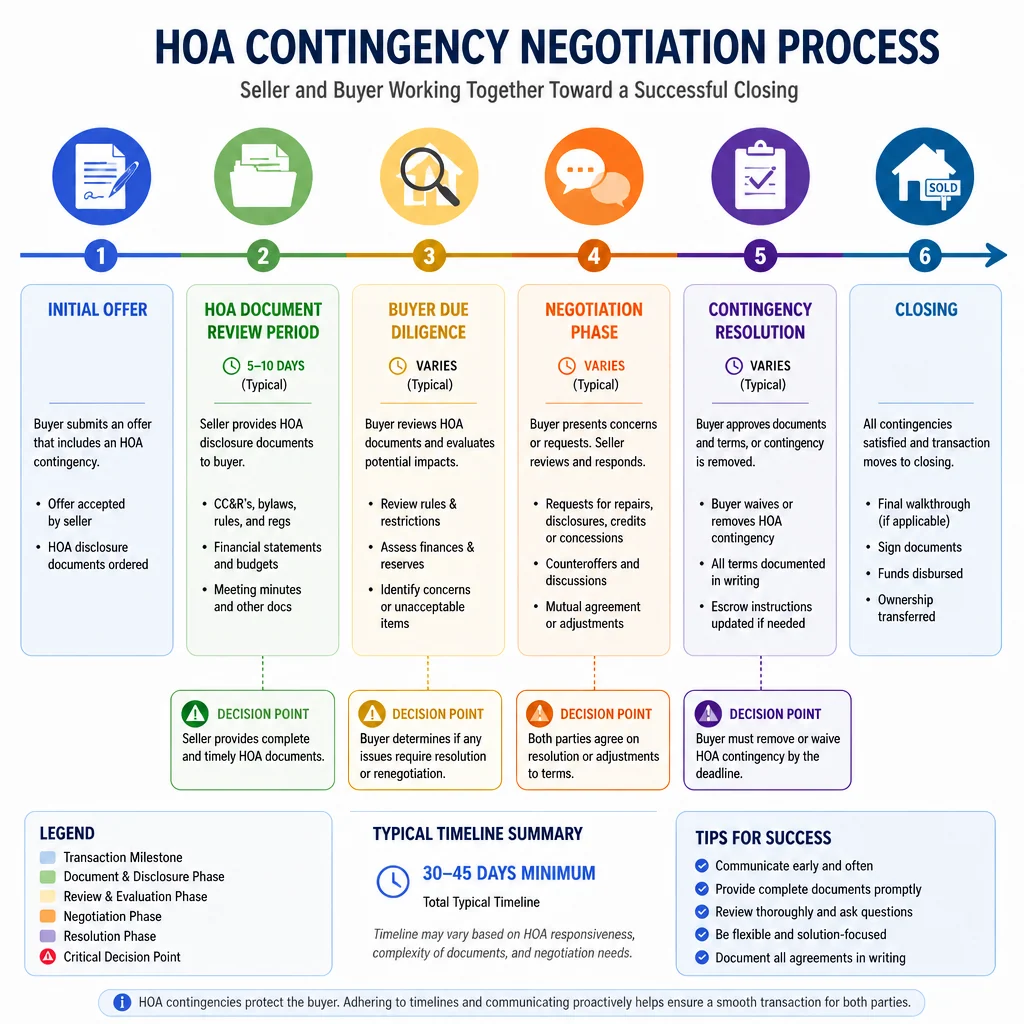
Buyers in HOA communities almost always include an HOA review contingency. That's typically 5 to 10 days to dig through the resale package after they get it. During this window, the buyer can back out without any penalty if the documents worry them. Here's the thing: when you provide complete, organized documentation upfront, you actually shorten that review period and cut down the risk of deals falling apart at the last minute. And if a buyer asks for a price reduction because they found HOA issues? Consider offering a credit at closing instead. You keep your list price intact for appraisal purposes, which often works better for you than a straight price cut.
Escrow and Closing Considerations
HOA stuff makes escrow more complicated. The title company will typically need a payoff statement for any delinquent dues, lien release documentation if there are liens, and in some states a formal resale certificate from the HOA signed by an authorized officer. Don't expect this to move quickly—budget 30 to 45 days minimum for HOA-heavy transactions. Complex situations (active litigation, major liens) can stretch to 60 to 90 days. Just as with easements and other encumbrances, surface every issue early. The title company shouldn't be discovering problems in the final week of escrow.
Back to topStep-by-Step Action Plan for Sellers
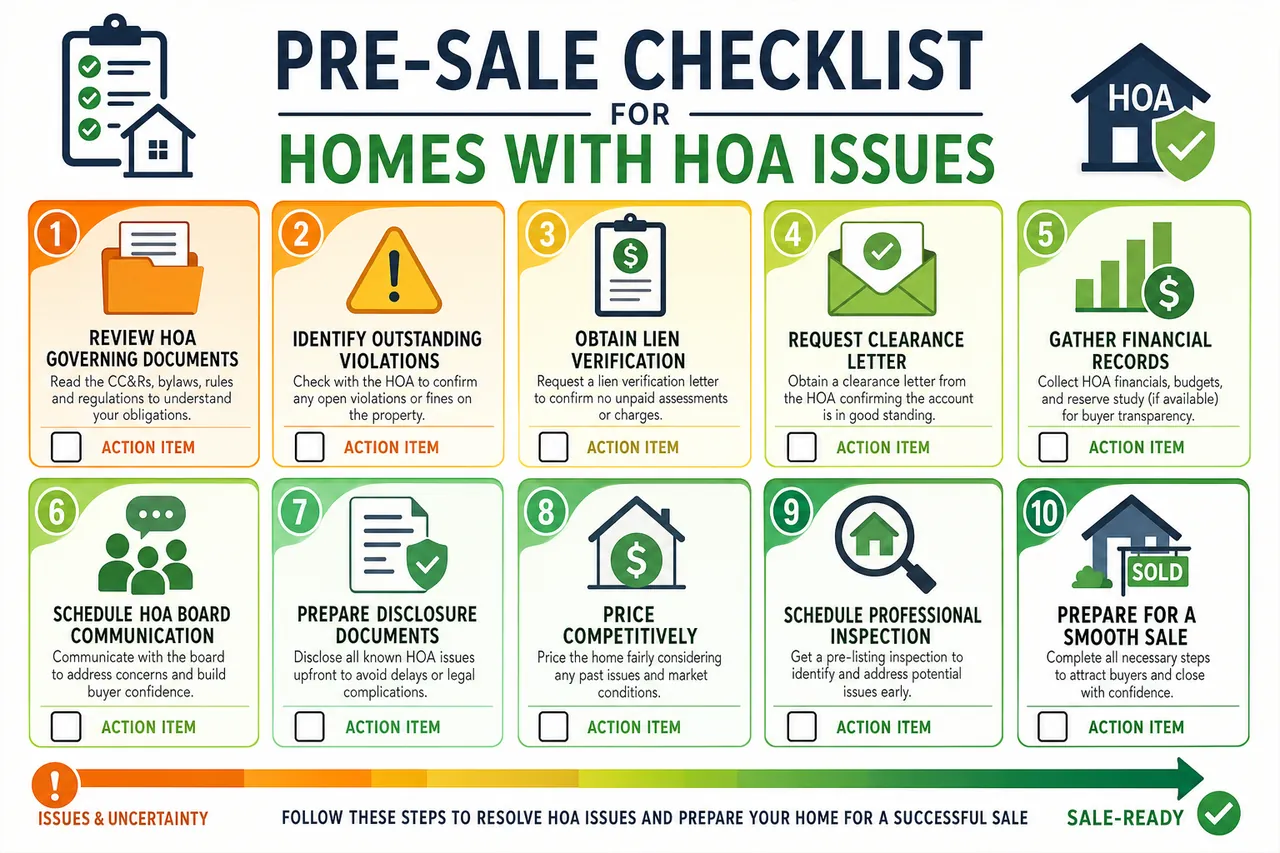
Pre-Sale Checklist
- Request a violation status letter from your HOA or management company — and make sure it's in writing.
- Pull your complete account history. Every assessment, fee, fine, and payment. You need to confirm your balance is actually accurate.
- Order the resale package before you list. Don't wait. Knowing what buyers will see gives you a real advantage here.
- Review CC&Rs for transfer restrictions — some HOAs have right-of-first-refusal clauses or rental restrictions that'll hurt your marketability.
- Consult a real estate attorney if you're dealing with an active lien, open litigation, or you're behind on assessments. Don't skip this step.
- Cure violations you can fix and get written confirmation from the HOA when each one is closed. Evidence matters.
- Document everything. Clearance letters, payment receipts, board correspondence — keep copies of it all.
- Disclose fully when you prepare your written disclosure statement. Be honest about every known issue and where it stands right now.
Realistic Resolution Timelines
The clock depends entirely on what you're fixing. Minor cosmetic violations? Days. A formal HOA board review of an architectural change can stretch 30–60 days. Here's what you should know: delinquent dues typically clear within 5–10 business days once you've paid. Then the county recorder's office needs another 2–4 weeks to release the lien. But special assessments that require a member vote — required in California when amounts exceed the board's 5% unilateral cap under Cal. Civ. Code § 5605 — follow your HOA's meeting schedule. You might wait weeks just for the next board session. And that's before the actual vote happens. Factor these timelines into your listing plan now. Getting blindsided mid-transaction costs you money and buyers.
When to List Despite Unresolved Issues
You're under pressure. Job relocation, foreclosure looming, financial stress piling up — waiting to resolve every issue isn't always realistic. Maybe the cost to fix something exceeds what you'd actually gain in sale price anyway. In that situation, you list. Price it honestly for what it is, disclose everything, and target buyers who can handle complexity: investors, cash buyers, or anyone putting 20% or more down who won't get blocked by FHA/VA HOA approval rules. The same strategy works for other property challenges — whether you're dealing with asbestos or plumbing problems in Florida. It's all the same calculus: fix what makes financial sense, price honestly for what remains, and move forward.
Back to topSummary
You can absolutely sell a house with HOA issues. The key? Get systematic about it.
First, figure out what you're actually dealing with. Are there violations on record? Unpaid dues stacking up? Liens attached to your property? Pending special assessments coming down the pike? Know the specifics before anything else.
Next—and this matters legally—disclose everything your state requires. Don't hold back hoping a buyer won't notice. Incomplete disclosure creates real legal trouble after you've already closed and moved on. Full transparency now beats lawsuits later.
Then make the strategic calls. Which problems make financial sense to fix before listing? What should you price realistically to account for what you're leaving unfixed? And here's the thing: you need to target buyers whose financing actually works with your HOA's situation. Not every lender will touch a property with certain issues.
The sellers who struggle most? They bury their heads in the sand until a buyer uncovers the problems mid-transaction. By that point, control has already slipped away from you.
Back to topFrequently Asked Questions
Can an HOA stop me from selling my house?
Not directly. Your HOA can't legally prevent a willing buyer from purchasing your property. But here's the catch: unresolved liens will stop the title company from issuing a clean title policy. That effectively kills most conventional and government-backed loan closings until you've paid the lien. Before you list, pull your CC&Rs and check for right-of-first-refusal clauses — some HOAs have them.
Do I have to disclose HOA violations to buyers?
Yes. Known violations, pending special assessments, active litigation with the HOA, and delinquent dues are all material facts in virtually every state. You have to reveal them. Skip this step and you're opening yourself up to fraud or misrepresentation lawsuits that don't stop at closing — they can follow you for years and cost you serious money.
What happens to unpaid HOA dues when I sell?
The title company handles this at closing. They'll get a payoff statement from your HOA, then deduct what you owe from your sale proceeds before you see a dime. And if your debt is bigger than your equity? That's a short sale situation. You'll need to negotiate with both the HOA and your mortgage lender.
Will HOA issues prevent a buyer from getting a mortgage?
They absolutely can. FHA and VA loans have strict requirements — the HOA community needs low delinquency rates, solid reserve funding, and no major active lawsuits. If your community doesn't meet these standards, buyers using those loan programs are completely locked out. Conventional condo loans have similar rules. The only exception? Cash buyers or people using non-conforming loans won't care about HOA approval at all.
How do special assessments affect my home sale?
A pending special assessment is a material fact you must disclose — there's no way around it. Once buyers know about it, you've got three options: pay it yourself before closing, accept a price reduction, or offer them a credit at closing. Some buyers will just walk away. The 2025 median special assessment was $1,100 per unit, but that's the median. Major structural repairs? They can run $20,000–$50,000 or more per unit as of March 2026. Those numbers will absolutely affect what price you can command and who's actually willing to buy.
Back to top
