Is It Illegal to Sell a House with Termites? Disclosure Requirements

Table of Contents
- The Legal Foundation: Why Disclosure Matters
- Understanding Termite Disclosure Laws by State
- Legal Consequences of Failing to Disclose
- How to Disclose Termite Issues Properly
- Your Selling Options When Termites Are Present
- Impact on Property Value and Buyer Behavior
- Navigating Buyer Disputes After Closing
- State-Specific Considerations and Where to Find Your Requirements
- Best Practices Summary
- Conclusion
- Frequently Asked Questions
You can sell a house with termites in most places — that's not illegal. But hiding what you know about termite damage? That's almost certainly against the law. Nearly every state requires sellers to disclose material defects they're aware of, and termite damage absolutely counts. The specifics change depending on where you live: disclosure forms vary, wording differs, and penalties for staying quiet range widely.
Selling a house that needs work? Start with our guide to selling a house as-is. It explains what as-is means, how pricing works and every way to sell a house with problems.
What does proper disclosure actually look like? This guide walks you through the legal requirements, shows you what sellers who skip disclosure face, and lays out your realistic options if you're selling a property with termite history. Keep in mind: disclosure rules shift from state to state, so you'll want to talk with a licensed real estate attorney in your area before you list. This article is for general informational purposes only and doesn't constitute legal, tax, or financial advice.

The Legal Foundation: Why Disclosure Matters
No Federal Termite Disclosure Law Exists
Lead-based paint? That's got federal teeth behind it for homes built before 1978. Termites don't. No federal law requires you to disclose termite problems when you're selling. What you do have to disclose comes straight from your state's rules, your local codes, and sometimes the buyer's loan requirements.
Your neighbor in the next state over might be dealing with completely different rules. But there's one thing nearly every state agrees on: you can't knowingly hide a material defect from someone buying your house. And termite damage—whether it's active right now or just history—almost always counts as material.
The Scale of the Problem
Termites show up in roughly 600,000 U.S. homes every year, according to 2025 data. The dollars behind this are staggering. The National Pest Management Association puts termite damage at $6.8 billion annually (2026 figure). The USDA Forest Service estimates run even wider—anywhere from $1 billion to $7 billion per year as of 2024–2025. When judges and lawmakers see numbers like that, they take non-disclosure seriously. For buyers, the financial hit can be enormous.
Back to topUnderstanding Termite Disclosure Laws by State
How State Requirements Vary
Some states demand sellers complete a standardized disclosure form with explicit termite questions. Others take a broader approach—requiring you to disclose any material defect, which implicitly covers pest damage. A few states still operate under "buyer beware," but they draw a hard line at active concealment. Not volunteering information is different from hiding it, and that distinction matters legally, though plenty of sellers miss it.
Two real examples show how specific these rules get:
- Texas: Texas Property Code § 5.008 requires you to provide a written Seller's Disclosure Notice (TREC Form OP-H) on or before your contract's effective date. It asks directly about wood-destroying insects.
- California: California Civil Code § 1102.3 requires sellers of one-to-four unit residential properties to complete a Transfer Disclosure Statement (TDS) covering known pest infestations and damage.
South Carolina's different. Real estate transactions there commonly use the CL-100, the official South Carolina Wood Infestation Report—a standardized WDI (wood-destroying insect) inspection form.
Start with your state real estate commission's website. That's where you'll find the actual form you need. Your state's department of agriculture or pesticide regulation agency usually publishes guidance on licensed inspectors and treatment standards too.
What Counts as "Known" Damage
Courts interpret "known" very broadly. And they don't care if the problem's been fixed. If you treated the home five years ago, got a pest inspection report, or paid for repairs and kept the receipts—that all counts as known. The infestation being resolved doesn't erase the fact that it happened, that you treated it, or that repairs were made.
"Known" covers these situations:
- Active or current infestations
- Past infestations, even if fully treated
- Structural repairs caused by termite damage
- Ongoing treatment contracts or termite bonds
- Inspection reports, whether from a licensed pest control company or a home inspector
Judges don't buy the "I forgot" excuse. If you knew, you disclose.
When Disclosure Timing Matters
Most states want disclosure before or at the moment your purchase contract becomes effective—not at closing. Texas requires the Seller's Disclosure Notice on or before the contract's effective date. California's TDS needs to reach the buyer early enough that they can actually review it and cancel if they want to. Handing over a pest report at the final walkthrough? That doesn't work and may not give your buyer a real chance to negotiate or back out.
Gather your documentation before you list. Not after.
Back to topLegal Consequences of Failing to Disclose
Fraud and Misrepresentation Claims
Knowingly hide termite history? You're looking at a fraud or negligent misrepresentation lawsuit. The buyer relied on what you told them—or didn't tell them—when deciding to buy and at what price. Once they discover post-closing that you knew about termite damage and stayed silent, the legal elements of fraud fall into place pretty quickly.
Two Maryland cases show what actually happens in court. One case ended in a $120,000 settlement paid to the buyer for undisclosed termite damage. The other resolved at $50,000 for hidden termite damage. Both were publicized in 2022–2023. And that's before you add in your own legal defense costs.
Sale Reversal and Rescission
Money judgments are one thing. But courts can also order rescission—which means unwinding the entire deal. You return the purchase price. The buyer returns the property. If you've already spent that money on a new home, rescission becomes a financial nightmare. Most sellers start negotiating seriously the moment rescission gets mentioned.
Punitive Damages for Willful Concealment
Active concealment is treated differently—and much worse. Paint over damaged wood? Remove signs of infestation? Lie on the disclosure form? Courts see that as willful fraud, not just careless omission. Beyond compensatory damages (repair costs, legal fees, loss of use), buyers can pursue punitive or treble damages. There's no general statutory cap on these awards in the research literature.
The distinction matters. Actively concealing damage carries much harsher penalties than simply not disclosing something you should have. Painting a damaged beam to look intact? That's active concealment. Not knowing about damage hidden deep in a crawlspace you never accessed? That's different—though the court will still ask whether a reasonable inspection would've caught it.
The Statute of Limitations Question
How long does a buyer have to sue? It depends on your state. Most statutes of limitations for fraud range from two to six years—and they typically start running from when the buyer discovered the defect (or should have discovered it). In real life, that often means the first time a licensed inspector points out termite damage during a home inspection. That could be years after you closed. Since the specific timeline depends entirely on your state's law and how local courts handle the discovery rule, talk to a real estate attorney in your area rather than guessing.
Back to topHow to Disclose Termite Issues Properly
What Information Must Be Included
Buyers need answers to these seven core questions:
- When was the infestation first discovered?
- Which areas of the home were affected?
- What treatment method was used (liquid barrier, bait stations, fumigation)?
- Who performed the treatment (licensed company name, license number)?
- What structural repairs were made, by whom, and when?
- Is an ongoing treatment contract or termite bond in place?
- What follow-up inspections have been conducted?
Documentation to Gather Before Listing
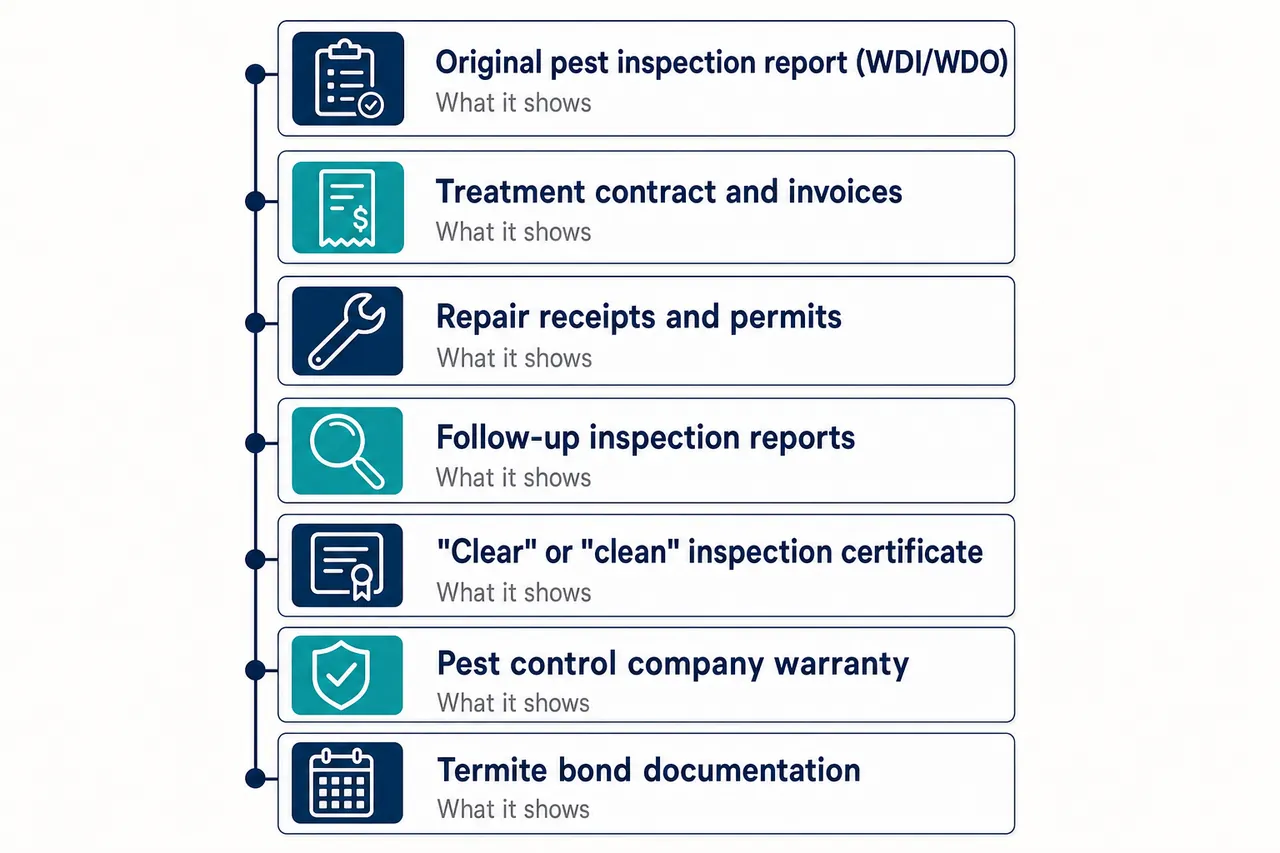
Collect these documents now. They form your complete termite disclosure packet.
| Document | What It Shows | Why It Matters to Buyers |
|---|---|---|
| Original pest inspection report (WDI/WDO) | Date, scope, findings, inspector credentials | Establishes baseline condition at time of discovery |
| Treatment contract and invoices | Method used, company, dates, cost paid | Confirms professional treatment was performed |
| Repair receipts and permits | Structural repairs made, licensed contractors used | Demonstrates damage was addressed to code |
| Follow-up inspection reports | Post-treatment monitoring results | Shows infestation was eliminated, not just treated |
| "Clear" or "clean" inspection certificate | No active infestation found at inspection date | Provides buyer with current status confirmation |
| Pest control company warranty | Coverage terms, duration, transferability | Gives buyer ongoing protection after purchase |
| Termite bond documentation | Annual inspection schedule, bond terms | Shows ongoing monitoring is in place |
Over-Disclosure as a Risk Management Strategy
Disclose more, not less. Full transparency on termite issues means buyers can't claim surprise later.
When a buyer knows everything—the infestation date, the treatment used, the repairs made, the current status—they can't sue you after closing for damages they already agreed to purchase. A buyer kept in the dark? That's a lawsuit waiting to happen.
This same logic works for other material defects too. The approach for selling a house with mold and understanding legal liability for mold non-disclosure follows the same principle.
The Role of Real Estate Agents
Your listing agent has their own legal duty not to hide known defects. A solid agent organizes your documentation, presents the termite history clearly in the listing, and ensures the state disclosure form is filled out correctly. If your agent tells you to downplay or leave out a known issue, that's a red flag.
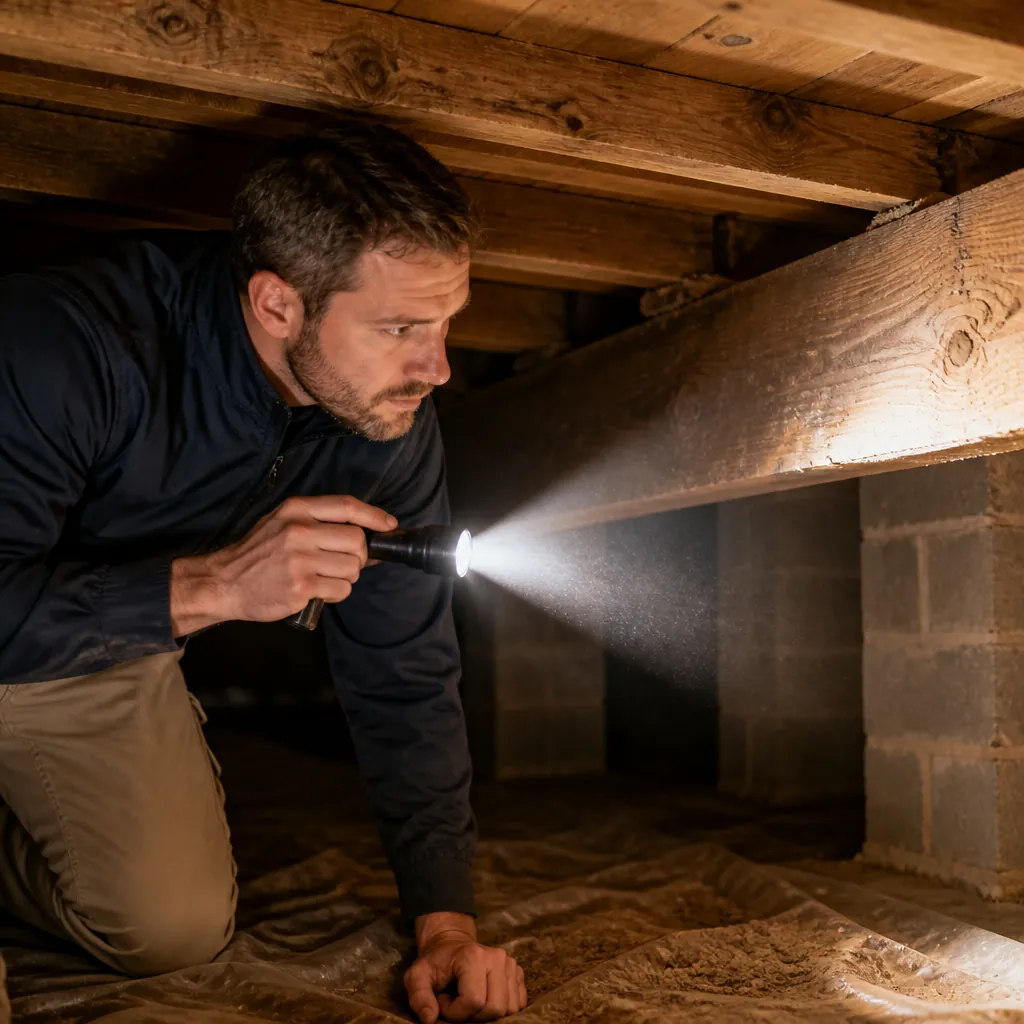
Order a pre-listing termite inspection before you list. It costs $75–$325 (typically $100–$133 as of 2025–2026). A WDI/WDO report for a real estate transaction runs $62–$277 as of 2025. That minor expense establishes a documented baseline and shows you acted in good faith. And it protects you far more than the cost of a potential lawsuit ever could.
Back to topYour Selling Options When Termites Are Present
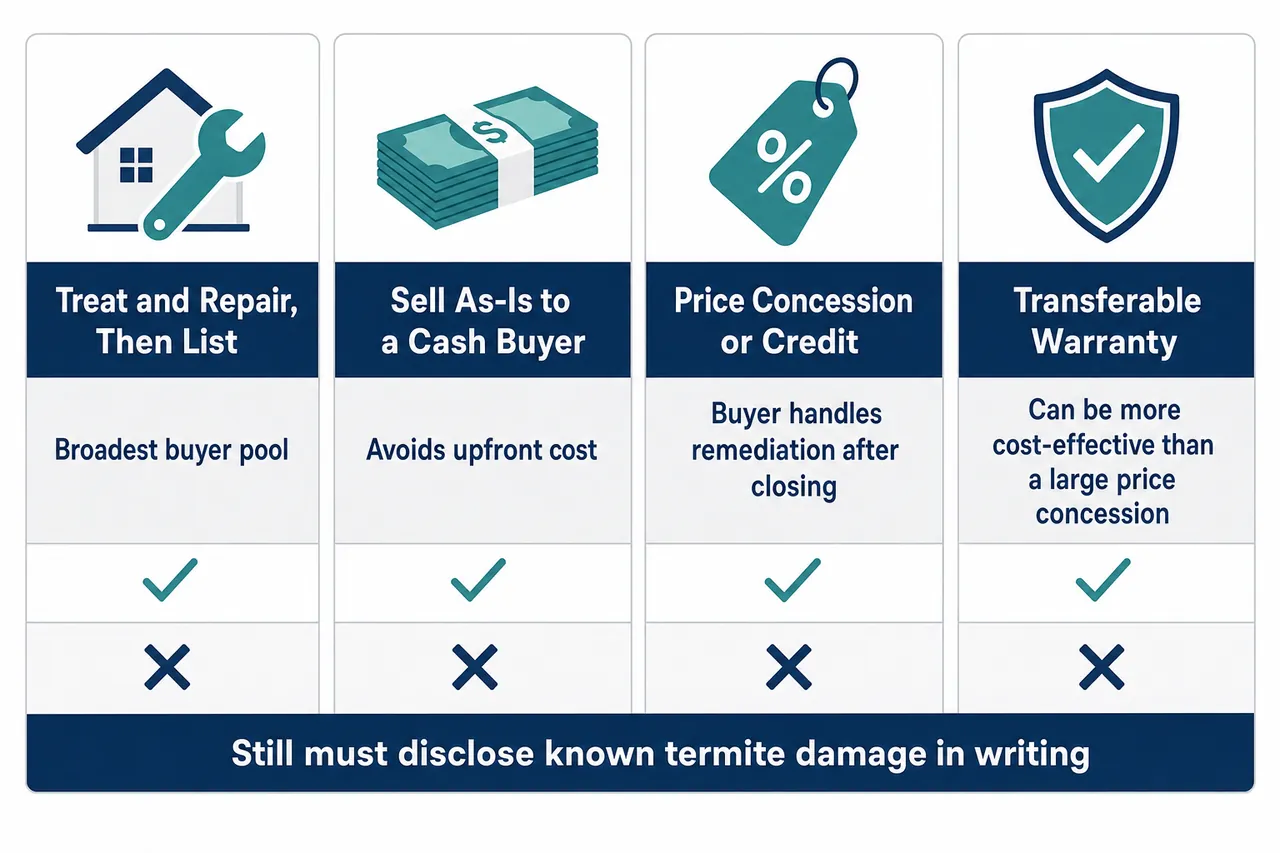
Now that you know what you're legally required to disclose, it's time to pick a selling strategy. No one-size-fits-all answer exists here. The severity of the damage, how quickly you need to sell, what's in your bank account, and what your local market looks like — these all matter. You can dive deeper into selling options for termite-affected properties, and we've also covered practical fixes sellers commonly use in separate guides.
Option 1: Treat and Repair, Then List on the Traditional Market
This path opens your property to the widest range of buyers — including those relying on FHA and VA financing (which we'll cover below). You'll typically get your highest price. But you'll pay upfront, and you'll wait for the work to finish before you can list.
Basic termite treatment runs $150 to $2,000 for average jobs, or $5–$20 per linear foot (2026 rates). Want the whole house tented? That's $2,000–$8,000, or $1–$4 per square foot (2026). Now add structural repairs. The average comes in around $3,000 per home, though severe cases can hit $100,000 (2025–2026). Before committing, get estimates from licensed contractors to see if this makes financial sense for your house.
Option 2: Sell As-Is to a Cash Buyer or Investor
You skip the treatment and repair costs. You skip the waiting. Cash buyers and investors buy damaged properties all the time — that's their business. Speed and simplicity matter more to them than you finding a perfect fix. You'll accept a lower sale price in exchange for fast closing and no financing headaches.

Important: Selling as-is doesn't wipe out your disclosure duty. You still write down what you know about termite damage. The as-is label means you won't fix anything — not that you get to hide problems. Regulators and courts take this seriously.
Option 3: Price Concession or Credit at Closing
Instead of hiring contractors yourself, you reduce the price or offer a closing-cost credit equal to what treatment and repair would cost. The buyer pays for the work after closing. The property stays on the traditional market, and you avoid shelling out cash upfront.
Getting the number right is tricky. Buyers dig in hard during negotiations once termites come up. If you price the discount in from the start and hand over a detailed contractor estimate, you're in a much better position than waiting for the buyer to demand money back.
Option 4: Transferable Warranty or Prepaid Inspection Plan
Some pest control companies offer warranties that transfer to the new owner. This works better than a big price cut for some sellers. Termite bonds and ongoing protection plans typically cost $500–$2,000 on top of your initial treatment (2026 figures). The buyer gets regular inspections and ongoing coverage — that reduces their anxiety. Use this alongside a price adjustment, not instead of one.
Back to topImpact on Property Value and Buyer Behavior

How Termite History Affects Your Sale Price
If you're selling a home with termite damage in its history, expect buyers to offer less than they would for a comparable property without it. Research shows price reductions typically fall between 20–25% (as of 2025), but that number shifts based on how severe the damage was, what records you have on file, what your local market looks like, and whether you've actually fixed the problem properly.
The key difference? A small area of damage that a licensed pest control company treated and documented won't hurt as much as moderate or severe damage affecting the structure itself. And your timing matters. Selling in a hot market? Buyers might accept a smaller price cut. Selling when homes are sitting on the market? Be ready for a steeper discount.
Regional Variations in Buyer Attitudes
Termites are part of life in Florida, the Gulf Coast, the Southeast, and parts of California. Buyers there have seen it before. They're not shocked. Up in the Northeast or upper Midwest? A termite history feels scarier to most buyers because it's rare.
This actually works in your favor if you're in a termite hotspot. Buyers in those regions often see a well-documented treatment history as proof you stayed on top of things. The problem's known. You fixed it. The paperwork's solid. That beats buying blind in an area where termites are common.
Selling in Florida? Make sure you understand the full disclosure picture. You've got termite requirements plus lead paint rules and other state-specific environmental rules stacked on top of federal law. For a parallel example of how Florida's requirements work, check out the guide on selling a house with lead paint in Florida.
FHA and VA Loan Requirements
Cash sales sidestep these problems entirely. But if your buyer's financing through an FHA or VA loan, termite issues become a formal roadblock.
FHA loans: HUD Handbook 4000.1 (2024–2025) requires a termite inspection during the appraisal process if the appraiser spots signs of active infestation, if your state or local laws require it, or if the lender asks for one. Find active termites? They have to be treated and eliminated before you close. This means you can't sell "as-is with active termites" to an FHA buyer.
VA loans: VA guidelines (2025–2026) mandate termite inspections in most states based on the VA's Termite Infestation Probability Map. Active termites or structural damage both require treatment and repair before closing. The seller typically covers the cost of the VA termite inspection.
Active termites or major structural damage? Your realistic buyer pool shrinks to cash buyers and conventional loan buyers whose lenders don't require termite inspections. FHA and VA buyers won't touch it until you've fixed the problem.
Homeowner's Insurance Won't Help
Don't count on your homeowner's insurance to cover termite repairs. Standard homeowners policies explicitly exclude termite damage as a maintenance issue (as of 2025–2026). You're paying for repairs out of your own pocket. This is exactly why catching termites early matters financially — the smaller the damage, the smaller the bill.
Your buyer faces the same wall after purchase. Their future insurance won't cover pre-existing termite damage either. That's why they'll push hard on price or demand you fix things before they sign.
Back to topNavigating Buyer Disputes After Closing
When Buyers Claim Undisclosed Termites
Your documentation is your defense. If a buyer contacts you after closing claiming you failed to disclose termite damage, that signed acknowledgment from them, those dated inspection reports, treatment contracts, and repair records prove you did your job. Without that paper trail? You're in a credibility contest. Sellers usually lose those.
And don't respond directly to the buyer — work through your real estate attorney instead. Even if you're absolutely certain you disclosed everything, getting legal guidance early stops you from making mistakes that turn a manageable dispute into an expensive lawsuit.
Home Inspection Contingencies
Most contracts let buyers order their own pest inspection. That's their right. If their inspector finds termite damage you didn't disclose — maybe you didn't know about it, maybe you did — they can ask for repairs, a price reduction, or out of the deal entirely. What you do next is negotiation. It's not a legal admission.
When termite issues come up in that contingency request, have your real estate attorney review your response before you send it. Worth the investment.
Back to topState-Specific Considerations and Where to Find Your Requirements
How to Find Your State's Disclosure Form and Rules
There's no single federal standard, so you need to find your state's rules. Here's the fastest approach:
- Start with your state real estate commission website — they post the official seller's disclosure form and explain exactly what goes on it.
- Call your state department of agriculture or pesticide regulatory agency. They set the rules for licensed pest control work and WDI inspection forms.
- Got a messy history? Multiple pest problems, big structural fixes, or old lawsuits tied to the property? Talk to a local real estate attorney before you list.
Disclosure Differences Across Property Types
Residential and commercial properties play by different rules. Those state forms above? They're usually for one-to-four unit residential sales only. Commercial deals often skip mandatory disclosure forms entirely. Instead, buyers and sellers negotiate terms themselves and use the due diligence period to dig into problems. Selling a multi-family building, mixed-use property, or commercial space? Double-check which disclosure rules actually apply to what you're selling.
Caveat Emptor States
A handful of states still use caveat emptor — "buyer beware" — for residential sales. That sounds like you can hide problems, but it's not that simple. You still can't actively lie, hide evidence of defects, or sign a disclosure form dishonestly. The protection caveat emptor actually gives you is much narrower than sellers think. Your real estate attorney can walk you through what you must disclose in your state versus what stays quiet.
And the same logic applies to hazardous materials. For how different states handle similar situations, check out these guides on selling a house with asbestos and Florida asbestos disclosure requirements, which both follow that state-by-state breakdown.
Back to topBest Practices Summary
Before You List
- Get a pre-listing termite inspection from a licensed pest control professional. Find out what's there before the buyer's inspector does. Problems you already know about and have fixed? Way easier to manage than surprises that pop up during buyer due diligence.
- Dig up every document you have on past termite treatment: inspection reports, treatment contracts, invoices, repair receipts, permits, warranty certificates. Everything.
- Your property's history is complicated? Talk to a real estate attorney before you fill out that disclosure form.
- Thermal imaging inspections can be really useful here. They show whether treated areas have the moisture signatures you'd expect to see if termites were still active.
During the Listing and Sale Process
- Fill out that state-required disclosure form with complete accuracy. Don't soften the language, leave things out, or take guesses.
- Frame the termite history as a closed chapter. Treatment complete? Documented? Then that's your narrative: the issue was caught, handled by professionals, and cleared. Done.
- When you're marketing the property, talk about the solution. "Professionally treated and certified clear in [year], with transferable warranty" is honest, transparent, and sells the property better than dwelling on the problem.
- Keep signed copies of your disclosure forms and buyer acknowledgments. Hold onto them for however long your state's statute of limitations runs.
After Closing
- Don't throw away anything from the transaction — disclosure forms, inspection reports, buyer acknowledgments. Keep them for at least as long as your state's fraud or misrepresentation statute of limitations lasts.
- And if a buyer calls you after closing with a termite complaint? Let your attorney handle it.
Conclusion
You can sell a house with termites. What you can't do is hide what you know about them. Almost every state requires sellers to disclose termite damage — the forms, timing, and penalties just vary. Skip that disclosure? You're looking at fraud lawsuits, sale rescission, and damage awards that real cases show hitting $50,000 to $120,000, and that's before your lawyer gets paid. Being honest costs way less than covering it up.
So what's your next move? Get a pre-listing inspection. Collect everything it shows you. Fill out your state's disclosure form truthfully. Then pick the path that works for your situation: treat the termites and list traditionally, sell as-is for cash, or adjust your price. Each one trades off differently on price, speed, and how much work you'll do. None of them asks you to lie.
And if termites aren't your only problem? The same approach works for lead paint, mold, asbestos, and other defects that buyers need to know about. The legal rules shift from one problem to the next, but the core principle stays the same: disclose what matters.
Back to topFrequently Asked Questions
Can I sell my house with active termites?
You can sell a property with active termites in most states — but disclosure is mandatory, and buyers with FHA or VA financing will run into real problems. Per HUD Handbook 4000.1, active infestation must be treated and cleared before an FHA loan closes. VA guidelines require the same thing. Realistically? Your buyer pool shrinks to cash purchasers and some conventional loan buyers. Most sellers decide it's worth treating the infestation first, then listing the property.
What if I genuinely didn't know about termite damage?
Your disclosure obligation covers what you knew or should have known. Damage that was truly hidden — tucked inside an inaccessible crawlspace or behind walls — and you have no inspection, repair, or treatment records? You're not required to disclose something you legitimately didn't know about. But courts dig into this carefully. If a reasonable pre-listing inspection would've caught it, your "I didn't know" defense falls apart fast. Here's why a pre-listing inspection matters: it surfaces problems you should disclose, and it proves your due diligence if something genuinely hidden turns up later.
Does selling as-is mean I don't have to disclose termites?
"As-is" tells buyers you won't make repairs. That's all it does. It doesn't erase your disclosure obligations. You still must disclose all known material defects — termite damage included — even in as-is transactions. Courts and state regulators agree on this across the board. Skip proper disclosure in an as-is sale, and you're facing the same legal trouble as any other sale with concealed defects.
How much will termite history reduce my sale price?
Research as of 2025 suggests termite damage history can reduce sale prices by 20–25%. What you'll actually see depends on how severe the damage is, whether the problem was properly documented and resolved, what your local market looks like, and what buyers in your area expect. If you've got solid treatment records and a transferable warranty? The price hit is usually smaller than properties where repairs were incomplete or records are sketchy.
What's the difference between active concealment and failing to disclose?
Active concealment means you deliberately hide a known defect — painting over damaged wood, filling termite tunnels with spackling, clearing away visible evidence before showings. Passive non-disclosure means you simply don't mention something you know about without trying to hide it. Both are legally risky. Active concealment, though? Courts punish it much harder, and you could end up owing punitive or treble damages on top of compensatory damages. If you know about termite damage, write it on the disclosure form. Don't try to minimize or hide it.
Back to topMore in Inspections and disclosures
- Selling a House with Termites: Disclosure, Treatment, and Buyer Impact
- Is It Illegal to Sell a House With Mold? Disclosure Laws and Liability
- Selling a House with Roof Damage: Disclosure, Repair, or Price Reduction
- Selling a House with Pests or Termites: Disclosure and Fixes
- Selling a House with Foundation Cracks: Disclosure and Repair Options
- Selling a House with Mold: Disclosure Requirements and Buyer Options
See our guide: “How to Sell a House As-Is: What It Means and How It Works” →