Can I Sell a House With Squatters in It? Legal Removal and Sale Options
Table of Contents
- Understanding Squatters, Tenants, and Holdover Occupants
- Why Self-Help Removal Always Backfires
- State-by-State Squatter Removal Laws and Timelines
- Adverse Possession: What It's and What It Isn't
- Your Two Core Options: Evict First or Sell As-Is
- Selling a House While Squatters Are Still Inside
- Specific Situations: Inherited Properties, Foreclosure, and Abandoned Homes
- Insurance Implications of Squatter-Occupied Properties
- What to Do Next: Immediate Steps
- Conclusion: Squatter Situations Are Stressful but Solvable
- Frequently Asked Questions
Yes, you can sell a house with squatters in it. Your ownership and title stay legally yours no matter who's living there without permission. The real issue isn't whether you can sell — it's figuring out which approach will cost you the least in time, money, and legal headaches. This guide breaks down every option with the straight talk your situation needs.
Nothing in this article is legal, tax, or financial advice. Squatter removal and property sales are governed by state and local law, and the right professional for your situation is a licensed real estate attorney in your jurisdiction.

Understanding Squatters, Tenants, and Holdover Occupants
Who Counts as a Squatter?
A squatter is someone living on your property without a lease, written permission, or any legal right to do so. They got in—or stayed—without your say-so. This distinction matters because it changes everything about how you remove them.
Compare that to a holdover tenant. They had a valid lease once, but it's expired. Then there's a guest who won't leave—someone you invited but who never actually had a tenancy agreement. The legal categories aren't just semantic. They determine which removal process applies to your situation.
A holdover tenant typically gets a notice to quit based on the original lease and your state's landlord-tenant laws. A squatter with no legitimate claim might qualify for a faster removal in some states. And a licensee or guest who overstays? That's the gray zone. Courts handle those case by case, which is why getting this classification right before you act is critical—and something your attorney should nail down first. For more on tenant rights when you're selling, check out Selling a House With a Tenant: Tenant Rights and Sale Options.
How to Verify Occupant Legal Status
Start by gathering evidence. Write everything down and keep copies:
- Photographs and video with timestamps showing unauthorized entry or occupation
- Copies of any written communications you've (or haven't) had with the occupant
- Utility records showing who's paying (or not paying) utilities
- Any mail or identification the occupant has used at the address
- Chain-of-ownership documents, including your deed and any prior lease agreements
If they pull out a lease—even one you suspect is fake—that's a problem. It'll drag out the removal process. Before you do anything else, have your attorney verify whether that lease is real or forged. Courts don't take shortcuts with documents, even when you're certain someone fabricated them.
Back to topWhy Self-Help Removal Always Backfires
The Self-Help Trap

Someone's living in your house without permission. Your first instinct? Change those locks. Shut off the water. Get them out today. I get it. But here's what happens next: you end up with legal bills that dwarf what you'd spend on a formal eviction, and you might face criminal charges yourself. Self-help eviction is illegal in every U.S. state, no exceptions.

California homeowners have learned this the hard way. Change a lock on someone who's established occupancy there — even someone you believe has zero legal right to be there — and you're looking at $1,000–$5,000 per violation under Civil Code § 789.3 (revised 2026). And that's just the state penalty. The court will throw out your eviction case and make you pay the occupant's attorney fees if you've tried any self-help moves. That's the real sting.
What Not to Do
- Don't change the locks — even if you're certain the occupant has no legal rights
- Don't cut utilities — water, electricity, and gas shutoffs are actionable in virtually every state
- Don't remove the occupant's belongings — this is considered constructive eviction and invites a lawsuit
- Don't threaten or intimidate — this can become a harassment or criminal charge
- Don't ask a locksmith or police officer to remove the person without a court order
Call the police hoping they'll drag the person out? They won't. Most officers will decline to remove a squatter without a court-issued writ of possession, especially if that occupant can point to any document—even a suspicious one—that looks like proof of tenancy. And the legal route really does work, even though it feels impossibly slow and frustrating. Notice. Hearing. Court order. Sheriff execution. That's the only sequence courts will actually respect.
Back to topState-by-State Squatter Removal Laws and Timelines

How long you'll wait depends on your state, your county's court backlog, and whether the squatter fights back. Notice-to-quit periods range all over the map — anywhere from 3 to 30 days depending on where you are. From that first notice to the moment the sheriff actually removes them? You're looking at anywhere from a few weeks in a friendly jurisdiction to many months in states where courts lean heavily toward tenant protections.
Florida
Florida Statute 82.036 gives property owners a direct path to removal that bypasses some of the usual court machinery. You verify you own the place and there's no actual lease — then you can call the sheriff to remove them. This statute was built specifically for squatter situations. It's one of the quickest tools available in the country. But if the occupant claims they have a tenancy agreement? Suddenly you're in a full court fight. Talk to a Florida real estate attorney before moving forward — they'll know if the Statute 82.036 affidavit approach actually works for your case.
Georgia
You'll need to give written notice first — three business days minimum. After that, the dispossessory hearing gets scheduled. And proper service matters. Miss the details on how you deliver that notice, and you have to start over. Metro Atlanta courts especially can sit backed up for months. Georgia doesn't automatically hand squatters the same protections as tenants get. If they claim an oral lease exists, your case just got messier.
Texas
Texas made a major move with SB 1333, effective September 1, 2025. Now the sheriff can remove squatters without a full lawsuit if certain boxes are checked. When cases do go through justice court, SB 38 (taking effect in 2026) cut uncontested squatter evictions down to roughly 2–4 weeks. Filing and serving papers in Dallas County for one person? $134.00 as of January 1, 2026. Lawyer bills run $500–$2,500 depending on whether the squatter actually contests it.
New York
New York lawmakers stripped away tenant protections for squatters in 2024. RPAPL §713 gives you a 10-day notice period. Still, New York City housing court is a nightmare for backlogs. If the squatter refuses to leave and you can't negotiate, expect 6–9 months from filing to actual removal. Attorneys want $3,500–$7,000 upfront just to start.
California
California is brutal on both time and money. A contested case in Los Angeles County drags on for 5–8 months. Court filing fees? $240–$435. Attorney work costs $2,500–$5,000 if nobody fights you, but $8,000–$15,000 if it reaches trial. Stack those together and you're at $3,000–$10,000+ in direct costs alone. Add lost rent and you can easily hit $20,000 or more.
Ohio
Expect 6 weeks or longer for the whole process. Contested cases will run you $1,500–$3,000 in attorney fees. The notice-to-quit minimum for squatters without a lease claim is just 3 days.
Louisiana and Missouri
Louisiana has formal eviction rules for squatters — your timeline depends on what your local court is handling at any given time. Missouri offers two paths: formal eviction or criminal trespass. The trespass route can be faster, but only if you can clearly show there's no lease. Both states need local legal advice because rules shift wildly from parish to parish and county to county.
Expedited Removal in Some States
Several states now let you remove squatters in 24–48 hours using an affidavit with law enforcement backing. You'll need to prove you own the property outright, there's zero lease, and sometimes that they broke in. Texas SB 1333 is the major example here. Call your state attorney's office and ask if your state has the same kind of shortcut.
One thing owners constantly miss: after eviction, you're legally responsible for storing their stuff for 15–45 days before you can throw it away. That's another cost hiding in plain sight.
Back to topAdverse Possession: What It's and What It Isn't
Requirements for Adverse Possession Claims
Someone can legally claim ownership of property they've occupied openly, continuously, and without permission — but only after a statutory period passes. That's adverse possession. You'll see it called "squatter's rights" in the news, which makes it sound like a quick takeover. It's not. We're talking years of occupation measured in court, not days or weeks.

How long does it take? The statutory periods range from 5 to 30 years depending on your state. California's the quickest at 5 years, but there's a catch — the person claiming the property has to pay property taxes the whole time. Florida requires 7 years plus something called "color of title" and tax payments. Texas wants 10 years under the standard path, though faster routes exist if someone has recorded deeds and paid taxes. New York's 10 years. Both Ohio and Pennsylvania clock in at 21 years. And then there's Louisiana at 30 years — one of the longest in the country if someone doesn't have title or good faith on their side.
| State | Years Required | Property Tax Payment Required? | Other Key Conditions | Defense Strategy |
|---|---|---|---|---|
| California | 5 years | Yes | Open, notorious, hostile, continuous possession | Maintain your own tax payments; post "no trespassing" notices; file police reports |
| Florida | 7 years | Yes (plus color of title) | Color of title required | Stay current on property taxes; document all trespass complaints |
| Texas | 10 years (standard) | Required for 5-year shortcut path | 3-year path with title; 5-year path with deed + taxes | Initiate removal promptly; pay taxes; record ownership documents |
| New York | 10 years | No statutory requirement | Occupation must be hostile and under claim of right | Serve proper notice; file eviction promptly |
| Ohio | 21 years | No statutory requirement | Open and notorious possession | File trespass and eviction without delay |
| Pennsylvania | 21 years | No statutory requirement | Actual, continuous, exclusive possession | Document ownership and use; file legal action promptly |
| Louisiana | 30 years | No statutory requirement | Without title or good faith; 10 years possible with good faith + just title | Louisiana's long period makes early action low-urgency but advisable |
How to Protect Against Adverse Possession Claims
Pay your property taxes. This is the strongest defense you have. It's the clearest public proof that you own the property, and it breaks the tax-payment requirement in states that have one. But don't stop there. File a police report when you discover trespassing. Post no-trespassing signs around the property. Most importantly, start legal removal right away. Waiting is the worst move you can make. Once you file legal action, even in states with 20+ year requirements, the continuous-possession clock stops. That future claim goes away.
Back to topYour Two Core Options: Evict First or Sell As-Is
You need to make one fundamental choice: clear the property before selling, or sell it occupied and pass the problem to the buyer. Neither is universally right. It depends on your state's eviction timeline, monthly holding costs, the property's shape, and how fast you need out.
Option 1: Formal Eviction, Then Traditional or Listed Sale
Evict first, and you unlock the full toolkit. You can list on the MLS with an agent, attract traditional financing buyers, and market at or near full market value. The U.S. median existing-home sale price was $429,100 as of August 2026, and prices are up 1.6% year over year. A clean, vacant property that's properly marketed can capture that.
But you're paying for it in time and money. Every month the property sits occupied, you're bleeding cash—mortgage, taxes, insurance, utilities. New York evictions run 6–9 months. California takes 5–8 months. That's real carrying costs. And if the occupant fights back? Attorney fees in contested cases can top $15,000 in high-cost states.
Option 2: Sell As-Is to a Cash Buyer
Cash buyers exist for exactly this situation. They'll buy squatter-occupied properties, close in two to three weeks, and handle the removal themselves after closing. Speed is real. You take a haircut on price.
Investors typically apply a 20%–40% discount below market value on squatter-occupied U.S. properties. That discount reflects what they're absorbing: legal fees, potential delays, property damage during occupation, and carrying costs during removal.
In California, cash buyers typically offer 70%–85% of comparable vacant market value on squatter-occupied properties. For comparison, cash buyers on standard distressed (non-squatter) properties average about 9% below AVM estimate (2025 Cotality data). Fix-and-flip investors typically target around 67% of after-repair value (Q1 2026 Kiavi/John Burns survey). The squatter discount sits higher than those because of the added legal and logistical burden.
Want more detail on this path? Read How to Sell a House With Squatters: Legal Options and Fast Solutions.
Comparing Time and Cost
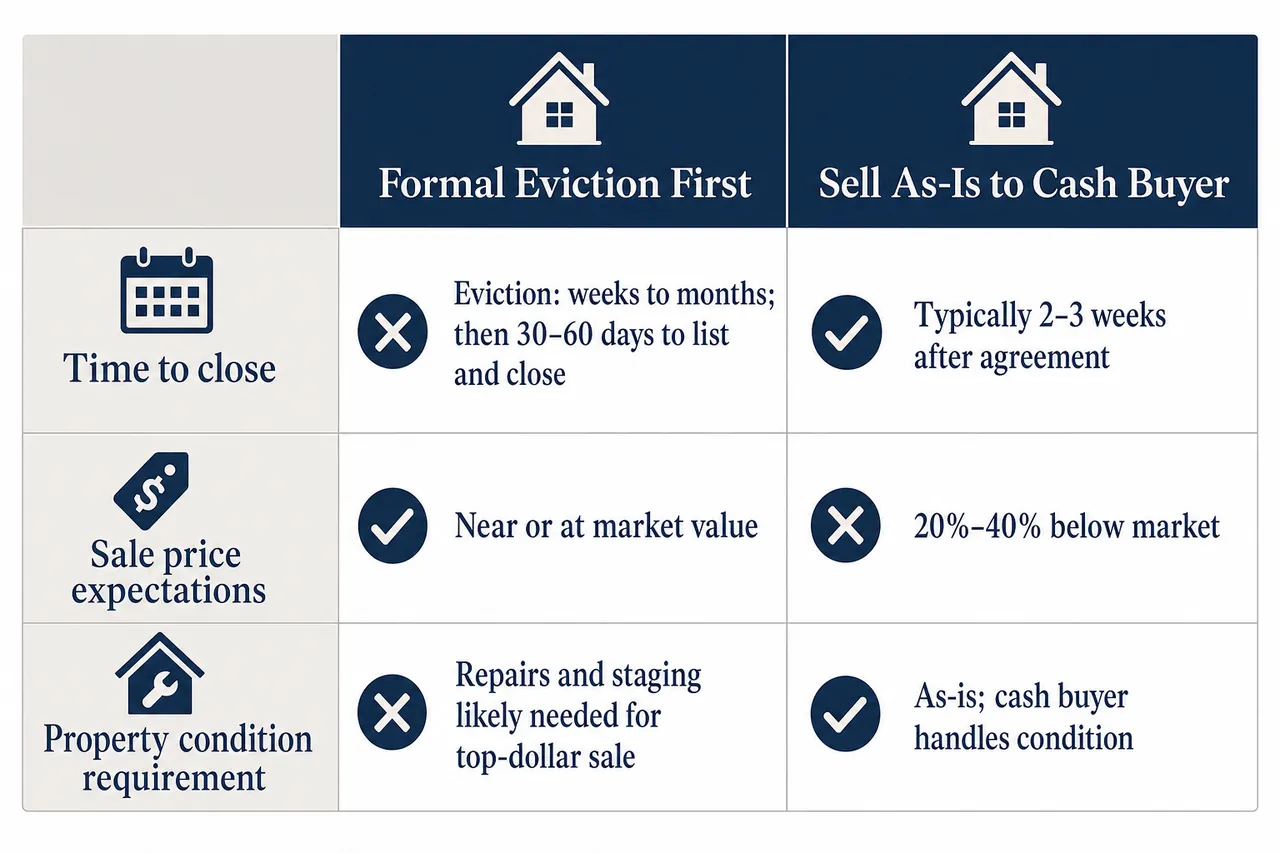
| Factor | Formal Eviction First | Sell As-Is to Cash Buyer | Traditional Listing After Eviction |
|---|---|---|---|
| Time to close | Eviction: weeks to months; then 30–60 days to list and close | Typically 2–3 weeks after agreement | 30–90 days after eviction completes |
| Your legal/court costs | $100–$500 filing fees + $1,500–$15,000+ attorney fees depending on state and contest | None — buyer assumes occupant problem | Same as eviction column; costs already sunk |
| Sale price expectations | Near or at market value; U.S. median $429,100 (Aug 2026) | 20%–40% below market | Market value with standard agent commission |
| Monthly holding costs | Mortgage, taxes, insurance, utilities continue throughout eviction | Minimal — sale closes quickly | Continue until closing; at least 30–90 days post-eviction |
| Buyer financing available | No (while occupied); yes after eviction and cleanup | No — cash only for occupied property | Yes — conventional and FHA once vacant and repaired |
| Property condition requirement | Court process doesn't require repairs | As-is; cash buyer handles condition | Repairs and staging likely needed for top-dollar sale |
Calculating Your Break-Even Point
Start simple. Add your monthly holding costs: mortgage (principal and interest), property taxes (prorated monthly), homeowner's insurance, utilities you're maintaining, and a buffer for deferred maintenance or liability risk. Multiply by however many months your state's eviction will likely take, then add expected attorney fees. That's your total.
Now compare it to the discount you'd accept on an as-is cash sale. If the discount is smaller than your projected carrying costs plus legal fees, the cash sale wins financially. You're not even factoring in the stress and uncertainty of litigation.
Some situations throw a wrench in this. Back taxes, for example, complicate everything. See Can You Sell a House With Back Taxes Owed? Your Options Explained to understand how those obligations affect your timeline and options.
Back to topSelling a House While Squatters Are Still Inside

Disclosure Requirements
You must fully disclose the occupancy status to any buyer. No exceptions. If you hide that squatters are living in the house, you're opening yourself up to fraud claims and a voided transaction after closing. A solid cash buyer? They expect this disclosure and they've already priced it into their offer. Traditional buyers won't work here—their lender will shut down the deal the moment they learn there's someone living inside with no lease, no agreement, nothing. That's why cash buyers are really your only realistic option for a property in this situation.
What Happens During Title Closing
Title companies close on squatter-occupied properties all the time. What they need from you is clear legal title. Your name has to be on the deed. There can't be any recorded adverse claim, lien, or competing ownership interest on the books. The squatter's physical presence doesn't cloud title—not in the legal sense. Title insurance covers ownership transfer, not possession.
After closing, the buyer owns the problem. They become responsible for the occupant and removal.
Your attorney needs to make sure the closing documents spell out the occupancy status explicitly. The buyer's assumption of that liability should be crystal clear in the paperwork. Title insurance underwriters might have specific requirements here, and your title officer will go through those with you during the closing process.
What Cash Buyers Do After They Purchase
Cash buyers who specialize in occupied properties have a playbook. First move? They try a "cash for keys" agreement. That means offering the occupant money to leave by a specific date—everything in writing. It's legal, it's often faster than court, and it keeps the property from getting trashed during a forced eviction.
When the occupant says no, the buyer launches the formal legal removal under state law. These experienced investors know the local courts. They have relationships with eviction attorneys. They've dealt with post-occupancy repairs before. That discount they're taking on your price? That's their payment for buying a problem they know how to solve.
Want to skip showings entirely while dealing with occupancy? Check out How to Sell a House Without Showings: Direct Sale Options Explained.
Back to topSpecific Situations: Inherited Properties, Foreclosure, and Abandoned Homes
Inherited Property With Squatters
You inherit a house. Then you discover someone's living in it — a former caretaker, a distant relative with no legal claim, or a stranger who moved in after the previous owner died. The state removal laws work the same way no matter how you got the property. Before your attorney files anything, they'll need to confirm that probate has wrapped up (or is on track) and that you actually have the legal authority to evict. Want the full picture on what comes next? Read Selling an Inherited House With Tenants: Legal Steps & Options.
Pre-Foreclosure and Foreclosed Homes With Squatters
Foreclosure doesn't erase squatters. A property goes through foreclosure with someone unauthorized living inside — the bank gets it, an investor buys it, or a third party picks it up at auction. That new owner still has to go through the legal removal process. The lender's REO department or the new owner has to file the right paperwork in the county where the house sits. Most foreclosure buyers don't expect this. And they're shocked at the cost.
Abandoned Properties Taken Over by Squatters
Empty houses attract squatters. A long vacancy basically broadcasts that nobody's paying attention. These abandoned properties also rack up code violations fast — overgrown yards, broken windows, doors that won't lock. That means municipal fines piling up on top of removal costs. If you own one of these properties, move quickly. The adverse possession clock keeps ticking, and code violations turn into liens that'll drag down your sale price later. Add deferred maintenance or hazardous materials into the mix, and your problem gets exponentially worse. Florida owners juggling multiple property issues should check out Can You Sell a House With Back Taxes Owed? Your Options Explained in Florida.
Back to topInsurance Implications of Squatter-Occupied Properties
Your standard homeowner's insurance policy almost certainly has a vacancy clause. Once a property sits empty for 30–60 days (check your specific policy—it varies), coverage gets limited or disappears entirely. A squatter-occupied property doesn't fit neatly into either category. Physically, someone's there. Legally? They have no right to be. Most insurers will treat it like vacancy anyway, and that's when claims get denied. Fire, water damage from neglect, intentional destruction—any of these could leave you uninsured.
Call your insurance company today. Don't delay on this one. Tell them exactly what's happening and ask which coverage (if any) still applies. Some carriers will sell you a specialized endorsement for vacant or non-owner-occupied properties. Ask specifically about this option.
And there's another risk you might not have considered: liability. If a squatter gets hurt on your property—a fall, an injury from something breaking—they could sue you in some jurisdictions, even without an official tenancy agreement. You're the owner. That exposure is real.
Get both your insurance agent and your attorney involved immediately. You need them coordinating, not working separately.
Back to topWhat to Do Next: Immediate Steps
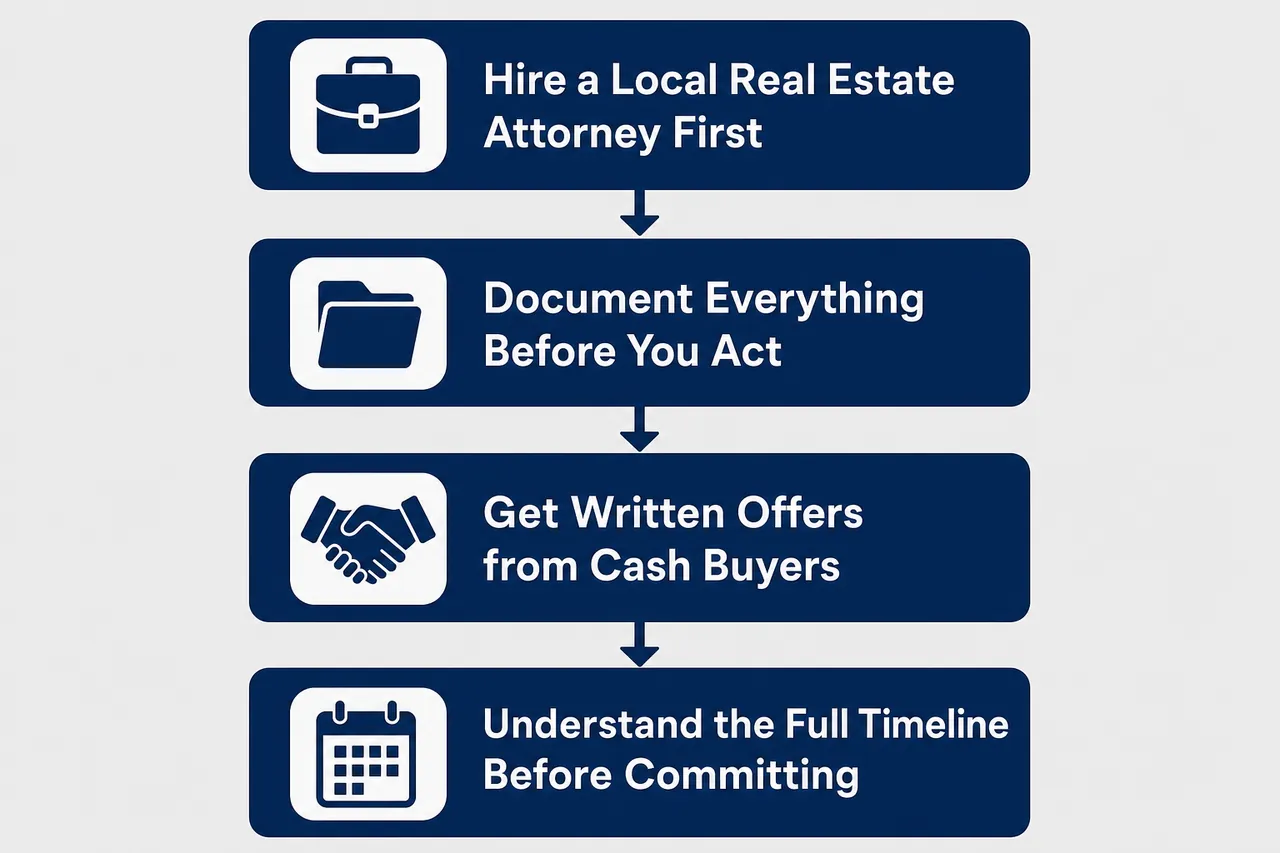
1. Hire a Local Real Estate Attorney First
This isn't optional. Squatter removal law shifts from state to state—sometimes even county to county. In cities like New York or Los Angeles, how the law actually works can depend on your specific neighborhood. You need an attorney who regularly handles evictions in your county. They'll know the current court backlog, understand how your local sheriff operates, and spot any expedited removal pathways you might qualify for. That upfront consultation fee? It's cheap compared to what one wrong move will cost you.
2. Document Everything Before You Act
Start gathering your ownership records, any emails or texts you've had with the occupant, photos of the property, utility bills, and copies of police reports you've filed. All of this becomes the backbone of your eviction filing. Any cash buyer doing their homework will ask for this documentation too.
3. Get Written Offers from Cash Buyers
Get preliminary offers in writing even if you're leaning toward eviction first. A serious cash buyer will give you a written, no-obligation number based on today's market and the fact that someone's currently occupying the place. Now you can actually do the math. What's your projected carrying costs plus legal fees? How does that stack up against the cash offer? This is where you stop guessing and start deciding based on real numbers, not emotion.
4. Understand the Full Timeline Before Committing
Ask your attorney for a timeline that isn't sugar-coated. What's the actual court backlog? Will the occupant fight the eviction? What does your state require for storing their belongings afterward? Get honest answers. Then stack that full timeline against a typical as-is cash sale—which usually closes in two to three weeks. Once you're looking at real numbers on both sides, your best option usually becomes obvious.
Back to topConclusion: Squatter Situations Are Stressful but Solvable
Finding someone living in your property without permission? It's disorienting. And it shakes your sense of control over what's legally yours. But here's what matters: the law is on your side. You own the property—full stop. It doesn't matter who's physically there. You can sell it occupied or vacant, and that choice comes down to money and timing, not legality. Your state's eviction timeline, your monthly holding costs, and your personal situation—those are what drive the decision.
Whatever you do, don't sit on this. And don't try to handle it yourself by locking them out or cutting utilities. That backfires fast, and you'll face counterclaims and legal penalties you don't deserve. The right path is unglamorous but essential: proper notice, court appearance, sheriff involvement. Some states move through this in weeks. Others take months. A local real estate attorney needs to be your first phone call—not your second one after you've already made mistakes. Once you have that legal guidance, it's just math and decision-making.
Back to topFrequently Asked Questions
Can I sell my house to a cash buyer while squatters are still living in it?
Yes. Cash buyers who specialize in distressed properties buy squatter-occupied homes all the time. You'll need to fully disclose the occupancy status. The buyer will price in the cost and risk of removing the occupant after closing. Expect offers in the range of 20%–40% below market value for squatter-occupied properties. Two to three weeks is typical for closing once you've reached an agreement.
Can a squatter eventually claim ownership of my property?
Adverse possession exists. But it requires years of continuous, open, hostile occupation — between 5 and 30 years depending on the state. Many states also require the claimant to have paid property taxes throughout. File for legal removal now and you'll interrupt that continuous-possession clock. Stay current on your property taxes, act fast, and adverse possession won't become a problem for you in the near term.
What's the difference between a squatter and a holdover tenant?
A holdover tenant had a valid lease that expired and stuck around without signing anything new. A squatter entered or occupied without any lease or permission whatsoever. This distinction matters because holdover tenants often get additional procedural protections under landlord-tenant statutes. Squatters with no colorable tenancy claim may qualify for expedited removal in states that have enacted those processes. Before you file anything, have your attorney verify which category you're dealing with.
Do I have to disclose squatters when selling my property?
Yes. You must tell every buyer — cash or financed — the true occupancy status. Failing to disclose unauthorized occupancy is a material omission. This can support fraud claims and potentially void the sale. The disclosure itself won't prevent the transaction. It's simply required so the deal holds up legally.
Will my homeowner's insurance cover damage caused by squatters?
It depends on your policy. Many standard homeowner's insurance policies contain vacancy clauses that reduce or void coverage after the property sits empty for a certain amount of time. Squatter-caused damage may get denied outright under a standard policy. Call your insurer right now and ask what's actually covered under your current plan. Find out whether a vacant or non-owner-occupied endorsement exists and what it costs. Have this conversation alongside your attorney consultation, not after something bad happens.
Back to top