

Selling Your House With Everything in It: Furniture, Contents, and More

Table of Contents
- Can You Sell a House with Everything in It?
- Your Main Options When Selling with Stuff
- How Contents Affect Your Home's Value
- Step-by-Step Preparation Guide
- Storage Solutions and Item Management
- Special Situations: Inherited Homes and Estates
- Working with Real Estate Professionals
- Legal Documentation and Contracts
- Tax Implications of Selling with Contents
- Common Mistakes to Avoid
- Timeline Expectations
- Conclusion: Finding the Right Path for Your Situation
- Frequently Asked Questions
Life doesn't always wait for you to pack. You're relocating on short notice. Or you're settling a loved one's estate. Maybe you've downsized after decades in the same home, or you're just exhausted by the idea of sorting through a lifetime of belongings. So here's the question that keeps you up at night: can you just sell the house with everything in it? The short answer is yes — and more sellers are choosing this route than you might expect. But here's the thing: the process involves more nuance than simply handing over the keys. From legal definitions and contract language to pricing strategy and buyer psychology, we'll walk you through every step of selling a home with its contents included.

Can You Sell a House with Everything in It?
Understanding What 'Selling with Contents' Really Means
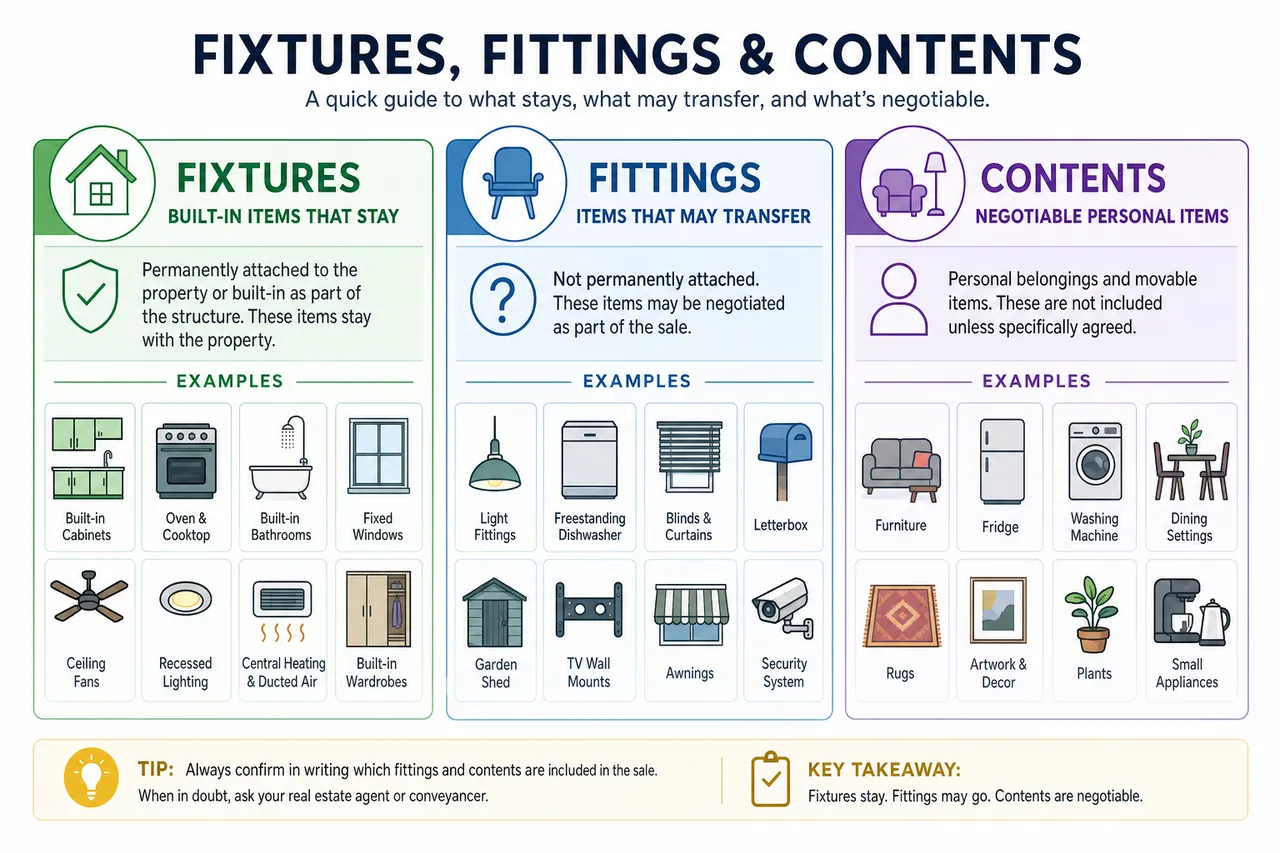
Yes, you can sell a house "with everything in it." It's a legally valid option — and it's becoming more common. But here's the catch: you need to know exactly what "everything" means in the eyes of the law. Real estate law splits the stuff in your home into three distinct categories, and each one gets treated differently when you sell.
Fixtures are bolted down, built in, or permanently attached to your home's structure. Built-in shelving. Your HVAC system. Plumbing. Ceiling light fixtures. Wall-to-wall carpet. In almost every state, these automatically transfer to the buyer unless your contract specifically says they don't.
Fittings — sometimes called semi-fixtures — sit somewhere in between. They're attached to your home, but you could pull them off without destroying anything. Think freestanding appliances, curtain rods, bathroom mirrors, and certain light fixtures. Whether the buyer gets these? That's up for negotiation in your contract.
Contents are your personal stuff. Furniture. Paintings. Your clothes. Kitchen items. Tools. Collections. The law assumes these stay with you unless you explicitly write them into the sale agreement.
| Category | Examples | Transfers Automatically? |
|---|---|---|
| Fixtures | Built-in cabinets, HVAC system, plumbing, ceiling fans, hardwired lighting, built-in bookshelves | Yes — unless excluded in writing |
| Fittings | Freestanding appliances, curtain rods, bathroom mirrors, garage door openers, storage sheds | Negotiable — depends on contract language |
| Contents | Furniture, artwork, clothing, kitchenware, tools, decorations, vehicles, collections | No — must be explicitly included in contract |
Legal Considerations and Regulations
No federal law stops you from including contents in your sale. But state and local laws? They do dictate how you document everything. Most states require you to disclose the condition of appliances and other items you're including. And if you're selling an estate as an executor or administrator, you've got fiduciary duties that might limit which items you can sell with the house versus distributing to heirs or selling separately.
Rules vary by state. Some have special forms just for listing personal property in a real estate sale. Others handle it through the purchase and sale agreement. Your real estate attorney or agent knows your local requirements — lean on them. Does the estate require probate court approval? Then a judge may need to sign off on the sale, and items might need to be formally inventoried and appraised before anything transfers.
Back to topYour Main Options When Selling with Stuff
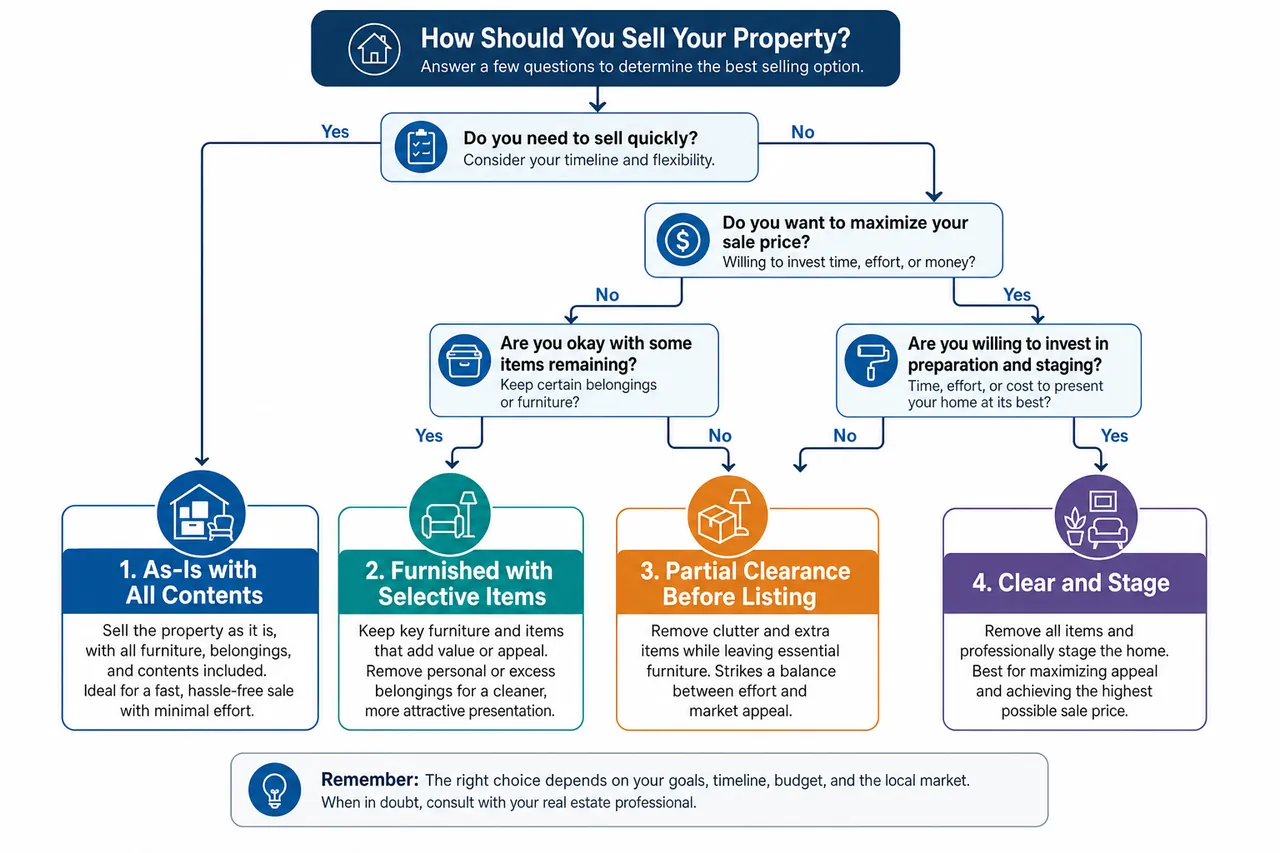
Once you've figured out what you're actually dealing with, you've got four main paths. Cost, timeline, and who'll show up to buy — they're all different depending on which route you pick.

| Option | Timeline to List | Upfront Cost | Buyer Pool | Price Impact | Best For |
|---|---|---|---|---|---|
| Sell As-Is with All Contents | Days to 1–2 weeks | Minimal | Narrower (investors, cash buyers) | Often below market | Inherited homes, urgent relocations, estate situations |
| Sell Furnished (Selective Contents) | 1–3 weeks | Low to moderate | Moderate (investors, vacation buyers, relocators) | Neutral to slight premium | Vacation homes, rental properties, fully-furnished lifestyle buyers |
| Partial Clearance Then List | 2–6 weeks | Moderate (disposal + storage) | Broader | Closer to market value | Sellers with some time and mixed-quality contents |
| Full Clearance and Stage | 4–10 weeks | Higher (clearance + staging) | Widest | Best potential price | Sellers maximizing return with time and resources |
Option 1: Sell the House As-Is with All Contents
This one requires the least work from you. You list the property — or sell it outright — and leave everything exactly where it sits. The buyer gets the house and every single thing in it, no exceptions. Maybe you're emotionally drained. Maybe you live three states away. Or maybe you're dealing with time pressure or a physical limitation that makes sorting through decades of stuff impossible.
Cash buyers and as-is home buying companies are built for this. They know how to evaluate a property that's full of unknown quantities, and they're not intimidated by it.
Now, the catch: you'll almost always sell below market value. A house stuffed with unknown-quality belongings, potential mess, and deferred repairs simply won't fetch what a cleared, staged property would. But here's what matters — once you subtract the cost of clearing that house yourself, plus the storage fees, the emotional toll, and the lost weeks? Sometimes the net difference isn't as bad as you'd think. Especially in estate situations.
Option 2: Sell as Furnished with Selective Contents
Think curated, not cluttered. You keep the nice furniture and household items that look intentional. Out go the personal documents, photos, valuables, and anything with sentimental weight. This approach is perfect for vacation properties, rental homes, and places that genuinely feel turnkey.
Who buys this way? Someone relocating from out of state who wants to move in Monday. An investor looking for a move-in-ready rental. These buyers pay a premium for convenience. For the full breakdown on making this work, check out our guide on selling a house with furniture included. And if you want to know what buyers actually respond to, here's what the data shows.
Option 3: Partial Clearance Before Listing
This is the middle ground. You pull out the junk, the personal stuff, and anything valuable. The good neutral furniture? Leave it. It actually helps people see themselves living there. An estate sale company can handle selling off items that have real value before you ever list.
You'll get more buyer interest than Option 1 and you'll spend less time than Option 4. That's the appeal.
Option 4: Clear Everything and Stage
The traditional route hits all three markers: longest timeline, highest cost, best price. Everything leaves the house — into storage, to donation, sold off, or disposed of. Then either a professional staging team comes in, or you present the space neutrally and clean.
This takes four to ten weeks and real money upfront. But it pulls in the widest buyer pool and typically gets you the closest to true market value.
Back to topHow Contents Affect Your Home's Value
Does Including Furniture Increase or Decrease Value?
Here's the truth: it really depends. Quality matters. Your buyer profile matters more. A luxury vacation home furnished with high-end pieces? That furniture can actually add value and let you ask for a premium. But a suburban family home packed with worn-out, mismatched furniture? That's not an asset — that's a red flag. Buyers see a cleanup project, not a bargain.
Now, here's what banks care about: they only appraise the real property — your house and the land it sits on. Furniture is personal property, and it can't be financed as part of a mortgage. That's the critical detail. If you've padded your asking price to account for furniture and it doesn't appraise at that number, the deal dies. The lender won't let the buyer borrow against those couches.
Pricing Strategy When Selling with Contents
The smartest move? Price your home at fair market value for the real estate itself. Then handle the furniture separately — either list it as an add-on in the contract or mention it as a bonus. "All furnishings included" costs you nothing to say and can push buyers toward making an offer faster without tangling up the appraisal.
You're selling into a market where the median existing home price hit $440,600 in June 2026. Buyers are stretched thin. And a furnished home? That moves faster. It's especially powerful for investors and people relocating for work — they want to walk in and live there immediately.
Valuation of Specific Items
Some furniture isn't just furniture. Antiques, fine art, jewelry, coin collections, designer pieces — these deserve a professional appraisal before you decide anything. You need to know what they're actually worth. Then you can choose: include them in the sale, sell them separately, or keep them. Items that matter only to you — family photos, heirlooms, personal documents — get removed before listing. Always.
Back to topStep-by-Step Preparation Guide
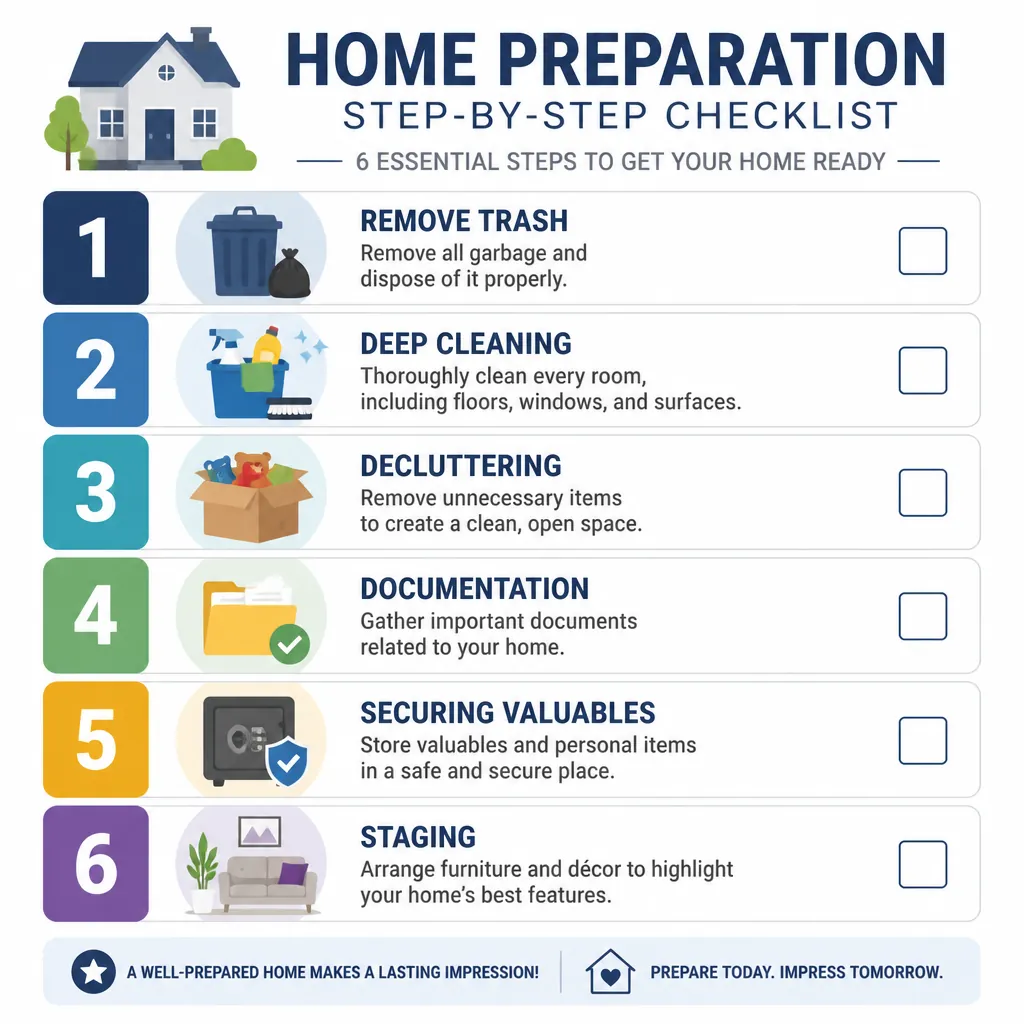
Remove Trash and Hazardous Materials First
Start here. Old paint cans, solvents, pesticides, and medications can't just go in a regular dumpster — your municipality has specific hazardous waste programs for this stuff. Toss them the wrong way and you're looking at liability issues that'll tank your sale the moment a buyer's inspector spots something concerning. Got a lot of junk piled up? A junk removal service or roll-off dumpster is usually your most cost-effective move for clearing it all out.
Deep Clean and Address Needed Repairs
You're selling as-is, sure. But a clean home tells buyers you actually cared for the place — and it stops them from immediately demanding a discount just out of spite. And here's what really matters: obvious safety problems like broken steps, exposed wiring, or missing handrails become your legal obligation to disclose. Want to know exactly what electrical issues you have to tell buyers about? Our guide on selling a house with electrical problems walks you through disclosure requirements and what options you actually have.
Declutter to Maximize Appeal
Even if furnishings stay, you need to cut ruthlessly. Remove family photos, that oversized sectional that makes the living room feel like a shoebox, and anything else so personal that buyers can't picture their own life happening there. Better photos. Better showings. Better buyer perception.
Document Everything in Writing
Write it down. Create a detailed room-by-room inventory of every item included in the sale, note each piece's condition, and photograph anything significant. This inventory becomes part of your purchase contract — it's what actually protects both of you from messy disputes after closing. You'd be surprised how many real estate fights happen because one person said "all furnishings" and the other person had a very different definition of what that meant.
Secure Valuables and Personal Documents
Before the first showing happens, get these out of the house: financial documents, tax records, passports, Social Security cards, prescription medications, jewelry, firearms, cash. Don't leave them lying around thinking a contract will protect you. It won't. These belong somewhere safe — not in a home where strangers are walking through.
Back to topStorage Solutions and Item Management

You've sorted through what stays and what goes. Now comes the harder part: actually getting the stuff out of your house. You've got several paths forward — storage, estate sales, donations, or the dump. Most people end up mixing and matching these options.
Estate Sale Companies
Have a lot of things worth selling? An estate sale company handles everything from start to finish. They'll price your items, advertise the sale, run it, and send you the money. But here's what it costs: according to 2026 data from EstateSaleFinder, you're looking at a commission between 30%–50% of what sells, with most companies landing around 35%–40%.
That sounds steep. Yet the average estate sale brings in more than $18,000 in gross proceeds. And when you've got a full house? Even after the commission, you could pocket real money — money that helps cover repairs or eating into closing costs.
Renting Storage Units and Portable Storage Options
Sometimes you need to keep things but get them out of the way while the house is on the market. Storage units work. So do portable containers that show up at your door, get filled at your speed, then get hauled away to a facility.
Storage prices jump all over the place depending on where you live and how big the unit is. Get quotes from at least two or three places, and don't forget to factor storage costs into your timeline. Portable storage? The real advantage is you load it whenever you want, then grab your stuff after you've moved into the new place.
Donation and Recycling Programs
Not everything that won't sell is worthless. Habitat for Humanity's ReStore program takes furniture, appliances, and building materials. Goodwill and Salvation Army will grab most household goods. Local charities do too.
And here's the bonus: donations to legitimate nonprofits can mean a tax deduction. But talk to your tax advisor first about whether you can actually claim it. The rules depend on what you're donating and how much it's worth, plus your own tax situation.
Back to topSpecial Situations: Inherited Homes and Estates
Inherited properties are emotionally complex. They're logistically complex too. If you've recently lost a parent or family member and you're managing their home, you're dealing with grief, family dynamics, legal obligations, and practical decisions all at once. Most people find this overwhelming — and that's completely normal.
Emotional and Practical Considerations
Before you liquidate anything, give yourself and other heirs time to identify items with real sentimental value. Rushing into decisions—selling everything immediately, throwing out items without a second look, or letting the house sit indefinitely—is surprisingly common. And people regret these moves.
Here's what works: hold a structured family meeting where everyone walks through the home and claims meaningful items before any sale or liquidation happens. This prevents conflict and ensures important pieces end up with the right people instead of ending up in a dumpster.
Need more guidance on the legal side of selling a parent's home? We've got state-specific resources for that: selling an elderly parent's home. We also have dedicated guides for California, Florida, Washington, Tennessee, and Indiana.
Estate Sale vs. As-Is Sale
When you've got a fully-stocked inherited home, you're looking at two main paths. First option: run an estate sale to liquidate the contents, then sell the empty house. Second option: sell the whole thing as-is to a buyer who'll handle what's inside themselves.
Which one makes sense for you? It depends on how much valuable stuff is actually there, how much time you've got, and whether you realistically have the bandwidth to manage an estate sale. A professional estate liquidator can give you honest numbers about what a sale might actually generate before you commit to going that route.
Legal Requirements for Estates
Properties going through probate are different. The executor typically has the authority to sell the real property, but some states require court approval depending on the sale terms. And here's what people often miss: the estate's contents may need to be inventoried for probate purposes regardless of how you ultimately dispose of them.
Before you list anything or shake hands on an offer, talk to a probate attorney in the state where the property sits. They'll walk you through what's actually required so you don't stumble into problems later.
Back to topWorking with Real Estate Professionals

Choosing an Agent Experienced with Furnished Sales
Here's the thing: not every real estate agent knows how to sell a furnished home. When you're interviewing agents, dig into specifics. Ask them about their experience marketing properties with contents included. How do they handle inventory documentation? What kind of buyer profiles do they typically attract? An agent who spends all their time selling move-in-ready suburban homes might not have the right network or marketing strategy for your furnished estate sale or as-is investor property.
Commissions matter here, especially when you're calculating what actually lands in your pocket. If you go the listing agent route, you're looking at an average of 2.88% as of 2026. And when a buyer's agent gets involved too? Total commissions typically fall between 4.50% to 6.20%, with most averaging around 5.70%. That percentage comes straight out of your proceeds, so factor it in when you're weighing a traditional listing against other options.
Cash Buyers vs. Traditional Buyers
Here's the fundamental problem with mortgage-financed buyers. Banks will finance the house itself, but they won't finance the furniture. Period. So if you're trying to roll the contents into your asking price, you've just shrunk your buyer pool dramatically — you're really only looking at cash buyers or someone willing to pay appraisal value for the home and then negotiate the furniture separately.
Cash buyers get this. Whether they're individual investors or as-is home buying companies, they don't have appraisal constraints hanging over their heads. They move fast. And they're already comfortable buying properties exactly as they sit. Want to know the speed difference? Traditional financed sales take 45–60 days to close. Many cash buyers can close in 7–14 days.
As-Is Home Buying Companies
This is where companies that buy homes directly for cash actually shine. They're built for situations exactly like yours. They'll evaluate your place quickly, give you an offer that covers both the building and what's inside, and close when you need them to. You won't get full market value — that's the trade-off. But you also skip the commission, you don't pay for repairs, and you're not spending months scheduling showings and dealing with inspections. If you're working against a deadline or you just can't manage the traditional sale grind, this approach often makes the most sense.
Back to topLegal Documentation and Contracts
What Must Be in the Sales Contract
Selling with contents? Your purchase and sale agreement needs to go way beyond a standard real estate contract. Here's what you absolutely need:
- A specific list (or reference to an attached exhibit/inventory) of all personal property included in the sale
- A list of any items explicitly excluded — even if physically present in the home at closing
- Condition representations for significant items (appliances, mechanicals, major furniture)
- A clause specifying what happens if included items are damaged or go missing between contract signing and closing
- Clear language about who's responsible for removing any items the buyer doesn't want
Disclosure Requirements
Most states require you to disclose known defects in appliances and mechanical systems. That washing machine leaking? The refrigerator that won't hold temperature? You need to tell the buyer. Skipping this creates serious post-closing liability for you. And here's the thing: general "as-is" language doesn't let you off the hook in most states. It just means you're not promising to fix anything — not that you can hide known problems.
Creating Detailed Inventories
Vague descriptions invite disputes at closing. Don't write "all furniture." That's asking for trouble.
Instead, get specific: "Living room: gray sectional sofa (IKEA, 2022), glass coffee table, floor lamp; Dining room: six-chair oak dining set; Master bedroom: queen bed frame and headboard, two matching nightstands." That level of detail prevents arguments about what stays and what goes. On the same day you sign the contract, photograph every single item on your list. Keep those photos safe.
Back to topTax Implications of Selling with Contents
Here's the good news: if you're selling your primary residence, the IRS Section 121 exclusion probably applies to you. That means up to $250,000 in capital gains for single filers, or $500,000 for married filing jointly — as long as you've owned and lived in the home for at least two of the past five years. But here's the catch: this exclusion only covers the real property itself, not the furniture and personal items you're throwing in.
When you sell contents alongside the house, those items technically create their own tax situation. Most household furniture loses value over time, so if you're selling a couch you bought for $2,000 fifteen years ago, that loss won't help you on your taxes — personal property losses aren't deductible. And that's actually fine for most people. But if you own high-value items? Think art, antiques, or collectibles that have actually gained value. Those appreciate, and you could owe capital gains tax on them. Before you bundle those into the sale, talk to a tax professional about whether selling them separately makes more sense.
Your situation gets more complex if this wasn't your primary residence the whole time.
Did you rent out the property or use part of it as a home office? Depreciation recapture rules kick in. The building itself gets hit with up to 25% in 2026. Personal property like furniture or appliances you depreciated gets taxed at ordinary income rates — up to 37% in 2026 under Section 1245. The IRS classifies residential rental furniture and appliances as 5-year MACRS property, meaning you may have already claimed full depreciation on those items.
If you end up with gain that's larger than your exclusion allows, long-term capital gains rates apply. In 2026, you're looking at 0% for single filers with taxable income up to $49,450 (or $98,900 MFJ), 15% up to $545,500 single / $613,700 MFJ, and 20% above those thresholds. And if you're a high earner? You might also owe the 3.8% Net Investment Income Tax on gain above the exclusion if your modified adjusted gross income exceeds $200,000 (single) or $250,000 (married filing jointly).
This stuff's complicated. Talk to a tax professional about your specific numbers before you close.
Back to topCommon Mistakes to Avoid
- Vague contract language. "All contents" sounds simple. But without a specific inventory, you're asking for a dispute. List everything explicitly.
- Overpricing contents. Your grandmother's dining table might be priceless to you. Buyers and appraisers won't see it that way. Tack $30,000 onto your asking price for furniture? You'll likely kill the deal.
- Leaving valuables in the home. Don't wait until closing day. Jewelry, cash, financial documents, firearms, and medications need to come out before the first showing even happens.
- Skipping professional appraisals. Do you own genuine antiques, fine art, or collectibles? Guessing at value is a gamble you can't afford. A professional appraisal costs pennies compared to what you might lose by underselling or throwing items into the deal unnecessarily.
- Ignoring insurance gaps. Here's what catches people off guard: your homeowner's policy might not cover contents if the home's vacant or already under contract. Call your insurer before you list. This matters even more if closing will take months.
- Missing disclosure obligations. Selling as-is is not the same as selling without disclosure. Your state has specific rules. Know them.
Timeline Expectations
Your choice here makes a huge difference in how fast you'll get paid and move on. Let's break down what's realistic:
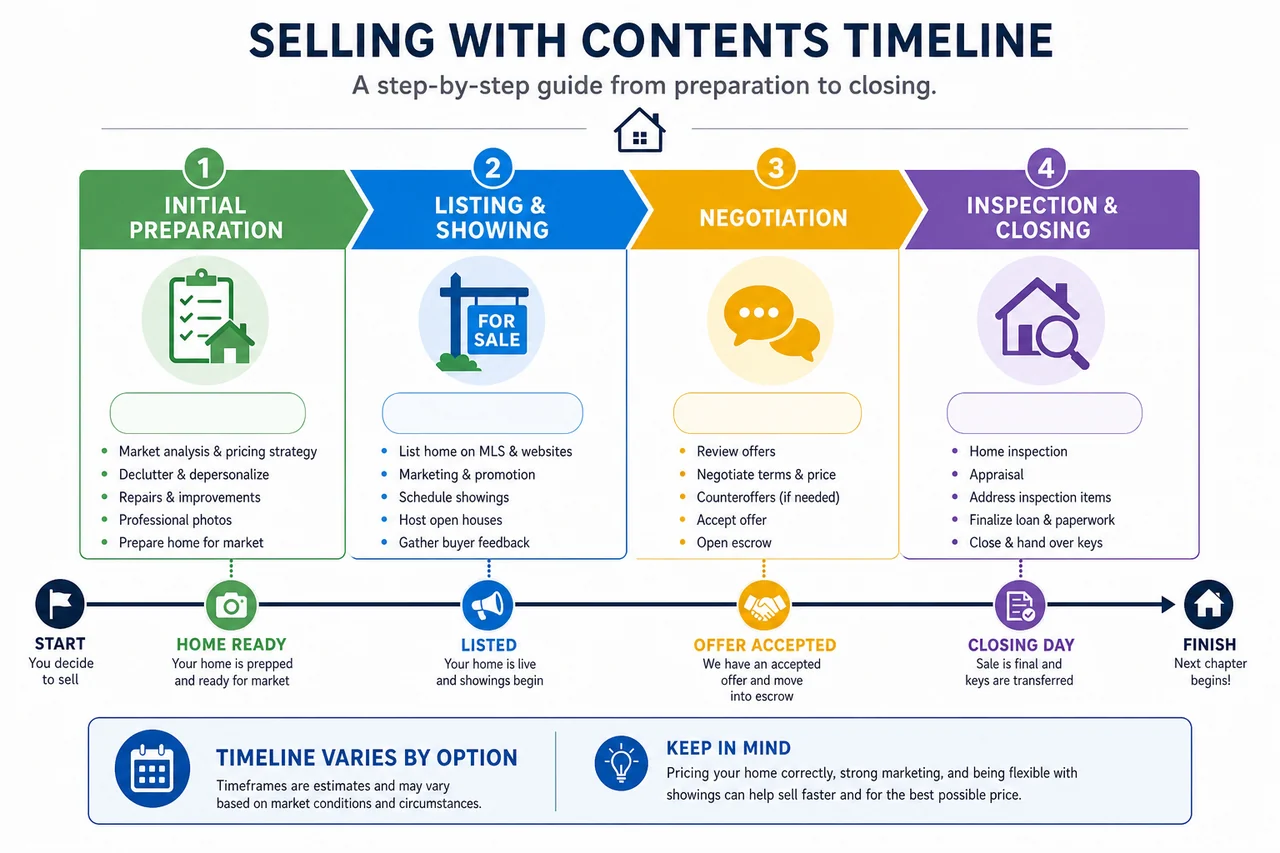
- Sell as-is to a cash buyer (all contents included): You could have an offer in days. Closing happens in as little as 7–21 days from acceptance. From the moment you decide to the moment money hits your account: 2–4 weeks.
- Sell furnished (selective contents, traditional listing): Allow 1–3 weeks to prepare and list the place. Then financing and closing take another 30–60 days. Total elapsed time: 6–12 weeks.
- Partial clearance then list: An estate sale or partial cleanout runs 2–6 weeks. Add the traditional listing and closing process—another 6–10 weeks. Total: 8–16 weeks.
- Full clearance and staged listing: Clearance, repairs, and staging take 4–10 weeks. Then listing and closing tacks on 6–10 more weeks. Total: 10–20 weeks or more.
Is time your biggest issue? Maybe you're relocating for work, facing financial pressure, or just emotionally exhausted by the whole thing. The as-is cash sale is your fastest exit—it's the most predictable route. But if you can wait 3–5 months and your real goal is walking away with the most money, a cleared and staged traditional listing almost always wins on price.
Back to topConclusion: Finding the Right Path for Your Situation
You can sell a house with everything in it. For many sellers, it's actually the smartest move. But it only works if you're honest about your options, your timeline, and what matters most to you. Managing an inherited estate? Relocating across the country in six weeks? Too overwhelmed to sort through thirty years of stuff? There's a real solution here for your specific situation.
Start by sorting what stays and what goes using the fixture, fitting, and contents framework we covered earlier. Then pick your selling approach—base it on how fast you need to move and how much money you need to make. Document everything. Pull out anything valuable before anyone steps foot in the house. And really think hard about whether a cash buyer makes sense for you, especially if getting it done quickly matters more than chasing top dollar.
The real cost of waiting?
Unsettled estates drain your energy. Vacant homes sit uninsured. Decisions get pushed off indefinitely. All of that costs you money and steals your peace of mind. Make your choice and act on it.
Back to topFrequently Asked Questions
Can I legally sell my house with all the furniture and personal belongings included?
Yes — you can. There's no law stopping you from selling a home with personal property included in the deal. But here's the catch: anything that isn't permanently attached to the structure has to be explicitly listed in your purchase contract. Personal property doesn't automatically transfer to the buyer just because it's sitting in the house. Work with a real estate attorney to make sure your contract spells everything out clearly and protects you both.
Will including furniture lower my home's sale price?
It really depends. High-quality furnishings? Those can actually add value, especially in vacation homes or investment properties. Dated couches and cluttered rooms? They typically turn buyers away from family homes. And here's a major problem: mortgage lenders won't finance personal property. So if you overprice the house to account for furniture, you'll run into appraisal issues that tank the deal. The smartest move is to price the actual house at market value and negotiate the contents as a separate addition.
How long does it take to sell a house with all its contents?
Speed depends entirely on your approach. Selling as-is to a cash buyer? You could close in 2–4 weeks. A traditional furnished listing usually takes 6–12 weeks from prep to closing. But if you decide to clear things out first, add another 4–10 weeks to that timeline. The full-clearance, full-staging approach typically lands somewhere between 10–20 weeks total.
What should I do with high-value items like antiques or jewelry?
Don't sell them as part of the house sale without knowing what they're worth. Get antiques, fine art, jewelry, collectibles, and firearms professionally appraised before you make any decisions. Never leave genuinely valuable items in the home during showings either. Depending on what you have, selling these pieces separately through an auction house, estate sale, or private buyer will almost always bring in far more money than lumping them into the home sale.
Do I have to pay taxes on the furniture and contents I sell with the house?
The IRS Section 121 exclusion covers capital gains on the real property — not on furniture or other personal items. Most household items are worth less when you sell them than when you bought them, so you're looking at a non-deductible personal loss anyway. Appreciated items like art or antiques? Those can generate taxable capital gains. And if you ever rented out the property or used it for business, depreciation recapture rules apply to both the structure and any furniture or appliances you depreciated. Talk to a tax professional before closing — this gets complicated fast, and you need advice tailored to your specific situation.
Back to top
