

Selling a House with Furniture Included: Pros, Cons, and How-To

Table of Contents
- Can You Sell a House with Furniture?
- What Items Should and Shouldn't Be Included
- Pros and Cons of Selling Furnished
- How to Price Furniture in Your Home Sale
- Step-by-Step Guide to Including Furniture in Your Sale
- Furnished vs. Vacant Sale: Which Is Better?
- Legal and Contractual Considerations
- Special Cases: When Selling Furnished Makes Sense
- Common Mistakes to Avoid
- Conclusion: Making the Right Call for Your Situation
- Frequently Asked Questions
Selling your house with furniture included can be a smart move. You'll simplify your move, attract more buyers, and potentially boost your sale price. But here's what catches most sellers off guard: it adds real complexity to the process. Whether you're relocating internationally, handling an estate sale, or just want to skip the moving truck entirely, selling a furnished home is totally legitimate — and increasingly common. This guide covers the legal requirements, pricing strategies, common pitfalls, and the step-by-step process to get it right.

Can You Sell a House with Furniture?
Legal Considerations and Contract Terms
Yes, you can sell a house with furniture. But here's the catch: the law treats furniture completely differently than the house itself. Your home's structure, the land it sits on, built-in cabinetry, and permanent fixtures? That's real property. The couch, dining table, and bedroom sets? That's personal property. And personal property doesn't automatically transfer to the buyer just because you're selling the house — not unless you spell it out in writing.
Why does this matter? Because a handshake deal or a casual conversation won't cut it. If you and the buyer agree over coffee that you're leaving the dining room set, but you don't document it in the purchase agreement, you're not legally bound to leave it. Neither is the buyer obligated to accept it. The only way furniture inclusion becomes enforceable is if both parties sign off on it in the purchase agreement or a separate addendum.
State laws complicate things further. Many states require a bill of sale when personal property above a certain dollar amount changes hands. Some have disclosure requirements if the furniture total is substantial. Before you close, talk to a local real estate attorney — especially if you're including high-value pieces.
What's Typically Included vs. Excluded
Here's the default rule: real estate contracts transfer only real property. That means furniture, many appliances, and personal belongings stay with you unless the contract explicitly says otherwise. The clearer you are about what stays and what goes — in writing — the smoother your closing will be.
Back to topWhat Items Should and Shouldn't Be Included
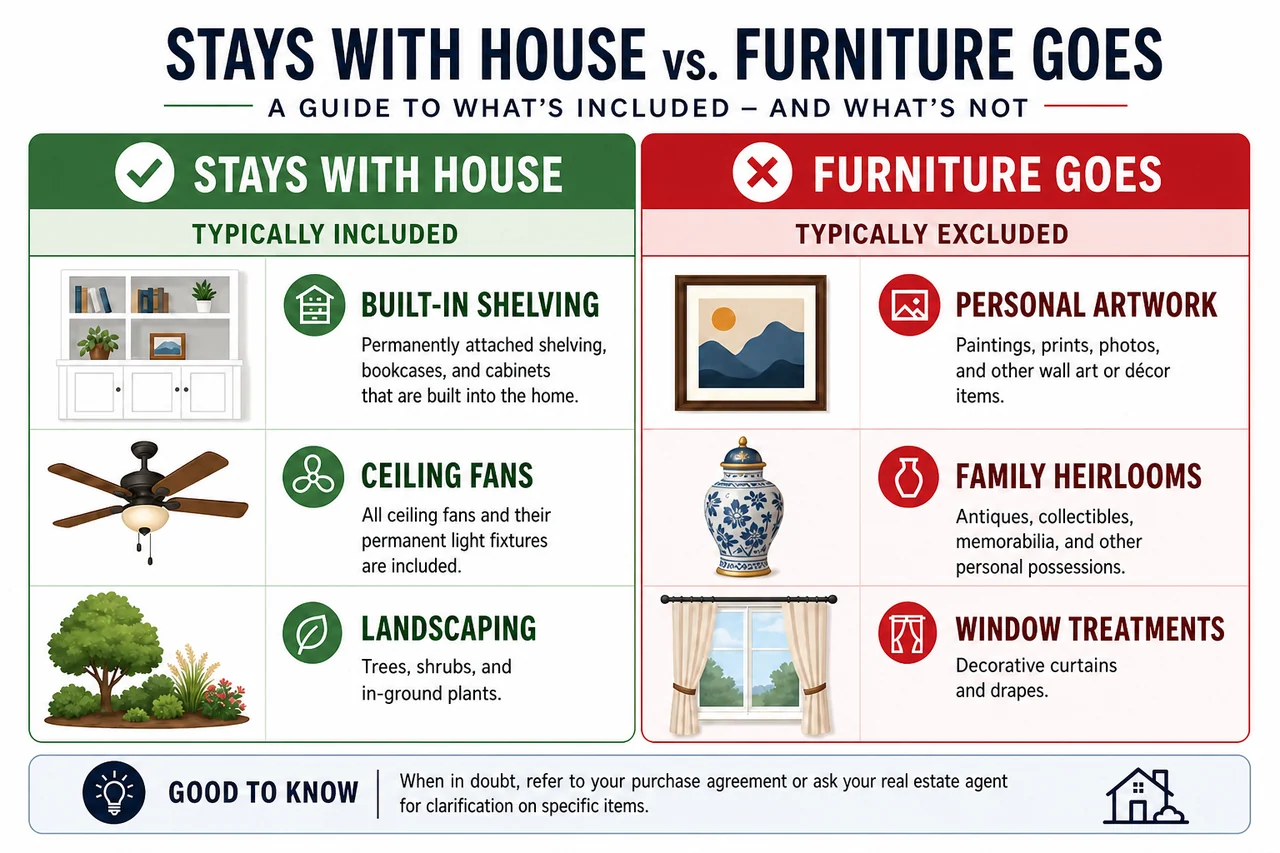
Furniture and fixtures cause more real estate conflicts than you'd think. Buyers assume something stays. Sellers assume they're taking it. And suddenly you've got a major problem on closing day.
Here's what you actually need to know:
| Category | Typically Stays with the House | Typically Goes with the Seller | Grey Area (Negotiate) |
|---|---|---|---|
| Cabinetry | Built-in kitchen cabinets, closet organizers | Freestanding bookshelves, armoires | Murphy beds, modular shelving |
| Appliances | Built-in ovens, dishwashers (varies by state) | Portable appliances, refrigerators (some states) | Washer/dryer, garage refrigerators |
| Window Treatments | Permanently installed blinds, curtain rods | Decorative curtains, drapes | Plantation shutters, custom window treatments |
| Lighting | Hardwired fixtures, ceiling fans | Plug-in lamps, portable lighting | Specialty pendant lights, chandeliers |
| Furniture | Built-in benches, window seats | All freestanding furniture by default | Any furniture explicitly negotiated into the deal |
| Décor & Art | Murals painted on walls | Artwork, collectibles, heirlooms | Mirrors, large decorative pieces |
| Outdoor Items | Permanently installed gazebos, in-ground trampolines | Patio furniture, grills, potted plants | Above-ground pools, storage sheds |
The basic rule? If it's bolted down, wired in, or screwed to the house, it stays. If you can grab it and walk out the door, it goes with you—unless you've written something different into the contract. And here's the critical part: anything with sentimental value, family heirlooms, or collectible worth needs to be explicitly excluded from your furniture agreement.
Back to topPros and Cons of Selling Furnished
Advantages for Sellers
- Reduced moving costs: Long-distance moves run $2,000 to $5,000 on average — sometimes way more. Leave the furniture behind and you're cutting out a huge chunk of that bill.
- Faster sale in the right markets: Furnished homes sell quicker, especially vacation rentals and urban condos. Buyers love the turnkey appeal — they can literally move in tomorrow.
- Higher perceived value: Good furniture makes your home photograph better and feel more inviting at open houses. That can justify asking for more money.
- Simplified logistics for international moves: Shipping a bedroom set overseas? That's tens of thousands of dollars you don't have to spend. Selling it with the house usually makes way more sense financially.
Disadvantages and Risks
- Appraisal complications: Lenders require furniture to be valued separately from the actual home. Here's the problem: if the appraisal doesn't support that inflated price, your deal collapses.
- Financing restrictions: Not all loan programs allow this. FHA and VA loans, specifically, have strict caps on how much of the purchase price can go toward personal property.
- Condition disputes: Between signing the contract and closing day, buyers claim furniture got damaged. And without a detailed inventory with photos documenting condition, you've got almost no way to defend yourself.
- Overpricing risk: Most sellers overestimate used furniture value. That $3,000 sectional? It's worth maybe $300 to $600 after a few years of living with it.
- Narrower buyer pool in some markets: In suburbs, buyers want a blank canvas for their own style. Your carefully chosen furniture might actually turn people away instead of attracting them.
Market Conditions That Favor Furnished Sales
Vacation rental markets, urban investment properties, international buyer markets — these are where furnished sales shine. Estate sales too, where clearing the house is just practical reality. In your typical suburban neighborhood? The picture gets murkier. It all hinges on furniture quality and condition.
Back to topHow to Price Furniture in Your Home Sale

Here's what most people get wrong: they think their used furniture is worth way more than it actually is. Pricing furniture accurately for a home sale is trickier than it sounds. Furniture depreciates fast. You're looking at losing 20–30% of the value in that first year alone, then it keeps dropping from there.
| Furniture Type | Avg. New Cost | Value After 2–3 Years | Value After 5–7 Years | Value After 10+ Years |
|---|---|---|---|---|
| Bedroom Set (Queen) | $1,500–$4,000 | 40–50% of purchase price | 20–30% of purchase price | 10–15% or antique value |
| Sectional Sofa | $1,200–$3,500 | 30–40% of purchase price | 15–25% of purchase price | 5–10% or negligible |
| Dining Table & Chairs | $800–$3,000 | 40–55% of purchase price | 25–35% of purchase price | 10–20% or antique value |
| Entertainment Center | $600–$2,000 | 20–30% of purchase price | 10–15% of purchase price | Minimal value |
| Home Office Desk/Chair | $400–$1,500 | 35–50% of purchase price | 20–30% of purchase price | 10% or less |
| Outdoor Patio Set | $500–$3,000 | 30–40% of purchase price | 15–20% of purchase price | Minimal unless high-end |
Do you have antiques, designer pieces, or custom built-ins? Those deserve a professional appraisal. A certified personal property appraiser documents fair market value and protects both you and the buyer. Your real estate agent gets a credible number to work with too.
Don't overlook the tax angle. When you sell furniture as part of a home sale, the IRS treats it as a separate transaction from the real estate itself. That means the gain or loss on personal property gets reported separately — it won't qualify for the home sale exclusion under Section 121. Before closing, especially if your furniture has real value, talk to a CPA or tax advisor. And here's another wrinkle: including furniture in the sale price can flag local property tax assessments in some areas. Assessors sometimes question unusually high sale prices when they're compared to similar homes in your neighborhood.
Back to topStep-by-Step Guide to Including Furniture in Your Sale
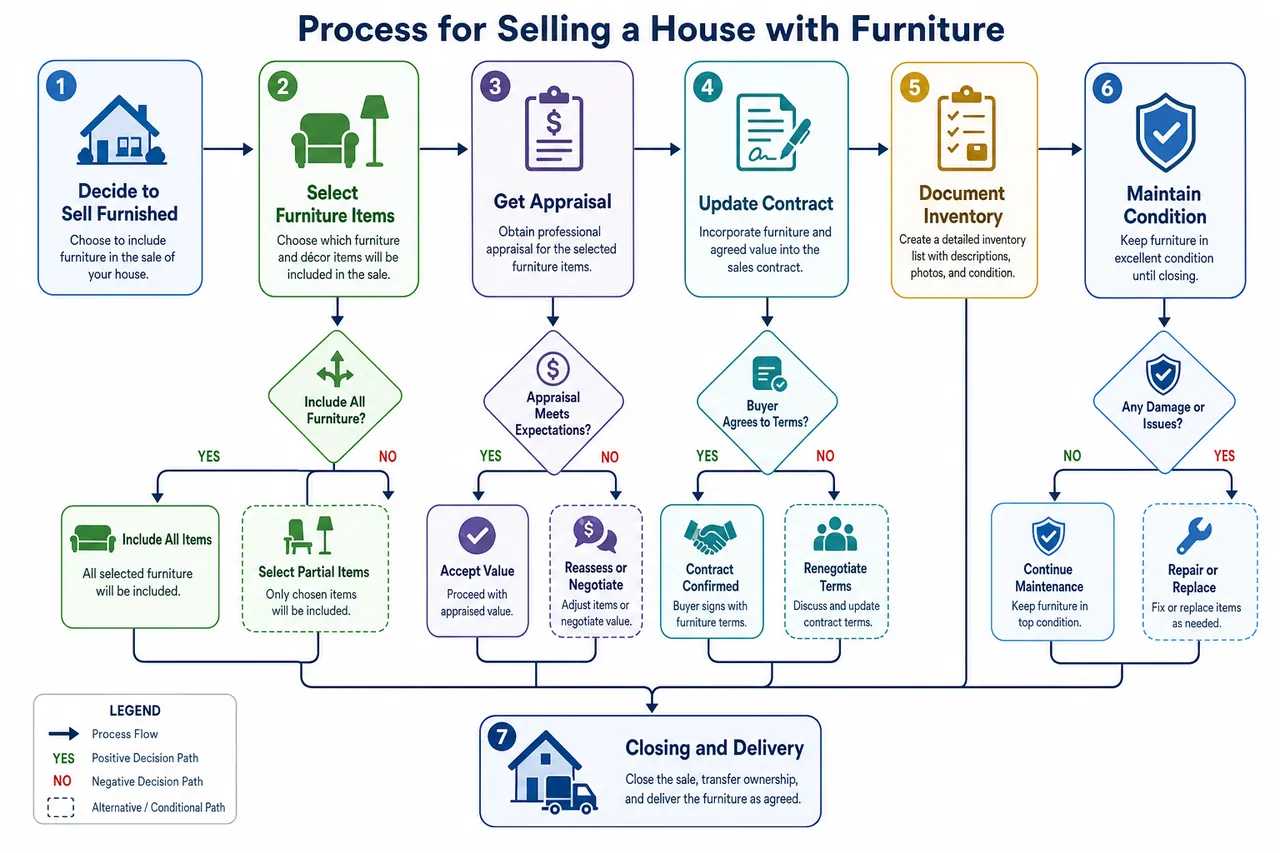
- Decide what you're including early. Walk through your home before you list it. Make a preliminary list of furniture you're actually willing to leave behind. Why? Because this prevents confusion during negotiations and lets your listing agent market the home accurately.
- Create a detailed inventory with photos. Document every piece — make, model if you know it, approximate age, what you paid, condition. Take multiple photos of each item from different angles. This protects you if disputes come up at closing about condition.
- Get professional valuations for high-value pieces. Antiques, designer furniture, and custom pieces need appraisals before you put a dollar value on them in the contract.
- Negotiate furniture separately from the home price when possible. Lenders prefer this. Sometimes they require it. A $400,000 purchase price with $10,000 in furniture listed separately is cleaner than a $410,000 purchase price with furniture bundled in. And the lender's going to care about that distinction.
- Document everything in the purchase agreement or addendum. Be specific about each piece — the name, where it's located, what condition it's in. "Gray L-shaped sectional sofa, 2019, good condition, main floor living room." Not "all furniture in the living room." Vague language invites disputes.
- Maintain furniture in the agreed condition through closing. It's yours to protect until the keys change hands. Don't remove items from your list. Don't let damage happen through neglect. And don't use things in ways that could damage them between contract and closing.
- Clarify delivery and handover logistics in writing. Will the furniture stay in place at closing? Do you need to make arrangements to move it? Include contingencies for any damage the buyer discovers during the final walkthrough.
- Do a pre-closing walkthrough with the buyer. Most transactions have this. With furnished sales, it's essential. Let the buyer verify that everything on your list is actually there and matches the condition you described before you close.
Furnished vs. Vacant Sale: Which Is Better?
| Factor | Selling Furnished | Selling Vacant |
|---|---|---|
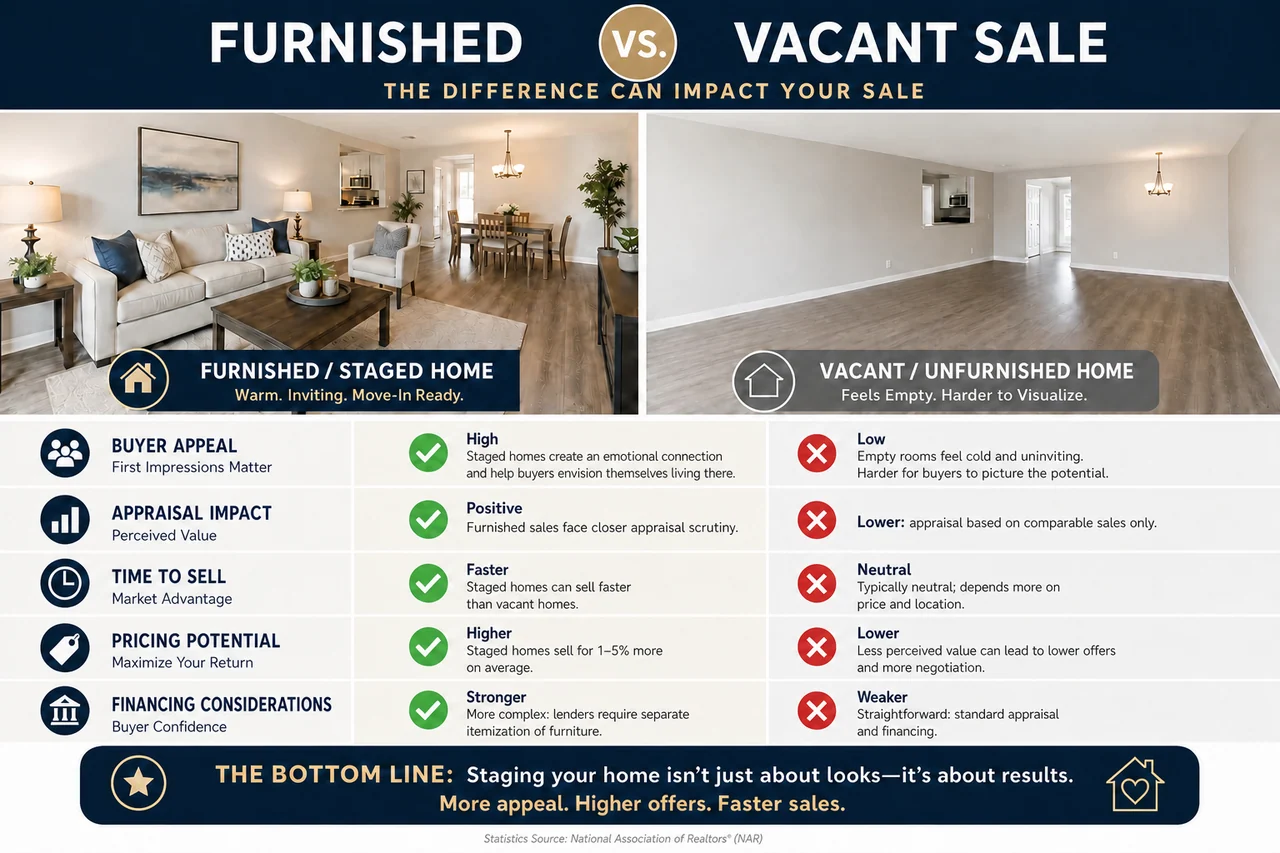
| Photography Appeal | Typically stronger — rooms look lived-in and proportional | Can look cold or smaller without furniture to anchor space |
| Buyer Imagination | Limited — buyers see your style, not theirs | Full — buyers can visualize their own furniture and décor |
| Appraisal Risk | Higher — appraisers scrutinize inflated prices | Lower — appraisal based on comparable sales only |
| Financing Complexity | More complex — lenders require separate itemization | Straightforward — standard appraisal and financing |
| Seller Moving Costs | Lower — less to move | Higher — full move required |
| Best Market Fit | Vacation rentals, urban condos, investment properties, estate sales | Suburban family homes, traditional residential markets |
| Time on Market | Faster in right markets; slower in wrong ones | Typically neutral — depends more on price and location |
| Buyer Pool | Investors, international buyers, vacation home seekers | Broader — appeals to most traditional buyers |
Here's the thing: professional home staging often beats selling with your own furniture. A stager brings in rented pieces selected to make your home shine. And it works. Staged homes sell for 1–5% more on average, according to the National Association of Realtors.

Does your current furniture look worn, dated, or just plain unphotogenic? Then staging or going vacant might be your answer in a traditional residential market.
Back to topLegal and Contractual Considerations

Here's what trips up most sellers: your standard purchase agreement only covers the house itself, not the furniture inside it. Want that couch or dining table to transfer to the buyer? You'll need explicit language in the contract or a separate personal property addendum that lists everything included, describes the condition, and agrees on value.
These are the legal points you can't skip:
- Explicit itemization: Name every single piece. Don't write "the furniture" or "all living room contents." Courts won't enforce vague language like that — and neither will arbitrators.
- Condition disclosure: Write down what condition each item is in on the day you sign. Is there a stain on the sofa? A wobbly table leg? Document it. This stops the buyer from claiming you damaged it after signing.
- Responsibility for damage before closing: Who pays if something breaks between signing and closing? Make it clear. Generally, it's the seller's responsibility until the deal closes.
- Contingencies for missing or damaged items: What happens if the buyer shows up at closing and a piece is gone or trashed? Your contract should spell out the remedy — a price reduction, replacement, or the buyer's right to walk away.
- Insurance coverage: Your homeowner's insurance covers your personal property right up until closing. But check with your insurer to confirm. The buyer's coverage probably doesn't start until after the deed is transferred — that gap matters.
And here's the thing: each state plays by different rules. Florida and California have established conventions for personal property addenda, but plenty of other states are all over the map. Get a licensed real estate attorney in your state involved, especially if you're selling significant furniture value. Dealing with an estate sale situation? Check out our guides on selling your elderly parent's home in Florida or handling a home sale in California — they'll give you the specific legal landscape in your state.
Back to topSpecial Cases: When Selling Furnished Makes Sense

Investment and Rental Properties
Here's what surprises most sellers: furnished rental properties pull in 15–30% higher monthly rents than unfurnished ones, especially in busy urban markets. When you're selling an investment property, keeping the furniture in the deal preserves that premium for the next owner. Plus, investors hunting for turnkey rentals will be far more interested in a property they can rent out immediately.
Vacation Homes
Vacation homes are basically the poster child for furnished sales. Think about it—buyers want to show up with nothing but a suitcase and start enjoying the place. And here's the real kicker: furnished vacation homes photograph infinitely better on Airbnb and VRBO. That translates to faster bookings and more income for whoever buys from you.
International Relocations
Moving overseas? Shipping furniture almost never makes financial sense. A single container from the U.S. to Europe or Asia runs $5,000–$20,000 minimum, plus you're looking at months stuck in storage. Selling the furniture with the house usually nets you more than you'd get after paying those shipping costs—and you won't be cramming a lifetime of stuff into a space that probably wasn't designed for it.
Estate Sales
Estate situations are messy in ways that furniture complicates. You're dealing with decades of accumulated belongings, and the heirs managing the property often just want this phase over. Selling the home furnished or partially furnished cuts through that logistical nightmare considerably. Check out our guides on selling an elderly parent's home, plus state-specific help for Colorado, Indiana, Tennessee, and Washington—they dig into the bigger picture of estate and senior home sales.
Back to topCommon Mistakes to Avoid
- Failing to itemize furniture specifically. "All furniture" won't hold up in court. You need to list each piece by name, location, and condition.
- Not documenting condition in writing. Skip this step and you're asking for trouble at closing. Disputes over furniture condition are nearly impossible to win without written documentation signed at contract time.
- Expecting full retail value for used furniture. That couch you bought for $3,000 five years ago? It's worth maybe $500 now. Price realistically or watch buyers walk.
- Bundling furniture into the home price without disclosure. Lenders notice when the sale price seems too high. Appraisers flag it. Be transparent and you'll sidestep problems down the line.
- Skipping the real estate attorney. Does hiring a lawyer feel expensive? A closing dispute over furniture costs far more. Get legal eyes on any transaction with significant furniture value.
- Not accounting for insurance gaps. Here's what you need to do: verify your homeowner's policy covers the furniture all the way through closing. And make sure the buyer's coverage kicks in at the exact right moment.
- Removing listed items before closing. Once it's in the contract, it stays. Removing furniture — for any reason — is a breach of contract. Want to take something out? Renegotiate with the buyer. Get it in writing.
Unsure about going the furnished route? Or want to know all your options? Working with a knowledgeable agent through KDS Homebuyers' vetted agent program can help you figure out what actually makes sense for your situation. They'll walk you through whether a furnished sale, staged listing, or vacant sale puts the most money in your pocket.
Back to topConclusion: Making the Right Call for Your Situation
Selling a house with furniture included isn't automatically good or bad. It's a strategy that works brilliantly in some situations and falls flat in others. Want to know if it'll work for you? You need honest pricing, meticulous documentation, clear contract language, and a realistic read on what your furniture's actually worth. Vacation markets, estate sales, and international relocations? Those are your sweet spots. The furniture inclusion genuinely benefits both sides there. Traditional residential markets are trickier. You'll need to handle things more carefully to dodge appraisal problems and buyer pushback.
And here's the non-negotiable part: protect yourself legally. Use a detailed personal property addendum. Photograph everything. Don't rely on verbal agreements — ever. The clearer you are about what's included and what stays with you, the smoother your closing will be.
Back to topFrequently Asked Questions
Does including furniture increase the sale price of a home?
Maybe. But here's the catch—that price bump rarely matches what the furniture is actually worth. Used furniture loses value fast, and appraisers won't just take your word for it. Lenders scrutinize these deals closely. In vacation rentals and investment properties, furnished homes do tend to sell for more. But in a typical residential neighborhood? The premium is much smaller, if it exists at all.
Can a buyer's lender refuse to finance a furnished home sale?
They won't shut down the whole deal, but don't expect a free pass either. The lender will insist that you list the furniture separately from the home's price and value it properly. Here's where it gets tricky: if the appraised home value doesn't justify the purchase price once you remove the furniture, the lender can demand a price cut. The buyer would then have to cover that gap with their own cash.
What happens if furniture is damaged between contract signing and closing?
Your contract controls this. Most agreements put the burden on you as the seller—you're responsible for keeping those items in the condition you promised right up until closing day. Damage happens? The buyer can ask for a price reduction, demand you replace the piece, or sometimes even walk away. It all comes down to what you both signed.
Do I need to pay taxes on furniture included in a home sale?
You might. And this is where things get complicated. The IRS draws a hard line between real property (the house) and personal property (the furniture). That $250,000 exclusion for single filers—or $500,000 if you're married filing jointly—only covers the real estate part. Any profit you make on the furniture itself could be taxed separately. Before you include high-value pieces, talk to a CPA who handles real estate deals. They'll tell you exactly what you owe.
Should I include furniture in a sale if I'm handling an estate?
Usually, yes. Including furniture takes a huge headache off your plate—no need to hire movers, rent storage, or coordinate logistics for the heirs. Buyers love it too. A furnished home feels move-in ready, and that appeal can help it sell faster. But don't skip this step: get expensive pieces appraised first, and make sure every heir is on the same page about what stays and what goes. Our guide to selling an elderly parent's home covers estate sale considerations in more depth.
Back to top
