Selling Your Airbnb Property: Disclosure, Timing, and Buyer Considerations
Table of Contents
- Understanding When to Sell Your Airbnb Property
- Navigating Tax Implications Before You List
- Preparing Your Airbnb Property for Sale
- Understanding Airbnb Platform Policies When Selling
- Creating a Full Financial Portfolio for Buyers
- Targeting the Right Buyer Audience
- Pricing Strategy for an Airbnb Property
- Should You Sell Furnished or Unfurnished?
- Working with Real Estate Professionals
- The Step-by-Step Airbnb Exit Timeline
- Common Mistakes to Avoid
- Conclusion
- Frequently Asked Questions
Selling an Airbnb property isn't like selling your primary home. You're managing income records, active bookings, platform obligations, and buyers who think like investors—not homeowners. That means your strategy, pricing, and legal exposure all work differently. This guide covers every major consideration so you can navigate the sale with confidence and get the full value from what you've built.
Nothing in this article is legal, tax, or financial advice. Rules vary by state and locality. Consult a licensed real estate attorney, CPA, and investment advisor before making decisions.

Understanding When to Sell Your Airbnb Property

Assessing Local Market Conditions
Short-term rental properties operate in a trickier selling environment than traditional homes. Cities nationwide have been cracking down—tightening STR licensing, capping permits, or banning non-owner-occupied rentals outright. Is your city moving in that direction? If stricter rules are coming, your window to sell while investor demand is strong could be closing. On the flip side, stable or permissive regulations mean more buyer competition, which typically pushes prices higher.
Beyond regulation, look at what's happening in your local market right now. Low inventory, rising comparable sale prices, and homes selling fast all point to a seller's advantage. Both traditional buyers and investors will pay more in those conditions. And if you're relocating as part of this sale, you'll want to understand the timing and logistics of selling while moving out of state as well.
Evaluating Your Property's Airbnb Performance
Grab at least 24 months of data from your platform before you list. Buyers and their lenders will dig into your occupancy rates, nightly rates, and revenue trends. The 2025 median? Typical U.S. Airbnb hosts earned $15,600. But that number's misleading for many properties. Industry data puts median U.S. short-term rental annual revenue at approximately $28,400 per listing in 2026.
How does your property stack up? If you're significantly outperforming those benchmarks, that documentation becomes your strongest negotiating tool.
Declining revenue needs attention before you sell. Local competition heating up, guest preferences shifting, or deferred maintenance piling up—any of these will suppress what buyers will pay. Fix what you can before listing.
Considering Your Financial Goals and Timeline
Your exit strategy isn't just about selling fast—it's about aligning with what you're trying to accomplish. Are you cashing out to retire, relocate, or reinvest in something else? Each choice has different tax and timing implications baked in. Planning matters more than speed here.
Planning a 1031 exchange? The clock starts ticking immediately. You'll need to identify your replacement property within 45 calendar days of closing and complete the full exchange within 180 calendar days. That's not something to figure out after you've already sold. And if retirement is driving this decision, selling a property in retirement involves considerations around tax timing and financial planning that deserve serious attention upfront.
Back to topNavigating Tax Implications Before You List
Capital Gains Tax on Your Airbnb Sale
Your Airbnb property won't qualify for the IRC §121 primary residence exclusion unless you lived in it as your main home for at least 2 of the 5 years before the sale. But if you do qualify, you're protected. The exclusion shields up to $250,000 of gain (single filer) or $500,000 (married filing jointly) from federal tax.
Your property doesn't qualify? Long-term capital gains rates kick in if you've owned it longer than a year. For tax year 2026, here's what you're looking at:
| Rate | Single Filer (Taxable Income) | Married Filing Jointly (Taxable Income) |
|---|---|---|
| 0% | Up to $49,450 | Up to $98,900 |
| 15% | $49,451 – $545,500 | $98,901 – $613,700 |
| 20% | Over $545,500 | Over $613,700 |
Source: Kiplinger, 2026 capital gains thresholds. And there's more: the 3.8% Net Investment Income Tax (NIIT) applies to gain above $200,000 MAGI (single) or $250,000 MAGI (married filing jointly).
Depreciation Recapture — The Tax Most Sellers Miss
You've been depreciating your rental property. The IRS expects it. And when you sell, you'll owe depreciation recapture tax on every dollar you deducted. Residential rental property depreciates over 27.5 years on a straight-line schedule under MACRS. At sale, the IRS recaptures that accumulated depreciation at a maximum federal rate of 25% (unrecaptured Section 1250 gain). If you've held the property for ten years or longer, this number gets big fast—and most sellers don't see it coming. Talk to your CPA and run these numbers before you price the sale.
The 14-Day Personal-Use Rule and Its Effect on Your Sale
How you actually used the property while running it on Airbnb matters at sale. Did you stay there yourself? Under IRC §280A, if your personal use topped the greater of 14 days or 10% of fair-rental days in any year, the property gets classified partly as a personal residence for that year. That changes which deductions you could claim back then. And that historical classification affects your basis calculation now—the number your CPA uses at sale.
Local Short-Term Rental Regulations and Zoning
Disclose the STR permit status accurately in your sale documents. Many jurisdictions don't transfer STR licenses from seller to buyer, or they run a cap-and-queue system where new permits aren't available. Your buyer wants to keep the Airbnb going? They need to know if they can even get licensed. You need to know too—because if the permit's out of reach, that uncertainty tanks the price. Call your city and county planning department. Check the ordinances yourself. Don't guess on this one.
Back to topPreparing Your Airbnb Property for Sale

Highlighting Unique Features and Amenities
A rooftop deck. A games room. A private pool steps from the ski lift. A chef's kitchen. An architectural style buyers won't find anywhere else in your market. These aren't just nice-to-haves for guests — they're the foundation of your investor pitch. When someone's evaluating whether to buy your STR, they want to know exactly what's driving your occupancy rates and your nightly rate premium, and unique features are usually the answer.
Start by listing every standout amenity your property has. Cross-reference that list against your five-star reviews and your pricing history. Are you consistently charging 20% above comparable listings in your market while keeping bookings strong? Then that unique feature is your competitive edge, and it needs to be front and center — not buried on page three of your marketing materials.
Work with your agent to create a short "amenity highlights" section for the MLS and investor channels. Pair each standout feature with actual numbers: "Private hot tub — mentioned in over 40 five-star reviews and supports a $60/night weekend premium over comparable three-bedroom listings nearby." You're not selling a feature anymore. You're selling revenue, which is exactly how investor buyers evaluate a property.
Minor Upgrades with Significant Perceived Value Impact
You don't need to gut-renovate to move the needle. Several low-cost improvements show up beautifully in listing photos, matter during walkthroughs, and signal to investors that the property is move-in ready. Focus on what guests actually notice and review — because buyers will notice it too.
- Hotel-quality bedding and towels: White, high-thread-count linens photograph beautifully and scream professionalism. The investment is modest; the perception shift is real.
- Updated cabinet hardware and door handles: Swapping out dated pulls in the kitchen and bathrooms costs under a few hundred dollars and instantly modernizes how your space looks in photos.
- Smart home additions: A smart thermostat, a video doorbell, or a noise monitor tells buyers you've built this property for remote management — a huge priority for investors who won't be managing it locally.
- Exterior curb appeal: Pressure wash the driveway, paint the front door, add potted plants. This costs almost nothing but transforms first impressions in person and in aerial shots.
- Dedicated workspace setup: If remote workers or "workcationers" book properties in your market, a simple desk with good lighting and a monitor stand expands your booking appeal and gives buyers another income angle.
The pattern is consistent: target changes that improve how the property photographs, what guests mention in reviews, and what signals to buyers that you've run a professional operation. Skip expensive renovations with uncertain payoff. Prioritize small, visible improvements that strengthen your turnkey story.
High-ROI Upgrades That Move the Needle with Investors
Investor buyers care about nightly rate potential, occupancy, and guest reviews. Upgrades that lift both perceived quality and actual income are worth your money. Purely cosmetic changes? Skip them. The table below breaks down upgrade categories that typically deliver solid returns in the STR market. Keep in mind: specific ROI percentages vary widely by market and property type. Use these as relative comparisons, not guarantees.
| Upgrade Category | Typical Cost Range | Impact on Nightly Rate | Buyer Appeal |
|---|---|---|---|
| Kitchen refresh (new hardware, counters, appliances) | $3,000 – $15,000 | Moderate to high | High — guests rate kitchens prominently |
| Bathroom update (tile, fixtures, vanity) | $2,500 – $10,000 | Moderate | High — cleanliness and modernity drive reviews |
| Outdoor amenities (hot tub, fire pit, seating) | $3,000 – $12,000 | High in leisure markets | Very high for vacation destinations |
| Smart locks and keyless entry | $200 – $600 | Low direct, high operational | Moderate — signals turnkey readiness |
| Fresh interior paint and deep clean | $500 – $3,000 | Low direct | High — first impressions in photos |
| High-speed internet upgrade | $100 – $300 setup | Moderate (remote-work appeal) | Moderate to high |
Target upgrades based on what shows up in professional photography and what guests actually mention in your existing reviews. If your five-star comments praise the hot tub but complain about the kitchen, fix the kitchen before you list. Buyers will read those reviews.
Professional Photography and Listing Optimization
Your new owner will eventually create their own Airbnb account and take new photos. But right now, your listing photos and description speak for the property. Hire a real estate photographer who's worked with STR properties before. Wide-angle shots of common areas, natural light streaming into bedrooms, and styled outdoor spaces improve both your MLS listing and any investor marketing materials you create.
How Your Airbnb Reviews and Ratings Affect Resale Value
Most sellers miss this entirely. A property with a 4.9-star average across 200 reviews sends a proven demand signal that a similar property with 15 reviews simply can't match. Yes, your account is non-transferable (see below), but you can share your review history and rating data as part of your financial portfolio. Savvy buyers will use your platform reputation to estimate their own ramp-up period — a strong review history means less time and money building social proof from scratch. Print or export your review summary and include it in your buyer package.
Back to topUnderstanding Airbnb Platform Policies When Selling
Accounts Are Non-Transferable — What That Means in Practice
Airbnb won't let you transfer a host account to anyone else. That's it — it's not up for negotiation with the platform. The incoming buyer needs to create their own account and build their own listing from scratch. What does this actually mean for you? The buyer's purchasing the property and its income potential, not a ready-made platform presence with years of reviews attached. You can hand over your data, your operational systems, your vendor contacts, and your pricing strategy. The account itself, though — including all those hard-won reviews — that stays with you.
This matters when it comes time to negotiate price. Some buyers will shave money off their offer because they'll need time to accumulate reviews and build credibility. You can counter that by showing documentation that proves the property's income is repeatable and sustainable, not dependent on who's running it.
Handling Active Bookings and Future Reservations
This is probably the most practical issue nobody talks about when selling an Airbnb. And it's genuinely tricky. You've got several options:
- Block future dates: Stop accepting new bookings once you list the property. The closing process becomes simpler, but you're losing income during however long the marketing takes.
- Honor existing reservations through closing: If closing is several weeks out, you might be able to complete confirmed guest stays before the deed transfers. You'd just schedule the closing around your last confirmed checkout.
- Negotiate a leaseback or operational agreement: Some sellers keep managing the property for a short period after closing to finish out existing bookings, with that income going to the new owner. This needs a written agreement with clear liability terms — your attorney should handle it.
- Transfer booking information directly to the buyer: The account can't transfer, but you can notify confirmed guests that there's new management and help ensure their stay goes smoothly. How you handle this communication is going to affect your final reviews.
Talk to your real estate attorney and agent right away about how active bookings will work in the purchase agreement. If you leave this undefined, you're setting yourself up for disputes at closing.
The Warm Handoff: Setting Your Buyer Up for Success
You're selling, yes — but the buyer who feels confident they can operate profitably from day one is the one who'll pay more. Create a transition binder. Include your pricing strategy by season, your cleaning service and their contact info, your maintenance vendors, your house manual, your supply restock list, your guest screening approach, and anything unusual about the property that impacts the guest experience. A buyer who walks away feeling prepared will pay a premium and won't come back asking for price cuts after inspections.
And that "turnkey" angle — where the buyer can literally place a listing and start earning quickly — is one of your strongest selling points. It separates your sale from a bare property sale. It justifies a price that's well above what comparable non-STR listings are getting.
Back to topCreating a Full Financial Portfolio for Buyers

What to Document and How to Present It
Investor buyers look at income first—not square footage. That's what actually matters to them. Your financial package needs to include at minimum:
- Monthly gross revenue for the past 24 months — pull this from your Airbnb host dashboard or your accounting records
- Annual net operating income — take your revenue and subtract platform fees, cleaning costs, supplies, maintenance, utilities, and property management if you have it
- Occupancy rates by month and season — buyers want to see the demand patterns, not just what happened during your best months
- Average nightly rate by season — break this down by weekday vs. weekend if it makes a difference
- All operating expenses, itemized — this is how buyers verify your claimed net income actually makes sense
- STR permit or license documentation — include renewal requirements and any restrictions that apply
- Tax returns (Schedule E) for the past 2 years — these back up your income claims with IRS records
Use a simple spreadsheet to organize everything. Make it clean and readable. When buyers have to hunt for numbers, they get suspicious. But when you hand them a solid financial package? They feel confident. And confident buyers make stronger offers.
Seasonal Trends and Occupancy Patterns
Show what really happens throughout the year—including the slow months. Your property might pull in $4,000 in July and only $400 in January. That's your actual business. A buyer who discovers January after they've already agreed to a price feels blindsided. Present the seasonality up front and explain it: "High season runs June through September; we manage the off-season with lower rates and longer minimum stays." Transparency works. Buyers respect it and reward it with better offers compared to sellers who only cherry-pick their strong months.
Back to topTargeting the Right Buyer Audience
Investor Buyers vs. Owner-Occupant Buyers
Who's going to buy your Airbnb property? That depends on your marketing strategy. Most STR properties attract one of three distinct buyer types:
- Experienced STR investors — They know this business inside and out. Cap rates, underwriting, financial documentation—they want it all. Yes, they'll negotiate aggressively, but they'll also close fast. If your numbers are solid, these buyers can get you premium pricing.
- First-time STR buyers — The income potential excites them, but they need guidance. That transition binder you create? Your willingness to consult for a few weeks after closing? That sets you apart from other sellers.
- Owner-occupants who want to Airbnb occasionally — They're buying a home, not purely an investment. Cap rates won't matter to them. But they might pay extra for location and lifestyle appeal.
Once you know who you're after, your marketing shifts. Investor-focused platforms, local REIA meetings, and STR-specific buyer networks exist for a reason—most standard real estate agents never touch them. Ask your agent directly if they've marketed to STR investors before. If they look confused, that's a red flag.
Marketing Channels Specific to STR Property Sales
The MLS is just the start. You've also got:
- Investor-focused real estate marketplaces and forums
- Local and regional real estate investment association (REIA) meetings
- Direct outreach to known STR operators in your market
- Cash buyer networks, which help you close faster when active bookings create timing headaches
Vacation-heavy states like Florida, Tennessee, and Colorado attract out-of-state investors constantly. That's your hidden advantage. And if you're selling remotely? Understanding the nuances of selling in Florida, Tennessee, or Colorado from a distance sharpens your whole approach.
Back to topPricing Strategy for an Airbnb Property
You've got two ways to price a short-term rental, and they don't always agree. First, there's the traditional approach: comparable sales—what similar properties in your area actually sold for. Then there's the income method: take your net operating income and divide it by a market cap rate. In hot STR markets, that income-based number runs higher. But if investor demand is sluggish where you are, comparable sales will pull the price down instead.
Show prospective buyers both analyses. Let the stronger one guide your asking price. Does your property's documented income beat what a comparable home would pull in as a long-term rental? That premium is real and you can defend it. If it doesn't, resist the temptation to overprice based on what you think a buyer *might* do with it.
And here's something that changes everything: STR negotiations rarely come down to just the number. The non-price stuff—furniture, the transition binder, your willingness to consult after closing, what happens with active bookings at closing—these matter as much as the sale price itself. You might drop your asking price but hold firm on including all furnishings and a 30-day seller consultation period. Or keep the price higher but offer less on the extras. That flexibility often closes deals better than pure price haggling.
Back to topShould You Sell Furnished or Unfurnished?
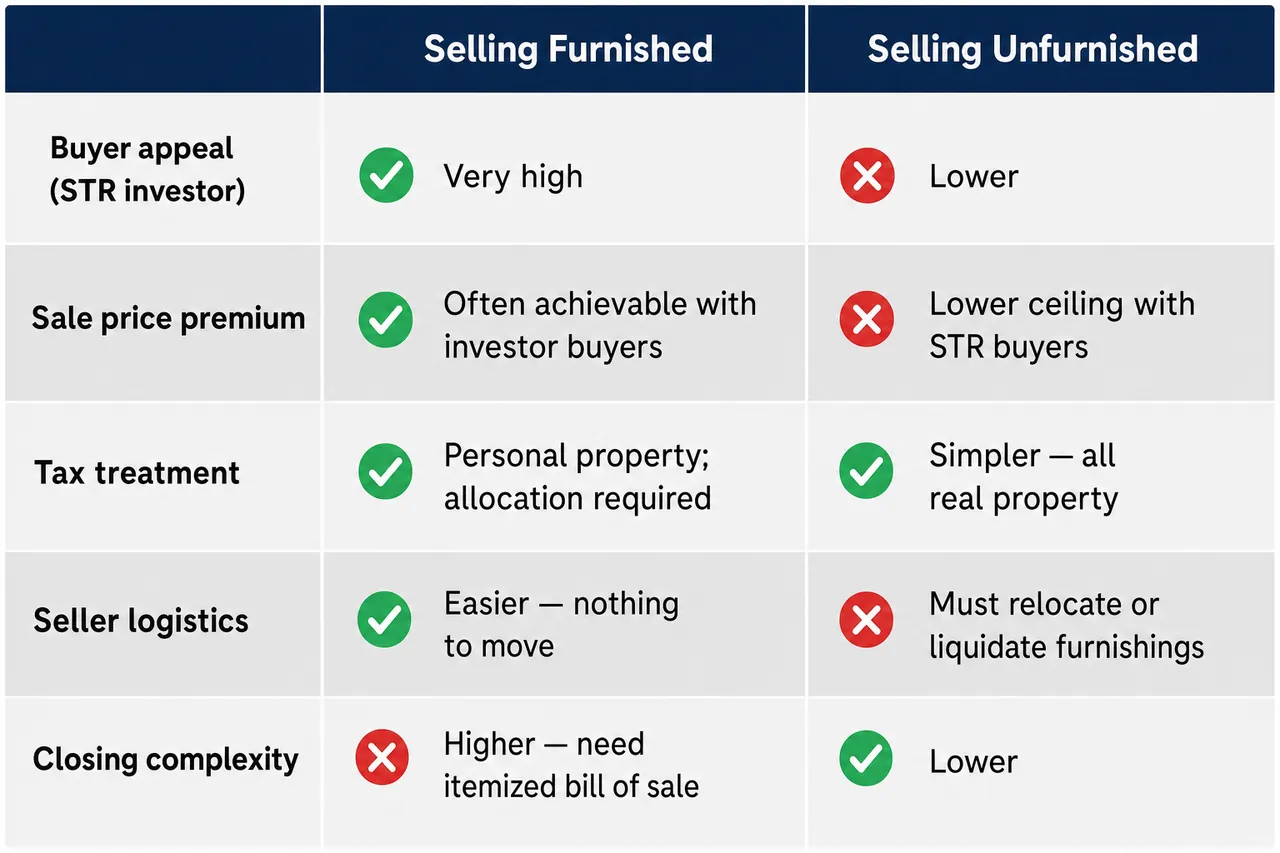
Three things matter here: taxes, logistics, and who's actually buying. Sell it furnished, and the furniture and equipment get classified as personal property in the deal — which creates separate tax and allocation issues you'll need to handle correctly. The guide on selling furniture with your home walks you through the legal and tax details.
| Factor | Selling Furnished | Selling Unfurnished |
|---|---|---|
| Buyer appeal (STR investor) | Very high — turnkey from day one | Lower — setup time and cost required |
| Buyer appeal (owner-occupant) | Mixed — may prefer own furnishings | Higher — blank slate |
| Sale price premium | Often achievable with investor buyers | Lower ceiling with STR buyers |
| Tax treatment | Furniture is personal property; allocation required | Simpler — all real property |
| Seller logistics | Easier — nothing to move | Must relocate or liquidate furnishings |
| Closing complexity | Higher — need itemized bill of sale | Lower |
Most STR sellers who want to attract investor buyers come out ahead going furnished. You'll command a premium. You skip the whole moving nightmare. The new owner can hit the ground running. But if your furniture's looking tired or beat up, it might actually hurt your sale. In that case, staging with newer pieces — or just selling it empty — could work better.
Back to topWorking with Real Estate Professionals
Find an Agent Experienced with Short-Term Rentals
Most agents have never sold an STR property. They don't know how to price it. They can't explain the financials to buyers. They lack investor connections. So ask the hard questions upfront: How many short-term rental properties have you actually sold in the past year? Walk through exactly how you'd present the financial package to buyers. Do you've relationships with STR investor buyers, or are you starting from scratch?
A blank stare or vague answer? Keep looking.
Before you even list, bring in a CPA who specializes in rental property owners. And don't wait until you've got an offer on the table. The depreciation recapture calculation, the capital gains exposure, the 1031 exchange strategy — these need modeling now, while you can still make decisions. If you're considering a 1031 exchange, your CPA will coordinate with a qualified intermediary. That intermediary's engagement must be locked in before closing happens, not after.
Disclosure Obligations
Tell the truth about material facts. All of them. That includes the STR permit status and whether it transfers to a new owner, any HOA restrictions that ban or limit short-term rentals, known physical defects, and any regulatory changes on the horizon that could kill the property's ability to operate as an STR. Got electrical issues that surfaced while you were running the property? The guide on selling a house with electrical problems walks through your options and obligations. Hide material facts, and you'll face legal liability even after the closing happens.
Back to topThe Step-by-Step Airbnb Exit Timeline
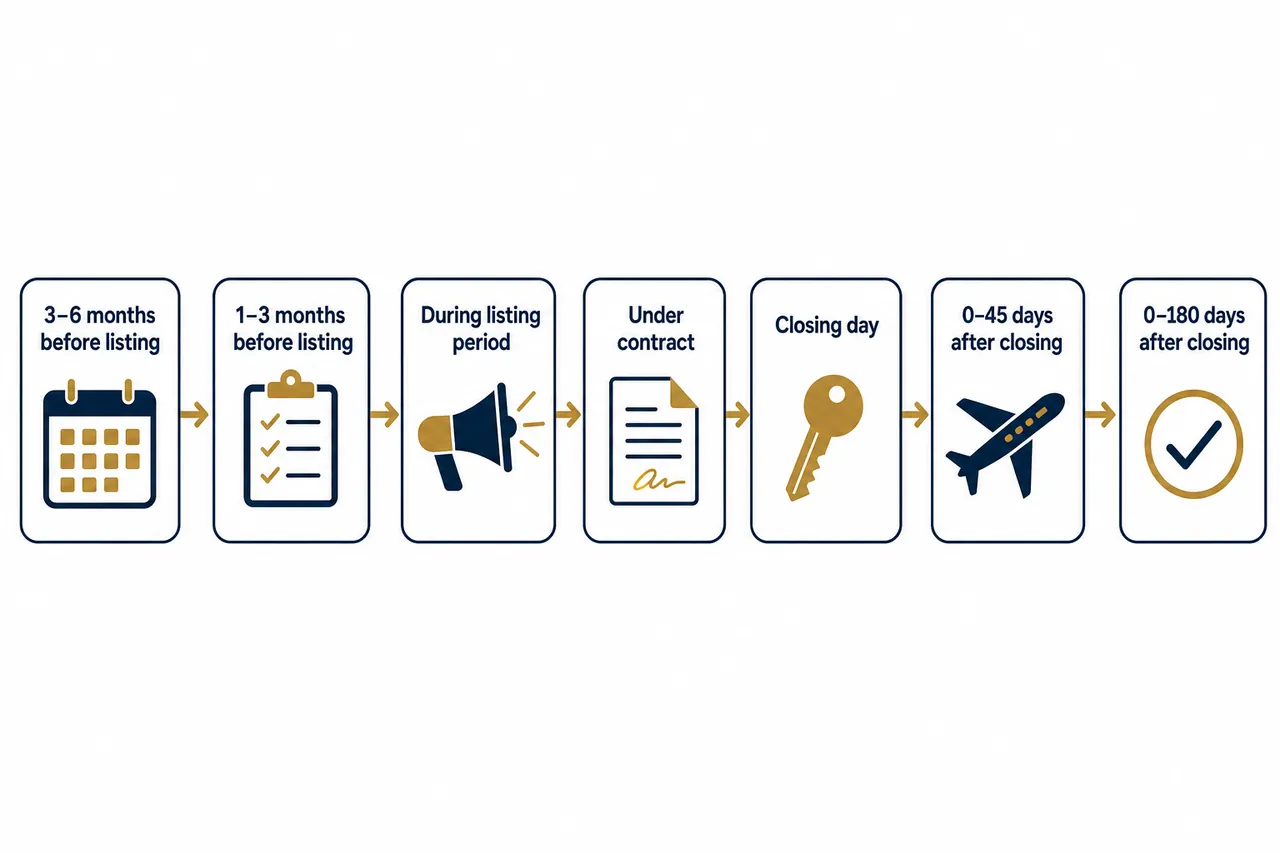
| Timeframe Before/After Closing | Key Actions |
|---|---|
| 3–6 months before listing | Talk to your CPA about tax exposure and get a depreciation recapture estimate. Check whether you qualify for a 1031 exchange. Do any upgrades that'll actually move the needle on your sale price. Then pull together 24 months of financial data so buyers see what they're getting into. |
| 1–3 months before listing | Find an agent who's actually sold short-term rentals before—not just someone who lists regular homes. Invest in professional photography. Assemble a financial portfolio showing your numbers. Verify your STR permit is active and in good standing. Decide right now whether you're selling furnished or unfurnished. Start blocking your booking calendar or managing reservations carefully. Pull together documentation of anything that makes your place special so your marketing materials stand out. |
| During listing period | Honor the bookings you've already got, or work through Airbnb's cancellation policy if you need to. Market specifically to investor groups who understand STR operations. When you're negotiating with buyers, factor in any active reservations on the books. |
| Under contract | Make sure your closing date works with when your last guest checks out. Negotiate whether furniture stays with the property or goes with you—get it in the purchase agreement. Build a transition binder with everything the new owner needs to run the place. If you're doing a 1031 exchange, identify your qualified intermediary now. |
| Closing day | Hand over all the operational documents, vendor contacts, and your house manual. If the place is furnished, sign an itemized bill of sale. Confirm every single booking's been squared away with the buyer. |
| 0–45 days after closing | Running a 1031? You've got 45 days to identify your replacement property. File the paperwork your intermediary needs. |
| 0–180 days after closing | Close out your 1031 exchange if that's what you're doing. Finalize all your tax records for the year. Provide any consulting help to the buyer you promised during negotiations. |
Common Mistakes to Avoid
- Skipping the depreciation recapture calculation. You'll focus on the sale price gain. Then the 25% recapture rate on accumulated depreciation hits you like a blindside. Calculate this before you even start negotiating.
- Presenting only peak-season revenue. Buyers who know what they're doing will demand a full year of numbers. The moment they catch you hiding January and February? Trust evaporates.
- Assuming the new owner can take over your Airbnb account. They can't—the account stays with you. Have this conversation early, before you're deep in contract negotiations.
- Ignoring active bookings until the last minute. A guest shows up the day of closing. Now you've got legal liability and angry reviews. Manage your booking calendar before you list the property.
- Using the wrong agent. Find someone who actually understands income-based valuation and short-term rental marketing. An agent who doesn't will cost you real money.
- Over-improving before sale. Those expensive renovations won't return a dollar-for-dollar gain. Invest in what buyers will actually pay premium prices for—not what makes you personally happier.
- Missing the 1031 deadline. You've got 45 days to identify a replacement property and 180 days to close. These deadlines don't bend. Miss either one and your tax-deferred exchange dies.
- Failing to highlight unique amenities. Buyers can't pay extra for features they don't know exist. That hot tub, that view, that rare location that keeps your calendar full? Make it unmissable in your marketing, your financial documents, and your agent's pitch.
Conclusion
Selling your Airbnb property isn't just a real estate deal. It's a business sale. And the sellers who nail it treat it exactly that way—they document income like a business owner would, they're transparent about platform obligations, they find buyers who actually understand what they're buying, and they figure out the tax hit before closing, not after.
What's the payoff? You can close the gap between a standard home sale and what a well-positioned short-term rental really commands. Two moves do most of the heavy lifting: showcase the specific features and amenities that justify your nightly rate, then make targeted upgrades that prove the property's turnkey. Neither costs a fortune.
The core steps don't change, no matter your market. Know your numbers. Disclose everything. Bring in professionals who actually understand STRs. Position the property as a turnkey income asset for the right buyer.
Follow that order and the process becomes manageable. Your outcome will be significantly better than if you'd just sold it like any other house.
Back to topFrequently Asked Questions
Can I transfer my Airbnb host account to the new owner?
No. Airbnb won't allow it. Their terms of service prohibit account transfers, so the buyer has to create their own account and build a new listing from scratch. You can hand over operational data, financial records, and your house manual — but the account itself stays with you. Same goes for all those reviews you've built up. When you're pitching the property's income potential to buyers, make sure they understand this tradeoff.
What happens to active guest bookings when I sell?
You've got options. Honor all existing reservations and time your closing around them. Block future bookings once the property hits the market. Or work out a post-closing arrangement where the buyer takes over operations. Whatever you choose, any post-closing deal needs to be in writing and your attorney needs to review it. Don't let this slip through as an undefined item in the purchase agreement.
Do I owe taxes on the full sale price of my Airbnb property?
No. You pay tax on the gain — not the entire sale price. That gain comes from your sale price minus your adjusted basis, which is what you originally paid plus any improvements you made, minus accumulated depreciation. The accumulated depreciation gets recaptured at a maximum federal rate of 25%, and whatever's left over gets taxed as long-term capital gains. Your CPA can calculate this precisely for your situation. If you're interested in deferring both taxes, a 1031 exchange works — but you'll need to reinvest in a qualifying replacement property within the required deadlines.
Should I sell the property furnished or unfurnished?
Furnished wins for most sellers who're targeting STR investor buyers. You'll command a turnkey premium and avoid the headache of moving all your stuff. Work with your agent and CPA on how to split the purchase price between real property and personal property in the contract. That split matters for taxes. For the nitty-gritty details, the guide on selling furniture with your home breaks down those tax and legal considerations.
How do I know if my Airbnb property qualifies for a 1031 exchange?
Your property qualifies if you've held it for investment or business use — not as your primary residence. But here's where it gets tricky: if you used it personally for more than 14 days or 10% of fair-rental days in any given year, that year's classification gets messy and could derail your exchange plan. Before you close on the sale, have a CPA or qualified intermediary who knows 1031 exchanges inside-out review your actual usage history.
Back to top