Can You Sell Your House With a Lien on It? How to Proceed

Table of Contents
- What's a Lien and Why Does It Attach to Your Property?
- Types of Liens You Might Find on Your Property
- How to Find Out If Your Property Has a Lien
- Lien Priority: Who Gets Paid First When There Are Multiple Liens
- Negotiating a Lien Settlement
- How to Sell a House With a Lien: Your Step-by-Step Path Forward
- How the Title Company Handles Liens at Closing
- When the Sale Price Doesn't Cover All the Liens
- Disputing an Invalid or Erroneous Lien
- Special Circumstances
- Selling Methods: Traditional vs. Cash Sale
- What Happens If You Ignore a Lien
- Summary: Your Path Forward
- Frequently Asked Questions
You can sell a house with a lien on it. The lien typically gets paid off from your sale proceeds at closing, so the buyer walks away with clear title—no need to resolve it beforehand. This happens constantly with standard mortgage payoffs, tax liens, judgment liens, and similar encumbrances. It's manageable once you understand what you're facing and follow the steps in the right sequence.
Nothing in this article is legal, tax, or financial advice. Lien rules, priorities, and timelines vary by state and circumstance. Work with a licensed real estate attorney, a title professional, and a tax advisor for guidance specific to your situation.

What's a Lien and Why Does It Attach to Your Property?
A lien is a creditor's legal claim against your property. It gets recorded in the public record, and it has to be satisfied before you can transfer ownership free and clear. Once your county recorder's or clerk's office records that lien, it creates what lawyers call constructive notice. That means any future buyer or lender is legally presumed to know the lien exists—even if they never actually looked it up. A buyer who closes without clearing a recorded lien can end up inheriting the creditor's claim. That's why title companies exist.
Voluntary vs. Involuntary Liens
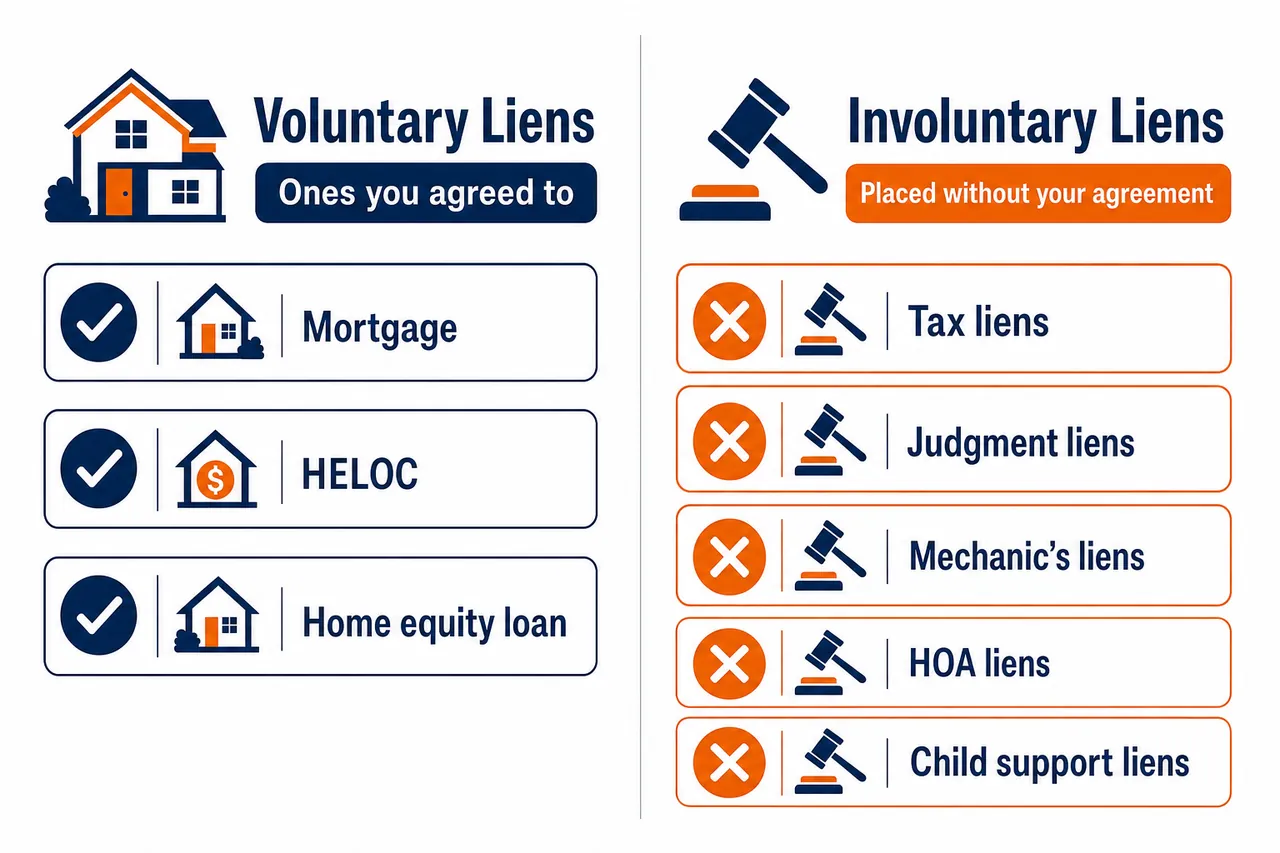
Liens come in two broad categories. Where they came from—and how much wiggle room you have in negotiating them away—depends on which type you're dealing with.
- Voluntary liens are ones you agreed to. Your mortgage, your home equity line of credit (HELOC), or your home equity loan—you signed a deed of trust or mortgage note that pledged the property as collateral for all of these.
- Involuntary liens show up on your property without your permission. Usually a court ordered it, or a government agency imposed it. Tax liens, judgment liens, mechanic's liens, HOA liens, and child support liens all fall into this bucket. These are the ones that tend to blindside sellers.
Types of Liens You Might Find on Your Property
Different liens mean different rules. Who can release it? Can you negotiate? How long will this take? The answers depend entirely on what type of lien is sitting on your deed.
| Lien Type | Voluntary or Involuntary | Who Places It | How to Remove |
|---|---|---|---|
| Mortgage / HELOC | Voluntary | Lender you borrowed from | Pay off loan at closing; lender releases automatically |
| IRS / Federal Tax Lien | Involuntary | Internal Revenue Service | Pay in full, discharge (Form 14135), or subordination agreement |
| State / Local Property Tax Lien | Involuntary | County or municipality | Pay delinquent taxes and penalties; taxing authority releases |
| Judgment Lien | Involuntary | Court (at creditor's request) | Pay judgment, negotiate settlement, or contest if invalid |
| Mechanic's / Contractor Lien | Involuntary | Contractor, subcontractor, or supplier | Pay amount owed, negotiate, or dispute if filing was improper |
| HOA Lien | Involuntary | Homeowners association | Pay dues, fines, and fees; association records release |
| Child Support / Alimony Lien | Involuntary | Court / state child support agency | Pay arrears; court or agency issues release |
Mortgage Liens
When you bought your home, the mortgage you signed became a lien on the property. Same with any second mortgage or HELOC. These are routine to clear — the title or escrow company handles it at closing. They request payoff statements from your lenders, subtract those amounts from your sale proceeds, and wire the money directly to each one. If you've got both a first and second mortgage, the first mortgage gets paid first if there's not enough money to cover both.
Federal Tax Liens
Owe the IRS money and ignore their demand for payment? They can file a Notice of Federal Tax Lien (NFTL) against you. Under the IRS Fresh Start program, this typically happens once unpaid taxes hit $10,000. Once that lien is filed, it attaches to everything you own — including your real estate.
Selling your home with an IRS lien is possible. You'll want to apply for a Certificate of Discharge using Form 14135. Per IRS Publication 783, submit this at least 45 days before closing. This certificate removes the lien from your specific property (even if you still owe the IRS) so the buyer gets clear title. Another option: a subordination agreement lets your new lender's claim take priority over the federal lien, which makes refinancing or buyer financing much easier.
Think the IRS got it wrong? You've got 30 days from when you receive IRS Letter 3172 to request a Collection Due Process (CDP) hearing. File Form 12153. And if what you owe is $25,000 or less, you might qualify for lien withdrawal. Set up a Direct Debit Installment Agreement and file Form 12277. This actually removes the public record of the lien entirely instead of just releasing your property.
One more thing to know: if your unpaid federal tax debt reaches the 2026 threshold of $66,000 (adjusted yearly under Rev. Proc. 2025-32), the IRS can notify the State Department. That can trigger passport denial or revocation under IRC §7345. It's a separate issue from the property lien, but it shows how aggressive the IRS gets with large debts.
Judgment Liens
A creditor sued you and won in court. That judgment can be recorded in your county, turning it into a judgment lien on your property. Under 28 U.S.C. §3201(c)(1), a federal judgment lien on real estate lasts 20 years and can be renewed once for another 20 years if the creditor goes back to court. State laws vary — some cap these at 10 years — so look up your state's specific rules. The practical reality: judgment liens don't disappear quickly. They'll show up on a title search years after the lawsuit ended.
Mechanic's Liens
Contractors, subcontractors, and material suppliers who weren't paid for work on your home can file a mechanic's lien (also called a construction lien or materialman's lien). State law sets strict filing deadlines — usually 60 to 180 days after the last work or delivery, depending on where you live. Miss that window and the lien may be invalid and challengeable. If it was filed on time, you're looking at paying it, negotiating it down, or contesting the amount before you can sell with clear title.
HOA Liens
Live in a community with a homeowners association? Unpaid dues, special assessments, or fines can trigger an HOA lien. In several states, these liens get "super-priority" status — they can take precedence over your first mortgage, though usually only up to a limited amount. For the specific rules in your state, check our guides on California, Florida, Colorado, Washington, Tennessee, and Indiana, or our general HOA lien overview.
Child Support and Alimony Liens
Courts can place liens on your real property for unpaid child support or alimony arrears. State child support agencies enforce these, and most states treat them as top-priority debts. You'll need to pay them in full or work out a settlement before clear title transfers. Negotiating these down is tougher than negotiating with other creditors.
Back to topHow to Find Out If Your Property Has a Lien

Order a preliminary title report before you list your home. Don't let a buyer discover lien problems for you. A title company produces this formal document, and it identifies every recorded lien, encumbrance, and title defect attached to your property. You'll get roughly four to six weeks to dig into the problem and start fixing it before a buyer's title search catches what you missed—and potentially kills the deal.
Want to save money and do it yourself? You can run a manual search through your county clerk's or recorder's office. Most counties have online search tools now. But here's what you need to know: a title company's search goes much deeper. Title professionals don't just check county real property records. They also dig into UCC filings, federal tax lien records, court judgment dockets, and other databases you won't find on your own.
Back to topLien Priority: Who Gets Paid First When There Are Multiple Liens
When a property sells and there's not enough money to pay every lien, priority decides who gets paid. The basic rule? "First in time, first in right" — the lien that was recorded earliest wins. But there are real exceptions that change everything:

- Property tax liens almost always come first — they beat out every other lien, no matter when they were recorded. That's the law in every state.
- HOA liens sometimes get "super-priority" status in certain states. This means they can jump ahead of your first mortgage, but only up to a specific dollar amount.
- IRS federal tax liens generally rank behind your first mortgage (since that was recorded earlier) but ahead of any liens filed after the IRS notice was recorded.
- Junior mortgages, judgment liens, and mechanic's liens get paid based on when they were recorded. They come after the senior debts are handled.
When there's barely any equity left, this matters enormously. Lower-priority lienholders might walk away with nothing if the sale price doesn't cover everything owed. And that's why they're often willing to negotiate a discounted payoff.
Back to topNegotiating a Lien Settlement
Private judgment creditors and mechanic's lien claimants often accept less than what's recorded. They'd rather get paid now than spend years chasing the debt. A lump-sum payoff beats a long collection effort. So settlement discussions usually start with you sending a written payoff request—then it comes down to what the creditor thinks they can realistically recover.
What should you actually do?
- Get the payoff in writing before closing. Make sure it includes the per-diem interest rate and an expiration date for the offer. Lien amounts grow fast when interest and fees keep accruing.
- Document any hardship. When a creditor sees that the sale price leaves you with minimal equity, they're much more likely to discount the lien.
- Bring in an attorney for large amounts. A real estate or collections attorney who knows your state's rules can structure a settlement far better than you negotiating solo.
- IRS settlements work differently. The IRS Offer in Compromise (OIC) program lets qualified taxpayers settle federal tax debt for less, but it's a separate process from the property discharge process and takes considerably longer. If you're closing on a deadline, discharge or subordination routes are usually more practical than waiting for an OIC to close out.
There's no magic number for how much creditors discount liens. It hinges on the creditor type, the balance, your financial picture, and state law. Run from anyone who promises a specific settlement percentage without actually reviewing your situation.
Back to topHow to Sell a House With a Lien: Your Step-by-Step Path Forward
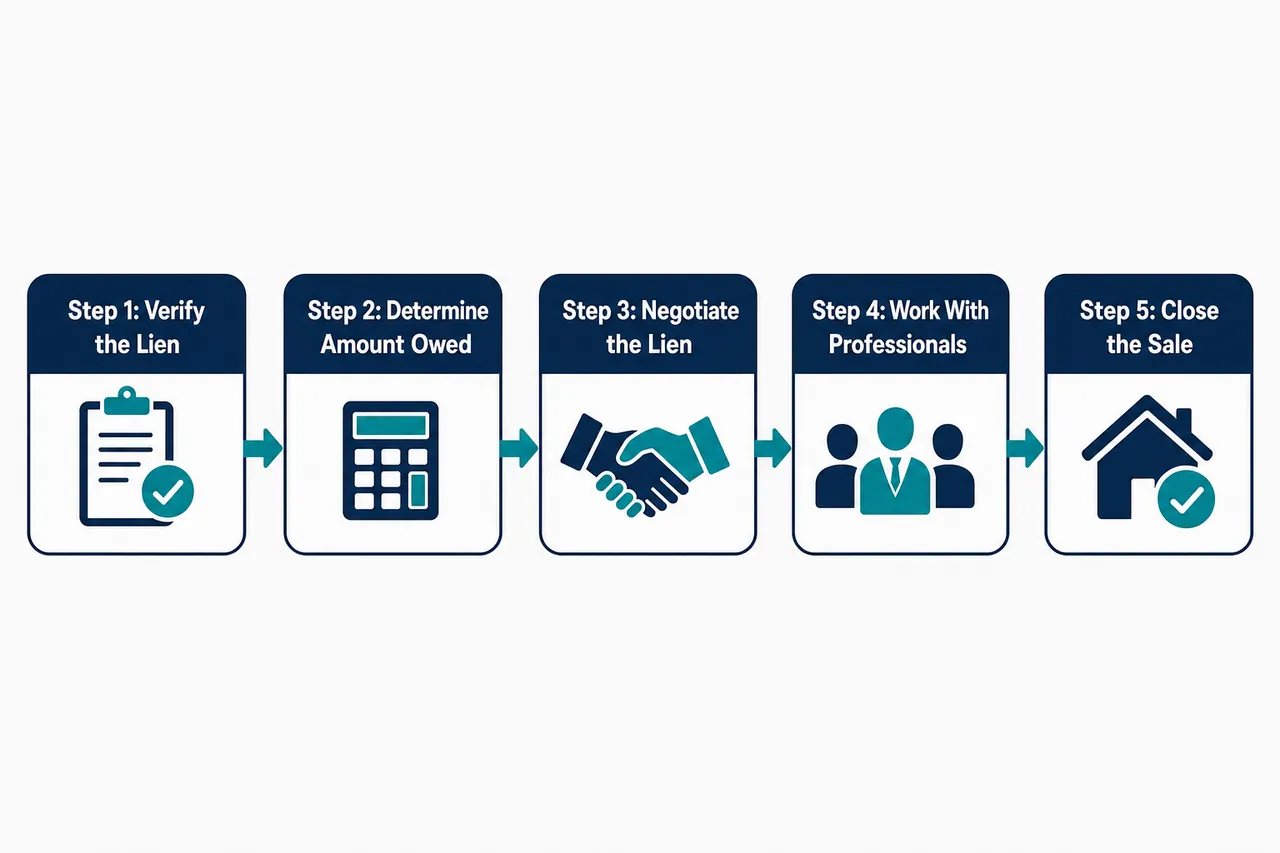
| Step | Who Handles It | Typical Timeline | Key Actions | Potential Delays |
|---|---|---|---|---|
| 1. Discover all liens | Title company / seller | 1–2 weeks before listing | Order preliminary title report; review county records | Liens in multiple counties can be missed |
| 2. Confirm amounts owed | Seller / attorney | 1–2 weeks | Contact each lienholder for a written payoff quote | IRS payoffs require a formal request; allow extra time |
| 3. Negotiate if possible | Seller / attorney | 2–6 weeks | Submit settlement offers; document agreement in writing | Creditors may be slow to respond or refuse negotiation |
| 4. IRS discharge application (if applicable) | Seller / tax attorney | Submit at least 45 days before closing | File Form 14135; provide appraisal and payoff figures | IRS processing backlogs can extend timeline |
| 5. List and accept offer | Seller / agent | Varies by market | Disclose known liens per state requirements | Buyer's lender may require liens cleared before funding |
| 6. Title company coordinates payoffs | Title / escrow company | During escrow (30–60 days) | Wire payoffs to each lienholder directly from proceeds | Last-minute lien discoveries; creditor payoff changes |
| 7. Lien releases recorded | Lienholders / title company | Days to weeks post-closing | Each lienholder records a release with the county | Slow release recording can delay title insurance issuance |
How the Title Company Handles Liens at Closing

Your title or escrow company runs the whole show when liens are involved. After you sign the contract, they'll order a complete title search and pull together a list of every recorded lien still attached to your property—along with what each one costs to clear. The settlement statement they prepare shows exactly how much gets deducted from your proceeds to wipe them out. On closing day, the title company sends money directly to each lienholder in the right order. Once paid, each lienholder issues a release document. The title company then records that release with the county, and the lien disappears from the public record.

If you're buying with a mortgage, your lender won't let you close without title insurance—and the insurance company absolutely won't issue it until every lien is gone. And here's something most cash buyers don't realize: even though you're paying all cash, you'll probably still need a clean title. That's because liens attach to the property itself, not to whoever originally owed the debt. Walk into closing with an unresolved lien still on the books, and you're handing the creditor a legal claim against your new home.
Back to topWhen the Sale Price Doesn't Cover All the Liens
This scenario keeps homeowners up at night. It's also way more common than you'd think. The median existing-home price hit $417,500 in September 2026 (according to the NAR's October 2026 report), which means many of you do have real equity. But then a mortgage balance, a tax lien, and a judgment lien stack up fast — and suddenly that equity vanishes before you see a dime.
What can you actually do?
- Pay the gap out of pocket. If the shortfall won't break you, bring cash to closing and cover it. All liens clear. You get a clean title and no more headaches.
- Negotiate reduced payoffs. Lower-priority lienholders are sitting in a tough spot — they'd walk away empty-handed if the house sold in foreclosure. That gives you leverage. Put together a simple breakdown of where the money goes, then approach them about accepting less.
- Short sale. Your mortgage lender can agree to let you sell for less than what you owe them. They take the loss and call it even. But watch out: forgiven mortgage debt gets treated as taxable income under federal law. The rules shift sometimes, so talk to a tax advisor before you sign anything.
- Loan modification or forbearance. Behind on payments? A modification can lower what you owe and buy you time to sell when you've built more equity.
- Bankruptcy lien avoidance. Chapter 13 bankruptcy lets you strip away judgment liens that eat into your homestead exemption, which cuts down what you have to pay at closing. It works, but it's complicated. Don't go this route without a bankruptcy attorney — and never shuffle assets around to game the system, because that gets treated as fraud.
HUD-approved housing counselors will talk you through your options for free and without bias. Find one at hud.gov. And steer clear of companies charging big upfront fees to "eliminate" your liens — real negotiators don't get paid until they deliver.
Back to topDisputing an Invalid or Erroneous Lien
Not every recorded lien is legitimate. You'll find mechanic's liens filed past the deadline, for work that was never completed, or slapped on the wrong property entirely. Judgment liens show up in error all the time. If you think a lien against your home is bogus, you've got several paths forward.
- Direct negotiation: Call the lienholder and send documentation proving the lien is improper. Most claimants will voluntarily release a defective lien rather than waste money defending it in court.
- Title company assistance: Title insurers employ examiners who specialize in fixing technical title problems without dragging anyone to court.
- Legal action: You can petition the court to have an invalid lien discharged or declared void. Many states have expedited processes specifically for mechanic's liens. With judgment liens, you might prove the judgment was satisfied already or that the recording itself was a mistake.
- IRS CDP hearing: Federal tax liens can be challenged. You've 30 days from the mailing of Letter 3172 to request a Collection Due Process hearing by filing Form 12153. This stops collection activity while your case gets reviewed.
Disputing a lien isn't fast. Expect weeks, sometimes months, depending on how complicated things get. That's why a preliminary title report early matters so much. Finding the problem three weeks before closing? You're basically stuck.
Back to topSpecial Circumstances
Co-Owned Properties
A lien filed against just one co-owner—say, a judgment against one spouse in a community property state, or against one tenant-in-common—typically attaches only to that person's share. The other owner walks away clean. But if you're selling the whole property, you still have to deal with it. A buyer purchasing the entire place wants the entire title clear, liens and all. When co-owners can't agree on what to do, things get messy. A court-ordered partition action can force a sale or split the property, but that route drains money and takes forever. Work out an agreement with your co-owners before it reaches that point.
Homestead Exemptions
Most states offer some protection. They shield a portion of your home equity from certain creditors through what's called a homestead exemption. The problem? Every state does this differently. Some protect a fixed dollar amount—say, $50,000 or $100,000. Others exempt your entire primary residence from unsecured judgment liens. How that exemption interacts with a sale? Also varies wildly. You need your state's specific rules, not a generic answer. Call your state's attorney general's office or consult a local real estate attorney to find out what actually applies to you.
State Disclosure Requirements
Most sellers have to tell buyers about known material defects and encumbrances. Whether a lien counts as something you must disclose, and how to disclose it, depends on your state's rules. Skip this step and you're opening yourself to liability even after the deal closes. When you're uncertain, disclose it anyway.
Multiple Liens: Managing the Payoff Waterfall
Several liens on the same property? They all show up on the closing settlement statement in priority order. The title company handles the waterfall. If you get notice of a lien you didn't know about late in the game, call your title company and attorney right now—don't hope it disappears on its own.
Back to topSelling Methods: Traditional vs. Cash Sale
A traditional sale with a financed buyer works well when liens are straightforward and you've got time to spare before closing. The buyer's lender will demand clear title before they release funds. That pressure keeps everyone moving on resolving those encumbrances.
But what happens when liens become the real problem? Maybe the IRS discharge process is dragging on, or a creditor won't return your calls. That's where a cash buyer changes the game. Real estate investors who specialize in complicated titles can close without lender approval, and they don't care if the title's messy — though they'll lower their offer to reflect the cleanup work they're doing. You also dodge that nightmare scenario where a financed buyer's lender kills the deal at the eleventh hour over some title issue.
Want to see your options side by side? KDS Homebuyers' seller programs let you compare a direct cash offer, traditional listing, and other paths in one conversation. That's helpful when you're still deciding what works for your timeline and how much equity you actually need to walk away with.
Going the for-sale-by-owner route keeps more money in your pocket.
Our guide on how to sell your house without a realtor walks you through the entire process, with state-specific versions for Florida, California, Colorado, and other states.
Back to topWhat Happens If You Ignore a Lien
Ignoring a lien won't make it disappear. That recorded lien sits in the public record, quietly growing as interest and fees pile up. And here's what matters most: almost every buyer and lender out there will walk away from your property if liens aren't cleared first. If you've got a tax lien and you let it sit long enough, the taxing authority can jump straight to foreclosure — they don't need to sue you like a private creditor would. A judgment lien creditor can also force a sale of your property to collect what you owe them. That lien doesn't vanish when you sell to someone else, either. It clouds the title and can land a buyer in serious trouble if they somehow close without resolving it.
Back to topSummary: Your Path Forward
You can sell a house with a lien on it. But you need to do this in the right order. Find every lien early. Understand what each one costs and which ones get paid first. Negotiate when you can. Work with a title company and attorney who actually know what they're doing—they'll coordinate everything at closing. Most deals fall apart because someone waited too long to discover a lien or just hoped it would disappear. Don't be that person. Order your preliminary title report before you even list the house. Get written payoff figures in hand. And if the IRS is involved, you're facing a big judgment, or you owe more than the house is worth, bring a real estate attorney into the conversation from day one. This process works when you give it time to work.
Back to topFrequently Asked Questions
Can I sell my house if it's a lien on it?
Yes, you can. Liens won't stop a sale outright. But they do need to get resolved—paid off, negotiated down, or formally discharged—before the buyer gets clear title to walk away with. At closing, the title company typically handles this by paying lienholders directly from your sale proceeds. The buyer doesn't deal with the lien money at all. They just get a property that's free and clear.
What if I owe more in liens than my home is worth?
You're not stuck. Several paths exist: negotiate reduced payoffs with junior lienholders, run a short sale (with your mortgage lender on board), cover the difference from your own pocket, or explore bankruptcy lien avoidance in some cases. But every option comes with real tradeoffs—forgiven debt can trigger tax bills, for instance. Bring both a real estate attorney and a tax advisor into this conversation. You need both perspectives.
How long does it take to resolve a lien before closing?
That varies wildly depending on what you're dealing with. A standard mortgage payoff? Days. A mechanic's lien negotiation might stretch two to four weeks. The IRS is slower—you'll file Form 14135 at least 45 days before closing. Court disputes can drag on for months. Order your title report early—aim for four to six weeks before you list. That gives you breathing room to work through whatever comes up.
Will a buyer's lender allow closing with an outstanding lien?
No. Lenders won't fund a purchase unless the title is clean and insurable. Their title insurance policy simply won't issue if there are unresolved liens sitting on the property. So in any financed deal, every single recorded lien has to be paid off or formally discharged at closing. Cash buyers? They're not bound by lender rules, but most still want clear title anyway.
Can I transfer or gift my home to someone else if it's a lien on it?
You can do it, but the lien sticks with the property. Whoever receives your home—whether it's a gift, inheritance, or anything else—takes ownership of a property that's still encumbered by that lien. The creditor's claim doesn't vanish just because the owner changed. And if that person needs financing down the road, their lender will demand the lien be cleared first. This creates serious risk for them. Talk to an attorney before you go this route.
Back to top