

Selling a House in Divorce: What Your Agreement Must Cover

Table of Contents
- Understanding Your Options: Sell, Keep, or Buy Out
- Legal Considerations and Divorce Agreements
- Should You Sell Before or After the Divorce is Finalized?
- Step-by-Step Guide to Selling Your Home During Divorce
- Dividing the Home Sale Proceeds
- Common Challenges and How to Resolve Them
- Financial and Tax Implications
- Working with Professionals
- Conclusion: Build Your Agreement Before the Conflict Arises
- Frequently Asked Questions
Your house is probably your biggest asset. It's almost certainly the most emotionally charged one too. And when you're going through a divorce, that home becomes the financial flashpoint of the whole process. Getting your selling house divorce agreement right matters enormously — we're talking about decisions that'll ripple through your finances for years. It's not just about dividing the equity, either. You need to think carefully about legal requirements, tax strategy, timing, and the actual logistics of selling. Do you and your spouse see eye-to-eye on what should happen? Or are you starting from completely different positions? Either way, knowing what your agreement must actually cover puts you in a much stronger position to protect yourself and move on with your life.

Understanding Your Options: Sell, Keep, or Buy Out
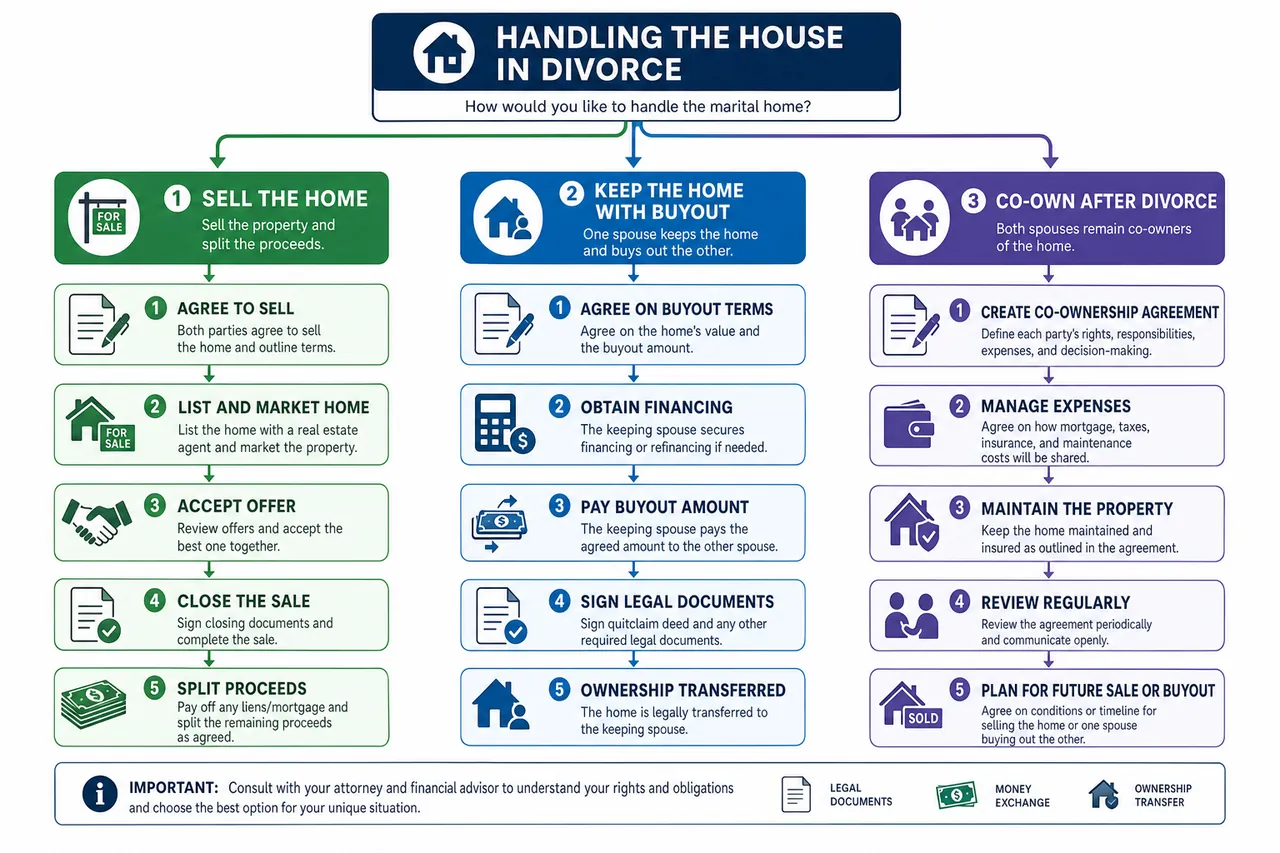
Before you sign anything, you and your spouse need to understand the three main paths for handling the marital home. Each one has different financial, legal, and emotional consequences. Pick wrong, and you could lose tens of thousands of dollars or create legal headaches that haunt you for years.
What Happens to the House in a Divorce
Here's the baseline: the marital home is marital property. That means both of you have a legal claim to its value, even if only one name is on the deed or mortgage. What matters is the equity — that's the home's market value minus what you still owe on the mortgage. Courts typically divide that equity as part of the overall settlement.
The exact rules depend on where you live and whether you signed a prenuptial or postnuptial agreement. One spouse owned the home before the marriage? And you can prove it? The court might classify it as separate property. But here's where it gets tricky: if the marriage paid the mortgage or funded improvements, courts often recognize a marital interest anyway.
Understanding what it actually takes to keep your house in a divorce needs to be your starting point. Don't assume anything about what you'll end up with.
Comparing Your Three Core Options
| Option | Pros | Cons | Best For | Tax Impact | Typical Timeline |
|---|---|---|---|---|---|
| Sell Now | Clean break, immediate liquidity, joint $500K exclusion available | Both must agree; market timing may be poor; emotional difficulty | Couples who want finality and need cash for fresh start | Up to $500K exclusion if sold while still married | 30–90 days once listed |
| One Spouse Keeps It (Buyout) | Stability for children; retains asset; avoids moving | Requires refinancing; buyer must qualify alone; may be overhoused | Spouse with children, financial stability, and desire for continuity | Reduced exclusion ($250K) for future solo sale | 60–120 days for refinancing |
| Co-Own Post-Divorce | Deferred decision; market may improve; children's stability | Ongoing financial entanglement; conflict risk; financing complications | Couples with amicable relationship and school-age children | Complex; tax treatment varies by arrangement | Ongoing until agreed sale date |
All three have real advantages. The key is choosing the one that matches your actual financial situation and the level of cooperation you can honestly maintain with your spouse going forward.
Back to topLegal Considerations and Divorce Agreements

Your home's sale hinges on two things working together: your state's property division laws and what's actually written in your divorce decree or settlement agreement. Get the language wrong, and you're looking at disputes right at closing that can tank the whole deal.
Community Property vs. Equitable Distribution States
| State Type | Home Division Rules | Automatic 50/50 Split? | Example States | Key Tax Implications |
|---|---|---|---|---|
| Community Property | Assets acquired during marriage split equally by default | Yes, unless agreed otherwise | CA, TX, AZ, NV, WA, ID, NM, LA, WI | Each spouse gets stepped-up basis on 50% of property |
| Equitable Distribution | Assets split "fairly" — not necessarily equally — based on contributions, needs, and circumstances | No — court determines fair share | FL, NY, CO, IN, TN, OH, PA, and most others | Basis allocation depends on final split percentage |
Live in California or Washington? You're in a community property state. Each spouse owns exactly half the marital home's equity as a matter of law. And if you're in equitable distribution states like Florida, Colorado, Indiana, or Tennessee? That's different. Courts have real discretion here — they'll factor in marriage length, earning capacity, who actually paid for improvements, and other circumstances to decide who gets what percentage.
What Your Divorce Decree Must Say About the Home
Your decree needs to spell things out. Whether you negotiated this, went to mediation, or fought it out in court, these elements have to be in there to actually work:
- Authority to sell: Explicitly grants either or both spouses the right to list and execute a sale
- Listing price parameters: Sets a process for determining the asking price, including whether an independent appraisal is required
- Offer acceptance threshold: Defines minimum acceptable offer amounts or percentage-of-list-price floors
- Decision-making process: Clarifies how disagreements on offers, repairs, or terms are resolved
- Proceeds distribution formula: States exactly how net proceeds are divided after mortgage payoff and closing costs
- Carrying cost responsibility: Identifies who pays the mortgage, taxes, insurance, and utilities until closing
- Timeline and deadlines: Sets listing dates, acceptance deadlines, and consequences for non-compliance
- Title transfer mechanism: Describes how the deed is cleared for transfer if one party is uncooperative
Here's the thing: judges can order the sale of marital property even if one spouse refuses. They'll appoint a commissioner or receiver to handle it. Non-compliant spouses can be held in contempt. But if your decree has clear default procedures built in, you won't need court intervention — which means you'll save both time and money.
Back to topShould You Sell Before or After the Divorce is Finalized?
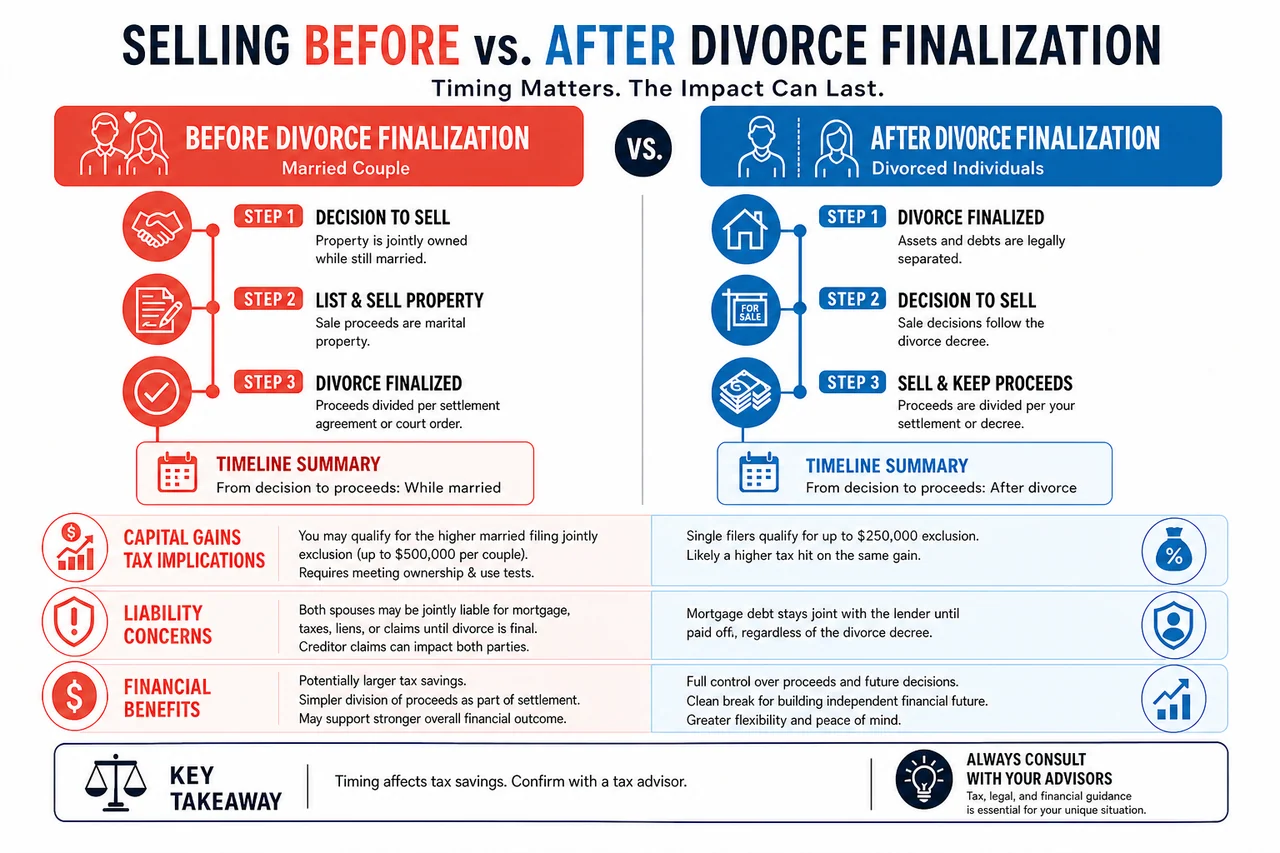
Here's what most divorcing couples don't realize until they're filing taxes: when you sell matters enormously. The difference between selling while married and selling after your divorce finalizes could cost you anywhere from a few thousand to tens of thousands of dollars in capital gains taxes. We're talking about the gap between a $500,000 tax exclusion versus a $250,000 one.
Capital Gains Tax Scenarios Based on Sale Timing
| Scenario | Marital Status at Sale | Capital Gain Example | Exclusion Available | Taxable Amount | Estimated Tax Owed* |
|---|---|---|---|---|---|
| Sell while married, filing jointly | Married | $480,000 | $500,000 (joint) | $0 | $0 |
| Sell while married, filing jointly | Married | $620,000 | $500,000 (joint) | $120,000 | ~$18,000–$28,800 |
| Sell after divorce, one spouse keeps home | Single | $480,000 | $250,000 (individual) | $230,000 | ~$34,500–$55,200 |
| Sell after divorce, transferred via divorce decree | Single | $300,000 | $250,000 (individual) | $50,000 | ~$7,500–$12,000 |
*Estimates based on 15%–20% long-term capital gains rate for illustrative purposes. Consult a tax advisor for your specific situation.
You've got to meet one key requirement to get that primary residence exclusion: you need to have owned and lived in the home as your main place for at least two of the last five years. Both parts matter. And here's the catch — if you've already moved out during a separation, that two-year clock is ticking. Once it runs out, you lose the exclusion entirely. This is why timing your sale before that window closes can save you tens of thousands.
Additional Timing Considerations
Don't overlook liability. While you're still co-owners, you're both on the hook for the mortgage, property taxes, and HOA fees. Your spouse stops paying? Your credit takes the hit. Selling quickly gets you out from under that risk. But if you're upside down on the home — owing more than it's worth — waiting might make sense. You'd give the equity a chance to recover. Just understand that strategy only works if your ex keeps making those payments, and that's risky.
And then there's property tax reassessment.
In certain states, a change in ownership triggers a reassessment that bumps up the property taxes for whoever buys next. Know when your state does this. Sometimes it can shift when you should actually list the home.
Back to topStep-by-Step Guide to Selling Your Home During Divorce
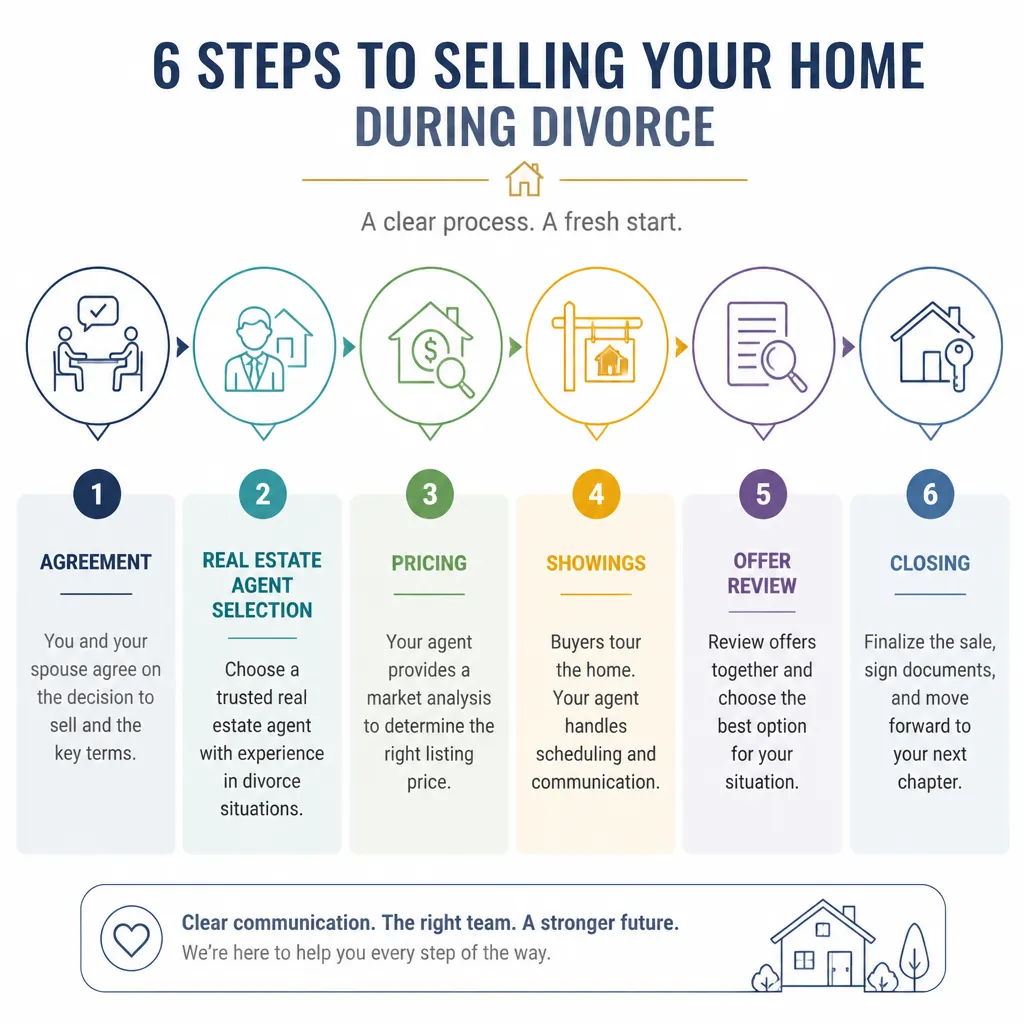
You've both agreed to sell. That's the easy part. Now comes the harder work: actually getting it done without letting old friction derail the whole process. Here's how to move from decision to closing.
Step 1: Obtain Documented Mutual Agreement
Verbal agreements don't cut it here. Once you both say yes to selling, write it down. Get it in the divorce settlement itself or create a separate signed memorandum of understanding. Your document needs to spell out who sets the price, how you'll pick an agent, what offer criteria matter to each of you, and who pays for what. You need this in writing because memories get fuzzy, especially when money's on the line.
Step 2: Select a Real Estate Agent Together
Not all agents can handle divorce sales. You need someone who gets it.
This agent maintains strict neutrality between you both, communicates equally with each spouse, coordinates showings without creating drama, and understands that major decisions might need two signatures. Interview candidates together when you can, and ask directly: have you sold homes for divorcing couples before? Look for someone who'll give you a honest answer. And if speed matters more to you than squeezing out every dollar — if you're exhausted and just want it done — you might consider a cash buyer like KDS Homebuyers. They close in days, no showings, no back-and-forth negotiation.
Step 3: Agree on Listing Price and Pricing Strategy
Pricing battles destroy more divorce sales than anything else. Don't guess. Pay for an independent appraisal — it'll cost you $300 to $500 and could save thousands in conflict. Your agreement should lock in exactly how many days the house stays at the original price before you're forced to drop it, and by how much. This takes the arguing out of the equation. You've already decided. The number just happens.
Step 4: Manage Access, Showings, and the Property Itself
One of you still lives there? That creates real complications. Set up a showing schedule that respects the occupying spouse's life while keeping the property accessible to buyers. That spouse is usually responsible for keeping things show-ready. But what if they stop caring? Your agreement should address it — including the option to go to court if someone's deliberately sabotaging the sale.
Step 5: Review and Accept Offers Together
Both spouses see every offer at the same time. Decide now how you'll handle disagreements later. Will you use mediation? Trust a real estate attorney's judgment? Set an automatic acceptance threshold that neither of you can block? The key is a rule that prevents either party from unreasonably rejecting a legitimate market-rate offer. This protects you both.
Step 6: Coordinate Closing and Mortgage Payoff
When closing day arrives, the mortgage gets paid first. Everything else comes after. Work with your divorce attorney and the closing agent to verify the payoff number is accurate, confirm closing costs are split correctly, and make sure the net proceeds go directly where your agreement says they should — often through an escrow account if either of you still disputes what's owed.
Back to topDividing the Home Sale Proceeds
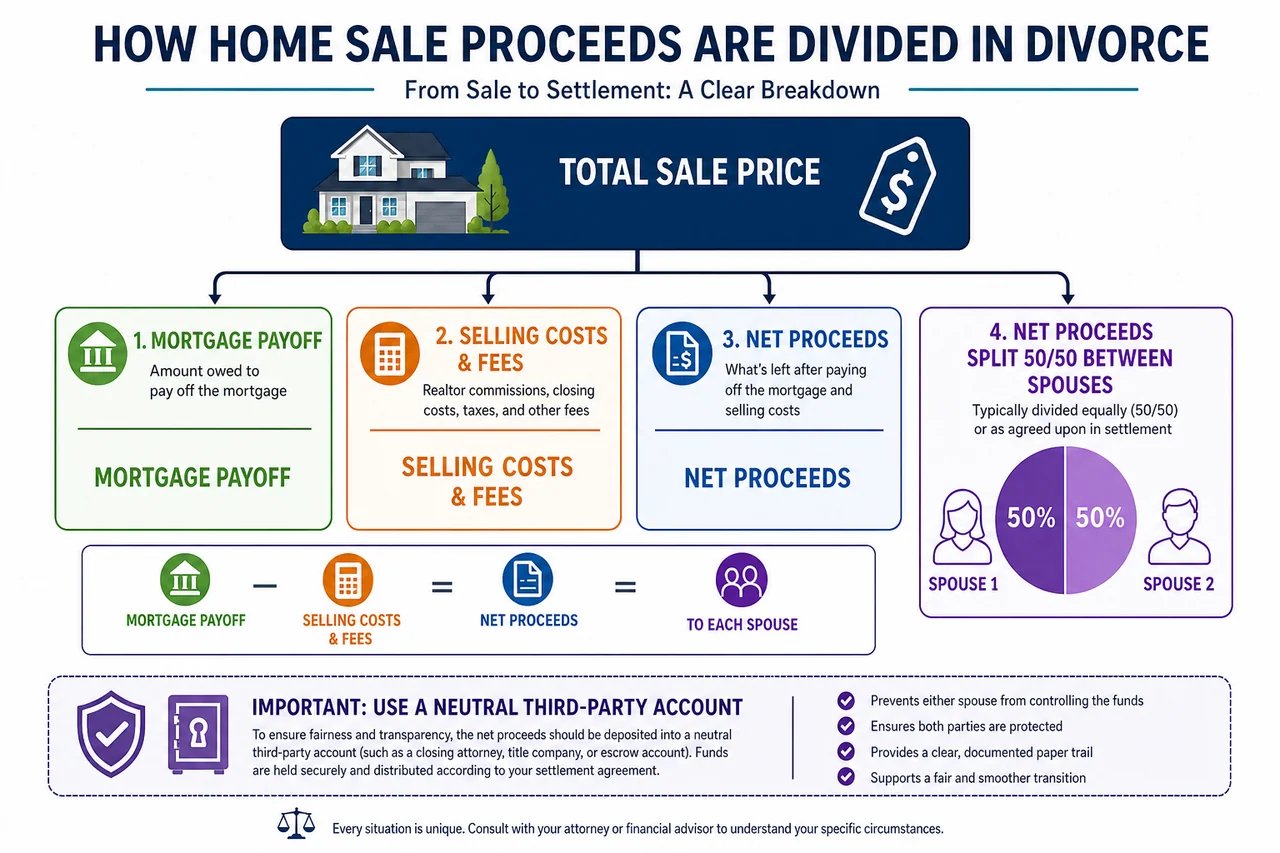
That listing price? You won't see it. Between agent commissions, the mortgage payoff, transfer taxes, and a dozen other costs, the actual money in your pocket shrinks fast. Getting clear on exactly what reduces your net proceeds is crucial for settlement negotiations that actually work.

Home Sale Cost Breakdown
| Expense Item | Typical Cost Range | Who Pays | Timing | Impact on Net Proceeds |
|---|---|---|---|---|
| Real estate agent commission | 5%–6% of sale price | Split from proceeds equally | Deducted at closing | High — reduces top-line by $15K–$18K per $300K |
| Mortgage payoff | Outstanding balance + prepayment penalty if any | Joint obligation | First deduction at closing | Very high — may consume most proceeds in high-LTV situations |
| Transfer taxes / recording fees | 0.1%–2.2% depending on state | Usually seller; varies by state | At closing | Moderate — $300–$6,600 per $300K |
| Title insurance and escrow | $1,000–$3,500 | Typically seller pays owner's title | At closing | Low-moderate |
| Pre-sale repairs and staging | $500–$15,000+ | Should be specified in agreement | Before listing | Moderate — but can increase sale price significantly |
| Outstanding liens / judgments | Varies — must be satisfied at closing | Typically responsible party per decree | At closing | Can severely reduce or eliminate proceeds |
| Capital gains tax | 0%–20% federal on taxable gain | Per individual tax return post-sale | Tax filing deadline | Significant depending on gain and exclusion eligibility |
Your agreement needs to spell out exactly how you're splitting what's left. And I mean net proceeds — not that listing price. Too many people assume 50/50 means half the gross sale price, then get blindsided at closing. That's when disputes blow up and escrow extends indefinitely.
One smart move? Set up a neutral escrow account to hold the proceeds if there's any chance of disagreements after closing. It protects both of you.
But here's the real danger nobody talks about: liens. If a judgment lien from a creditor is attached to the property in either spouse's name, the title won't transfer until it's paid off — full stop. Before you even list, get a title search done. Call your local title company and ask them to run it. You need to know what clouds are on the property now, not the day before closing.
Back to topCommon Challenges and How to Resolve Them
Real-world complications happen. Even the best agreements run into trouble. But if you know what's coming and have solid resolution mechanisms in place, you'll save yourself thousands of dollars and countless headaches.

Disagreement on Price or Timing
This is the most common conflict in divorce home sales. What can you do? Build resolution mechanisms right into your agreement. Get an independent appraisal. Require mediation before either of you goes to court. And set automatic price reduction triggers if the house sits on the market too long. Courts can and do order specific pricing terms if you two can't agree.
One Spouse Refuses to Cooperate
One spouse won't sign listing agreements. Won't allow showings. Won't consider reasonable offers. You have options. The other spouse can typically seek a court order to force compliance. Many divorce decrees include what's called a "commissioner authority" clause — it lets one party sign documents on behalf of the other if they're being uncooperative. Get this language in your decree now, before you actually need it.
Underwater Mortgages and Negative Equity
The home is worth less than what you owe on it. Neither of you gets any money from the sale. In fact, you might both need to bring cash to closing. Or you'll need to negotiate a short sale with your lender. Here's what you need to know: a short sale requires lender approval and typically takes 3–6 months. Both spouses must agree to it. The lender must agree to release both of you from any remaining liability. And the tax treatment of forgiven mortgage debt gets complicated in divorce situations. Talk to a tax advisor before you move forward.
Pre-Marital Property Claims
One spouse owned the home before you married. They have documentation to prove it — original purchase records, gift fund receipts, inheritance paperwork. They may be entitled to a credit for that separate property portion before you divide whatever equity remains. This gets technical fast, especially if marital money went toward improvements or mortgage payments over the years.
Access and Showing Disputes
One spouse is still living in the home during the sale. Tension around showings? Almost guaranteed. Your agreement needs to spell out the rules. Require reasonable advance notice — typically 24 hours — for any showing. The occupying spouse has to keep the home presentable. And specify what happens if someone blocks access unreasonably, including potential court sanctions.
Back to topFinancial and Tax Implications
You can save thousands by planning your taxes before closing. Capital gains, transfer taxes, and your filing status after divorce — these are the big three to tackle.
Claiming the Primary Residence Exclusion
Here's what married couples get: up to $500,000 in capital gains excluded from federal taxes when you sell your primary residence. The catch? You need to have owned and lived in the home for at least two of the five years before the sale. After divorce, that drops to $250,000 per person. But there's a break the IRS offers called the "reduced exclusion" — if divorce forced the sale and you didn't quite hit that two-year mark, you may still qualify for a partial exclusion. It's worth asking your tax pro about.
Divorce's Effect on Tax Filing Status
Once the divorce is final, married filing jointly is off the table. This isn't just about the capital gains number — your whole tax bracket shifts. A home sale can push you into a higher-income year, which matters a lot. And here's the real question: does closing before or after December 31 actually save you money when you factor in your new filing status? You need a CPA who specializes in divorce taxation. This isn't general tax work. The dollar difference can be substantial.
State-Specific Obligations
Transfer taxes are all over the place depending on where you live. Texas? Zero. Parts of Connecticut and New Jersey? Over 2%. That's a massive swing. States also treat capital gains differently — California taxes yours as regular income, which hits high-earners hard. Don't just look at federal rules. You have to run the full picture on both sides.
If you're dealing with Medicaid planning alongside your divorce and home sale, add another layer of complexity. The intersection of Medicaid and home sales matters especially if you're an older divorcing spouse. It's worth understanding how the sale affects your asset limits.
Back to topWorking with Professionals

You need professionals on your side. No article can substitute for guidance built around your actual situation. The team you build will shape both your financial outcome and whether you get through this with your sanity intact.
Real Estate Agent Selection
Find an agent who's actually sold homes for divorcing couples. They should understand they represent both of you equally, and they need to be comfortable handling written communication with each spouse separately. Can they manage conflict without picking sides?
Ask directly: "Have you sold homes for divorcing couples before? How do you handle disagreements between the parties?" Their answer matters.
Divorce Attorney's Role in Sale Agreements
Your divorce attorney needs to review or draft the home-specific language in your settlement agreement. And don't just accept generic boilerplate language here. Pricing, access rights, what happens if someone defaults, how proceeds get split — negotiate these with the same intensity you'd apply to custody terms. For many couples, they're just as important.
Tax Advisor Involvement
Before closing, get a CPA or tax attorney involved who actually understands divorce taxation. The capital gains calculation alone is complex. Your adjusted basis, improvement costs, exclusion eligibility, state taxes — these need professional analysis. Miss this step and you'll discover the damage on your next tax return, when there's nothing you can do about it.
Mediation and Collaborative Divorce Specialists
Stuck on agreement? A mediator trained in divorce can move negotiations forward at a fraction of litigation costs. And then there are collaborative divorce attorneys — professionals specifically trained to solve problems rather than escalate them. Both of you can reach a settlement that a judge would likely approve anyway, while keeping more money in both your pockets instead of handing it to lawyers.
Back to topConclusion: Build Your Agreement Before the Conflict Arises
Here's the hard truth: you need a full written agreement before you list the house, not after things fall apart. Your selling house divorce agreement should spell out who decides on price, how you'll handle offers, who pays what costs, how you'll split the proceeds, tax responsibilities, and what happens if someone doesn't follow through. Make it detailed enough that a real estate agent could execute the whole thing without calling either of you for clarification.
Why? Because when serious decisions come up during the sale—like whether to accept an offer or negotiate repairs—you probably won't be on speaking terms.
The money involved is significant. We're talking capital gains exclusions, state taxes, carrying costs if the sale drags on. A solid agreement versus a sloppy one? That gap can easily cost you five figures. Don't try to figure this out alone or cut corners here.
Bring in a divorce attorney, find a neutral real estate professional, and hire a tax advisor who's actually dealt with divorce transactions before. This matters.
Get this right, and selling the house becomes a real financial ending—not a fight that never stops. You both deserve that clean break.
Back to topFrequently Asked Questions
Can one spouse force the sale of the marital home if the other refuses?
Yes. Courts have broad authority to order the sale of marital property during a divorce. If your spouse won't cooperate, you can ask the court to force the sale through a petition. What happens next? The judge can appoint a third-party commissioner to handle the whole transaction, and refusing to cooperate can result in contempt findings. And here's the real lesson: build those default mechanisms into your settlement agreement before any dispute even surfaces. It's so much cheaper and faster than fighting in court later.
What happens to the mortgage when the house is sold during divorce?
The closing agent pays off your entire mortgage balance from the sale proceeds before either of you gets a dime. That's done by the title company — it's their job. But here's what matters most: both of you stay jointly and severally liable to the lender until that mortgage is gone. A bank doesn't care what your divorce decree says. They can chase either spouse for the full balance, period. The decree only controls how you two split things — not what you owe the bank.
How is the home's equity divided if we've a prenuptial agreement?
A valid prenup or postnup can completely override state property division rules, including your home's equity. If your agreement spells out exactly how the house gets treated in a divorce, courts will enforce it — but only if it was truly voluntary, fully disclosed, and free from fraud or pressure. Here's where it gets tricky: even if you owned the house before marriage, marital funds spent on improvements or mortgage payments can muddy the waters fast. Your attorney needs to trace every dollar carefully if this applies to you.
Do we both have to sign closing documents?
Yes, almost always. Both spouses must sign the deed and closing documents to transfer clean title, even if only one name appears on the deed itself. Marital property rights attach to both of you. Your divorce decree might give one person authority to sign on behalf of the other, or the court can execute documents if someone's unavailable or refuses to cooperate. Don't assume this will happen automatically — the title company will demand written proof of that authority before they'll budge.
What if the house sells for less than we owe on the mortgage?
Welcome to an underwater or "short sale" situation. This one's painful. You'll need your lender's approval to sell for less than what's owed, and that approval takes 3–6 months to negotiate. Both spouses must be involved, and here's the critical part: the lender has to agree to release both of you from the deficiency — that gap between sale price and what you still owe. Forgiven mortgage debt often counts as taxable income to the IRS (though some exceptions exist), and you must handle that tax hit explicitly in your divorce agreement. Seriously consider talking to a HUD-approved housing counselor alongside your attorney. They'll walk you through scenarios your lawyer might not cover.
Back to top
