Can I Sell My House With Tenants in It? Landlord's Guide to Occupied Sales

Table of Contents
- Can You Legally Sell a House With Tenants in It?
- Understanding Lease Agreements and Tenant Rights
- Notice Requirements and Legal Obligations
- Steps to Successfully Sell a Property With Tenants
- Your Options: How to Structure the Sale
- Handling Uncooperative or Difficult Tenants
- Impact on Property Value and Sale Price
- What Happens to Tenants After the Sale Closes
- Marketing a Tenant-Occupied Property Effectively
- The Closing Process With Tenants in Place
- Tax Considerations When Selling a Rental Property
- State-Specific Guides
- Summary: Selling a Tenant-Occupied Property Is Manageable
- Frequently Asked Questions
You can sell a house with tenants in it. It's legal in virtually every U.S. jurisdiction. The lease doesn't automatically cancel when the property changes hands, and your tenants can't block you from listing or closing. But the process works differently than selling vacant. You'll need to follow notice requirements, honor lease obligations, and handle disclosures — skip these and you're opening yourself up to real legal trouble. With proper planning, it's entirely doable. This guide walks you through every step: reviewing the lease before listing, managing inspections and showings, handling tenant notifications, and closing with people still living there.
Nothing in this article is legal, tax, or financial advice. Landlord-tenant law varies significantly by state and municipality — always consult a licensed landlord-tenant attorney and a CPA before acting on any information here.

Can You Legally Sell a House With Tenants in It?
Yes, the Law Permits It
You own the property. You own the right to sell it. The lease? That's separate. You can list, market, accept offers, and close while tenants are still living there. What you can't do is kick them out to make the sale easier — their lease sticks around even after the new owner takes over.
Legal Protections for Tenants During a Sale
Federal fair housing law covers every step of the process. Don't steer buyers away from properties with tenants. Don't refuse to let them see the place. Don't treat tenant communication differently based on race, color, national origin, religion, sex, familial status, or disability. These are non-negotiable across the entire country. Your state probably has additional protected categories too — it's worth checking your state's fair housing statute.
Most states also protect tenants from retaliation. A tenant complains about mold. Another organizes with neighbors about repairs. Someone simply stays past when you'd prefer they leave but while their lease is still active. You can't respond with threats or start eviction proceedings. Retaliatory eviction is illegal nearly everywhere and can cost you damages, attorney's fees, and sometimes punitive damages on top of that.
Existing Lease Agreements Transfer to the New Owner
This is what actually matters: a lease is a property right that travels with the land. The buyer becomes the landlord automatically. In most states, an active fixed-term lease survives the sale, and the new owner must honor it until it ends. The rent stays the same. The lease end date stays the same. All the renewal options and other terms? They stay too. The sale price doesn't matter. What the buyer wants doesn't matter either.
Back to topUnderstanding Lease Agreements and Tenant Rights
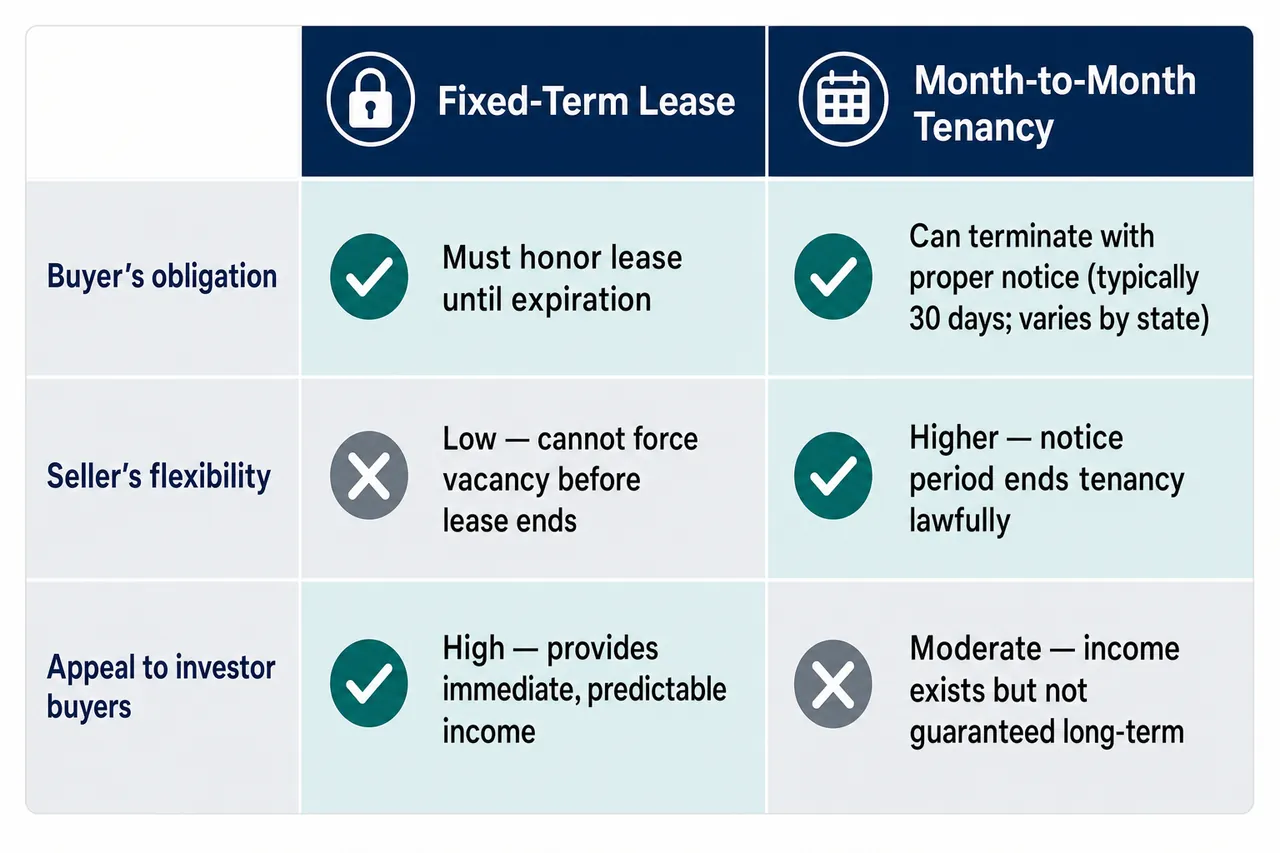

Fixed-Term vs. Month-to-Month Leases
Your lease type dictates almost everything that comes next. Check the table below to see how each one affects your position as a seller.
| Factor | Fixed-Term Lease | Month-to-Month Tenancy |
|---|---|---|
| Buyer's obligation | Must honor lease until expiration | Can terminate with proper notice (typically 30 days; varies by state) |
| Seller's flexibility | Low — can't force vacancy before lease ends | Higher — notice period ends tenancy lawfully |
| Appeal to investor buyers | High — provides immediate, predictable income | Moderate — income exists but not guaranteed long-term |
| Appeal to owner-occupant buyers | Low — can't move in until lease expires | Moderate — can plan move-in around notice period |
| Impact on sale price | Positive with strong rental terms; neutral/negative if below-market rent | Slight negative vs. vacant for owner-occupants |
| Closing timeline risk | Low conflict if lease terms are clear | Moderate — timing of vacancy uncertain |
Lease Clauses to Review Before Listing
Sit down with your lease before you list. Read every page.
What you're looking for:
- Sale or termination clauses: Some leases let either you or the tenant walk away if the property sells or gets listed. If yours includes this, know exactly what notice you need to give to trigger it.
- Right of first refusal: Your tenant might have the legal right to match any offer you receive before you sell to someone else—either because the lease says so or because your state law allows it. Miss this and your sale could stall.
- Notice and access provisions: Your lease sets how much warning you must give before showing the place. It might be tighter than what your state requires.
- Subletting and assignment: These won't block your sale, but they tell you whether the tenant's likely to cooperate or cause friction.
Want the full walkthrough? Read Selling a House with Tenants: Laws, Process, and Options.
Security Deposit Transfer Obligations
When you close, you hand off the security deposit to the new owner—and you give them a written record of exactly what that deposit covers. The buyer now owns the obligation to return it (minus any legitimate deductions) when the tenant leaves. If you don't do this right, both you and the buyer can get sued. Write it down. Keep copies. File them away after closing.
Back to topNotice Requirements and Legal Obligations

Notice for Property Showings
Before you show a tenant-occupied property to prospective buyers, most states require you to give advance notice. The standard is 24 hours, though your lease might demand more. And here's what matters: entering without proper notice could breach your lease and, in some states, opens you up to an unlawful entry claim — regardless of your reason for being there.
Notice to Terminate a Month-to-Month Tenancy
Got a month-to-month tenant and you need them out before closing? You'll need to serve written notice to vacate. But notice periods vary wildly by state — sometimes dramatically. The table below shows what landlords must give when ending a month-to-month tenancy (not a fixed-term lease). Always verify your state's current statute — these rules change, and local ordinances often require longer notice periods than the state minimum.
| State | Landlord Notice to End Month-to-Month Tenancy | Key Source / Notes |
|---|---|---|
| Most U.S. states (general baseline) | 30 days | Minimum; lease or local ordinance may require more |
| California (tenancy < 1 year) | 30 days (Cal. Civil Code § 1946.1) | Just-cause rules under AB 1482 may also apply |
| California (tenancy ≥ 1 year) | 60 days (Cal. Civil Code § 1946.1) | City rent-control ordinances can extend further |
| New York (tenancy < 1 year) | 30 days (N.Y. RPL § 226-c) | HSTPA 2019 governs; rent-stabilized units have additional rules |
| New York (tenancy 1–2 years) | 60 days (N.Y. RPL § 226-c) | Same source |
| New York (tenancy ≥ 2 years) | 90 days (N.Y. RPL § 226-c) | Same source |
| Texas | 30 days (Tex. Prop. Code § 91.001) | Unless lease specifies a different period |
| Oregon (longer tenancies) | Up to 90 days | Oregon has strong tenant protections; verify current statute |
| Maryland, Virginia, DC, PA, MO, TN, NH, CO, FL, IN, WA | Varies — check your state statute | See state-specific guides linked in this article |
Important: Notice for showing access (typically 24 hours) and notice to terminate a tenancy are two completely different things. Don't mix them up. If you're selling in California, Florida, Washington, Tennessee, Indiana, or Colorado, KDS Homebuyers has state-specific guides linked throughout this article that'll walk you through it.
Fixed-Term Leases Can't Be Terminated Early Through Sale
Selling your property doesn't automatically end a tenant's fixed-term lease. The new owner inherits it. Period. Only a few things can actually end a fixed-term lease before it expires: a sale or termination clause written into the lease itself, a cash-for-keys agreement (where the tenant voluntarily leaves in exchange for payment), a lease violation serious enough to justify eviction, or in just-cause eviction states, specific grounds like owner move-in or substantial rehabilitation. Each path has its own legal procedures, so talk to an attorney before you take action.
Back to topSteps to Successfully Sell a Property With Tenants
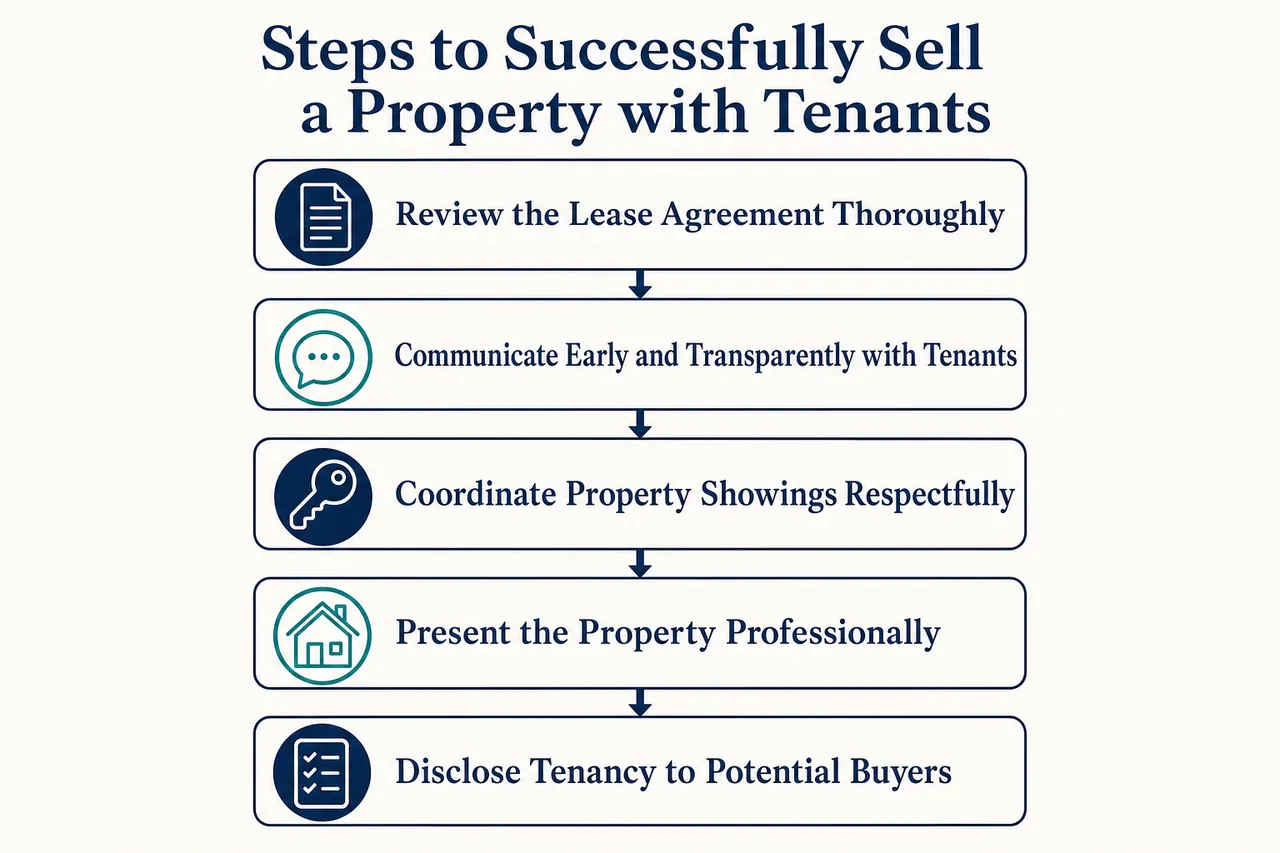

1. Review the Lease Thoroughly Before Listing
Your lease is everything. Before you call an agent, before you set a price, before you talk to the tenant—sit down and read it cover to cover. You need to know the lease type, when it expires, the rent amount, any clauses about sale or termination, right of first refusal provisions, and what notice and access rules apply. Missing even one detail here can derail the whole sale.
2. Communicate Early and Transparently With Tenants
A tenant who finds out about your sale from a stranger at the door? That's how you get someone who becomes difficult—and they have legal tools to make showings a nightmare. Call them early. Explain what's happening and why. Tell them the lease continues unchanged for now. Walk through what you'll need from them: access for showings, keeping the place clean, being flexible with timing. Early, honest conversation stops most problems before they start.
3. Consider Offering Incentives to Encourage Cooperation
You may not owe them anything beyond proper notice, but a small incentive changes everything. A reluctant tenant becomes cooperative. What works? A temporary rent cut during the listing period in exchange for maintaining the unit and allowing flexible showing access. Or a one-time payment at closing if they've been helpful throughout. Many tenants prefer moving help—covering a moving truck rental or their first month's rent elsewhere—over a straight cash payment. The right incentive depends on your local market, the tenant's situation, and how fast you need to sell. Talk to a local property manager or landlord-tenant attorney to understand what's realistic. Whatever you offer, write it down. A side agreement spelling out exactly what they must do to earn it prevents disputes later.
4. Document Every Communication
Put everything in writing. Email works. Certified mail is better for formal notices. Keep copies of notices, responses, every agreement. If something goes wrong at closing—or after—that paper trail is your defense. Courts don't accept "I think I told them that." They want documentation.
5. Schedule Showings Lawfully
Follow your state law and lease (whichever requires more notice). Schedule showings during reasonable hours—typically business hours or early evening on weekdays. Document every refusal if a tenant blocks access after you've given proper notice. That documentation matters if you eventually need legal help. And never show the property without giving proper notice first, even if you think the tenant won't mind.
6. Disclose Tenant Occupancy to All Buyers
Put it in your listing from day one that tenants live there. Include the lease type, expiration date, monthly rent, and deposit amount in your disclosure materials. Buyers who find out later will either walk away or demand a price drop. For more on what you're legally required to disclose, see Selling a House With Undisclosed Defects: Legal Liability Guide.
7. Prepare for Inspections and Appraisals With Tenants Present
Buyers will hire inspectors. Lenders will send appraisers. Both need access under the same notice rules as showings. Tell your tenant well ahead. Explain what each visit is for. An appraiser who can't get into key areas, or an inspector who spots neglected maintenance, can tank the deal. If the property has maintenance or habitability problems, fix them. A run-down house creates liability for you and kills buyer confidence.
Back to topYour Options: How to Structure the Sale
You've got several distinct paths forward. Your lease type, timeline, tenant relationship, and financial goals all shape which one makes sense for you. Let's compare them side by side.

| Option | How It Works | Timeline Impact | Pros | Cons |
|---|---|---|---|---|
| Wait for lease expiration | Allow lease to run its course; list when vacant | Delays sale by weeks to months | Broadest buyer pool; vacant possession is simplest; no tenant conflict | Carrying costs continue; market conditions may shift |
| Sell to the tenant | Offer tenant right to purchase before listing publicly | Can accelerate closing | No showings needed; motivated buyer; tenant knows property | Tenant may not qualify for financing; price may be below market |
| Sell with tenants to an investor | Market to landlords and investors; tenant stays in place | No vacancy needed; can close quickly | Investor values income stream; good tenants add value; cash buyers available | Owner-occupant buyers excluded; price may reflect investor discount |
| Negotiate voluntary vacancy (cash for keys) | Offer tenant financial incentive to vacate early; must be voluntary and in writing | Depends on negotiation; often 30–60 days | Opens property to full buyer pool; tenant leaves willingly | Cost of relocation assistance (varies widely; no authoritative national figure); tenant may decline |
| Invoke a sale or termination clause | Use lease language that permits early termination upon sale | Depends on clause notice period | Legally clean if clause is properly drafted; avoids negotiation | Clause must exist in the lease; tenant may dispute interpretation; consult an attorney |
Want the full picture? How to Sell a House With Tenants: Landlord's Complete Guide walks through each option in much greater detail.
Cash for Keys: What to Know
Cash for keys is straightforward: you offer the tenant money to leave before the lease ends, and they agree in writing. It's completely voluntary—no coercion, no eviction. Your written agreement needs to spell out the vacate date, how much you're paying and when, what condition the unit should be in when they leave, and a mutual release of claims. Have an attorney draft or review this agreement before you sign anything. What amount actually works? That depends entirely on your market, your tenant, and local conditions. Talk to a property manager or attorney in your area for realistic numbers.
Money isn't always the magic bullet. Some tenants care more about keeping their last month's rent-free than pocketing a lump sum. Others want a written reference letter, help covering moving costs, or flexibility on when exactly they need to be out. Combining a solid financial offer with practical perks—especially if you help them with the actual move—often gets a fence-sitter to yes.
Back to topHandling Uncooperative or Difficult Tenants
What You Can't Do
When tenants aren't cooperating, it's tempting to take matters into your own hands. Don't. These actions are all illegal self-help remedies — and they can hit you with serious civil liability, or even criminal charges in some states:
- Changing locks or removing the tenant's access
- Shutting off utilities
- Removing the tenant's belongings
- Threatening eviction in retaliation for a tenant exercising legal rights
- Discriminating against or harassing tenants during the showing process
A tenant won't let you show the property? Your path forward is documentation and legal action — not shortcuts that'll cost you far more down the road.
Legal Strategies When Tenants Resist
Write down every refused showing. Get dates, times, what you said, what they said. If your lease requires reasonable access and the tenant's blocking showings, an attorney can send a formal breach notice. Some states will back you up if there's a clear pattern of refusal — but you have to work through the court system to make it stick.
And honestly? Professional mediation often works faster and cheaper than courtroom battles. Most access disputes resolve in days, not months.
When to Seek Legal Counsel
Call a landlord-tenant attorney if you're dealing with any of these situations: invoking a sale or termination clause, a tenant challenging your notice, suspected lease violations, cash-for-keys negotiations, or just-cause eviction requirements in your area.
The investment in an attorney upfront is almost always smaller than what you'll lose if the deal collapses or you end up in court anyway.
Back to topImpact on Property Value and Sale Price
How Tenancy Affects What Buyers Will Pay
Who's buying matters enormously. The median existing-home sale price in the U.S. was $416,700 as of October 2026 — but that number shifts dramatically when a tenant's already living there. A tenant-occupied property can trade well above or well below that benchmark. It depends on the factors in the table below.
| Buyer Type | How They Value Tenant Occupancy | What Matters Most to Them |
|---|---|---|
| Owner-occupant | Generally discounts occupied property; needs vacant possession to move in | Lease expiration date, vacancy timeline |
| Investor / landlord | May pay at or above market for well-tenanted property with strong lease | Rent amount vs. market, tenant payment history, lease duration, condition |
| Cash home buyer | Buys occupied as-is; prices in uncertainty and carrying cost | Speed of close, legal clarity on lease, no repairs required |
A tenant who pays on time and maintains the property becomes an asset to investors. Add a lease at or above current market rent, and you're looking at a real marketing advantage. That's the opposite of what you'd think — but it's how investors evaluate deals. Meanwhile, a tenant with late payments, complaints, or damage history? That gets priced right into the offer. Some buyers will skip your property entirely.
How Lease Terms Affect Valuation
Investors buy rental property based on cap rate math: net operating income divided by purchase price. Strong, predictable income pushes your valuation higher. That means a long remaining lease term, rent that meets or beats the market, and minimal landlord obligations. Want the worst-case scenario for investor buyers? Month-to-month tenancy at below-market rent in a rent-controlled area. You won't get top dollar there.
Tenant Screening History as a Marketing Factor
Your tenant's track record is a selling tool. Gather everything: on-time payment history, any lease renewals, absence of complaints or violations. Build a clean tenant file and hand it to buyers. It reduces their uncertainty and justifies a higher asking price. If you work with a property management company, their documentation carries extra weight with experienced investors — they know those records are thorough and credible.
Back to topWhat Happens to Tenants After the Sale Closes
Lease Continuity Through Ownership Transfer
The new owner becomes the landlord the moment the deed transfers. Everything else stays the same — the lease terms, rent amount, due date, maintenance responsibilities, all of it. Your tenants can't be kicked out just because you sold the property. The new owner can't raise rent, change house rules, or add new conditions until that lease expires and you all negotiate a fresh agreement. They also can't do this if the lease itself allows changes or if the tenant agrees to it in writing.
Security Deposit Handling at and After Closing
Your security deposit gets handed over to the new owner at closing. That handoff has to include written records showing the deposit amount, any deductions you've already claimed, and why you made them. Write to your tenant and tell them the deposit transferred — and give them the new owner's contact information. From that point forward, the new owner holds the responsibility for returning it when the tenancy ends. Not you anymore. This is where things get messy if you don't handle it right, so nail down the details in your purchase agreement and get everything documented at closing.
Can the New Owner Change the Terms?
Not while a fixed-term lease is active. The buyer steps into your shoes and your obligations. Once that lease runs out? They can propose a new one with different terms, increase rent (unless rent control applies in your area), or give proper notice to end a month-to-month arrangement. But wait — some states and tons of cities have just-cause eviction rules. These laws stop landlords, even new ones, from terminating tenancies at renewal without a legitimate reason. California, Oregon, New York, and many other cities take this seriously. Before the lease expires, the new owner needs to get their own legal advice on what they can and can't do.
Back to topMarketing a Tenant-Occupied Property Effectively
Target the Right Buyer Profile
You're selling with tenants already in place? Then your marketing approach needs to shift immediately. Skip the mainstream consumer portals and focus on platforms where investors and landlords actually shop—places like investor networks, commercial real estate sites, and landlord-focused databases. Your listing should feature the numbers that matter to this buyer: monthly rent collected, when the lease ends, how long the tenants have been there, and what you've recently upgraded or improved. Position this as income-producing property, not a home.
Transparency From the First Listing
Put tenant occupancy right up front. Mention it in the listing description, flag it in the MLS remarks, and spell it out in your disclosure package. Don't surprise buyers at the showing or during contract review—that's when deals blow up. Buyers who know from day one have already decided they're comfortable with it. Either they're investors seeking exactly this situation, or they're owner-occupants who've already planned around the lease end date.
Property Condition and Habitability During Sale
Tenants or no tenants, the property has to meet code throughout the sale process. Deferred maintenance, code violations, or habitability problems create real liability for you and may tank the buyer's financing. If the lender's appraiser spots a habitability issue, the loan dies. Fix known problems before you list and keep records of what you've repaired.
HOA and Condo Considerations
Does the property sit in an HOA or condo building? Check the governing documents before you market it. Some HOAs cap how many units can be rented out, demand owner-occupancy during resale, or require tenant approval. And here's what actually matters: these restrictions determine whether your investor buyer can legally keep the tenants in place—which directly affects whether they'll bid and how much they'll offer. Tell prospective buyers about any rental restrictions upfront.
Back to topThe Closing Process With Tenants in Place
How Occupancy Affects Closing Timeline
Occupied sales close on the same timeline as vacant ones — usually 30 to 60 days for financed deals, faster for cash. But the complications pile up fast. You'll need to schedule inspections and appraisals while getting your tenant's cooperation and proper notice. Title review gets trickier because the lease shows up as a title encumbrance. And you've got to handle the security deposit transfer at closing. If your tenant hasn't been cooperative, add even more buffer time for access coordination into your schedule.
What Goes Into the Purchase Agreement
Your purchase agreement needs to spell out: exactly which lease terms transfer to the new owner, the security deposit amount and how it moves at closing, your representations about whether the tenant pays on time, tenant access and showing rights from contract signing through closing, and what happens if the tenant leaves or stops paying before you close. Get a real estate attorney to review this language — or write it from scratch. Want to understand how mortgage payoffs factor into occupied closings? Check out How to Sell a House With a Mortgage: Step-by-Step Guide.
Cash Buyers and Streamlined Closings
Cash home buyers who work with tenant-occupied properties cut through most of this mess. No lender appraisal. No financing contingency hanging over your head. No requirement that the property sit empty or look move-in ready. They buy as-is, they keep the existing lease in place, and they close on whatever timeline works for you. Cash offers run below retail market value. You're trading money for speed and certainty — and whether that trade makes sense depends entirely on what you're facing. Sell My House As Is for Cash: Fast Sales Without Repairs breaks down exactly what that discount looks like.
Back to topTax Considerations When Selling a Rental Property
This is a brief overview only. Tax rules are complex, fact-specific, and they change. Talk to a CPA before you close.
Capital Gains and the Section 121 Exclusion
Using a rental property instead of living in it as your primary residence? The Section 121 exclusion ($250,000 for single filers / $500,000 for married filing jointly in the 2026 tax year) won't work for you unless you meet the two-of-five-year ownership and use test. Any time you rented it out after December 31, 2008 counts as "nonqualified use" under IRC § 121(b)(5). The gain from those rental years? You can't exclude it. Long-term capital gains above the exclusion get taxed at 0%, 15%, or 20%—it depends on your overall taxable income.
Depreciation Recapture
Residential rental property depreciates over 27.5 years on a straight-line basis. If you've claimed that depreciation, the IRS wants it back when you sell. The unrecaptured Section 1250 gain gets taxed at a maximum rate of 25%. And here's what trips people up: the IRS recaptures depreciation you could have claimed even if you didn't actually claim it. Run the numbers with a CPA before you list the property. You need to know your depreciation recapture exposure.
Net Investment Income Tax
Your modified adjusted gross income is over $200,000 (single) or $250,000 (married filing jointly) in 2026? The 3.8% Net Investment Income Tax may apply to your rental property gain. This stacks on top of capital gains tax and depreciation recapture—it's not replacing them.
Back to topState-Specific Guides
Every state plays by different rules when it comes to landlord-tenant law. The basics we've covered here apply almost everywhere, but the specifics don't. Notice periods change. Just-cause eviction requirements shift. Rent control exists in some places and not others. Security deposit rules vary. Anti-retaliation protections differ too — and sometimes your city adds its own layer on top of state law. Before you make your next move, find your state below and read through what actually applies to you:
- How to Sell a House With Tenants Still Living In It in California
- How to Sell a House With Tenants Still Living In It in Florida
- How to Sell a House With Tenants Still Living In It in Washington
- How to Sell a House With Tenants Still Living In It in Tennessee
- How to Sell a House With Tenants Still Living In It in Colorado
- How to Sell a House With Tenants Still Living In It in Indiana
- Selling an Inherited House With Tenants: Legal Steps & Options (if the property came to you through an estate)
- Selling a House with Tenants: Rights, Disclosure, and Timeline
Summary: Selling a Tenant-Occupied Property Is Manageable
You can sell a house with tenants in it. It's legal, common, and workable when you know the basic rules. The lease transfers to the new owner. Notice requirements exist for showings and terminations. Tenants can't be evicted just because you're selling. Keep everything in writing — this matters most.
Your lease type changes everything. Month-to-month tenancies give you breathing room if you follow proper notice rules. But a fixed-term lease? The buyer inherits your obligations, which appeals to investors but complicates things for someone who wants to move in themselves. And here's what surprises most sellers: good tenants with solid payment histories actually become selling points when you're marketing to investors. Problem tenants need patience, careful documentation, and a lawyer — not DIY eviction attempts. Even when cooperation looks shaky, small incentives offered early and recorded in writing can make a real difference.
Start by reading your lease thoroughly. Talk to your tenant sooner rather than later. Pick a buyer profile that matches your situation. Then bring in the pros — a landlord-tenant attorney, a CPA, and an experienced real estate agent or cash buyer familiar with tenant situations. Yes, this is more complicated than selling an empty house. But it's entirely doable.
Need the full step-by-step breakdown? Read How to Sell a House With Tenants Still Living In It.
Back to topFrequently Asked Questions
Can I evict a tenant just because I want to sell the house?
In most states, no. If your tenant has a fixed-term lease, they're staying through the end of that lease — your sale doesn't change that. With a month-to-month arrangement, you can terminate the tenancy with proper written notice (usually 30 days minimum, often longer depending on where you live). But that's a lease termination, not an eviction, and you have to follow the rules. Some states and cities have just-cause eviction ordinances that add extra restrictions on top of this. Before you give any notice, talk to a landlord-tenant attorney in your state.
Does the new owner have to honor the existing lease?
Yes. A lease survives the sale of the property in most states, which means the buyer steps into the landlord role and inherits all the lease terms. They're bound by the rent amount, the lease duration, and everything else until it expires. Only three things change that: if your lease has a termination-on-sale clause built in, if you and the tenant agree to a cash-for-keys deal, or if state law specifically allows termination at sale.
What happens to the security deposit when I sell?
You have to hand it over to the new owner at or before closing. Include written documentation showing the deposit amount and any claims you've made against it. That's it — the new owner becomes responsible for returning it (minus any lawful deductions) when the tenant leaves. Write the tenant and give them the new owner's contact information. Skip this step and you're opening yourself and the buyer up to serious liability. Make sure the purchase agreement spells out exactly how this transfer happens.
Can I offer the tenant money to leave early?
Absolutely. It's called a cash-for-keys agreement, and it works. You and the tenant agree voluntarily on a payment in exchange for them vacating by a set date. No coercion, no threats — that ruins the whole deal legally. Write it down. Include the payment amount, move-out date, the condition the unit needs to be in, and a mutual release of claims. Have an attorney look it over before you show it to the tenant. You don't have to offer just cash either — a rent waiver for the final month, moving expense reimbursement, or a positive reference might sweeten the deal and actually get someone to say yes. What amount motivates a tenant shifts wildly depending on your market and the specific situation, so a local attorney or property manager can give you real guidance on what's realistic where you are.
Should I sell with tenants in place or wait until the property is vacant?
Neither choice is universally better. A vacant property attracts owner-occupants and the full buyer pool, plus showings and inspections run smoother. Selling occupied can close faster if you're marketing to investors, it skips the carrying costs and lost income from sitting empty, and it's the smarter move if your tenant is solid and paying market rate or better. What matters most: your lease structure (is it fixed-term or month-to-month?), whether the tenant will cooperate, your deadline, how many investors are actually buying in your market, and your tax picture. Work through the numbers with a CPA and talk through the pros and cons with a local agent who knows your market before you decide.
Back to top