Can Someone Sell a House With a Lien on It? Legal Process Explained

Table of Contents
- What's a Lien?
- Common Types of Liens on Houses
- How Do You Know If Your Home Has a Lien?
- Can You Actually Sell a House With a Lien?
- How to Sell a House With a Lien: Five Options
- What Happens If You Don't Have Enough Equity?
- Multiple Liens: Priority Order Matters
- Timeline Expectations
- Steps to Take Before Listing
- Credit and Financial Record Implications
- Liens and Mortgage Refinancing
- Prevention: How to Avoid Future Liens
- Summary
- Frequently Asked Questions
You can sell a house with a lien on it. The lien won't legally stop the sale itself — but here's what matters: that debt has to get paid off before closing happens, because no title company will give a buyer a clean title policy with liens still attached. This article walks you through what liens actually are, how they'll impact your sale, and what your realistic options look like. Keep in mind this isn't legal, tax, or financial advice—your state has specific laws and the IRS has specific rules that need a licensed real estate attorney, tax professional, or HUD-approved housing counselor to sort out.

What's a Lien?

Definition and Legal Meaning
A creditor can file a legal claim against your property. That's a lien. Once it's in place, they have the right to get paid from whatever money you receive when you sell, refinance, or transfer the home. Imagine a financial flag stapled to your property's title. You own it. You live in it. But you can't hand over clean ownership to anyone else until that claim goes away.

Once recorded, the lien creates a clouded title. That's attorney-speak for a title with multiple claims fighting over who gets paid first. And here's what matters: banks won't lend money on a clouded title, title insurance companies won't cover it, and most buyers won't touch it. Getting that cloud cleared is basically the entire challenge of selling a property with a lien on it.
How Liens Are Recorded
Your county recorder's office or clerk's office—whichever your state uses—is where liens become legally binding on future buyers. Recording makes it public record, which is why any title search pulls it up. A lien that was never recorded properly might be beatable, but don't count on that without talking to an attorney first. Have them verify the paperwork.
Back to topCommon Types of Liens on Houses
Liens attach to your home from many different sources. They vary wildly in amount and complexity, and federal, state, and local laws all govern them differently. Identifying which lien you're dealing with is crucial — it's your first real step toward getting rid of it.
| Lien Type | Who Files It | Voluntary or Involuntary | Priority (General) | Difficulty to Remove |
|---|---|---|---|---|
| Mortgage Lien | Your lender | Voluntary | First (if first recorded) | Low — paid at closing from proceeds |
| Federal Tax Lien (IRS) | IRS | Involuntary | High — attaches to all assets | Moderate — negotiable, discharge available |
| State/Local Tax Lien | State or county taxing authority | Involuntary | Often super-priority | Moderate — varies by state |
| Mechanic's / Contractor's Lien | Contractor, subcontractor, supplier | Involuntary | Varies; often behind mortgage | Low to moderate — often negotiable |
| HOA Lien | Homeowners association | Involuntary | Varies by state; can be super-priority | Low — usually paid at closing |
| Judgment Lien | Creditor with court judgment | Involuntary | Behind mortgage; order by recording date | Moderate — negotiable |
| Child Support Lien | State child support agency | Involuntary | Varies by state; often high priority | Moderate — requires payment or court order |
Mortgage Liens vs. Other Liens
Your mortgage is a voluntary lien — you signed up for it when you borrowed money to buy the house. It's the most common lien on any property and gets paid off routinely at closing. Before the sale closes, the title or escrow company requests the payoff amount from your lender and wires it over. But when additional involuntary liens show up alongside your mortgage, things get complicated because those have to be satisfied too before you can pass clear title to a buyer.
Federal Tax Liens
Once your unpaid tax debt hits $10,000 in aggregate unpaid tax (a threshold unchanged since the 2011 Fresh Start initiative), the IRS files a Notice of Federal Tax Lien (NFTL) automatically. This lien grabs all your property — your home, your car, your bank accounts — and shows up on your title. After you pay the full liability, the IRS must issue a Certificate of Release (Form 668(Z)) within 30 days under IRC §6325(a)(1).
There's also a certificate-of-discharge process. It can remove the lien from your specific property during a sale even if you haven't paid the entire tax debt yet. A tax attorney can guide you through it. For the full breakdown, check out Selling a House with an IRS Lien: Process and Solutions.
Beyond the lien itself, there's another consequence if your combined unpaid federal tax debt (including penalties and interest) exceeds $66,000 in 2026. The IRS can certify the debt to the State Department, which can deny or revoke your passport. That's separate from the lien, but it signals how seriously the IRS takes large tax debts.
Federal tax liens do expire. They self-release 10 years from the assessment date under IRC §6325(a)(1), assuming nothing extends that period. Sitting around waiting for the clock to run out while you own a house? That's rarely a smart move.
HOA Liens
Missing HOA dues, assessments, or fines? The homeowners association can record a lien against your property. In many states, HOA liens get "super-priority" status — they can jump ahead of even your first mortgage in a foreclosure. But the rules shift dramatically from state to state. Check out state-specific guides for California, Colorado, Florida, Indiana, Tennessee, and Washington, or start with the overview at Can You Sell a House With an HOA Lien?.
Mechanic's and Contractor's Liens
You hired a contractor to renovate your kitchen. Final invoice never got paid. That contractor can file a mechanic's lien — also called a construction lien or materialman's lien. Subcontractors and suppliers have the same right, which means a lien can show up even if you paid your general contractor but they stiffed their subs. State law governs these liens and sets strict filing deadlines. An improperly filed lien might be challengeable.
Judgment Liens
A creditor sued you, won in court, and got a money judgment. They can now record that judgment against your real property in any county where you own land. You'll often see multiple judgment liens on one property. They're paid in priority order — generally the order they were recorded.
Child Support Liens
Unpaid child support triggers state enforcement. A lien appears on your home and often carries high legal priority. These liens don't get discharged in bankruptcy the way other debts might. If you're facing a child support lien, talk to both a family law attorney and a real estate attorney.
Back to topHow Do You Know If Your Home Has a Lien?

Title Search Process
A title company or real estate attorney digs through public records — deeds, court filings, tax records, and the county recorder's index — going back a set number of years. This is how you find out if liens, encumbrances, or competing claims sit on your property. A standalone residential title search typically costs $75–$250 in 2026. Compare that to what a delayed or collapsed closing will cost you.
You could start by checking your county recorder's website yourself. But a professional search is different. They catch liens hiding in separate court or tax databases that you'd miss on your own.
Why Early Discovery Matters
Find a lien during the buyer's due-diligence period and you've got a problem. Find it at the closing table? That's a catastrophe.
Buyers and their lenders need a clear title commitment before they can move forward. Once you go under contract, discovering a lien creates panic on all sides and may give the buyer an easy exit from the deal. Run a title search before you list the house. You'll have time to research the lien, call the lienholder, and work out a solution without someone else's closing deadline hanging over your head.
Back to topCan You Actually Sell a House With a Lien?
Yes — with one critical caveat. A lien won't void your sale contract legally, and nobody can stop you from accepting an offer. But here's what happens: a lien blocks the transfer of clear title. Since most buyers need financing and lenders demand a clean title insurance policy, that lien has to get resolved by closing day. The real question isn't whether you can sell. It's which path you'll take to clear it.
Voluntary vs. Involuntary Liens
You agreed to voluntary liens — your mortgage is the primary example. Involuntary liens get slapped on without your permission, usually because you didn't pay a debt. Why does this matter? Voluntary liens almost always disappear cleanly at closing. Involuntary liens might demand negotiation, court paperwork, or extra time to resolve.
How Liens Affect Traditional Buyers
A clouded title is a dealbreaker for conventional buyers. Their lender won't release funds, and the title company won't issue the insurance policy the lender requires. That unresolved non-mortgage lien? It shrinks your buyer pool dramatically. You're looking at fewer offers, lower prices, and a longer wait to sell.
Back to topHow to Sell a House With a Lien: Five Options
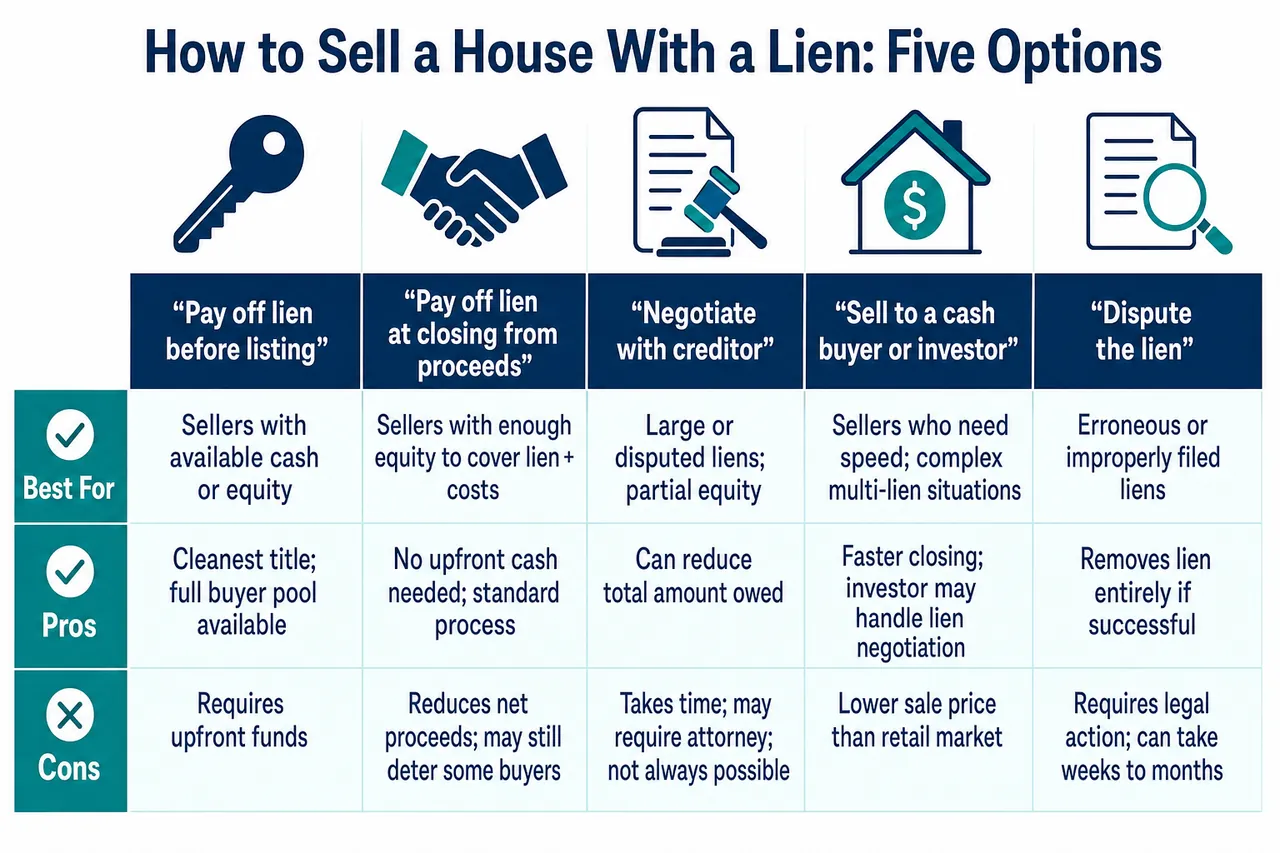
No single path works for everyone. Your best move depends on your equity, the type and amount of lien you're facing, whether the lienholder will negotiate, and how fast you need to close. Before you decide on anything, talk it through with a qualified attorney or housing counselor — it's worth the conversation.
| Option | Best For | Pros | Cons |
|---|---|---|---|
| Pay off lien before listing | Sellers with available cash or equity | Cleanest title; full buyer pool available | Requires upfront funds |
| Pay off lien at closing from proceeds | Sellers with enough equity to cover lien + costs | No upfront cash needed; standard process | Reduces net proceeds; may still deter some buyers |
| Negotiate with creditor | Large or disputed liens; partial equity | Can reduce total amount owed | Takes time; may require attorney; not always possible |
| Sell to a cash buyer or investor | Sellers who need speed; complex multi-lien situations | Faster closing; investor may handle lien negotiation | Lower sale price than retail market |
| Dispute the lien | Erroneous or improperly filed liens | Removes lien entirely if successful | Requires legal action; can take weeks to months |
Option 1: Pay Off the Lien Before or at Closing
The title or escrow company handles most of the work. They collect the payoff amount, wire it to the lienholder, and get back a release that clears your title. This is the most common way liens get resolved, and it's straightforward if you have enough equity — meaning your sale price exceeds all your liens plus closing costs.
If you've got sufficient equity, you don't need to do much. Just give the title company account information for each lienholder. For context, the median existing-home sale price was $417,500 as of September 2026 (NAR). If your home's in that ballpark and your liens aren't huge, this path is probably your easiest.
Don't forget closing costs. Average total closing costs for a single-family home sale run about $6,800 (ClosingCorp data, 2026), and that number's climbing as home values rise. You need to factor that into whether you actually have enough equity to walk away with money.
Option 2: Negotiate With the Lienholder
Many lienholders will take less than what you owe. The IRS does it regularly. When they know waiting for full payment could take years, partial payment guaranteed right now starts looking pretty good.
The IRS, for instance, will withdraw a filed Notice of Federal Tax Lien if you set up a direct-debit installment agreement and your balance is $25,000 or less (2026, IRS Fresh Start program). For bigger balances, options like an Offer in Compromise or certificate of discharge might be available. Contractor lienholders often settle for a percentage of what they're owed because they know a sale is happening and they'll actually get paid. Judgment creditors negotiate too — collecting without forcing a sale is their real problem.
Get any settlement deal in writing before you close. No handshake agreements.
Option 3: Dispute an Erroneous Lien
Did someone file a lien on the wrong property? File one for work you never authorized? List a debt that's already paid? You can fight back. Send a formal written dispute to the lienholder. If they won't respond or release it voluntarily, you can file a legal action to quiet title and get a court to remove it.
This isn't fast. Depending on court schedules and how responsive the lienholder is, you're looking at weeks to several months. You'll almost certainly need a real estate attorney. Get written fee estimates from at least two lawyers before you commit.
Option 4: Sell to a Cash Buyer or Real Estate Investor
Cash buyers and investors don't need mortgages, so the strict lender requirements for a perfect title don't apply the same way. Many experienced investors know how to negotiate liens and factor that work into what they'll offer you.
This is often your fastest option when you've got multiple liens, your timeline is tight, or you can't afford to spend months fighting creditors. You'll get less money than you would on the retail market. But that lower price might still be your best outcome if the alternative is a long, expensive legal battle.
Option 5: Address a Short-Sale Situation
If your home is worth less than everything you owe — including your mortgage — you're underwater. A short sale lets you sell for less than your total debt, but your mortgage lender has to approve it. And so does every other lienholder.
Forgiven debt in a short sale can count as taxable income. The rules around Cancellation of Debt (COD) income shift with tax law changes. Talk to a tax professional before you close to understand what you're really looking at. And before you sign anything, call a HUD-approved housing counselor — you can find one at HUD.gov at no cost.
Back to topWhat Happens If You Don't Have Enough Equity?

Negative Equity and Insufficient Proceeds
Your sale price doesn't cover everything — all the liens, plus closing costs. That's when things get tricky. You've got four real options here: bring cash to closing to make up the shortfall; pursue a short sale if the lienholders will agree to it; negotiate reduced payoffs directly with junior lienholders; or look into loan modification or refinancing if staying put is still your plan. Each choice hits your finances and credit score differently. For the tax side of this puzzle, check out Can You Sell a House With Back Taxes Owed? — we've got state-specific guides for California, Colorado, Florida, Indiana, and Tennessee that dig into how this works in your state.
Homestead Exemptions
Most states protect part of your home's equity through what's called a homestead exemption. It shields your primary residence from certain creditors. But protection amounts swing wildly state to state. Some states offer just a few thousand dollars. Florida and Texas? Essentially unlimited. Homestead exemptions typically block judgment liens, but they don't touch mortgage liens, tax liens, or mechanic's liens. And rules differ everywhere. Don't guess based on what you heard from someone in another state. Call your state's statutes office or talk to a local attorney instead.
Foreclosure Risk
Ignore a lien long enough, and the lienholder can force a sale through foreclosure to get paid. Numbers matter here. As of Q3 2026, 0.71% of mortgage loans were actively in foreclosure, and 4.42% of all mortgage loans were delinquent. You're not alone if you're facing this. Lenders and servicers have worked with struggling borrowers for years — they have systems in place, and foreclosure isn't their first move. And if you're behind on your mortgage right now, contact your servicer. Ask them about loss mitigation options. Early contact matters.
Back to topMultiple Liens: Priority Order Matters
Your property could have multiple liens on it. At closing, they get paid in a strict legal order—and not all of them will necessarily get paid in full. Property tax and government liens come first. Your first mortgage is second. Everything else recorded after that lines up based on when it was filed. Here's what complicates things: some HOA liens have what's called "super-priority" in certain states, meaning they can jump ahead of your first mortgage (though only for a limited amount). If the sale doesn't bring in enough money, lower-priority lienholders get whatever's left—or nothing. That's why each one of them has to sign off on releasing their lien before you can sell.
Coordinating with multiple lienholders at once? That's genuinely complicated. You'll want a title attorney or someone at the escrow company who knows what they're doing.

Timeline Expectations
How long does it take to sell a house with a lien? The answer depends on three big things: what kind of lien you're dealing with, whether the lienholder will work with you, and which path you pick to resolve it. The ranges below are realistic, but your actual timeline will swing based on your state, how fast the courts move, and how quickly the creditor responds.
| Scenario | Estimated Timeline from Decision to Closing | Key Variable |
|---|---|---|
| Single mortgage lien, paid at closing | 30–45 days (standard sale) | Normal lender payoff request time |
| HOA or small judgment lien, paid at closing | 30–60 days | Lienholder's speed issuing release |
| IRS federal tax lien — certificate of discharge | 60–120+ days | IRS processing time for discharge application |
| Contractor lien negotiation | 30–90 days | Contractor's willingness to negotiate and respond |
| Disputed / erroneous lien, legal action required | 3–12 months | Court scheduling; lienholder response |
| Multiple liens, short sale | 3–6 months or longer | All lienholder approvals required |
| Sale to cash buyer with lien negotiation | 14–45 days | Investor's speed and lienholder cooperation |
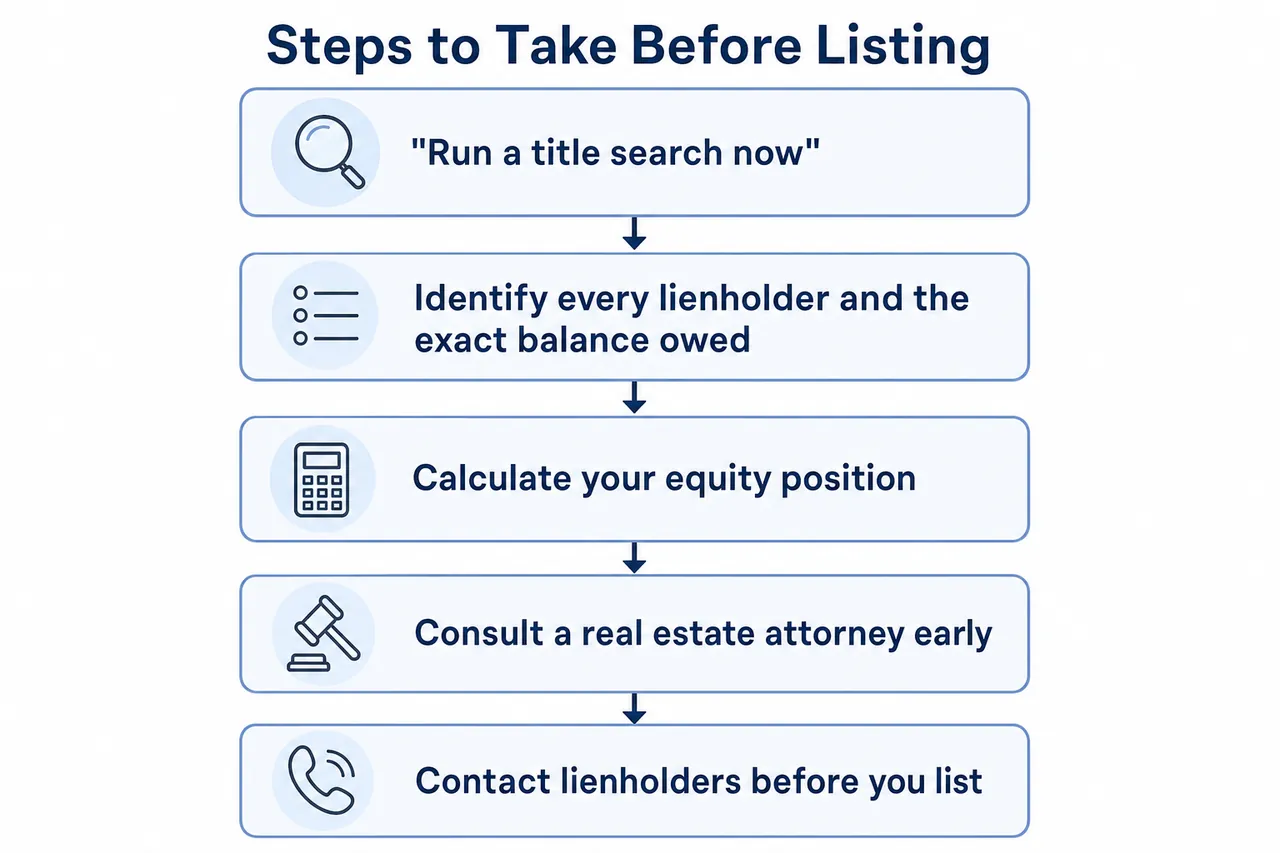
Steps to Take Before Listing
- Run a title search now. Before you list, spend $75–$250 on a professional title search. You need to know what liens are attached to your property before a buyer's offer puts you on a clock.
- Identify every lienholder and the exact balance owed. This isn't a one-time call. Contact each lienholder directly and ask for a formal payoff statement in writing. Interest and fees change constantly, so you need a document with an expiration date attached.
- Calculate your equity position. Take your expected sale price. Subtract every lien payoff amount plus your closing costs. What's left? That's what you're actually working with.
- Consult a real estate attorney early. Lien law, priority rules, and negotiation leverage shift from state to state. One consultation now costs way less than a closing that falls apart later.
- Contact lienholders before you list. Don't wait until you're under contract. Call the IRS, judgment creditors, and other lienholders first. Early conversations give you breathing room and more negotiating power.
- Explore free assistance. HUD-approved housing counselors won't charge you anything. Visit HUD.gov to find one near you. Watch out for for-profit companies promising "debt relief" or "lien removal"—many charge huge upfront fees, and some are targeting homeowners in tough situations on purpose.
Credit and Financial Record Implications
Your credit score has likely already taken a hit from the recorded lien itself. The underlying debt—say, a judgment—often comes with collection activity that damages your score even before the lien shows up. Paying off the lien, settling it, or getting a negotiated release will stop the bleeding, but that delinquency history doesn't just disappear. It stays on your credit file for years, following the timelines set by federal and state credit reporting laws.
Settling for less than what you owe? That's where taxes get tricky. The difference between what you pay and what you actually owed might count as taxable income. You'll want to verify the current rules with a tax professional before you sign anything, since this part of tax law shifts more often than you'd think.
Back to topLiens and Mortgage Refinancing
When you refinance, a lien creates the same roadblock it does when you sell. The new lender will spot it during the title search. They won't approve your refinance until it's gone. And if you're counting on a cash-out refinance to pay off that lien? That only works if the lien is small relative to your equity—which is rare in real situations. Most of the time, you'll need to clear the lien before closing, or at the same time you close, just like you would for a sale.
Back to topPrevention: How to Avoid Future Liens
- Get lien waivers from contractors before you hand over that final payment. A signed lien waiver protects you from subcontractor claims you didn't even know existed.
- Stay current on property taxes and HOA dues. These pile up fast—and they come with penalties and interest stacked on top. They're the most common involuntary liens out there.
- Address IRS correspondence promptly. You'll typically get multiple notices before the IRS files an NFTL. Respond early, and you've got options like installment agreements or offers in compromise. Wait until after the lien hits your record, and those doors start closing.
- Use title insurance when you purchase. Your owner's title insurance policy catches liens and encumbrances that existed before you bought the place but somehow slipped through the title search.
Summary
Thousands of homeowners sell houses with liens every year. It's entirely possible. The lien won't stop your sale—but it will stop you from handing over a clean title until that debt gets paid off. What you do next depends on three things: what kind of lien it is, whether you have equity, and whether the lienholder will work with you. If you've got positive equity and a cooperative lienholder, paying off the lien at closing is usually simple. But larger or messier liens might call for negotiation, a legal fight, or selling to a cash buyer who'll handle the whole mess.
Start here: Get a professional title search done. Know your numbers—calculate your equity position honestly, not optimistically. Then find a qualified attorney in your state and call the lienholder early. Don't wait.
And you don't have to pay for advice. HUD-approved housing counselors offer free help.
Back to topFrequently Asked Questions
Can a house with a lien be sold without the lienholder's knowledge?
Not legally with a clear title. During a title search, every recorded lien gets flagged. Your closing or escrow agent is legally bound to pay off those liens from the sale proceeds before you see a dime. If you try to hand over the deed without disclosing or settling a known lien, you're opening yourself up to fraud charges.
What if I don't have enough equity to pay off the lien?
You've got options. Bring cash to closing to cover the shortfall. Pursue a short sale if the lienholder agrees. Negotiate a reduced payoff amount. Or if you're staying in the home, explore loan modification. Each path has different financial and credit consequences — there's no one-size-fits-all answer.
Before you decide, talk to a HUD-approved housing counselor (they're free at HUD.gov) or a real estate attorney. Don't go it alone on this one.
Can the IRS really negotiate down what I owe on a tax lien?
Yes. The IRS has actual tools designed for this. An Offer in Compromise lets you settle for less than the full amount. A certificate of discharge removes the lien from your specific property during a sale—even though the debt stays on your record. And if your balance is $25,000 or less and you set up a direct-debit installment agreement, the IRS can withdraw the lien entirely.
For the full breakdown on navigating this, check out Selling a House with an IRS Lien: Process and Solutions.
How long does a lien stay on my property if I do nothing?
That depends on what kind of lien it is and where you live. An IRS federal tax lien self-releases 10 years from the date of assessment under IRC §6325(a)(1), unless extensions push that deadline back. Mechanic's liens? They typically expire within one to several years if the contractor doesn't file a foreclosure action—your state law sets the exact deadline. Judgment liens have a fixed duration that varies by state and can often be renewed.
And waiting around doesn't make liens vanish, and the debt underneath keeps collecting interest.
Should I try to sell my liened property myself or hire a professional?
If you're dealing with an involuntary lien—an IRS lien, a judgment lien, or multiple liens stacked on top of each other—get professional help. A real estate attorney negotiates with lienholders, challenges liens that shouldn't be there, and works with the title company to get the closing sequence right. That lawyer's fee is almost always cheaper than a failed closing or a lawsuit from a botched lien situation.
Get written fee estimates from at least two attorneys before you hire one.
Back to top