

How to Keep Your House in a Divorce: What It Takes in Colorado
You may feel worried about how to keep your house in a divorce, especially with so much at stake. About 90% of divorce settlements involve the marital home or real estate as a key asset. 3 This guide covers Colorado-specific property division rules, home equity, and what it takes to keep your house — from understanding mortgage loans to working with a Colorado divorce attorney.
Your next move could shape your future — see how you can protect it. 2
Key Takeaways
- About 90% of divorce settlements involve the marital home or real estate as a key asset 3.
- Colorado is an equitable distribution state, meaning the marital home is divided fairly — not necessarily 50/50 — based on factors like each spouse's financial situation, contributions to the marriage, and child custody needs.
- To keep your house, you must first know its current value and your share of equity. If your Denver-area home is worth $500,000 and you owe $300,000 on the mortgage, there is $200,000 in equity to divide.
- You can keep the house by buying out your ex-spouse's share using savings, retirement funds (with tax risks), or cash-out refinancing. Lenders require credit scores of at least 620 for conventional loans or 580 for FHA loans, plus two years of steady income.
- If housing costs exceed 35% of your income after divorce, selling and splitting proceeds may be the smarter path. Federal capital gains tax rules protect up to $250,000 profit for single filers ($500,000 married). Colorado does not have a separate state capital gains tax, but income from a home sale may affect your Colorado state income tax return.
Understanding Your Options

Facing divorce in Colorado can leave you with tough choices about your marital home. You have several paths forward, each affecting your property ownership and financial future in its own way.
Keeping the house through a buyout
To keep the marital home after a Colorado divorce, you must create a reasonable buyout offer for your spouse. Start by getting a professional home appraisal to establish current market value. Subtract any mortgage debt from this amount to calculate home equity. For example, if your Colorado Springs home is valued at $450,000 and you owe $280,000 on the mortgage, there is $170,000 in equity to divide.
You can fund a buyout with cash from savings, retirement accounts, or through cash-out refinancing using FHA or VA loans. Some spouses trade other assets — such as retirement accounts — in exchange for full property ownership. Trading retirement funds carries tax risks and long-term growth consequences, so review this carefully with a financial adviser.
Make sure child support obligations and legal fees do not overwhelm your budget. Colorado courts will want to see that any proposed arrangement is financially sustainable, especially when children are involved.
Selling the house and splitting the proceeds
Selling the marital home and dividing proceeds is often the cleanest solution when neither spouse can afford to keep it. After paying off the mortgage, any home equity loans, and closing costs, you split what remains per your Colorado divorce settlement.
Federal capital gains tax applies to profits over $250,000 for single filers; married couples filing jointly are exempt up to $500,000 in profit under IRS rules. Colorado taxes income at a flat rate, and profit from a home sale that exceeds federal exclusion thresholds may be included in your Colorado taxable income. Keep careful records of the original purchase price and major improvements, as these affect your cost basis and capital gains calculations.
In competitive markets like Denver or Aurora, a well-priced home can sell quickly — potentially giving both parties a faster financial resolution than years of co-ownership.
Co-owning the house temporarily
Co-owning the marital home after a Colorado divorce can help maintain stability for your children. 1 Colorado courts can allow joint ownership if both parties agree and sign a written co-ownership agreement spelling out who pays the mortgage, property taxes, insurance, and repairs. Missed payments on a shared mortgage hurt both credit scores.
Many divorcing Colorado couples choose joint ownership while waiting for better market conditions or while one spouse builds credit to qualify for refinancing. 1 Include co-ownership terms in your parenting plan and legal documents to limit future disputes. If ongoing co-ownership becomes unworkable, a buyout or sale remains an option.
Financial Requirements to Keep the House

You need a clear picture of your home equity and property value before making any decisions. Colorado mortgage lenders will review your credit score, income, and debt-to-income ratio to determine whether you qualify for a new loan or mortgage assumption.
Appraising the home and calculating equity
Start with a professional appraisal or comparative market analysis (CMA) to get an accurate property valuation. A certified appraiser will review recent comparable sales in your area and assess your home's condition. Lenders require this step for any refinanced loan or buyout. 2
Subtract the current mortgage balance from the appraised value to find home equity. In Colorado, this equity is treated as a marital asset subject to equitable distribution under state law. Colorado courts divide marital property based on fairness, considering factors such as each spouse's economic circumstances, contributions to the marriage, and the needs of any children. 3
Qualifying for refinancing or assuming the mortgage
Lenders look at your income, credit score, and debt-to-income (DTI) ratio before approving a refinance or mortgage assumption. Most require a credit score of at least 620 for conventional loans or 580 for FHA refinancing. Your DTI should be below 43% to improve approval odds.
Cash-out refinancing lets you borrow against the home's equity to pay out your ex-spouse's share. Expect the process to take 30 to 60 days after finalizing divorce papers — Colorado lenders typically won't approve loans until the Decree of Dissolution of Marriage is issued by the court. Review your credit report and bank statements early to avoid surprises.
Understanding credit score, debt-to-income ratio, and income requirements
Credit scores below 700 can mean higher mortgage rates or difficulty qualifying for refinancing after a Colorado divorce. 4 Your DTI — all debts including credit cards, car loans, and the new mortgage — must stay under 43% of gross monthly income. 5
Income requirements are stricter once you go from two incomes to one. Most lenders require two years of steady earnings documented with pay stubs or tax returns. If you receive spousal maintenance (alimony) or child support under a Colorado court order, some lenders will count that income — but it must be documented and likely to continue for at least three years.
Calculating If You Can Afford It
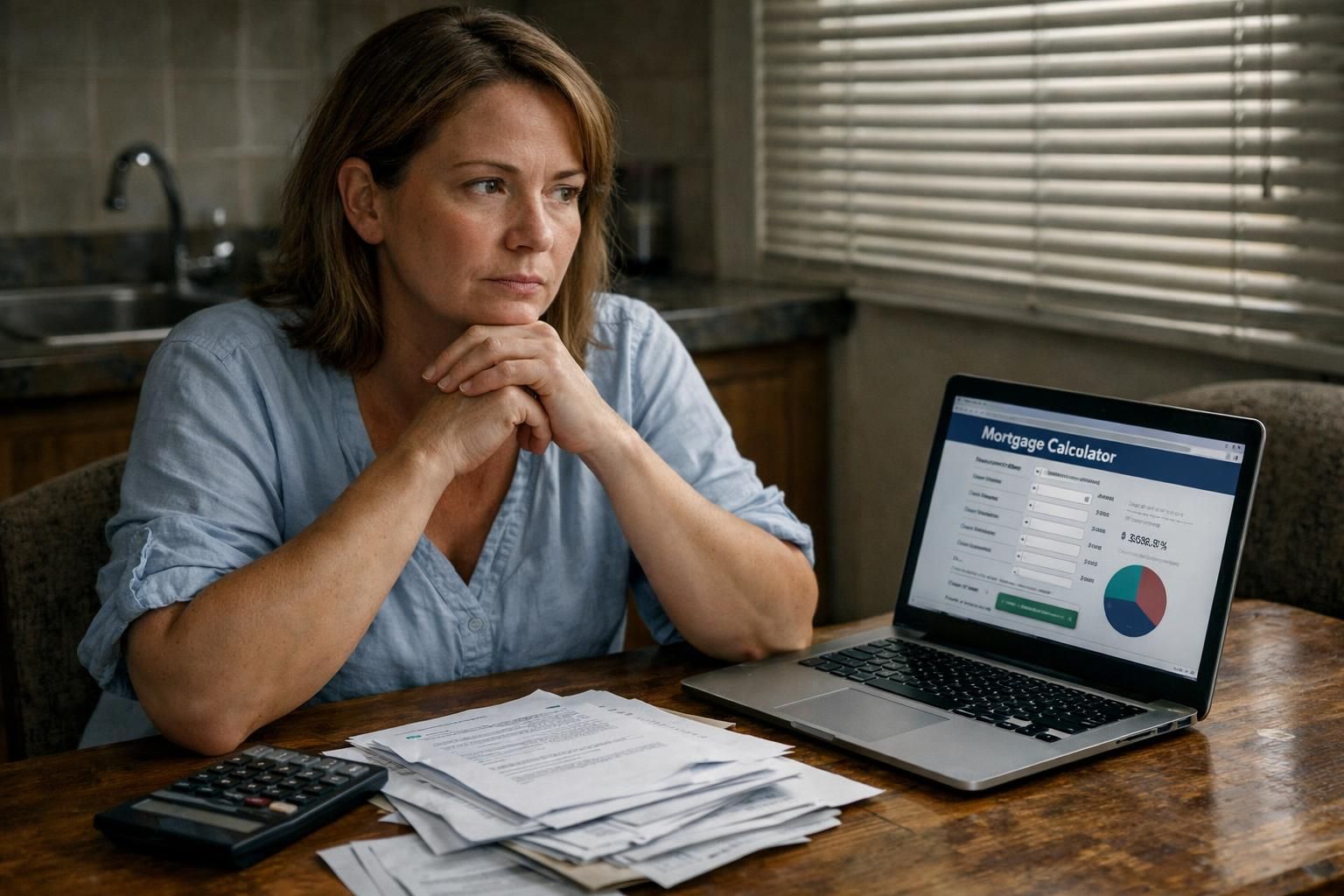
To see if you can truly afford to keep your Colorado home, compare your income and debts against all housing costs — mortgage, property taxes, insurance, and maintenance — before committing to a buyout or refinance.
Budgeting for mortgage, taxes, insurance, and maintenance
Monthly housing expenses can add up fast after a Colorado divorce. 6 Keep total housing costs under 35% of your income. Colorado property taxes vary significantly by county — Denver County and Jefferson County homeowners pay at different effective rates, so confirm your actual tax bill with your county assessor. Include utilities and potential repairs; even routine Colorado maintenance like snow removal, roof upkeep, and HVAC servicing adds real cost year-round.
Colorado has a property tax exemption program for qualifying senior homeowners, but most divorcing homeowners in their prime working years won't qualify. Track your original purchase price and improvement costs carefully for future capital gains calculations. 7
Applying the 28/36 rule to assess financial feasibility
Under the 28/36 rule, housing expenses should not exceed 28% of gross monthly income, and all debt payments combined should stay below 36%. Banks set an absolute ceiling at a DTI of 43%, but staying closer to 36% gives you more financial cushion.
Colorado's strong housing market — particularly in the Denver metro and Front Range — means home values and property taxes have risen sharply in recent years, making solo ownership more expensive than many divorcing spouses expect. If housing costs will exceed 35% of your post-divorce income, carefully weigh whether keeping the home truly serves your long-term financial health.
Legal and Divorce Settlement Considerations in Colorado

Colorado's divorce laws govern how the marital home is divided. Understanding how courts treat property — and the role of quitclaim deeds — can protect your rights during settlement.
Colorado is an equitable distribution state
Unlike community property states such as California or Arizona, Colorado uses equitable distribution. This means the marital home and other assets are divided fairly, but not necessarily equally. Colorado courts consider factors including each spouse's financial resources, contributions to the marriage (including homemaking), and the economic circumstances each party will face after divorce.
If children are involved, a Colorado judge may allow the custodial parent to remain in the family home to preserve stability — particularly if doing so aligns with the children's best interests under the court's parenting time analysis. If both spouses want the home but cannot agree, the court may order its sale and divide the proceeds equitably.
Colorado divorce cases are handled in district court. The process begins with filing a Petition for Dissolution of Marriage, and Colorado requires a 91-day waiting period before a decree can be entered. Complex asset cases — including disputed home valuations — often take longer to resolve.
The importance of quitclaim deeds and refinancing
A quitclaim deed transfers your ex-spouse's ownership interest in the marital home to you, making you the sole owner of record. However, a quitclaim deed does not remove your ex from the mortgage — only refinancing or a formal mortgage assumption accomplishes that.
In Colorado, quitclaim deeds must be signed, notarized, and recorded with the county clerk and recorder in the county where the property is located. After refinancing is complete and the deed is recorded, your ownership and financial responsibility are clearly separated.
Refinancing requires at least a 620 credit score for conventional loans or 580 for FHA. Expect closing costs of 2% to 5% of the new loan amount. If you cannot qualify for refinancing within a time period set by your Colorado divorce decree, the court may order the home sold.
Steps to Keep Your House in Colorado

Appraise the home and review finances
Arrange a professional appraisal or comparative market analysis to determine your Colorado home's current market value. Subtract the outstanding mortgage balance to calculate equity. 2 List every ongoing cost — mortgage, insurance, property taxes, HOA fees if applicable, utilities, and maintenance — and compare them to your projected post-divorce income. 8 Check your current debt-to-income ratio and factor in any child support obligations or spousal maintenance payments that may affect your budget.
Negotiate buyout terms and finalize the settlement agreement
Use a certified appraisal to agree on a fair home value, then calculate each spouse's equitable share based on Colorado's distribution standards. Work with a Colorado divorce attorney or mediator to document all terms. You can fund a buyout using cash savings, retirement accounts (understand the tax consequences), or structured installment payments.
Your settlement agreement should specify who pays legal fees, what happens if a payment is missed, and the timeline for completing refinancing or a property transfer. Make sure quitclaim deed language and new loan documents match the terms of your Decree of Dissolution of Marriage before signing anything. 2
Complete refinancing and execute the quitclaim deed
Refinance the mortgage into your name alone to take full financial responsibility for the property. Provide lenders with two years of income documentation and meet credit score and DTI requirements. Budget for closing costs of 2% to 5% of the loan amount.
Once refinancing closes, have your ex-spouse sign a quitclaim deed and record it with your county clerk and recorder's office. Colorado lenders typically require your Decree of Dissolution of Marriage before finalizing the loan. Completing both steps — refinance and deed recording — gives you clean legal title and protects both parties going forward.
When Keeping the House Doesn't Make Sense
Sometimes, holding onto the marital home in Colorado stretches your finances too thin or delays a fresh start. Reviewing your loan-to-value ratio and consulting with a Colorado divorce attorney can help you make a clear-eyed decision.
Financial red flags and emotional considerations
Key warning signs include: being unable to qualify for refinancing within the timeframe set by your decree; needing most of your savings for a buyout; facing over $20,000 in essential repairs; or finding that housing costs exceed 35% of your post-divorce income. Colorado's rising Front Range home values and property tax increases in recent years have made solo ownership increasingly difficult for many.
Divorce stress can lower your credit score, limiting access to FHA or VA refinancing. Decisions driven by emotional attachment rather than financial reality often lead to problems down the road. If keeping the home requires tapping retirement accounts, consult a financial adviser about taxable events and long-term impacts before agreeing to any terms.
Exploring alternatives for a fresh start
Selling the marital home and splitting proceeds can provide a clean financial break and allow both spouses to start fresh. Colorado's real estate market — particularly in the Denver metro — has generally supported strong sale prices, which can mean meaningful equity for both parties even after transaction costs.
Other options include renting after the sale, downsizing, or using a home equity line of credit toward new living arrangements. Mediation in Colorado can produce creative solutions like temporary co-ownership or birdnesting arrangements that keep children stable while both parents regain financial footing. Exploring these alternatives now may help you avoid future capital gains complications and financial stress.
Conclusion
Keeping your house after a Colorado divorce takes careful planning, realistic budgeting, and sound legal guidance. Colorado's equitable distribution standard means outcomes vary depending on your circumstances — which is why working with a knowledgeable local divorce attorney matters.
Check whether you qualify for refinancing, review every cost tied to the home, and weigh your long-term financial security honestly. Your home may feel essential, but the smartest decision today lays the groundwork for a stable tomorrow.
If keeping the home isn't the right fit, KDS Homebuyers can help. We buy houses directly from Colorado homeowners for cash — no repairs, no listing, no waiting. Visit kdshomebuyers.net to request your free cash offer and get clarity on your next step.
FAQs
1. How does Colorado divide the marital home in a divorce?
Colorado is an equitable distribution state. Courts divide marital property — including the home and its equity — based on fairness, considering each spouse's financial situation, contributions to the marriage, and the needs of any children. This does not always mean a 50/50 split.
2. What role does child custody play in keeping the house in Colorado?
Colorado courts may allow the custodial parent to remain in the family home to preserve stability for children. Parenting time arrangements and child support obligations often factor into decisions about who keeps the marital home.
3. How is home equity calculated during a Colorado divorce settlement?
Home equity equals your home's current appraised value minus any outstanding mortgage or home equity loan balances. This figure is treated as a marital asset and divided equitably under Colorado law.
4. Can retirement accounts affect my ability to keep my house after a Colorado divorce?
Yes. Colorado courts can consider retirement accounts alongside real estate when dividing marital assets. A spouse may agree to give up part of a retirement account in exchange for full ownership of the home — but tax consequences must be evaluated carefully.
5. Are there Colorado-specific tax considerations when keeping or selling the home?
Federal capital gains exclusions ($250,000 single / $500,000 married) apply. Colorado does not impose a separate state capital gains tax, but any taxable gain from a home sale is included in Colorado taxable income, which is taxed at a flat state rate. Consult a tax professional for your specific situation.
6. Should I hire a Colorado divorce attorney to help keep my house?
Yes. A Colorado divorce attorney can advise you on equitable distribution rules, draft and review settlement agreements, ensure quitclaim deeds and refinancing documents align with your court decree, and represent your interests if the case goes before a district court judge.
References
- ^ https://www.divorcenet.com/resources/divorce/marital-property-division/continue-co-own-house-after-a-
- ^ https://www.homelight.com/blog/how-to-keep-the-house-in-a-divorce/
- ^ https://digitalcommons.law.uga.edu/cgi/viewcontent.cgi?article=1946&context=fac_artchop
- ^ https://www.northshorerealtors.com/news/considerations-for-retaining-the-marital-home-after-a-divorce
- ^ https://institutedfa.com/surviving-financially-after-divorce-1/
- ^ https://www.prosperityplanninginc.com/blogs/financial-planning-for-the-marital-home-in-divorce
- ^ https://pmc.ncbi.nlm.nih.gov/articles/PMC9303434/
- ^ https://corient.com/us/en/insights/articles/should-you-keep-the-house-when-divorcing
