Sell My House As Is for Cash: Fast Sales Without Repairs

Table of Contents
- What Does It Mean to Sell Your House As-Is for Cash?
- Step-by-Step Process for Selling Your House As-Is for Cash
- How Fast Can You Actually Close?
- Types of Cash Buyers: Who Will Buy Your House?
- Pros of Selling Your House As-Is for Cash
- Cons of Selling Your House As-Is for Cash
- How Much Lower Will a Cash Offer Be? Understanding the Real Numbers
- Cash Sale vs. Traditional Sale: Side-by-Side Comparison
- Vetting and Finding Legitimate Cash Buyers
- Tax Implications of Selling Your House As-Is for Cash
- Is Selling Your House As-Is for Cash Right for You?
- Conclusion: Matching the Tool to the Problem
- Frequently Asked Questions
You can sell your house as-is for cash. A cash buyer takes your property in whatever condition it's in right now—no repairs, no improvements, nothing. Closing happens in 7–14 days instead of the 30–60 days you'd wait with a traditional financed sale. But there's a real cost to that speed: cash offers typically come in below market value, and sometimes the gap is substantial. Whether you should take that deal depends on three things: how urgently you need to sell, what your timeline actually is, and whether you can afford to walk away from some of your equity.
Selling a house that needs work? Start with what to know before selling a house that needs repairs. It explains what as-is means, how pricing works and every way to sell a house with problems.
This article is educational and informational only. It's not legal, tax, or financial advice. Tax rules, disclosure requirements, and closing procedures vary by state. Consult a licensed attorney, CPA, or real estate professional for guidance specific to your circumstances.

What Does It Mean to Sell Your House As-Is for Cash?
"As-is" means the property sells in its current condition. You don't repair anything. You don't renovate. You don't paint or replace the roof. The buyer accepts what's there — damage, wear, everything.
"Cash" doesn't mean someone shows up with a briefcase of bills. It means the buyer has the money sitting in the bank already, ready to close without a mortgage. No lender means no appraisal, no underwriting delays, no contingencies waiting to kill the deal.
But here's what matters: selling as-is doesn't erase your legal obligation to tell the buyer about known problems. Each state has its own disclosure rules about what you must reveal and when. And one federal requirement hits every homeowner — if your house was built before 1978, you're required by the Residential Lead-Based Paint Hazard Reduction Act to give buyers a lead-based paint disclosure. Before you list, call your state's real estate commission or talk to a real estate attorney about what you're legally required to disclose.
Cash sales aren't rare. From January through April 2026, 31.4% of all U.S. home sales were all-cash transactions, according to Realtor.com deed-record data. The numbers shifted slightly by fall — NAR's September 2026 data showed all-cash sales at 27%. Either way, cash buyers make up a real chunk of the market, and they're actively looking.
Back to topStep-by-Step Process for Selling Your House As-Is for Cash
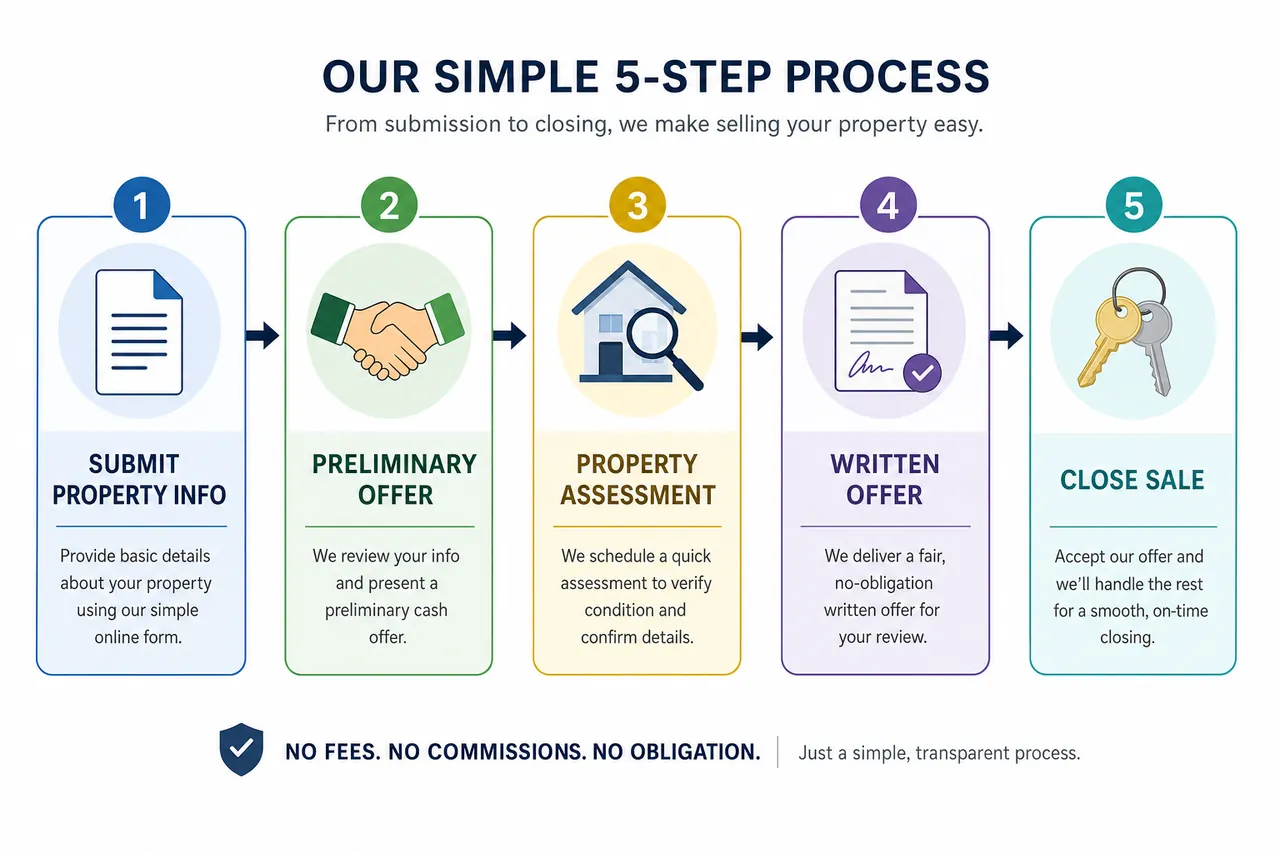
You'll find this faster than listing with a realtor. But it's still orderly — each step builds on the last one, so you know what's coming and can't get blindsided.
- Submit your property information. Cash buyers accept submissions online or by phone. Local investors, national franchises, iBuyer platforms — they all start the same way. You'll give them your address, property type, rough square footage, and an honest description of what condition it's in. The whole thing takes 5–15 minutes.
- Receive a preliminary offer. You'll get an initial offer within 24–48 hours. Don't treat it like the final number. It's based on limited information and subject to change once someone walks through.
- Schedule a property assessment. This isn't a formal home inspection. A cash buyer's walkthrough is usually quick — 20–30 minutes of looking around. They're checking how much work the place needs and whether what you told them about the condition is accurate. You don't need to fix anything before they show up.
- Receive a firm written offer. After the walkthrough, you'll get a revised offer in writing. And this one counts. Study it closely. What deductions or fees are they factoring in? What credits are they offering?
- Review, negotiate if possible, and sign. You're not locked in. If you decide to sign, make sure the purchase agreement spells out the closing date, any remaining conditions, and what happens to earnest money if someone walks away. Have a real estate attorney look at the contract if you're uneasy about any part of it.
- Close on your chosen date. No mortgage lender means no waiting. Closing can happen in as few as 7–14 days. A title company or closing attorney still handles title work — that step happens in every legitimate sale, regardless of how fast everything else moves.
How Fast Can You Actually Close?
Speed. That's the main reason homeowners turn to cash sales. But what does the timeline actually look like?
Cash transactions close in 7–14 days, while financed sales take 30–60 days, according to 2026 data. Why the difference? Mortgage-backed purchases require underwriting, appraisal, title search, and lender approval. Each one adds days and risk. You eliminate the lender, you eliminate most of those delays.
But nothing closes in a vacuum. Several things can slow you down:
- Title issues — liens, unresolved judgments, or unclear ownership chains require time to clear regardless of how the buyer is paying.
- Estate and probate situations — if the property is part of an estate, court approval may be required before sale.
- Seller's own timeline — if you need extra time to move, most cash buyers can accommodate a delayed closing date.
- Buyer due diligence — some buyers include a brief inspection or financing verification period even in cash deals.
That 7–14 day close? It happens when your title is clean and both sides are ready. If there are title problems, add time to the calendar.
Back to topTypes of Cash Buyers: Who Will Buy Your House?

Cash buyers aren't all equal. When you understand who's actually buying — and why they're offering what they're offering — you can evaluate offers much more intelligently.
Local Real Estate Investors and House Flippers
These folks buy properties, fix them up, then either flip them for resale or keep them as rentals. They operate fast and they'll buy almost anything. But here's what matters: their business only works if they pocket a significant profit after renovation costs. That's why local investors typically offer 15%–30% below market value as of 2026. The worse the condition, the steeper the discount gets.
"We Buy Houses" Companies and Franchises
HomeVestors ("We Buy Ugly Houses") and similar national brands operate the same way everywhere. You know what to expect, and you won't be surprised by the process. They close fast—that's their reputation—but the math is the same: they need renovation profit built in. Want a predictable closing in days with zero fees? KDS Homebuyers' We Buy Houses program closes in days with no fees or repair requirements. That matters when you need out fast.
iBuyers (Technology-Enabled Platforms)
Opendoor and Offerpad generate offers through algorithms—no inspector showing up initially. Their headline numbers look better than local investors. iBuyers typically offer 9%–11% below market value as of 2026. But don't celebrate yet. They charge a service fee—around 5% of the purchase price—right off the top. That fee eats into what you actually take home. And they prefer homes in decent shape and often won't touch properties that need serious work.
Individual Owner-Occupant Cash Buyers
These are the people buying with actual cash because they plan to live there. Downsizers. Retirees. People with inheritance money. They don't need to factor in renovation profit margins. You might get closer to real market value from them. Finding them takes longer and timelines are unpredictable, but if your property is in solid condition, it's worth the search.
| Buyer Type | Typical Offer Range | Fees / Additional Costs | Closing Timeline | Best For |
|---|---|---|---|---|
| Local investors / house flippers | 15%–30% below market value (2026) | Usually none beyond standard closing costs | 7–14 days | Heavily distressed properties, urgent timelines |
| "We Buy Houses" franchises | Typically 15%–25% below market value | Usually none; verify upfront | 7–21 days | Sellers wanting a known, repeatable process |
| iBuyers (tech-enabled) | 9%–11% below market value (2026) | ~5% service fee charged to seller | 14–30 days | Moderate-condition homes; sellers comfortable online |
| Individual owner-occupant buyers | Closest to market value; varies widely | Standard closing costs only | 14–45 days depending on circumstances | Properties in good condition; less urgent timelines |
Note: Offer ranges in this table are based on 2026 data cited above. Individual offers depend heavily on property condition, local market, and buyer motivations.
Back to topPros of Selling Your House As-Is for Cash
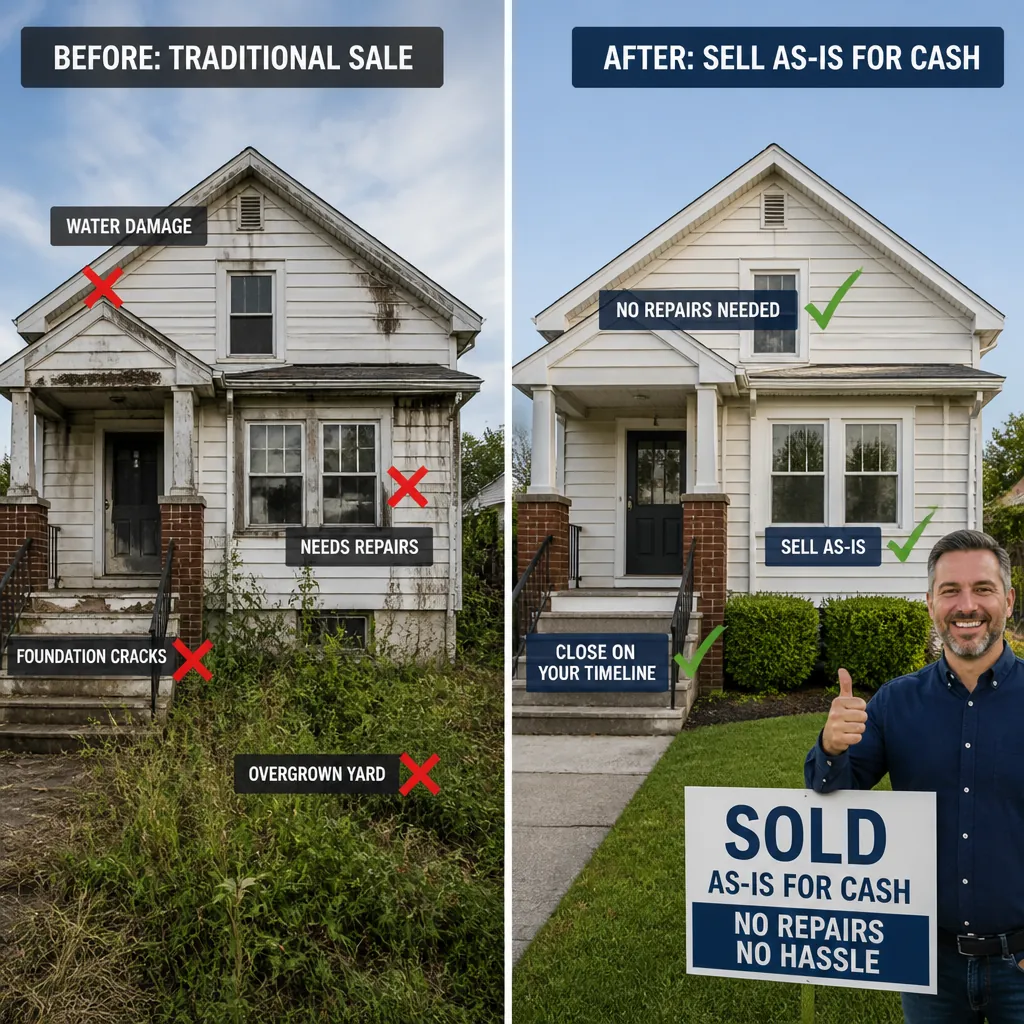
Not everyone needs a cash sale, but if you're in the right situation, the advantages are real and tangible.

- Speed. Seven to fourteen days to closing. If you're staring down a foreclosure notice, relocating for a new job, or managing an estate with a deadline, that speed can save your situation.
- No repair requirements. You won't spend money fixing your roof, replacing flooring, or painting walls. You won't spend weeks coordinating contractors either. According to a 2026 Clever survey, 71% of sellers made repairs before or after listing, spending an average of $27,649. Even if a cash offer comes in lower, skipping that $27k-plus expense can mean you walk away with more money in your pocket.
- No financing contingencies. A buyer's mortgage gets denied two days before closing? Not your problem anymore. Cash buyers bring proof of funds upfront. The lender can't suddenly demand new inspections or require costly repairs at the last minute.
- No appraisal contingency. Financed buyers often make their offer conditional on the home appraising for at least the purchase price. When an appraisal comes in low, the whole deal can collapse or you're forced to negotiate down. Cash buyers don't need an appraisal — unless they specifically want one.
- Certainty. And that matters. Once you've signed with a legitimate cash buyer, the sale is going to close. You can rely on that. In a stressful situation, that predictability has genuine value.
- Useful for specific situations. Are you facing foreclosure or pre-foreclosure? Navigating a divorce? Managing an inherited property, maybe out of state? Trying to exit a problem rental? Relocating for work? These are exactly the moments when a cash sale's speed and simplicity often matter more than the price discount you're giving up. For details about inherited properties specifically, see Sell Inherited House for Cash: Fast Options for Heirs.
Cons of Selling Your House As-Is for Cash
Yes, those advantages exist. But you need to see the full picture, drawbacks included.
- Lower sale price. This is the real cost of a cash deal. You might walk away with 9%–30% below market value, depending on who's buying. Take a home valued at the September 2026 median of $417,500. That discount lands somewhere between $37,575 and $125,250. That's not a small range—and it changes everything about whether this makes sense for your situation.
- Closing costs still apply. The "cash" label doesn't erase these expenses. You're still paying title insurance, transfer taxes, prorated property taxes, and attorney fees at the closing table. Every real estate transaction includes them. For a detailed breakdown, check out Sell Your House for Cash Fast: How to Avoid Hidden Fees.
- Limited negotiation use. Cash buyers have a specific trade-off in mind: they want speed and certainty. They get it at a discount. Most operate with firm internal models, so while you can counter-offer, don't expect the negotiation room a traditional sale gives you.
- Service fees with iBuyers. That headline offer from an iBuyer might look sharper than an investor's proposal. Then you see the ~5% service fee. Always look at your net proceeds, not the gross number on the offer letter.
- Risk of unfair or fraudulent offers. Not every cash buyer is legitimate. This market attracts both real companies and predators. Sellers under financial pressure get targeted frequently. Vet whoever you're considering before you sign anything.
How Much Lower Will a Cash Offer Be? Understanding the Real Numbers
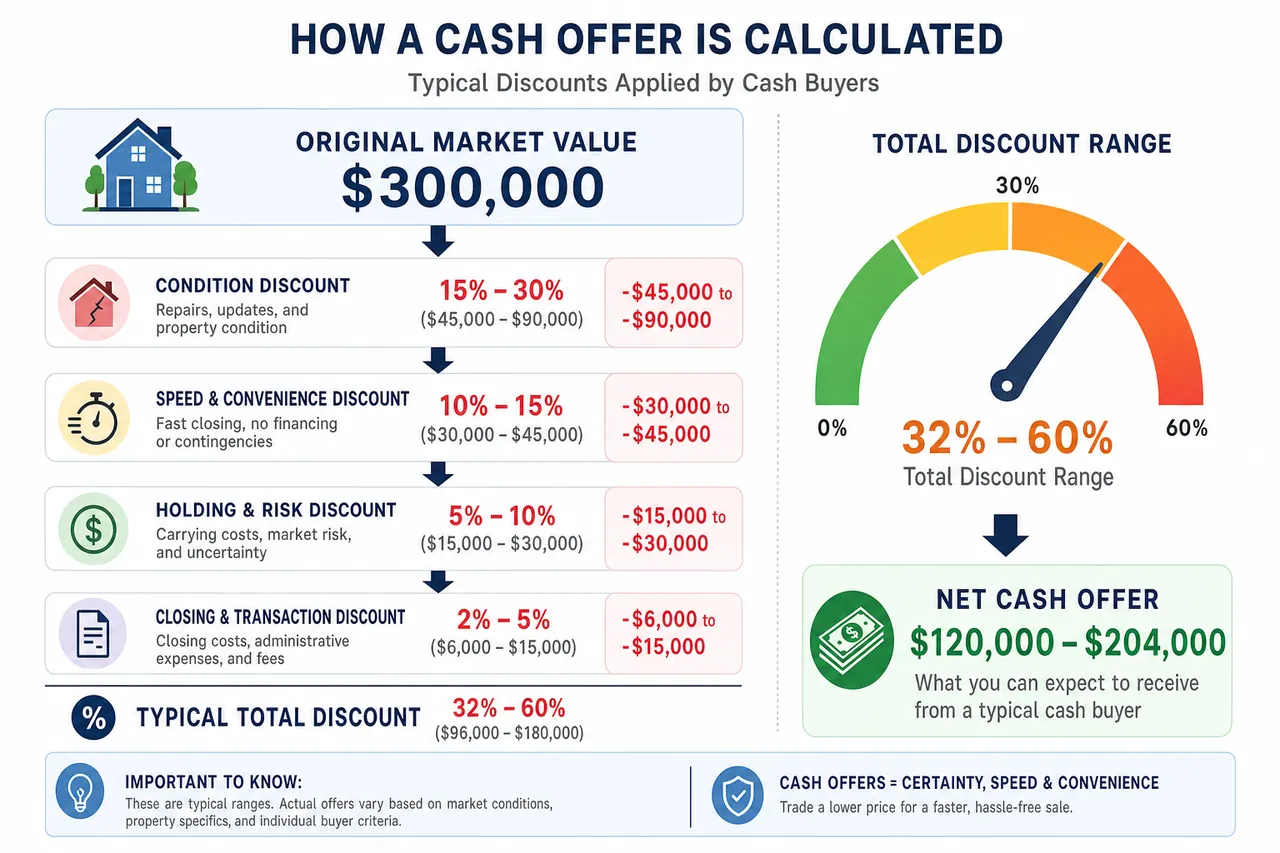
The discount varies significantly by buyer type and property condition. What matters is the actual number you'll walk away with.
The Discount in Dollar Terms
Let's use the September 2026 median existing-home price of $417,500 as our baseline.
- An iBuyer offering 9%–11% below market would propose roughly $372,000–$380,000 before their ~5% service fee. After that fee hits, you're looking at approximately $353,000–$361,000 in your pocket.
- A local investor at 15%–30% below market would offer roughly $292,000–$355,000, and there's no hidden service fee on top — just standard closing costs.
Keep in mind: these are ranges built from median prices and 2026 discount data. Your home might be worth significantly more or less than the national median. And your property's actual condition? That'll push any offer toward the high or low end.
The Repair Cost Offset
Don't ignore what you'd spend to fix things up the traditional way. The average seller spent $27,649 on repairs in 2026. If your roof is shot, your foundation's cracked, or your HVAC system is dying, that cash discount might actually wipe out what you'd otherwise spend repairing and listing. But if you just need paint and new countertops? Traditional listing after those modest fixes will almost certainly put more money in your account. For that route, check out How to Sell a House That Needs Repairs (Without Fixing It Up).
How to Calculate Your Net Proceeds
Don't accept an offer until you've done this math:
- Get a comparative market analysis (CMA) from a local real estate agent. Most give them away for free, and it gives you a solid estimate of what your home's actually worth.
- Subtract the cash offer from the CMA value. That's your gross discount in dollars.
- Subtract closing costs from both scenarios — agent commissions, transfer taxes, staging, and holding costs if you're sitting on the market.
- Compare the net proceeds side by side.
- Put a dollar value on time. If a traditional sale takes 60 extra days, add up 60 days of mortgage payments, property taxes, insurance, and utilities you'd still owe.
That final number — the net comparison, not the gross offer — is what actually tells you if selling for cash makes sense.
Back to topCash Sale vs. Traditional Sale: Side-by-Side Comparison
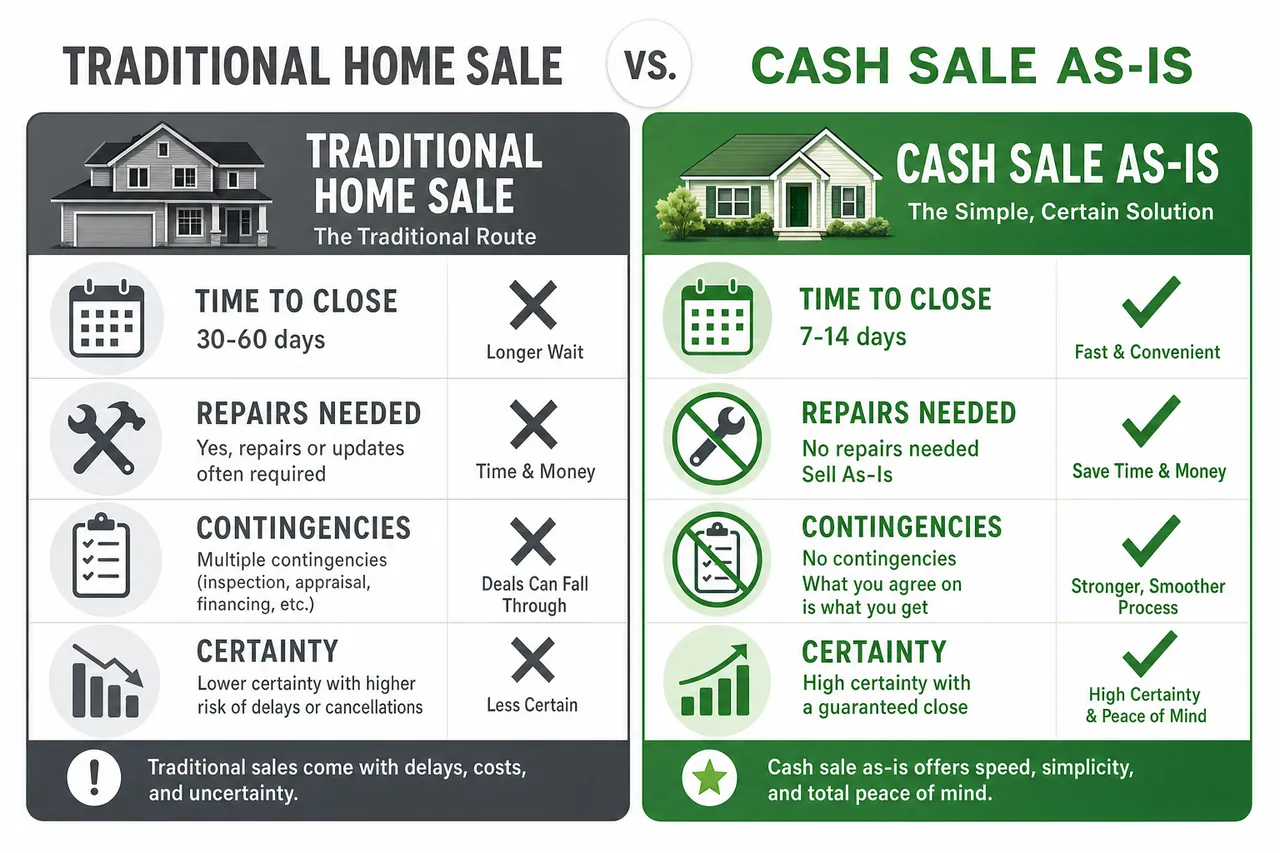
Which path makes sense for your situation? The answer depends on what you need most: speed or maximum profit. Let's look at how they stack up.
| Factor | Cash As-Is Sale | Traditional Financed Sale |
|---|---|---|
| Closing timeline | 7–14 days (2026) | 30–60 days (2026) |
| Typical price received | 9%–30% below market value depending on buyer type | Closer to or at market value with proper preparation |
| Repairs required | None — buyer accepts as-is | Often required; lenders may mandate repairs for financing approval |
| Formal inspection | Brief walkthrough only; no formal inspection contingency | Full buyer inspection typical; results may trigger repair requests |
| Appraisal | Not required | Required by lender; low appraisal can renegotiate or kill deal |
| Financing contingency | None | Standard; deal fails if buyer's loan is denied |
| Closing costs to seller | Closing costs still apply; no agent commission if sold directly | Agent commissions (typically 5%–6% total), plus closing costs |
| Disclosure obligations | Full state disclosure requirements still apply | Full state disclosure requirements apply |
| Best for | Distressed properties, urgent timelines, heavily damaged homes | Move-in-ready or cosmetically updated homes; non-urgent timelines |
Notice the trade-off? You get out in two weeks with a cash sale, but you're looking at losing roughly 9–30% of what your house could fetch on the open market. That's a real number that hits your pocket. A traditional sale takes longer because the buyer needs bank approval and a formal appraisal, but you're much more likely to land closer to actual market value.
And here's what matters when things are falling apart: repairs. With cash, the buyer takes your house exactly as it is. Roof leaking? Foundation issues? Doesn't matter. They own it now. With financing, the lender won't even fund the deal if major problems show up during inspection. You'll either fix them or negotiate a price cut—sometimes both.
One more thing that stings most sellers: if you're using an agent for a traditional sale, you're paying 5–6% of the sale price as commission. Sell directly for cash? You skip that fee, though your closing costs stay the same.
Back to topVetting and Finding Legitimate Cash Buyers

Not all cash buyers are legit. The market mixes real companies with outright cons, and scammers know exactly who to target — people facing foreclosure, divorce, or estate deadlines. You're vulnerable when you're under pressure, which is precisely when they strike. These verification steps protect you.
Red Flags to Watch For
- Any request for upfront payment. Period. Legitimate cash buyers never charge sellers money before closing. Application fees, inspection fees, deposits before purchase — all of it means you need to leave.
- They're pushing you to sign without time to review. Urgency is a tactic, not a reason.
- No written contract. No proof of funds. Both are non-negotiable.
- Vague company details — no physical address, no business registration, zero reviews online.
- Unsolicited mail offers or door-knock pitches claiming your house is worth more than market. That doesn't happen by accident.
How to Verify a Cash Buyer
- Request proof of funds. You need a bank statement or letter from a financial institution showing they've got enough liquid cash to close. A real buyer won't blink at this request. It's standard.
- Search for the company online. Type the name in with "reviews," "complaints," and "BBB." Check the Better Business Bureau, Google Reviews, and Trustpilot. Look for patterns in complaints, not just one angry review.
- Confirm business registration. Most states have searchable databases for registered business entities. Make sure they're actually registered where you're selling.
- Read the contract carefully. The purchase agreement needs to spell out the price, closing date, what happens to earnest money if someone backs out, and any contingencies the buyer's holding onto.
- Use a title company or closing attorney. Money in a real cash sale flows through escrow or a title company, not hand-to-hand between you and the buyer.
Earnest Money in Cash Transactions
Cash deals still include earnest money — it works the same way financed deals do. You'll typically see 1%–3% of the purchase price, though that's negotiable and not set in stone. Your contract has to clearly state what happens to that money if the buyer backs out without a legitimate reason. And if a cash buyer offers zero earnest money? That's a yellow flag worth investigating.
How to Compare Multiple Cash Offers
Got more than one offer on the table? Don't just look at the headline number. Compare your actual net proceeds after fees and closing costs, how fast they'll close, what contingencies they're keeping, how much earnest money they're putting down, and whether the closing date is flexible. A lower offer with no service fees and a quick close could put more money in your pocket than a higher bid loaded with charges. Write them out side by side. The numbers tell the real story. For your specific state, check resources like How to Sell a House That Needs Repairs in Florida, Washington, Colorado, and Tennessee to understand local market conditions and typical offer ranges.
Back to topTax Implications of Selling Your House As-Is for Cash
Here's what matters: the IRS doesn't care how your buyer pays. Cash, mortgage, crypto—doesn't matter. What matters is your gain, how long you've owned the place, and your filing status.
The Section 121 Capital Gains Exclusion
If you've lived in your home as your primary residence for at least 2 of the past 5 years, IRC Section 121 lets you exclude some or all of your gain from taxes. Specifically: $250,000 if you're filing single, or $500,000 if you're married filing jointly (as of 2026). That threshold hasn't budged since 1997.
But what if you're over that limit? Or you don't qualify because you haven't owned it long enough? The excess gain gets taxed. Long-term capital gains rates of 0%, 15%, or 20% apply to anything above your exclusion amount—your actual rate depends on your income bracket.
Other Tax Considerations
- Depreciation recapture. Did you ever rent out the property? You'll owe depreciation recapture tax on the gains tied to depreciation you already claimed. This tax hits you no matter how you structure the sale.
- 1031 exchanges. Own an investment property you're selling? You can defer capital gains tax by rolling your proceeds into another investment property through a 1031 like-kind exchange. But there's a catch—the timeline is tight, and you need a qualified intermediary locked in before you close. Cash sales can still qualify, but they close so fast you've got to move quick. Talk to a tax professional before you sign anything if this applies to you.
- State income taxes. Don't assume your state follows federal rules. Many states tax capital gains or impose income taxes on home sale profits, and the federal exclusion won't automatically shield you at the state level. Call a CPA licensed in your state and ask—this varies wildly.
Tax situations are rarely simple, and yours may have wrinkles we haven't covered. The information above reflects 2026 rules based on verified sources, but that's not personalized advice. Sit down with a licensed CPA or tax attorney before you finalize your sale.
Back to topIs Selling Your House As-Is for Cash Right for You?
Selling for cash as-is works. But it's not your only option. You could also repair and list traditionally, put it on the market as-is with an agent, offer buyers a repair credit instead of fixing things yourself, or go the auction route. Each path trades off price, time, and stress differently.
| Situation | Recommended Approach | Key Factor |
|---|---|---|
| Facing foreclosure with little time | Cash sale — prioritize speed | Closing before foreclosure date protects credit and equity |
| Inherited property out of state | Cash sale or as-is listing with agent | Managing remotely makes repairs impractical; see Sell Inherited House for Cash |
| Divorce requiring fast asset division | Cash sale if speed required; traditional if both parties can wait | Speed and certainty reduce conflict and carrying costs |
| Home in excellent condition, no urgency | Traditional sale with agent | Market value achievable; discount not justified |
| Job relocation with tight move date | Cash sale or iBuyer | Carrying two properties or missing start date is costly; see Need to Sell Your House Now? |
| Home needs major repairs, limited funds | Cash sale or as-is listing | Repair cost may exceed incremental value gained; see How to Sell a Fixer-Upper House Fast |
Questions to Ask Yourself Before Deciding
- How urgent is my timeline? Can I wait 60–90 days for a traditional sale?
- What's my home's actual market value? Have I gotten a CMA from a local agent?
- How much would repairs cost, and do I have the funds and bandwidth to manage them?
- What's my actual net proceeds from the cash offer after all fees and closing costs?
- Am I in a situation — foreclosure, divorce, estate — where certainty and speed are worth a price discount?
Conclusion: Matching the Tool to the Problem
Selling your house as-is for cash works when the timing is tight or the repairs are extensive. You get your money in 7–14 days. No appraisals. No inspection contingencies. No contractor bills. And that certainty has real value. Cash transactions now account for roughly 27%–31% of U.S. home sales as of 2026, which means you'll find buyers in most markets.
The tradeoff is price. Expect offers 9%–30% below market value depending on who's buying, and you'll still pay closing costs either way. If your home sits near the September 2026 median of $417,500, that gap stings. Before you sign anything, do the math on both paths—factor in repairs you won't make, holding costs you'll skip, and fees on each side. Ask a local agent for a free comparative market analysis. It gives you the real baseline you need to judge an offer fairly. For specifics in your area, check out resources like Sell House for Cash in Austin and Sell Your House Fast to Cash Buyers in Hampton Roads to see what cash buyers are actually paying in your region.
Do your due diligence on the buyer. Don't hand over money upfront. Get the terms in writing. Talk to a tax professional about capital gains before you close. A cash sale as-is can absolutely be the right move—but only if it solves your actual problem.
Back to topFrequently Asked Questions
Do I still pay closing costs in a cash sale?
Yes. Closing costs apply to every real estate transaction, no matter how the buyer pays. We're talking title insurance, transfer taxes, prorated property taxes, and attorney or escrow fees. Some cash buyers will offer to cover certain closing costs as part of their pitch — but don't treat that as a bonus. Factor any concessions directly into your net proceeds comparison instead. Get all costs in writing before you sign anything.
Can I negotiate a cash offer?
You absolutely should try to counter-offer. That said, your leverage is limited compared to a traditional sale. Cash buyers are banking on speed and certainty in exchange for a price discount, and most of them have internal pricing models that don't bend much. If you've got multiple competing offers or your home inspected better than expected, negotiation is definitely worth the effort. Counter at least once before accepting the first offer.
What about taxes on a cash home sale?
How you pay doesn't affect your tax bill. Own your primary residence for at least 2 of the last 5 years? You can exclude up to $250,000 of gain (single) or $500,000 (married filing jointly) under IRC Section 121. Anything above that gets taxed as long-term capital gains — 0%, 15%, or 20% depending on your income. Investment properties work differently, and you might owe depreciation recapture. Talk to a licensed CPA before closing — not after.
Do I need a real estate agent to sell for cash?
Legally? No. An agent isn't required to sell your home to a cash buyer. But they can pull a comparable market analysis to establish what your place is actually worth, help you attract competing cash offers, and review the contract terms so you don't miss anything. Sell directly to a buyer without representation, and you skip the 5–6% commission. You'll just be doing more of the legwork yourself — vetting the buyer, reviewing the contract, handling the details. Consider hiring a real estate attorney instead if you go this route solo.
Are there hidden fees I should watch for in cash sales?
After the walkthrough, some cash buyers slip deductions into the offer — repair credits, administrative fees, processing costs that weren't mentioned before. iBuyers charge a service fee around 5% on top of whatever number they quoted you. Always ask for a detailed net proceeds worksheet before signing anything. Compare the actual net you'll receive, not the headline offer number. Want a thorough breakdown of what to look out for? Check out Sell Your House for Cash Fast: How to Avoid Hidden Fees.
Back to topMore in Selling as-is and repairs
- Sell Your House As-Is or Fix It Up? Cost-Benefit Analysis and Best Path
- Sell House for Cash in Austin: Fast & No Repairs Needed
- How to Sell a Home As-Is: Pros, Cons, and What to Expect
- Selling a House As Is: Real Seller Experiences and Strategies
- Selling a House As-Is: Pros, Cons, and Whether It's Right for You
- Sell House As-Is Where-Is: What This Means and How to Price It
See our guide: “How to Sell a House As-Is: What It Means and How It Works” →