

Why Title Companies Ask for a Certified Divorce Decree When Selling

Table of Contents
- Why Title Companies Require a Certified Divorce Decree
- How Property Ownership Changes After Divorce
- What a Certified Divorce Decree Must Include
- State-Specific Requirements and Variations
- How to Prepare Your Divorce Documents for Closing
- Common Issues and Problems Avoided
- Questions to Ask Your Title Company
- Conclusion
- Frequently Asked Questions
You're selling a home after a divorce, and suddenly your title company asks for a certified divorce decree. Maybe your divorce wrapped up years ago. Why are they asking for this now?
It's not bureaucratic nonsense. Title companies issue title insurance, verify legal ownership, and make sure the property moves cleanly to the new buyer. That's their job. Without a certified divorce decree in hand, they can't confirm who actually owns the home — or whether your ex-spouse might still have some legal claim hanging over it. A missing or outdated document can torpedo your closing timeline and cost you thousands in unexpected complications.
Getting this right matters.
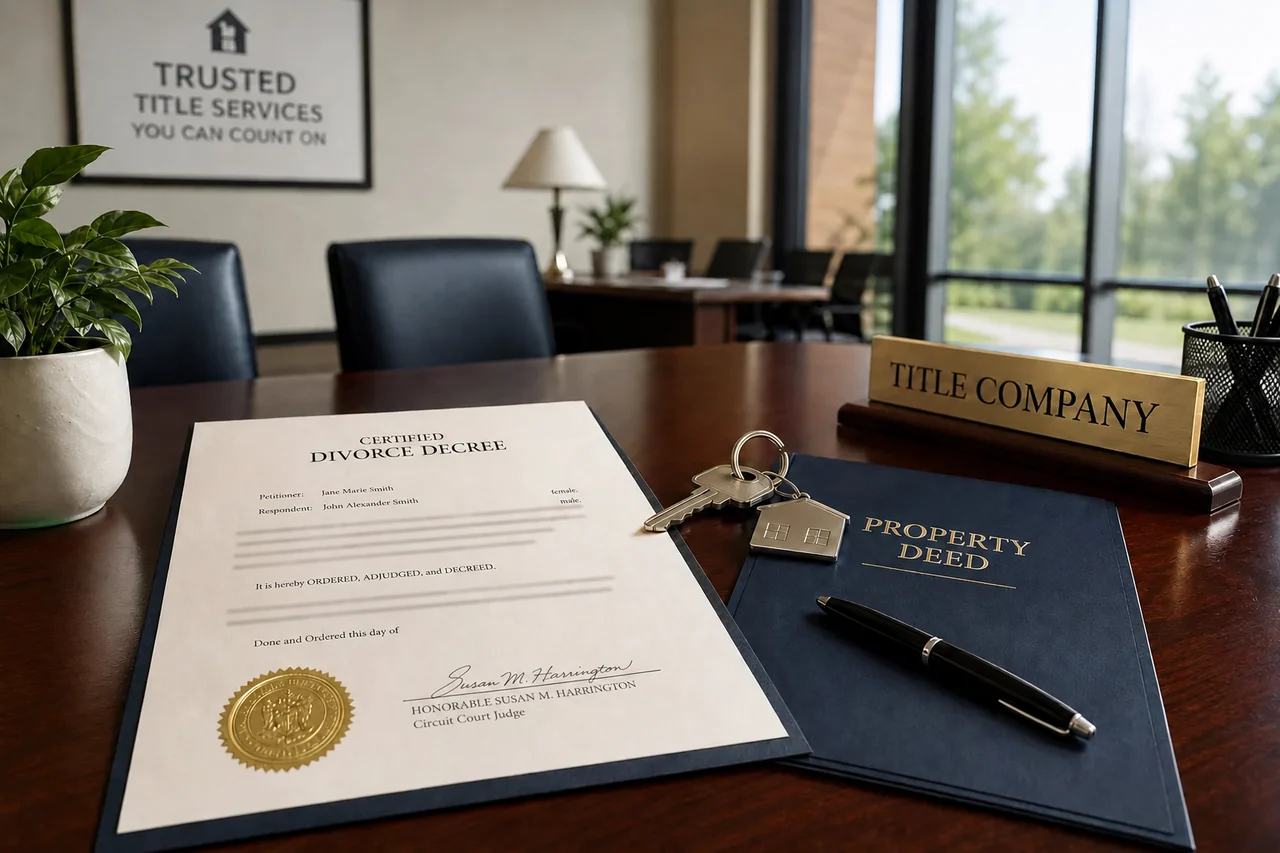
Why Title Companies Require a Certified Divorce Decree
You bought a home with your spouse. Then you divorced. Here's the thing—that judge's signature doesn't automatically hand the property to one person or the other. Title companies need hard proof that ownership is actually clear before they'll insure it. A certified divorce decree is the document that shows exactly how the marital property got divided.
Why do they care so much? Title insurance underwriters are taking on real financial risk when they insure your title. Without that certified decree confirming the property division was legally completed, they're exposed—your ex-spouse could potentially file a claim down the road and cost them money. And that protects you too. It protects your lender. It protects everyone in the deal.
Beyond that, title companies have to follow state real estate and lending laws that demand a clear chain of title. Any ownership gap—any weird spot in the history—is a title defect. Unresolved marital property rights absolutely count. Nothing closes until it's fixed.
Back to topHow Property Ownership Changes After Divorce
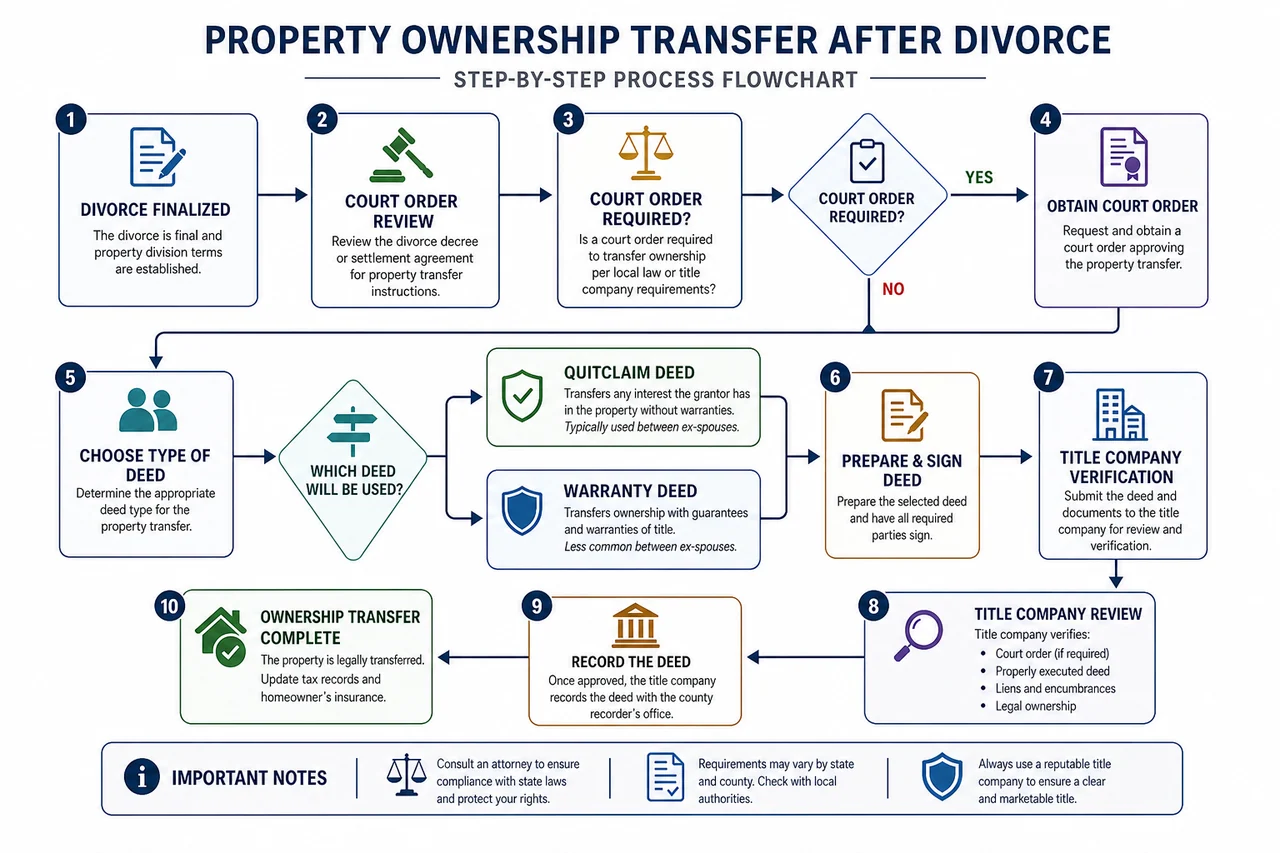
Here's what trips up most divorced homeowners: thinking the divorce decree automatically transfers the property. It won't. That court order tells you what's supposed to happen to the house, but it doesn't actually move ownership. You'll need a separate deed — usually a quitclaim deed or warranty deed — recorded at your county recorder's office to make the transfer official.

The quitclaim deed is your go-to for divorce property transfers. One spouse uses it to formally give up their ownership stake and hand it over to the other. And here's the critical part: without that recorded deed sitting in the county records, both of you might still show up on the title. This stays true even when the judge awarded the house to just one of you.
Now, some states let you use a divorce decree with the property description built right in instead of a separate deed. But most don't work that way. When you're selling or refinancing, the title company will demand both the certified decree and proof that the deed was recorded properly. Thinking about selling after your divorce? Don't skip reviewing Capital Gains Tax When Selling a House — the tax hit can surprise you if you're not prepared.
Back to topWhat a Certified Divorce Decree Must Include
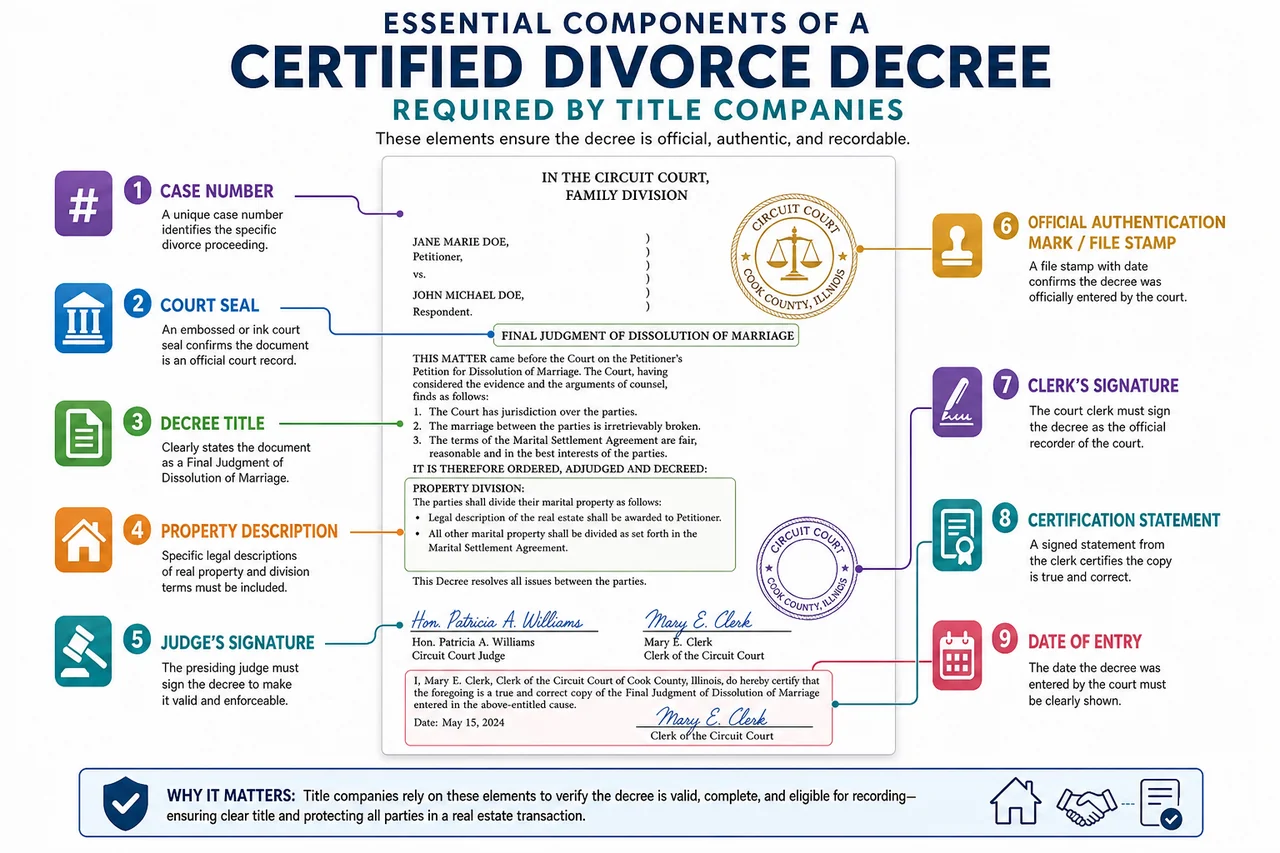
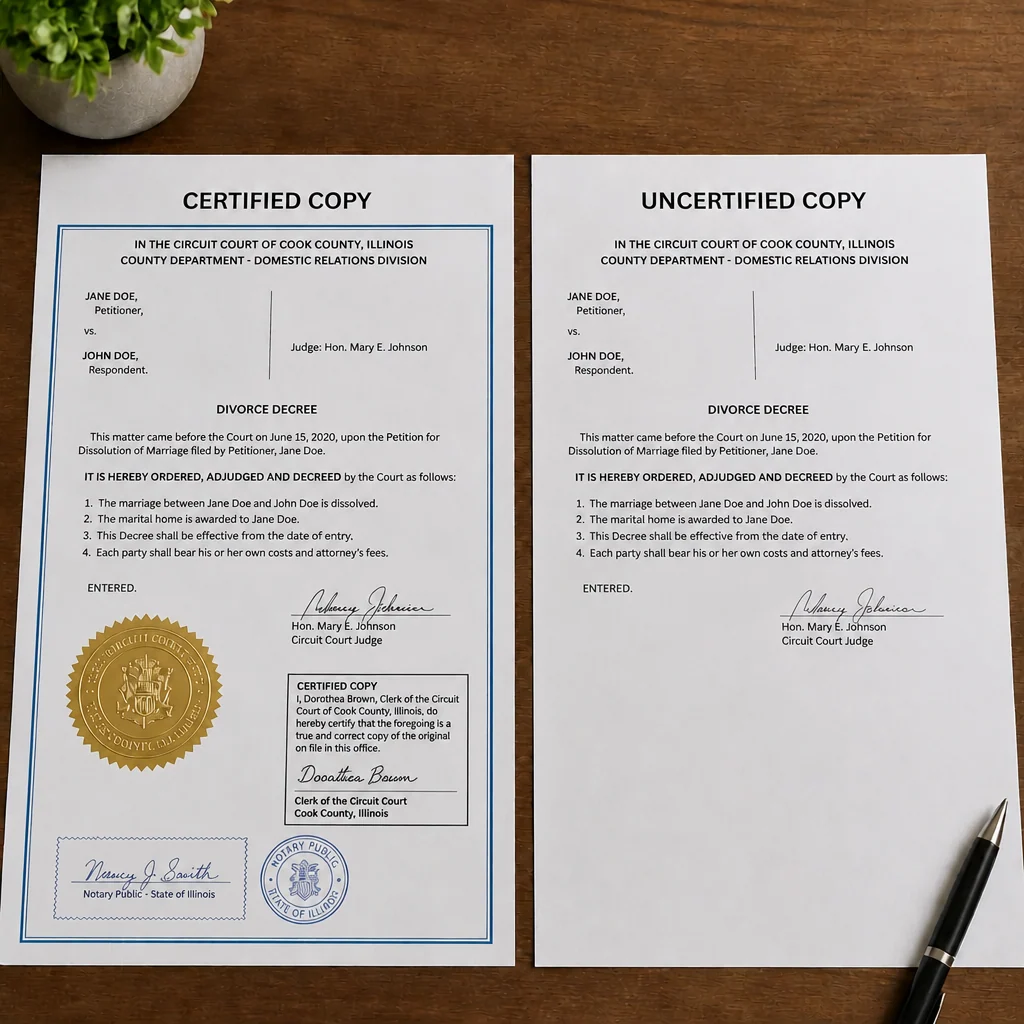
Here's the thing: not all divorce decree copies work the same way. Title companies won't touch a photocopy, a scanned image, or an uncertified "conformed" copy. They need a certified copy — one that's been officially authenticated by the court clerk and stamped with an actual court seal. Without that, you're stuck.
| Feature | Certified Copy | Uncertified Copy |
|---|---|---|
| Court Clerk Signature | Yes | No |
| Official Court Seal | Yes | No |
| Accepted by Title Companies | Yes | No |
| Accepted by Lenders | Yes | Rarely |
| Legal Standing in Disputes | Full | Limited |
| Cost to Obtain | $5–$25 per copy (varies by state) | Free or minimal |
Your decree also needs to be crystal clear. It must state exactly which spouse gets the property, include the legal description of the real estate, and show the final judgment — not some temporary order from months ago. Vague language like "the parties agree to divide assets equitably" without actually naming the home? That'll send title companies back asking for legal clarification before they'll move forward. And that costs you time.
Back to topState-Specific Requirements and Variations
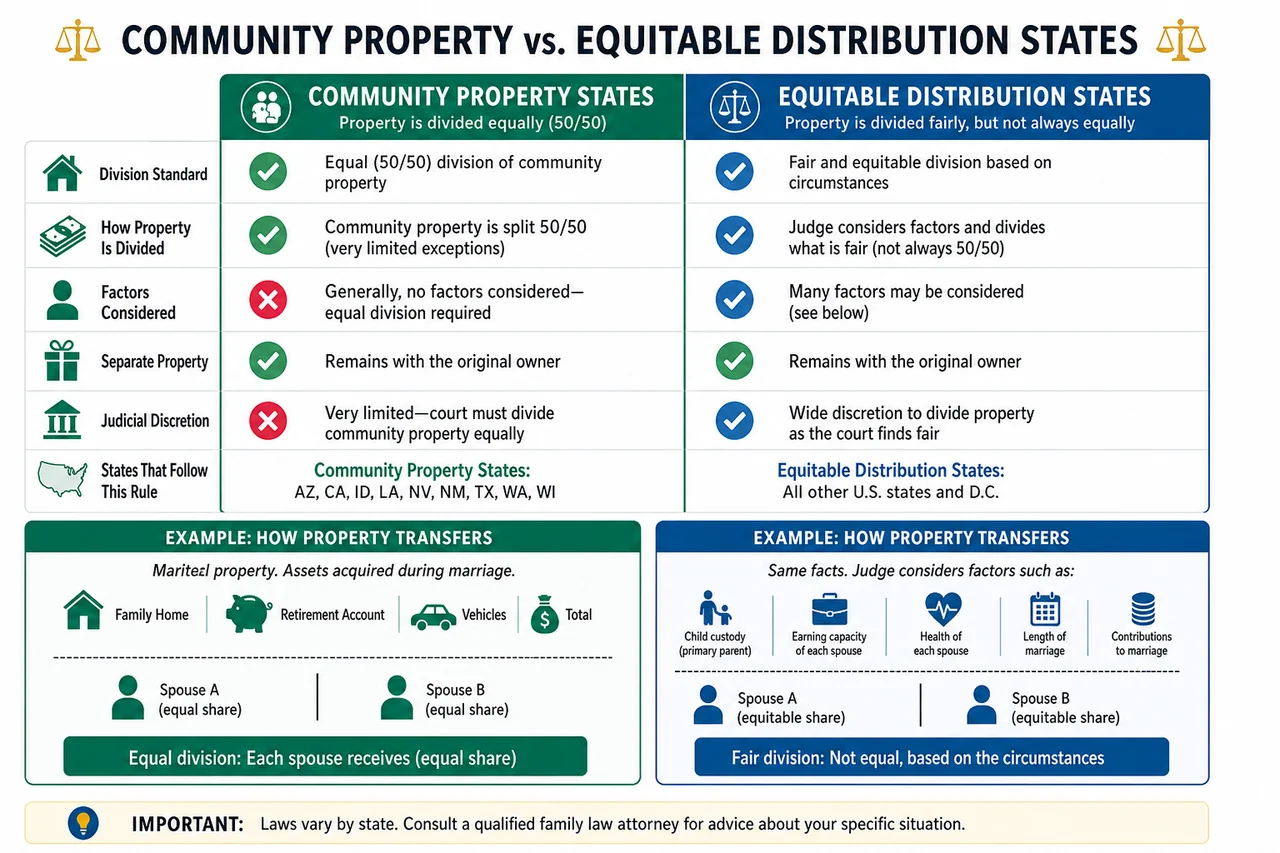
Title companies don't all ask for the same paperwork. It depends on where you're selling. Community property states like California, Texas, Arizona, Nevada, and Washington handle marital assets in one specific way. Equitable distribution states do it differently. And here's the key difference: in community property states, the law presumes both spouses own marital property equally. That's why title companies in those states are extra cautious when verifying how assets actually got divided between you and your ex.
| State | Property System | Decree Must Be Recorded? | Separate Deed Required? | Notes |
|---|---|---|---|---|
| California | Community Property | Recommended | Yes (typically) | Interlocutory decree not sufficient |
| Florida | Equitable Distribution | No | Yes | Decree must specify property clearly |
| Texas | Community Property | Yes (often) | Sometimes | Special warranty deed common |
| Washington | Community Property | Recommended | Yes | Both decree and quitclaim often needed |
| Colorado | Equitable Distribution | No | Yes | Decree plus recorded deed standard |
| Tennessee | Equitable Distribution | No | Yes | Title companies typically require both |
| Indiana | Equitable Distribution | No | Yes | Certified decree plus deed of conveyance |
Which state are you in? That matters. Pull up your state's specific guidance before you sell. Sellers in Washington should check out Capital Gains Tax When Selling a House in Washington for the tax angle. Florida sellers? You'll want Capital Gains Tax When Selling a House in Florida.
Back to topHow to Prepare Your Divorce Documents for Closing
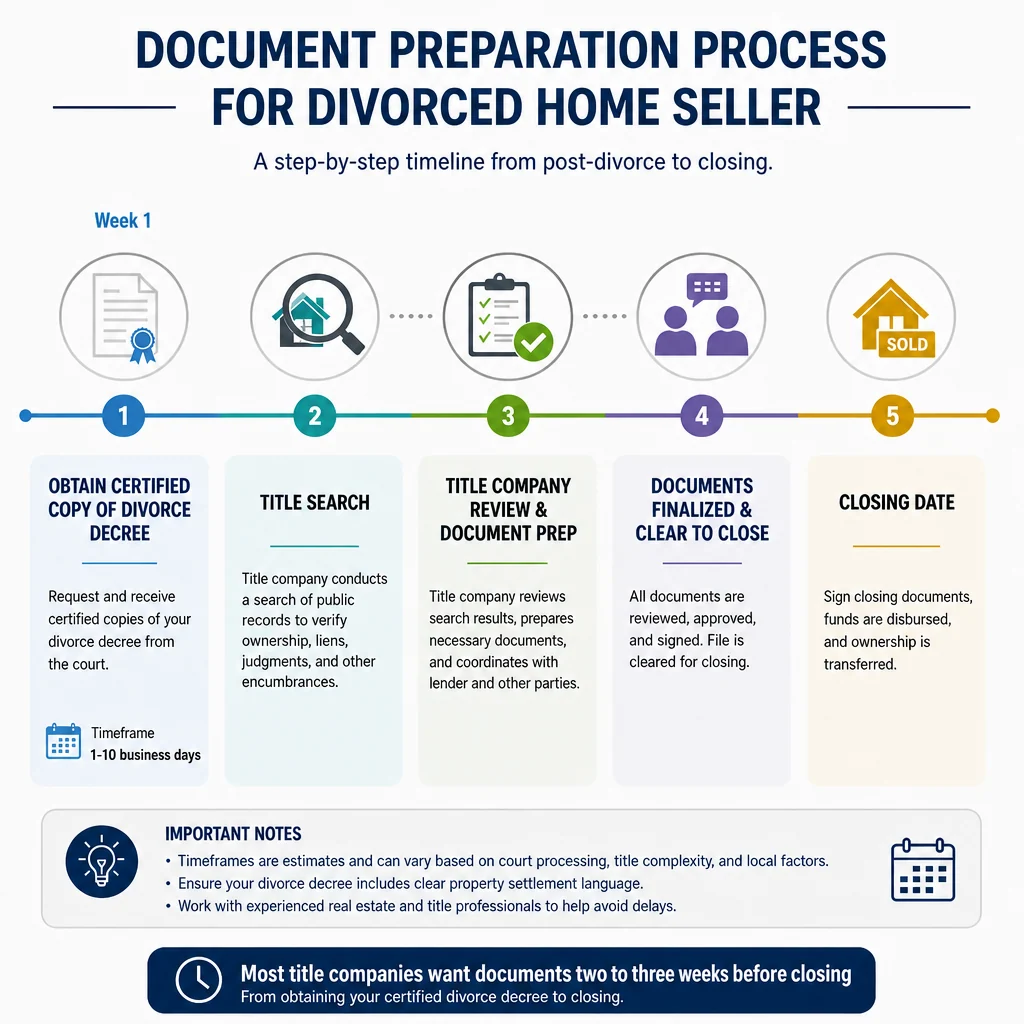
Start gathering documents early. This is your best defense against closing delays. Most title companies want all divorce paperwork at least two to three weeks before closing — that's your window to get everything in order without panic.
| Document | Where to Obtain | Typical Timeline | Notes |
|---|---|---|---|
| Certified Divorce Decree | Court Clerk's Office | 1–10 business days | Request multiple copies |
| Recorded Quitclaim Deed | County Recorder / Assessor | Immediate if already recorded | If not yet recorded, may take 2–4 weeks |
| Marital Settlement Agreement | Divorce Attorney / Court File | Varies | Some title companies request this as backup |
| Property Legal Description | County Assessor / Prior Deed | Immediate | Must match what's in the decree |
| Mortgage Payoff Statement | Current Lender | 3–5 business days | If mortgage remains in both names |
Here's how to get your certified divorce decree: Call or visit the court clerk's office in the county where your divorce was finalized. You can request copies in person, by mail, or online through most court systems. Expect to pay between $5 and $25 per copy. Order at least two — one for the title company and one for yourself.
And here's where people run into trouble: vague property language in the decree. If your paperwork describes the property as "the marital home" without a formal legal address or parcel number, the title company will catch it. That's when you need a divorce or real estate attorney. Ambiguous terms create costly legal corrections down the road. Your attorney might need to file a clarifying motion with the original court to amend or interpret the language.
Back to topCommon Issues and Problems Avoided
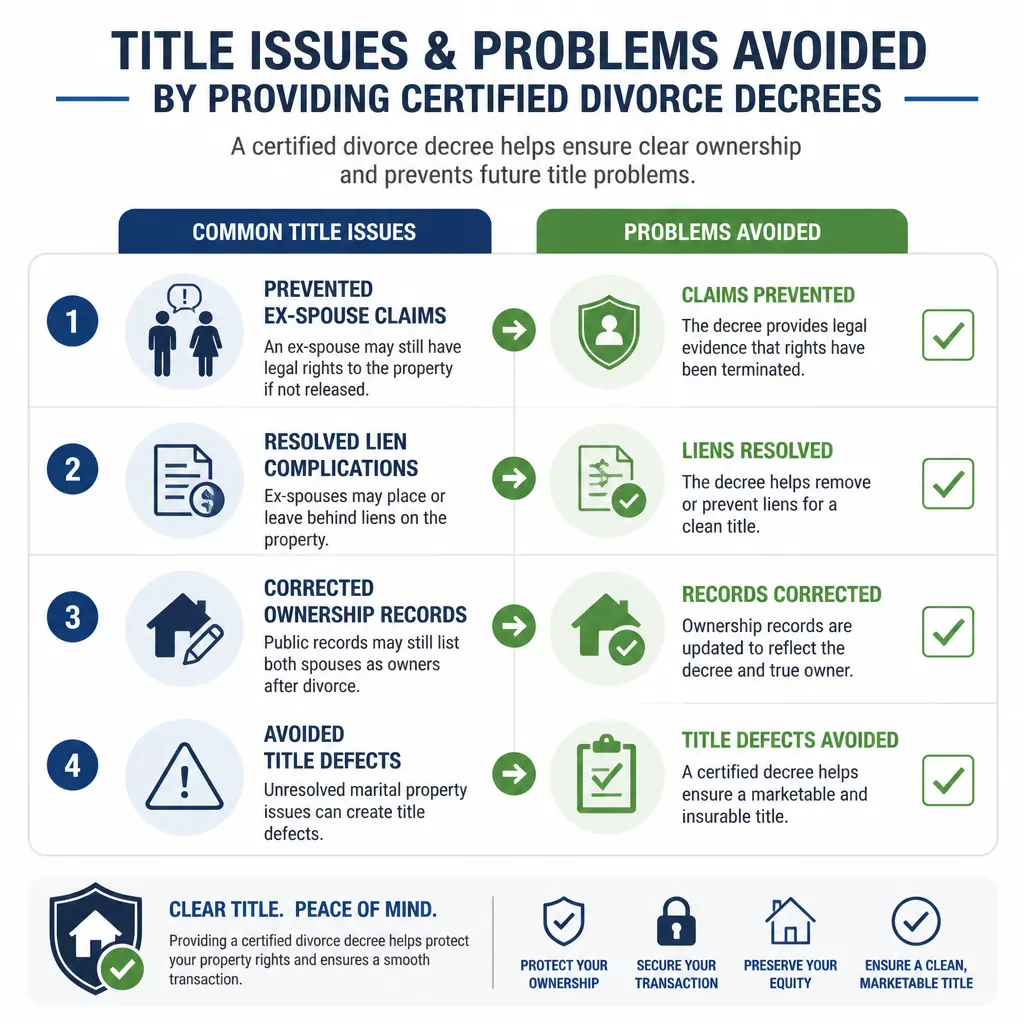
Skip the certified divorce decree — or hand over one that's incomplete — and you're inviting real trouble. Here's what can go wrong:
- Ex-spouse retains legal claim: Your ex could technically still own part of the house if the deed never got updated and the decree is vague. That means no sale. Period.
- Title insurance denial: Title companies won't insure a property without solid paperwork. And without title insurance, most buyers can't get financing. Your sale stalls.
- Lien exposure: Your ex has old debts or a judgment against them? Those can attach to property they still legally appear to own on the records. Now your title's clouded with liens that aren't even yours.
- Closing delays: Title defects discovered during the final walkthrough can push your closing back weeks or months. The buyer gets cold feet and walks.
- Legal disputes: Without documented proof of who owns what, fighting with your ex down the road becomes a nightmare — and an expensive one.
This is why some divorcing sellers turn to cash home buyers. They can close fast and handle title mess-ups without the typical financing roadblocks. That said, a traditional sale is still the better move for plenty of people.
Back to topQuestions to Ask Your Title Company
Call your title company before closing. A quick conversation now saves you from ugly surprises later. Here's what you actually need to ask:
- What specific documents do you need related to my divorce? Requirements vary, and some companies need both the decree and recorded deed.
- Do you need a certified copy, or will a conformed copy work? Always confirm — assume certified unless told otherwise.
- Are there state-specific recording requirements I should know about? Especially relevant in community property states.
- How early do you need the documents to complete your title search? Two to three weeks is the typical minimum.
- What happens if the decree contains ambiguous property language? Know the contingency plan before it becomes a crisis.
If you're selling in Washington state, you'll want to understand whether an attorney needs to be involved. Is an Attorney Necessary when Selling a Home for Cash in Lacey, Washington? gives you the real answer.
Back to topConclusion
Here's the reality: title companies won't budge on requiring a certified divorce decree. Why? Because clear ownership on paper is everything in real estate. Your decree shows exactly how the marital property got divided — and that documentation protects you, the buyer, the seller, and the lender from messy ownership disputes down the road. It's also what the title insurance underwriter needs to do their job.
Get your documents together early. Find out what your specific state requires. And partner with a title company and attorney who've actually handled post-divorce sales before. They'll know the shortcuts and common pitfalls.
Yes, the paperwork feels like one more thing when you're already stressed. But it's absolutely worth it. This step — this single step — keeps your home sale from falling apart at closing.
Back to topFrequently Asked Questions
Can I use a photocopy of my divorce decree for a home sale?
No—don't even try. Title companies won't touch anything but a certified copy with an official court seal and the clerk's actual signature on it. A photocopy, scanned image, or uncertified conformed copy won't pass underwriting. Lenders and title insurers will reject it outright.
What if my divorce decree doesn't specifically mention the property?
You've got a problem. When the decree is vague or leaves out the legal property description, you'll likely need to go back to court and file a motion to clarify or amend the judgment. Here's the good news: a real estate or family law attorney can map out the fastest route without forcing you to renegotiate your entire divorce settlement.
Does the divorce decree transfer the title by itself?
Not in most states. The divorce decree tells the court what should happen—but it doesn't actually move the title. You need a separate recorded deed for that, usually a quitclaim deed filed with your county recorder's office. Your state might have different rules, though. Call your local title company and ask what they need from you.
How long does it take to get a certified copy of a divorce decree?
It depends where you live. Most courts turn around certified copies in one to ten business days. Older divorces? They might take longer if the records are sitting in archives somewhere. Order early. And get at least two copies at the same time—trust us, you don't want to make this request twice.
What if my ex-spouse is uncooperative in signing a quitclaim deed?
This one stings, but you have options. If the court already awarded you the property and your ex won't sign, go back to divorce court and file a contempt motion to enforce the order. Some judges will even authorize a court-appointed officer to sign the deed on behalf of the uncooperative spouse. An attorney who handles post-divorce enforcement can push this through without wasting months.
Back to top
