Selling Property with a Lien: How to Clear It and Close the Sale

Table of Contents
- What's a Lien on a House?
- Types of Liens You May Encounter
- Can You Sell a House with a Lien? The Short Answer
- How Liens Affect Your Home Sale
- Understanding Lien Priority and Payment Order
- Your Options for Selling a House with a Lien
- The Closing Process with a Lien — Step by Step
- What If You Don't Have Enough Equity?
- Cost Implications of Selling with a Lien
- State-by-State Variations: What You Must Verify Locally
- Working with the Right Professionals
- Steps to Take Before Listing Your Property
- Conclusion
- Frequently Asked Questions
You can sell a property with a lien on it—liens don't block sales outright. What they do require is that the lien gets resolved before or at closing, which means extra steps and sometimes extra costs compared to a clean title. Most of the time, liens get paid directly from your sale proceeds at closing, so you won't need to pull money from your own pocket. Everything hinges on three things: how much equity you've got, how many liens are sitting on the property, and what type of lien you're dealing with.
This article is for general educational purposes and isn't legal, tax, or financial advice. Lien laws, priority rules, and timelines vary by state; consult a licensed real estate attorney and a tax professional for guidance specific to your situation.

What's a Lien on a House?

Definition and Legal Meaning
A lien is a legal claim attached to your property that secures an unpaid debt or obligation. When someone files a lien against your home, they're establishing a legal right to a portion of your property's value. This right stays in place until you satisfy the underlying debt. The person holding the lien doesn't own your house—but they do hold a financial interest in what it's worth.

How Liens Cloud Title
Once someone records a lien at your county recorder's office, it becomes public record. That's what people mean by a "cloud" on the title. And it creates real problems. No title insurance company will issue you a clean policy. No conventional mortgage lender will fund a buyer's purchase loan. That cloud is essentially a red flag telling everyone there's another financial claim on your property. Until you resolve that claim, the title stays clouded—and it won't transfer cleanly to a new owner.
Why Liens Matter When Selling
Every home sale requires a title search. Most require title insurance too. During that search, every recorded lien surfaces. If one's discovered—and they almost always are—your closing stops cold until you pay it off, settle it, bond over it, or successfully dispute and remove it. You can't ignore a lien and hope it goes away. It'll show up in the title search every single time.
Back to topTypes of Liens You May Encounter

Liens aren't all created equal. The type of lien on your property determines what happens next — and what it'll take to sell.
| Lien Type | Who Files It | Reason for Lien | Typical Priority | Voluntary or Involuntary |
|---|---|---|---|---|
| Mortgage Lien | Lender / Bank | Unpaid home loan balance | First (if first mortgage) | Voluntary |
| Property Tax Lien | Local / County Government | Unpaid property taxes | Often supersedes all others | Involuntary |
| Federal Tax Lien | IRS | Unpaid federal income or other taxes | High — attaches to all assets | Involuntary |
| Judgment Lien | Winning party in lawsuit | Court-ordered money judgment | By recording date (behind mortgage) | Involuntary |
| Mechanic's Lien | Contractor / Subcontractor | Unpaid construction or repair work | By recording date; some states grant priority | Involuntary |
| HOA Lien | Homeowners Association | Unpaid dues or assessments | Varies by state | Involuntary |
Voluntary vs. Involuntary Liens
You agreed to a voluntary lien. Your mortgage is the prime example — you signed the paperwork, understood what you were doing, and knowingly put the lender's claim on your home. An involuntary lien is different. Nobody asked permission. A judgment creditor files it after winning a lawsuit against you. The IRS files a Notice of Federal Tax Lien (NFTL) for taxes you didn't pay. A contractor files a mechanic's lien because you stiffed them on a job.
Involuntary liens complicate sales. Buyers see them and wonder what went wrong. Clearing them often means haggling rather than just writing a check.
The IRS Federal Tax Lien — a Special Case
Once your unpaid tax debt hits a certain point, the IRS files a Notice of Federal Tax Lien. Under the IRS Fresh Start Initiative, that threshold is $10,000 in aggregate unpaid balance. When they file it, the lien grabs everything you own right now — plus anything you buy later. Property, vehicles, bank accounts. It all becomes subject to collection.
But there's also a release mechanism built in. The IRS must release the lien within 30 days of receiving full payment under IRC §6325. And the agency only has a 10-year window to collect from the moment taxes were assessed. After that, the lien automatically releases under Collection Statute Expiration Date (CSED) rules. If your lien's been sitting for years, talk to a tax professional — it might be nearing its expiration date.
Back to topCan You Sell a House with a Lien? The Short Answer
Yes — but you've got to deal with the lien first. Most residential sales with liens close without the seller writing a check beforehand. The title company or escrow company hunts down every lien during the title search, figures out exactly what each one costs to clear, and then—at closing—pays each lienholder directly from your sale proceeds. You get the remaining equity, the buyer gets a clean title, and the lienholders get paid.
Things get complicated when the liens plus your mortgage plus closing costs add up to what you'll actually sell the house for. When that happens, you need a different game plan—and we cover those strategies below. Want the full picture on how different lien types affect your sale? Check out our guide on Selling a House with a Lien: Types, Solutions, and How to Close.
Back to topHow Liens Affect Your Home Sale
Buyer Perception and Market Impact
Your lender won't approve the purchase if there's an unresolved lien on the property. That's the rule for conventional mortgages and government-backed loans alike. Even cash buyers—who don't need lender approval—will push hard for a significant discount. They want to cover the cost and hassle of resolving the lien, plus the time it'll take.
A judgment lien or tax lien sends a red flag to the market. Buyers see distress, and your pool of interested buyers shrinks. The price gets pushed down. It's not dramatic—it's just what happens when people smell uncertainty.
Title Search Requirements
Every transaction requires a title search, whether it's cash or financed. You'll pay $75–$300 for a professional to dig through decades of public records. They're looking for liens, easements, encumbrances, and any gaps in ownership history.
Get your own title search done before you list. Seriously. This one step tells you what you're actually dealing with—no surprises when the buyer's title company runs their own search and potentially kills the deal. You'll know exactly what needs to be fixed.
Closing Process Implications
Liens don't stop closing. They reshape it.
The title company adds your lien payoff as a line item on the closing settlement statement, and your net proceeds drop by that amount. Got multiple liens? The title company requests payoffs from each lienholder and choreographs the disbursements at closing. It takes longer than a standard closing—expect one to three weeks extra—but title professionals handle this routinely. It's not a problem; it's just part of the process.
Back to topUnderstanding Lien Priority and Payment Order
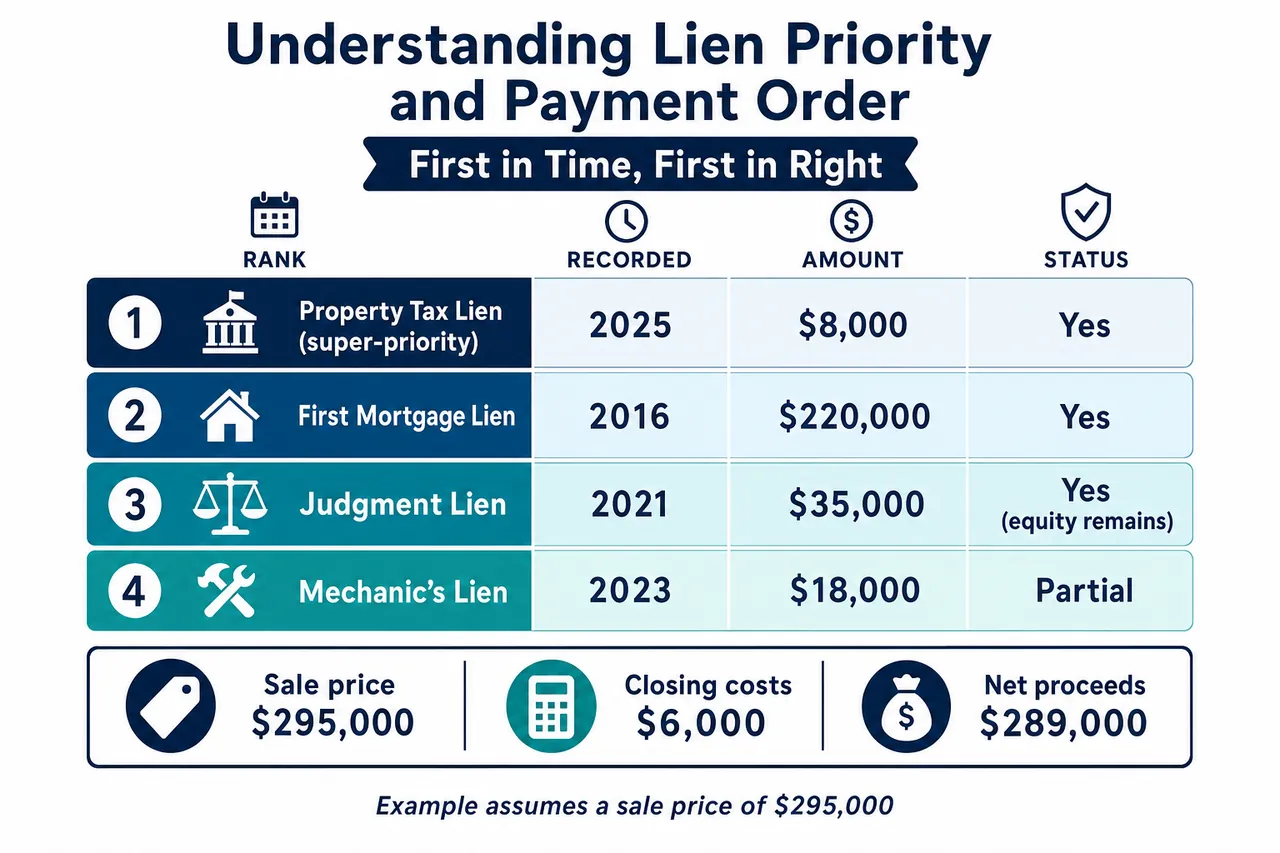
First in Time, First in Right
Liens get paid in the order they were recorded. That's the core principle: "first in time, first in right." A first mortgage from 2018 beats out a judgment lien from 2022. Every single time.
Why does this matter? Because when a property sells for less than what's owed across all liens, the early ones get their full cut while later ones may get pennies on the dollar — or nothing.

Exception: Tax Liens
Property tax liens don't follow the standard rules. Your county or municipality gets preferential treatment — they jump ahead of everything, even a first mortgage, in most states. That's called "super-priority" status, and it's real.
Federal tax liens from the IRS work differently. They won't automatically beat a first mortgage that's already recorded, but they can still throw a wrench in any sale. And the rules shift depending on where you live. Before you assume anything about tax lien priority in your state, talk to a local real estate attorney who can walk you through the specifics.
Multiple Liens Scenario
Picture this real-world example:
| Priority Rank | Lien Type | Recorded | Amount Owed | Gets Paid in Full? |
|---|---|---|---|---|
| 1 | Property Tax Lien (super-priority) | 2025 | $8,000 | Yes |
| 2 | First Mortgage Lien | 2016 | $220,000 | Yes |
| 3 | Judgment Lien | 2021 | $35,000 | Yes (equity remains) |
| 4 | Mechanic's Lien | 2023 | $18,000 | Partial (only $14,000 equity remains after liens above) |
Example assumes a sale price of $295,000 with $6,000 in closing costs, leaving $289,000 in net proceeds. Numbers are illustrative only. Actual sale proceeds depend on market value, negotiated sale price, and local closing costs.
What Happens If Liens Exceed Equity?
You're underwater when all the liens plus the mortgage payoff add up to more than what your property will sell for. The creditor at the bottom of that priority stack won't get paid in full — maybe nothing at all.
And then they face a choice. They can block the sale and try their luck with foreclosure down the road. Or they can negotiate a reduced settlement now and at least collect something instead of nothing.
Most choose the latter.
Even the IRS has built-in processes for cases like this, where a full payoff during a property sale just isn't possible.
Back to topYour Options for Selling a House with a Lien
Your best move depends on how much equity you have, what liens are on the property, how quickly you need to sell, and what cash you can access right now. No single path works for everyone. Let's look at what's actually available to you:
| Option | Typical Timeline | Complexity | Best For | Key Consideration |
|---|---|---|---|---|
| Pay off lien before listing | 1–4 weeks (after payoff) | Low | Small lien amounts; sufficient cash on hand | Requires upfront cash; lien release may take 30 days (IRS: 30 days per IRC §6325) |
| Pay lien from closing proceeds | Standard closing + 1–3 weeks | Low–Medium | Sellers with positive equity after all debts | Most common path; title company handles payoff logistics |
| Negotiate reduced settlement | 4–12 weeks | High | Sellers with limited equity; lien exceeds available proceeds | Creditor must agree; professional negotiator or attorney strongly recommended |
| Dispute erroneous lien | 4–16 weeks | High | Liens already paid, filed in error, or past statute of limitations | Requires documentation and potentially court action; attorney advisable |
| Short-term loan to clear lien | 2–4 weeks (loan) + standard sale | Medium | When sale math works but timing gap exists between loan and closing | Carrying cost of loan must be weighed against sale benefit |
| Sell to cash buyer / investor | 1–4 weeks | Low (for seller) | Sellers with little equity, urgent timelines, or multiple liens | Price will be below market; investor absorbs lien risk and resolution cost |
Option 1: Conduct a Title Search First
Start here. A professional title search runs $75–$300 and it's non-negotiable. You can't work around liens you don't know exist, and you can't figure out what equity you actually have without exact payoff amounts. After you get the results, call each lienholder directly and ask for a written payoff statement. That statement tells you the precise amount needed to clear the lien as of a specific date, with all interest and fees included.
Option 2: Pay Off the Lien Before Selling
Have cash sitting around? Paying off the lien before you list gives you a clean title and opens your property to every potential buyer out there, including people who need financing. But know this: lien releases don't happen overnight. The IRS must release a federal tax lien within 30 days of receiving your full payment. County or court judgment liens can take several weeks after the creditor files the satisfaction document. Plan for the wait.
Option 3: Use Sale Proceeds at Closing
This is what most sellers do when they have enough equity. Your title company requests payoff figures from each lienholder, structures the closing so liens get paid in the right order, and you walk away with whatever's left after everything's settled. You don't need cash upfront. It works because the sale price comfortably covers all liens, your mortgage, and closing costs.
Option 4: Negotiate with Creditors
Thin equity or underwater? Negotiation's your leverage. Judgment creditors, contractors, even the IRS would rather take 50 or 60 cents on the dollar than get nothing when your house sells. The IRS has a Certificate of Discharge process (Form 14135) that lets you sell a property free of a federal tax lien when you can't pay in full — file at least 45 days before closing, and expect 30–60 days of processing time. For private creditors, start with a written settlement offer backed by proof of the home's value and all senior lien amounts. It shows you're serious.
Option 5: Dispute Erroneous Liens
Some liens shouldn't even be there. Maybe one was filed after the deadline your state allows, or it's already been paid but the creditor never filed a release, or it's past the statute of limitations. A mechanic's lien filed too late is unenforceable in most states — timelines vary wildly, so a local real estate attorney can tell you if yours is time-barred. If a satisfied judgment lien is still on the books, you may need to petition the court to force a release. Get this right. Pushing back on a lien without proper legal help can actually slow you down.
Option 6: Sell to a Cash Buyer or Real Estate Investor
Speed matters when equity is tight, liens are complicated, or foreclosure's breathing down your neck. Cash buyers and investors buy properties with liens all the time. They negotiate the lien payoffs themselves and factor those costs into what they offer you. You'll get below-market value, yes. But you avoid months of back-and-forth with creditors and you sidestep the risk of a financed buyer's loan falling apart when liens show up on the title search. If a foreclosure deadline's approaching, this deserves serious consideration—time's something you can't get back. Want more context on selling properties with issues? Read our guides on selling a house with water damage and selling a house with plumbing problems. The principle is the same: price honestly, disclose everything, and find the buyer whose expectations match what you're actually selling.
Back to topThe Closing Process with a Lien — Step by Step
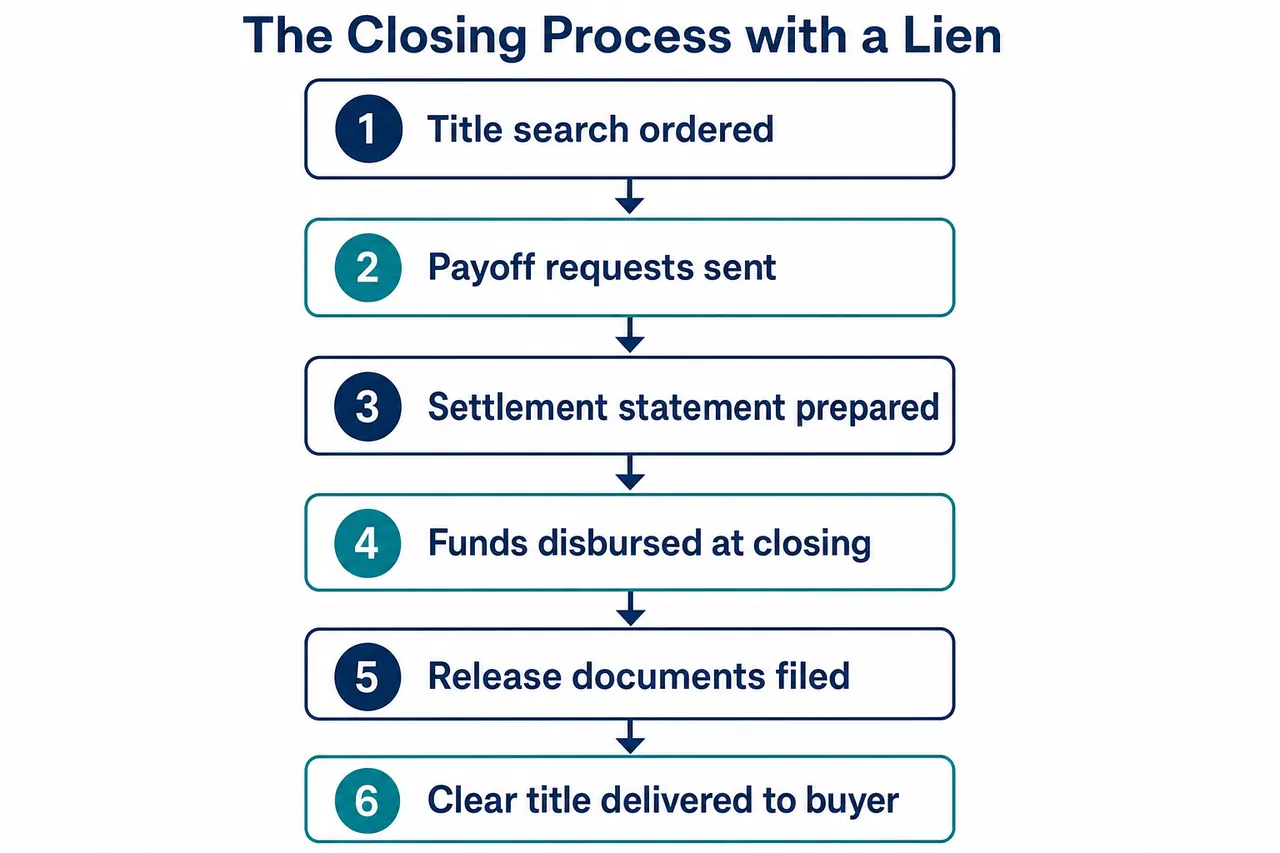
Closing with a lien doesn't have to feel like a mystery. Once you understand what's actually happening — step by step — it becomes manageable.
- Title search ordered. The buyer's title company (or yours, if you're being proactive) digs through public records to find every lien, easement, and other claim against your property.
- Payoff requests sent. Each lienholder gets contacted by the title company and asked for a written payoff statement. You'll know the exact number needed to clear that lien as of your closing date, plus how much it'll cost per day if closing gets pushed back.
- Settlement statement prepared. All those payoff amounts show up as deductions from what you're getting on the Closing Disclosure or HUD-1 settlement statement.
- Funds disbursed at closing. Your buyer's money arrives. The title company pays off each lienholder in order of priority — straight from your proceeds — before you see a dime.
- Release documents filed. When a lienholder gets paid, they're required to file a satisfaction or release document with your county recorder's office. That's what actually removes the lien from public record.
- Clear title delivered to buyer. After releases are recorded, the buyer gets title insurance on a clean property. Done.
If you've got enough equity, this whole thing runs like clockwork. Title companies do it constantly. The IRS, state tax authorities, courts, and private creditors all know how this works and have systems in place to get paid at closing.
Back to topWhat If You Don't Have Enough Equity?

Mapping the Shortfall
Before you decide anything, nail down your numbers: estimated sale price minus (mortgage payoff + all lien amounts + estimated closing costs). A negative number means you're short. How short matters enormously because it changes what you can actually do. Sometimes a small gap—a few thousand dollars—gets covered by a short-term personal loan you pay back when the house closes, if the whole deal still pencils out. But a large gap? That's a completely different animal.
Negotiating from the Creditor's Perspective
Creditors operate on simple logic. They can wait years for payment, sure. But they might also get nothing at all. A judgment lien sitting behind your first mortgage on a property with zero equity? That creditor can't foreclose and recover anything—the first mortgage gets paid off first, leaving them with crumbs. When you show a creditor the actual numbers—proof of exactly how much equity remains after senior liens are paid—you're giving them a real reason to take a partial settlement and call it done.
And this applies to government too. The IRS Certificate of Discharge (Form 14135) exists for one reason: situations where a property sale won't generate enough to pay the full federal tax lien. The IRS knows a lien on a property that can't support collection is basically worthless. Submit Form 14135 at least 45 days before your expected closing date, then wait 30–60 days for processing.
Short Sale as an Alternative
When the mortgage itself—not just the liens on top of it—exceeds what the house is worth, you're looking at a short sale. The lender agrees to take less than the full mortgage payoff and releases the lien so the sale can close. This requires lender approval, stretches out your timeline, and carries a tax risk: forgiven mortgage debt sometimes counts as taxable income. Talk to a tax professional about where things stand now, since tax rules in this area shift around and yours depends on current IRS guidance.
Foreclosure Timeline as a Factor
Your window shrinks fast if a lienholder's already filed for foreclosure. Some states finish the process in months. Others stretch it past a year. But the bottom line? States vary wildly on this. If you're approaching a foreclosure sale date, a cash buyer who closes in one to four weeks might be your only shot at preserving equity or keeping a foreclosure judgment off your record. Find out your state's timeline right now. A HUD-approved housing counselor can walk you through this at no charge and help you figure out your real options before you talk to creditors or buyers.
Back to topCost Implications of Selling with a Lien
The lien payoff is just the starting point. You'll also face these costs when you calculate what you'll actually pocket from the sale:
- Title search: $75–$300 for a professional search. And if your sale drags on, you might need to order it more than once.
- Owner's title insurance: You'll pay 0.5%–1.0% of the purchase price as a one-time premium at closing. On a home near the September 2026 median existing-home price of $417,500, that works out to roughly $2,088–$4,175.
- Attorney fees: Disputing a lien or negotiating a reduced settlement? You'll need legal help. Rates vary wildly depending on where you live and how complicated your situation is—hourly billing or flat fees are both common. Always get a written fee estimate upfront.
- IRS discharge or subordination application: Filing Form 14135 or Form 14134 doesn't cost anything to the IRS. But if you hire a tax attorney or enrolled agent to prepare it, that professional fee adds up.
- Accrued interest on judgment liens: Interest starts piling up the day the judgment is entered. Federal judgments use the weekly 1-year Treasury CMT rate — hovering around 4% to 4.5% in mid-to-late 2026. State court judgments often charge more. You need to check your state's specific law on this.
State-by-State Variations: What You Must Verify Locally
Lien law changes from state to state. What's true in California won't work the same way in Texas. Don't rely on national articles for the specifics that matter most to your situation—you need local legal advice on these points:
- Mechanic's lien filing deadlines: The clock starts ticking after work wraps up, and you've got 60 days to file in some states, 120 days in others. Miss the deadline? Your lien becomes unenforceable. But here's what most people don't realize: even a dead lien can still mess with your property's title until someone formally removes it.
- Judgment lien duration: A judgment lien doesn't disappear after a few years. Most states let them stick around for 5 to 20 years, and many allow creditors to renew them. That old judgment hanging over your property? It might've expired years ago—or someone could've quietly renewed it without telling you.
- HOA lien super-priority: Some states let your HOA's lien jump ahead of your mortgage. Others don't give HOAs that power. If you're behind on dues, this distinction could change everything.
- Redemption periods: You lose a property to taxes or foreclosure—but you might not lose it forever. Many states give you a grace period (sometimes months, sometimes years) to pay what's owed and get it back. Are you sitting in that window right now? A local attorney can walk you through what's still possible.
- Short sale deficiency rules: Walk away from a short sale and think you're done? Not in every state. Some states let lenders chase you for the difference; others shut that down completely. Before you sign anything, know exactly what your state allows.
Working with the Right Professionals
Your specific situation determines who you actually need in your corner. Not every professional combination works for every homeowner.
- Real estate attorney: You'll need one if you're disputing liens, negotiating reductions, handling short sales, or juggling multiple involuntary liens. IRS or state tax liens? Don't skip this step.
- Tax professional (CPA or enrolled agent): They're essential when you need to understand what happens tax-wise with forgiven debt, when you're applying for an IRS lien discharge, or if you're considering an Offer in Compromise separate from the sale itself.
- Experienced title company or escrow officer: These folks coordinate all the payoff mechanics when you close. But pick one who actually knows how to handle involuntary liens. Not every title company moves at the same speed with them.
- Real estate agent experienced with distressed sales: They understand how to price a property that's got liens attached. And they know which buyers—cash buyers, investors, whoever—will actually show up for a property in your situation.
- HUD-approved housing counselor: You can find one through the HUD housing counselor locator. It's free or low-cost. This matters most if you're behind on your mortgage on top of everything else.
One critical warning: Run the other direction if someone wants a big upfront fee to "remove" your liens before they've actually done anything. Real attorneys and negotiators bill for work completed, not for guarantees. When a company demands thousands upfront with zero contract protections and promises you'll never see those liens again? That's a red flag you can't ignore.
Back to topSteps to Take Before Listing Your Property
You've confirmed the lien is there. Now what? Work through these steps in order if you want to sell.
- Order a professional title search. Every lien needs a name, a number, and a recording date attached to it. You can't make smart decisions without this information in front of you.
- Get the lienholder's exact payoff amount in writing. Don't rely on a phone quote. Call each lienholder directly and ask for a payoff statement that's valid through your expected closing date.
- Calculate your equity position. Take your realistic sale price. Subtract the mortgage payoff, all lien payoffs, and estimated closing costs. What's left? That's your answer—and your negotiating power.
- Identify your timeline constraints. Is foreclosure breathing down your neck? Does a lien have a renewal date coming up? These pressures matter because they shrink your options fast.
- Consult an attorney if liens are involuntary or exceed your equity. Don't skip this one. A consultation costs far less than the wrong move.
- Choose your sale strategy. Based on everything above, you'll pick one: pay off the lien before listing, use sale proceeds to cover it at closing, negotiate a settlement with the lienholder, or sell to a cash buyer who can absorb liens more easily.
- Disclose fully. Whatever strategy you choose, tell buyers in writing about every lien you know about. And be thorough. Hiding a known lien exposes you to legal liability long after the sale closes.
Conclusion
Selling property with a lien isn't unusual. It's rarely insurmountable either. The title system was built specifically to surface these claims and resolve them at closing. Got positive equity? Your title company handles most of the work with little friction. Equity is thin? You can negotiate with creditors—including the IRS—and people do this all the time. No equity and the clock's ticking? A cash buyer or investor gets you out while preserving whatever value's left, and that beats the long-term damage foreclosure brings.
Act on information, not fear. Start with a title search. Figure out exactly what you owe and to whom. Calculate your actual equity position. Then pick a strategy that matches your real situation, not some worst-case scenario you're imagining.
Three professionals matter here: a real estate attorney, a title company that's actually worked with liened properties before, and a tax advisor if the IRS is in the picture. They change both your outcome and your stress level, often dramatically.
Whether your property's got liens, deferred maintenance, structural problems, or all three—one principle solves it: understand it, disclose it, price for it, and find the right buyer. If you're dealing with other property complications, check out our guides on selling a house with water damage in Florida, selling a house with plumbing problems in California, and selling a house with water damage in Colorado.
Back to topFrequently Asked Questions
Can a buyer purchase my house if it's a lien on it?
A financed buyer whose lender requires clean title can't close until all liens are resolved. Cash buyers are different — they can purchase a property with liens attached, but they'll typically lower their offer to cover what they'll pay to satisfy the liens themselves. Most sales involving liens get sorted out at closing, actually. The title company takes money from your proceeds, pays off the lienholder, and the buyer walks away with clean title. The lien doesn't follow the new owner as long as it's paid and released properly before closing.
How long does it take to sell a house with a lien?
If you have enough equity and the lien is straightforward, expect one to three extra weeks on top of your normal closing timeline. That's mostly just coordinating the payoff. Everything changes when negotiation gets involved — especially with the IRS. They want you to submit a Certificate of Discharge application (Form 14135) at least 45 days before closing, and actual processing runs 30–60 days. Contested or erroneous liens needing court action? Those can stretch for months. Cash buyers are your speed option here — sometimes closing in two to four weeks total.
What happens if I sell my house but forget about a lien?
You won't accidentally slip a lien past closing. The title search catches it every time. But if somehow a lien does surface after closing, the title insurance policy usually covers the buyer's loss. You could face liability as the seller if you knowingly hid a lien or lied about the title status. That's why you need to disclose everything in writing.
Will the IRS negotiate a federal tax lien during a sale?
They will. Two formal options exist. The Certificate of Discharge (Form 14135) lets you sell the specific property free and clear, with the sale proceeds going straight to the IRS. The Certificate of Subordination (Form 14134) moves the IRS lien behind a new mortgage, which works for refinancing situations. Both demand advance planning — file at least 45 days before your transaction date. Bring in a tax attorney or enrolled agent for either one. And there's an IRS Offer in Compromise (OIC) that can wipe out the underlying tax debt altogether, but don't count on that finishing in time for closing unless you've got a professional steering the ship.
Can I refinance my house to pay off a lien before selling?
Refinancing to pay off a lien sounds logical. The problem is that most lenders won't touch a refinance while an involuntary lien sits on the property. One workaround exists: IRS lien subordination (Form 14134) lets the IRS agree to step behind your new mortgage, which opens the door to refinancing. Processing takes 30–45 days typically. For other liens, your better move is usually to pay them off first using savings, a short-term personal loan, or family help — get that release recorded — and then refinance with a clean slate. Talk to both a mortgage lender and a real estate attorney about which path makes sense for your situation.
Back to top