

Selling a House with a Lien: Types, Solutions, and How to Close

Table of Contents
- Can You Sell a House With a Lien on It?
- What's a Lien on a House?
- Types of Property Liens Explained
- How to Find Out if Your Property Has a Lien
- 7 Steps to Selling a House With a Lien
- Selling Your Home When There's a Lien
- What Happens at Closing When There's a Lien
- State-Specific Considerations
- What If the Lien Exceeds Your Home's Equity?
- How to Remove or Satisfy a Lien
- Can You Transfer or Gift Property With a Lien?
- Working With Real Estate Professionals
A lien on your property can feel like a roadblock. But here's the truth: it's usually just a detour, not a dead end. Selling a house with a lien on it is entirely possible — millions of homeowners do it every year. The trick? You need to understand what you're actually dealing with, know your options, and bring in the right professionals to resolve the lien at or before closing. What exactly is a lien, and how does it affect your sale? This guide walks you through every type of property lien, how to track them down, what happens during a sale, and how to navigate the tougher situations when the numbers don't add up.

Can You Sell a House With a Lien on It?
The Short Answer
Yes, you can sell. Even homes with liens on them sell every day. In fact, most homeowners are selling with a mortgage lien — that's probably the most common lien you'll encounter in any real estate deal. The key? That lien gets paid off from your sale proceeds before closing happens. No clean title transfer without it. That's non-negotiable.
Why Liens Matter in Home Sales
A lien is a legal claim against your property that's recorded in the public record. And here's the important part: it sticks to the property itself, not to you personally. If you sell without resolving it, that lien follows the house to the buyer. That's exactly why title companies and lenders dig so hard into liens before closing. Most buyers won't touch a deal without a clean title commitment.
Beyond the paperwork, liens kill marketability. A buyer getting a conventional mortgage? They'll require clear title — no exceptions. Cash buyers will still do a title search and buy title insurance. When you've got complex, disputed, or expensive liens hanging over the property, your buyer pool shrinks. Sometimes dramatically. Though you'll rarely find yourself with literally zero interested buyers.
Then there's timing. A mortgage payoff happens in minutes at closing. But a mechanic's lien dispute or a federal tax lien you're negotiating down? Those can drag on for weeks or months. Knowing what type of lien you're dealing with changes everything about your sale timeline and expectations.
Back to topWhat's a Lien on a House?
How Liens Work
A lien is basically a legal claim. A creditor puts it on your property as collateral for a debt you owe. Once it's recorded, it shows up in the public record — the chain of title — so any buyer, lender, or title company can see that someone else has a financial stake in your home. You still own it. You can still live there. But here's the catch: that lien blocks you from selling or refinancing until you deal with the underlying debt.

Liens get created three different ways. You might voluntarily agree to one — like when you sign a mortgage. A court might slap one on you after you lose a lawsuit. Or the law itself creates one automatically, such as when you don't pay property taxes or skip out on a contractor's invoice. How a lien got there matters more than you'd think. It determines what order it gets paid in, whether you can fight it, and how hard it'll be to get rid of.
Liens vs. Mortgages
A mortgage is actually a type of lien. It's the voluntary kind you willingly sign when you borrow money to buy or refinance. Most people know about their mortgage. They understand the payoff process.
But other liens? They're sneakier. Judgment liens, tax liens, contractor liens — these often blindside homeowners. You don't realize they're there until someone runs a title search before closing. And that's when everything can fall apart. A lien you never knew existed could tank your sale if nobody catches it in time.
Back to topTypes of Property Liens Explained
Here's the thing: not all liens work the same way. How they're created, what order they get paid in, and how hard they are to shake off — it all varies. The table below shows you the key details on the most common lien types you'll encounter.
| Lien Type | Created By | Priority Level | Common Amount Range | Time to Enforce | Removal Difficulty |
|---|---|---|---|---|---|
| Mortgage Lien | Voluntary (borrower) | High (by recording date) | Varies by loan balance | Immediate to 12+ months | Low — routine payoff |
| Federal Tax Lien | IRS (automatic after assessment) | Very High (supersedes most) | $5,000–$100,000+ | Immediate after filing | High — IRS negotiation required |
| State/Local Tax Lien | State taxing authority | Very High (often superior) | $1,000–$50,000+ | Varies by state | Moderate to High |
| Judgment Lien | Court judgment (creditor wins lawsuit) | Moderate (by recording date) | $2,000–$500,000+ | Immediately upon recording | Moderate — may negotiate |
| Mechanic's Lien | Unpaid contractor or supplier | Moderate (may predate recording) | $500–$100,000+ | Varies by state (30–90 days) | Moderate — often negotiable |
| HOA Lien | Homeowners Association | Varies by state | $500–$15,000+ | 30–90 days after notice | Low to Moderate |
| Child Support / Alimony Lien | Family court order | High (statutory priority) | Varies widely | Immediate upon recording | High — court involvement |
Mortgage Liens
Your primary mortgage, plus any home equity loans or HELOCs — these are all recorded liens. They're paid in the order they were recorded when you sell. That's why your first mortgage lender gets paid before a second mortgage holder. If you're selling, it's straightforward: get a payoff statement from your lender, give it to your title company, and they handle the rest at closing. The lien release shows up in the records within days.
Tax Liens (Federal and State)
The IRS files a federal tax lien when you owe federal taxes and haven't responded to their collection notices. Once it's filed, it attaches to everything you own — your house, your car, your bank accounts. Federal tax liens have serious priority. The IRS does have some relief options: a "discharge" removes the lien from one specific property so you can sell it, or a "subordination" lets another creditor get paid first. But both require formal paperwork and patience. State and local property tax liens? They're even tougher in many places. They get "super-priority" status, meaning they can beat out your first mortgage in the payment line.
Judgment Liens
You lost a lawsuit. A civil case — maybe a debt collection action, a personal injury claim, or a business dispute. The other party (the plaintiff) can now record that court judgment against your property as a lien. You'll find these recorded at the county recorder's office, and they take effect from that recording date forward. And here's what catches people off guard: most states let judgment liens stick around for 10 years or longer, and you can often renew them. Did you have a lawsuit settle years ago? A title search might unearth a judgment lien you completely forgot about.
Mechanic's Liens
Contractors, subcontractors, and material suppliers who didn't get paid for work on your property can file a mechanic's lien — sometimes called a construction lien or materialman's lien. This is tricky. You might've paid the general contractor in full, but if the general contractor stiffed the subcontractors, those subs can still lien your property. You could face a mechanic's lien even though you think you've settled everything. States set tight deadlines for filing these liens — usually 30 days to 6 months after work wraps up. File it late or improperly, and you can challenge it. This is one situation where hiring a real estate attorney actually saves you money.
Had major renovation or repair work done recently? Work like what you'd find in articles about selling a house with plumbing problems? Double-check that every contractor and supplier has been paid before you put your house on the market.
HOA Liens
Your homeowners association can slap a lien on your property for unpaid dues, special assessments, or fines. State by state, HOA lien priority works differently — some states give HOA liens "super-priority" over your first mortgage for part of what you owe. While HOA liens are usually smaller than other lien types, they add up fast when late fees and interest kick in. When you're selling, most title companies ask for an HOA payoff letter anyway as standard procedure.
Child Support and Alimony Liens
Unpaid child support or alimony can become a recorded lien on your property by court order. These liens often have statutory priority and can work like tax liens — meaning they jump ahead of other creditors' claims. Because they come from family court, you can't just write a check and move on. You may need court filings and approval from the family court to prove the obligation is satisfied.
Back to topHow to Find Out if Your Property Has a Lien
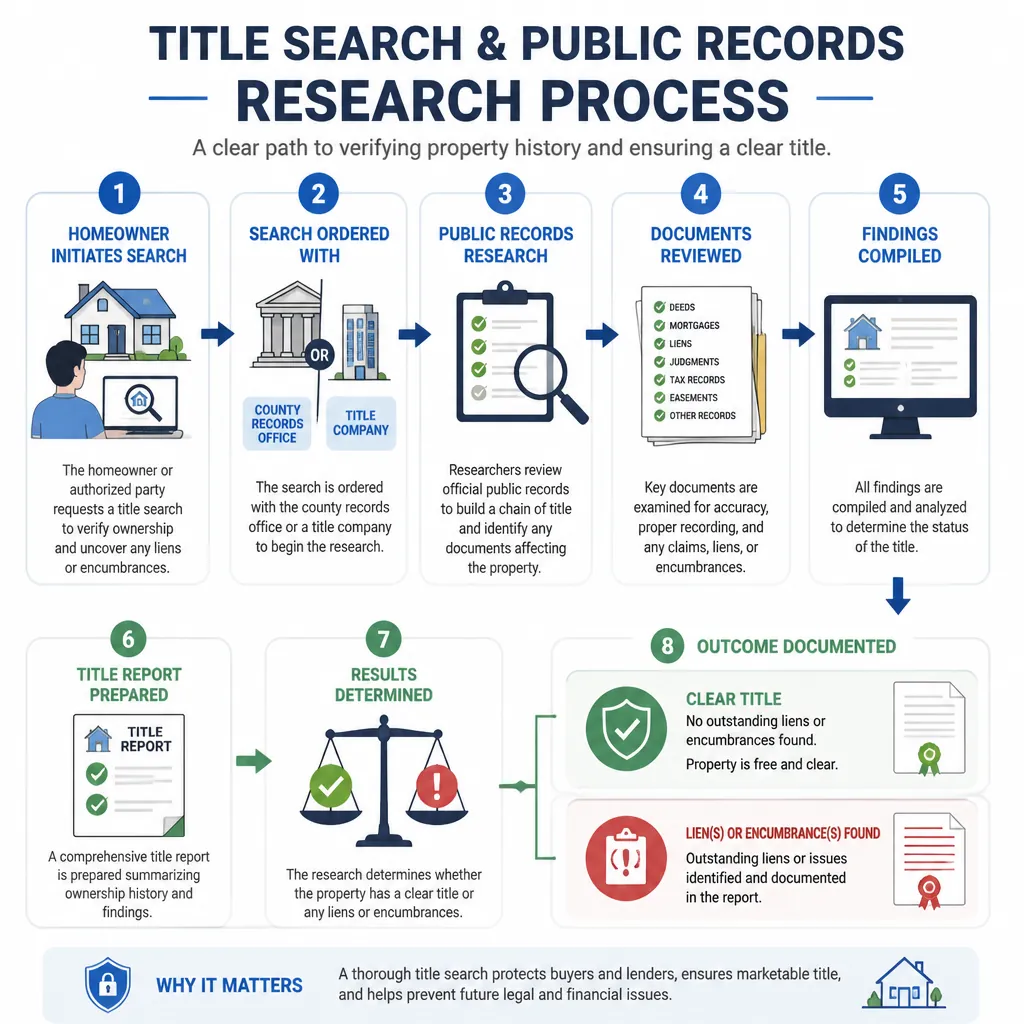
Title Search Process
Want the complete picture? A professional title search is your best bet. A title company or real estate attorney digs into the public record—usually at your county recorder or clerk's office—going back as far as state law requires, typically 40 to 60 years. They're hunting for a complete chain of title and flagging any outstanding encumbrances along the way. What you'll get back is a preliminary title report that lays out all the recorded liens, easements, and title defects they found. Budget $150 to $600 for a basic search, though costs vary depending on where you live and how messy your property's history is.
Public Records Research
You can start digging yourself through your county recorder's or assessor's website. Most counties have digitized at least some records by now, so you can search by owner name or parcel number to pull up recorded documents. But here's the catch: DIY searches miss things. They skip liens recorded in other counties if you've moved around, federal tax liens filed through the IRS's separate system, or older records that haven't been scanned yet. Think of a DIY search as a preliminary check—helpful, but not the final word.
Working With a Title Company
Get a title company involved early. Before you even list. A preliminary title report from them brings lien problems to the surface while you've still got breathing room to fix them—without a buyer tapping their foot. Title companies also manage the payoff process at closing, so they're critical no matter how you decide to sell your place. And here's the good news: many will run a preliminary search for almost nothing, or fold it into their closing services without an extra charge.
| Method | Cost | Turnaround Time | Comprehensiveness | Professional Required | Best For |
|---|---|---|---|---|---|
| DIY County Search | Free | 1–2 hours | Low | No | Quick initial check |
| Online Title Search Service | $25–$100 | 24–72 hours | Moderate | No | Preliminary verification |
| Title Company Preliminary Report | $150–$400 | 3–7 business days | High | Yes | Pre-listing discovery |
| Full Professional Title Search | $300–$600 | 5–10 business days | Very High | Yes | Pre-closing, complex histories |
| Real Estate Attorney Search | $500–$1,500+ | 1–2 weeks | Very High + legal analysis | Yes | Disputed or complex liens |
Red Flags to Watch For
Don't wait for a title search to spot trouble. Check your county assessor's website right now for past-due property taxes. Look back several years for any unpaid contractors or repair bills. Have you been hit with lawsuits or court judgments? Is your HOA breathing down your neck about unpaid dues? What about unpaid income taxes? These are the situations that scream "lien alert." Tackle them before a buyer's lender does their own digging. When you address these proactively, you've got far more negotiating power and the freedom to solve problems on your own timeline.
Back to top7 Steps to Selling a House With a Lien
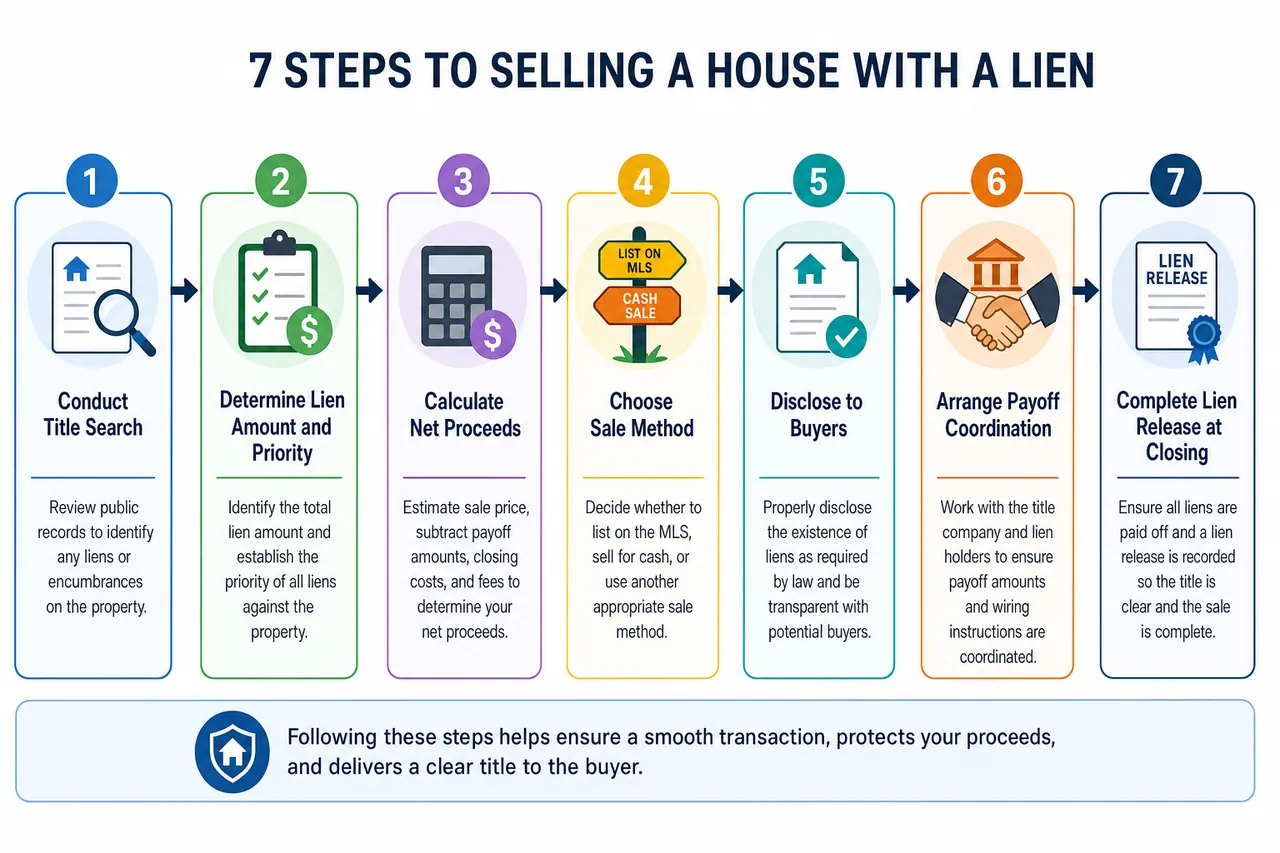
Step 1: Conduct a Title Search
Order a preliminary title report before you list your home, price it, or sign anything. You can't fix what you don't know about. Getting this done early gives you breathing room to solve problems, keeps your deal from blowing up mid-escrow, and shows buyers and their agents you're serious and organized.
Step 2: Determine Lien Amount and Priority
Once you know what liens exist, call each lienholder and ask for a formal payoff statement. These statements expire fast—usually within 30 days—and they show you the exact balance owed, interest that's piled up, and any additional fees. Write them down in priority order, because that's the sequence for who gets paid when the sale closes. Your title company can help you map this out if you get confused.
Step 3: Calculate Net Proceeds After Payoff
Add everything up: all the lien payoffs, plus closing costs (which run 6–10% of your sale price and include agent commissions, title insurance, transfer taxes, and escrow fees). Subtract that from what you expect to sell for. What's left? That's your take-home number.
And if that number is negative or making you nervous, you've got some choices. You might try negotiating liens down. You could adjust your asking price. Or you might explore other sale structures before you move forward.
Step 4: Choose Your Sale Method
Licensed agents through traditional listings cast the widest net, but the timeline's longer. Cash buyers close faster and tend to be forgiving about title complications. Short sales need your lender's stamp of approval—but sometimes they're your only shot when what you owe exceeds what the house is worth. We dig into each option next.
Step 5: Disclose Liens to Buyers
Most states legally require you to tell buyers about material facts, and known liens count. But here's the practical side: if a buyer finds out about a lien you didn't mention, they'll either walk away or come after you in court. Tell them upfront. It builds confidence and keeps you out of legal trouble.
Step 6: Arrange Payoff Coordination
Your title company will ask each lienholder for updated payoff statements right before you close and will get wire instructions locked in. Complicated liens—especially IRS tax liens requiring discharge applications—might need coordination starting weeks earlier. Talk to your title officer and confirm they've got everything they need. Make sure everyone's on the same timeline.
Step 7: Complete Lien Release at Closing
When you close, the title company pays off each lienholder in order of priority using your sale proceeds. After they get paid, lienholders must provide a lien release (also called a satisfaction of lien or reconveyance) within a certain window—often 30 days, but it depends on your state and the type of lien. The title company then records these release documents at the county recorder's office. That's when the title's officially clean for the new owner.
Back to topSelling Your Home When There's a Lien
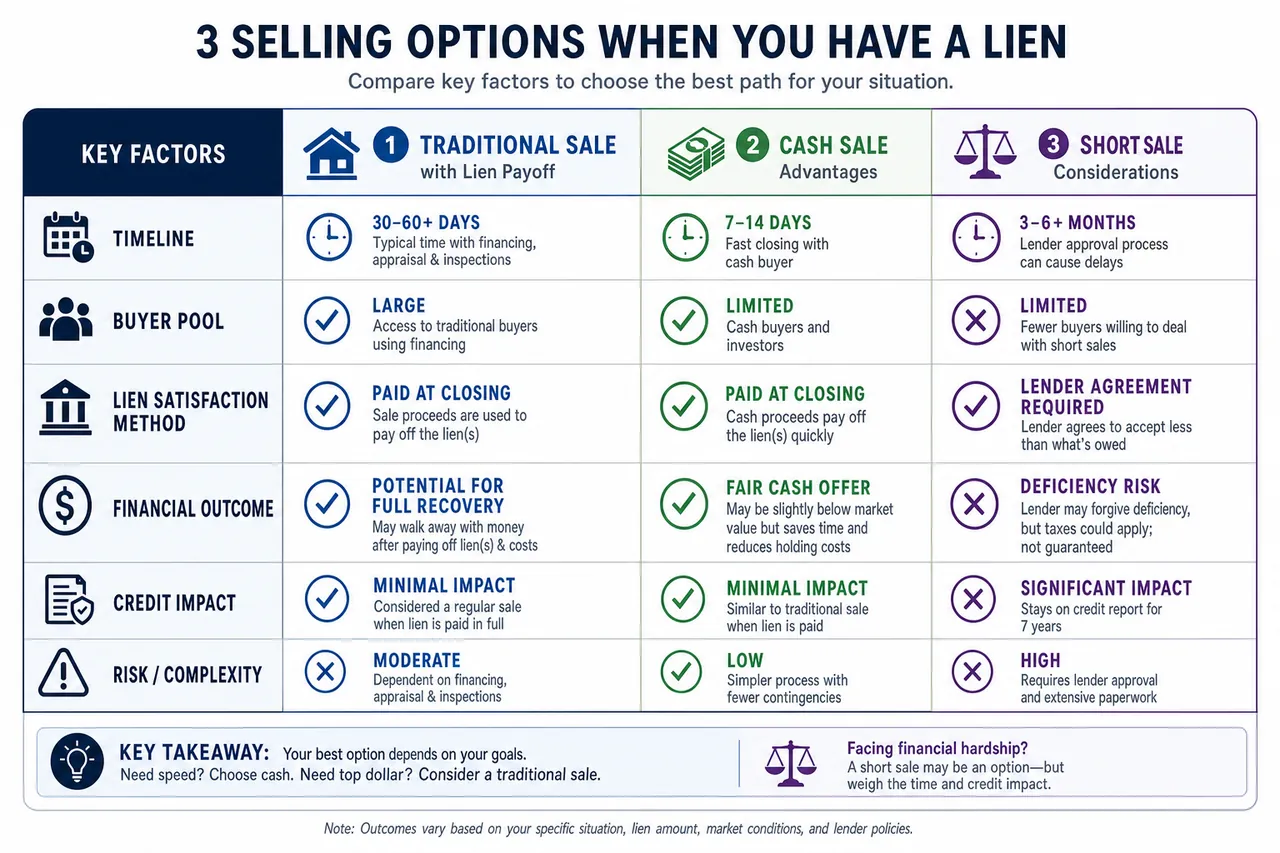
Your timeline, your budget, and how much breathing room you get with the lien itself — it all depends on which selling method you pick. The three main paths look very different on paper. Let's break down what each one actually costs you, how long it takes, and whether it'll work for your specific situation.
| Sale Method | Typical Timeline | Buyer Pool Size | Flexibility with Liens | Cost of Payoff Process | Complexity Level |
|---|---|---|---|---|---|
| Traditional Listing (Agent) | 30–90 days | Large | Moderate | Standard closing costs (6–10%) | Low to Moderate |
| Cash Sale (Investor/iBuyer) | 7–30 days | Smaller | High | Lower (no agent commissions) | Low |
| Short Sale | 3–6 months | Moderate | Low (lender controls) | Lender may absorb shortfall | Very High |
Traditional Sale With Lien Payoff
You've got decent equity and a straightforward lien? A traditional listing is usually your best bet for getting top dollar. Everything gets disclosed upfront, priced into the deal, and settled at closing like any other debt. Your listing agent and the title company do the heavy lifting on coordination — that's their job. But here's the real risk: mid-escrow, some weird lien complication pops up and either derails the whole thing or kills momentum. That's exactly why getting a title search done before you list matters so much.
Cash Sale Advantages
Real estate investors and cash-for-house companies handle liens differently. They don't have a bank breathing down their neck. Title problems that would make a traditional lender walk away? A cash buyer shrugs and keeps going. Most of them have dealt with lien payoffs before and understand the mechanics.
You give up some money on the sale price. But you get speed, certainty, and way less headache. When you're juggling multiple liens, a disputed lien, or a deadline that won't wait, that trade-off usually wins.
Sites like KDS Homebuyers let you get a direct cash offer and compare it head-to-head with what a traditional listing might net you. See both numbers. Then decide which one makes sense for your life right now.
Short Sale Considerations
Your liens add up to more than what the house will sell for. Now what? A short sale means asking your mortgage lender to take a haircut — they accept less than they're owed so the property can close and the lien gets released. Sounds simple. It isn't.
Your lender needs to sign off first. Then comes a blizzard of paperwork — hardship letters, financial statements, listing agreements, and purchase offers. The whole process eats 3 to 6 months, sometimes way longer. Not every lender approves every request, even when the paperwork is perfect.
And don't forget the tax hit. Any debt your lender forgives might count as income on your tax return unless you qualify for an IRS exclusion. We'll dig deeper into negative equity scenarios below, because this is serious stuff.
Back to topWhat Happens at Closing When There's a Lien

Title Company's Role
Think of the title company as your closing referee. They're neutral, and they handle the money. They collect funds from the buyer and the buyer's lender, then pay out every obligation on your list — lien payoffs, agent commissions, transfer taxes, escrow fees. Whatever's left over? That goes to you, the seller. But here's the key: their title insurance commitment (both the lender's policy for the buyer's lender and the owner's policy for the buyer) won't be issued until every recorded lien is actually resolved at closing.
Lien Payoff from Proceeds
Closing day payments follow a strict pecking order. Senior liens — the ones recorded earliest, plus tax liens that often get special legal priority — get paid first. Best case scenario: your sale proceeds cover everything and you walk away with a check. Worst case? You don't have enough to pay off all the liens. That's called a short sale, and you'll need lender approval before closing can even happen.
Lien Release Documentation
Just because you paid off a lien doesn't mean it disappears from the public record. The lienholder has to file paperwork to officially remove it. The document's called different things depending on your situation — satisfaction of mortgage, reconveyance deed, or lien release — but the concept's the same across states. Title companies usually handle the coordination by requiring lienholders to produce the release at closing or send it to the county recorder's office right after they get paid. Got a judgment lien? The creditor has to file a satisfaction of judgment both with the court and the recorder's office.
Escrow and Hold-Back Amounts
Sometimes a lien issue isn't clean. An IRS discharge application might still be in process but not finalized. A mechanic's lien could be disputed. And you can't just wait forever. So the title company arranges a hold-back — they put part of your proceeds into escrow until the lien gets resolved. This way the sale closes on time. The buyer and their title insurer get protection. Everyone moves forward.
Back to topState-Specific Considerations
Every state plays by different rules when it comes to liens. California's approach won't work in Texas. Texas won't work in Florida. The table below breaks down five major states — but you really should talk to a local real estate attorney who knows your specific situation inside and out.
| State | Homestead Protection | Key Lien Issues | Disclosure Requirements | Notable Timeframes |
|---|---|---|---|---|
| California | Up to $300,000–$600,000 (sliding scale) | Mechanic's lien priority disputes common | Broad Transfer Disclosure Statement required | Mechanic's lien must be filed within 90 days of completion |
| Texas | Unlimited homestead exemption (no dollar cap) | Constitutional restrictions on certain liens | Seller's Disclosure Notice required | Judgment liens don't attach to homestead in most cases |
| Florida | Unlimited (for primary residence) | HOA liens — super-priority in some districts | Full disclosure statute | Mechanic's lien: 90 days from last work/materials |
| New York | $89,975–$179,950 (varies by county) | Judgment liens attach broadly to real property | Property Condition Disclosure required | Judgment lien valid for 10 years, renewable |
| Illinois | $15,000 ($30,000 for married couples) | Tax liens have super-priority; county tax sales | Residential Real Property Disclosure Act | Tax lien can trigger tax sale after 2 years delinquency |
Texas stands out. The state's constitution gives homestead protections that rank among the toughest in America. Want to know the biggest advantage? Judgment creditors generally can't force a sale of your Texas primary residence to collect on a judgment lien — though there are limits and exceptions you need to understand. If you're in Florida dealing with HOA problems or water damage at the same time, pay attention: the Florida seller disclosure requirements for property condition apply right alongside lien disclosures. And if you're selling in Colorado with stacked property issues? Check out Colorado's disclosure framework so you know exactly what buyers need to hear.
Back to topWhat If the Lien Exceeds Your Home's Equity?
Understanding Underwater Situations
You're "underwater" when your total lien obligations exceed what your home is actually worth. It's a negative equity position. But you're not trapped — just working with fewer options. Here's what makes this complicated: selling without lender approval leaves you short on the mortgage payoff, and no title company will close the deal without the lienholder's consent.
Short Sale Options
A short sale lets you sell the home for less than what you owe, but only with your lender's written approval. The lender agrees to accept a lower payoff amount in exchange for releasing the lien. Not all lenders will approve this. You'll typically need to prove financial hardship, have a signed purchase agreement already in place, and submit extensive paperwork. Here's the key: lenders approve short sales when they figure the proceeds exceed what they'd recover through foreclosure. Your home's market value drives this entire calculation.
Negotiation With Lienholders
Subordinate lienholders — that's second mortgage holders, judgment creditors, HOAs — often accept pennies on the dollar to release their claim. Why? They'd rather get something than wait indefinitely for nothing. Say you have a $50,000 judgment lien on a property where only $10,000 of equity remains after the first mortgage gets paid off. That creditor might accept $7,000–$8,000 to walk away. This negotiation really needs a real estate attorney handling it directly with lienholders to keep everything documented and legally binding.
Tax Implications
When your lender forgives part of the mortgage debt in a short sale, the IRS can treat that forgiven amount as taxable income. That's called cancellation of debt income, and it stings. The Mortgage Forgiveness Debt Relief Act has offered some relief for primary residences, but the rules have shifted over time. Talk to a CPA or tax attorney before you finalize any short sale. You need to know your actual tax exposure first.
Back to topHow to Remove or Satisfy a Lien
Payment and Lien Release
Here's the simplest path: pay what you owe, get a written release from the lienholder, and record that release with the county. Done. For mortgages, your title company handles this automatically at closing. But with other liens? You'll need to stay on top of it yourself. The release document has to actually get recorded. A receipt in your drawer doesn't cut it — the lien stays on your title until that paperwork's officially filed.
Negotiated Settlement
Judgment creditors and other lienholders often will take less than the full amount, especially if the lien's been sitting there for years, your finances are tight, or they'd spend more trying to collect than they'd actually recover. This is where negotiating makes sense. But here's the critical part: get everything in writing. Your settlement agreement needs to spell out that they'll file a lien release (or satisfaction of judgment) as soon as you pay. Don't hand over a dime without that commitment in writing first.
Legal Disputes and Lien Challenges
Some liens shouldn't be there at all. Mechanic's liens filed past their deadline. Judgment liens recorded in the wrong county. Liens based on debts you actually dispute. Any of these can be challenged. A real estate attorney can dig into whether a lien holds up legally or has procedural problems you can use against it. And here's the payoff: knock out an invalid lien through a successful challenge and you owe nothing. That's why getting legal eyes on unusual or surprising liens before you just pay them off is almost always worth the investment.
Timeline for Lien Removal
Straightforward payoffs — mortgage or HOA balance — wrap up in days. IRS tax lien discharges? Plan on 30–45 days from when you file a complete application. Negotiated judgment settlements typically take 2–6 weeks. And if a mechanic's lien dispute actually goes to court, you're looking at 6 months to over a year. Work backward from your sale closing date. The most complicated lien on your property should drive your timeline. Start dealing with liens as soon as you know they exist.
Back to topCan You Transfer or Gift Property With a Lien?
Here's the hard truth: liens stick with the property itself, not with you as the owner. So when you gift or transfer a property—whether to a family member, into a trust, or anywhere else—those liens come along for the ride. The new owner inherits the property encumbered by whatever liens were already there. And they're now on the hook for dealing with them. Think about it: if you try to transfer your home to your child to dodge a creditor, that creditor's lien still attaches to the house. Your child now owns it subject to that lien.
Mortgages complicate things further. Most loan documents have a "due-on-sale" clause buried in there. It says the lender can demand the entire loan balance immediately if you transfer ownership without their permission. Break this rule, and the lender has the legal right to call in the full amount right away. But don't panic yet—some transfers actually get a free pass under federal law. A revocable living trust where you stay the beneficial owner? Usually fine. Transfers between spouses? Also typically exempt. Before you move forward with any transfer, though, get explicit lender consent and solid legal guidance.
Back to topWorking With Real Estate Professionals

When to Hire a Real Estate Attorney
You don't always need a lawyer to handle a lien. But there are situations where one becomes essential—and trying to go it alone can cost you more in the long run.
Back to top
