What Can You Do With Squatters? Legal Remedies for Property Owners

Table of Contents
- What's a Squatter?
- Do Squatters Have Legal Rights?
- Requirements for Adverse Possession Claims
- Adverse Possession Periods and Key Requirements by State
- How to Evict a Squatter: The Legal Process
- Recent Legislative Changes at a Glance
- New York's 30-Day Occupancy Rule: What Changed
- How to Protect Your Property From Squatters
- The Broader Policy Debate and Why Squatting Has Increased
- When Squatting Affects a Sale
- Conclusion
- Frequently Asked Questions
Someone's living on your property without your permission or any legal claim to it. You're not stuck—you've got real legal options. Law enforcement can help. Courts can order them out. What actually works depends on your state's specific laws, how long they've been there, and whether they ever had permission to be on the property in the first place. This guide breaks down every tool available to you, the legal concepts behind them, and how to stop squatters before they become your problem.
This article is for general informational purposes only and doesn't constitute legal advice. Squatter and eviction laws vary significantly by state and locality. Consult a licensed attorney in your jurisdiction before taking any action.

What's a Squatter?
Definition of a Squatter
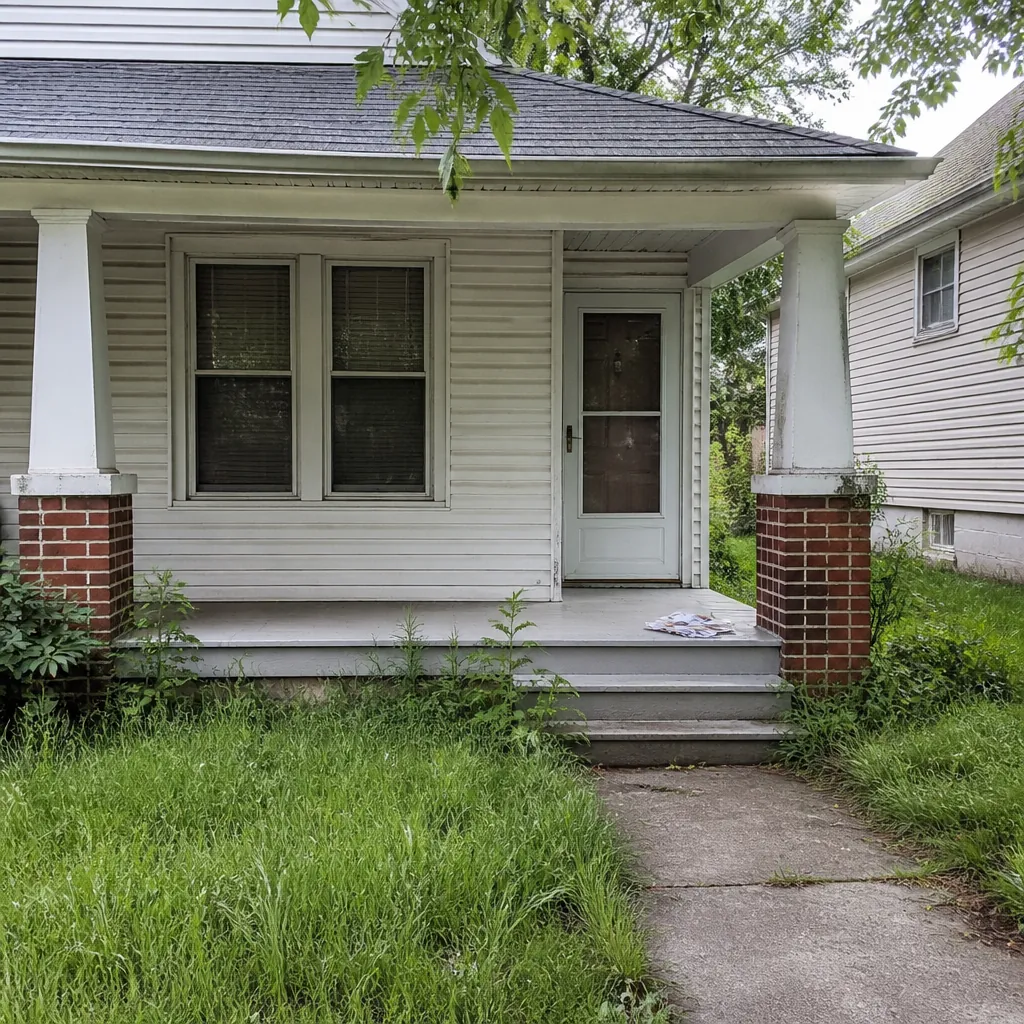
Someone moves into your empty house. No lease. No permission. No legal right to be there. That's a squatter. They're different from tenants (who have a lease) or guests (who you invited). Squatters set up residence in vacant land, abandoned homes, foreclosed properties, or even your second home sitting empty for a few months.
Squatting vs. Trespassing
The legal line between these two matters more than you'd think. Trespassing is criminal—you're breaking the law by being somewhere you don't belong, and police can remove you right then and there in most states. Squatting usually lives in civil court instead. Once someone's been camped out in your property for a while, law enforcement often steps back and says this needs a formal eviction, not an arrest.
When you call the cops, timing everything. Fresh break-in? Officers typically treat that as trespassing and remove them immediately. But if weeks or months have passed, don't expect police to do it—you'll need to file for eviction through the court system first.
Squatting vs. Adverse Possession
Social media squatters claim they own your place after a few days. That's not how adverse possession works, and you need to understand the difference.
Adverse possession is a real legal doctrine. It allows someone to claim ownership if they occupy your property continuously, openly, exclusively, and "hostilely" (meaning without permission) for years—usually 5 to 20 depending on your state. The burden is massive. Courts don't hand over property lightly. Someone squatting for a week or even a month isn't gaining any legal rights to your home, no matter what they post online.
Holdover Tenants vs. Squatters
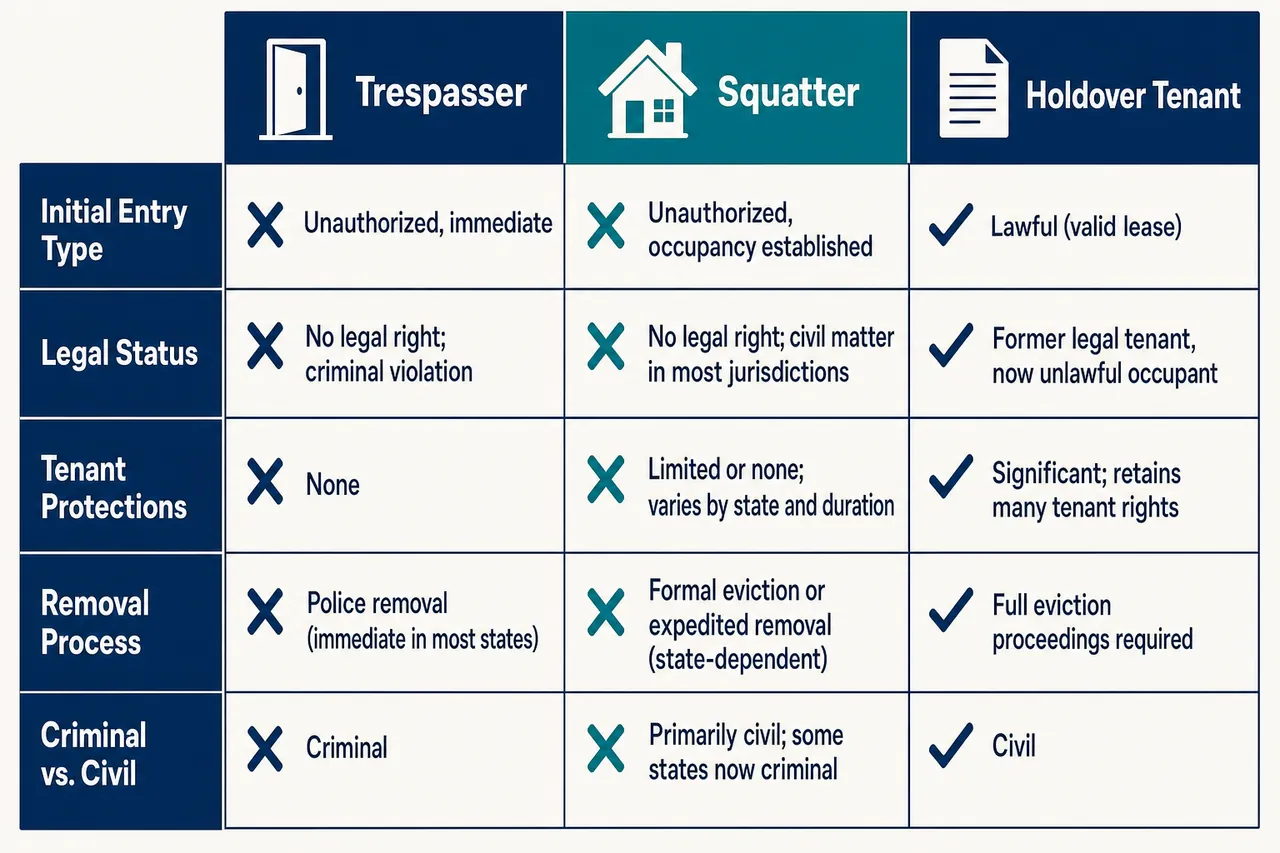
A holdover tenant came in legally with a valid lease. Their lease expired, they never left, and they're still there—that's the whole situation. They actually keep some tenant rights under state law, even though their lease is gone. A squatter? They never had permission in the first place. The legal process to remove them and what protections they're entitled to differs dramatically between these two categories.
| Classification | Initial Entry Type | Legal Status | Tenant Protections | Removal Process | Criminal vs. Civil |
|---|---|---|---|---|---|
| Trespasser | Unauthorized, immediate | No legal right; criminal violation | None | Police removal (immediate in most states) | Criminal |
| Squatter | Unauthorized, occupancy established | No legal right; civil matter in most jurisdictions | Limited or none; varies by state and duration | Formal eviction or expedited removal (state-dependent) | Primarily civil; some states now criminal |
| Holdover Tenant | Lawful (valid lease) | Former legal tenant, now unlawful occupant | Significant; retains many tenant rights | Full eviction proceedings required | Civil |
Do Squatters Have Legal Rights?
Overview of Squatters' Rights by Jurisdiction
All 50 states recognize some form of adverse possession. It's the main legal path squatters might eventually use to claim property rights. But here's what matters: squatters don't gain any rights just by moving in. What they actually have are procedural protections—the right not to be physically thrown out without a court order in many states, plus the theoretical ability to pursue an adverse possession claim after satisfying strict requirements over many years. For you as a property owner, this translates to one thing: you'll need to go through formal legal channels to remove them, not handle it yourself.
Adverse Possession as a Legal Doctrine
Adverse possession goes back centuries. It's a common law doctrine that lets someone claim ownership of property they've occupied openly, continuously, and exclusively for a set statutory period—without permission from the actual owner. Why does it exist? Originally, it was meant to handle abandoned land and incentivize productive use of property. It's not designed to protect someone who breaks into your house while you're on vacation. Meeting the full legal standard takes real effort and years of continuous occupation. Most modern squatter situations never result in a successful adverse possession claim, which is why the doctrine matters far less in practice than people think.
Recent Legislative Changes

High-profile squatter cases and social media have pushed several states to tighten or clarify their laws. Illinois SB 1563, which kicks in January 1, 2026, reclassifies squatters as criminal trespassers and gives law enforcement clearer power to remove unauthorized occupants. Florida HB 621 (Fla. Stat. § 82.036), effective July 1, 2024, streamlined the sheriff removal process. Texas SB 1333 created a sworn-complaint removal process starting September 1, 2025. And Texas SB 38, effective January 1, 2026, fast-tracked the entire eviction timeline. Indiana SEA 157 and North Carolina Session Law 2025-88 did the same thing in 2025. You're seeing a nationwide shift toward protecting property owners.
New York changed course too. In 2025, lawmakers scrapped a protection that had allowed squatters to claim tenant status—and all the delays that come with it—after just 30 days of occupancy. That old rule meant someone with no lease and no right to be there could hide behind tenant protections designed for actual renters, forcing you through a full eviction instead of a simple removal. The new amendments make that much harder. It's tougher now for an unauthorized occupant to claim tenant status just by staying put for a month. If you own property in New York, talk to a licensed New York attorney about where things stand. The law, local rent rules, and existing court procedures can still create complexity even after these changes.
Back to topRequirements for Adverse Possession Claims
A squatter needs to check every single box. Even in states with short statutory periods, missing just one element kills the entire claim.

Continuous Possession
The squatter must occupy your property continuously for the entire statutory period. No major gaps. "Continuous" doesn't mean they're there every single day—if someone owns a seasonal cabin, using it seasonally counts. What matters is whether their usage pattern matches how a real owner would use the property during that whole window.
Open and Notorious Occupation
Hidden occupation doesn't count. The squatter's presence has to be visible and obvious. Ask yourself: would you notice someone living here if you paid attention? If the occupation is concealed, the adverse possession clock never starts ticking in the first place.
Exclusive Use
They can't share the property. Not with the public, not with other squatters, and definitely not with you. The possession must be as exclusive as a true owner's would be. The moment a squatter allows others to come and go freely, or occupies the space alongside you, that element crumbles.
Hostile Possession
"Hostile" doesn't mean aggressive or confrontational. It means they're there without your permission—no lease, no license, no informal agreement. If you've ever given them permission to occupy the space, even casually, the adverse possession clock stops dead.
Payment of Property Taxes
Several states make this mandatory. California demands it. The state boasts the nation's shortest adverse possession period at just 5 years (Cal. Civ. Proc. Code § 325), but there's a catch: the claimant must pay every single property tax bill during those five years. Florida has the same requirement under Fla. Stat. § 95.18, demanding annual tax payments. This tax obligation stops most squatters cold. Few have the resources or willingness to keep paying.
Color of Title
This is a document that looks like it conveys ownership but isn't legally valid—think a flawed deed or an unrecorded transfer. A squatter armed with color of title has a much stronger adverse possession claim in most states. And many states will actually shorten the statutory period if someone can show both color of title and tax payments. If a squatter or law enforcement shows you any documentation claiming ownership, don't brush it off. Call an attorney immediately. Even a defective document can make removal proceedings significantly harder.
Back to topAdverse Possession Periods and Key Requirements by State
Every state has its own rules. Some give squatters a path to ownership in just a few years—others make it nearly impossible. The table below shows the states where adverse possession claims actually happen or where laws just changed, and we've verified every number against the actual statute.
| State | Statutory Period (Years) | Tax Payment Required? | Color of Title Effect | Recent Legislative Changes |
|---|---|---|---|---|
| California | 5 (Cal. CCP § 325) | Yes — all taxes during period | Strengthens claim; reduces period with taxes | None recent; existing law is already strict |
| Florida | 7 (Fla. Stat. § 95.18) | Yes — annual payments required | Can reduce period; check local statute | HB 621 (expedited sheriff removal), eff. July 1, 2024 |
| Texas | 10 (standard); 3–5 with color of title + taxes | Required for shorter period | Reduces period to 3–5 years with taxes | SB 1333 (eff. Sept. 1, 2025); SB 38 (eff. Jan. 1, 2026) |
| New York | 21 | Not required | Strengthens claim | 2025 legislation limited 30-day occupancy protections (see below) |
| Illinois | 20 (check current statute) | Check state statute | Strengthens claim | SB 1563: squatters now criminal trespassers, eff. Jan. 1, 2026 |
| North Carolina | 20 (continuous possession) | Not required | Strengthens claim | Session Law 2025-88: expedited removal, eff. Dec. 1, 2025 |
| Indiana | 10 (check current statute) | Check state statute | Strengthens claim | SEA 157: 48-hour police removal affidavit, eff. July 1, 2025 |
| Louisiana / New Jersey | 30 (longest in U.S.) | Check state statute | Varies by state | No major recent changes |
These laws change all the time. Before you make any decisions based on this information, talk to a licensed attorney in your state and verify the current statute yourself. Don't assume anything's the same as it was last year.
Back to topHow to Evict a Squatter: The Legal Process
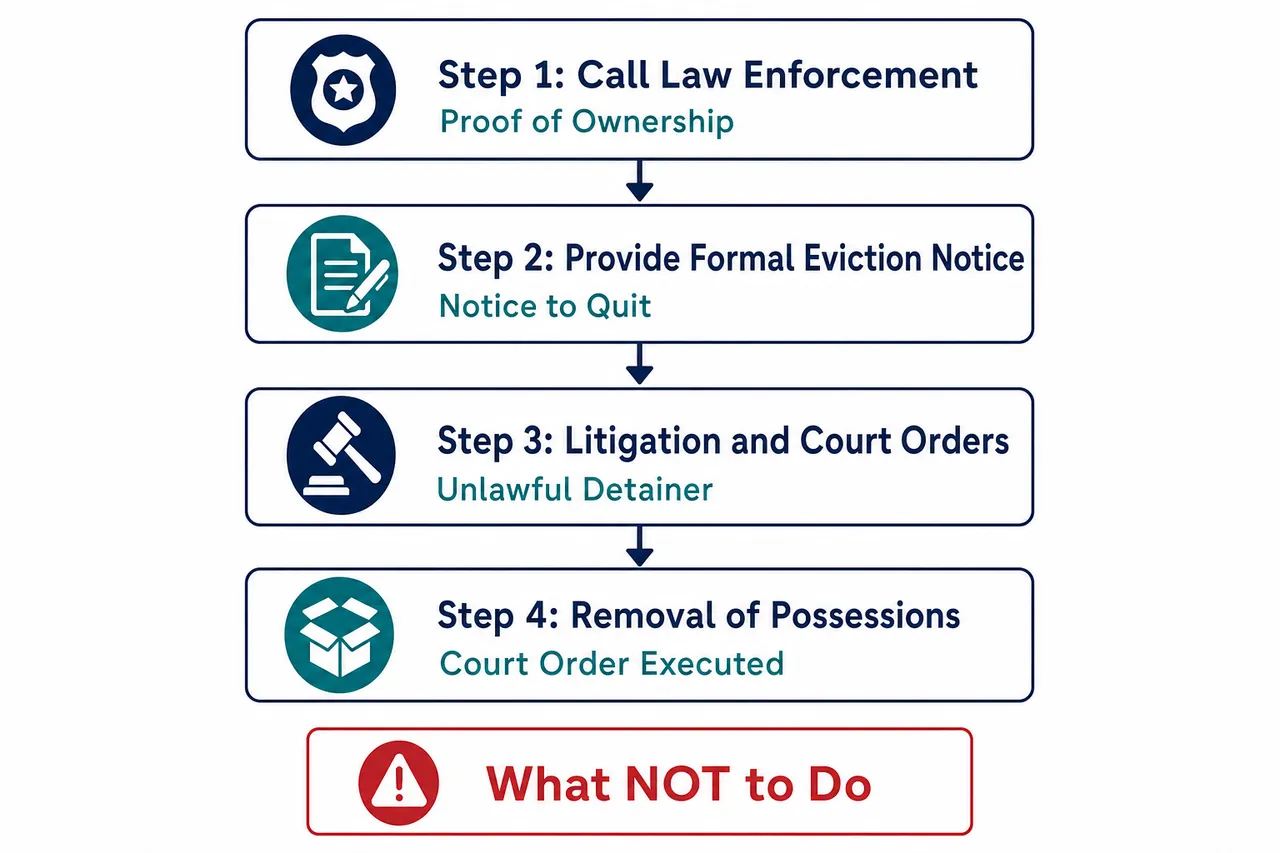
Most states follow a similar four-step eviction framework. But timelines and available shortcuts? They vary considerably depending on where you live. Some states have recently enacted expedited procedures that can speed things up significantly.

Step 1: Contact Law Enforcement with Proof of Ownership
Start by calling your local police department. Bring documentation proving you own the property—a deed, recent property tax statement, or mortgage statement. Whether they can immediately remove the squatter depends on your state and the specific circumstances. Illinois changed its game with SB 1563 (effective January 1, 2026), classifying squatters as criminal trespassers and giving law enforcement clearer authority to act. Texas SB 1333 (effective September 1, 2025) lets you file a sworn complaint with a sheriff or constable to initiate removal. Florida's HB 621 (Fla. Stat. § 82.036) goes further—a county sheriff can remove an unauthorized occupant within 24–48 hours after you file a verified complaint. Indiana SEA 157 (effective July 1, 2025) allows removal within 48 hours of an affidavit filed with police. And North Carolina's Session Law 2025-88 (effective December 1, 2025) provides for a magistrate hearing within roughly 48 hours after you file an affidavit. In states without these expedited mechanisms, police might decline to act and tell you to pursue civil eviction instead.
What should you bring when you contact law enforcement? Gather your recorded deed, the most recent property tax bill in your name, any utility account statements showing your name and the property address, and photographs documenting your ownership—renovation permits, insurance declarations, whatever you have. The stronger your documentation package, the more likely law enforcement treats this as trespass rather than a civil dispute.
Step 2: Issue a Formal Eviction Notice
Can't get police to remove the squatter immediately? Then you need a formal written notice to quit. Notice periods range from 3 to 30 days depending on your state. Squatters with no lease at all typically get the shortest notice periods. And here's what matters: serve the notice exactly as your state requires. Some states demand personal service, others allow posting on the door, some require both. Keep copies of everything and document exactly how you served it—you'll need this evidence if the squatter doesn't leave and you end up in court.
Step 3: File for Eviction in Court
The squatter still won't go? File an unlawful detainer (or summary possession) action in your local court. This is where your expenses start climbing. Court filing fees vary by location: Florida charges $185 plus $10 per summons, with a writ of possession running approximately $90 in most counties and $115 in Miami-Dade. California's unlawful detainer filing fees range from $240 to $450 depending on your county and the amount claimed (as of January 1, 2025). In Washington State's Clark County, the initial filing fee is $135, rising to $247 total if the squatter files an answer (as of June 11, 2026). And then there's attorney fees—potentially much higher than court costs. An uncontested eviction typically takes 30 to 90 days from notice through lockout. Contested cases drag on much longer. Texas has accelerated this under SB 38 (effective January 1, 2026)—you can now get an uncontested eviction judgment as early as day 10 after filing.
Step 4: Execute the Court Order and Handle Remaining Belongings
You've got your court order. A sheriff or marshal will execute the writ and physically remove the squatter. But you're not done yet. Don't immediately throw out whatever belongings are left behind. Most states require you to hold abandoned property for 15 to 45 days, and you must typically notify the former occupant about how to retrieve their things. Skip these steps and you're opening yourself to liability.
What NOT to Do: Illegal Self-Help Tactics
No matter how angry you feel, some actions are illegal in virtually every state. They'll expose you to civil liability and possibly criminal charges.

- Changing the locks while the squatter is present or has belongings inside
- Shutting off utilities (water, electricity, heat) to force a squatter out
- Removing or damaging the squatter's belongings
- Physically threatening or intimidating the occupant
- Entering the property repeatedly to harass the occupant into leaving
These self-help eviction tactics backfire. The squatter can successfully sue you for damages, they can delay your ability to regain possession, and in some states you face criminal penalties. There's only one legal path, and it runs through the courts.
Need to sell your property while a squatter's still there? Our guide on how to sell a house with squatters: legal options and fast solutions breaks down what options you actually have.
Back to topRecent Legislative Changes at a Glance
States across the country are tightening squatter laws. If you own property, these changes directly affect how fast you can reclaim it.
| Jurisdiction | Law / Bill | Key Change | Effective Date | Impact on Property Owners |
|---|---|---|---|---|
| Florida | HB 621 (Fla. Stat. § 82.036) | Expedited sheriff removal within 24–48 hours after verified complaint | July 1, 2024 | You can get someone off your property faster. No lengthy eviction court case required if you meet the qualifications. |
| Texas | SB 1333 (Property Code Ch. 24B) | Sworn-complaint removal via sheriff/constable | September 1, 2025 | Law enforcement can step in and remove squatters. You don't need a court judgment to make it happen. |
| Texas | SB 38 | Overhauled eviction timeline; uncontested judgment possible by day 10 after filing | January 1, 2026 | Court-based eviction now moves dramatically faster. What used to take months could wrap up in under two weeks. |
| Indiana | SEA 157 | Police removal within 48 hours after owner files affidavit | July 1, 2025 | File an affidavit with police and they'll handle removal themselves. This skips the entire court process. |
| North Carolina | Session Law 2025-88 | Magistrate hearing within ~48 hours of owner affidavit | December 1, 2025 | A magistrate can hear your case in roughly two days. This cuts what's normally a months-long eviction timeline down significantly. |
| Illinois | SB 1563 | Squatters reclassified as criminal trespassers | January 1, 2026 | Police now treat squatters as criminals committing a crime, not as a civil matter between you and a tenant. |
| New York | 2025 legislative amendments | Limited the ability of unauthorized occupants to claim tenant protections based on 30-day occupancy | 2025 (verify exact effective date with a NY attorney) | Squatters can't hide behind tenant protections as easily anymore. You won't get bogged down in procedural delays based on that claim. |
New York's 30-Day Occupancy Rule: What Changed
New York used to be a nightmare for property owners dealing with squatters. Here's what used to happen: someone could physically occupy your property for just 30 days, and suddenly they'd have the same legal protections as a paying tenant. That meant Housing Court, formal eviction notices, court hearings, delays—the whole process. A squatter who stayed put for a month could drag you through weeks or months of legal proceedings before you'd even get your property back.
The 2025 amendments changed that. They specifically target this loophole. Now, unauthorized occupants—people with no lease, no rental agreement, and absolutely no legal right to be there—can't automatically claim tenant protections just because they've been squatting for 30 days. The goal is straightforward: give property owners a faster way to remove someone who was never supposed to be there in the first place.
What this means for you: You don't automatically get trapped in full eviction court if a squatter has been in your New York property for 30+ days. But New York City's local rent laws and Housing Court procedures add extra layers of complexity. Your specific situation, especially if you're in NYC, might still trigger those protections. You need to talk to a licensed New York real estate attorney to know for sure where you stand. Document that you own the property. Call a lawyer before that 30-day mark passes.
Back to topHow to Protect Your Property From Squatters

Stopping squatters before they move in costs far less than fighting eviction later. And it's worth the effort—both financially and emotionally. The strategies below will dramatically reduce your risk.
Keep the Property Visibly Occupied or Maintained
Squatters look for easy targets. They want vacant properties with overgrown grass, boarded windows, piled-up mail, and absolutely no signs of life. If you own a vacant house, that's exactly what you want to avoid looking like. Arrange regular lawn care. Leave lights on timers so the place glows at night. Make sure the exterior actually looks like someone lives there.
Inherited or foreclosed properties? These get hit hardest. That's the first place squatters check.
Conduct Regular Inspections
Visit vacant properties yourself and take dated photos each time. This matters more than you might think. A squatter who's been there two weeks? You can remove them. A squatter claiming tenant status after six months? That's a legal nightmare you don't want.
If you manage multiple properties or live out of state, hire a local property manager to do walkthroughs regularly. For guidance on managing inherited property decisions including whether to keep or rent, factor in these ongoing management obligations before you commit.
Secure the Property Properly
Every entry point needs to be locked down. Use solid-core doors with deadbolts, secure your windows, padlock gates, and don't leave basement or garage entries exposed. For properties sitting vacant for months? Install a monitored alarm system and security cameras you can check remotely.
Post "No Trespassing" signs where people can clearly see them. This isn't just a suggestion—it establishes legal notice and strengthens criminal trespass charges in most states.
Maintain Clear Documentation of Ownership
Your recorded deed, property tax statements, insurance documents, and utility accounts should be organized and easy to access. If you need to call police or file an emergency removal affidavit, you'll need proof of ownership immediately—not hours later when you're digging through files.
This is especially crucial if you own inherited property with multiple owners, where title documentation gets complicated fast.
Screen Tenants Carefully
Some squatter problems don't start as squatting at all. They start as normal rental agreements that fall apart. A tenant quits paying rent. Someone sublets without permission. The tenant leaves but brings people back who refuse to go. All of these situations escalate quickly. Run thorough screening—verify identity, check rental history, call references. If you do end up with a tenant relationship that's gone wrong, our guide on selling rented property with tenants walks through your options.
Act Immediately When You Discover Unauthorized Occupancy
Time is not on your side. Every single day pushes them closer to claiming they've established occupancy and belong there.
The moment you find out unauthorized people are living on your property, document everything with photos and timestamps. Then call your attorney. Then call law enforcement. Don't sit around hoping they'll just leave.
Back to topThe Broader Policy Debate and Why Squatting Has Increased
Why Squatting Has Become More Visible
Squatting itself isn't new. But you're seeing it everywhere now—on the news, social media, TikTok—and that visibility has changed everything. Social media has spread awareness (and sometimes outright coaching) about "squatters' rights," often twisting what the law actually says. Major cities have been hit with high-profile cases: multimillion-dollar homes occupied by squatters, Airbnb properties turned into unauthorized long-term rentals, inherited homes claimed by distant relatives or complete strangers. And then there's the housing crunch. In expensive urban markets, desperation is real, and some people view unauthorized occupancy as their only option for shelter.
Constitutional Concerns: Fifth Amendment Takings
Some legal scholars and property rights advocates argue that squatting laws violate the Fifth Amendment. Their position is straightforward: if the government forces you to let someone live in your home without paying rent—even temporarily—that's a taking of your property. You should be compensated for it. The enforcement delays that keep you locked in removal proceedings? That physical occupation by an unauthorized person? Both qualify as government-sanctioned use of your private property. The Supreme Court hasn't settled this question definitively in the squatting context yet, but it's becoming a serious legal argument. And it's likely to shape future laws and court rulings.
The Policy Tension: Tenant Protections vs. Property Rights
Between 2024 and 2026, legislatures across the country have shifted direction. For years, tenant-protection laws kept expanding—sometimes covering unauthorized occupants by accident, sometimes on purpose. Now that's reversing. Florida, Texas, Indiana, North Carolina, and Illinois all passed expedited removal laws. The message: squatters don't deserve the same procedural protections as actual tenants. New York's 2025 changes say the same thing. The state concluded that sending every unauthorized occupant through a full tenant-eviction process just because they'd been there 30 days was absurd. It gave squatters a procedural shield the system was never meant to provide.
But tenant advocates have a point too. Speed creates dangers. Legitimate tenants with messy lease disputes can get caught in expedited processes designed for squatters. The difference between a squatter and a holdover tenant matters legally—and moving too fast risks erasing that distinction.
Back to topWhen Squatting Affects a Sale
Squatters on your property make selling harder. But you're not stuck—you have options. Depending on where you live and how far along any eviction is, you might sell while the eviction's happening, finish the eviction first and then list, or find a cash buyer willing to take the place as-is. Each path trades off differently on how fast you can sell, what you'll get paid, and how messy the legal side becomes.
Need the specifics? Our guides break down exactly what to do:
- Can you sell a house with squatters in it? What sellers must know
- Can I sell a house with squatters in it? Legal removal and sale options
- Can you sell a house with squatters living in it? What to do
Inherited property with squatters? That's a whole other mess. The estate is still being settled, and now you've got unauthorized occupants too. If the inherited property also has title problems or beneficiaries who can't agree, check out our guides on whether an executor can sell property without all beneficiaries approving and selling inherited property with a contested will.
Back to topConclusion
Your options for dealing with squatters come down to three things: your state's laws, how long they've been there, and what paperwork you can prove. And here's what matters most—2024 through 2026 have brought real wins for property owners. Florida, Texas, Indiana, North Carolina, Illinois, and New York all passed reforms that make it harder for squatters to drag out the process with legal delays. The playbook is straightforward: prove you own it, show law enforcement your documentation, give them proper legal notice, file in court if they won't leave, and execute the removal order when you win. Skip the DIY removal tactics. They'll drain your wallet far more than a formal eviction ever would.
Occupation alone doesn't hand squatters any legal claim to your land. Adverse possession demands years—not months—of continuous, open, exclusive, and hostile possession that meets every statutory requirement in your state, and judges don't just rubber-stamp these claims. Document everything. Get a licensed attorney who knows your state's specific rules. Move fast. The quicker you respond, the more leverage you retain—and the less likely this turns into a years-long nightmare you can't escape from.
Back to topFrequently Asked Questions
How quickly can I remove a squatter from my property?
Speed varies dramatically by state. Florida's HB 621 is remarkably fast—you can get removal through the county sheriff within 24–48 hours after filing a verified complaint. Indiana and North Carolina moved in the same direction, now offering 48-hour affidavit-to-removal windows. Most other states? Expect 30 to 90 days if nobody contests it. And if they do fight back, you're looking at significantly longer. Your move: call a local attorney today to find out what expedited options your state actually has.
Can a squatter claim my property through adverse possession if they've only been there a few months?
No chance. Adverse possession requires years of continuous occupation. The wait differs wildly across the country—5 years in California, 7 years in Florida, 10 years in Texas, and as long as 30 years in Louisiana and New Jersey. Someone who's been squatting for a few weeks or months? They have zero claim. Remove them quickly, and you stop any adverse possession clock before it even starts ticking.
What if the squatter claims to have a lease or some documentation of ownership?
Don't blow it off. But don't believe it either. Fake leases and forged deeds happen constantly. Gather your ammunition first: a recorded deed in your name and your property tax statements are your strongest proof of ownership. Call law enforcement with those documents in hand. Then get an attorney involved immediately. Courts have to weigh competing claims, and you need legal cover. Never physically remove anyone when ownership is disputed. Period. You need a court order first.
Can squatting affect my property insurance?
Absolutely. Squatters trash properties, create injury liability risks, and can actually void your coverage outright. Insurance companies hate this scenario. The moment you spot unauthorized occupants, call your insurer and ask point-blank: does my policy cover damage caused by squatters? Also check for vacancy clauses. Many policies cut coverage after 30 to 60 days of emptiness. This is yet another reason to move fast and keep the place visibly maintained.
Is it different if the squatter is in a foreclosed property I recently purchased?
Foreclosed homes are squatter magnets. They sit empty, nobody's watching them, and opportunists move in. When you buy at auction or from a bank, anyone living there is almost certainly a squatter or a former owner who refused to leave—not a legal tenant under your ownership. But former owners sometimes have post-foreclosure occupancy rights during redemption periods, and those vary by state. Talk to a real estate attorney before you act, then move to secure and document everything as fast as the law allows.
Back to top