

Selling Property in a Divorce: Legal Process and Rights

Table of Contents
- Understanding Your Legal Position When Selling Property During Divorce
- Timing: Selling Before, During, or After Divorce
- Financial Considerations and Equity Division
- What Happens When Both Parties Don't Agree
- Practical Steps for Selling Your Property
- Emotional and Practical Challenges
- Alternatives to Selling the Property
- Regional and Legal Considerations
- Making the Decision: Should You Sell?
- Conclusion: Moving Forward with Confidence
- Frequently Asked Questions
Divorce is one of life's most difficult transitions. Add a shared home to the mix? Now you're juggling emotions alongside serious legal and financial complexity. Whether you're just starting to navigate separation or you're already deep in proceedings, understanding how to sell property during divorce can help you make smarter decisions, protect your financial interests, and move forward with clarity. This full guide walks you through every stage — from establishing legal ownership to closing the sale — so you know exactly what to expect and what choices you've got.

Understanding Your Legal Position When Selling Property During Divorce
Who Owns the Property?
Ownership has to be established first. That's the only way a sale can actually happen. In most cases, a home you bought during the marriage counts as marital property — which means both of you have a legal claim to it, regardless of whose name is on the deed or mortgage. But here's where it gets tricky: property one spouse owned before the marriage, or inherited or received as a gift, might be classified as separate property. And yet that classification can be challenged if you used marital funds to pay the mortgage or fund improvements.
Joint ownership changes everything. Both parties typically need to agree before the home can be sold or transferred. Does only one spouse's name appear on the deed? The court may still recognize the other spouse's equitable interest — especially in equitable distribution states.
Court Approval and Requirements
The moment divorce proceedings start, many courts issue automatic temporary restraining orders (ATROs). These orders freeze marital property sales. Neither party can sell, transfer, or encumber the home without the other's consent or explicit court permission. Violate this? You're looking at serious consequences — contempt of court charges included. Talk to your attorney before you even think about listing the home once divorce papers are filed.
Marital vs. Separate Property and Equity Division
Your state's legal rules determine how equity gets split. That matters enormously. Community property states (California, Texas, and Arizona are the big ones) typically divide marital assets straight down the middle — 50/50. Equitable distribution states — which covers most of the U.S. — divide assets "fairly" but not necessarily equally, weighing factors like each spouse's income, what each person contributed to the marriage, and who has custody of the kids. You need to know which framework applies to your divorce before you start negotiating any property settlement.
Back to topTiming: Selling Before, During, or After Divorce
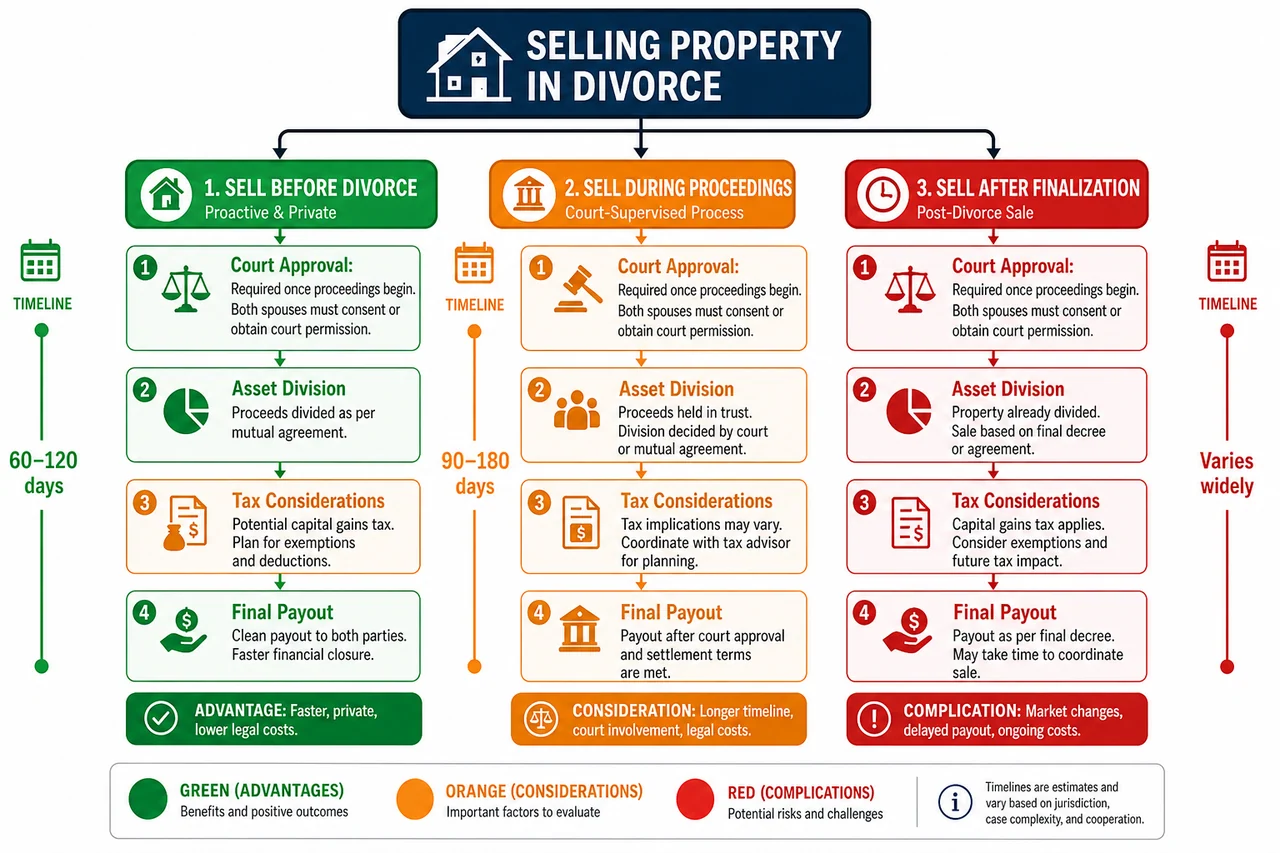
Timing matters. The month you sell your home during divorce affects your taxes, your legal position, and how much cash you actually walk away with. It's not just about listing the property — it's about strategy.
| Timing Option | Advantages | Disadvantages | Tax Implications | Typical Timeline |
|---|---|---|---|---|
| Before Divorce | Simpler tax exclusion (married filing jointly); fewer court complications; both parties motivated | Emotional difficulty; may feel rushed; proceeds must still be divided | Up to $500,000 capital gains exclusion as married couple | 60–120 days depending on market |
| During Proceedings | Clears major asset before decree; can accelerate settlement | Court oversight required; tension affects negotiations; harder to access funds mid-case | May still qualify for married exclusion; consult a CPA | 90–180 days; court approvals add time |
| After Divorce | Legal clarity; clean title transfer; lower conflict | Each spouse limited to $250,000 exclusion; ongoing carrying costs; co-ownership complications | Single-filer exclusion ($250,000 per person) applies | Varies widely; can be years post-decree |
Here's the real question: Are you sitting on $200,000 in home equity gains? Or $500,000? The answer changes everything.
When you're still married and sell, the IRS lets you exclude up to $500,000 in capital gains under Section 121. That's massive. You could pocket an extra $50,000, $75,000, even $150,000 depending on how much your home appreciated. But once the divorce is finalized? Each of you gets just $250,000. The tax hit can be brutal on homes that appreciated significantly. And that's before you factor in the emotional toll of selling while negotiations are happening or the legal costs piling up during proceedings.
Post-divorce sales offer peace of mind. No court hovering over the transaction, no tension between you and your ex affecting the sale price. But you're juggling higher tax consequences and ongoing costs — property taxes, insurance, maintenance — if you're still co-owners. Sometimes that shared burden stretches for years.
Back to topFinancial Considerations and Equity Division
Calculating Net Proceeds
Here's what you actually take home: your net proceeds. That's the sale price minus the mortgage balance, real estate agent commissions (usually 5–6%), closing costs (1–3%), any outstanding liens, and repairs you've agreed to make. Let's say your home sells for $400,000. You owe $200,000 on the mortgage and face $28,000 in selling costs total. You'd walk away with roughly $172,000 — which then gets divided according to your divorce agreement or what the court ordered.

Common Costs You'll Encounter
| Cost Type | Typical Range | Variables | Who Typically Pays |
|---|---|---|---|
| Real estate agent commission | 5%–6% of sale price | Negotiable; market dependent | Seller (deducted from proceeds) |
| Closing costs | 1%–3% of sale price | Title, escrow, transfer taxes | Typically seller; sometimes split |
| Home repairs/staging | $1,000–$15,000+ | Property condition; market expectations | Per divorce agreement |
| Attorney fees (real estate) | $500–$3,000+ | Transaction complexity | Per divorce agreement |
| Mortgage payoff/prepayment penalty | Varies | Loan terms; remaining balance | Both parties (from proceeds) |
| Capital gains tax | 0%–20% (federal) + state tax | Profit amount; filing status; exclusions | Each party on their share |
Mortgage and Debt Considerations
Both of you are still on the hook if you're both on the mortgage. That liability doesn't disappear until the loan gets paid off or refinanced — and selling almost always takes care of it at closing. But here's the tougher scenario: an underwater home. That means you owe more than the house is worth. You'll need to talk your lender into a short sale, which requires their approval and can affect your credit.
Back to topWhat Happens When Both Parties Don't Agree

You're stuck. One of you wants to sell the house right now. The other wants to wait, refinance, keep it, or handle things differently. When divorcing spouses can't agree on whether, when, or how to sell the home, it becomes one of the messiest parts of the whole process. But you've got options to break the deadlock.
Court-Ordered Property Sales
A judge can step in and order the sale themselves. This legal mechanism is called a partition action, and it often gets written directly into your divorce decree. The court may bring in a neutral third party — a special master or referee — to actually manage the sale from start to finish.
Here's the catch: these court proceedings are expensive. And they take time. Often a lot of it. You're looking at additional months layered on top of an already exhausting divorce.
Want details on how forced sales work where you live? Check out our guides on court-ordered property sales in divorce, with specific breakdowns for California, Florida, Washington, and Colorado.
Mediation and Buyout Alternatives
Before you let a judge decide your house's fate, try mediation. A neutral mediator sits down with both of you and works through the disagreement. It's structured but way less adversarial than court, and it usually costs way less too. Most divorce attorneys will tell you to give mediation a genuine shot before involving the courts on property disputes.
Then there's the buyout option. One spouse buys out the other's share and keeps the house.
Here's how it works: the buying spouse refinances the mortgage into their name alone and pays the other spouse their portion of the equity. To figure out what that buyout amount should be, take the home's appraised value, subtract what you still owe on the mortgage, subtract estimated selling costs (usually 6–10% of the sale price), then split the remaining equity according to your divorce agreement. That's your number.
Back to topPractical Steps for Selling Your Property

Assembling the Right Team
Here's the reality: a real estate agent alone won't cut it when you're selling during divorce. You need a coordinated team of professionals working together, each with their own expertise.
| Professional | Role | When to Hire | Estimated Cost |
|---|---|---|---|
| Divorce attorney | Protects your legal rights; reviews agreements; court representation | Immediately upon separation | $200–$500/hour |
| Real estate agent | Lists, markets, and negotiates the sale | Once sale is agreed upon | 5%–6% commission |
| Certified Divorce Financial Analyst (CDFA) | Models financial outcomes; tax planning | During settlement negotiations | $150–$400/hour |
| CPA or tax advisor | Capital gains planning; filing strategy | Before listing; before decree finalized | $100–$300/hour |
| Real estate appraiser | Establishes fair market value for equity calculation | Before buyout negotiations or listing | $300–$600 |
| Mediator | Helps dispute resolution | When parties disagree on sale terms | $100–$300/hour (split) |
Preparing the Home and Navigating the Sale
Buyers don't care about your divorce. They care about whether the kitchen's updated, if the roof leaks, and whether the price is fair. Make necessary repairs. Declutter thoroughly. Get both of you on the same page about showings—especially if kids are living there.
And here's what often gets overlooked: write down agreements upfront. Who pays for repairs during listing? How do you schedule showings around your custody arrangement? These details prevent conflicts down the road.
When you're picking a real estate agent, find someone who's handled divorce sales before. You need an agent who gets that they're working for both parties and operates with strict neutrality. That means clear communication from day one, or resentment builds fast.
One more thing: both of your attorneys need to review all listing agreements and offers before anyone signs anything. Don't skip this step.
Back to topEmotional and Practical Challenges

Your family home isn't just a building. It's where your kids took their first steps, where you carved turkey on Thanksgiving, where you built a life together. That emotional weight is real, and you shouldn't pretend it isn't there while you're trying to make smart financial decisions. Acknowledging this attachment honestly—while keeping those financial choices grounded in facts rather than feelings—is honestly one of the hardest parts of selling property in a divorce. And here's the thing: it's okay to grieve the loss of the home even while making the practical choice to sell.
Children in the picture? Their stability matters in concrete ways. Courts factor housing stability into custody arrangements, which means keeping kids in the same school district or neighborhood could influence whether one parent pushes for a buyout instead of selling outright. Work with your attorney to spell out housing transitions explicitly in any custody agreements.
Now for the practical side.
You and your ex both need to coordinate a shared maintenance schedule for the property during the sale period. Both parties are responsible for keeping it market-ready, and arguments over upkeep can drag out the sale and drain your pocket in the long run.
Back to topAlternatives to Selling the Property
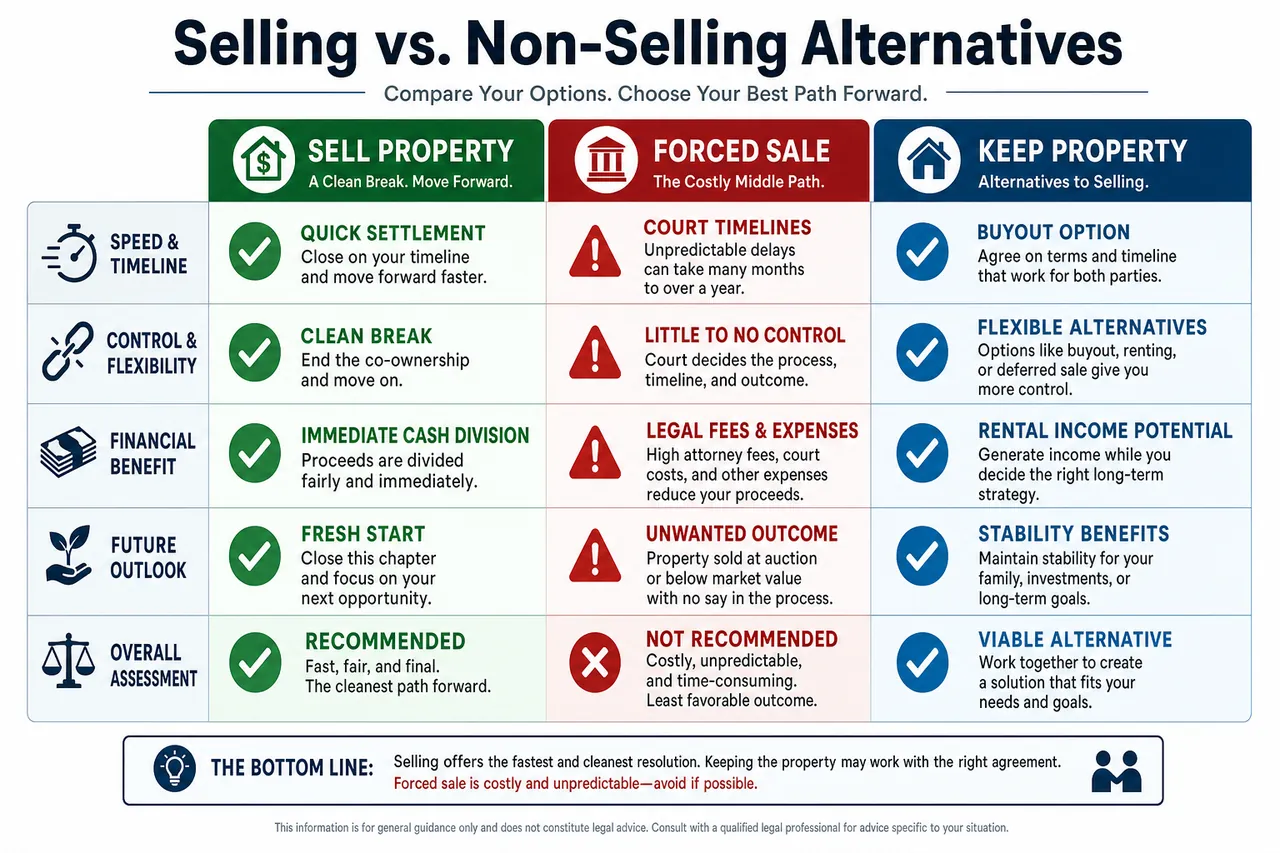
You don't have to sell. There are other paths forward, and it's worth understanding each one before you decide.

- Buyout and refinance: One of you keeps the house. You'd pay your ex their share of the equity and refinance the mortgage in your name only—but you'll need to qualify for that new mortgage on your own income.
- Deferred sale agreement: You both hold onto the property and agree not to sell it for a set number of years—maybe until the kids graduate. One person lives there while the other gets rental payments or occupancy credits. Here's the catch: you need a detailed, written agreement. Handshake deals fall apart fast.
- Convert to rental property: Stay on as co-owners and rent it out. Split the rental income. You keep the asset, but you're also sharing landlord duties forever—or at least until one of you buys the other out.
- Equity division without sale: Sometimes the house itself doesn't have to change hands. You trade it. One person gets the home; the other gets the retirement account, investment portfolio, or other assets worth the same amount. It balances the books without listing the place.
Each option carries different financial, legal, and tax consequences. And they don't all feel the same in your wallet five or ten years from now. A Certified Divorce Financial Analyst can run the numbers on all of them side-by-side, showing you exactly what each choice costs or saves you down the road.
Back to topRegional and Legal Considerations
Divorce property law isn't the same everywhere. What's fair in California might be handled completely differently in Florida. That's why you need to understand your state's specific rules before making any decisions about your home.
There are two main systems that states use:
- Community property states (California, Arizona, Nevada, Texas, Washington, Idaho, Louisiana, New Mexico, Wisconsin): Marital assets get split 50/50.
- Equitable distribution states (all remaining states): Courts divide assets "fairly" based on multiple factors—and fair doesn't always mean equal.
Your state also sets rules about timelines, how much you both have to disclose, and what happens in court. Take Tennessee's court-ordered sale process. It works differently than Tennessee's court-ordered sale process and Indiana's procedures. Get a divorce attorney licensed in your state.
And then there's international property. This gets messy fast. If you or your spouse owns a home abroad, or if your divorce involves multiple countries, you're dealing with conflicting laws, currency problems, and tax treaties. That's specialist territory—you'll need lawyers and financial advisors who understand both systems.
Back to topMaking the Decision: Should You Sell?
Your specific situation matters here. How much equity do you actually have in the home? What's the local market doing right now? Can you qualify for a mortgage on your own if you're thinking about buying out your ex? These questions shape everything. Your co-parenting arrangement and overall financial health matter too — a lot.
Speed might be your priority. If financial strain or a messy split means you need to move fast, cash home buyers can close in days instead of months. That certainty matters when everything else feels uncertain.
But if your situation involves both an estate and a divorce at the same time, you're dealing with something more complex. Our executor's guide to selling estate property walks you through overlapping ownership issues like this.
Back to topConclusion: Moving Forward with Confidence
Selling property in a divorce is legally complex, financially significant, and emotionally exhausting. But it's manageable. You'll need the right information and the right team around you. Start by understanding your legal ownership position — then figure out what framework governs property division in your state. Timing matters. Get this wrong and you'll miss tax advantages you could've captured. Your team should include more than just a real estate agent. You'll want a divorce attorney, a tax advisor, and potentially a financial analyst in your corner. And here's something many people overlook: selling isn't your only option. A buyout, deferred sale, or rental arrangement might actually work better for what you're facing.
When emotions run high, decisions get cloudy. That's exactly when you need to step back and ask yourself: what choice protects my long-term financial health and my family's stability? The home is an asset. Your future is the priority.
Back to topFrequently Asked Questions
Can one spouse sell the house without the other's consent during a divorce?
Generally, no. Once divorce proceedings begin, the court locks down marital property. Neither of you can sell, transfer, or put a lien on the house without the other's written consent or a judge's approval. Try it anyway, and you're looking at contempt charges and real legal trouble. Before you touch anything jointly owned, talk to your attorney first.
What happens to the mortgage if we sell the house during a divorce?
The closing process pays off your mortgage from the sale proceeds. Both of you walk away free—the lender releases you both once that loan is satisfied. But here's the catch: if your home sells for less than what you owe, you're both still on the hook for that shortfall unless you negotiate a short sale or special deal with your lender. Simply divorcing doesn't erase your mortgage obligation. Only a sale, payoff, or refinance actually does that.
How is the capital gains tax handled when selling a home during divorce?
Timing matters here. If you're still legally married when you sell and you both meet the IRS requirements—meaning you've each lived in the home for 2 of the last 5 years—you can exclude up to $500,000 in capital gains. After the divorce is final? You drop to $250,000 each. And there's a special IRS rule for divorcing couples: if one spouse gets the house in the settlement and sells it later, they can still count the other spouse's time living there toward the use test. Before you finalize anything, sit down with a CPA. They can show you how to structure the sale to save the most in taxes.
What if my spouse refuses to cooperate with the sale?
Blocking the sale is a real problem. Won't sign listing agreements? Won't let the realtor in? The court can force cooperation. You file a petition asking the judge to step in. What happens next depends on your situation—sometimes a judge will sign documents on behalf of the resistant spouse, or they'll appoint a commissioner to move things forward. Refusing a court order brings contempt charges, fines, and worse. For a deeper dive on how this works, check out our detailed guide on how court-ordered property sales work.
Do we have to use a real estate agent, or are there faster alternatives?
You don't need a traditional real estate agent. And frankly, during a divorce, you might not want one. Cash buyers, auctions, and for-sale-by-owner sales are all valid options. The choice comes down to what matters most to you. A traditional listing usually brings in more money, but it takes longer and demands constant coordination between you and your spouse—exhausting when you're already at odds. If you need speed, simplicity, and minimal back-and-forth? A direct cash sale closes in days with way less friction.
Back to top
