Selling a House with Mold: Real Homeowner Experiences and Solutions

Table of Contents
You found mold while getting your home ready to sell. It feels overwhelming, but it's absolutely manageable — and you're far from alone. Scroll through Reddit's r/RealEstate or r/HomeImprovement and you'll find dozens of sellers who've dealt with exactly this. What they all discovered? Transparency, solid documentation, and knowing your actual options change everything. This guide shares what those homeowners wish they'd known upfront.
Selling a house that needs work? Start with our guide to selling a house as-is. It explains what as-is means, how pricing works and every way to sell a house with problems.
This article isn't legal, tax, or financial advice. Mold disclosure laws are set by your state and differ dramatically from place to place. Before you list, talk to a licensed real estate attorney in your state. For health questions, follow EPA guidance on mold and get in touch with a qualified remediation professional.
Understanding the Mold Problem
Types of Mold: Allergenic, Pathogenic, and Toxigenic
Mold isn't all the same. And that matters—both for your health and for how potential buyers will react to what they find. There are three main categories you're dealing with:
- Allergenic molds (such as Cladosporium and Penicillium) trigger respiratory symptoms and allergic reactions but are rarely life-threatening to otherwise healthy people. They're the most commonly found in homes.
- Pathogenic molds (such as Aspergillus) can cause infections and illness, particularly in people with compromised immune systems, the elderly, or infants.
- Toxigenic molds (such as Stachybotrys chartarum, often called "black mold") produce mycotoxins that can cause serious health effects. These require the most aggressive remediation approach and tend to generate the most concern among buyers.
The EPA doesn't recommend testing to identify mold species before you remediate—if you can see it or smell it, address it regardless. What actually matters for selling is documenting what was found, where it was, and what you did to fix it.
Active vs. Dead Mold
Most people miss this distinction entirely: the difference between active mold and dead mold. Active mold is still growing. It looks moist, shiny, or fuzzy. That means moisture is still feeding it. Dead mold is dry and crumbly—the moisture problem has stopped, but the spores stay behind and can still cause health reactions.
Why does this matter? If mold is actively growing, you can't just clean it up and move on. You have to fix the moisture source first. Skip that step, and you're applying a band-aid to a broken pipe. The mold will come back, and when it does during a buyer's inspection, you'll regret it.
Common Locations and Warning Signs
Moisture is what mold wants. Here's where sellers typically find it:
- Basements and crawlspaces — poor ventilation and ground moisture make these prime locations
- Attics — inadequate ventilation combined with roof leaks creates ideal conditions
- Under flooring — especially after flooding or slow plumbing leaks
- Around windows and exterior walls — condensation and water intrusion
- HVAC systems — mold in ducts can spread spores throughout the entire house
A musty smell is often the first clue. Watch for water staining or discoloration on walls and ceilings too. Peeling paint or wallpaper should raise a red flag. And if people in your home are having unexplained allergic reactions, that's worth investigating before you list. Any of these warrant a closer look.
Back to topAssessing Your Mold Situation
DIY Assessment vs. Professional Inspection
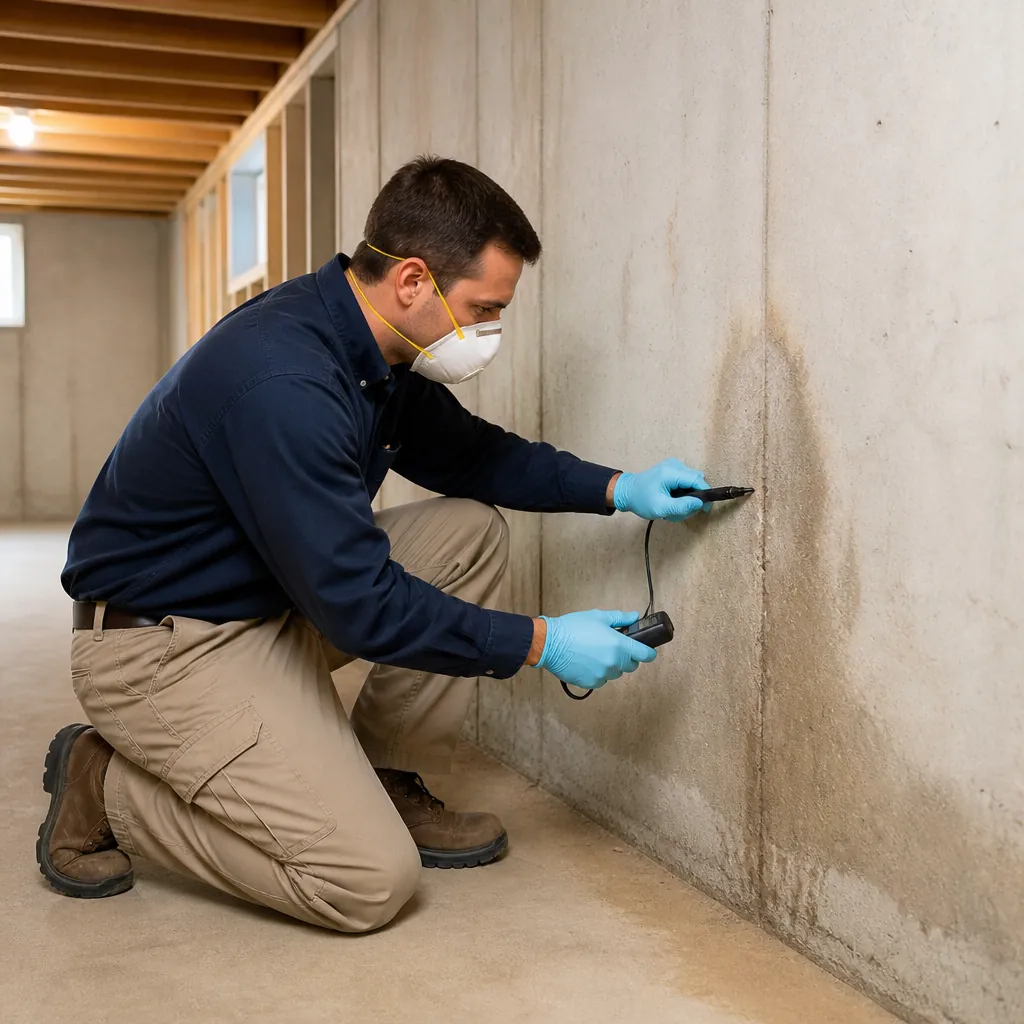
You can handle a small, visible mold patch in a low-risk spot yourself. Grab a flashlight and look carefully. But if mold's hiding behind walls, tucked into your HVAC system, or spreading through the house, a professional mold inspector is worth every penny — especially if you're planning to sell.

What's the actual cost? A visual-only inspection runs $150–$300, while a full inspection with lab analysis costs $400–$800. Add air quality testing (2–3 samples) and you're looking at $250–$500 more. The 2026 national average sits around $670, based on Angi data.
And here's why it matters for sellers: a pre-listing inspection protects you legally by creating a documented record of what you found and when. It also reassures buyers that you didn't hide anything.
Determining Extent of Contamination
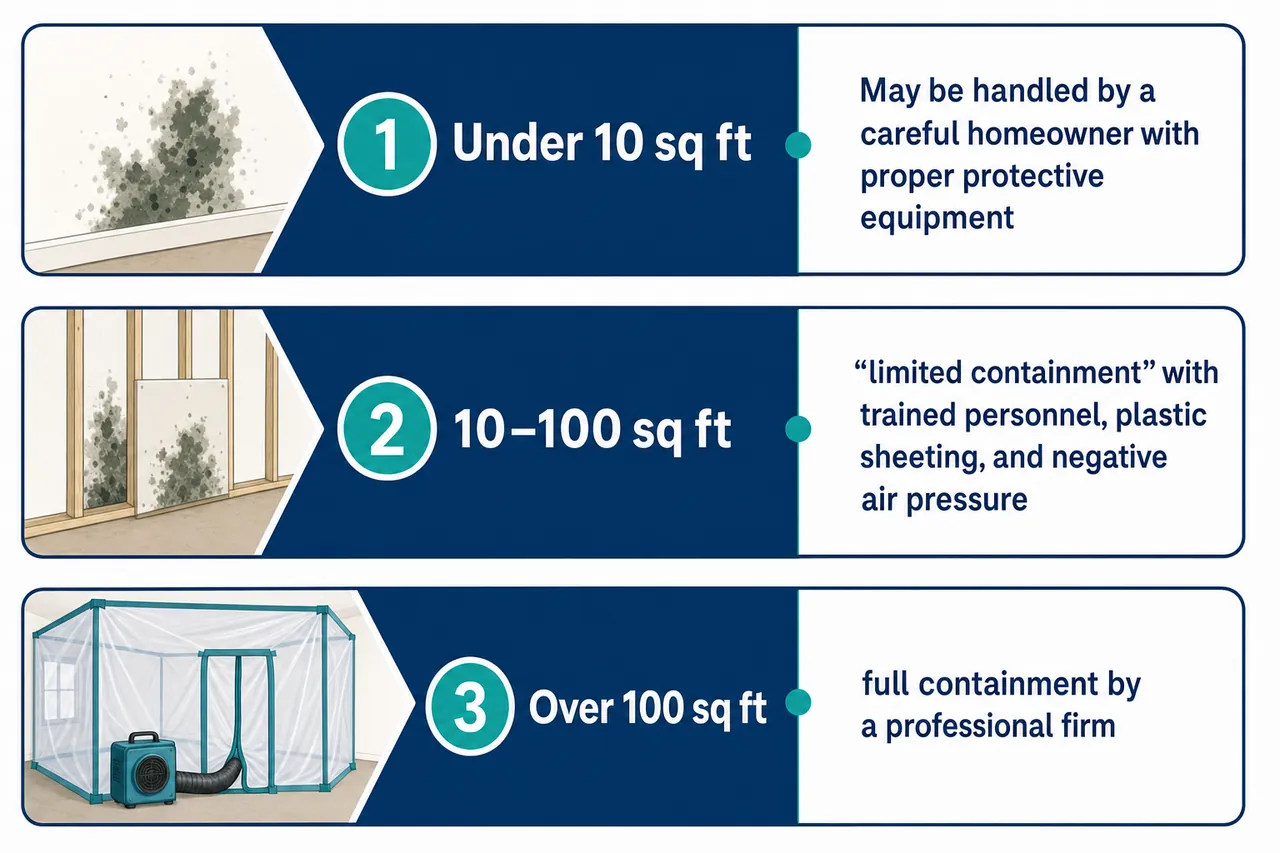
Square footage tells you a lot. The EPA's mold remediation guidelines break it down this way:
- Under 10 sq ft: You might tackle this yourself if you've got proper protective gear
- 10–100 sq ft: EPA wants "limited containment" — trained people, plastic sheeting, negative air pressure to contain spores
- Over 100 sq ft: This needs a professional firm. Full containment, full PPE, verification after cleanup
These aren't carved in stone, though. Mold in your HVAC ducts or stuck in hard-to-reach structural areas? Get a professional regardless of the square footage.
Back to topMold Remediation Options
DIY Cleaning for Small Areas
Mold patches smaller than 10 square feet? You can usually handle them yourself. According to EPA guidelines, grab an N-95 mask, gloves, goggles, and non-toxic cleaning solutions. Contain the affected area properly as you work.
But here's what trips up most homeowners: porous materials like drywall and insulation can't just be cleaned. They need to come out and get replaced. Non-porous surfaces are different—those you can actually clean and dry effectively.
Fix your moisture problem before you start cleaning, or you're just throwing money at a problem that'll come roaring back. And even if you're doing the work yourself, take photos of everything and keep every receipt. That documentation matters.
When to Hire Certified Professionals
Anything larger than a small isolated patch needs a professional. Same goes if you've got mold near your HVAC system, in structural materials, or if anyone in your home has health vulnerabilities.
What should you look for? Certifications from the Institute of Inspection, Cleaning and Restoration Certification (IICRC) or the American Council for Accredited Certification (ACAC). These mean the contractor actually knows how to contain the problem, follow proper procedures, and document everything correctly.
If you're selling? This is worth the investment. A remediation report from a certified professional carries real legal weight—it's not just you saying "we took care of it." Buyers and their inspectors will trust it.
Remediation Costs by Scope
What's this actually going to cost you in 2026? Here's what real projects show:
| Scope | Typical Cost Range (2026) | Notes |
|---|---|---|
| Small area (<10 sq ft, minimum charge) | $500–$1,500 | Most firms apply a minimum job charge |
| Standard residential (per sq ft) | $10–$25/sq ft | Accessible surfaces |
| Complex areas (wall cavities, HVAC, confined spaces) | $15–$30/sq ft | Higher labor and containment costs |
| Basement | $500–$3,000 | Depends on size and severity |
| Attic | $1,000–$4,000 (up to $7,000 severe) | Roof leak source must be repaired |
| HVAC system | $3,000–$10,000 | High range if ductwork must be replaced |
| Whole-house | $10,000–$30,000 | Severe or long-neglected infestations |
| National average (typical project) | $2,369 (range: $1,223–$3,758) | Based on 7,940+ verified Angi projects, 2026 |
Add another $200–$400 for a post-remediation clearance inspection after the work's done. That report proves the job was successful and becomes a solid disclosure document when you're selling.
Preventing Recurrence
Spending money on remediation without fixing what caused the mold in the first place? That's like bailing water out of a sinking boat without plugging the hole.
After cleanup, tackle these:
- Fixing all moisture sources: roof leaks, plumbing leaks, grading issues directing water toward the foundation
- Improving ventilation in attics, crawlspaces, and bathrooms
- Installing or upgrading vapor barriers in crawlspaces
- Running dehumidifiers in basements where humidity regularly exceeds 50%
- Ensuring HVAC systems are properly maintained and drain pans are clear
When buyers see that you've actually fixed the underlying problems—and you can show them proof—their worries about mold coming back drop significantly.
Back to topLegal Disclosure Requirements

No Federal Mold Disclosure Law Exists
Most sellers don't realize this: there's no federal law requiring you to disclose mold. What matters is your state's rules — and they're all over the map. Here's what won't happen: no state requires you to get a mold test before listing. But here's what will: most states absolutely require you to disclose any mold you already know about.
And that's the trap many sellers fall into. If you're aware of mold and you hide it, you've opened yourself up to serious legal trouble — with or without a specific mold statute on the books. That's because known defects affecting value or livability must be disclosed. The practical implication hits hard when buyers discover it later. Want specifics for your situation? Our detailed breakdown of mold disclosure requirements and buyer options walks through the details.
Key State Variations
Not all states approach this the same way. Here's what several of them actually require:
| State | Disclosure Requirement | Statutory Basis | Notes |
|---|---|---|---|
| California | Must disclose known mold as material defect on Transfer Disclosure Statement | Civil Code §1102 / §1102.6 | Broad material defect standard applies |
| Texas | Must disclose known mold on Seller's Disclosure Notice; must provide all Certificates of Mold Remediation from prior 5 years | Property Code §5.008; Occupations Code §1958.154 | Certificate lookback period is 5 years prior to sale |
| New York | Indoor mold history is a required question on Property Condition Disclosure Statement; "yes" answer requires attaching any test report | Real Property Law Article 14 (since June 2023) | Requirement added June 2023 |
| Montana | Must disclose if home was ever tested for mold or had mold remediation | Mold Disclosure Act | One of the more specific state statutes |
| Maryland | No dedicated mold question; falls under general material-defect disclosure duty | Md. Code §10-702 | Known mold must still be disclosed as a defect |
This is just a sample. Your state might have entirely different rules. Before you list, talk to a licensed real estate attorney in your area and confirm what you're legally required to do. Our companion article on mold disclosure rules and buyer concerns gives you more context too.
Timing of Disclosure
Disclose early. Tell buyers about known mold before they make an offer — not during inspections, not after going under contract.
Why? Buyers who stumble onto undisclosed mold later are angry. They'll walk away from the deal, demand tens of thousands in concessions, or sue. Buyers who know upfront and choose to proceed anyway? They've already priced that into their offer. You're in a far stronger legal and financial position.
Back to topSelling Strategies When Mold Is Present

You've probably seen Reddit threads where homeowners debate: should I fix it first, disclose and lower the price, offer a credit, or sell as-is to an investor? The reality is that there's no one-size-fits-all answer. What works depends on how much equity you have, how fast you need to move, and what your local market actually looks like. Let's look at each option side by side:
| Approach | Pros | Cons | Best For | Timeline Impact |
|---|---|---|---|---|
| Full remediation before listing | Maximizes sale price; broadest buyer pool; reduces stigma; cleaner disclosure | Upfront cost ($1,223–$30,000+); delays listing by weeks to months | Sellers with equity and time; widespread mold affecting market appeal | Adds 2–8+ weeks before listing |
| List as-is with full disclosure | No upfront remediation cost; faster to market | Smaller buyer pool; lower offers; higher fall-through risk during inspection | Isolated, minor mold; sellers without remediation capital | Faster listing; longer negotiation phase |
| Offer buyer credit at closing | Closes quickly; avoids managing remediation; buyer controls the work | Buyers often pad credit requests; lender may not allow credits above a threshold | Moderate mold issues with known remediation cost | Minimal; credit negotiated during due diligence |
| Sell to investor/cash buyer | No repairs required; fast close; no inspection contingencies; certainty | Lower sale price (typically 45%–70% of mold-free value) | Severe mold; sellers needing speed; limited financial resources | Often closes in 1–3 weeks |
| Auction | Price discovery; fast; can attract investors | Unpredictable outcome; auction fees; not ideal for retail buyers | Distressed properties where other options have failed | Variable; typically 30–60 days |
Impact on Home Value and Buyer Confidence
Mold doesn't just affect how your house looks—it affects what it's worth. According to industry sources referencing The Appraisal Journal, unremediaged mold can tank your property value by 20%–37%. And even after you've had professional work done and have the paperwork to prove it, buyers still tend to dock you about 3% more for what's called a "stigma discount." Worse: roughly 42% of buyers won't touch a home with any mold history whatsoever, remediated or not.
This shows up constantly in Reddit conversations. Sellers who hired professionals, got the work documented with inspection reports and clearance tests, and fixed the moisture problems? They closed deals more smoothly. Those who tried to hide it or did sloppy remediation without proof? They hit wall after wall.
Working with Investors or Cash Buyers
Severe mold can feel impossible to handle, especially if you don't have $20,000–$30,000 sitting around for repairs. That's where cash buyers and real estate investors come in. They'll buy your place as-is, but they'll price it like a fixer-upper. Understanding how selling your house for cash actually works helps you figure out if it makes sense for you. You should also look at what other sellers experienced when selling as-is.
Do the math. If remediation would cost $20,000–$30,000 and push back your sale by three or four months, an offer at 45%–70% of market value might actually be your best move. Don't just assume one path is better—calculate what each option leaves you with.
How to Market a Home After Remediation
Got the work done and kept all your receipts? Use it. Highlight the professional remediation, show those clearance inspection results, talk about any moisture-prevention upgrades you made. Many buyers find this reassuring, not scary—it shows you caught something, fixed it properly, and didn't try to hide it. That's worth something. Work with your agent to frame the documentation as proof you did the right thing, not as baggage you're dragging along.
Back to topDocumentation and Records

What to Keep
Your documentation is your legal shield. It shows buyers you've done the work properly and protects you if problems surface later. Keep at least:
- Pre-remediation inspection report from a certified mold inspector
- Photographs documenting the location and extent of mold before work began
- Contracts and invoices from all remediation contractors
- Certificates of mold remediation (required for disclosure in some states, including Texas)
- Post-remediation clearance inspection report confirming successful remediation
- Records of any moisture-source repairs (plumber invoices, roofing receipts, etc.)
- Warranties on remediation work, if provided
Don't throw these away once closing happens. If a buyer comes back claiming you hid something? Your file of records becomes your defense.
Back to topSpecial Considerations and Real-World Scenarios
Lessons from Reddit: What Sellers Got Right and Wrong
Real estate forums show patterns worth paying attention to. We're not making these up:
- What worked: Sellers who disclosed upfront, provided professional remediation reports, and priced reflecting the history consistently closed deals. Buyers who understood the problem was addressed showed up — often the ones who'd been burned by undisclosed issues before.
- What backfired: Sellers who painted over mold or made cosmetic fixes without addressing the moisture source had deals fall through at inspection, or worse, faced legal claims after closing. Home inspectors are specifically trained to look for signs of past water damage and mold concealment.
- Underestimating professional buyers: Multiple forum threads involve sellers who tried to minimize mold disclosure in hopes of attracting a retail buyer, only to end up selling at a larger discount after the problem surfaced during inspection. Transparent disclosure from the start often produced better final numbers.
Undisclosed Mold: Liability and Legal Consequences
Concealing known mold from buyers carries serious legal risk. And it's not theoretical. Depending on your state, remedies available to buyers who discover undisclosed mold after closing can include rescission of the sale, damages for repair costs and diminution in value, and in some cases, fraud claims. This comes up regularly in real estate litigation.
Real estate attorneys are consistent on this point: disclose what you know, document what you've done, and let buyers make an informed decision. You're also protected if a buyer later claims the mold was worse than disclosed — your documentation shows what was known and when.
Home Inspection Contingencies and Mold Discovery
Most standard purchase agreements include an inspection contingency. That gives buyers the right to walk away or renegotiate if the inspection reveals significant defects. Mold discovered during a home inspection routinely triggers one of three outcomes: the buyer requests remediation before closing, the buyer requests a price reduction or credit, or the buyer terminates the contract.
Sellers who disclosed mold upfront typically face fewer terminations at inspection because buyers have already priced the issue into their offer. Sellers who disclose at inspection (or whose inspector finds it) start the renegotiation from a weaker position. For related situations where multiple property issues complicate the sale, see our guide on selling your house as-is with a realtor.
Insurance Implications
Many homeowners assume their insurance will cover mold remediation. It won't, reliably. Most standard homeowner's policies cover mold only when it results directly from a covered peril (such as a sudden pipe burst), and exclude mold from long-term moisture intrusion or neglect. If you believe your mold resulted from a covered event, contact your insurer and consider consulting a licensed public adjuster before beginning remediation. Remediation work done before an insurance inspection can complicate claims. Policy terms vary significantly — never assume coverage without reviewing your policy.
Timing: How Long Does Remediation Take?
Timeline matters if you're under pressure to sell. Small, isolated remediation projects wrap up in 1–3 days. Moderate projects (a basement or attic) typically take 3–7 days for the actual remediation work, plus drying time. The post-remediation clearance inspection should follow, adding another few days. Larger whole-house or structural remediation projects can run 1–4 weeks. Add contractor scheduling time in busy markets, and you're looking at 2–6 weeks from starting remediation to having a clean clearance report in hand.
If timeline is critical — a job relocation, a looming foreclosure, an estate situation — factor this into your strategy decision. Cash buyers and investors sidestep this entirely by purchasing as-is. For sellers navigating other complications alongside mold, our articles on selling a house with a lien and selling without a realtor may also be useful.
Back to topConclusion: Your Path Forward
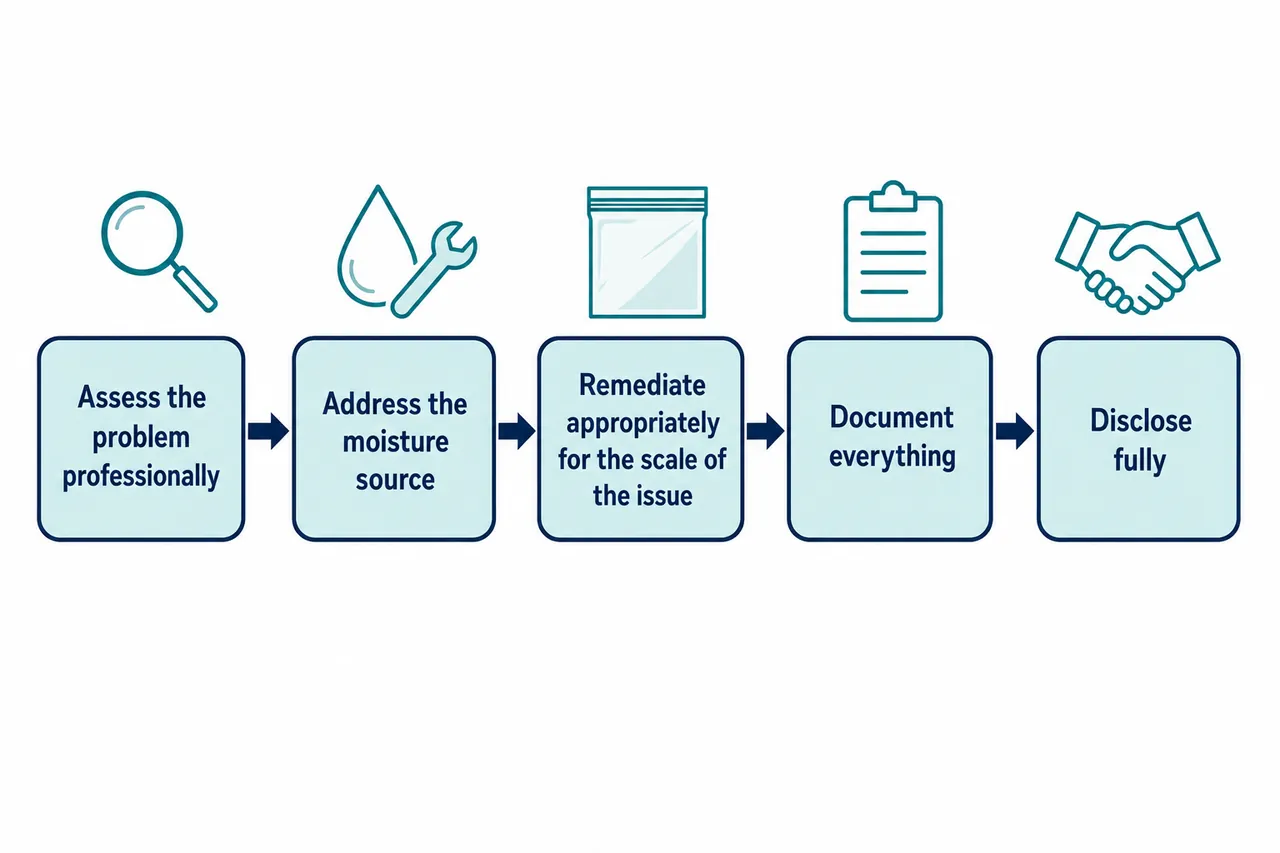
Selling a house with mold isn't easy. But it's entirely manageable when you're honest about what you've got. The steps are straightforward: get a professional assessment, fix the moisture problem at its source, handle the mold remediation based on how bad it actually is, keep detailed records, and disclose everything. This protects you legally, keeps buyers confident in what they're buying, and leaves you with more leverage when negotiations happen.
Your best move depends entirely on you. Some sellers remediate before listing. Others offer a credit at closing. Some sell as-is to investors. Cash buyers are another route entirely. The severity of your mold, your timeline, and what your bank account looks like right now all factor in. None of these options is universally correct.
What fails repeatedly? Hiding it. What works? Being straight about it and proving you were straight about it with documentation.
Your state's disclosure rules might be stricter than you think. If your mold situation is complicated or you're not 100% certain what you're legally required to tell buyers, talk to a real estate attorney before you list. That consultation costs far less than the lawsuit you'll face if you get this wrong.
Back to top
Frequently Asked Questions
Do I legally have to disclose mold when selling my home?
No federal law requires it. But here's what matters: most states do require you to disclose known material defects — and mold almost always qualifies. California, Texas, New York, and Montana have specific mold disclosure statutes. Even if your state doesn't have a dedicated mold law, hiding mold you know about can expose you to fraud or misrepresentation lawsuits after the sale closes. Talk to a licensed real estate attorney in your state to find out exactly what applies to your situation.
How much does mold remediation cost, and is it worth it before selling?
Professional mold remediation runs about $2,369 on average as of 2026. You're typically looking at somewhere between $1,223–$3,758 for a standard job. Severe cases affecting the whole house? Those can hit $10,000–$30,000. Whether you should fix it before selling comes down to your numbers. If untreated mold drops your sale price by 20%–37%, and remediation costs $3,000, you'll probably come out ahead. But if fixing it would cost $25,000, an as-is sale or asking the buyer for a credit might net you more money. Do the math on your specific home and what buyers in your market are offering.
Can I sell my house with mold to a cash buyer without fixing anything?
Absolutely. Cash buyers and real estate investors buy mold-infested homes all the time. They factor the remediation cost into their offer and move on. You still need to disclose known mold, though — even to investors. Skipping disclosure puts you at legal risk no matter who's buying. Cash offers typically come in at 45%–70% of what a mold-free home would sell for in your area. You're trading a lower price for speed and certainty. It's a solid move if you can't afford to remediate yourself or you need to close fast. Want real homeowner perspectives? Check out our guide on actual experiences selling for cash.
What happens if a buyer discovers mold after closing that I didn't disclose?
You're in serious legal trouble. If the buyer can prove you knew about the mold and hid it, they can sue you for misrepresentation, fraud, or breach of contract. Depending on your state, they can recover money for remediation, the loss in home value, and in extreme cases, they may even undo the sale entirely. Keep detailed records about what you knew, when you found out, and what steps you took. It protects you and gives the buyer confidence you're being straight with them.
How long does mold remediation take, and will it delay my closing?
Quick jobs wrap up in 1–3 days. A moderate project like a basement or attic? Count on 3–7 days of work, plus drying time and an inspection to confirm it's done. Big projects can stretch to 1–4 weeks. Realistically, budget 2–6 weeks from start to finish, including the final clearance report. If your closing date is tight, talk to your contractor and your real estate agent about starting remediation before you list or working out a post-contract timeline with the buyer. As-is sales to cash buyers sidestep this problem altogether.
Back to topMore in Mold, asbestos, radon and lead paint
- Can You Sell a House With Mold? Legal Requirements and Buyer Expectations
- Banish Mold and Mildew for Good! Discover the Key Differences between Black Mold and Mildew
- White Mold Wreaking Havoc? Discover the Shocking Tolls it Takes on Health and Property
- Pink Mold: Silent Menace or Harmless Fungus? Learn How to Protect Your Family
- From Gross to Glossy: Transform Your Home with These Powerful Mold-Killing Household Cleaners!
- Are You Tired of Fighting Mold? Learn How Vinegar Can Be Your Secret Weapon!
See our guide: “How to Sell a House As-Is: What It Means and How It Works” →