Can You Sell a Property With Tenants in Situ? Complete Guide

Table of Contents
- What Does Selling a Property With Tenants in Situ Mean?
- Is It Legal to Sell a Property With Tenants?
- Advantages of Selling With Tenants in Situ
- Disadvantages of Selling With Tenants in Situ
- Impact on Property Price and Valuation
- Legal Requirements Before Selling
- Tenant Rights During the Sale Process
- Month-to-Month vs. Fixed-Term Leases When Selling
- How to Sell a Property With Tenants: Step by Step
- Marketing a Tenant-Occupied Property
- Negotiating With Tenants: Cash for Keys and Incentives
- Selling Directly to Your Tenant
- Tenant in Situ vs. Vacant Possession: Side-by-Side Comparison
- What Happens After the Sale Completes?
- Regional Considerations and Local Laws
- Tax Considerations When Selling a Tenanted Rental Property
- Insurance During the Sale Process
- Common Mistakes to Avoid
- Should You Sell With Tenants or Pursue Vacant Possession?
- Conclusion
- Frequently Asked Questions
You can sell a property with tenants living in it. It's completely legal, and thousands of landlords sell tenanted properties every year. The tenancy agreement doesn't end when you do — it passes straight to the new owner, who becomes the landlord from completion day onward. What changes for you? Everything else in this guide covers it: what you're legally required to do, how tenants affect your sale price, what rights they have, how to market the place, and the step-by-step process that keeps things moving forward.
This article is general information only — it's not legal, tax, or financial advice. Landlord-tenant law differs wildly depending on where you are. Before you make any decisions about your property, talk to a qualified solicitor or local legal professional who knows your area's rules.

What Does Selling a Property With Tenants in Situ Mean?

Definition of a Sitting Tenant
A tenant in situ — also called a sitting tenant — is someone who's legally living in your property when you sell it. The Latin phrase in situ means "in place." You're not selling an empty property that your buyer can move into or re-let however they want. Instead, you're selling it as a working rental, with someone already there paying rent.
How the Tenancy Transfers to the New Owner
Here's what matters: a tenancy agreement is a legal contract attached to the building itself, not to you personally. When you sell, the lease doesn't disappear. It automatically transfers to your buyer on completion day. That person becomes the new landlord right then and there, with all the same rights and responsibilities you had.
What the Buyer Inherits
Your buyer's stepping into your shoes. They get the rent amount you've been collecting, whatever lease term you agreed to, every condition in that tenancy agreement, and the security deposit responsibility. And it doesn't stop there.
They're also liable for any repairs you've been putting off. Gas safety certificates, electrical condition reports, energy performance certificates — your buyer must keep all of these current and compliant with UK law. Most importantly, the new owner can't just rewrite the rules because they own the property now. The tenancy terms stay exactly as they are.
Back to topIs It Legal to Sell a Property With Tenants?
Yes, you can sell a tenanted property in England and Wales — and across the UK. Tenants don't have to leave before you list, and you're not legally required to give them first dibs on buying. Some landlords do offer it anyway, though that's your call.
Tenant Rights During a Sale
Your tenants have a right to quiet enjoyment of their home. That means you can't just kick them out because you've decided to sell. They're also entitled to reasonable notice before you or a buyer's agent shows up for viewings or inspections. While the law doesn't set one fixed notice period across the country, most tenancy agreements require 24 to 48 hours' written notice before each visit. Tenants can't block all access, but they don't have to accept last-minute requests either.
Notice Requirements for Viewing and Sale Intent
There's no single statutory rule forcing you to serve formal "notice of sale intent" the way eviction notices work. But good practice — and what most tenancy agreements demand — is to tell the tenant in writing before the property goes on the market. Explain that the tenancy continues and they're not losing their home. This keeps stress down, makes tenants cooperate during showings, and gives you a paper trail proving you handled it right.
Most landlords give 30 to 60 days' informal notice before active marketing starts. That gives your tenant breathing room to understand what's happening, ask questions, and sort out a viewing schedule. It's not a legal requirement — it's just practical. What actually works for you depends on your tenancy agreement and any local rules. Check both before you decide.
Statutory Notice Requirements
Need the tenant out so the buyer gets an empty property? The rules changed in 2026, and they're stricter now. Section 21 "no-fault" eviction notices were abolished in England's private rented sector from 1 May 2026 under the Renters' Rights Act 2025 (SI 2026/421). If you served a Section 21 before that date, the last day to issue court possession claims was 31 July 2026.
From 1 May 2026, you need to use Section 8 on specific grounds instead. Ground 1A covers selling — that's your most relevant route. It requires four months' notice and can't be used in the first 12 months of a tenancy. Once a court grants you possession under Ground 1A, you can't re-let or license the property for 12 months. And from 1 September 2026, if you haven't registered on the new Private Rented Sector database, your Section 8 notice could be invalidated — registration is essential now.
But if you're selling with the tenant staying put, none of this applies. You simply let them know you're marketing the place and arrange viewings through the normal route. No statutory notice to quit required.
Back to topAdvantages of Selling With Tenants in Situ
Benefits for the Seller
- Continued rental income flows right up until closing day—no empty months eating into your profits.
- Skip the staging entirely. No redecorating, no furniture rentals, no pretending the place looks pristine. What you've got is what you're selling.
- Faster route to market since you're not waiting around for a lease to end first.
- Reduced management burden. And this matters if you're already stretched thin. The tenancy keeps running while your sale closes; you're not juggling an empty property on top of everything else.
Benefits for the Buyer
- Immediate rental income starts the day you close. There's no waiting period while you hunt for tenants and run background checks.
- A proven occupant with a solid payment history? That's your evidence right there. You know the income stream is real from day one.
- Lower purchase price in many cases. Even after you factor in the discount, your yield calculations often come out ahead.
Benefits for the Tenant
- No forced move. Their home stays their home through closing and beyond.
- The law protects their lease terms. A new owner can't just rewrite the rules when they take over.
Disadvantages of Selling With Tenants in Situ
Reduced Buyer Pool
Owner-occupiers make up most of the property-buying market. They can't touch a tenanted property unless the tenancy ends before or at completion. That's your biggest practical problem right there. You're stuck marketing to landlords, portfolio investors, and buy-to-let buyers instead — a much smaller group. And when your pool of interested buyers shrinks, they know it. They'll use that against you in negotiations.

Impact on Sale Price
Tenanted properties sell cheaper. We're not talking a rounding error here either. At auction, 2026 data shows tenanted properties fetching 30–40% below vacant possession market value. Private treaty sales don't hit as hard, but you should expect a 10–20% discount compared to what you'd get with vacant possession — the exact number depends on your rent level, lease type, tenant quality, and how many investors are looking in your area. Put this in perspective: the average UK house price hit £271,000 as of May 2026 (ONS UK HPI, provisional). A 15% discount on that means you're leaving roughly £40,000 on the table.
Operational Challenges
- Scheduling viewings requires tenant cooperation and adequate notice.
- The property is presented in lived-in condition, which may not photograph as well as a staged home.
- Repair or inspection work needed to satisfy a buyer's survey must be coordinated around the tenant's schedule.
- Some buyers are uncomfortable purchasing a home that feels like someone else's space — this matters less to experienced investors, but can still affect negotiations.
Impact on Property Price and Valuation

That discount you've heard about? It's not the same for every property. The number shifts depending on what's actually happening with your tenancy, your tenant, and the local market around you.
- Rental yield: If you're charging market rate rent in an area where tenants are desperate to find a place, buyers will pay closer to full price because they're getting a solid income stream right away. But if the previous landlord locked in a below-market rent on a lease with years left to run, the discount jumps considerably — the new owner can't touch those rents until the lease ends.
- Lease type: Month-to-month tenancies are gold to investors. They mean the new owner can adjust rent or terminate the arrangement with minimal fuss. Compare that to a fixed-term lease with three years still running. You'll see investors bid significantly higher for the flexibility that comes with a periodic tenancy.
- Tenant history: Can you prove your tenant paid on time, every time? That they haven't trashed the place? Use this. Buyers want concrete evidence, not promises. Package together bank statements, maintenance records, photos—make it obvious this is a low-risk investment.
- Property condition: Don't overlook the basics. A clean, well-maintained house will always command better offers than one where the gutters are sagging and the carpets haven't been cleaned in five years.
- Local investor demand: Some areas have thriving rental markets. Others don't. If you're selling in a hot buy-to-let zone, you'll see more serious bidders and tighter competition, which works in your favor. Tenanted property auction listings jumped 70% year-on-year, with Auction House UK recording 46 tenanted lots sold in April 2026 versus just 27 in April 2024—a clear sign that investors are actively hunting for these purchases.
Then there's the SDLT problem. The additional dwelling surcharge is +5 percentage points on top of standard rates across every band (this came into effect on 31 October 2024), and it stings buy-to-let buyers directly. They'll reduce their offer to cover this extra cost. When you understand what investors are actually paying out of pocket, pricing your property realistically becomes much easier—and so does negotiating effectively.
Back to topLegal Requirements Before Selling
You'll need to gather specific documents before you list. Your buyer's solicitor will ask for most of them during due diligence.
- The tenancy agreement — get a full, signed copy with every addendum attached. The buyer will want to review this.
- Rental payment history — pull bank statements or your rent ledger for the last 12 months. Include payment dates and amounts.
- Security deposit details — find out which government-approved scheme is holding the deposit and confirm the exact amount. Here's what matters: the deposit transfers to the new owner when the sale completes. Your solicitor handles this through the sale contract.
- Compliance certificates — you need a current Gas Safety Certificate, Electrical Installation Condition Report (EICR), and EPC. If any have expired, renew them before you sell. This isn't optional.
- Prescribed information — keep evidence that you served prescribed information to the tenant when you first protected the deposit.
- Notice history — gather copies of any notices you've served, relevant emails and letters, and a list of any repair requests still outstanding.
Ask your solicitor about local licensing requirements too. HMO licences and selective licensing schemes transfer to the buyer, and you're required to disclose them.
Back to topTenant Rights During the Sale Process

Your tenant has real protections. Understanding what they are — and being upfront about them — keeps things civil and makes your sale run smoother.
- A change of ownership isn't grounds for eviction. Your tenant can't be evicted solely because the property is being sold.
- They need advance notice before any viewings or inspections. That's typically 24–48 hours in writing, though your lease agreement might require more time.
- When you sell, the security deposit must transfer properly to the new owner at completion. If your jurisdiction requires it, it needs to be re-registered in an approved scheme.
- And the new owner? They're bound by everything. The existing lease stays in full force — rent amount, term, every condition.
- But tenant rights differ significantly depending on where you are. England's abolition of Section 21 starting May 2026 made tenants much harder to remove. California and New York have powerful local protections too — if you're selling a US property, dig into your state and city rules before listing.
Month-to-Month vs. Fixed-Term Leases When Selling
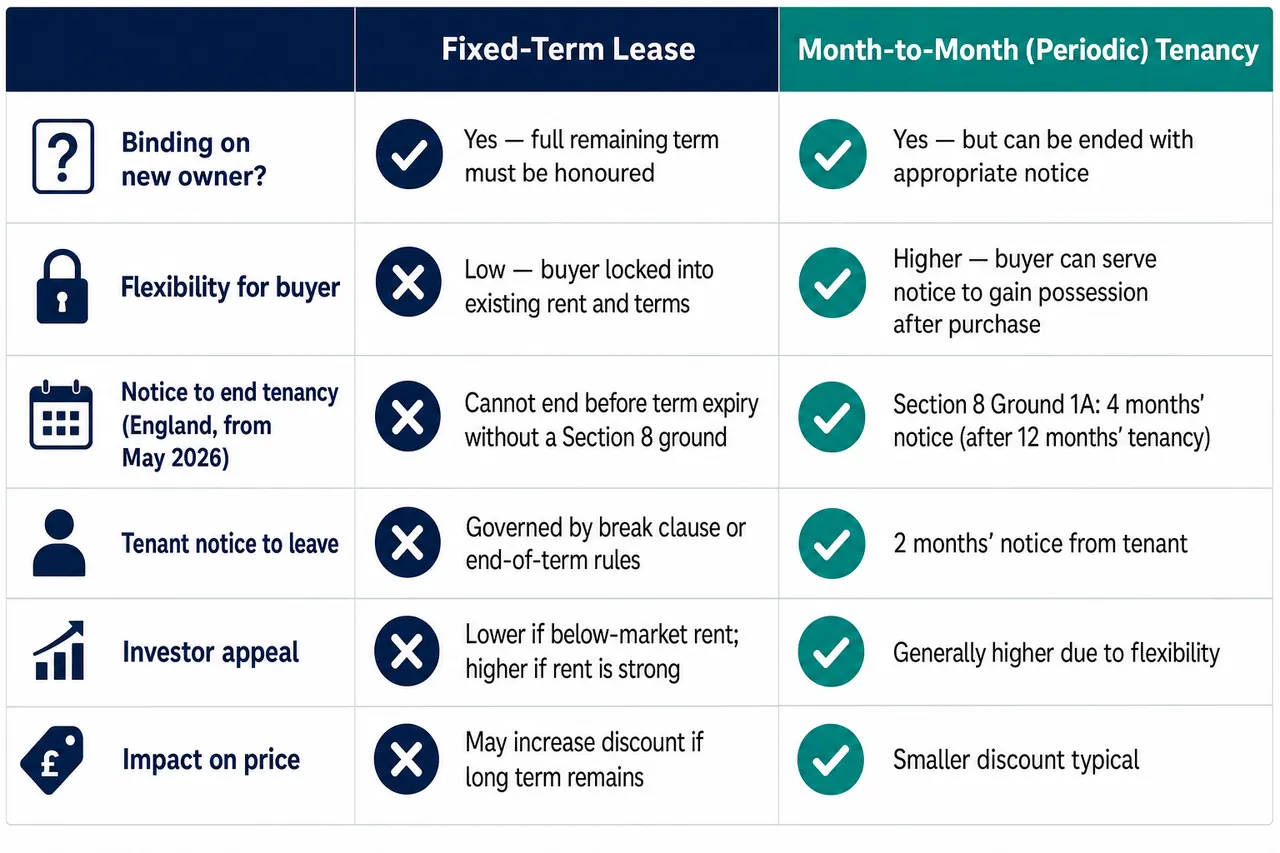
Your lease type shapes everything about the sale. It affects what buyers can do, what they'll pay, and how quickly you can close.
| Factor | Fixed-Term Lease | Month-to-Month (Periodic) Tenancy |
|---|---|---|
| Binding on new owner? | Yes — the full remaining term is their responsibility | Yes — but they can end it by giving proper notice |
| Flexibility for buyer | Low — they're stuck with your rent and your terms | Higher — they can serve notice and regain possession after buying |
| Notice to end tenancy (England, from May 2026) | Can't terminate early without a Section 8 ground | Section 8 Ground 1A: 4 months' notice (after 12 months' tenancy) |
| Tenant notice to leave | Governed by break clause or end-of-term rules | 2 months' notice from tenant |
| Investor appeal | Lower if the rent lags behind market rates; higher if it's competitive | Generally higher because buyers want flexibility |
| Impact on price | Expect a steeper discount if years remain on the lease | Price typically takes a smaller hit |
How to Sell a Property With Tenants: Step by Step
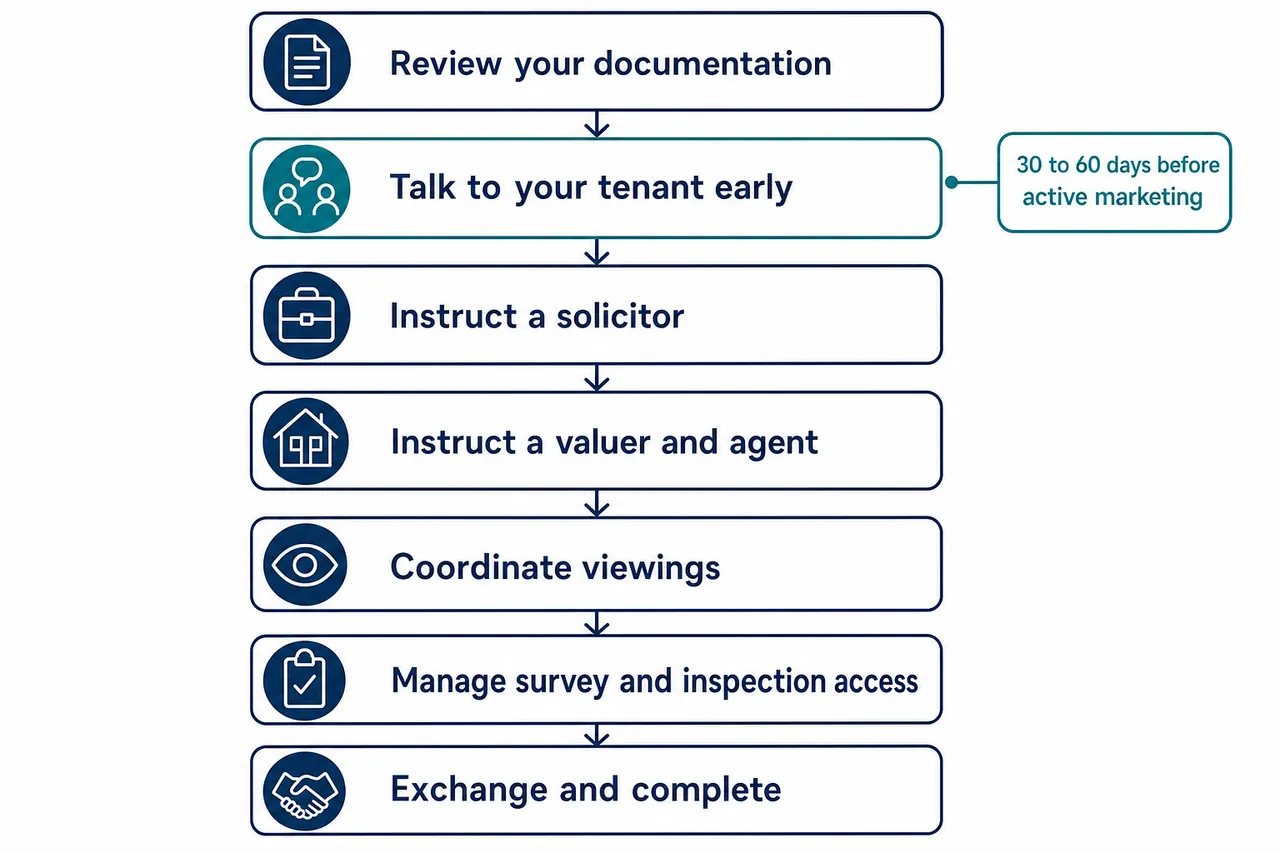
Want the full picture? Check out our detailed guide on how to sell a house with tenants. But here's what you need to do right now:
- Review your documentation — before you list anything, gather your lease, payment history, certificates, and deposit information. Have it all in one place.
- Talk to your tenant early — don't let them find out from a "for sale" sign. Give them 30 to 60 days notice before you start marketing actively. Explain what stays the same (their lease is still valid, they're not losing their home) and how showings will work. Send this in writing so both of you have proof. You'll be amazed how much smoother things go when tenants aren't blindsided. They're more likely to keep the place presentable for buyers too.
- Instruct a solicitor — transferring a tenancy, moving the security deposit, and handling compliance docs? That's not a DIY job. You need a solicitor with landlord-tenant experience. They'll draft the sale conditions, manage the deposit transfer, and make sure the buyer's solicitor gets every document they need.
- Instruct a valuer and agent — this matters: your agent needs to know you're selling an investment property, not your home. They should market it differently and have access to an investor buyer network.
- Coordinate viewings — always give the tenant proper notice. Keep written records of every viewing. Be realistic about timing that works for them. Try grouping showings into set time slots so you're not disrupting their life every day.
- Manage survey and inspection access — buyers will get a survey done. Set this up with your tenant ahead of time and confirm it in writing so there's no confusion.
- Exchange and complete — your solicitor handles transferring the deposit and makes sure rent collected after completion goes to the new owner. Your tenant gets formal notice that they have a new landlord.
Marketing a Tenant-Occupied Property

Forget lifestyle photography and school catchment talk. Your buyer doesn't care about staged living rooms or neighborhood charm—they're an investor looking at this as a cash flow asset, so speak directly to what moves them.
- Lead with the numbers: What's the current rent? What's your gross yield, and what's left after known costs (net yield)?
- Highlight tenant quality: How long have they been there? Do they pay on time? Any recent lease renewals? This matters—investors fear problem tenants more than anything else.
- Describe the property's maintenance history: A well-maintained asset with current compliance certificates tells buyers their money isn't going straight into urgent repairs. Lower risk means they'll move faster.
- Be transparent about lease type and remaining term. Investors ask this immediately. Post it upfront to speed negotiations.
- Use investor-focused channels: property auction houses, landlord forums, buy-to-let investor networks, and agents who specialize in investment property rather than residential sales.
Photographs don't need professional staging. Clean rooms in good daylight are all you need—with tenant consent, of course. Skip the shots of their personal stuff unless they've explicitly approved it.
Back to topNegotiating With Tenants: Cash for Keys and Incentives
Want the property empty before closing? You might offer your tenant money to leave early. It's called "cash for keys," and it can help you attract more buyers or push the sale price higher.
What you need to know:
- Everything must be completely voluntary. No pressure, no harassment, no coercion—that's illegal eviction, and it'll cost you.
- Get it in writing. Both you and the tenant sign a document that spells out the payment amount, the move-out date, and that you're both ending the tenancy by agreement. A handshake means nothing if things go wrong.
- What should you offer? The tenant's deposit back early, their moving costs, help with the first month's rent elsewhere, or a cash payment. It really depends on your local rental market and how hard it'd be for them to find a decent place.
- Local rules matter. Some areas—especially rent-controlled zones—have specific relocation assistance minimums built into law. Call your local housing authority or check your city's tenant rights page to see what applies to you.
- Have your solicitor write the surrender agreement. You can't wing this with a napkin note.
Selling Directly to Your Tenant
Your tenant already lives there. They know every quirk of the place, won't need a single showing, and they won't have to pack up and move across town. That's a real advantage for both of you. You get a faster, cheaper sale without spending money on marketing or staging.
But there are some real logistics to work through:
- The legal machinery still runs the same way — you'll need solicitors, property searches, and a formal contract even though you're selling to someone you already know.
- Your tenant has to prove they can actually buy it, whether that's a mortgage approval or bank statements showing liquid funds. Get clarity on their financial position before you take the property off the market. This process takes weeks, sometimes longer.
- When completion happens, the lease simply ends and they become the owner. You won't need any special tenancy paperwork.
- Owner-occupiers don't take the same discount an investor would. If you're negotiating price with your tenant, you might actually come out ahead even after a small goodwill reduction compared to what an investment buyer would offer.
Tenant in Situ vs. Vacant Possession: Side-by-Side Comparison
| Factor | Selling With Tenant in Situ | Selling With Vacant Possession |
|---|---|---|
| Typical sale price | You'll lose 10–20% off the asking price in a private treaty sale—and potentially 30–40% at auction | You get the full open-market value |
| Buyer pool | Only investors and landlords will touch it | Everyone's interested: owner-occupiers, families, investors, all of them |
| Income during sale | Rent keeps coming in while you're selling | No income once your tenant moves out |
| Time to market | You can list right now. No waiting around for the tenancy to end | If you need to end the tenancy first, that adds months to your timeline |
| Legal complexity | It's moderate—you're dealing with tenancy transfers, deposit paperwork, and proper disclosure | Once you've got possession, the legal side is simpler |
| Possession process (England) | You skip this entirely | Section 8 Ground 1A means 4 months' notice and a 12-month re-letting restriction after |
| Staging / presentation | It stays lived-in. Your marketing targets investors, not families | You can stage it properly and show it at its absolute best |
| Void period risk | Zero risk here. Someone's paying rent the whole way through | You might sit vacant for months between when the tenant leaves and when you close the sale |
What Happens After the Sale Completes?
The moment the sale closes, the buyer steps into your shoes as the new landlord. That means several legal handoffs need to happen immediately.
- The security deposit transfers to the new owner. If it's held in a government-approved scheme, the scheme provider gets notified about the ownership change. Your tenant also gets updated prescribed information with the new landlord's details.
- Did your tenant pay rent in advance? Any portion covering the period after completion gets split in the completion statement — you keep what covers up to closing day, and the buyer gets the rest.
- The new owner must reach out to your tenant right away with their name, address, and contact information for rent payments and repair requests. This isn't optional — it's required under the Landlord and Tenant Act 1985.
- All compliance certificates and the full tenancy documentation package go to the buyer.
- Can't jack up the rent tomorrow or rewrite the lease terms. Once the tenancy becomes periodic, the new owner can follow the statutory process for rent increases — but not before.
- What if the new owner wants the property back someday (maybe to sell it empty)? They'll need to wait 12 months from when the tenancy started, then serve notice under Ground 1A, then give four months' notice after that.
Regional Considerations and Local Laws
Everything here focuses on England. But if you're in Scotland, Wales, Northern Ireland, the United States, or elsewhere—the rules change. Sometimes dramatically. Here's what you need to know:
- Scotland uses the Private Residential Tenancy framework. Repossession grounds and notice periods work differently than they do in England.
- Wales has the Renting Homes (Wales) Act 2016. This gives tenants an occupation contract with its own notice rules.
- The United States sets eviction rules at the state level, and sometimes the city level too. California? Strong just-cause eviction protections and local rent control in many cities—check our California guide on selling a rental property with tenants. Florida, Colorado, Washington, Tennessee, and Indiana each have their own rules. Most states require landlords to give 30 to 60 days' notice before showing the property or closing a sale. But that timeline varies by state and sometimes by city. You need to verify what applies where you are.
Wherever you live, one rule never changes: hire a solicitor or attorney licensed in your jurisdiction before you move forward. A legal mistake costs far more than getting advice right at the start.
Back to topTax Considerations When Selling a Tenanted Rental Property
Selling a rental property isn't taxed the same way as selling your primary home. The exact amount you'll owe depends on your situation—and you absolutely need to confirm everything with a qualified accountant or tax adviser before you close. But understanding how these taxes work will help you prepare.
- Capital Gains Tax (CGT) — In the UK, you'll pay CGT on gains from selling residential rental property. The rates and annual exempt amount change, so don't rely on old numbers. Your accountant can tell you what applies to your specific sale.
- Depreciation recapture — Claimed depreciation on a US property? The IRS taxes the recaptured amount differently than long-term capital gains. Talk to your CPA before you finalize the sale.
- 1031 Exchange (US) — Selling a US rental property opens the door to a 1031 exchange, which defers capital gains tax entirely. But you're on a tight timeline: identify a replacement property within 45 days and close within 180 days using a qualified intermediary. A tenanted property doesn't automatically disqualify you, though—just confirm with your CPA that your deal qualifies.
- Rental income and completion apportionment — Any rent you collect in the tax year of sale counts as taxable rental income until closing day. Document how you're splitting the apportionment carefully.
Insurance During the Sale Process
Your landlord buildings insurance needs to stay active while the property's under offer and before you close. Call your insurer and tell them you're selling — some policies have quirky rules about void periods or what happens if the property's use changes. You don't want to discover mid-sale that your coverage lapsed. The buyer will handle their own buildings insurance, usually starting from exchange of contracts or completion at the latest.
When exactly does the risk pass to them? That's a question for both your solicitor and your insurance company. The answer lives in your sale contract, and it matters more than you'd think.
Back to topCommon Mistakes to Avoid
- Skipping legal advice — tenancy law, conveyancing, and tax all intersect in ways that trip up DIY sellers. When you skip the solicitor, documentation problems surface during the buyer's due diligence phase and can stall or torpedo the entire deal.
- Informal cash-for-keys arrangements — a handshake agreement to pay a tenant to leave won't hold up in court. It actually exposes you to harassment or illegal eviction claims. Get a written surrender agreement from your solicitor instead.
- Inadequate notice for viewings — entering without proper notice violates the tenant's right to quiet enjoyment. This can invalidate your tenancy and leave you with legal liability you didn't bargain for.
- Failing to notify the tenant before marketing — if the property's already listed when your tenant finds out, they'll know you weren't straight with them. The result? Uncooperative behaviour during showings, possible breach of the tenancy agreement, and damaged trust. Give them a written heads-up 30 to 60 days before listing. It costs nothing and makes the entire process smoother.
- Failing to disclose the tenancy to buyers — buyers need to know about the tenancy, its terms, and all the paperwork attached to it before you exchange contracts. Hide it and they can rescind.
- Incorrect deposit handling — if you don't transfer the deposit properly or it stays unregistered after the new owner takes over, you've created a legal headache for them and complicated the completion process.
- Underestimating the buyer's SDLT position — the additional 5-percentage-point SDLT surcharge on second properties and buy-to-let purchases is real money out of their pocket. If your asking price ignores this, they'll negotiate harder and the sale takes longer than it needs to.
Should You Sell With Tenants or Pursue Vacant Possession?
It really boils down to three things: how fast you need out, whether that buyer discount actually matters to your situation, and what vacant possession would genuinely cost you in time and money.
Your best move depends on what you're actually dealing with:
- Periodic tenancy at market rent? Selling to an investor with tenants in place is usually your smartest play. You'll take a small discount—if any—and keep collecting rent while the sale happens.
- Fixed lease with years left at below-market rates? Now the discount gets real. You might actually save money by using Ground 1A to push for possession, though you're looking at four months' notice, a 12-month bar on re-letting, and all the hassle that comes with it.
- Need owner-occupiers to get top dollar? Then vacant possession is non-negotiable. But don't underestimate what that costs: solicitor fees, potentially months without rent coming in, the notice waiting period, possible court battles if your tenant fights back, and even more time before you can close. Add it all up first.
- Tenant willing to go? Get a written surrender agreement done now. This is often your cleanest, fastest route to vacant possession.
Want the full picture? Check out our complete guide to selling a rental property.
Back to topConclusion
Selling a property with tenants already living there is completely legal. It's also practical, and for most landlords looking to exit without messy evictions or months of legal battles, it's often the smartest move. You keep the rental income flowing while you sell, and you avoid the headache of fighting for possession through the courts. The essentials are simple enough: be fair to your tenant, give proper notice whenever you need to show the property, and notify them in writing before marketing begins—aim for 30 to 60 days ahead, depending on your tenancy agreement and local rules. After that, gather your documentation, price the property realistically for investors, and hire professionals who know both the legal side and conveyancing inside and out.
England's rental market shifted dramatically after May 2026. Section 21 evictions are gone completely. Ground 1A comes with restrictions and complications. And you now must register with the PRS database before Section 8 notices even count as valid. These aren't small tweaks—they've fundamentally changed the math for landlords. Pursuing vacant possession has become a procedural maze compared to what it was. That's exactly why selling with tenants in place has become the more attractive option for so many people now.
Whatever you decide to do, get professional advice before you move forward. Talk openly with your tenant. Base your decision on everything—not just the sale price number on paper.
Back to top
Frequently Asked Questions
Can my tenant refuse to allow viewings when I'm selling?
Your tenant can't block every single viewing. But they do get proper notice — typically 24–48 hours in writing — before you show up. If your tenancy agreement says longer, that rules. What counts as "unreasonable"? Persistent refusal after you've given proper notice could breach the tenancy agreement, but that's something your solicitor needs to weigh in on. And forcing your way in? Never legal.
Does the tenant have the right to buy the property before anyone else?
In England, private tenants in a standard residential tenancy don't generally have a statutory right of first refusal (this is different for leasehold flat owners with collective enfranchisement rights). You can offer your tenant the chance to buy if you want to — it's sometimes smart strategy — but you're not required to do it unless your tenancy agreement explicitly says otherwise.
What happens to the security deposit when I sell?
You've got to transfer it to the new owner at completion. If it's held in a government-approved scheme, that scheme needs to know there's a new landlord. Your tenant also gets updated prescribed information with the new landlord's details. Get this wrong and the new owner could face financial penalties.
Can I sell a property with tenants even if they're in rent arrears?
Yes. The tenant's arrears don't legally stop you from selling. What you must do is tell buyers about the arrears during due diligence. Some will adjust their offer; others won't proceed unless arrears are cleared before completion. If you're thinking about using Ground 8 (mandatory rent arrears) under Section 8, note that it now requires three months' arrears at both the notice stage and the court hearing, with a four-week notice period. Talk to a lawyer before you go down that path.
How long does it typically take to sell a tenanted property?
It depends. Cash investors might close in four to six weeks. A buyer using a buy-to-let mortgage? Expect eight to sixteen weeks from offer to completion. Coordinating surveys and inspections with your tenant adds time around the edges. Set realistic expectations from day one and loop your tenant in early. That cuts down delays from access disputes or scrambled paperwork at the last minute. For specifics where you live, check our guides for Florida, California, and Washington.
Back to top