

Selling a House in Divorce: Tax Implications and How to Minimize Them

Divorce is already one of the most financially complex events a person can navigate — and when a jointly owned home enters the picture, things get even messier. The tax implications can add a significant layer of stress and confusion to an already stressful situation. Whether you're planning to sell the family home now, after the divorce is finalized, or are considering a buyout arrangement, the decisions you make have real dollar consequences on your tax return. Here's what makes this so important: for many divorcing couples, the family home is their single largest asset. A well-timed, well-documented sale might save you tens of thousands of dollars in avoidable taxes. But get it wrong, and you could owe substantially more than you expected. This guide breaks down everything you need to know about selling house divorce taxes — from the capital gains exclusion and ownership tests to state-specific rules, step-by-step calculation examples, and the most common mistakes that cost divorcing homeowners money.

Capital Gains Tax Basics for Home Sales
What's Capital Gains Tax on Home Sales?
You sell your home for more than you paid for it? That profit is called a capital gain, and the IRS wants a cut. To figure out what you actually owe, subtract your adjusted basis (basically what you paid plus the cost of qualifying improvements) from your net sale price (the sale price minus agent commissions, closing fees, and other selling costs).
If you've owned the home longer than a year, you're taxed at the long-term capital gains rate. That's either 0%, 15%, or 20% depending on your income. For 2024, here's where the brackets land: single filers hit the 15% rate between $47,026 and $518,900 in taxable income, while married couples filing jointly fall into 15% between $94,051 and $583,750. And if you're a high earner? You might also owe an extra 3.8% Net Investment Income Tax (NIIT) on top.
Let's make this concrete. You and your spouse bought your home in 2015 for $300,000, put $50,000 into improvements, and sold it today for $750,000 after paying $45,000 in commissions and closing costs. That's an adjusted basis of $350,000 and a net sale price of $705,000, leaving you with a $355,000 gain. Without any exclusion, a couple in the 15% long-term capital gains bracket would face roughly $53,250 in federal taxes alone. So how do you reduce or eliminate that hit? That's what tax planning during divorce is really about.
How the $250,000/$500,000 Exclusion Works
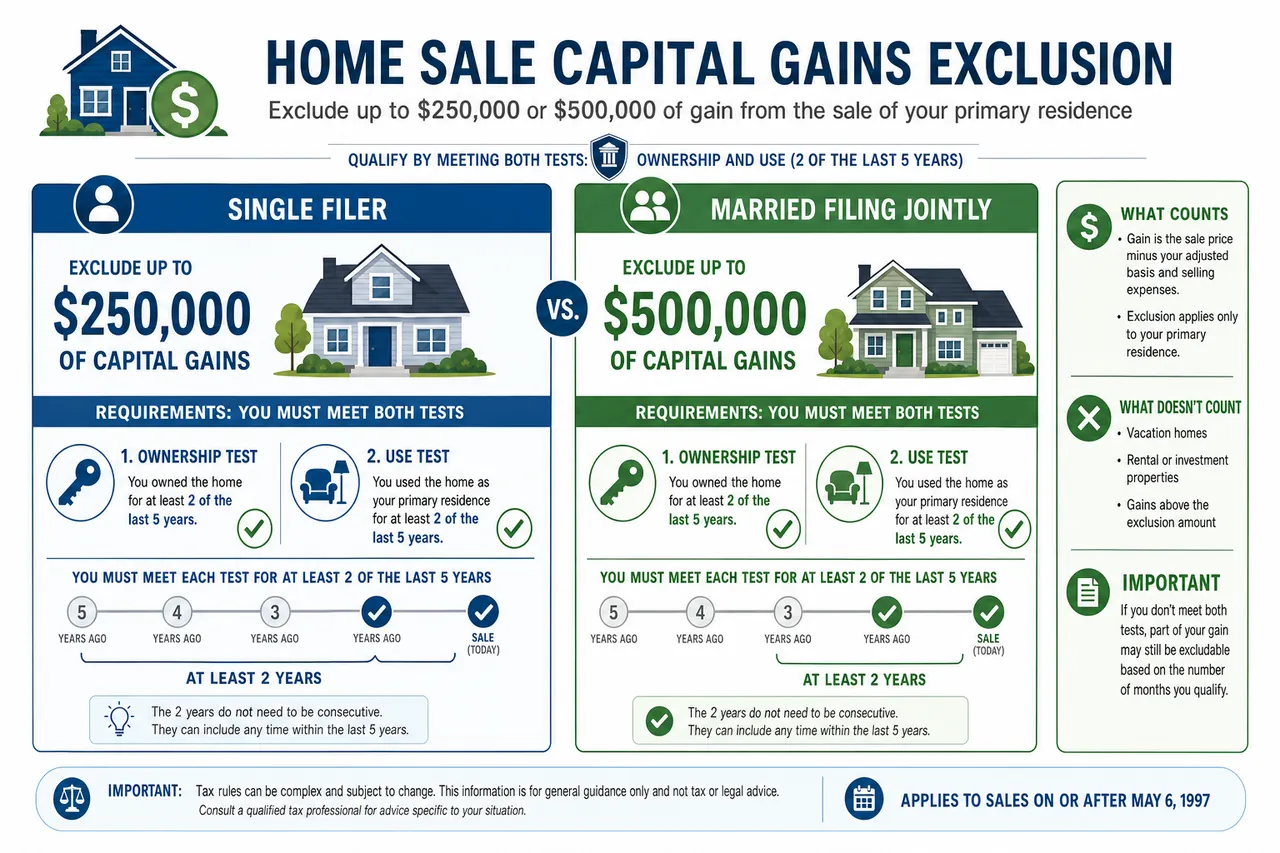
There's one tool that stands above the rest: the Section 121 exclusion under the Internal Revenue Code. This is huge. It lets eligible homeowners exclude up to $250,000 of capital gains if you're single, or up to $500,000 if you're married filing jointly. This isn't a deduction that reduces your taxable income—it wipes out the gain entirely up to those limits, so you pay zero tax on that portion of your profit.
Back to that example. If the couple sold while still legally married and filed jointly, the $355,000 gain disappears entirely under the $500,000 exclusion. Zero federal capital gains tax owed. Now sell the same house after the divorce is final. Each spouse files as single and can exclude $250,000 apiece—still totaling $500,000 overall—and you'd still pay nothing. But here's the catch: both spouses have to meet the eligibility requirements. Divorce throws a wrench in that equation.
Ownership and Use Tests Explained
Want to claim the Section 121 exclusion? You need to pass two tests, both measured over the five-year period before you sell:
- Ownership test: You owned the home for at least 24 months (two years) out of the last five years.
- Use test: You lived in the home as your primary residence for at least 24 months (two years) out of the last five years.
And here's the thing—those two years don't have to run back-to-back. You can stack them up in chunks. Both tests have to be satisfied though. If you owned the place but rented it out instead of living there for two of those five years, you've blown the use test. No exclusion, no matter how long you held the title.
The ownership test and the use test can happen at different times too. Say you owned for three years but only actually lived there for the last two. You've still got both tests covered. This detail matters big-time when one spouse moves out during divorce—we're getting to that next.
How These Rules Apply Specifically During Divorce
Divorce brings two special IRS provisions that bend the normal rules. Under IRC Section 121(d)(3), when a spouse gets the home in the divorce settlement, they can "tack on" the other spouse's ownership time to their own. So if one spouse owned it four years and the other only one year before the transfer, the spouse who got the house can use the full four years for their ownership test.
But there's more. If one spouse moves out under a divorce or separation agreement, the use test gets special treatment: the spouse who left can count the time their ex-spouse continues to live in the home as their principal residence. This matters enormously because it means you don't automatically lose your exclusion just because divorce forced you to move out.
Back to topHow Divorce Affects Capital Gains Tax on Your Home

Timing Considerations: Selling Before vs. After Divorce
When you sell matters most. This single decision shapes your filing status, your available exclusion amounts, and whether you'll actually pass the ownership and use tests. There's rarely a one-size-fits-all answer, but the numbers usually tell a story.
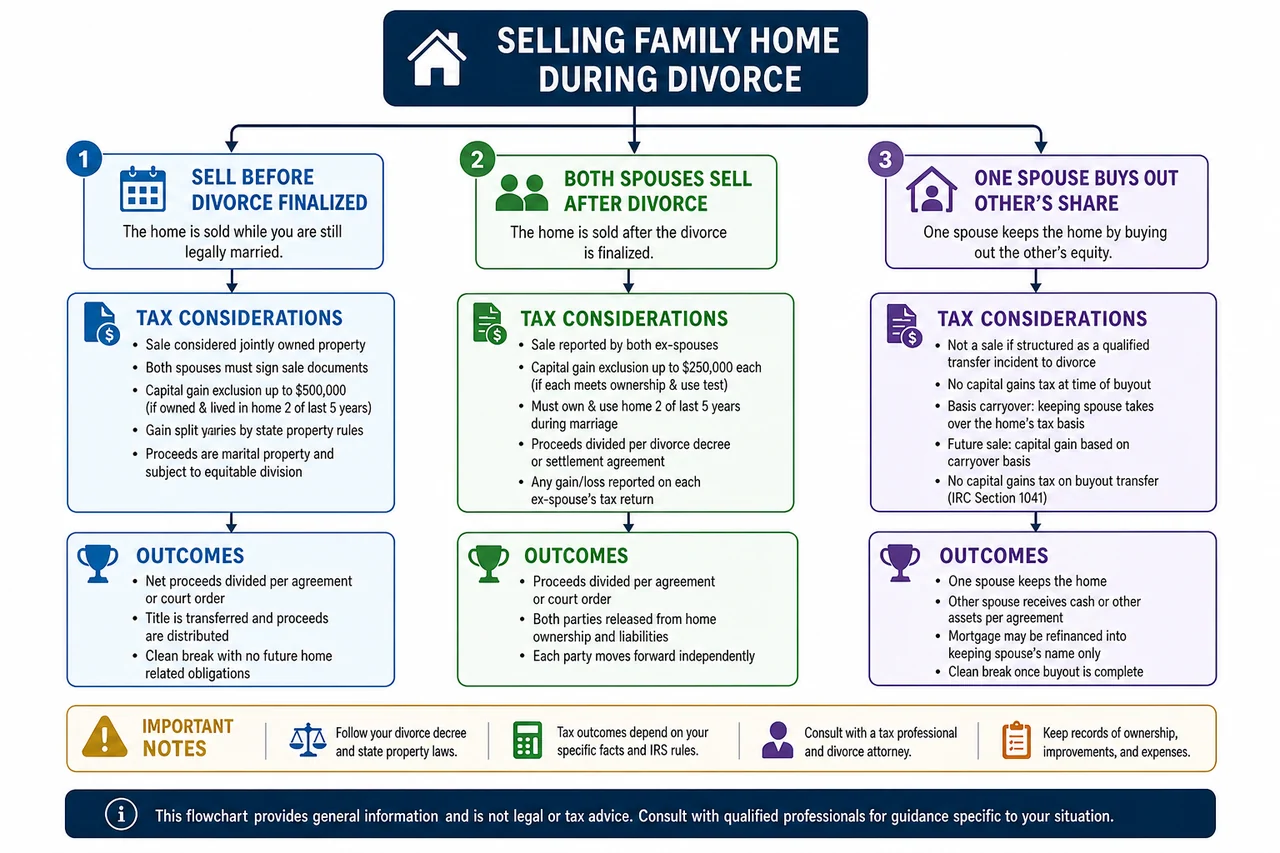
Sell while you're still married? File jointly that year, and you're looking at the full $500,000 exclusion — assuming both of you hit either the ownership or use test individually. Here's the catch: only one spouse needs to own it, but you both need to have lived there for the full $500,000 joint exclusion to work. This path can be huge if your gains are creeping toward or past $250,000 each.
But if the divorce is already final when you sell, everything changes. You're each limited to $250,000. For couples in moderate markets, that's still enough protection. And yet — if you're in California, Washington, or Colorado, where homes appreciate fast? You might be looking at total gains that blow past $500,000. That's when timing becomes critical.
Want to dig deeper into the timing question? Our guide on Should You Sell Your House Before the Divorce Is Final? walks through the specifics.
Impact of Property Settlement Agreements
IRC Section 1041 treats divorce property transfers as gifts for tax purposes. No capital gains tax due when you hand over your interest. The receiving spouse takes the property at your original adjusted basis, not at what it's worth today. It's smart and risky at the same time.
The upside? You dodge capital gains tax on the transfer itself. The downside? Your ex-spouse gets stuck with a low basis and faces a larger tax bill later. Picture this: you bought for $200,000. It's now worth $600,000. You transfer your half to your spouse in the divorce settlement. They now own a $600,000 home on a $200,000 basis — that's a $400,000 built-in gain just sitting there. When they sell for $650,000, their taxable gain isn't $50,000. It's $450,000.
Maintaining Eligibility for the Capital Gains Exclusion
One spouse moves out. The divorce drags on for two years. Suddenly nobody's using the home as a primary residence anymore, and you've both blown past the two-of-five-years residency requirement before you even sell. This happens constantly.
Don't let this happen to you. Here's what to do:
- Write it into the divorce or separation agreement that one spouse stays as the primary resident.
- Use the IRS special rule that lets the absent spouse count their ex's occupancy toward their own use test.
- Lock in a hard deadline in the settlement for when the home sells or transfers — so neither of you runs out of time on that five-year window.
- Keep records of any dates you actually lived there during the divorce, even briefly.
Step-Up in Basis Rules During Property Division
The stepped-up basis rule gets a lot of hype, but here's what you need to know: it doesn't apply to divorce property transfers. Not really. Under Section 1041, you carry forward the original adjusted basis — you don't get reset to fair market value like you would with inherited property.
There's one exception, though. In community property states, if one spouse dies before the divorce wraps up, the survivor might get a full step-up on the entire community property — including the deceased spouse's half. This could slash your capital gains exposure dramatically. If you're in one of these states, talking to an estate planning attorney (separate from your divorce lawyer) could save you serious money. Need details on how stepped-up basis works with inherited homes? Check out our guide on Taxes on Selling an Inherited House: What You'll Owe.
Back to topScenarios: Selling the Family Home During Divorce
Numbers matter. Divorcing homeowners need to see exactly how the numbers play out in real situations — not just abstract rules. Here are four scenarios with consistent base assumptions so you can see meaningful comparisons.
Base Assumptions: You bought your home in 2017 for $350,000, invested $30,000 in capital improvements (adjusted basis = $380,000), and it's now worth $750,000 on the fair market. After agent commissions and closing costs, you'll net $705,000. That's a total gain of $705,000 − $380,000 = $325,000. Both of you are in the 15% long-term capital gains bracket as individuals.
| Scenario | Total Gain | Exclusion Available | Taxable Gain | Federal Tax Owed (15%) | Key Condition |
|---|---|---|---|---|---|
| Sell while married, file jointly | $325,000 | $500,000 | $0 | $0 | Both meet use test |
| Sell after divorce, both file single | $325,000 | $250,000 each ($500,000 total) | $0 | $0 | Each meets ownership & use test |
| One spouse buys out the other (later sells) | $325,000 carried forward | $250,000 (single) | $75,000 | $11,250 | Buyout spouse inherits full basis |
| Co-own, sell 4 years post-divorce | $400,000 (appreciated further) | $250,000 each ($500,000 total) | $0 | $0 | Both still meet use test at sale |
Both Spouses Sell Immediately After Divorce Finalization
From a tax angle, this is your cleanest path — assuming both of you still qualify under the ownership and use tests. Say the divorce finalizes in October 2024 and you sell in November. Each of you files as single for 2024 and claims up to $250,000 in exclusion. Split the $325,000 gain equally, and you each owe tax on $162,500 of it.
That's well under your individual $250,000 limit. Federal tax owed: $0.
But here's the catch: if the departing spouse moved out more than five years ago, or if the divorce dragged on so long that the five-year lookback window has closed, you'll lose this benefit. In active real estate markets, divorces can stretch for years. You'll need to track move-out dates carefully. For step-by-step details on how this works, see our Selling a House During Divorce: A Step-by-Step Guide.
One Spouse Buys Out the Other's Share
Spouse A pays Spouse B for their 50% equity interest. Spouse B transfers title and walks away. No tax hit at that moment — thanks to Section 1041.
But Spouse A inherits the original $380,000 adjusted basis, not the inflated value of $565,000 (what the home was worth at buyout time). This matters later.
Fast forward: Spouse A sells the home for $750,000. Their gain is $325,000. They claim $250,000 as a single filer. That leaves $75,000 taxable at 15% — a federal bill of $11,250. Spouse B got their cash and doesn't owe a dime on the home sale. This scenario shows why the buying spouse should run the math on future tax liability before agreeing to a buyout price. That "hidden" tax bill eats into the real value of what you're getting.
Continued Co-Ownership and Later Sale
Some divorcing couples keep both names on the deed. Maybe the kids need stability. Maybe the market's soft and you're waiting. It can work tax-wise, but you'll need careful documentation and ongoing agreement between ex-spouses.
If both of you retain ownership and eventually sell, each can claim $250,000 in exclusion as single filers. The use test is where things get tricky. The spouse who moves out must sell within five years of leaving — unless the IRS special divorce rule saves you. Here's how it works: if your divorce agreement gives the other spouse the right to use the home, you can count that occupancy toward your own use requirement. Get this in writing. Our guides for Selling a House During Divorce in Florida and Selling a House During Divorce in Washington tackle state-specific details you'll want to know.
Selling the Home Before the Divorce Is Finalized
This option can save you the most in taxes when your gain is large. You're still legally married during the sale, so you file jointly that year and claim the full $500,000 exclusion. Both of you need to have used the home as a primary residence for the required period — though only one needs to meet the ownership test.
The catch? You'll need to cooperate with your soon-to-be ex. Agree on list price. Coordinate sale terms. Work with both attorneys so the proceeds get split properly in the settlement. For couples willing to make it work, the tax savings are real. In high-appreciation markets like California, a $500,000 gain plus state income tax can hit you with a combined bill over $120,000. The joint exclusion wipes it out entirely. Check out our article on Should You Sell Your House Before the Divorce Is Final in California for the details on how this plays out in your state.
Back to topTax Planning Strategies for Divorcing Couples


Coordinating the Sale Date with Divorce Finalization
Timing is everything in a divorce home sale when it comes to taxes. Get the timing right, and you could save tens of thousands. Get it wrong? You're paying taxes you didn't need to pay. Here's how to figure out your best window:
- Calculate your current gain: Start with your adjusted basis (what you paid plus any major improvements), then subtract it from what you'll actually net when you sell. That number tells you how much gain you're potentially dealing with before any tax breaks kick in.
- Assess exclusion eligibility: When did each of you last live in the house? If one of you is getting close to that five-year deadline, you're working against the clock.
- Compare joint vs. individual exclusion scenarios: Here's where the math gets interesting. If your total gain is more than $250,000 per person but less than $500,000 total, you might eliminate the tax entirely by selling while you're still legally married.
- Model the post-divorce scenario: Did the divorce get finalized this calendar year? Can you close the sale before year-end too? If so, each of you might still qualify for the full exclusion on your own.
- Factor in filing status changes: Selling before December 31 while you're still married opens the door to filing jointly. Sell after January 1 next year, and you're both filing as single — which changes everything about your tax picture.
Using the Capital Gains Exclusion Strategically
| Filing Status | Max Exclusion | Ownership Test Required | Use Test Required | Best For |
|---|---|---|---|---|
| Married Filing Jointly | $500,000 | One spouse (2 of 5 years) | Both spouses (2 of 5 years) | Gains between $250K–$500K |
| Single (post-divorce) | $250,000 each | Each spouse (2 of 5 years) | Each spouse (2 of 5 years) | Gains under $250K each |
| Married Filing Separately | $250,000 each | Each filer independently | Each filer independently | Rarely beneficial |
| Head of Household (post-divorce) | $250,000 | Two of five years | Two of five years | Custodial parent, lower rates |
Most people don't know about this: if you can't exclude your entire gain under Section 121, the IRS might still let you claim a reduced exclusion under the divorce-related hardship exception. According to IRS Revenue Procedure 2005-14, divorce actually qualifies as an unforeseen circumstance. The partial exclusion gets calculated based on how many months of the required time period you actually lived there. Let's say you met 12 out of 24 months of the use test. You'd be able to exclude up to $125,000 (that's 50% of the $250,000 single filer limit) instead of nothing.
Considerations for Rental Properties and Investment Real Estate
The Section 121 exclusion only works on your primary home. But what if you own a rental property, a vacation home, or other investment real estate together? The rules shift completely:
- Depreciation recapture: Any rental property you've owned will hit you with depreciation recapture taxes at 25% federally. And that's money you can't exclude under Section 121, no matter what.
- 1031 exchanges: You can defer capital gains on investment property by doing a like-kind exchange — basically rolling your proceeds into another investment property. But both of you have to agree, and the IRS rules are tight. You've got 45 days to identify the replacement property and 180 days to close.
- Vacation homes: Used it part of the year as a vacation home and part as your primary residence? The gain from those vacation months might still be taxable. The IRS allocates the tax based on the ratio of personal use days versus total days you owned it.
Working with Tax Professionals and Divorce Attorneys
This stuff is genuinely complicated. Experienced divorce attorneys make mistakes here all the time — and those mistakes cost their clients real money in taxes that shouldn't have been owed. You need the right team around you:
- A Certified Divorce Financial Analyst (CDFA) or CPA who specializes in divorces and can model different settlement scenarios before you sign anything.
- Your divorce attorney — but they need to understand the tax angle so they can write the settlement agreement in a way that protects your exclusion eligibility. That might mean giving the other spouse a right to live in the home for a while, or setting a firm deadline for the sale.
- A real estate professional who can give you realistic net proceeds and market timing advice. Ideally someone who's handled divorce sales before, since they move differently than regular sales.
Bring in the CPA or CDFA before you sign the property settlement agreement. Doing tax planning afterward is almost always more limited and way more expensive.
Back to topState-Specific Considerations
Community Property vs. Equitable Distribution States
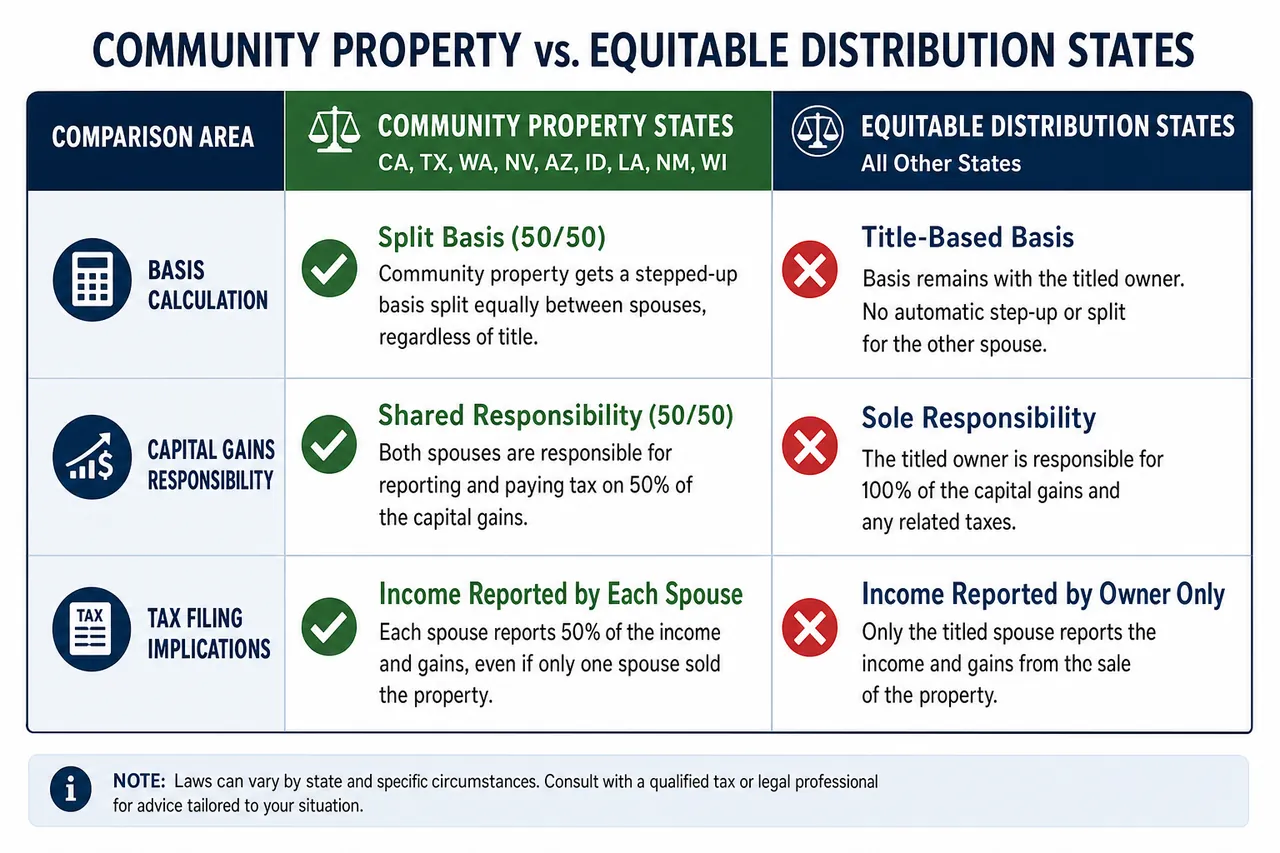
Where you live matters a lot. Your state's property division rules directly shape how your home's basis and gain get split during a divorce. The country uses two different systems:
- Community property states (Arizona, California, Idaho, Louisiana, Nevada, New Mexico, Texas, Washington, Wisconsin): Anything you and your spouse bought during marriage belongs to both of you 50/50 by default. That means each of you owns half the home and gets a basis equal to half the total adjusted basis.
- Equitable distribution states (all other states): Marital property gets divided "fairly" — though fair doesn't always mean 50/50. How the basis splits depends on what each spouse put in and what the judge decides in the settlement.
Community property rules can give you a real advantage on basis, especially when someone passes away and gets that full step-up we talked about earlier. But here's what matters for divorce: community property states typically split the basis equally between you and your ex, while equitable distribution states might give you an unequal split based on the settlement agreement.
| State | Property System | State Income Tax on Capital Gains | Key Divorce Tax Note |
|---|---|---|---|
| California | Community Property | Up to 13.3% (same as ordinary income) | No state capital gains exclusion; federal exclusion still applies |
| Texas | Community Property | None (no state income tax) | No state tax exposure; federal rules govern |
| Washington | Community Property | 7% on long-term capital gains over $262,000 (2024) | New capital gains tax applies; divorce sales may qualify for exemption |
| Florida | Equitable Distribution | None (no state income tax) | No state tax; equitable distribution may produce unequal basis splits |
| Colorado | Equitable Distribution | 4.4% flat rate | State conforms to federal exclusion; moderate additional exposure |
| Indiana | Equitable Distribution | 3.05% flat rate | State conforms to federal exclusion; low additional exposure |
| Tennessee | Equitable Distribution | None (no income tax on wages/capital gains) | No state tax exposure; federal rules govern |
| New York | Equitable Distribution | Up to 10.9% | No state exclusion for capital gains; high additional state exposure |
California Capital Gains Tax Implications
California needs its own section. Here's why: you've probably seen massive home appreciation in California, and the state taxes capital gains harder than almost anywhere else. The federal government lets capital gains sit at lower rates. California doesn't. Your gains get taxed as regular income at rates up to 13.3%. The good news? California does recognize that federal $250,000/$500,000 exclusion, so it applies at the state level too.
Picture this: You and your spouse sell your California home while married with a $600,000 gain. After the $500,000 joint exclusion, you owe taxes on $100,000 — that's $13,300 in California state taxes alone on top of federal. Now imagine you wait and sell after the divorce closes. Each of you has $300,000 in gain, each gets a $250,000 exclusion, so each owes tax on $50,000. At the top California rate, that's $6,650 per person — a combined state tax hit of $13,300 for both of you. Timing the sale wrong could cost you thousands in state taxes.
Want the specifics for your situation? Check out our detailed guide on selling your house before the divorce is final in California.
Washington State's New Capital Gains Tax
Washington jumped into the capital gains tax game in 2023. They're taking 7% on gains over $262,000 (the threshold rises with inflation each year). But here's the catch that helps divorcing couples: your primary residence is completely exempt. Even if you're sitting on a massive gain, you won't pay Washington state tax on your family home sale.
Investment properties and vacation homes? Those aren't protected. You could face the 7% tax on those. For the full breakdown of how this affects your divorce situation, read our state guide on Should You Sell Your House Before the Divorce Is Final in Washington.
How Divorce Decrees Affect State Tax Treatment
Most states recognize divorce transfers as non-taxable events. They line up with the federal Section 1041 rule that lets you move property to your ex without triggering a tax bill. Your divorce decree or property settlement agreement usually counts as proof that no state income tax is owed when the property changes hands.
Some states want you to actually file something or make an election to lock in this treatment.
Colorado, Indiana, and Tennessee stick pretty closely to federal rules without adding much complexity on top. We've broken down the state-specific requirements for Selling a House During Divorce in Colorado, Selling a House During Divorce in Indiana, and Selling a House During Divorce in Tennessee — including exactly what documents you need and what timelines to follow.
Back to topCommon Mistakes to Avoid
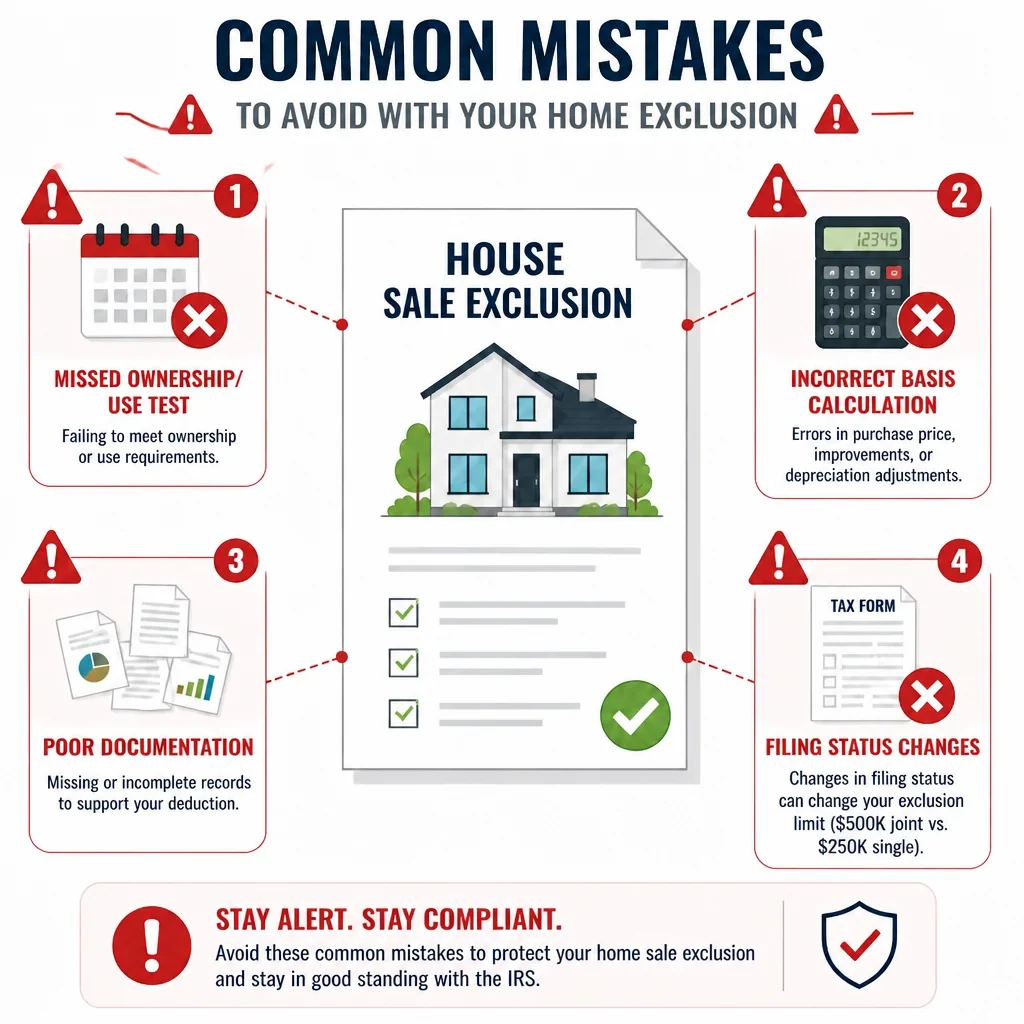
Failing to Meet the Ownership and Use Tests
This one's expensive. It's the biggest tax mistake divorcing homeowners make — and most of the time, it's not carelessness. It's just not knowing the rules. Here's what catches people: the five-year lookback window starts the moment your sale closes, not when you filed for divorce or got the papers signed. Let's say Spouse A moved out in January 2020. The house doesn't sell until February 2025. That's five years and one month. Spouse A is now outside the window. They lose their entire $250,000 exclusion.
Want to avoid this? Track your actual move-out date. Calculate when the five years end. Then coordinate with your attorney to either close the sale before that deadline or file the special divorce exception paperwork that lets the absent spouse count the other ex's use toward their own requirement.
Miscalculating Basis After Property Settlement
Most divorcing homeowners have no idea what their home's adjusted basis actually is. And that's a problem.
Your original purchase price? That's just the starting point. Your adjusted basis is built on top of that — it includes closing costs paid at purchase, capital improvements you've made over the years, and subtracts any depreciation you've claimed. The details matter:
- Original purchase price
- Closing costs paid at purchase (title insurance, origination fees, recording fees)
- Cost of capital improvements (additions, renovations, landscaping that increases value)
- Less: any depreciation claimed (if any portion was ever used as a rental or home office)
- Less: any casualty loss deductions previously taken
Over a 10- or 20-year marriage, home improvements can stack up to $50,000, $100,000, even $150,000 or more. That's real money off your taxable gain. But here's the catch: if you don't document these improvements and nail down your adjusted basis, you'll overstate your gain. And you'll overpay taxes. Keep receipts for everything.
Back to top
