

How to Sell a Home As-Is: Pros, Cons, and What to Expect

Table of Contents
- What Does It Mean to Sell a House As-Is?
- Why Sellers Choose to Sell As-Is
- Pros of Selling a House As-Is
- Cons of Selling a House As-Is
- How Much Will You Lose Selling As-Is?
- Legal Considerations and Disclosure Requirements
- Tax Implications of an As-Is Sale
- Step-by-Step Guide: How to Sell Your House As-Is
- Marketing Tips for As-Is Properties
- Alternatives to Selling Completely As-Is
- Is Selling As-Is Right for You?
- Conclusion
- Frequently Asked Questions
Selling a home is rarely straightforward. Add significant repairs to the equation, and suddenly you're facing a much harder choice. Should you sink thousands into fixing things before you list? Or just sell it as-is and be done with it? If you're working against the clock, watching your budget carefully, managing an inherited property, or navigating a major life shift, an as-is sale might be your answer. But here's the thing—it comes with real trade-offs you need to understand before you sign anything. This guide covers everything you need to know about how to sell a home as-is: what it legally means, what it typically costs you in lost value, how to market it effectively, and when it actually makes sense for your situation.
Selling a house that needs work? Start with what to know before selling a house that needs repairs. It explains what as-is means, how pricing works and every way to sell a house with problems.
What Does It Mean to Sell a House As-Is?
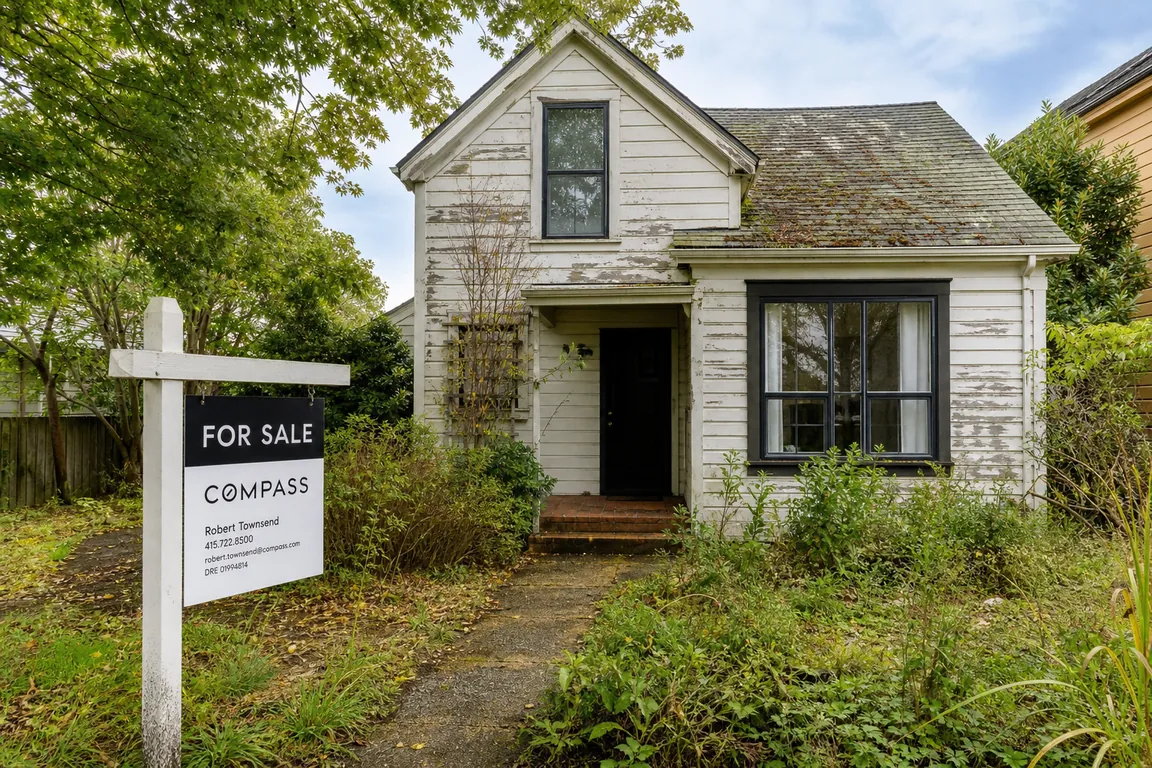
You're selling the house exactly as it sits right now. No repairs. No improvements. No haggling over what the inspection finds. When you list a property "as-is," you're telling buyers: take it or leave it. They accept everything — the water stains, the outdated wiring, the foundation crack — and the price reflects that reality.
Legal Definition and Implications
Here's what as-is actually means in a real estate contract: the buyer agrees to take ownership of the property in its current physical state. But here's the catch — and pay close attention — an as-is clause doesn't wipe away your disclosure obligations as a seller. Every U.S. state and Canadian province requires you to disclose known material defects. Period. That as-is label just means you won't fix the problems; it doesn't give you permission to hide them.
Deliberately concealing a leaking roof, faulty wiring, or foundation damage? You can still get sued after closing. The courts don't care about your as-is clause. They call it fraud.
Common Misconceptions About As-Is Sales
Many sellers think as-is means skipping disclosures entirely. Wrong. Others believe it automatically cuts the price by some standard percentage. Also not how it works — the actual discount hinges on how bad the problems are, your local market conditions, and what type of buyer you're dealing with. And here's another myth: you can't sell an as-is house to someone with a mortgage. Actually, you can — it's trickier, but we'll dig into that below.
How As-Is Differs from a Traditional Sale
Normal home sales look like this: buyer inspects, finds issues, negotiates for repairs, credits, or a price drop. Then you hammer out a deal. As-is sales eliminate that entire back-and-forth. You're saying upfront: "This price is what it is. We're not doing repair credits or work orders." That means the buyer absorbs all the renovation costs and all the risk. And that's exactly why as-is homes have to be priced lower to get any offers at all.
Back to topWhy Sellers Choose to Sell As-Is
As-is sellers don't fit one mold. A dozen different situations can push you toward this path, and figuring out what's driving your decision is key to knowing if it's actually right for you.
Time Constraints and Quick Sale Needs
Sometimes life doesn't give you three months to renovate. Job relocations happen. Military deployments happen. Financial emergencies happen. When speed matters most, traditional selling feels impossibly slow. The national median is 55 days from listing to accepted offer as of March 2026 (Redfin data) — and that's just the listing phase. Then you're looking at another 30–45 days while a financed buyer arranges their mortgage. Three months or more, start to finish.
An as-is cash sale compresses that dramatically.
Financial Limitations Preventing Repairs
Fixing a house costs real money. We're talking an average of $5,600 or more per deferred repair item, according to 2026 Pearl Certification data. Now stack up multiple problems — the roof's failing, the HVAC's on its last legs, plumbing issues are piling up — and you're easily staring at $30,000 to $60,000. Most people don't have that sitting around. For you, selling as-is probably isn't a strategy. It's survival.
Inherited Properties and Estate Sales
Inherited homes come with baggage. Decades of neglected maintenance. No renovation budget. You might live three states away or disagree with your co-heirs about how much to spend. And honestly? You just want the estate settled without drama. As-is sales solve that cleanly.
Avoiding Foreclosure Situations
Behind on your mortgage payments? The clock's ticking. Foreclosure moves fast, and once it hits your credit, the damage lasts years. Selling as-is to a cash buyer can close in days — fast enough to satisfy your lender before foreclosure completes, preserve some of your equity, and keep your credit from taking that hit.
Life Changes Requiring Immediate Sale
Divorce. Serious illness. A move to assisted living. Death in the family. These situations don't care about your timeline. You need a fast, uncomplicated sale — and you're willing to trade some money at closing to get certainty instead. That's exactly what as-is selling delivers.
Back to topPros of Selling a House As-Is
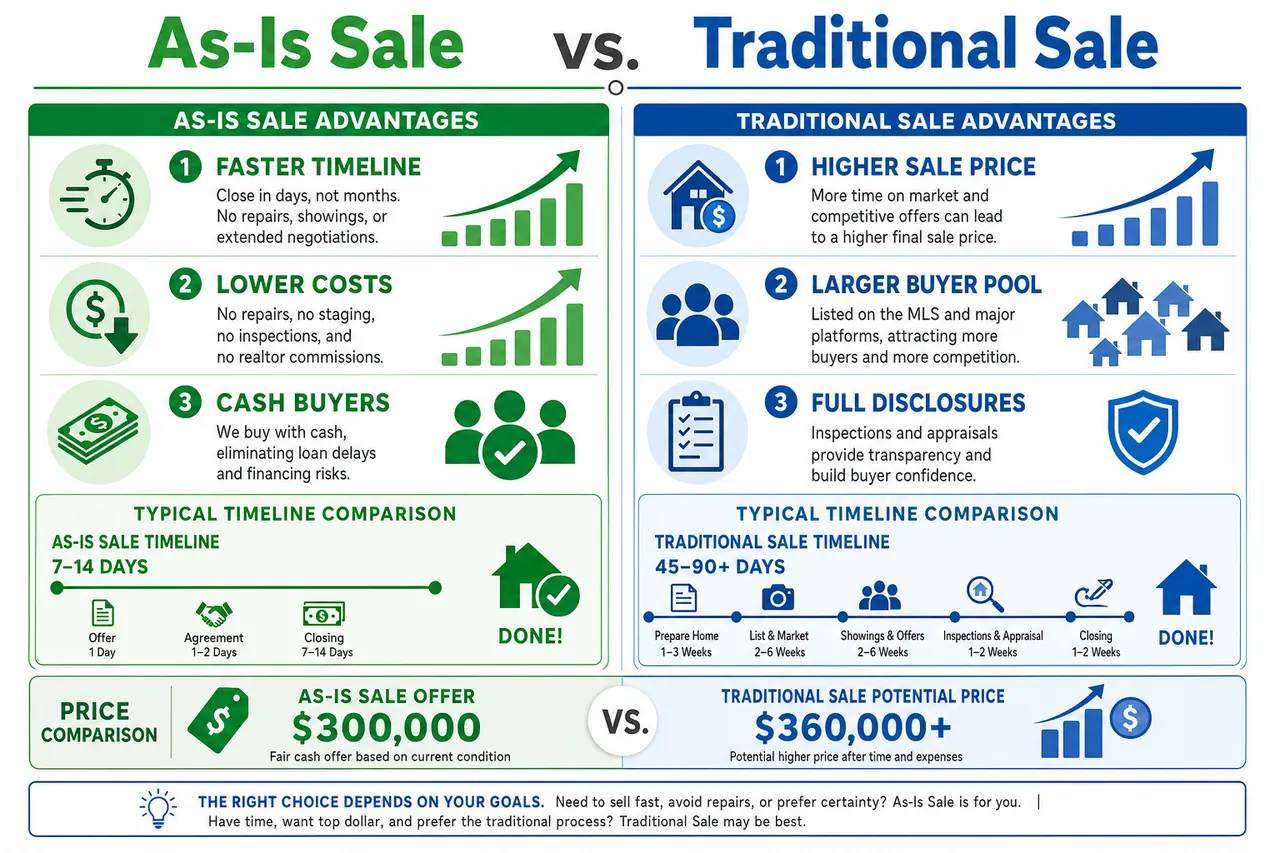
Sure, you'll take a lower price. But as-is sales come with real advantages that traditional listings can't offer. Want to know what actually works in your favor?
Faster Closing Timeline
The speed is unbeatable. Cash buyers — and they're a significant chunk of the as-is market — can close in just 7–14 days. That's massive. A financed buyer needs 30–45 days just for mortgage underwriting, and that's before you've even found them. According to NAR data from June 2026, 25% of all U.S. home sales were all-cash transactions. There's an active, real market of buyers ready to move fast.
Lower Upfront Costs
Staging, fresh paint, landscaping, repairs — traditional sellers throw thousands at this stuff before they even list. You don't. What you save upfront can help offset the lower sale price, depending on your situation.
Attraction of Cash Buyers and Investors
Here's the thing: investors, house flippers, and cash home buyers specifically hunt for as-is properties. They've got renovation budgets already factored in. They don't wait for mortgage approval. And inspection reports? They don't care. You're tapping into a buyer pool that simply doesn't exist the same way in traditional listings.
Simplified Selling Process
No repair negotiations. No contractor calls at 6 AM. No re-inspections dragging on forever. You get an offer, you say yes or counter, and you close. For people buried in an estate settlement, going through a divorce, or dealing with a health crisis, that simplicity matters more than you'd think.
No Repair Coordination Headaches
Coordinating contractors while trying to sell? It's a nightmare. Costs balloon. Timelines slip. Workers cancel. As-is selling erases all of that stress completely.
Back to topCons of Selling a House As-Is
Selling as-is isn't a shortcut — it comes with real trade-offs. You need to understand what you're giving up before you commit to this path.
Significantly Lower Sale Price
Here's the hard truth: you'll lose money. As-is homes typically sell for 5%–30% below comparable fully updated homes (as of June 2026). Think about that on a $400,000 home — you're potentially walking away from anywhere between $20,000 to $120,000. Whether you land on the low or high end of that range depends on how bad the problems are, what type of buyer shows up, and whether your local market is hot or sluggish.
Reduced Buyer Pool
FHA and VA loans have strict property standards. Many first-time buyers use these programs — and they can't buy your house in its current condition. And conventional buyers? Most of them will pass too. Your market just got a whole lot smaller.
Buyer Financing Complications
Appraisals can kill deals. Lenders refuse to finance a home for more than its appraised value, and any damage or deferred maintenance tanks that number fast. Before you list, you should understand how a home appraisal works so you're not blindsided. Is your home's condition likely to trigger appraisal problems? Know this going in.
Risk of Failed Negotiations
Even cash buyers can change their minds. They'll get an inspection, find issues, and suddenly they want money off the agreed-upon price. Without airtight contract language protecting you, you'll find yourself renegotiating after you thought the deal was done.
Longer Time on Market If Priced Incorrectly
Overprice an as-is home and watch it sit. Investors have strict numbers — they won't budge on price. Traditional buyers are already nervous. This is one of the biggest mistakes sellers make with as-is properties, and it costs you time and leverage.
Back to topHow Much Will You Lose Selling As-Is?
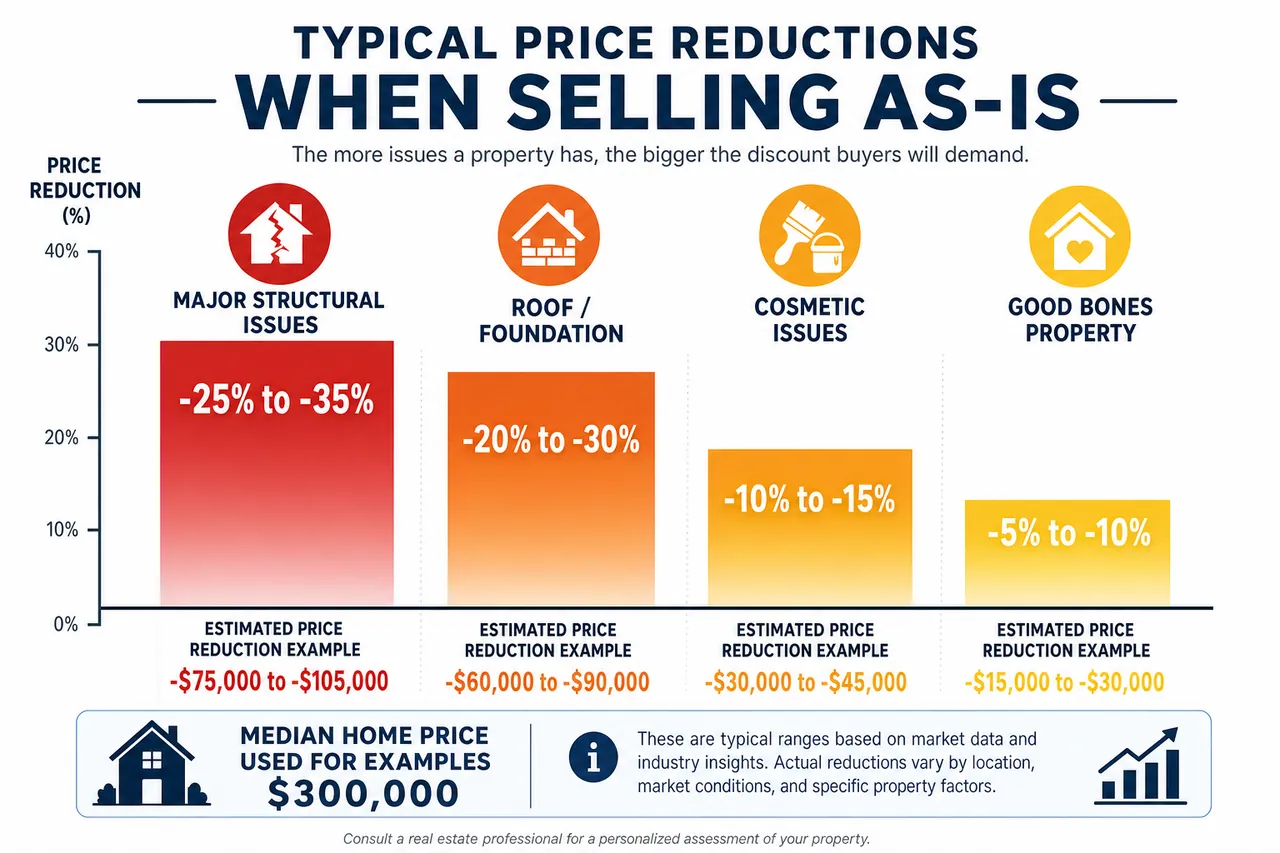

There's no one-size-fits-all answer here. Your actual loss depends on what's wrong with the house, how bad it is, whether buyers in your area are hungry for deals, and who's even willing to make an offer.

Here's what to expect: as-is homes typically sell for 5%–30% below what a fully renovated comparable home would fetch. Cosmetic problems—a dated kitchen, worn floors, peeling paint—sit at the lower end because renovation costs look manageable to buyers. But structural issues, active leaks, outdated electrical systems, or a failing septic? That's where you hit the upper range.
Cash investors and flippers work backward from a number. They figure out what the home's worth after they fix it up, subtract their renovation costs, pocket their profit margin, and that's their offer. And that's why investor and flipper offers typically run 15%–30% below market value (2026). Non-flipper cash buyer programs are usually more generous—somewhere in the 9%–11% below market range—but you're still taking a hit.
Don't forget what a traditional sale actually costs you. As of February 2026, real estate agent commissions average 5.70% of the sale price (roughly 2.88% to the listing agent and 2.82% to the buyer's agent), based on feedback from 533 agents surveyed by Clever Real Estate. On a $400,000 home? That's around $22,800 gone before you even think about repairs, staging, or how long it sits on the market. Many sellers are surprised to realize that after commissions and pre-sale repairs, an as-is cash sale sometimes nets them almost as much as a traditional sale would have.
| Sale Method | Estimated Sale Price (on $400K home) | Typical Costs to Seller | Timeline to Close | Buyer Pool |
|---|---|---|---|---|
| Traditional sale with repairs | $400,000 | Agent commissions (~5.70%) + repair costs + staging | 55 days to offer + 30–45 days to close | Broadest — all buyer types |
| As-is sale (financed buyer) | $340,000–$380,000 (5%–15% discount) | Agent commissions (~5.70%), minimal prep costs | 55+ days to offer + 30–45 days to close | Moderate — excludes FHA/VA buyers |
| As-is sale (cash investor/flipper) | $280,000–$340,000 (15%–30% discount) | Minimal — often no agent or reduced fee | Days to offer + 7–14 days to close | Narrow — investors and cash buyers only |
Commission percentages linked to Bankrate, February 2026; timeline figures from Opendoor/Redfin, March 2026 and Zillow, 2026.
Back to topLegal Considerations and Disclosure Requirements
Here's the thing: this section matters more than you might think. Get your legal obligations wrong when selling as-is, and you could face expensive lawsuits years down the road.
Mandatory Disclosures Still Apply
Every state has its own disclosure laws. But they all say the same thing: you must disclose known material defects even if you're selling as-is. Material defects are problems that would seriously affect the property's value or whether someone can actually live there — think structural damage, water intrusion, mold, pest infestations, faulty electrical panels, or unpermitted additions. An as-is clause doesn't change this requirement.
California, Florida, and Washington? They require extensive disclosures on standardized forms. Other states keep it narrower. If you're selling in Florida, it helps to understand how the appraisal market works in your state. Our guide on how a home appraisal works in Florida walks through the condition-related items that appraisers document and flag in their reports.
What an As-Is Clause Does — and Doesn't — Protect You From
An as-is clause shields you from post-closing demands to fix things the buyer could have spotted based on your home's age and the condition you disclosed. It won't protect you from:
- Fraudulent concealment of defects you knew about
- Failure to complete required disclosure forms
- Active misrepresentation of the property's condition
- Violations of local housing codes that require repair before transfer
Known vs. Latent Defects
Courts draw a line between known defects (things you were aware of) and latent defects (hidden problems nobody could have reasonably discovered). You're typically liable for known defects you didn't disclose. Latent defects that only show up after closing? Those are different. And that's where an as-is clause actually helps you.
Document Everything in Writing
Disclose everything you know. Write it down. Even if you think the as-is clause covers it, put it in writing anyway. Get the buyers to sign and acknowledge they received your disclosures. Keep copies of every inspection report, contractor estimate, and disclosure document. This documentation is your best legal protection.
When You Can't Sell As-Is
Some areas won't let you off the hook. They require specific repairs or certifications before the title transfers — smoke detector compliance, septic certifications, or lead paint remediation in homes built before 1978. Non-negotiable. These apply no matter what your as-is agreement says. Talk to a local real estate attorney before you assume you can pass any defect to the buyer.
Back to topTax Implications of an As-Is Sale
Here's something most sellers don't think about until it's too late: taxes. But there's good news for you if this is your primary residence.
The IRS gives you serious protection through Section 121. Single filers can exclude up to $250,000 in capital gains, and married couples filing jointly get up to $500,000. That's money you don't owe taxes on. The catch? You've got to have owned and used the home as your primary residence for at least 2 of the past 5 years (per 2026 tax year rules).
And here's the thing about selling as-is: it doesn't hurt your tax exclusion eligibility at all. What actually matters is your gain — that's your sale price minus what you paid for it, plus any capital improvements you made. Selling as-is typically means a lower sale price, which means a lower gain, which means less tax you might owe. But if you're an investor or you're selling an inherited property? That's a completely different story. You'll want a tax professional's eyes on this before you close.
Back to topStep-by-Step Guide: How to Sell Your House As-Is
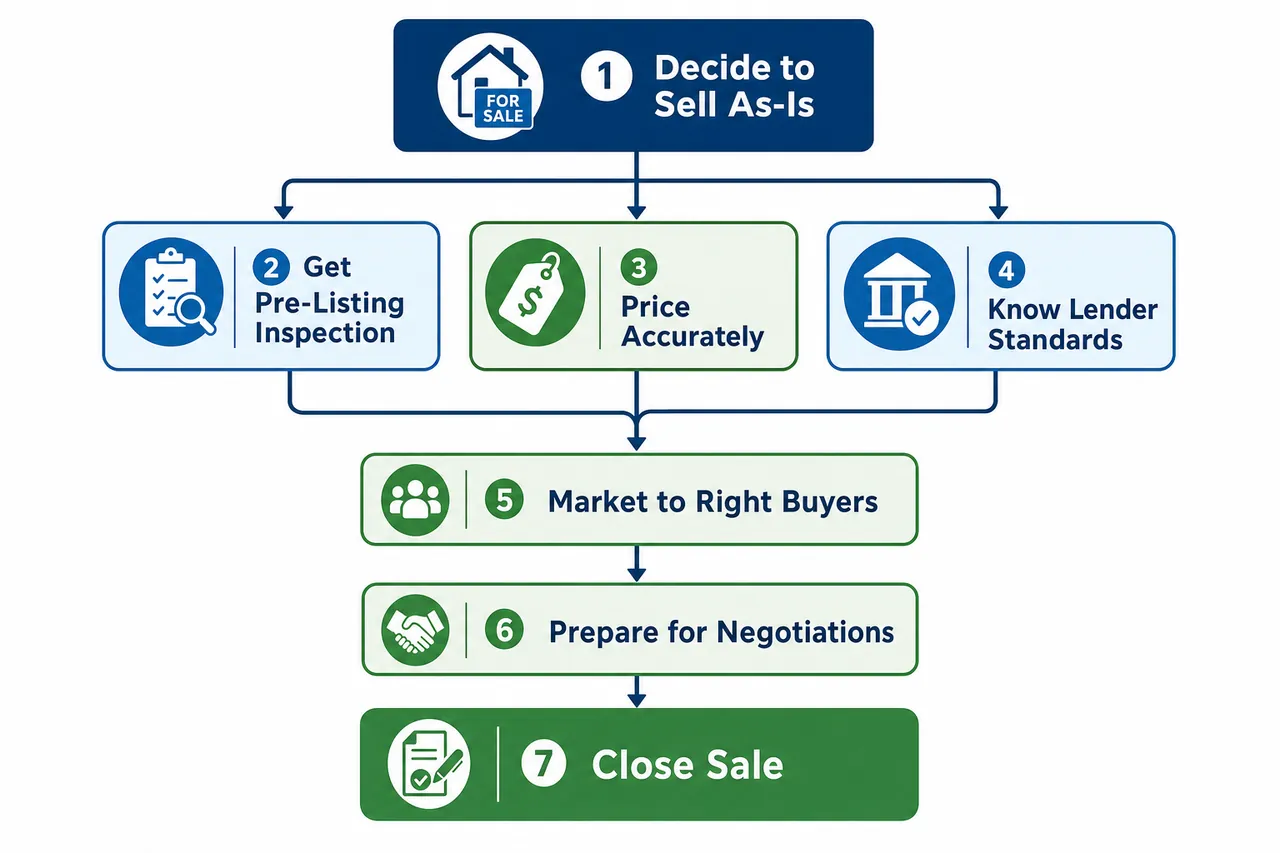
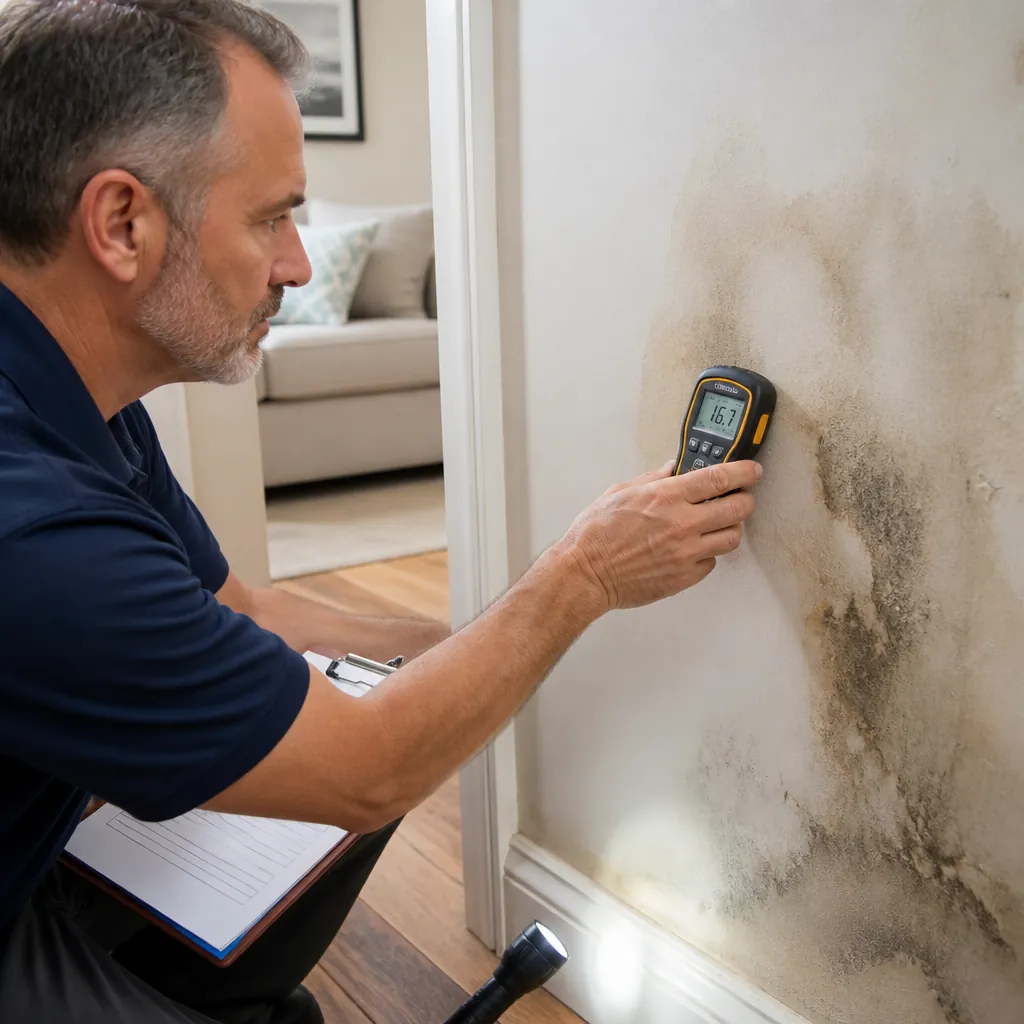
Knowing you want to sell as-is is one thing. Actually doing it well? That's different. Here's the practical roadmap if you've decided an as-is sale makes sense for your situation.
Step 1: Get a Pre-Listing Home Inspection
I get it — paying for an inspection when you're not fixing anything sounds backward. But here's why it matters: you need to know what you're actually selling. An inspection report becomes your negotiating weapon. It tells you exactly what's wrong, helps you price the home realistically, prepares you for what buyers will find, and covers your disclosure obligations. Go in blind and you're inviting post-offer renegotiation when a buyer's inspector uncovers something you didn't mention.
Step 2: Price Your Home Accurately
Pricing an as-is home isn't like pricing a standard listing. You can't just look at similar homes in your area — you need to find comps of other distressed sales in similar condition. Pull those numbers. Then factor in what your specific repairs would actually cost to fix and subtract that from the market value of an updated home. Most as-is sellers overprice. And overpricing kills momentum. Your house sits. Buyers walk past it. And eventually you sell it for less than a properly priced listing would've brought in the first place.
For context: NAR data shows the median existing home sale price at $427,000 in Q1 2026, while Redfin reports the median at $407,730 as of July 2026. Those numbers? They're for homes in move-in condition. Your as-is property needs to price well below comparable updated homes in your neighborhood.
Step 3: Understand Lender Inspection Standards
Planning to accept financed buyers? You need to know what lenders will actually approve. FHA loans require properties to hit minimum standards — that means no peeling paint on pre-1978 homes, railings have to be there, roofs can't be falling apart, and systems have to work. Conventional loans through Fannie Mae and Freddie Mac give you a bit more breathing room, but appraisers will still flag condition issues. Understanding how appraisals work helps you predict where lenders are going to push back hardest.
Step 4: Market Effectively to the Right Buyers
Cash buyers. Investors. House flippers. Developers. That's your audience. List on the MLS, absolutely — but also reach out to local real estate investment groups, post on investor platforms, and contact known cash buyers directly in your area. Your listing language matters too. Use phrases like "investor special," "priced to reflect condition," or "sold as-is with all disclosures provided." This language pre-filters your buyer pool and sets realistic expectations from day one.
Step 5: Highlight Positive Features
Even homes that need work have real selling points. Location. Lot size. Square footage. Good bones. Solid foundation. A great school district. A roof that's only five years old. A newer HVAC system. These things are genuine assets. Professional photos that show potential rather than problems make an enormous difference in buyer interest — even for as-is listings.
And if you're thinking about hosting open houses? Our guide on open house tips for sellers walks through preparation and expectations. Most of that advice works even when you're selling as-is.
Step 6: Prepare for Negotiations
Cash buyers still negotiate. Have your inspection report and contractor estimates on hand. They justify your price with actual evidence. Know your minimum number before talks even start. Decide ahead of time whether you'll cover closing costs and how flexible you can be on closing timeline — sometimes a faster close or flexible date is worth more to an investor than squeezing out another few thousand in price.
Back to topMarketing Tips for As-Is Properties

You don't need to mislead anyone to market well. It's about presenting your property honestly — in the most compelling way possible — to the buyers who actually want it.
Target the Right Buyer Audience
Cash investors, house flippers, and developers looking at teardown or renovation potential? That's your audience. And buyers who specifically hunt for fixer-uppers. These folks move fast. They understand what "as-is" means and won't waste your time asking why the foundation isn't perfect. Find them through local real estate investor associations, online networks, and by reaching out directly to people who've bought distressed properties near you recently.
Be Transparent but Strategic in Listing Language
Transparency isn't just legally required — it's smart business. But here's the thing: you don't start by listing every problem. Lead with strength instead. The location. The lot size. The square footage. The layout. School district? Mention it. Then clearly state that it's sold as-is and priced to match the condition. Something like "Great bones in a prime location — sold as-is, priced to reflect condition" beats a depressing bullet list of everything that needs work.
Use Professional Photography of Strength Features
That dated kitchen? Photograph the natural light flooding through the windows. Is your backyard oversized for the neighborhood? Make sure it's front and center in photos. Good photography isn't about hiding problems — it's about showing potential and value, even when a home needs serious work.
Emphasize Potential and Comparable After-Renovation Values
Investors live and breathe after-repair value (ARV). Show them comp data. Pull up what similar, updated homes in your neighborhood are actually selling for. You're not inflating anything. You're speaking their language and helping them see the upside that justifies their renovation investment.
Alternative Sale Channels
Don't limit yourself to the MLS. iBuyer platforms exist. Direct home buying companies too. Auction services. When speed matters more than squeezing out every last dollar, programs like KDS Homebuyers' We Buy Houses service close in days with zero agent fees and no repair requirements. It's worth understanding as one option alongside traditional channels when you're weighing your exit strategy.
Back to topAlternatives to Selling Completely As-Is
Selling as-is isn't all-or-nothing. You've got options between a complete gut renovation and doing absolutely nothing. Strategic partial fixes often beat either extreme.
Strategic Repairs: Fix the Big-Ticket Items Only
Not all repairs move the needle equally. A roof that's recently certified, an electrical panel that passes code, and an HVAC system that actually works? Those are the three things that kill deals for financed buyers. Fix those three, and you'll suddenly have access to a much bigger buyer pool. You won't need to spend money on paint, new counters, or other cosmetic stuff that barely moves the needle on price.
Seller Concessions Instead of Repairs
You don't have to fix anything yourself. Instead, offer a credit at closing—let the buyer handle repairs after they own the place. This keeps you out of the contractor coordination headache. And here's the thing: buyers often feel better about a $10,000 credit than a $10,000 price cut, even though they're mathematically identical.
Price Reduction vs. Repair Tradeoffs
Here's the math you need: skip repairs that cost more than they'll add to your sale price. Do repairs that cost less. A $2,000 paint job adding $5,000? Worth it. A $35,000 kitchen adding $25,000? Skip it. Run the numbers before you write any checks.
Negotiating Inspection Contingencies
You can accept an inspection contingency while staying as-is. Just specify upfront that you won't make repairs—only offering a fixed dollar credit for anything serious. Buyers get peace of mind. You avoid endless negotiation. This middle-ground approach works especially well on moderately distressed properties.
Back to topIs Selling As-Is Right for You?
It depends on your situation. Let's walk through a framework to figure this out together.
Questions to Ask Yourself
- How severe are the issues? Cosmetic problems? You might fix a few things and list traditionally. Structural damage or systems that are failing? As-is makes more sense.
- What's your timeline? Need to close in 30 days or less? As-is with a cash buyer is probably your only realistic option.
- Do you have the capital for repairs? If the answer's no, as-is isn't just an option — it's often your only realistic path forward.
- What's your local market doing right now? Strong seller's market? Even distressed homes get competitive offers. Soft market? The as-is discount can hit hard.
- What matters more to you — net proceeds or certainty of sale? As-is gives you certainty. Traditional sales maximize proceeds. But they don't guarantee them.
Decision Framework
Answer yes to two or more of these, and an as-is sale is probably your best move: (1) You need to close within 45 days. (2) Repair costs will run over $25,000. (3) You can't pay for repairs out of pocket or via a bridge loan. (4) The property is inherited, or you don't have emotional skin in the game around price. (5) Your market is soft and homes are sitting for 60+ days.
None of those describe your situation?
And your home mostly needs cosmetic work? Then a focused repair strategy before listing will almost certainly put more money in your pocket — even when you factor in repair costs and agent commissions.
Life circumstances like paying for long-term care shift the equation. Our resource on selling your house to pay for long-term care walks through those specific trade-offs.
Your state matters too. Understanding how home appraisals work in California or in Washington helps you predict whether an as-is price will hold up when a lender gets involved. Both states have strong investor markets, but they also enforce strict disclosure rules that can complicate things.
Back to topConclusion
Selling a home as-is isn't failure. It's a smart, practical strategy — a calculated trade-off where you accept a lower price to gain speed, certainty, and freedom from repair costs. Want to make it work? You'll need three things: understanding the real discount (typically 5%–30% below market), meeting your disclosure obligations completely, and pricing honestly from the start. Don't bank on traditional buyers overlooking major problems. Target the ones who actually want as-is properties.
And here's what separates winners from regretters: going in prepared. Get a pre-listing inspection done. Know your realistic price. Have your disclosure paperwork locked down. Be clear-eyed about what you're optimizing for — usually speed and certainty over maximum profit. That's not settling. That's strategy. With those boxes checked, an as-is sale can actually be clean, fast, and financially sound even when circumstances feel impossible.
Back to topFrequently Asked Questions
Do I have to disclose known problems even if I'm selling as-is?
Yes. You're legally required to disclose known material defects in virtually every U.S. state — no matter what your listing says. Here's the thing: an as-is clause means you won't fix the issues. It doesn't mean you can hide them. Skip disclosure, and you're opening yourself up to fraud claims and lawsuits that could chase you long after you've closed.
Can buyers back out after an inspection on an as-is sale?
It depends entirely on what your contract says. Most purchase agreements include an inspection contingency, which gives buyers the right to walk away during that period — and yes, that includes as-is homes. Want to protect yourself? Some sellers require buyers to waive inspection contingencies upfront. The downside? You'll attract fewer serious buyers. Another option: allow the inspection but make it clear there's no renegotiating afterward. Whatever approach you take, have a real estate attorney review your contract language first.
Can I sell a home as-is if it has a pest infestation or mold?
Yes,
Back to topMore in Selling as-is and repairs
- Sell My House As Is for Cash: Fast Sales Without Repairs
- Sell Your House As-Is or Fix It Up? Cost-Benefit Analysis and Best Path
- Sell House for Cash in Austin: Fast & No Repairs Needed
- Selling a House As Is: Real Seller Experiences and Strategies
- Selling a House As-Is: Pros, Cons, and Whether It's Right for You
- Sell House As-Is Where-Is: What This Means and How to Price It
See our guide: “How to Sell a House As-Is: What It Means and How It Works” →

