

How to Sell a House When One Partner Refuses: Your Legal Options

Table of Contents
- Understanding the Legal Framework
- Why Partners Refuse to Sell
- Negotiation and Communication Strategies
- Financial Options and Buyout Solutions
- Legal Remedies and Court Options
- Options Comparison: Choosing Your Path
- Practical Steps to Move Forward
- Dealing with Sabotage and Non-Cooperation
- Alternative Solutions Beyond Sale
- Your Realistic Range of Outcomes
- Conclusion
- Frequently Asked Questions
Selling a shared home when one partner won't budge? It's one of the messiest situations you can face — legally and emotionally. Maybe you're divorcing, separating, or just can't agree on timing. The good news: there are real legal solutions. The catch: what works depends on how the deed is written, which state you live in, and how aggressive you're willing to be. This guide covers every realistic option, from having a calm conversation to asking a court to force a sale through partition. You'll find the path that actually fits your circumstances.

Understanding the Legal Framework
Start here. Before you can make a move, you need to understand the legal foundation beneath your feet. How your home is titled — and what your relationship status is — determines almost everything about what you can and can't do unilaterally.
Married vs. Common Law Partners
Married couples have the clearest rights and obligations around shared property. When divorce proceedings happen, courts can order the sale of a marital home, divide the proceeds, and make sure both parties comply. Common law or unmarried partners? They've got fewer automatic protections under most state laws. This cuts both ways: one partner might have more power to force a sale, but the other also has fewer ways to block it — it all depends on how the deed is written.
You're in a common law relationship with both names on the deed? Then property law, not family law, governs your situation. The remedies available to you — and how long it actually takes to reach resolution — will look very different from a formal divorce proceeding.
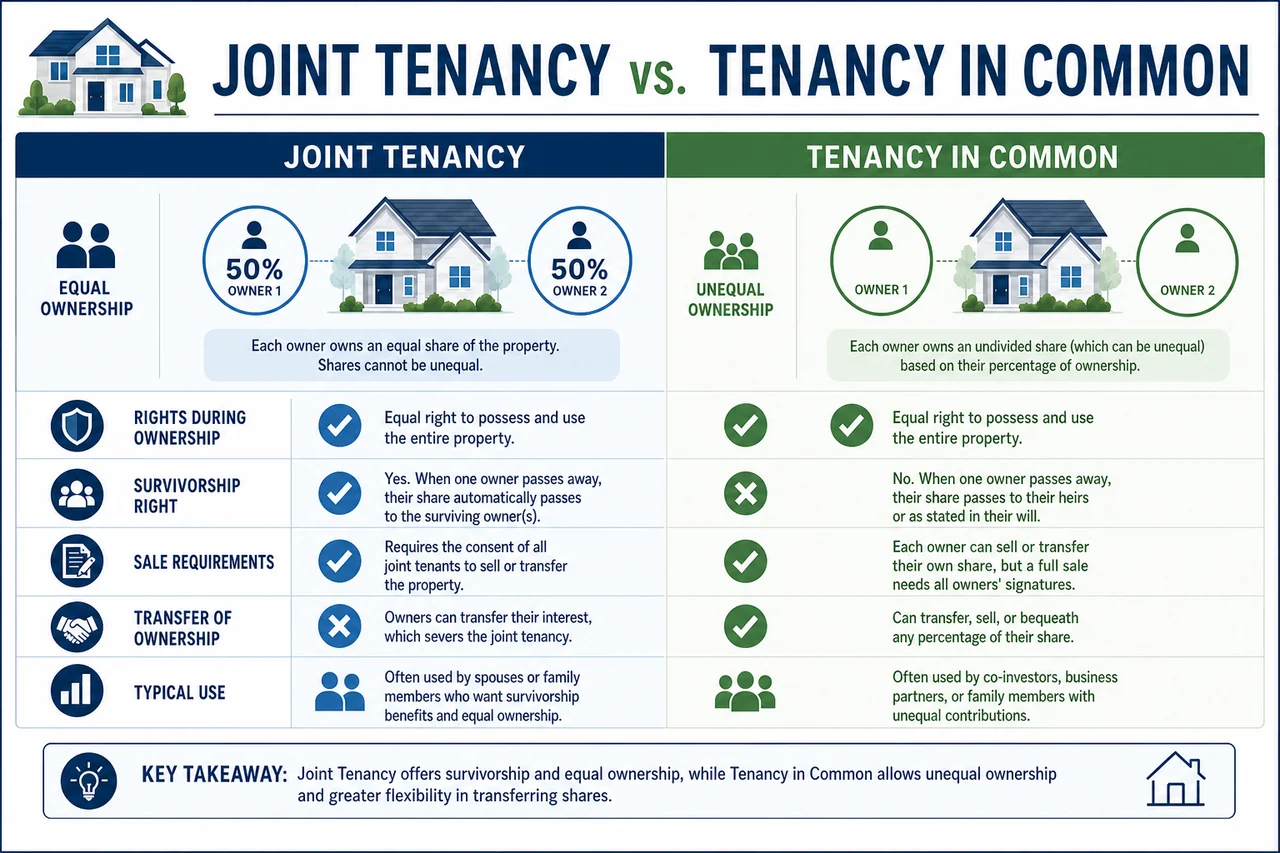
Joint Tenancy vs. Tenancy in Common
These two ownership structures have dramatically different outcomes when one person won't agree to sell.
A joint tenancy means both owners hold equal, undivided shares in the entire property. And there's a right of survivorship — the surviving owner automatically inherits the other's share when they pass away. Neither owner can sell the property or their share without the other saying yes. This protects a refusing partner completely, but it also locks up the partner who wants to sell.
A tenancy in common works differently. Each owner holds a defined percentage interest, and those percentages don't have to be equal. Here's what matters: each owner can theoretically sell or transfer their own interest without permission from the co-owner. But here's the catch — no rational buyer will want to become a co-owner with a stranger, so a full sale still needs both signatures. When you're ready for legal action, tenancy in common owners have an advantage: they can bring a partition action more easily (we explain that below).
| Feature | Joint Tenancy | Tenancy in Common |
|---|---|---|
| Ownership shares | Equal and undivided | Can be unequal; separately defined |
| Right of survivorship | Yes — survivor inherits automatically | No — interest passes through estate/will |
| Can one owner sell their share? | Generally no without severing tenancy | Yes, in theory — but impractical |
| Consent needed to sell whole property | Yes, from all owners | Yes, from all owners |
| Partition action available? | Yes, severs joint tenancy first | Yes, often easier to bring |
| Death of one owner | Other owner inherits entire property | Deceased's share goes to their heirs |
Matrimonial Home Protections
Many states treat the family home as special property during marriage or separation. Even if only one spouse's name is on the deed, the other spouse often has a protected right to live there and must consent before any sale happens. These "matrimonial home" or "homestead" protections exist in different forms across the country. They mean a sole title owner can't just sell — they need spousal consent or a court order. You're dealing with this situation in a specific state? Resources like what to do when your spouse refuses to sell in Florida or California's specific rules can walk you through the local requirements.
Title Ownership and Its Impact
Your name alone is on the title and the home isn't protected as a matrimonial property? You generally have stronger legal authority to move forward with a sale — though you might still run into problems if your state considers it marital property under equitable distribution laws. Both names on the deed? Then no unilateral sale is possible. Your first essential step is getting the deed itself and reading exactly what it says.
Back to topWhy Partners Refuse to Sell

Your partner's reasons matter. Really matter. Because each one demands a completely different response, and pushing harder without understanding what's actually driving the "no" will almost always make things worse.
Emotional Attachment and Home Identity
This house isn't just real estate to them. It's where the kids came home from the hospital. Where you celebrated anniversaries. Where memories are literally baked into the walls. A partner refusing to sell might be grieving — not just the relationship, but an entire chapter of their life. And selling the home? That feels like admitting it's all really over. Pressuring them without acknowledging that emotional weight almost always backfires.
Financial Concerns and Equity Distribution
They're scared. Scared they'll get shortchanged in the split, that after the mortgage is paid off and the costs come out, they'll be left with nothing. These fears deserve real answers, not reassurance. Get a professional appraisal. Pull together clear numbers on what the mortgage balance actually is. Show them, in writing, exactly what each of you walks away with. Numbers kill arguments.
Housing Stability for Children
When kids are in the picture, this becomes powerful. Your partner wants them staying in the same school. In familiar neighborhoods. They want something stable while everything else is falling apart — and honestly? Judges agree with this argument. Courts regularly delay or restrict forced sales when minor children are living in the home.
Market Timing and Property Value Concerns
Sometimes it's not stubbornness at all. Sometimes your partner genuinely believes waiting six months means a bigger check. Maybe they think local market conditions are about to shift. With a June 2026 median existing-home price of $408,776 holding relatively steady nationally, the market hasn't collapsed — but local markets tell different stories. Your partner might actually be right about your neighborhood's timing. Do the research before you dismiss their concern.
Control and Power Dynamics
And then there's this. In really contentious splits, refusing to sell has almost nothing to do with the house. It's about control. About keeping you in contact. About winning. Recognizing this pattern early matters because no spreadsheet will change their mind. No amount of logic. These situations need lawyers.
Back to topNegotiation and Communication Strategies

Litigation is expensive. It's slow. And it damages everyone involved. Before you go that route, try genuine negotiation—and make sure you document it. Here's why: courts actually favor the person who made reasonable attempts to settle things before suing.
Starting the Conversation Right
First, pick the right moment and place. Don't dive into this conversation while you're already fighting about something else. Instead, frame it around what you both actually need: "We both want financial clarity and a real path forward. What does that look like from your side?" Skip the ultimatums early on. They just make people defensive and shut down any real dialogue.
Understanding Your Partner's Perspective
Ask them what specifically worries them about selling. Then—and this matters—listen without jumping in to argue. You might discover their real concern is something totally different from what they said at first. Maybe they're afraid of where they'll live. Maybe they need more time to save money for a down payment somewhere else. The actual problem and the stated problem aren't always the same thing.
Finding Common Ground
What would it take for them to say yes? A higher listing price. A specific timeline. A clear agreement on how you split the proceeds. Even offering financial help as they find a new place can unlock a deal. Even a partial agreement—"we list in six months at this price"—gets you somewhere. Put it in writing.
When to Bring in Professional Mediators
If you two can't talk anymore, bring in a mediator. These are usually retired judges or attorneys trained in dispute resolution. You'll get productive dialogue for a fraction of what litigation costs. It's confidential. Nothing's binding unless you both actually reach an agreement. And most cases wrap up in days or weeks, not months dragging on. Many family law attorneys won't even file certain motions without evidence that you tried mediation first. Dealing with this in a divorce? Check your state's rules—they matter a lot. See the details on Tennessee and Washington state to understand how local law shapes what happens next.
Back to topFinancial Options and Buyout Solutions

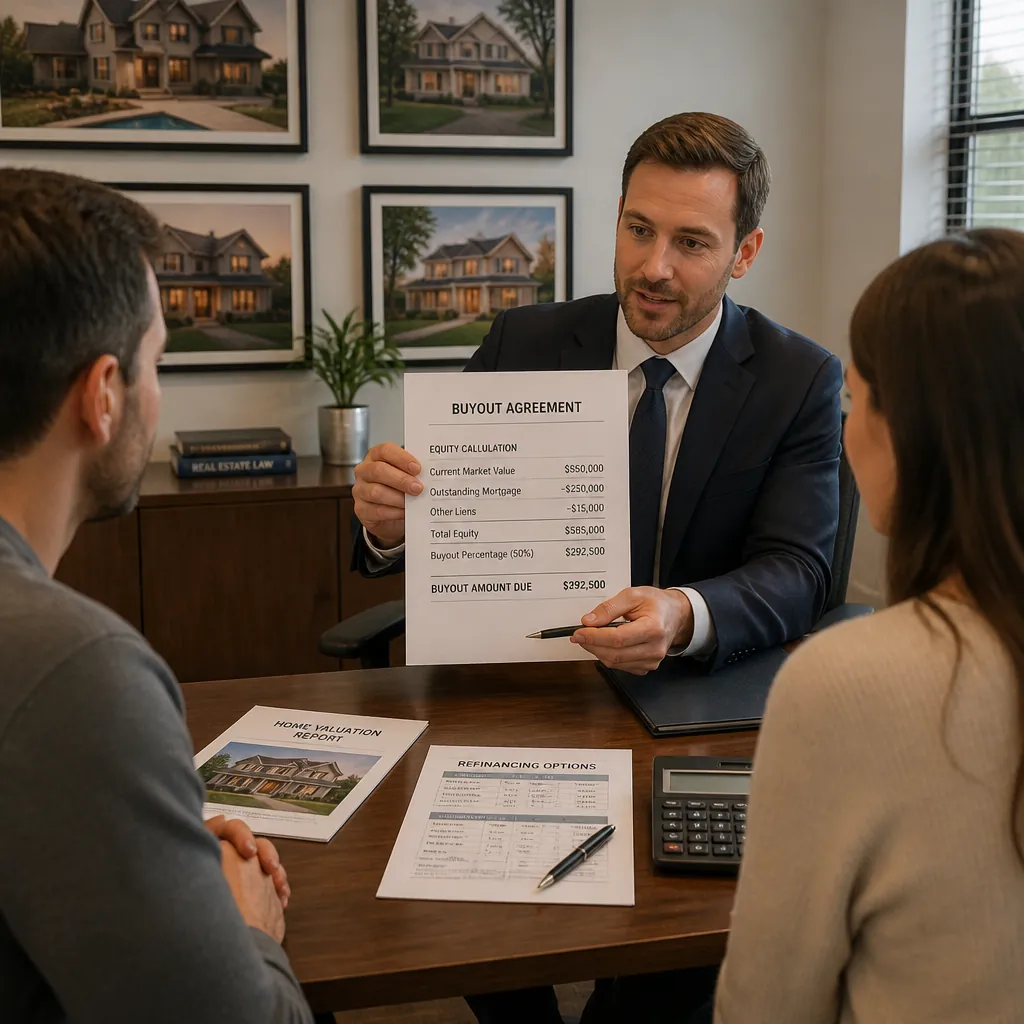
Here's the thing: sometimes you don't actually need to sell. A buyout can be the answer. One partner buys out the other's equity share, and suddenly you've got individual financial freedom instead of a deadlocked property.
Co-Owner Buyout Process
Here's how it works. One partner purchases the other's equity stake in the home. The buying partner refinances into a new mortgage in their name only, pays off the joint mortgage, and compensates their co-owner for their equity share. You transfer the title to the sole remaining owner. But here's the catch — the buying partner has to qualify for financing on their own income, credit, and the lender's current requirements.
How to Calculate Buyout Price
The math isn't complicated, though disagreements about value sometimes are:
- Get an independent professional appraisal of the home's current market value
- Subtract the outstanding mortgage balance to determine total equity
- Multiply total equity by each partner's ownership percentage
- The buying partner pays the departing partner their equity share
Let's say your home appraises at $410,000. Your mortgage balance sits at $210,000. That's $200,000 in total equity. Split it 50/50, and each of you gets $100,000. The partner staying would refinance into a larger loan and pay the leaving partner $100,000 to make the buyout happen. And if either of you disagrees on the home's value? Get separate appraisals. Courts will order one anyway if this ends up in litigation.
Financing a Buyout
Cash-out refinancing is your go-to method. The buying partner refinances the home for more than what's owed, uses the extra cash to pay off the joint mortgage and cover the buyout, then refinances everything into their name. This only works if they qualify on one income. Call a mortgage lender early — don't wait. You need to know what you can actually borrow before you commit to anything.
Asset Swaps and Alternative Arrangements
Tight on cash? A buyout doesn't have to be all cash. You could swap assets instead — one partner keeps the house, the other takes the investment account or retirement savings of equivalent value. But don't do this without professional help. Different assets have different tax bases and future liabilities. Talk to a tax professional and financial advisor before finalizing any asset swap.
Tax Implications of Buyouts and Sales
Capital gains tax matters whether you sell or do a buyout. Under IRS Section 121, you can exclude gains if you've owned and used the property as your primary residence for at least 2 of the last 5 years. That's $250,000 for single filers or $500,000 for married couples filing jointly in the 2026 tax year.
Any gains above those limits get hit with long-term capital gains rates — 0%, 15%, or 20% depending on your income bracket. For 2026, the 0% rate applies if you're single with income under $49,450 or married filing jointly with income under $98,900. Higher earners, watch out — the 3.8% Net Investment Income Tax kicks in when your MAGI hits $200,000 (single) or $250,000 (married filing jointly).
And if this becomes a forced sale or one partner moves out? You might lose part or all of that Section 121 exclusion. That's another reason to settle things before you cross that 2-of-5-year threshold.
Back to topLegal Remedies and Court Options
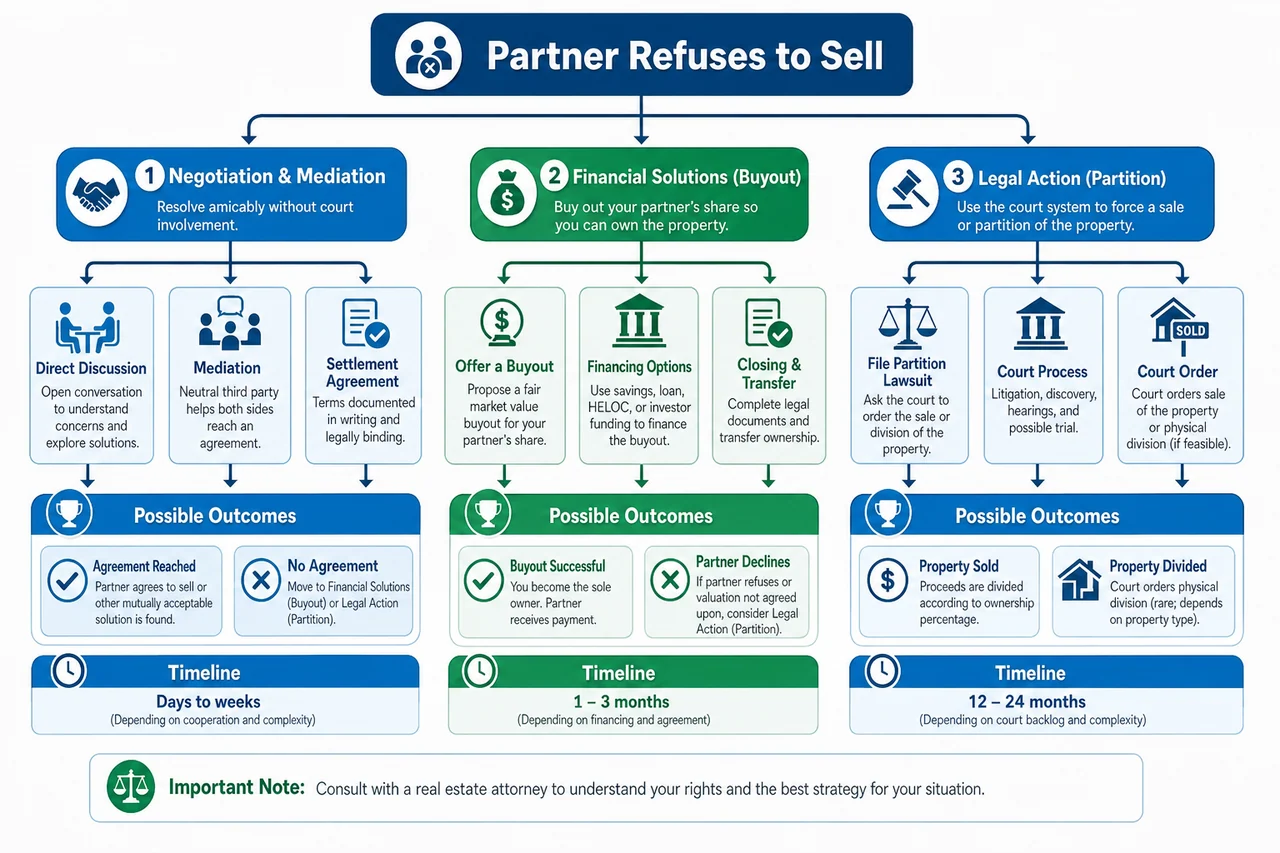
Negotiation's fallen through. A buyout isn't happening. At this point, you're looking at legal action to move forward. The main tool you'll use is called a partition action — it's how one co-owner forces a resolution when you can't agree. If you're married, divorce proceedings can sometimes get you there faster.
Partition Actions Explained
Think of a partition action as a lawsuit filed by one co-owner that asks the court to divide the property — or sell it and split the money. You don't need permission from the other co-owner to file. That's the power here. Courts tend to grant these requests because they solve real deadlocks, and in most states, your right to partition is basically ironclad if you hold title to the property. Want specifics for your state? Check out our guides for Colorado or Indiana.
Partition in Kind vs. Partition by Sale
The court gets to pick one of two approaches:
- Partition in kind: The property gets physically divided between you. Rarely happens with a house. You can't exactly cut a home in half without tanking its value, so courts only order this when the land can actually be split meaningfully.
- Partition by sale: This is what you'll almost always see with residential homes. The court orders the sale — either through a court-supervised process or a regular listing — and splits the money based on who owns what percentage. Your co-owner can't stop it once a judge orders it.
Court-Ordered Sales in Divorce
During divorce, the family court judge has real power here. They can order the marital home sold as part of the property division. Once that order is in writing, both of you have to follow it. Refusing to sign paperwork, sabotaging showings, or blocking the sale? That's contempt of court. And contempt comes with teeth — fines, jail time, the works.
Forced Sale Timelines and What to Expect
This isn't quick.
Most partition lawsuits drag on for 12 to 24 months — you're waiting for filing, service, discovery, possibly mediation, and then the judge to get to your case. Uncontested cases with reasonable people can move faster. Bitter fights with appeals? You're looking at the long end. Budget accordingly, and don't file a partition action as a scare tactic. Courts know the difference, and judges notice when you're not serious.
And here's something that matters if you inherited the home: Over 25 states plus D.C. now have the Uniform Partition of Heirs Property Act (UPHPA), which gives extra protections to co-owners who got the property through an estate.
Cost and Complexity of Litigation
Partition litigation gets expensive fast. You're typically looking at $10,000 to $45,000 or more in total costs — attorney fees, court fees, the whole package depends on how messy the case gets. A straightforward case? Expect $10,000 to $30,000 in attorney fees alone. Most lawyers bill between $250 and $500 per hour, and court filing fees vary by location — Florida charges around $400 to $500 just to file. Here's the kicker: these costs come straight out of what you get when the house sells, so you're splitting a smaller pot.
| Cost Component | Low Estimate | High Estimate | Notes |
|---|---|---|---|
| Court filing fee | $400 | $500+ | Florida example; varies by state |
| Attorney fees (total) | $8,000 | $40,000+ | At $250–$500/hr; complexity-dependent |
| Professional appraisal | $400 | $800 | Often required by court |
| Mediation (if ordered) | $1,500 | $5,000 | Per day; split between parties typically |
| Total range | $10,000 | $45,000+ | Contested cases trend toward higher end |
Options Comparison: Choosing Your Path
You'll want to see how your options stack up before you decide. The catch? Every path trades off time against money, and cooperation against conflict. Not all of them require your partner to agree.
| Option | Typical Timeline | Estimated Cost | Conflict Level | Cooperation Needed? |
|---|---|---|---|---|
| Negotiated sale | Weeks to months | Low (agent commissions only) | Low to medium | Yes — both must agree |
| Buyout by one partner | 1–3 months | Low–medium (refinancing costs) | Low to medium | Yes — both must cooperate |
| Mediation | Days to weeks | Low–medium ($1,500–$5,000) | Medium | Yes — both must participate |
| Partition action | 12–24 months | High ($10,000–$45,000+) | High | No — court can compel |
| Rental arrangement | Ongoing | Low (management costs) | Low to medium | Yes — both must agree |
| Divorce court order | Months to years | High (divorce legal fees) | High | No — court can compel |
Practical Steps to Move Forward
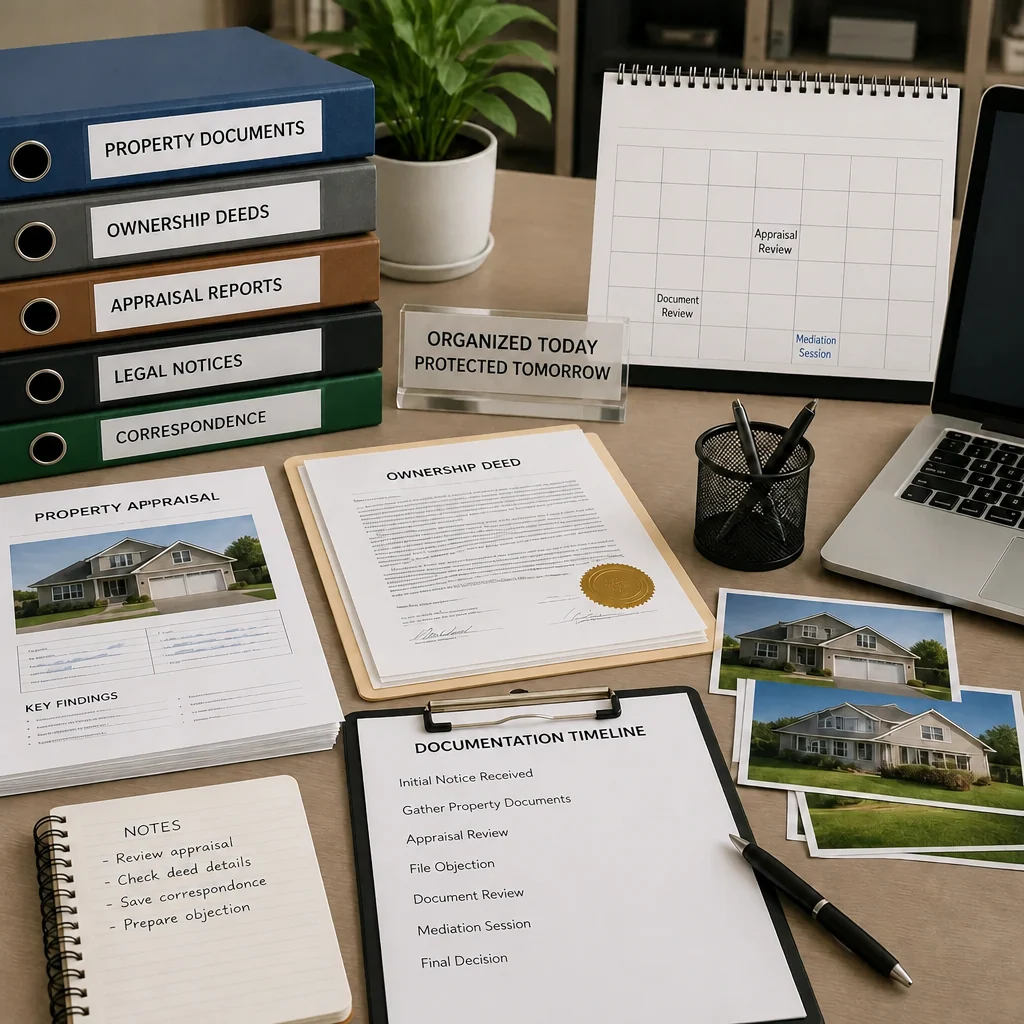
Here's what matters most: being organized, documented, and informed. Attorneys, mediators, and judges take you seriously when you show up with your ducks in a row.
Step 1: Get Professional Valuations
Hire a licensed appraiser. This gives you an objective number — not a guess. If you and your co-owner disagree on what the house is worth, each of you can get a separate appraisal and split the difference. A court will order one if you can't agree. But here's what you shouldn't do: rely on Zestimates or casual estimates when legal money is on the line.
Step 2: Understand Your Jurisdiction's Laws
Property law isn't the same everywhere. Your state might presume you have a right to partition — or it might require you to prove specific factors first. Matrimonial home protections differ wildly. Divorce laws too. Before you make any formal moves, talk to a local real estate attorney — not a generalist, a real estate specialist. That first consultation fee is cheap insurance. Want to dig deeper? Check out our guide on spouse refusal situations and look for jurisdiction-specific articles for your state.
Step 3: Document Everything
Write it down. All of it.
Save text messages and emails. When you have a phone conversation, note the date, time, and what was discussed. If your co-owner refuses a showing, won't sign documents, or takes items out of the house — document that too. You're building two things here: a legal record that protects you, and evidence that you tried to work things out before heading to court.
Step 4: Choose Your Approach
Think about what's actually blocking the sale. Is your partner emotionally attached? Mediation often works there. Is the problem money — as in, they can't afford to move or they want a bigger share? A buyout might solve it. Are they just throwing up obstacles for no real reason? Time to call a partition attorney while you keep trying to negotiate in writing. Your choice here determines both your timeline and how much this costs everyone involved.
Step 5: Execute and Monitor
Don't drift. Stay sharp.
Listing the house? Be ready to show it on notice. In mediation? Come prepared. Working with a partition attorney? Hit every deadline they give you. Every delay costs money and extends pain for both sides.
Back to topDealing with Sabotage and Non-Cooperation
A refusing partner might go beyond simply saying no. They could actively block the sale. You need to know what that looks like and what you can actually do about it.
Recognizing Deliberate Obstruction
Watch for these red flags: refusing to let showings or inspections happen, blocking listing agreements or purchase contracts, removing or damaging fixtures, bad-mouthing the property to potential buyers, or ghosting you entirely. These aren't just frustrating — they can constitute bad faith conduct under the law, and each one carries different legal weight.
Refusing Access for Inspections
You've got a court order for the sale. Your ex won't let inspectors, appraisers, or buyers' agents inside? That's contempt of court. Document everything. Send time-stamped written requests every single time you need access. Your attorney takes these denials straight to the judge, who'll typically issue a tougher compliance order — or hit them with sanctions.
Legal Consequences of Non-Compliance
Courts take obstruction seriously.
A partner who refuses to comply with a sale order faces civil contempt findings, monetary sanctions, and attorney fees paid to you. And in extreme cases? Incarceration until they cooperate. Some judges appoint a receiver or commissioner who can sign documents instead of the non-compliant owner, which cuts them out of the process entirely.
Documenting Non-Cooperation for Court
Write everything down. Even if they refuse to communicate in writing, follow up any conversation with an email recapping what was said and what you asked for. Keep a dated log with specific times and incidents. When they see you're tracking it all, the dynamics shift — and judges absolutely notice when one party keeps detailed records. This paper trail changes everything in negotiation and mediation.
Back to topAlternative Solutions Beyond Sale
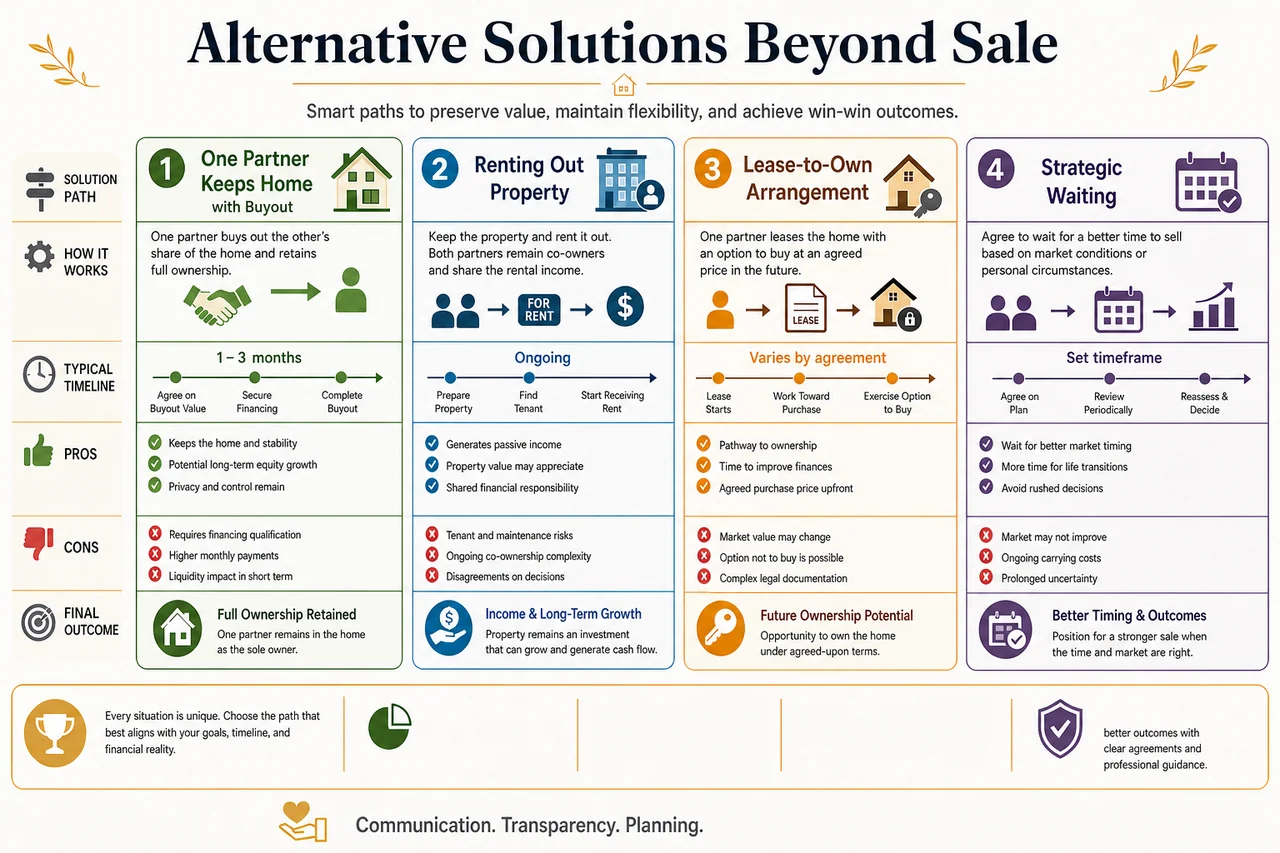
A forced sale isn't your only option—even when you have the legal right to one. What often works better? Finding a solution that lets both of you get what you actually need without the legal fees, stress, and years of fighting that comes with court battles.
One Partner Keeps the Home (Buyout)
The buyout is straightforward. One person buys out the other's share, keeping the house, and the departing partner walks away with cash. It's usually the cleanest outcome, especially if there are kids involved. But here's the catch: the person staying has to qualify for a mortgage on their own. With today's lending standards, that's not always realistic—even if you could've qualified together.
Renting Out the Property
Neither of you can afford to buy the other out? Both need breathing room? Turn it into a rental. You'll generate monthly income while you figure out your next move. The real requirement here is that you actually get along well enough to make decisions together—about hiring a property manager, splitting the rent checks, how long this lasts, and what happens when one of you wants out for good. Write it down. Both sign it. Have a lawyer look it over if you can.
Lease-to-Own Arrangements
One person stays in the house as a tenant, pays rent to the other owner, and has a set window to buy it outright.
This works when one partner needs time to save money or rebuild their credit score. The person leaving gets monthly income today instead of waiting for a future sale. The downside? These deals are complicated. They have to be drafted carefully to actually hold up in court if things go sideways.
When Waiting May Be Strategic
Markets cycle. If your neighborhood is soft right now—and you both genuinely agree that waiting makes sense—a written agreement to revisit the sale in a set timeframe (90 days, six months, a year) can keep you out of court while keeping your options open. But don't do this handshake-style. Get it in writing. Include an asking price or a formula for setting one. And spell out exactly what happens if either person balks when the deadline arrives.
You might also be juggling bigger money problems alongside the ownership fight. If you're struggling to carry the mortgage alone, or you're facing bankruptcy, you're not the first person in this spot. Check out our guides on selling after a job loss or selling before bankruptcy—they address the pressure to move fast.
Back to topYour Realistic Range of Outcomes
Let's be honest. Most home sale disputes between partners never actually make it to a courtroom. You'll see the same outcomes pop up over and over, and here they are in rough order of how often they happen:
- Negotiated agreement — Your attorneys talk it out on your behalf when you two can't sit in the same room anymore
- Mediated settlement — A neutral third party facilitates one to three sessions, and you walk out with a written agreement on price, timeline, and how the money gets split
- Buyout — One of you buys out the other's share. Done. No sale, no drawn-out process
- Court-ordered sale in divorce — The family court judge includes the home sale right in your divorce decree
- Partition action judgment — This is rare because most cases settle before it gets here, but it's your absolute last resort if nothing else works
Which path you end up on? That hinges on whether your partner actually wants to move forward and how much you're willing to spend getting there. And here's something practical: if you're just starting this process and want a real picture of your selling options — traditional listing, cash offer, the whole range — KDS Homebuyers' seller programs can show you a side-by-side comparison of what's actually realistic for your house. That's useful ammunition when you're negotiating with a reluctant partner about what a sale could actually bring in.
Back to topConclusion
How do you sell a house when your co-owner won't budge? It's genuinely hard — legally, financially, and emotionally. But here's the thing: you aren't without options. Patient negotiation works for some situations. Professional mediation helps others. And when those fail, partition actions and court-ordered sales exist as real remedies. The legal system's got your back.
Start with the least expensive approach first. That means negotiation before mediation, mediation before lawyers, lawyers before court. Document everything — every conversation, every offer, every refusal. Your state's laws matter hugely here, so don't skip understanding what applies to you specifically. Then escalate methodically if earlier attempts fail.
Get professional guidance. You don't have to navigate this alone. With the right preparation and expert help, even the most entrenched disputes reach resolution.
Back to topFrequently Asked Questions
Can I force my partner to sell the house if both our names are on the deed?
Not right now. Not on your own. But here's the thing — you do have options down the line. If your partner won't budge on selling and both names are on the deed, you can file what's called a partition action in court. Courts can actually order a sale of jointly owned property even if one owner fights it tooth and nail. The
Back to top
