

How to Sell a Condemned House: Options When Your Home Is Unsafe
Table of Contents
- What's a Condemned House?
- Can You Actually Sell a Condemned House?
- Disclosure Requirements When Selling a Condemned House
- Financial Obstacles: Liens and Costs
- Who Can Buy a Condemned House?
- Step-by-Step Guide to Selling a Condemned House
- Selling Options: As-Is vs. Renovation
- Working with Real Estate Professionals
- State-Specific Considerations
- Special Situations: Tenants and Occupancy
Your home's been condemned. That red placard on the door, the official notice, the total uncertainty about what happens next — it hits hard. You might feel trapped, like there's no way out. But here's the thing most homeowners don't realize: condemnation doesn't take away your ownership rights, and yes, you can still sell. Sure, it's messier than selling a normal house. Yet thousands of condemned properties trade hands every single year. Cash buyers, investors, specialized companies — they all buy these homes. This guide shows you exactly how to do it. Legally. Efficiently. And keeping as much money as you possibly can.
Selling a house that needs work? Start with our guide to selling a house as-is. It explains what as-is means, how pricing works and every way to sell a house with problems.
What's a Condemned House?
Definition and Legal Meaning
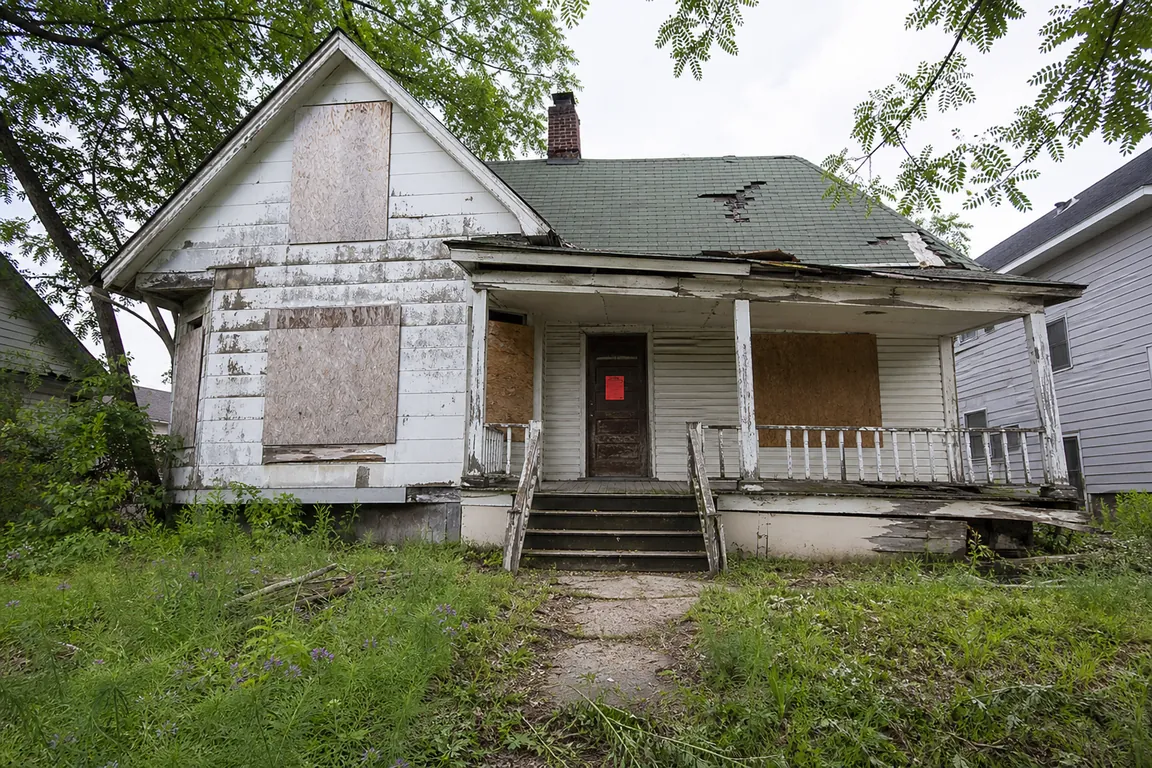
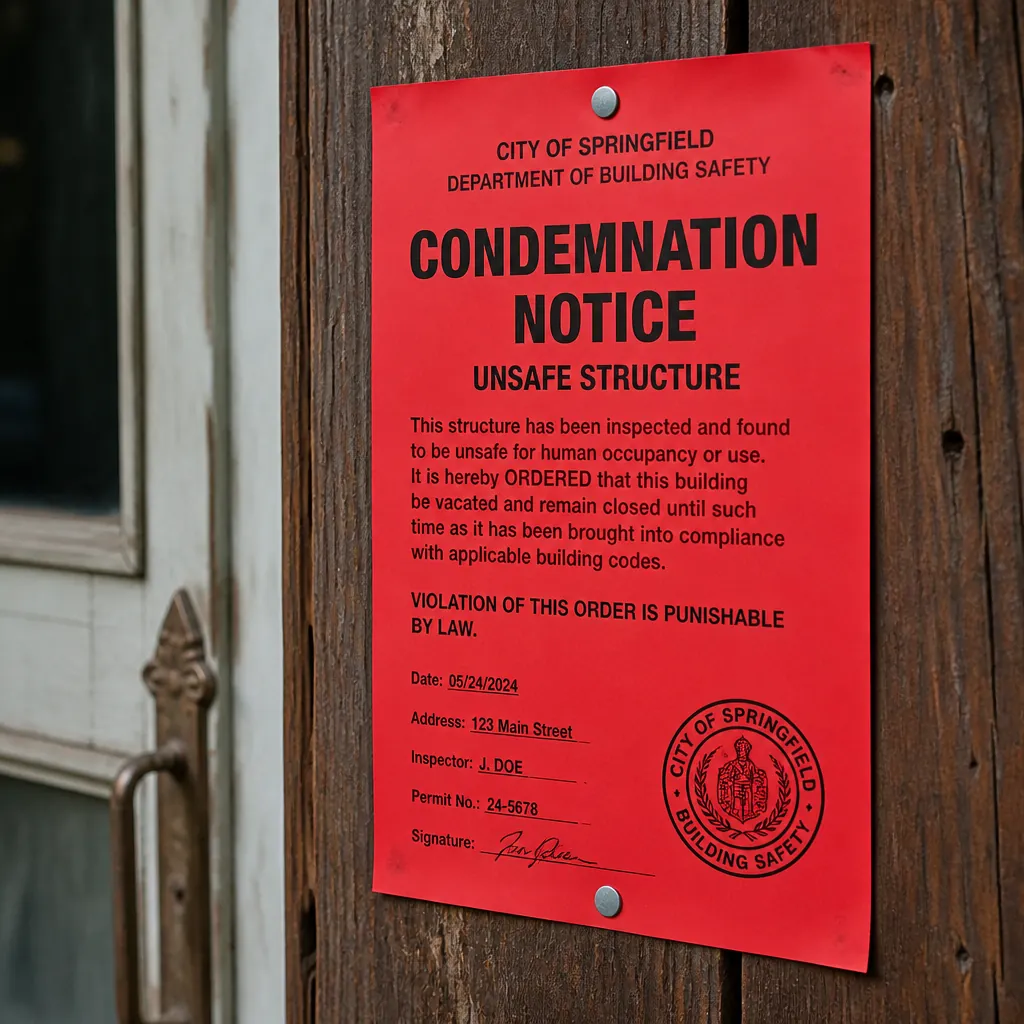
Your local government just declared your house unsafe. That's what a condemned property is — a formal, legal decision by a city, county, or state authority that the place is uninhabitable and unsafe for anyone to live in. This isn't some vague complaint. It's a binding legal order, usually issued by the building department, code enforcement, or health authority. They notify you in writing, and suddenly you've got real obligations and the government's got real power over what happens next.
Don't picture a crumbling Victorian mansion from a horror movie. That's Hollywood. A house can get condemned for one serious problem — maybe your foundation's cracked and sinking, raw sewage is backing up into the basement, or the utilities simply don't work. It doesn't need to be falling apart.
How Properties Get Condemned
Someone reports a problem. Could be a neighbor, a tenant, or an inspector doing routine checks. An official shows up, documents what's wrong, and hands you a notice. You get a deadline — usually days or weeks — to fix it. Don't fix it? The government issues a formal condemnation order. But here's the thing: if there's an emergency, like a fire or structural collapse, they skip the waiting game and condemn immediately.
Common Reasons for Condemnation
- Structural failure: Foundation cracks, roof collapse, load-bearing wall damage
- Fire or flood damage: Significant damage that leaves the structure unsafe
- Mold and biological hazards: Severe mold infestations, sewage backups
- Pest infestation: Termite damage severe enough to compromise structure
- Environmental contamination: Asbestos, lead paint hazards, chemical spills
- Code violations: Lack of working plumbing, electrical hazards, inadequate heating
- Abandoned and neglected properties: Long-term neglect leading to accumulated violations
- Uninhabitable conditions: No running water, no sanitation, dangerous wiring
Red Tag vs. Condemned: Key Differences
People mix these up all the time. But they're legally different — and that matters. A red tag (sometimes called a "stop-work order" or "unsafe placard") is essentially a warning. It tells you the property failed inspection and you need to stop work or make repairs. Condemnation? That's the heavy-duty version. The government's formally saying nobody can live here, period. Check the table below to see exactly how they stack up against each other.
| Category | Normal Property | Red-Tagged Property | Condemned Property |
|---|---|---|---|
| Occupancy Allowed? | Yes | Often restricted; depends on violation type | No — occupancy is illegal |
| Legal Status | Standard | Violation notice / stop-work order | Formal government declaration |
| Financing Options | Conventional, FHA, VA, etc. | Lender discretion; many decline | Almost never financeable; cash only |
| Disclosure Required? | Standard disclosures | Yes — must disclose violations | Yes — full disclosure mandatory |
| Can You Sell? | Yes | Yes, with disclosure | Yes, but buyer pool is limited |
| Typical Sale Channel | MLS / agent | MLS or cash buyer | Cash buyer, investor, or auction |
Can You Actually Sell a Condemned House?

Legal Right to Sell Despite Condemnation
Yes — you can sell a condemned property in most situations. Here's what matters: condemnation stops you from using the property, but it doesn't strip away your ownership rights. You still hold the title. You can still transfer it. The buyer who takes it on will accept the condemnation status and every obligation that comes with it. And that's the key distinction. You're not stuck. You've got options.
Title and Ownership Considerations
Your title stays valid even when a property's condemned. But condemnation often brings baggage — code enforcement liens, unpaid city fees, demolition cost assessments. The city puts these liens on the property. They won't vanish at closing. A title search before you list is critical because the buyer's title company will absolutely catch them. Are you dealing with a co-owner who won't cooperate? That adds another layer. The situation mirrors what we cover in our guide on how to sell a house when one partner refuses.
Financing Restrictions for Buyers
Here's where you'll feel real pressure. Conventional lenders. FHA. VA loans. They all want the same thing: proof the property meets minimum safety and habitability standards. A condemned house fails that test by definition. So most buyers for condemned homes must pay cash. Your buyer pool shrinks dramatically. But it doesn't disappear entirely — cash investors hunt for these deals.
Timeline Considerations
A condemnation order usually comes with a deadline. Repair the property to code by this date, or demolish it. If you're selling, you need to know this deadline exists. It creates real pressure. Why? Because if you don't act, the government might demolish the building themselves — and they'll place a demolition lien against the property to recover their costs. Cash sales can close in 7–14 days. That speed might be your lifeline if you're racing a municipal deadline.
Back to topDisclosure Requirements When Selling a Condemned House
Legal Disclosure Obligations
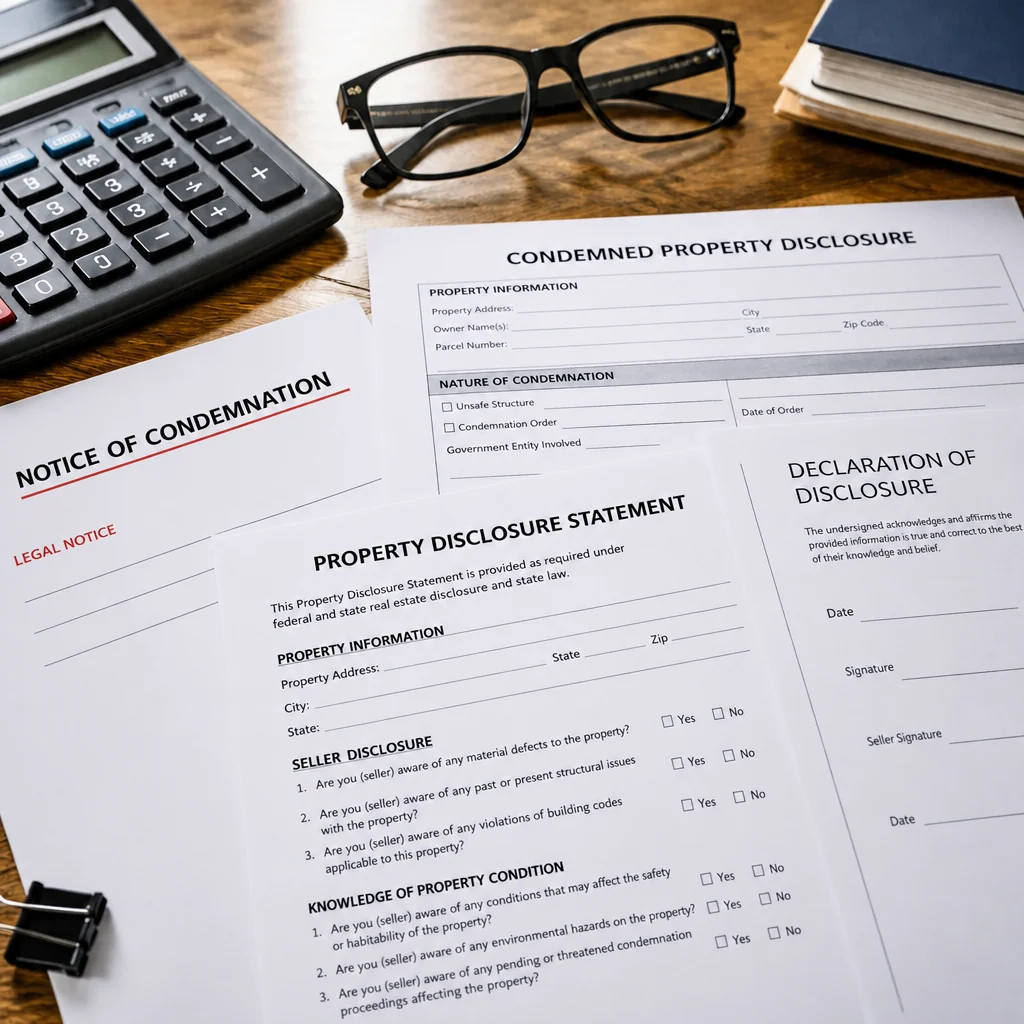
These rules exist to protect buyers. But they also protect you — if you follow them. Sellers who hide known issues face serious legal consequences. In virtually every U.S. state, you're legally required to disclose material facts about your property's condition, and condemnation status absolutely qualifies. Don't even think of hiding a condemnation order. It's not a gray area. That's fraudulent concealment, plain and simple. Buyers have successfully sued sellers — and their agents — for burying this information.
What Must Be Disclosed
- The existence of any condemnation order, notice, or declaration
- Outstanding code enforcement citations and violations
- Abatement notices from health or building authorities
- Any code enforcement liens recorded against the property
- Prior demolition orders or notices
- Environmental hazards identified by inspectors (asbestos, lead paint, mold)
- Any government actions related to eminent domain or taking
State-Specific Forms and Documentation
Your state probably has a standardized disclosure form. California requires a Transfer Disclosure Statement (TDS) for residential sales — condemnation status goes right on it. Pennsylvania sellers fill out a Seller's Disclosure of Property Condition form with the same expectations. South Carolina uses a Residential Property Condition Disclosure Statement. The process is straightforward: find your state's current form on your real estate commission's website and complete it truthfully. A real estate attorney can walk you through it.
Penalties for Non-Disclosure
This is where things get serious. A buyer who discovers after closing that you knew about the condemnation can sue for rescission (getting the sale reversed), compensatory damages, and sometimes punitive damages on top of that. In fraud cases, you might even face criminal liability. The safest move? Disclose everything. In writing.
Back to topFinancial Obstacles: Liens and Costs

Understanding Code Enforcement Liens
Code enforcement liens trip up most people selling condemned property. Here's what happens: A municipality fines you for code violations. You don't pay. The city records a lien against your property. Sounds straightforward, right? It's not. Unlike a mortgage lien, these work differently depending on where you live. Some jurisdictions won't let you transfer the title until you satisfy the lien completely. Others allow the lien to stay attached to the property even after you sell. Before you list, you've got to figure out which rule applies in your jurisdiction — and it makes a huge difference to your sale.
How Liens Affect the Sale
Any lien shows up in the title search. You can't get a clean transfer without dealing with it. And that's where your options come in. You might negotiate a payoff with the municipality — they'll often settle for less than what they're owed. You could pay the lien from your sale proceeds at closing. In messier situations, a real estate attorney can challenge whether the lien's even valid. But here's the problem: what if your sale doesn't bring in enough money to cover all the liens? That's essentially a short sale situation. Our guides on selling a house for less than you owe walk you through exactly how that works.
Escrow Holdbacks Explained
Sometimes buyer and seller agree to hold back a chunk of the sale proceeds in escrow. That money sits there until something specific happens — maybe the buyer finishes a demolition, or pulls the right permit. It's a practical solution when condemnation orders leave future obligations hanging over the property.
Demolition Costs and Tax Implications
Demolition gets expensive fast. According to 2026 data from Angi, full house demolition runs $6,000–$25,000 total, or $4–$17 per square foot. For a typical 2,000 sq ft home, you're looking at roughly $15,800. Then add permit fees between $150–$500. These numbers shape the entire deal. Investors who plan to demolish and rebuild will subtract their full demolition estimate from their offer price.
Now for taxes. Even a condemned property has land value — and if you sell at a profit, capital gains taxes kick in. The IRS Section 121 exclusion is generous: single filers can exclude up to $250,000, married filers up to $500,000. But you need to have owned and used the property as your primary residence for at least 2 of the past 5 years. If your gain exceeds that exclusion, long-term capital gains rates for 2026 begin at 15% for single filers making above $49,450 and joint filers above $98,900. And watch out — there's also a 3.8% Net Investment Income Tax (NIIT) surtax that may apply to gains above the exclusion threshold. Talk to a tax professional about your specific situation. Condemnation sales have quirks that ordinary sales don't.
Back to topWho Can Buy a Condemned House?
Cash Buyers Are the Primary Market
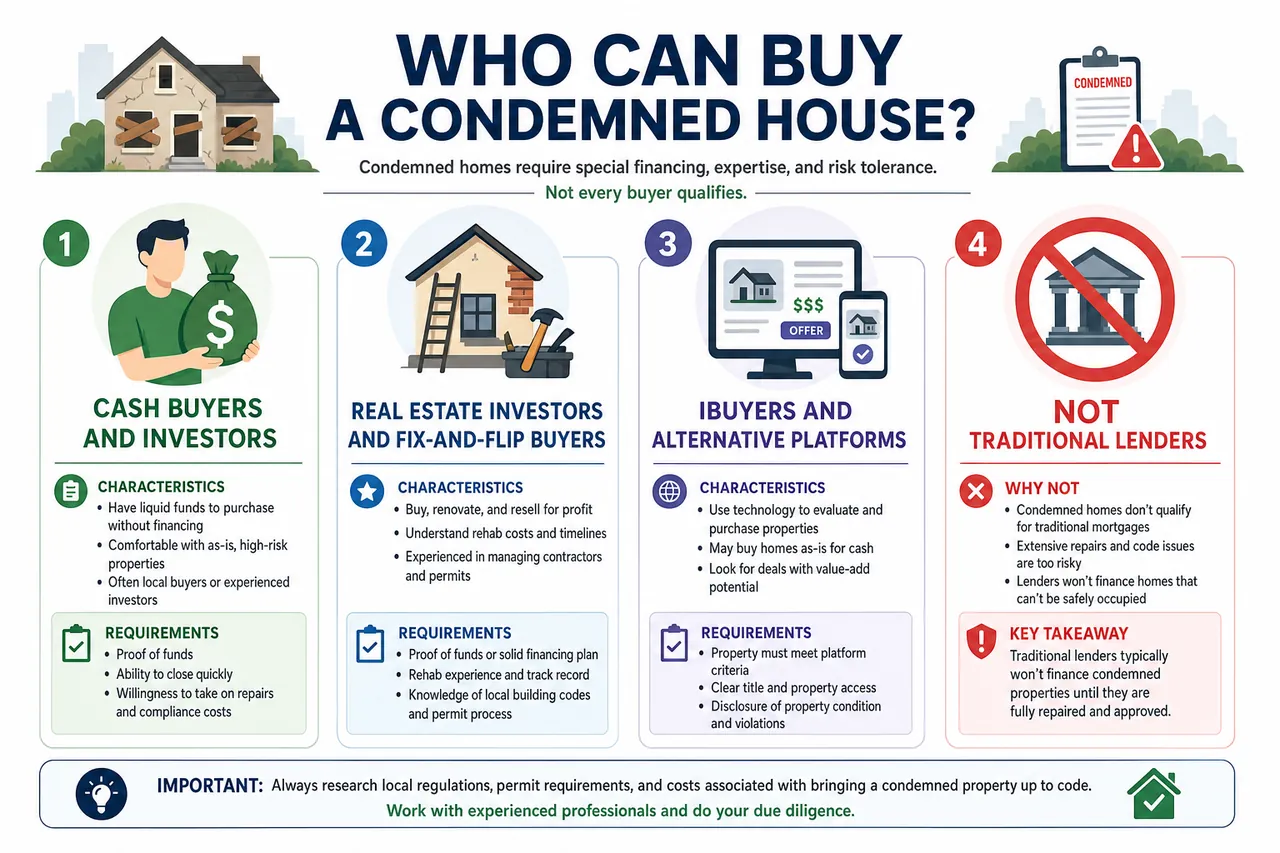
Here's the reality: conventional financing doesn't work for condemned properties. That's why cash buyers own this market. We're talking about individual investors, real estate investment companies, fix-and-flip operators, and land developers who either want to rebuild or just want the lot itself. The good news? They close fast, they won't demand you fix anything, and they actually know what they're doing with distressed properties. But there's a catch — their offers reflect what they're risking and spending to take the problem off your hands.
When investors price a condemned house, they use what's called the "70% Rule." It works like this: they take the After Repair Value (ARV), multiply it by 70%, then subtract their estimated repair costs. A 2026 survey of over 700 investors found the median offer actually lands around 67.5% of ARV — a bit below that 70% threshold because they're building in extra cushion for risk. On a condemned property? Your repair estimates will be so high that offers drop even further.
Why Traditional Lenders Won't Finance
Fannie Mae, Freddie Mac, the FHA, and the VA all have the same requirement: properties must be safe, sanitary, and structurally sound before they'll approve a loan. A condemned house fails all three. Some hard-money lenders will finance condemned properties — but only for experienced investors. This helps the buyer, not you. It doesn't expand your pool of people willing to purchase.
Real Estate Investors and Fix-and-Flip Buyers
Fix-and-flip investors? They're often your best bet. They know how to estimate renovation costs down to the dollar. They've navigated complicated permitting and lien issues before. They have cash reserves sitting around to cover surprises that'll inevitably pop up. Want to find serious buyers faster than posting on the MLS? Connect with local investor networks through BiggerPockets or your local real estate investment association.
iBuyers and Alternative Platforms
Don't count on the big names like Opendoor or Offerpad. Their algorithms and buying rules automatically reject condemned properties — especially if there's an active condemnation order or code enforcement lien. Some regional cash-buying programs and specialized distressed-property platforms do take these deals, though. Platforms that let you compare multiple offer types side-by-side — like KDS Homebuyers' seller programs — save you from having to cold-call dozens of investors one at a time.
Auction Services
Auction platforms like Auction.com and Xome specialize in distressed properties, and they do handle condemned homes. You get speed and exposure to a concentrated group of cash buyers ready to move. The trade-off? Prices can swing wildly, reserve prices might not get met, and auction fees cut into what you actually take home.
| Buyer/Channel Type | Typical Speed to Close | Price Offered vs. Market | Process Complexity | Works for Condemned? |
|---|---|---|---|---|
| Direct Cash Buyer / Investor | 7–21 days | 15%–30% below market | Low | Yes — ideal |
| Fix-and-Flip Buyer | 14–30 days | 67.5%–70% of ARV minus repairs | Low to moderate | Yes — very common |
| National iBuyer | 14–30 days | Varies; generally closer to market | Low | Rarely — most exclude condemned |
| Property Auction | 30–60 days | Unpredictable; can be low | Moderate | Yes — common channel |
| Traditional Agent / MLS | 60–120+ days | Closest to market (after commissions) | High | Rarely effective without repairs |
| Wholesaler | 7–30 days | Below market (additional assignment fee) | Low | Yes — common for distressed |
Step-by-Step Guide to Selling a Condemned House
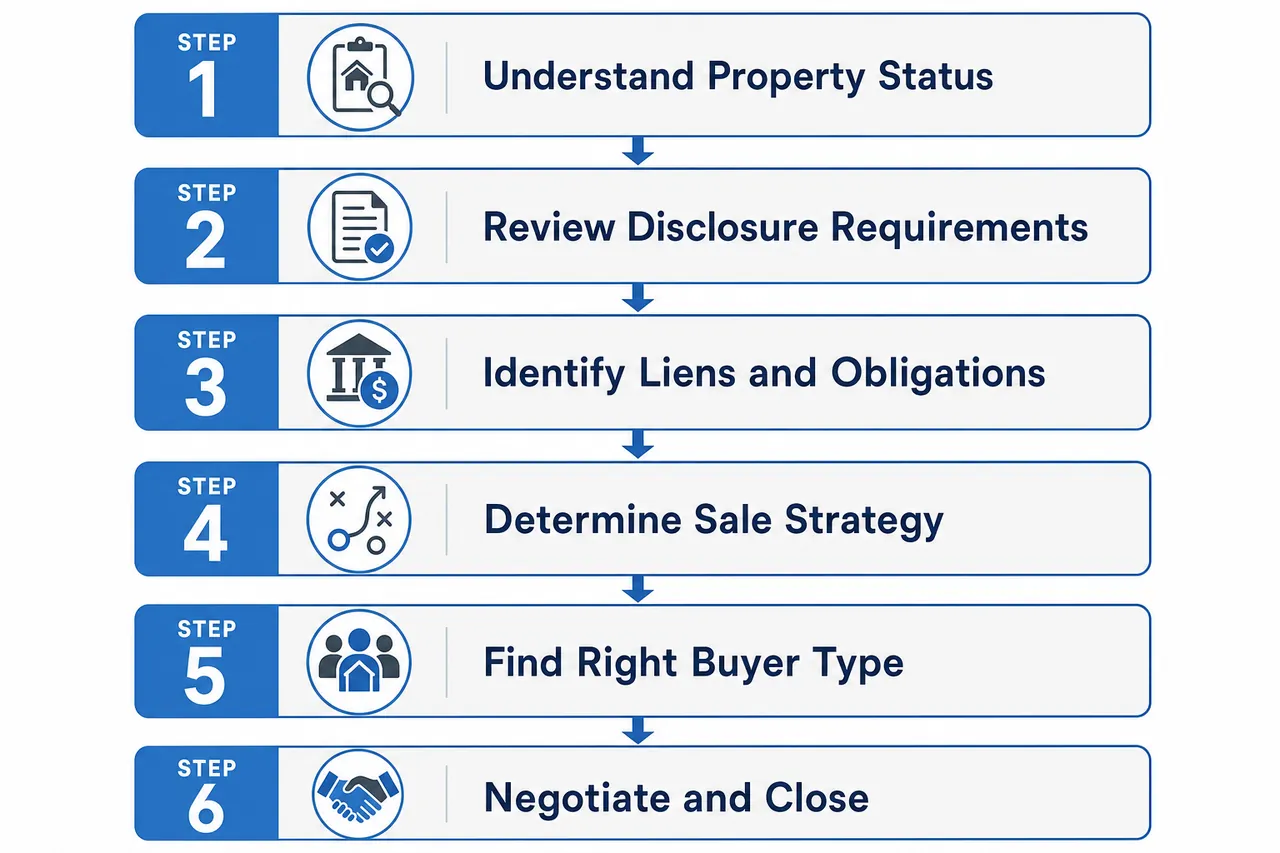
Step 1: Understand Your Property's Exact Status
Start by contacting your local building department or code enforcement office. Request everything — the original condemnation order, any follow-up notices, amendments, the specific violations they cited, any deadlines you're facing, and a complete record of fines and fees. This paperwork is your roadmap. Without it, you're flying blind.
Step 2: Consult a Real Estate Attorney
Before you do anything else, hire a real estate attorney who's actually handled condemned properties in your area. The rules shift dramatically from city to city — disclosure requirements, lien types, how code enforcement works — it all varies. You need someone who knows your local building department's procedures, not just generic real estate law.
Step 3: Order a Title Search
This step matters more than you might think. A title search uncovers every lien, encumbrance, and title issue attached to your property. You can't negotiate a fair deal — or close at all — if you don't know what's lurking in the records. Title companies or your attorney can order this. Expect to pay a few hundred dollars. It's worth every penny.
Step 4: Determine Your Sale Strategy
Now comes the real decision. Do you repair and sell, or sell as-is? The condemnation details, liens you're carrying, how quickly you need to move, and your cash situation all factor in. And if you're already drowning financially — maybe a job loss is what led to the neglect in the first place — check out our guide on selling a house after job loss. You might be dealing with more than just the condemned property.
Step 5: Prepare Your Disclosure Package
Pull together everything: the condemnation docs, all code enforcement records, your title search, prior inspections, environmental reports if you have them. Put it in one organized packet. Buyers' attorneys will demand this stuff anyway during due diligence — handing it over upfront builds trust and moves things faster.
Step 6: Find the Right Buyer
Cash investors are your best bet here. Reach out to local real estate investment clubs. Post on investor platforms. Call cash-buying companies directly. Consider an auction if you've got time. The key? Get multiple offers. Even in a tight buyer pool, competition pushes prices up.
Step 7: Negotiate and Close
Don't just haggle over price. Push back on contingencies, closing timelines, who pays liens, and any escrow holdbacks. Then bring in a title company that knows distressed properties inside and out. They'll handle paying off every recorded lien from your closing proceeds and issue title insurance to the buyer — something most investors, even cash buyers, won't touch without it.
Back to topSelling Options: As-Is vs. Renovation
The Case for Selling As-Is
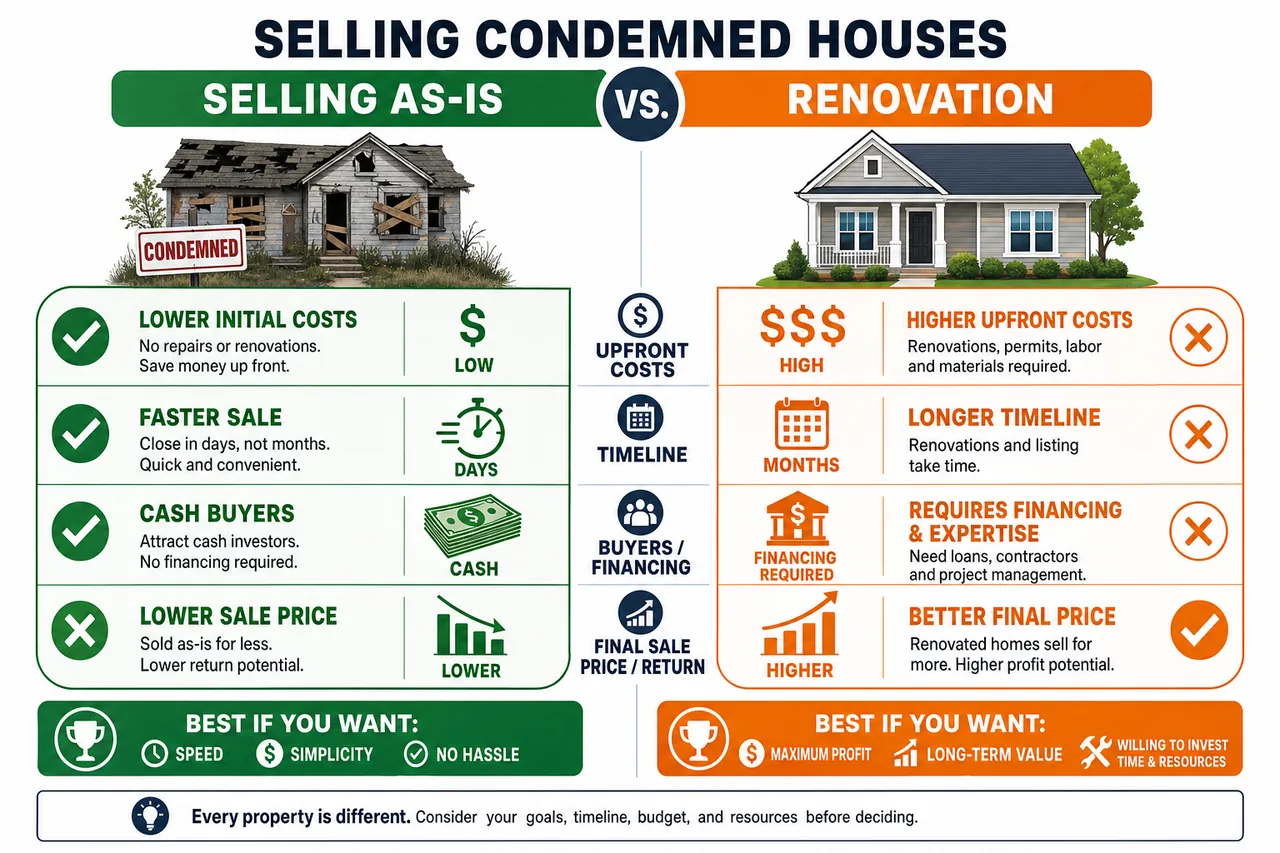
You hand over the property exactly as it sits right now. The buyer knows what they're getting — and they're responsible for fixing it all. The upside? You skip the headaches of managing contractors, pulling permits, and paying for repairs that may cost more than you expected. For most condemned properties, the damage is so extensive that it'd be throwing good money after bad to try fixing it yourself.
The Case for Repairing Before Selling
But here's the thing: if the condemnation comes from something specific — a bad roof, outdated electrical wiring, one code violation — it might actually make sense to fix it. Once the city lifts that condemnation order, suddenly you're in a completely different ballgame. Regular buyers with mortgages can now purchase your home. And that matters enormously.
The median existing U.S. home sale price hit $427,000 in Q1 2026. A cash investor offer? You're looking at 15%–30% less than market. The difference between those two numbers could be $50,000 or more depending on your area.
Cost-Benefit Comparison
| Factor | Sell As-Is (Condemned) | Repair and Re-List |
|---|---|---|
| Upfront Cost | Minimal (disclosure preparation, attorney) | High — full repair costs required |
| Time to Close | 7–30 days (cash buyers) | 3–9 months (repairs + listing period) |
| Sale Price vs. Market | 15%–30% below market | Near or at market (if fully remediated) |
| Buyer Pool | Cash investors, flippers, auctions | Full market including financed buyers |
| Financing Available to Buyers? | No | Yes (if condemnation fully lifted) |
| Risk | Low — price already reflects condition | High — cost overruns, re-inspection failures |
| Lien/Code Violation Handling | Disclosed and negotiated in sale | Must be resolved before listing |
| Best For | Time pressure, extensive damage, limited capital | Minor violations, high land value, strong market |
When to Choose Each Option
Sell as-is if you're facing a tight deadline from the city. Or if the repairs would eat up most of what you'd make anyway. Same applies when you don't have cash on hand to fund the work, or when the land itself is worth more than the structure.
And consider repairs if the problem is actually fixable — one system, one violation, something with a real price tag. It only makes sense if that repair cost is well below what the house would sell for afterward. You also need the time and money to do this right. Don't start this path if you're broke or desperate for a quick exit.
Already underwater on your mortgage? This calculation changes entirely. Repairs might not save you financially. In that situation, look into selling for less than you owe — sometimes that's the clearer path forward.
Back to topWorking with Real Estate Professionals

Finding Agents Experienced with Condemned Properties
Here's the honest truth: most residential real estate agents have never sold a condemned property. So if you're thinking about hiring one, you need someone different. Look for agents who specialize in distressed properties — ones with REO (bank-owned property) experience, foreclosure expertise, or a solid track record with as-is sales. When you interview them, ask specific questions about condemned properties they've actually sold. A standard agent using standard strategies? That'll just waste your time and money.
Then there's the commission question. The average real estate commission in 2026 runs 5.70% of the sale price — that's 2.88% for the listing agent and 2.82% for the buyer's agent. When you're already selling a condemned property below market value, that kind of commission hit stings. Sometimes working directly with investors instead — skipping the agent altogether — makes way more financial sense.
Cash Buying Companies
National and regional cash-buying companies specialize in purchasing distressed properties, including condemned homes. The big draw? It's straightforward. One phone call. One offer. No showings to arrange. No repairs required. Fast closing. But there's always a catch — they'll offer significantly below market value. Your best move is getting offers from multiple cash buyers. Compare them all before you say yes to anything.
Real Estate Investors and Wholesalers
Wholesalers work as intermediaries between you and the actual buyer. They'll put your property under contract, then assign that contract to an end buyer (usually a fix-and-flip investor or landlord) and pocket an assignment fee for the trouble. It moves fast, and you won't need to make any repairs. The problem? That wholesaler's profit comes straight out of what you'd otherwise receive. Make sure any wholesaler you work with is transparent about their fees and has a real history of closing deals — not just lining them up.
Auction Services
Auction platforms built for distressed and bank-owned properties can reach serious cash buyers quickly. You set the minimum bid at your reserve price. But here's the risk: if not enough people bid, you might not hit that minimum, and you've just lost time. And auction fees? They typically run 5%–10% of the sale price. That's another layer of costs to factor in.
Back to topState-Specific Considerations
California
California doesn't mess around with seller disclosures. You'll need to complete the Transfer Disclosure Statement (TDS) for most residential sales, and it's mandatory. This form requires you to explicitly report government notices, orders of abatement, and any pending code enforcement actions. And if someone's living in the property? California's strict habitability laws and tenant protections kick in immediately. Before you list a condemned property here, get a real estate attorney involved. Period. If you're dealing with financial pressure on top of everything else, our guide on selling after job loss in California walks through your options.
South Carolina
You'll need to file a Residential Property Condition Disclosure Statement that lays out known defects and government orders. But here's what complicates things in South Carolina: condemnation timelines aren't the same everywhere. A condemned property in Charleston faces completely different procedures than one in Columbia or Greenville. Municipal code enforcement moves at different speeds depending on the city. This is why you absolutely need a local real estate attorney who knows your specific city's playbook.
Pennsylvania
Pennsylvania's Seller Disclosure Law requires a detailed property condition form. You're reporting structural defects, hazardous materials, code violations—and any condemnation orders. The real trap here? Municipal lien laws. Unpaid code enforcement fines don't just sit there. They become super-priority liens that have to be paid off before closing. This matters enormously if you're already underwater on your mortgage. Check out our guide on selling for less than owed since Pennsylvania's lien priority rules create specific challenges.
Florida, Tennessee, Indiana, Washington, and Colorado
These five states all require written disclosure of known defects and government actions. That's where the similarity ends. Timelines shift. Lien procedures differ. Municipal authority structures aren't consistent. In Florida's coastal areas? Storm-damaged condemned properties show up regularly, and there's an actual investor market for them. Tennessee and Indiana throw additional wrinkles into the mix—rural condemned properties often have septic system and well water complications that add time and cost. For state-specific guidance tailored to your situation, check our resources for Florida, Tennessee, Indiana, Washington, and Colorado.
Back to topSpecial Situations: Tenants and Occupancy
Selling Condemned Houses with Tenants
This is one of the toughest scenarios you'll face in real estate. A condemned property with tenants living in it creates major legal complications. Condemnation orders say nobody can live there — so tenants have to leave. Here's the catch: tenant eviction rights are protected by local landlord-tenant law. That means you might owe them 30, 60, or even 90 days' notice, relocation help, or other protections. The condemnation doesn't erase those rights.
Eviction and Relocation Requirements
Many places require you to give tenants serious advance notice before they can be evicted, even when the building is condemned. And in strong tenant-protection cities? That's California, New York, and similar markets. You're often required to pay relocation assistance to help displaced tenants find new housing. Buyers know this. They'll factor in both the cost and the hassle of dealing with tenants, and they'll adjust their offers down — sometimes dramatically.
Legal Responsibilities
You have real legal obligations here as the seller.
Back to topMore in Code violations, permits and hoarding
- Who Buys Condemned Houses: Types of Buyers and How to Sell
- How to Sell a Condemned House: Is It Even Possible?
- How to Sell a House With Code Violations
- Can You Sell a Condemned House? How It Works
- Exposed: The Real Dangers of Hoarding That Can Lead to Your Home Being Condemned
- Full Cost Breakdown of Cleaning and Restoring a Hoarder House
See our guide: “How to Sell a House As-Is: What It Means and How It Works” →

