

What to Do With an Inherited House: Common Questions and Solutions

Table of Contents
- Understanding Your Inherited House Options
- Tax Implications of Inherited Property
- Financial Considerations and Costs
- Assessing the Property Before You Decide
- Selling Your Inherited House
- Keeping and Renting Out the Property
- Dealing with Co-Heirs and Family Disputes
- State-Specific Considerations
- Managing an Inherited Property Across State Lines
- Emotional Factors: Giving Yourself Permission to Decide
- A Practical Decision Framework
- Conclusion
- Frequently Asked Questions
You've inherited a house. Now what? Most people face three main options: keep it, sell it, or rent it out. But which path works best for you depends on way more than just preference. Your financial situation matters. So does your relationship to the property. Then there are the curveballs nobody warns you about: outstanding liens, co-heirs splitting the inheritance, or a roof that's about to cave in. This guide tackles the questions that actually come up, the same ones getting debated in Reddit threads and kitchen table conversations. You'll get concrete answers here, not the vague stuff that leaves you more confused than when you started.
Handling an inherited house? Start with our step-by-step plan for heirs and executors. It walks through probate, the house, taxes and selling, in order.
Fair warning: this isn't legal or tax advice. Inherited property decisions hinge on your state's probate law and your specific tax situation. Before you make any moves, talk to a probate attorney and a CPA.

Understanding Your Inherited House Options
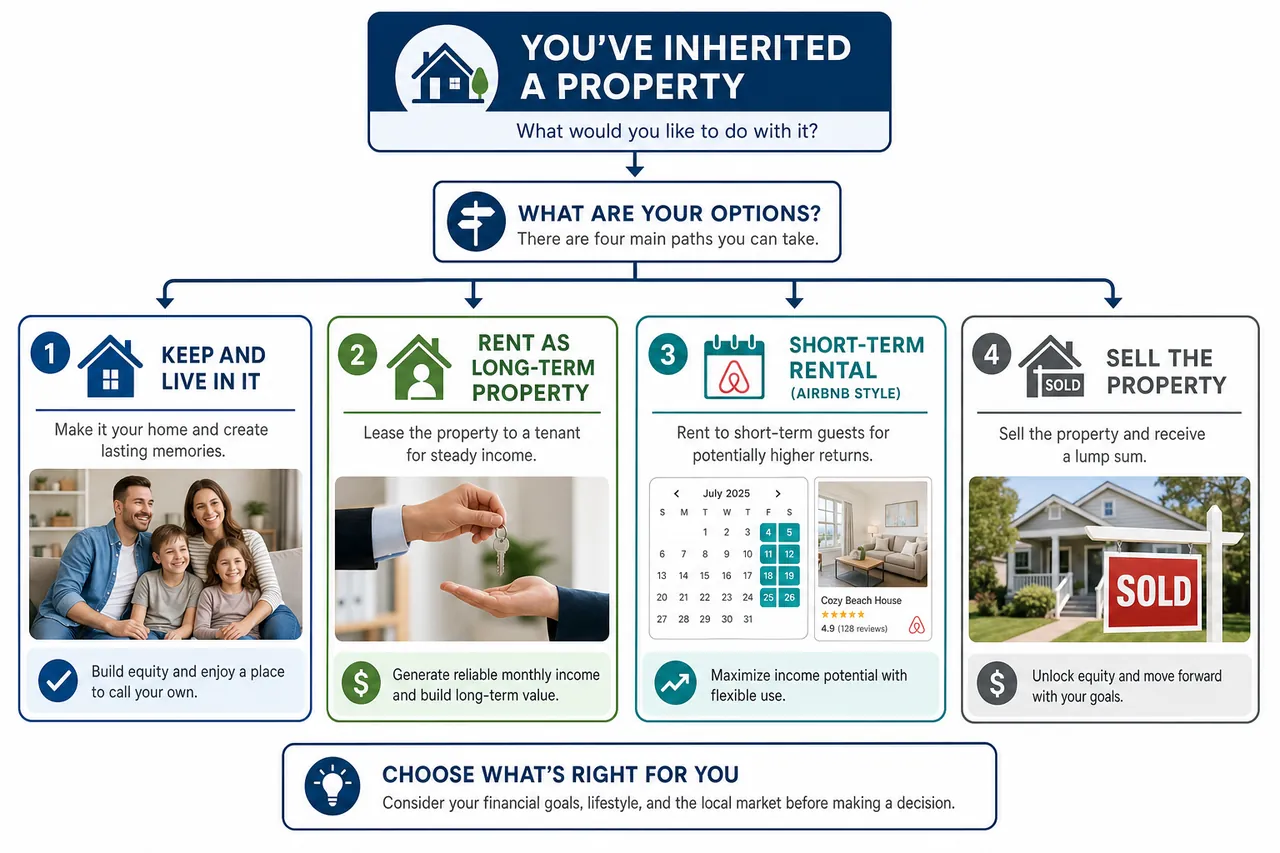
Each path looks completely different once you dig into the details. Time commitments, money requirements, and emotional weight aren't the same across these three options—not even close.
| Factor | Keep & Live In | Sell | Rent Out |
|---|---|---|---|
| Time to liquidity | None (ongoing equity) | 30–90+ days after probate closes | None (monthly income only) |
| Upfront cash needed | Repairs, moving costs | Minimal if sold as-is | Repairs, landlord setup |
| Ongoing responsibility | High (owner-occupant) | None after close | High (landlord duties) |
| Tax complexity | Low initially | Moderate (capital gains) | High (depreciation, income) |
| Emotional ease | Can be comforting or difficult | Closure, but loss | Ongoing attachment |
| Long-term wealth potential | High (appreciation) | Lump sum to redeploy | High (income + appreciation) |
You can't just decide to sell on your own. Only someone with real legal standing can actually make that happen. That means an executor who's received letters testamentary, a trustee managing a trust that holds the property, or an heir after clear title has moved through probate. Until you've got that authority in hand, your hands are tied. So step one? Find out your state's probate timeline.
Back to topTax Implications of Inherited Property
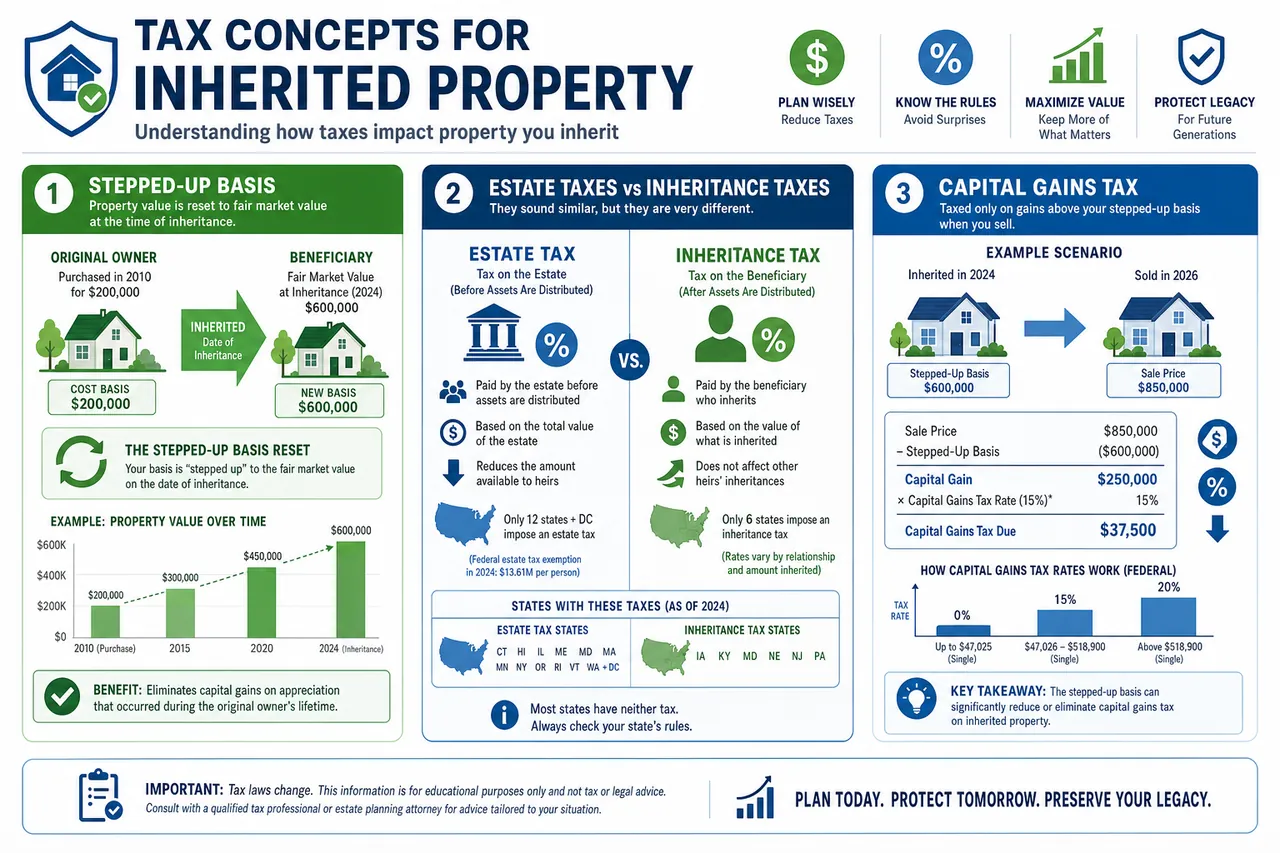
Stepped-Up Basis: Your Biggest Tax Advantage
Here's the game-changer for inherited property: the stepped-up basis under IRC §1014(a). When you inherit a home, your cost basis for tax purposes gets reset to what the property's actually worth on the day the original owner died—not what they paid for it years ago. Your parent bought the house for $80,000 back in 1985? It's worth $400,000 now? Your basis is $400,000. Sell it right after for $400,000, and you owe zero capital gains tax. That's the power of this rule.
And this rule's still standing. The stepped-up basis under IRC §1014(a) survived unchanged through 2026 and wasn't touched by recent legislation.
Capital Gains Tax If You Sell Later
The picture changes if the property appreciates after you inherit it. Sell it down the road for more than your stepped-up basis, and you'll owe capital gains tax on that increase. But here's the silver lining: inherited property automatically gets treated as long-term, per IRC §1223(9). That means you'll never pay short-term capital gains rates—only the lower long-term rates, no matter how quickly you sell.
Want to know what you'd actually owe? Check the 2026 federal long-term capital gains brackets:
| Rate | Single Filer Taxable Income | Married Filing Jointly |
|---|---|---|
| 0% | Up to $49,450 | Up to $98,900 |
| 15% | $49,451 – $545,500 | $98,901 – $613,700 |
| 20% | Above $545,500 | Above $613,700 |
If you're a high earner, don't forget about the 3.8% Net Investment Income Tax (NIIT). It kicks in when your modified adjusted gross income tops $200,000 (single) or $250,000 (married filing jointly). That pushes your maximum federal rate up to 23.8% on long-term gains.
One more thing trips up landlords all the time: if you rent out the inherited property for years and then sell, you're facing depreciation recapture at up to 25% on any deductions you claimed during the rental years. Most new landlords don't see this one coming.
The Section 121 Exclusion—and Why Most Heirs Don't Qualify
The IRC §121 primary residence exclusion sounds amazing: up to $250,000 tax-free for single filers, up to $500,000 for married couples. But there's a catch. You need to have owned and actually lived in the home as your primary residence for at least two of the five years before you sell. Most heirs don't live there, so they don't qualify. Think you might move in instead? The two-year clock starts when you move in, not when you inherited it.
Estate Taxes vs. Inheritance Taxes
People mix these up constantly, and it matters. The federal estate tax? That's paid by the estate itself, not by you. For 2026, the exemption is $15,000,000 per individual (or $30,000,000 for married couples using portability), with a 40% top rate on anything above that. Most estates never hit this threshold and pay nothing.
Inheritance taxes work differently. You (the heir) pay these, and only certain states have them. As of 2026, just 5 states collect inheritance tax. But 12 states plus DC have their own estate taxes, often with much lower thresholds than the federal level. This is where a local CPA or estate attorney pays for itself—get your state's specific rules nailed down.
Back to topFinancial Considerations and Costs

Outstanding Mortgages, Reverse Mortgages, and Liens
If the home you inherited has a mortgage, the Garn-St Germain Depository Institutions Act has your back. Lenders can't demand immediate full repayment just because the borrower died. You actually get time to breathe and decide what's next for the property.
But—and this matters—those mortgage payments keep coming. The lender will have their own process for documenting the transfer, so don't ignore their paperwork. Our detailed guide on what to do when you inherit a house with a mortgage walks you through every step.
Reverse mortgages (HECMs) are a different animal. When the borrower passes away, the loan typically becomes due and payable right away. You'll have options—paying it off, refinancing, or buying the home at 95% of appraised value. Timelines vary though. Call the servicer immediately and don't wait.
Liens complicate everything. Tax liens, mechanic's liens, judgment liens—they all need resolving before you can sell with a clean title. This directly impacts how fast you can actually move forward. Check out how to handle an inherited house with liens for the exact steps.
Ongoing Costs During the Decision Period
While you're still figuring things out, money keeps flowing out the door. Here's what you're actually paying for:
- Property taxes: They don't stop just because nobody's living there. Skip them and you'll get a tax lien slapped on the property.
- Homeowner's insurance: Your standard policy might lapse or drop coverage if the home sits vacant. Call your insurer right now and ask about a vacancy endorsement.
- Utilities: Even empty houses need some attention—keep heat running in winter and water trickling to avoid frozen pipes and burst damage.
- Maintenance: Lawn care, snow removal, basic upkeep. Skip this and code enforcement shows up, or someone breaks in.
- HOA fees: These keep piling up if the property's in an HOA community, and unpaid fees can turn into liens fast.
Probate Costs and Timeline
Probate rules? They change depending on which state you're in—sometimes even by county. Some states let small estates bypass court entirely through an affidavit process. Others demand full court supervision. Indiana distinguishes between supervised and unsupervised administration. Washington state gives personal representatives what's called nonintervention powers, meaning they can act on most decisions without asking a judge first. And whether you need court approval to sell varies too.
One thing never changes: you can't legally do anything with the property until you've got the authority to do it.
Probate legal fees usually run 2–5% of the estate value, though that swings widely depending on complexity and location. Build this into your cost planning from day one.
Back to topAssessing the Property Before You Decide
You can't make a smart choice about keeping, selling, or renting until you know what you're actually dealing with. Here's your roadmap to getting real numbers and real answers:
- Order a professional appraisal. The U.S. median existing-home sale price hit $417,500 as of September 2026—that's up 1.3% year-over-year according to NAR data from October 2026—but your neighborhood might be worth way more or way less. An appraisal gives you the defensible fair market value you'll need for taxes and decision-making. It also establishes your stepped-up basis documentation, which matters if you sell later.
- Hire a home inspector. Inherited homes almost always have neglected maintenance hiding somewhere. You need to know if the roof's about to fail, whether the HVAC system has five years left or five months, what shape the electrical panel is in, and if plumbing's going to become your biggest headache.
- Check for environmental issues. Older homes can carry lead paint, asbestos insulation, or buried oil storage tanks. Don't overlook this one—it tanks your value and limits your buyer pool. FHA and VA loans come with stricter requirements, so environmental problems shrink your options fast.
- Pull the title search. An estate attorney or title company will uncover any liens, easements, or other encumbrances that'll need clearing before you can sell. This is non-negotiable.
- Review utility and maintenance records. Want to know what it actually costs to keep this place running year-round? These records tell you exactly what you're looking at in carrying costs.
This groundwork saves you regardless of what you decide. Skip it and you'll discover expensive problems after the fact—when it's far too late and far too costly to do anything about it.
Back to topSelling Your Inherited House

Timing and Process
First things first: you can't put the house on the market until probate gives the personal representative (usually you or another family member) the legal green light. Sometimes title passes directly to heirs instead—but either way, you need that authority before listing.
Once you've got it? Plan on 30 to 90 days from listing to closing on the open market. But that's a rough range. Your local market might move faster or slower depending on supply, demand, and how many buyers are actively shopping.
Here's what trips people up: state disclosure laws still apply to inherited properties. You'll need to reveal any known material defects, even if you just inherited the place. "I didn't know" gives you some cover, but not complete protection. Get a professional inspection done. It costs a few hundred dollars and saves you from post-sale lawsuits. Plus, you'll actually know what you're disclosing—not guessing.
As-Is Sales and Cash Buyers
Major repairs needed? Don't have the money or patience to manage renovations? An as-is sale to a cash buyer or investor might be your answer.
The math is simple. You'll walk away with less than market rate, but you get three things in return: speed, certainty, and zero renovation headaches. You don't repair anything. You don't stage it. You close fast. This approach works especially well if the property's in rough shape, you're handling the estate from out of state, or the family needs money now.
And don't settle on the first offer. Get multiple bids from cash home buyers, understand why each one is priced the way it is, and compare terms carefully.
Seller Costs to Budget
Real estate agent commissions usually run 5–6%, split between the listing and buyer's agent—though you can negotiate. Title work, escrow fees, and transfer taxes all add up too, and transfer taxes vary wildly depending on which state the property's in. You might also need to fund repair credits if the buyer finds issues during inspection.
Here's what that looks like in dollars. On a home valued at the national median of $417,500, agent commissions alone can eat $20,000 to $25,000 of your proceeds. Factor in everything else and you're looking at a serious chunk of the sale price going to closing costs.
Back to topKeeping and Renting Out the Property
Becoming a Landlord: What It Actually Involves
Rental income sounds great. But here's what you're really signing up for: screening tenants, keeping the place habitable, fixing things at 2 a.m., following local landlord-tenant laws, and dealing with lease renewals or evictions when they go sideways. It's not passive income—it's active responsibility.
Got a tenant already living there? They stay. You can't kick someone out just because you inherited the deed. That existing lease transfers to you automatically, and you're bound by it.

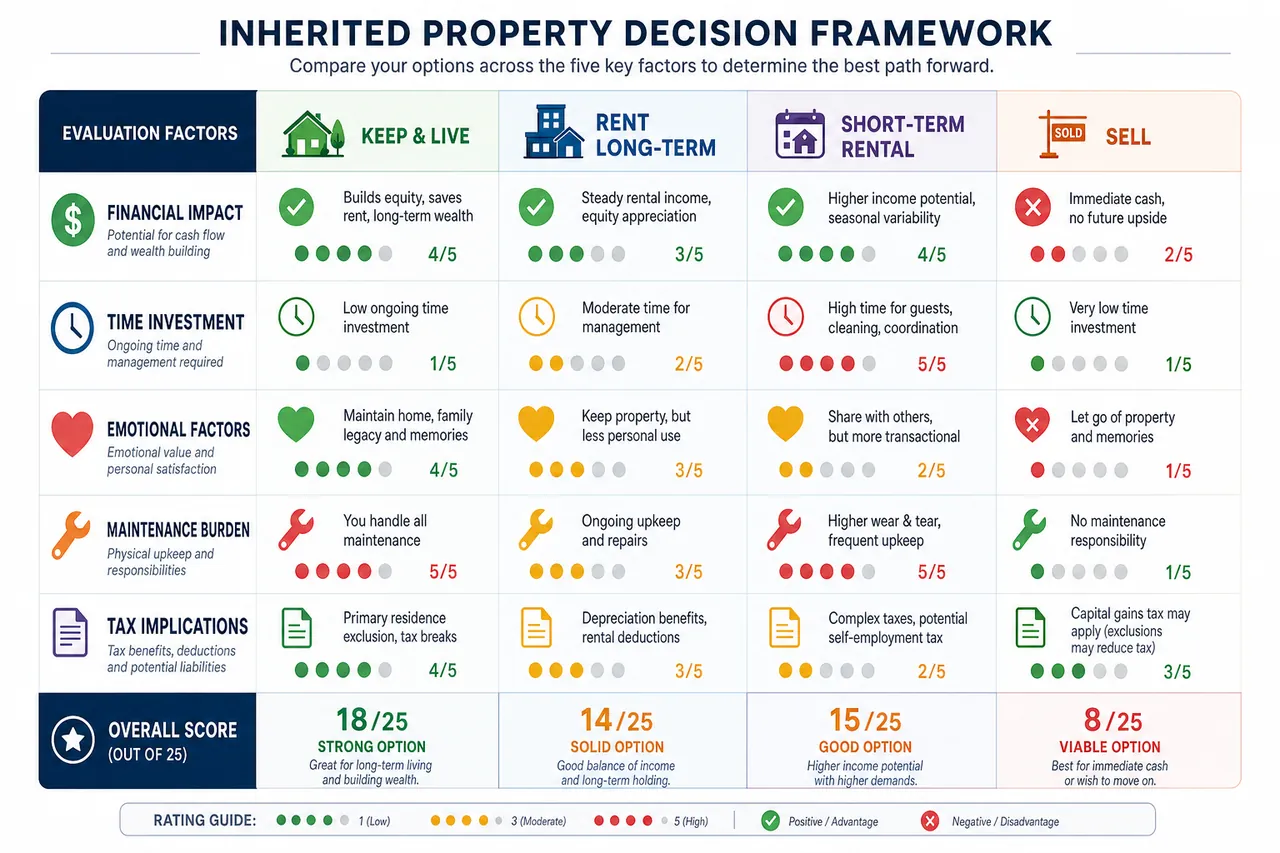
Managing from across the country? Professional property management runs 8–12% of your monthly gross rent, plus leasing fees—usually one month's rent when they place a tenant. That eats into profits. But for out-of-state owners, it's often worth every penny because you're buying freedom from constant calls and emergencies.
Tax Treatment of Rental Income
You'll pay taxes on rental income. And yes, that stings. But here's the silver lining: you deduct mortgage interest, property taxes, insurance, repairs, and depreciation on the building itself. Depreciation is the kicker—it's a non-cash deduction that lowers your taxable income year after year, which means you can show a "paper loss" while actually pocketing cash. The downside? When you eventually sell, the IRS recaptures all those depreciation deductions and taxes them at up to 25%. Work with a CPA from day one to track this correctly.
Sell vs. Rent: Running the Numbers
This comes down to opportunity cost. Here's your test: take your net rental income (after taxes, insurance, maintenance, and management fees) and divide it by what you'd pocket if you sold the place today. If that percentage is higher than what you could safely earn investing that sale money elsewhere, keep it as a rental. If not, sell and move the capital. Neither choice is wrong—it depends on your local rent-to-price ratio, your tax bracket, and how much risk you can handle.
Back to topDealing with Co-Heirs and Family Disputes

Shared Ownership Complications
One sibling needs cash now. Another wants to keep the house forever. You're the third heir and just want this settled. That's the reality of inheriting a property with brothers, sisters, or other co-heirs—and it's one of the most common sources of family conflict you'll encounter.
Each heir brings different priorities to the table. One person's financial emergency doesn't match another's emotional attachment to the place. Different timelines. Different dreams for the property. And because nobody can move forward without everyone's agreement, disputes like this can freeze an entire estate for months or even years.
Buyout Calculations
Want to keep the house? A buyout might be your path forward. Here's how it typically works:
Order a professional appraisal to lock in fair market value. Subtract any mortgage, liens, or debts attached to the property. Divide whatever's left by each person's ownership share. The heir keeping the property then pays the others their cut—whether that's cash, refinancing money, or a structured payment plan.
This approach works because it's concrete. A professional appraisal means nobody can later claim you stiffed them on the price. Everyone knows the numbers.
When Heirs Can't Agree: Partition Actions
If you and your co-heirs hit a wall, the law gives any owner a nuclear option: force a sale through partition litigation. When the property can't be split up physically, partition by sale usually happens. It's expensive, it's adversarial, and it takes forever—but it exists as your last resort when family members refuse to budge.
Some states have adopted the Uniform Partition of Heirs Property Act, which adds real protections for family-owned land. Check what your state actually allows, because rules vary significantly from place to place.
But stop. Before you hire a litigation attorney, try a mediator first. Estate mediation costs a fraction of partition litigation and often unlocks solutions when family conversations have completely broken down.
When to Hire an Estate Attorney
Get an estate attorney involved if you're facing any of these:
Multiple heirs with competing interests. Significant mortgage debt or liens against the property. Assets scattered across different states. A reverse mortgage in the mix. Any heir making noise about taking you to court.
Simple estates are different. One heir, clean title, no debt? You might handle it fine with just a title company and a CPA. But once things get messy, an attorney's upfront cost usually saves you far more in mistakes avoided and problems prevented.
Back to topState-Specific Considerations
Your state's laws control probate, property taxes, and what you'll owe on inheritance. The rules vary wildly. Here's what you need to know.
- California: Proposition 19 (effective February 2021) hit hard. Parent-to-child tax breaks on inherited property? They're mostly gone now. You can only skip reassessment if you live in the property as your main home, and even then there's a cap on the value excluded. If you were counting on keeping a California rental property in the family without a massive tax hit, the math changed. Read our California guide on inheriting a house with a mortgage for the full picture.
- Washington: The state has its own estate tax—and it kicks in at a much lower threshold than federal rules. But here's the flip side: Washington doesn't have income tax, though you will pay a real estate excise tax when you sell. One advantage? Washington's nonintervention probate process moves faster than most states. Dig deeper with our Washington inherited property guide.
- Florida: No state income tax. No state estate tax. If you're thinking about rental income, that's genuinely favorable. But here's where it gets tricky: Florida's homestead laws can complicate everything during probate and when you're ready to sell—especially if the surviving spouse is in the picture. Get the details in our Florida guide.
- Tennessee and Indiana: Tennessee? No state income tax, no inheritance tax. Indiana's different—it distinguishes between supervised and unsupervised probate administration, which directly affects how quickly you (as the personal representative) can actually move forward. Check our guides for Tennessee and Indiana.
Five states still impose inheritance taxes. And they don't all work the same way. Most exempt close family members entirely or charge reduced rates for spouses and kids. Don't guess about whether you owe. Pull up your state's specific rules instead.
Back to topManaging an Inherited Property Across State Lines
Everything gets harder when you inherit property in another state. Why? Because probate happens where the property sits, not where you live. You'll need to hire a local probate attorney. A local real estate agent who knows that market is essential. And if you're renting it out, you're probably looking at a local property manager too.
Squatters are a real problem with out-of-state properties that sit vacant. Have you thought about what you'd actually do if someone moved in without permission? Our guide on how to sell a house with squatters walks through your legal options. Dealing with liens adds another layer of complexity. Check our state-specific guides if you're dealing with this: Florida, Washington, Colorado, Indiana, Tennessee, and California.
Don't forget about travel costs. Two or three flights a year to handle tenant issues, repairs, or inspections? That adds up fast—and it's coming directly out of your return on investment.
Back to topEmotional Factors: Giving Yourself Permission to Decide
Scroll through Reddit threads about inherited property. You'll see the same thing over and over: people paralyzed by guilt about selling a home full of family memories, even when the math clearly says to sell. They drag their feet for months or years, hemorrhaging money on carrying costs while the decision just... sits there.
The people in those threads usually figure out the same hard truths:
- Keeping a house doesn't preserve memories—it preserves costs. The memories travel with you regardless of whether you own the property.
- Delay has a price. Every month of indecision is a month of taxes, insurance, and maintenance that comes out of the inheritance's value.
- Sentimental attachment is valid data. If living in the home would genuinely improve your life and you can afford it, that's a real return that belongs in your analysis—not just a soft factor to dismiss.
- Family pressure is real but not your obligation. Co-heirs can't force you to keep a property you can't afford to maintain, and you can't force them to sell one they want to keep. The legal process exists precisely because these situations require resolution.
Pick a decision deadline. Ideally within 60 to 90 days of probate closing. Before that date, commit to gathering the information you actually need. An informed decision takes time. Indefinite delay? That serves no one.
Back to topA Practical Decision Framework
Work through these questions in order:
- Do you have legal authority to act yet? If not, the probate process comes first. Don't move forward until the paperwork is solid.
- What's the property worth and what does it owe? You'll need an appraisal and a full title search to answer this honestly.
- What are the annual carrying costs? Add up taxes, insurance, maintenance, and any mortgage payment. Can you actually cover these without strain while you're making up your mind?
- Do you want to live there? Be real about this. Location, size, condition—does it actually work for your life right now?
- Does the rental math work? Research what similar properties rent for in your area. After you subtract all expenses and management fees, what percentage return do you actually get on the property's value? Now compare that to what you'd earn if you sold it and invested that money elsewhere instead.
- What are the tax implications of each path for your specific income level? This one isn't optional. You need a CPA.
- Are there co-heirs, and do you all agree? If disagreement exists, what's your realistic path to resolution—and what's it going to cost you?
- What does your gut say—and is that response about the property or about grief? Both deserve an honest look.
Conclusion
Inheriting a house isn't just a financial transaction. It's wrapped in grief, family complexity, and decisions you probably weren't expecting to navigate. But here's what matters: you almost always have more time than it feels like you do. Probate takes time. Markets don't move overnight. That gives you room to think clearly.
Here's what actually needs to happen: establish legal authority through probate, look at the property with honest eyes, talk to a CPA about your tax picture, crunch the real numbers on each option, and then commit to a decision with a firm deadline. Does the property have solid equity and you need to close out the estate fast without listing it traditionally? A direct cash buyer is one legitimate path—just know what you're trading. Speed and certainty usually cost some market-rate value.
Keep records of everything. Appraisals, tax filings, inspection reports, agreements with co-heirs—it all matters. And get professional help on the tax and legal details specific to your state. Good advice costs money. A mistake on something this big costs a lot more.
Back to topFrequently Asked Questions
Do I owe taxes when I inherit a house?
Inheriting a house typically isn't a taxable event at the federal level. Thanks to the stepped-up basis under IRC §1014(a), you'll usually owe zero capital gains tax if you sell shortly after inheriting—even if you sell at or near the appraised value. State inheritance tax is another story. Only 5 states currently impose it, so check your state's rules. And the estate itself pays estate taxes, not you as the heir. With the 2026 federal estate tax exemption sitting at $15,000,000, most estates won't hit that threshold anyway.
Can I sell an inherited house before probate is complete?
Not yet. You can't sell until someone has the legal right to transfer the title—and that doesn't happen until probate wraps up or you've got a trustee in place. The personal representative needs letters testamentary from the court, or the trustee needs to be acting under the trust document. Probate timelines are all over the map depending on your state and how complicated the estate is. Call a probate attorney in the state where the property sits. They'll walk you through exactly what needs to happen and how long it typically takes.
What if I can't afford to keep the inherited property?
You're not stuck with it. Nobody can force you to hold onto a property bleeding money every month. Property taxes, insurance, a mortgage, maintenance—if these costs are drowning you, selling makes sense. And even unloading it at a discount to an investor or as-is buyer might put more cash in your pocket than you'd lose to six months of carrying costs. If other heirs want to keep the place, they can buy you out at fair market value based on a proper appraisal.
What happens if siblings can't agree on what to do with an inherited house?
Any co-owner can file for a partition action and force a court sale, but don't go there unless you have no other choice. It's expensive. It's adversarial. Most families don't recover from it well. Instead, bring in a neutral mediator who handles estate disputes professionally. You'd be surprised how often siblings reach a workable solution with a third party in the room—especially when direct conversation has already failed.
Is it better to sell an inherited house or rent it out?
It depends entirely on your situation. Renting generates income and builds equity over time, but you're also managing tenants, dealing with maintenance calls at midnight, and navigating depreciation recapture taxes when you eventually sell. Plus, the rent-to-price ratio in your area has to make the numbers work. Selling is cleaner. You get cash now, and thanks to the stepped-up basis, the tax side is straightforward. Your local market, your tax bracket, how much you actually want to be a landlord—these are the real questions. Talk to a CPA and run both scenarios before you decide.
Back to topMore in Probate basics
- What to Do When You Inherit a House: Your First Steps and Options
- How to Purchase a House in Probate: Buyer's Guide to Probate Sales
- What Do You Have to Do When You Inherit a House? Legal and Financial Steps
- How Much Does Probate Cost? A Full Breakdown of Fees
- Transfer on Death Deed: How to Avoid Probate on Your House
- How Long Does Probate Take? Realistic Timelines by State
See our guide: “Inheriting a Home: A Step-by-Step Plan for Heirs and Executors” →

