

What Is an iBuyer? Complete Guide for Home Sellers

Table of Contents
- What's an iBuyer?
- How iBuyers Work: The Step-by-Step Process
- Major iBuyer Companies: Who's Still Around and Who Bailed Out
- Advantages of Selling to an iBuyer
- Disadvantages of Selling to an iBuyer
- iBuyer Fees: What You'll Actually Pay
- iBuyers vs. Traditional Real Estate Agents
- iBuyer Eligibility: What Homes Qualify
- Who Should Use an iBuyer?
- iBuyer Market Share and Why the Disruption Predictions Didn't Materialize
- How Repair Estimates Work — and What You Can Negotiate
- Tax Implications of an iBuyer Sale vs. a Traditional Sale
- Key Considerations Before Choosing an iBuyer
- Conclusion
- Frequently Asked Questions
An iBuyer — short for "instant buyer" — is a tech company that makes fast, all-cash offers on homes using automated software. You get an offer in 24 to 48 hours. No inspections dragging on for weeks. No waiting to hear back from buyers. But here's what matters: this guide walks you through how they actually price your home, what fees eat into your proceeds, whether you'll even qualify, and most importantly — when you're better off selling the traditional way.
Comparing ways to sell? Start with every way to sell your house, compared. It compares agents, FSBO, iBuyers, cash buyers and more on cost, speed and what you keep.

What's an iBuyer?
An iBuyer is a real estate company that buys homes directly from sellers. They use proprietary technology instead of listing your home on the open market. You submit your address online and get a preliminary cash offer back — usually within 24 to 48 hours. No showings. No waiting around.
Speed and volume drive the whole business. iBuyers purchase homes at a discount below full market value, make some repairs or cosmetic updates, and resell them for profit. You're trading some equity for convenience: predictable closing dates, no financing contingencies, no showings to schedule.
Only two major iBuyer companies are still operating in the U.S. as of 2026: Opendoor and Offerpad. Earlier players like Zillow Offers, RedfinNow, and Knock have exited or stopped buying homes directly — which tells you something important about how hard this model is to keep running at scale.
How iBuyers Differ from Traditional Real Estate Agents
A traditional listing agent markets your home to as many buyers as possible and uses open-market competition to push your price up. They earn a commission on the final sale. An iBuyer flips this completely. It's the buyer. It sets the price using an algorithm. It profits on what it can resell the house for, not on a commission percentage.
This distinction has real teeth when it comes to what you actually pocket. With an agent, competing buyers can push your price above asking price. With an iBuyer? You get a take-it-or-leave-it offer with almost no room to negotiate. Want to know what agents typically charge on the traditional side? Check our guides to real estate agent commissions or commissions in specific states like California, Florida, and Washington.
The Technology Behind iBuyer Offers: Automated Valuation Models
iBuyers rely on Automated Valuation Models (AVMs) to price homes — the same technology that powers Zillow's Zestimate, though every company builds its own version. The AVM pulls in publicly available data: recent comparable sales, property tax records, square footage, bedrooms and bathrooms, lot size, neighborhood price trends, and how fast homes are moving in your area. Then it spits out an estimated value and a preliminary offer based on that number.
AVMs are speedy and consistent. But they have real blind spots. They struggle with unique properties, homes in neighborhoods where not much has sold recently, and features that don't appear in public records — a brand-new kitchen, a yard that floods during heavy rain, or proximity to a noisy highway. That's why iBuyers always do an in-person inspection after the automated preliminary offer: the algorithm gives you a starting point, and the inspector adjusts for what the data missed.
Here's what matters for you: that preliminary offer can shift — sometimes dramatically — after they walk through the house. Any repairs they discover get deducted from your final offer price.
Back to topHow iBuyers Work: The Step-by-Step Process
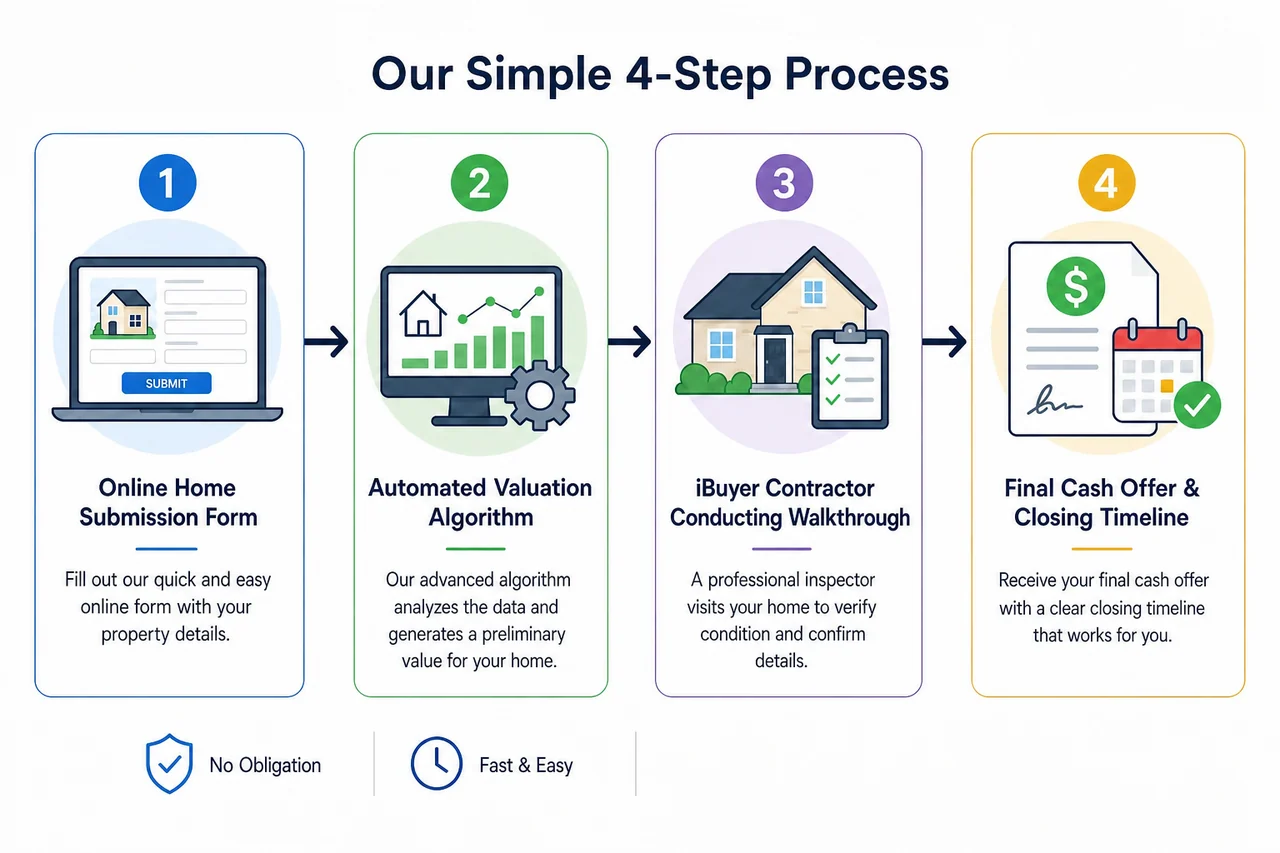
- Online submission. Head to the iBuyer's website and type in your home address along with some basic property details. No real estate agent standing over your shoulder. No pressure to commit to anything.
- Preliminary offer. Their AVM (automated valuation model) runs your home through a comparison analysis using recent sales and market data in your area. Within 24 to 48 hours, you'll get a preliminary cash offer. That's it.
- In-person inspection. So you like the number they're offering? An inspector or contractor from the iBuyer shows up to actually look at your place. They're documenting everything — the deferred maintenance, repairs that need doing, code violations, all of it.
- Final offer and repair deductions. Here's where things shift. The iBuyer revises their offer downward to account for those repair costs they found. You've got three basic options: accept it, walk away, or negotiate the repair list a bit if you think they've overestimated something.
- Closing. You accept? Then you pick your closing date from whatever window that company allows. Opendoor lets you choose anywhere from 14 to 60 days after you accept; Offerpad stretches that to 8 to 90 days — honestly one of the most flexible timelines out there.
And the whole thing — from filling out that first form to handing over your keys — can wrap up in two to four weeks. That's a whole different speed compared to selling the traditional way.
Back to topMajor iBuyer Companies: Who's Still Around and Who Bailed Out
Before you spend energy chasing an iBuyer offer, you need to know which companies are actually operating — and which have already left the game. The iBuyer market has shrunk dramatically since its peak in the mid-2010s.
Opendoor
Opendoor started in 2014 and now dominates the iBuyer space by a huge margin. Right now in 2026, it's active in 50+ metro areas, takes a flat 5% service fee, and typically closes in 14 to 60 days. The company holds approximately 92% of the iBuyer market. It evaluates homes roughly between $100,000–$600,000, built after 1930, on lots up to 2 acres. Here's the kicker though: even with that market dominance, Opendoor acquired only approximately 8,241 homes in all of 2025. That tells you how small the whole iBuyer category really is.
Offerpad
Offerpad launched in 2015 and remains the only other national iBuyer still standing as of 2026. It operates in roughly 25 markets across 9 states and charges 5% to 8% in service fees — though real agents in active markets report seeing 7% to 8.5%. Want flexibility on timing? Offerpad gives you the widest closing window: 8 to 90 days. The company targets homes under $1,000,000 built after 1950. But don't expect huge numbers — it picked up only 110 homes in Q4 2025.
Redfin Now (RedfinNow)
RedfinNow was Redfin's stab at the iBuyer game. Launched in 2017, it shut down in November 2022. Redfin blamed the bad economy and losses they couldn't sustain. The company still operates as a traditional brokerage and discount agent platform. But it's not buying homes anymore. If you're reading older articles that mention RedfinNow, skip past it — the program is dead.
Knock
Knock tried something totally different. Instead of just buying your old home, it offered a "home swap" model where you could buy your next place before selling the current one. Knock would use the equity in your existing home to fund the new purchase, then sell the old one on the open market for you. The problem? Rising interest rates killed the model's economics. Knock paused in 2023 and hasn't come back. As of 2026, its direct purchasing and bridge programs aren't widely available anymore. Check their website before assuming anything's active in your area.
Zillow Offers, RedfinNow, and Knock all bailed out within a short stretch. That's no coincidence. Buying homes, holding them, and reselling them for profit at scale is brutally hard — especially when interest rates climb or values drop. The survivors have shrunk their footprints and gotten pickier about which homes they'll touch.
Back to topAdvantages of Selling to an iBuyer

Speed and Certainty
Here's what matters most: an iBuyer sale actually closes on time. No waiting months for someone to stumble onto your listing. No financing contingency that kills the deal three weeks before closing. No back-and-forth over counters and concessions. If you're facing a job relocation, buying another home next month, or finalizing a divorce settlement, that certainty has real dollars attached to it.
No Staging, Showings, or Negotiations
Think about what selling the traditional way demands. Decluttering. Deep cleaning. Professional photography. Letting strangers walk through your home while you're still living there. iBuyers eliminate all of it. You fill out an online form, schedule one inspection, and you're done negotiating. Are you managing a health condition, raising young kids, or trying to sell a house you don't live near? The time and stress you save here is genuinely substantial.
All-Cash Payment Eliminates Financing Risk
One scenario homeowners dread: a buyer's mortgage approval falls apart five days before closing. That costs you weeks, sometimes months. And you'll probably have to renegotiate on your way back to market. iBuyers pay cash. No lender drama. No financing contingency. The offer you accept is the one that closes.
As-Is Sales and Flexible Closing Dates
Your roof's shot. The electrical panel's ancient. iBuyers don't care — they buy as-is. Instead of you paying $15,000 to fix the roof before listing, they estimate the repair costs and lower their offer by roughly that amount. You get cash without the upfront expense. Better yet, closing windows stretch from 8 to 90 days (that's Offerpad's range), so you pick a close date that actually works with your move.
Back to topDisadvantages of Selling to an iBuyer
Below-Market Offer Prices
IBuyers need to buy low. They've got carrying costs, renovation bills, and a profit margin to hit. So what do the numbers actually show? A February 2026 Clever Real Estate study of 409 Opendoor transactions found that Opendoor's offers averaged 8.79% below the home's eventual resale price. Offerpad was even steeper — a companion study of 532 Offerpad transactions showed an average discount of 13.89% below resale. That gap? It's the difference between what you got paid and what the iBuyer turned around and sold it for, before they've even paid their own bills.
Service Fees and Closing Costs
And then there are the fees. As of 2026, Opendoor charges a flat 5% service fee. Offerpad charges 5% to 8% — though agent-reported data in active markets shows they're typically pulling 7% to 8.5%. On top of that, Opendoor also tacks on approximately 1% in closing costs. Add service fees, closing costs, and repair deductions all together? You're looking at 8% to 11% total all-in costs according to 2026 data. And that's not even counting the fact that their offer was below market value to start with.
Repair Deductions Reduce Net Proceeds Further
Once someone from their team walks through your house, that preliminary offer can drop fast. The iBuyer's own contractors generate the repair estimates — you don't get a second opinion. Sure, you can negotiate a bit, but honestly, you don't have much leverage. One big deduction for your HVAC, roof, plumbing, or foundation issue can blow up the whole deal.
Limited Negotiation and Geographic Restrictions
iBuyers run on algorithms, not relationships. That means there's basically no negotiating the base offer. The market moves, but their number doesn't — not unless you wait and they run the analysis again. And here's another catch: they don't operate everywhere. Opendoor operates in 50+ metro areas as of 2026, while Offerpad covers approximately 25 markets across 9 states. If you're outside those zones, this option isn't even available to you.
Back to topiBuyer Fees: What You'll Actually Pay
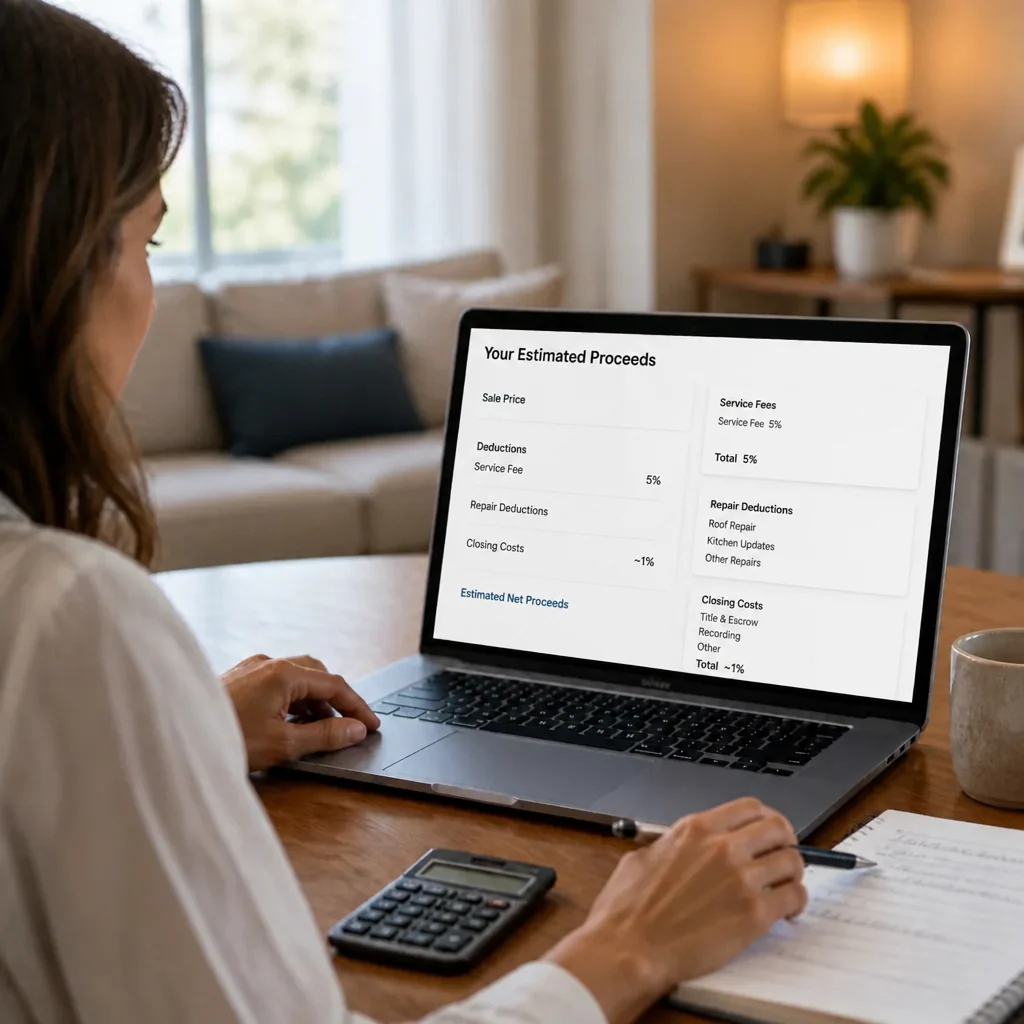
Here's what trips up most sellers: they look at the service fee and stop. But there are actually three separate costs eating into your proceeds, and you need to count them all together to see the real picture.
| Cost Component | Typical Range (2026) | How It Works | Source |
|---|---|---|---|
| iBuyer service fee | 5%–8.5% of sale price | Charged at closing; Opendoor is flat 5%, Offerpad ranges 5%–8%+ | ibuyer.com, Feb 2026 |
| Closing costs (iBuyer-charged) | ~1% (Opendoor) | Additional charge on top of service fee; varies by company | ibuyer.com, 2026 |
| Repair deductions | Varies by home condition | Estimated by iBuyer's contractors after inspection; deducted from final offer | Standard iBuyer process |
| Offer discount vs. market value | 8.79%–13.89% below resale | Built into the offer price; not a separate fee line item but a real cost | Clever study, Feb 2026 |
| Total all-in seller cost | 8%–11% of sale price | Service fee + closing costs + repairs (doesn't include the offer discount) | KDS, 2026 |
Net Proceeds Example: $400,000 Home (Illustrative)
What follows is based on stated assumptions and is illustrative only. Your actual results will vary depending on your market, your home's condition, and the specific company's current fee schedule—which may have changed since this was written.


Assumptions: Home's fair market value: $400,000. iBuyer offer: 8.79% below market (Opendoor's 2026 average discount). Service fee: 5%. Seller-side closing costs charged by iBuyer: 1%. Repair deductions: $8,000 (hypothetical). Traditional agent commission: negotiated separately per current practice; for this example, a combined seller-side commission of 2.5% is used as one illustrative figure—your negotiated rate may differ. See our state-specific commission guides for context.
| Item | iBuyer Route | Traditional Agent Route |
|---|---|---|
| Starting market value | $400,000 | $400,000 |
| Offer / sale price | ~$364,840 (8.79% discount) | $400,000 (or higher with competition) |
| Service or agent fee | −$18,242 (5%) | −$10,000 (2.5% illustrative; negotiate your rate) |
| iBuyer closing costs | −$3,648 (~1%) | Varies; see transfer tax guide |
| Repair deductions / pre-sale repairs | −$8,000 | −$5,000 (optional pre-listing repairs, assumed) |
| Estimated net proceeds | ~$334,950 | ~$385,000 |
See the $50,000 gap? That's the real difference in this scenario. And it swings based on your agent commission (negotiate hard), how competitive your local market is, actual repair costs, and whether multiple buyers push your price above listing. Don't mistake the 5% service fee for your total cost. The actual damage is much bigger than most sellers realize when they're sitting down with the iBuyer's paperwork.
Back to topiBuyers vs. Traditional Real Estate Agents
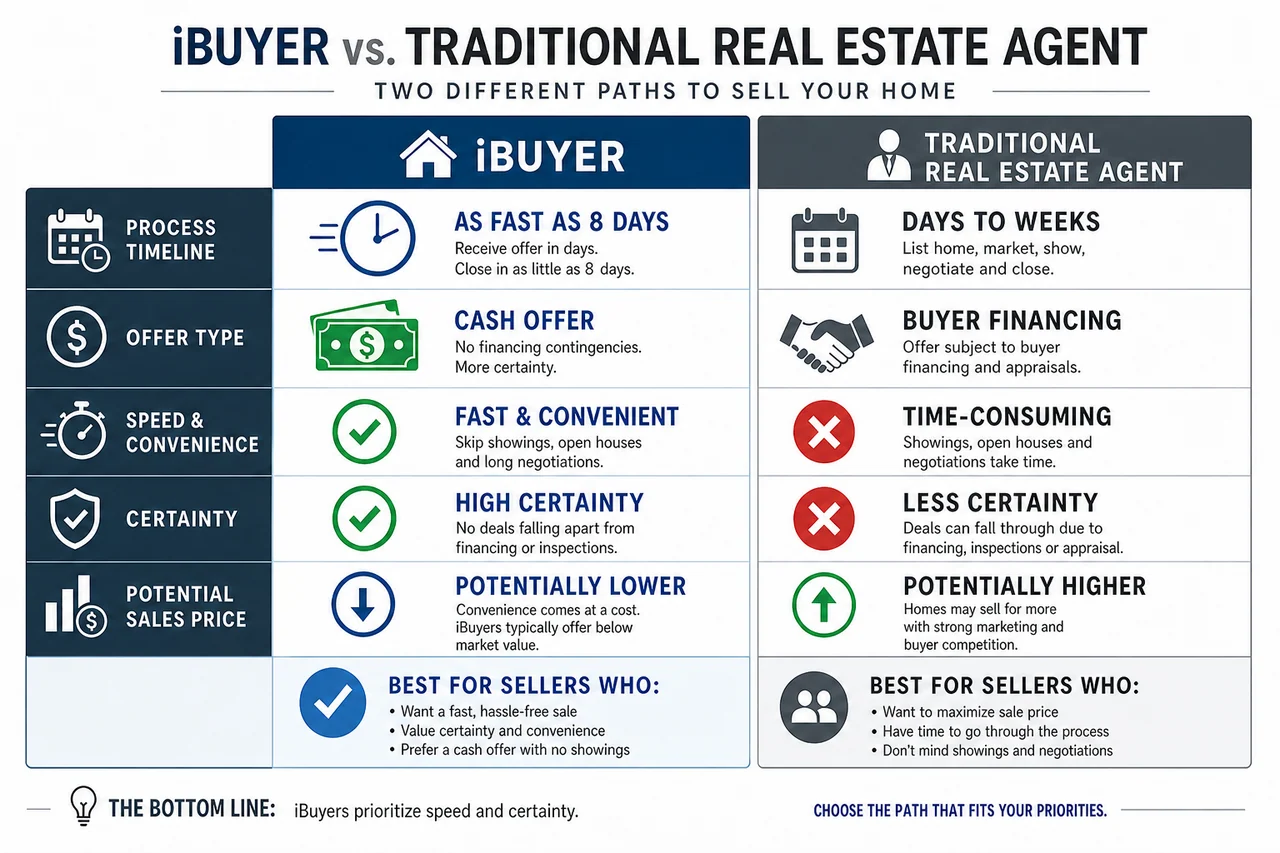
| Factor | iBuyer | Traditional Agent |
|---|---|---|
| Initial offer timeline | 24–48 hours | Days to weeks (market-dependent) |
| Closing timeline | As fast as 8–14 days; up to 90 days | Typically 30–60+ days after accepted offer |
| Sale price | Below market (8–14% discount on average) | At or above market with competition |
| Showings required | No (one inspection visit) | Yes, multiple |
| Staging required | No | Usually yes |
| Negotiation | Minimal; mostly on repairs | Full negotiation on price and terms |
| Closing certainty | High (cash, no financing contingency) | Moderate (financing can fall through) |
| As-is sale | Yes (repairs deducted) | Usually no; repairs often required |
| Geographic availability | Limited metros only | Nationwide |
| Best for | Speed, convenience, certainty | Maximum net proceeds |
Here's what matters most if you're deciding between these two paths. According to a March 2026 survey, only 3% of sellers actually used an iBuyer program. That means the vast majority of homeowners still go the traditional route with agents. And there's a reason—competition and smart marketing push your final sale price higher when you're on the open market.
Back to topiBuyer Eligibility: What Homes Qualify
Not every home qualifies for an iBuyer offer. Both major companies stick to standard single-family homes in active resale markets. Why? Because they need to price your home using an AVM (automated valuation model) and flip it quickly.
- Opendoor generally considers homes priced between $100,000 and $600,000 (prices vary by market), built after 1930, and sitting on lots of up to 2 acres (1–1.5 acres in some markets).
- Offerpad focuses on homes under $1,000,000 and built after 1950.
So what disqualifies you? Manufactured homes don't work. Homes with serious structural damage won't get offers. And if your property has unpermitted additions, active liens they can't resolve fast, or sits in a market where the iBuyer doesn't operate — you're out of luck.
Does your home have unusual characteristics? Large acreage, an attached commercial unit, or a sky-high price tag? An iBuyer offer probably isn't happening, no matter where you live.
Back to topWho Should Use an iBuyer?
There's no one-size-fits-all answer here. It really depends on what matters most to you. But certain situations make the iBuyer model genuinely worth considering:
- Quick relocations. Your new job starts in six weeks. That's nowhere near enough time for a traditional listing, multiple showings, and a 45-day escrow. What's that certainty worth to you? For many sellers, having a confirmed closing date is invaluable.
- Inherited properties. You're managing a probate estate as an heir—maybe you're even out of state. Do you really want to maintain a vacant property for months while you wait for buyers? iBuyers let you close efficiently. See our guide to probate in real estate for context on how inherited properties are transferred.
- Properties in below-average condition. Your home needs serious work. You don't have the cash or time to fix it up. Even with the iBuyer's repair deductions, you might net more than you would listing it at a steep discount. Retail buyers get spooked by major repairs needed.
- Sellers who strongly value certainty. Some people will take less money to eliminate the "what if" factor entirely. That's not settling—that's a legitimate financial choice.
- Investment property liquidation. You're a landlord ready to exit. Tenants have moved out and your carrying costs are eating you alive. An iBuyer's fast timeline suddenly looks a lot better than holding the property through a traditional six-month sale.
When to Avoid an iBuyer
- Your home is in excellent condition and sits in a competitive market. Open-market competition can push prices well above what any algorithm will offer.
- You've got time. The longer you can wait, the more likely a traditional listing makes back that iBuyer discount and then some.
- Maximum net proceeds are your only goal. The data doesn't lie: iBuyer sales return less money to sellers on average.
- Your home doesn't meet iBuyer eligibility criteria (age, price, lot size, location).
iBuyer Market Share and Why the Disruption Predictions Didn't Materialize
Some analysts predicted iBuyers would fundamentally reshape how Americans sell homes when they emerged in the mid-2010s. That prediction didn't pan out. As of 2025, iBuyers accounted for approximately 0.22% of total U.S. home sales — roughly 9,000 homes out of about 4.06 million total transactions. Even with Opendoor controlling approximately 92% of that tiny market, the impact has been minimal.
The real problem? The numbers don't work. Buying homes with your own capital, fixing them up, and reselling them profitably when the market doesn't cooperate is genuinely hard. Zillow learned this the hard way — they exited iBuying in 2021 after significant losses, and that's a company with unmatched data and traffic on their side. RedfinNow followed in 2022. Knock's home swap model paused in 2023. And only 27% of homeowners can accurately define what an iBuyer even is as of 2026. That tells you everything about how niche this category remains.
Does this mean iBuyers are bad? Not necessarily.
What it means is they're a specialized tool for specific situations, not a replacement for the traditional market. The March 2026 survey data showing only 3% of sellers used an iBuyer program backs this up.
Back to topHow Repair Estimates Work — and What You Can Negotiate
Here's where things get tricky. You accept a preliminary offer, and then an iBuyer inspector shows up at your door. This person — usually a contractor hired by the iBuyer — walks through and catalogs everything that needs fixing, replacing, or updating. Then comes the repair credit request. It reduces your final offer price, sometimes significantly.
But these aren't neutral estimates from independent appraisers. The iBuyer's contractor is working off the company's own cost model, and those numbers tend to run higher than what you'd actually pay if you hired a local contractor yourself. You do have some negotiating room. You can push back on individual line items, submit your own contractor quotes as a counteroffer, or volunteer to handle certain repairs yourself before closing. Your leverage is almost gone by this point. You've already walked away from the open market, and saying no to the repairs means losing the deal entirely.
Don't sign off on anything yet. Request the full repair list in writing first. Then get at least one independent contractor quote for each item on that list. Do the math: would it actually make sense financially for you to complete some of those repairs yourself before closing?
Back to topTax Implications of an iBuyer Sale vs. a Traditional Sale
Here's the straightforward part: the IRS treats an iBuyer sale exactly like any other home sale. You've lived in the home for at least two of the last five years as your primary residence? Then you're likely eligible for the capital gains exclusion — $250,000 if you're filing single, or $500,000 for married couples filing jointly. What determines your tax hit is the money in your pocket, not how you sold the place.
But timing changes everything. When you close with an iBuyer versus going the traditional route can push your sale into a different tax year entirely. That matters because your gain gets reported in whatever year the sale closes. If your home has appreciated significantly, talk to a tax professional before you sign anything. This affects estimated tax payments and how much you'll owe when you file.
Transfer taxes are a reality no matter which selling method you choose. They vary wildly depending on your state and even your specific county or municipality. Need specifics? Check our state guides for California, Florida, Colorado, and Washington.
Back to topKey Considerations Before Choosing an iBuyer
Thinking about an iBuyer offer? Here's what you need to work through before you say yes:
- Calculate the real net, not just the fee. Add up the offer discount, the service fee, closing costs they're charging, and repair deductions. Now compare that total to what you'd actually pocket from a traditional listing. Don't forget agent commissions, repairs you'd do upfront, and how long your house sits on the market. The real number is what matters.
- Verify the iBuyer operates in your market. Opendoor and Offerpad don't work everywhere. They're concentrated in specific metros, so if you're outside their service areas, an iBuyer offer just isn't an option for you.
- Get the preliminary offer without obligation. Both major iBuyers let you request a preliminary offer with zero strings attached. Do it. Then grab a comparative market analysis from a local agent and actually compare the numbers before you decide anything.
- Understand the repair deduction process. This matters. Ask how repairs get estimated, if you can push back on specific items, and whether you're allowed to do repairs yourself before closing. Every company handles this differently.
- Match the choice to your actual priority. Speed and certainty? An iBuyer might be your answer. But if you're trying to maximize what you walk away with, the data consistently shows a traditional listing wins in a competitive market.
Here's a smarter move: instead of calling each company separately, some sellers use a service that pulls together multiple selling options in one comparison—iBuyer offers (where available), a traditional agent listing, and direct cash buyers. KDS Homebuyers' seller program does this for all U.S. markets.
Back to topConclusion
Speed. Certainty. Convenience. An iBuyer delivers on all three. If you're under time pressure, hate the thought of strangers touring your home, or own property across the country, those benefits matter. But there's a real cost.
Look at the numbers. Opendoor's 8.79% offer discount and Offerpad's 13.89% discount relative to eventual resale prices aren't small. Add in service fees and repair deductions on top of that, and iBuyer sellers walk away with significantly less money than they'd make listing traditionally. That's not a secret — it's how the model works.
The market itself has shrunk dramatically too. Only Opendoor and Offerpad remain as of 2026. Zillow Offers, RedfinNow, and Knock have all exited. What does that tell you? iBuyers are a specialized tool for specific situations, not a replacement for traditional real estate.
So stop asking whether iBuyers are good or bad. Ask yourself this instead: What's my time, certainty, and convenience actually worth in dollars?
Once you know that answer, you're ready to decide. Get a preliminary iBuyer offer. Request a comparative market analysis from a local agent. Calculate your net proceeds from both options. Then pick the path that matches what you actually need right now.
Back to topFrequently Asked Questions
How quickly can I close with an iBuyer?
It depends on which company you choose. Offerpad gives you the longest window—anywhere from 8 to 90 days after you accept their offer. Opendoor's range is 14 to 60 days. Here's what matters: you get to pick your actual closing date within that window. That flexibility helps if you're coordinating a move or lining up another purchase.
Will an iBuyer buy a home that needs major repairs?
Yes—but You don't need to fix anything before closing. The iBuyer will send an inspector to assess the property, and whatever repairs they find get deducted from your final offer price. Homes with serious structural issues or code violations? Those might not qualify at all. It depends on the company's standards.
Can I negotiate an iBuyer offer?
The initial price? Almost no room there. iBuyers rely on algorithms to set offers, and they don't budge much based on what you want. But you do have some leverage once the inspection happens. You can challenge their repair estimates or submit your own quotes from contractors you've called. Once you've accepted that preliminary offer, though, your negotiating power drops significantly.
Do iBuyers operate everywhere in the U.S.?
No—not even close. As of 2026, Opendoor covers 50+ metro areas while Offerpad reaches roughly 25 markets across 9 states. RedfinNow and Knock have both exited the iBuyer business. If you live in a rural area or smaller city, iBuyers probably aren't an option for you. Check your specific location first before counting on this route.
Is an iBuyer the same as a "we buy houses" cash buyer?
Similar idea, different execution. Both close fast and pay cash. iBuyers are tech companies that use automated valuation models to evaluate hundreds or thousands of homes yearly—and they charge you a formal service fee for it. Traditional cash buyers are usually smaller, local operations. They might close in days instead of weeks, and they often don't have the same fee structure. What really matters? Getting side-by-side offers from both types. That gives you the clearest comparison of speed, net proceeds, and actual costs.
Back to topMore in iBuyers and cash buyers
- Sundae Real Estate Reviews: How It Works for Selling Your House As-Is
- How to Sell a House by Owner for Cash: Avoiding Agents and Closing Fast
- Selling to an iBuyer: Real Reviews and What to Expect
- We Buy Houses: Pros, Cons, and How to Evaluate Cash Home Buyers
- The Easiest Way to Sell a House Fast: Cash Buyers vs. Agents vs. iBuyers
- iBuyer Pros and Cons: Is Selling to an Online Buyer Right for You?
See our guide: “Every Way to Sell Your House, Compared: Costs, Speed and What You Keep” →

