

Selling Your House After Divorce: Legal and Financial Considerations

Table of Contents
- Options for Handling the Marital Home
- Timing: When to Sell Your House
- Legal Considerations and Requirements
- Financial and Tax Implications
- Steps to Selling Your Home During or After Divorce
- Handling Disagreements and Disputes
- Protecting Your Interests and Stability
- Tips for Selling Successfully After Divorce
- Conclusion: Moving Forward with Clarity
- Frequently Asked Questions About Selling Your House After Divorce
Divorce is one of life's most disruptive transitions. Add a shared home to the mix? The complexity multiplies fast. The family home is typically a couple's largest asset — and often its most emotionally charged one. Selling a house after divorce means you'll navigate property division laws, tax implications, mortgage obligations, and co-owner disagreements, all while managing significant personal stress. Getting this wrong can cost tens of thousands of dollars or drag proceedings on for years. But getting it right? That requires a clear understanding of your legal options, smart financial planning, and the right professional support. This guide walks you through every major consideration so you can make informed decisions and move forward with confidence.

Options for Handling the Marital Home
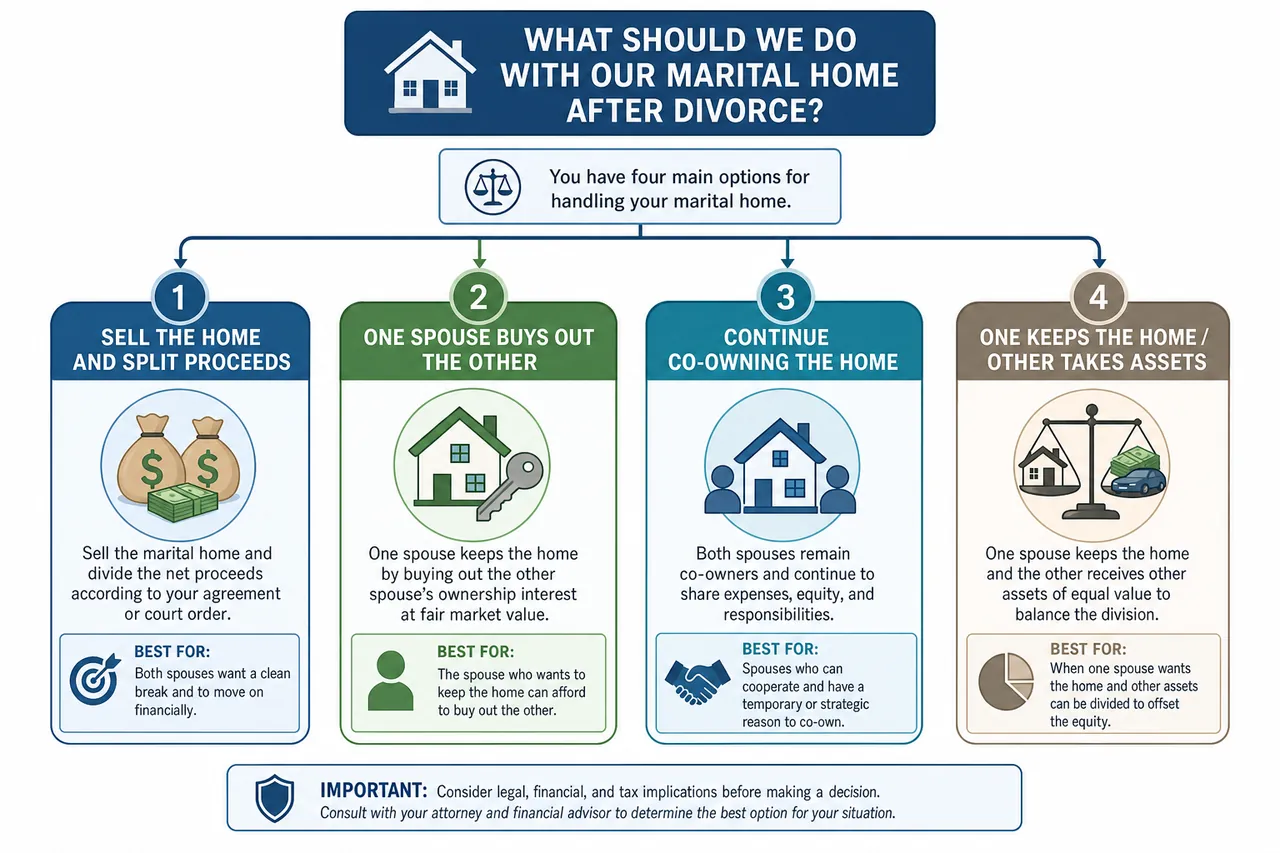
You'll need to make a decision about the house before moving forward. Either both of you agree on what happens next, or a judge decides for you. Here are four main paths forward, and each one comes with its own financial and practical consequences.

Sell the Home and Split the Proceeds
Most divorcing couples go this route. You list the house, sell it, and after you pay off the mortgage, realtor commissions, closing costs, and any liens, you divide what's left according to your settlement agreement. It's straightforward because you're converting a complicated asset into cash that's much easier to split fairly.
One Spouse Buys Out the Other
Your spouse wants to keep the house? They'll need to refinance the mortgage in their own name and pay you your share of the equity. But here's the catch: they have to qualify for that new mortgage on their income alone. With today's higher interest rates, that's becoming a real barrier for a lot of people. Before you agree to any buyout number, make sure your spouse gets an independent appraisal done so you know you're getting a fair price.
Continue Co-Owning After Divorce
Many parents — especially those with kids still at home — choose to wait before selling. You might agree to hold onto the house until the youngest finishes high school, for example. The upside: your children have stable housing. The downside: you're still legally and financially tied to your ex-spouse indefinitely. You'll both be responsible for the mortgage payments, property taxes, insurance, and repairs. You absolutely need a detailed written co-ownership agreement that spells out exactly who pays what and when the house will actually be sold.
One Spouse Keeps the House; the Other Takes Other Assets
Instead of a cash payment, the spouse keeping the house gives up other marital property of equal value. Retirement accounts, investment accounts, or other assets balance out the equity. This only works if you have enough other valuable assets to match the home's equity, and it demands careful appraisals of everything involved.
| Option | Process | Timeline | Financial Outcome | Complexity |
|---|---|---|---|---|
| Sell and Split | List, sell, divide proceeds | 30–90 days after listing | Clean cash split; transaction costs apply | Low–Medium |
| Buyout | Refinance; pay ex their equity share | 30–60 days for refi | One spouse retains asset; requires mortgage qualification | Medium |
| Co-Own Post-Divorce | Defer sale; share costs | Years; set by agreement | Deferred; depends on future market | High |
| Asset Swap | Home vs. other marital assets | Resolved during settlement | Balanced by asset valuation | Medium–High |
Timing: When to Sell Your House
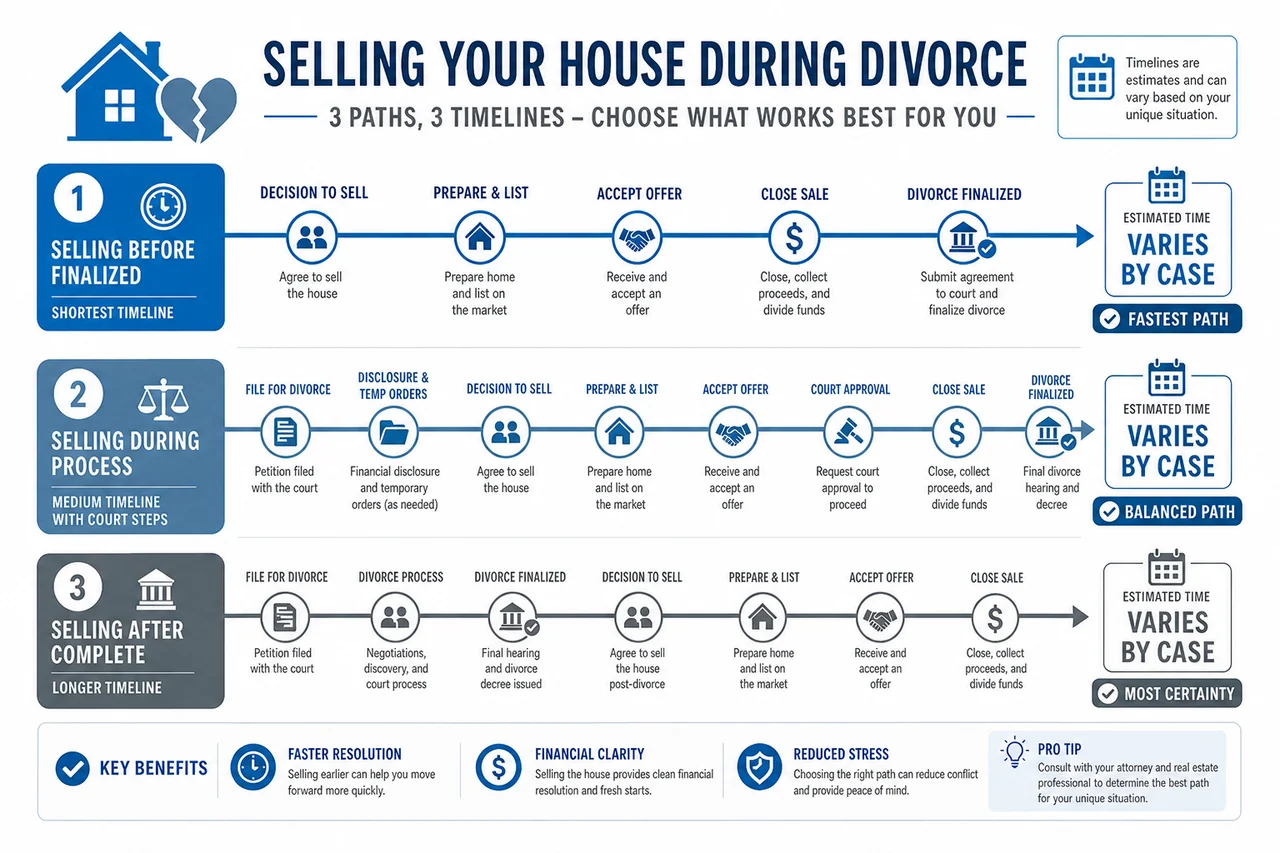
When you sell your house matters more than you might think. The timing relative to your divorce proceedings affects taxes, legal issues, and your bottom line. Each path comes with its own set of advantages and drawbacks.
| Timing | Pros | Cons | Best For |
|---|---|---|---|
| Before Divorce Finalized | Both spouses may qualify for full $500K capital gains exclusion; simplifies settlement | Requires full cooperation; emotional difficulty | Couples with large equity gains and mutual agreement |
| During Divorce Process | Eliminates ongoing shared costs; reduces conflict over asset | May require court approval; harder to coordinate showings | High-conflict situations; properties with carrying costs |
| After Divorce is Complete | Clear legal ownership; simpler decision-making | Individual may only qualify for $250K exclusion; title transfer needed first | When one party is buying out the other or asset swap is involved |
Here's the tax reality: selling while you're still married is usually your best financial move. You and your spouse together can exclude up to $500,000 in capital gains from the sale of your primary residence. Once you're single, that drops to $250,000 each. If your home's worth $800,000 and you bought it for $300,000, that $500,000 difference matters. But here's the catch — don't sacrifice a good deal for a tax break. If your local market's sliding downward, selling fast in a weak market can cost you far more than you'd save on taxes.
Back to topLegal Considerations and Requirements

Your state's property laws will dictate how proceeds get split when you sell. And they're not all the same.
Community Property vs. Equitable Distribution
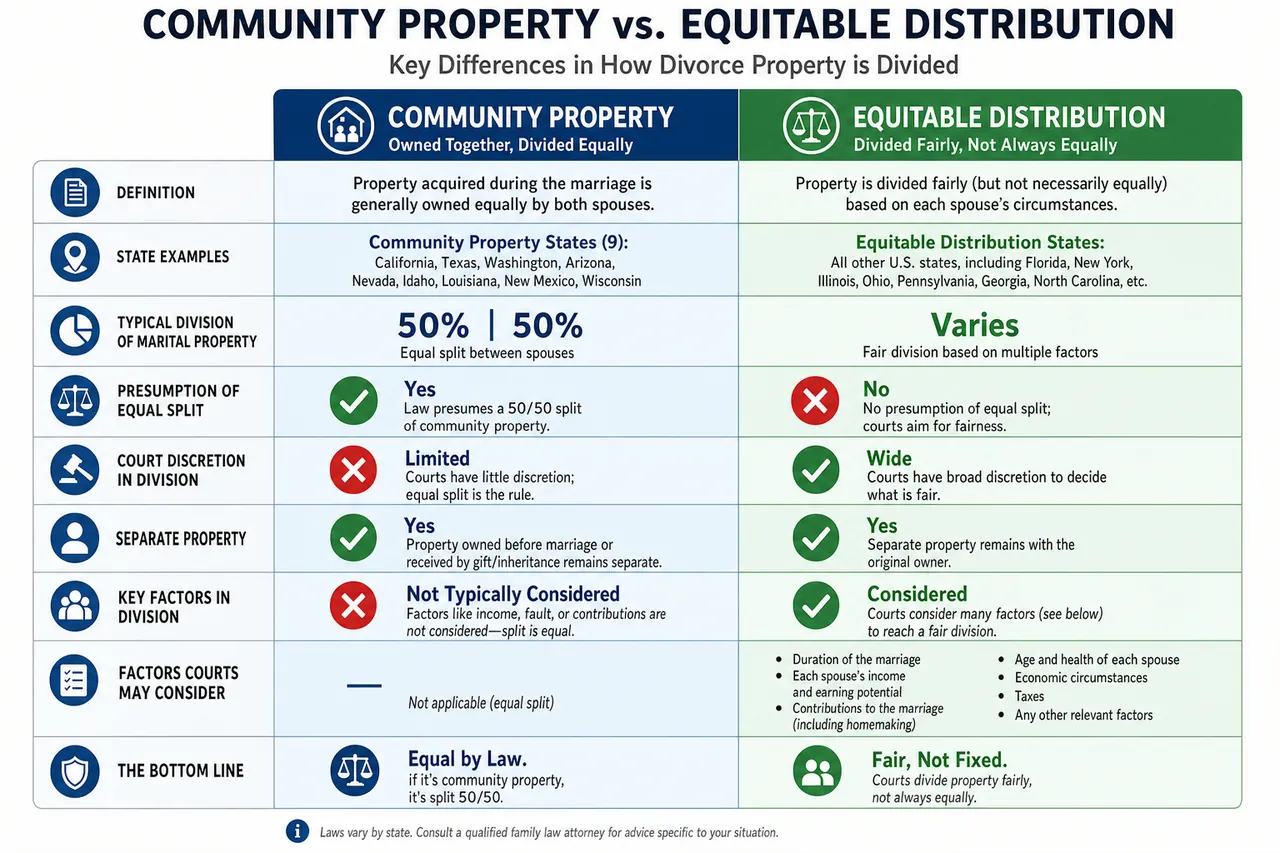
Nine states — California, Texas, and Arizona among them — operate under community property rules. Here's what that means: most assets and debts acquired during the marriage belong equally (50/50) to both spouses. The other 41 states? They use equitable distribution, which divides marital assets "fairly." That doesn't automatically mean 50/50. Courts look at your financial situation, what each of you contributed, and other factors to determine a fair split. This distinction fundamentally changes how the money from your home sale gets divided between you and your ex.
Selling a home in California requires you to understand community property rules. But if you're in Florida, things work differently — it's an equitable distribution state, so courts have more flexibility. The tax and title considerations in Florida reflect this difference, and they matter for your bottom line.
Marital vs. Separate Property
Did one of you own the home before you got married? It might be separate property and off-limits for division. But here's the catch: if you used marital funds to pay the mortgage or improve the place, that changes things. Part of it could convert to marital property. This is where mistakes happen. Get an attorney's guidance.
Required Documentation
When you're selling a divorce home, you'll need several documents in order.
Start with your divorce decree or separation agreement — it'll specify the sale terms. You'll also need a quitclaim deed or warranty deed to officially transfer the title. Both of you must sign the listing agreement and sale contracts in most states. Grab mortgage payoff statements from your lender. And keep any court orders about the property in your file.
Here's a critical detail: if one spouse is keeping the home, the other spouse must come off the mortgage — not just the title. A quitclaim deed won't do that. You're still financially liable for a loan if your name's on it, even if your ex now owns the house.
Back to topFinancial and Tax Implications
When you sell a home during divorce, the tax rules can make or break your financial outcome. Get this right, and you'll protect a meaningful chunk of your proceeds.
The Section 121 Capital Gains Exclusion
Here's what you need to know: IRS Section 121 lets you exclude up to $250,000 in capital gains from your home sale ($500,000 if you're married filing jointly). The catch? You must've lived in and owned the home for at least two of the five years before you sell. Divorce throws a wrench into this formula. Say one spouse moves out before the closing. They can still claim the exclusion if the divorce agreement gives them a use right in the property and their ex's residency time counts toward that two-year requirement. The rules are intricate. You really do need a tax professional to walk through your specific situation.
Mortgage Payoff and Proceeds Division
What actually lands in your pocket? Take the sale price and subtract agent commissions (usually 5–6%), closing costs (1–3%), your mortgage balance, any home equity lines of credit, liens, judgments, and any agreed repairs or seller credits. The remainder gets split according to your settlement agreement.
| Cost Type | Typical Amount | Tax Deductible? | Notes |
|---|---|---|---|
| Agent Commissions | 5–6% of sale price | Reduces capital gain | Negotiable; some agents offer reduced rates for divorce sales |
| Closing Costs (Seller) | 1–3% of sale price | Partially (reduces gain) | Includes title, escrow, transfer taxes |
| Mortgage Payoff | Varies by balance | No | Prepayment penalty may apply on some loans |
| Repairs/Improvements | $0–$30,000+ | Increases cost basis | Can improve sale price; agree on budget in writing |
| Capital Gains Tax | 0–20% of net gain | N/A | Section 121 exclusion may eliminate entirely |
And here's something people often overlook: just like selling a house after a spouse's passing, divorce proceeds require you to track down every lien, loan, and title claim. Don't skip this step. It's the only way to know what actually divides between you.
Back to topSteps to Selling Your Home During or After Divorce

You've both agreed to sell. Now what? A clear process keeps you on the same page and helps you walk away with the most money possible.
| Phase | Duration | Key Actions | Responsible Party |
|---|---|---|---|
| Valuation | 1–2 weeks | Independent appraisal; CMA from agent | Both parties (jointly ordered) |
| Agent Selection | 1–2 weeks | Interview agents; confirm divorce experience | Both parties must agree |
| Preparation | 2–4 weeks | Repairs, staging, decluttering | Coordinated; often one occupying spouse |
| Listing & Marketing | 2–8 weeks | MLS listing, photography, showings | Agent-led; both parties notified |
| Offer Review | 1–3 days per offer | Both spouses review and sign acceptance | Both parties required |
| Closing | 30–45 days after contract | Escrow, title transfer, proceeds distribution | Escrow/title company; both parties sign |
Choosing the Right Real Estate Agent
Not every agent knows how to handle this. You need someone who's actually sold homes for divorcing couples—someone comfortable working with two decision-makers who don't always want the same thing. When you interview agents, ask directly: Have you managed divorce sales? How do you handle it when the two owners disagree? Can you stay completely neutral? This last part matters most. If an agent already knows one spouse personally, that creates a trust problem you don't need. Even the appearance of bias can torpedo the whole deal.
Setting the Asking Price
An independent appraisal beats relying on just the agent's opinion. Why? Because you and your ex have different financial pressures, and an objective third-party number removes that tension. The market might've softened since you bought. That's okay. A realistic asking price that gets serious offers rolling in fast often puts more cash in your pocket than waiting for some peak price that never comes.
Back to topHandling Disagreements and Disputes

One spouse won't budge. Won't sign. Won't cooperate. That's when your sale stalls — and your costs keep climbing. The longer this drags on, the more you both lose.
Mediation
Start here, not in court. A neutral mediator costs far less than litigation and usually moves much faster. You sit down with both parties, and the mediator helps you reach actual agreements on price, timing, and how to split the money. Most divorce attorneys recommend this as your first move when the home sale hits a wall.
Partition Action
Mediation didn't work? Then either co-owner can file what's called a partition action — basically asking a judge to force the sale. Courts grant these requests almost every single time. But here's the catch: you're looking at six to eighteen months of waiting, thousands in legal fees eating into your proceeds, and potentially a fire-sale outcome. And sometimes the property sells at auction for significantly below market value.
High-conflict divorces breed this problem. One spouse weaponizes the home to stall or punish the other. If you're stuck in this situation, get your divorce attorney involved immediately — don't wait.
Back to topProtecting Your Interests and Stability
Children and Housing Stability
Housing stability matters when kids are in the picture. Courts look hard at keeping children in their school and community when deciding what happens to the marital home. That's a real factor in how judges rule.
If you're both keeping the house temporarily for the kids' sake, your co-ownership agreement needs to spell out who pays for what, how you'll split the sale money down the road, and what happens if one of you can't cover your costs. Don't skip these details — they prevent ugly disputes later.
Managing Emotions During the Process
Your home isn't just real estate. It's filled with memories and meaning that go way beyond what the market will pay for it. But here's the hard truth: you need to make decisions based on numbers, not nostalgia.
Will the process be emotionally tough? Absolutely. That's exactly why you should consider working with a therapist or counselor while you're also talking to your lawyer and financial advisor. Keeping those professional relationships on track — with your agent, attorney, and financial planner — creates boundaries that protect everyone involved.
Post-Sale Financial Planning
The sale closes. Your instinct? Spend the money. Don't.
Take real time to look at your post-divorce finances — what you're actually earning, what you actually spend each month, any alimony or support payments, and where you want to live long-term. A financial planner can help you see how your share of the proceeds fits into your overall recovery plan before you lock that money into a new home.
Speed changes everything, though. If you need to end a contested divorce fast or you're bleeding money carrying two households, a cash home buyer can close in days — no waiting for listings, no repairs, no agent delays. And if you're in a high-conflict or time-crunch situation, knowing this option exists can be a real relief.
Back to topTips for Selling Successfully After Divorce
- Put everything in writing. Your listing price, repair budgets, showing access, proceeds distribution — all of it needs to be documented. Ideally, this gets incorporated into your formal divorce settlement or a separate co-seller agreement that both attorneys have reviewed.
- Communicate through professionals where necessary. Can't talk directly with your ex without things getting heated? Route all sale decisions through your attorneys or real estate agent instead. You'll reduce conflict and create a clear paper trail at the same time.
- Stay current on the mortgage. Missing payments tanks both of your credit scores and can kill the sale entirely. Write down who pays what and how those payments get credited against your final settlement.
- Disclose all known defects. Seller disclosure laws don't care about your divorce. Hiding material defects exposes you both to lawsuits after closing.
- Understand the escrow process. An escrow or title company holds the money and handles the proceeds distribution in most states. You'll both sign closing documents — sometimes at different times — and the funds get distributed according to your settlement agreement.
How the house was titled during your marriage matters too. Selling a house after getting married: tax and title considerations walks you through joint ownership and what it means when you're ready to sell.
Back to topConclusion: Moving Forward with Clarity
Selling your house after divorce isn't simple. But it's absolutely doable when you've got solid information and the right people in your corner. Here's what matters most: the timing you choose, how ownership gets structured, your tax strategy, and who you pick as your agent. These decisions aren't small — they directly impact your wallet, sometimes to the tune of tens of thousands of dollars.
Don't let emotion drive these choices. Instead, approach each decision with clear-eyed practicality. Before you sign anything or commit to a major move, sit down with a divorce attorney and a tax professional. Make sure you understand what's actually happening with your money and your legal standing.
And here's the biggest thing: get everything in writing. Every agreement, every understanding, every timeline. This protects you and keeps things from becoming messy later.
When you plan carefully, selling your marital home becomes a real turning point — not the start of a prolonged battle, but the beginning of your financial fresh start.
Dealing with similar situations? You might find our guides helpful too. Check out our resource on selling a house after a spouse's death in California and our guide on selling after marriage in Colorado — both offer state-specific details depending on where your property sits.
Back to topFrequently Asked Questions About Selling Your House After Divorce
Is selling the home mandatory after a divorce?
No. The court won't automatically force you to sell. But here's the reality: if neither of you can afford to buy the other out, and you can't keep owning it together, a sale is usually your best bet. Can't agree? The court can step in and order a sale through what's called a partition action.
Can I sell the house without my ex-spouse's consent?
Not usually. Both names on the title means both signatures required — on the listing agreement, the contract, the closing docs. There's no workaround to force a sale without their signature, except a court-ordered partition action. A few states have narrow exceptions buried in legal separation agreements, but don't count on it.
What documentation is required to sell a jointly owned marital home?
You're going to need several things. Start with your divorce decree or settlement agreement. Then gather the quitclaim or warranty deed, both spouses' government-issued IDs, the current mortgage payoff statement, the original title (or a title search from the closing company), and any court orders that affect the property. Your title company or real estate attorney will tell you exactly what else your state requires.
How long does the process typically take?
Once you both agree to sell, expect 60 to 120 days from listing to closing in most markets. And if the divorce is still being finalized? That'll stretch things out. Want it fast? A cash buyer can close in one or two weeks — but you'll take a below-market offer in exchange.
What happens if there's still a mortgage on the home?
Your lender gets paid first from the sale proceeds. Whatever's left goes to you and your ex. Now, what if you're underwater — selling for less than you owe? Both of you stay on the hook for that shortfall unless you negotiate a short sale or get the lender to agree otherwise. This situation demands immediate help from a real estate attorney and your mortgage servicer.
Back to top
