Selling a Section 8 Property: Regulations, Obligations, and Process

Table of Contents
- Understanding Section 8 Property Ownership and Contracts
- Housing Quality Standards (HQS) Inspections and Their Impact on Sale
- Three Primary Sales Options for Section 8 Properties
- Tenant Rights and Protections During a Sale
- How Section 8 Status Affects Your Buyer Pool
- Steps to Prepare Your Section 8 Property for Sale
- Legal and Administrative Considerations
- Tax Implications for Section 8 Property Sellers
- How to Market a Section 8 Property Effectively
- Common Challenges and How to Address Them
- Conclusion
- Frequently Asked Questions
You can sell a Section 8 property whenever you want—there's no federal law stopping you. What gets tricky is how the sale works with your Housing Assistance Payment (HAP) contract, what your tenant can and can't do, and what buyers will actually want. If you dig into these details before listing, you'll dodge headaches later and protect yourself legally and financially.
This article is for general informational purposes only and isn't legal, tax, or financial advice. Section 8 rules vary by state, county, and local housing authority. Talk to a licensed attorney and a CPA about your specific situation before you decide anything.

Understanding Section 8 Property Ownership and Contracts

What You Own vs. What the Tenant Has
You own the property. That's clear. But your tenant? They hold the Housing Choice Voucher (HCV) — and it belongs to them, not to your building. This distinction changes everything when you're selling. The voucher moves with the tenant if they relocate. You can't transfer it, void it, or bundle it into your sale. As of December 31, 2025, 2,334,114 occupied voucher units operated under the Housing Choice Voucher program. That's a lot of landlords grappling with this exact situation.
Housing Assistance Payment (HAP) Agreements Explained
Think of the HAP contract as the financial rulebook. It's a separate agreement between you and your local Public Housing Authority (PHA) — not a lease. The HAP contract spells out when and how the PHA sends its portion of rent your way. Tenants typically pay 30% of their adjusted monthly income toward rent, and the PHA picks up the rest up to the payment standard. But if the unit rent climbs above that payment standard, the tenant's share can jump to 40%. As of December 31, 2025, the average monthly HUD Housing Assistance Payment per voucher hit $1,255, with tenants chipping in an average $493 per month on top of that.
Your local PHA sets its payment standards within a specific band: 90% to 110% of the local HUD Fair Market Rent (FMR), per 24 CFR 982.503(c). The FY 2027 FMRs went into effect October 1, 2026. National average for a two-bedroom? $1,760/month — that's up 2.0% from FY 2026.
How Section 8 Contracts Work During a Sale
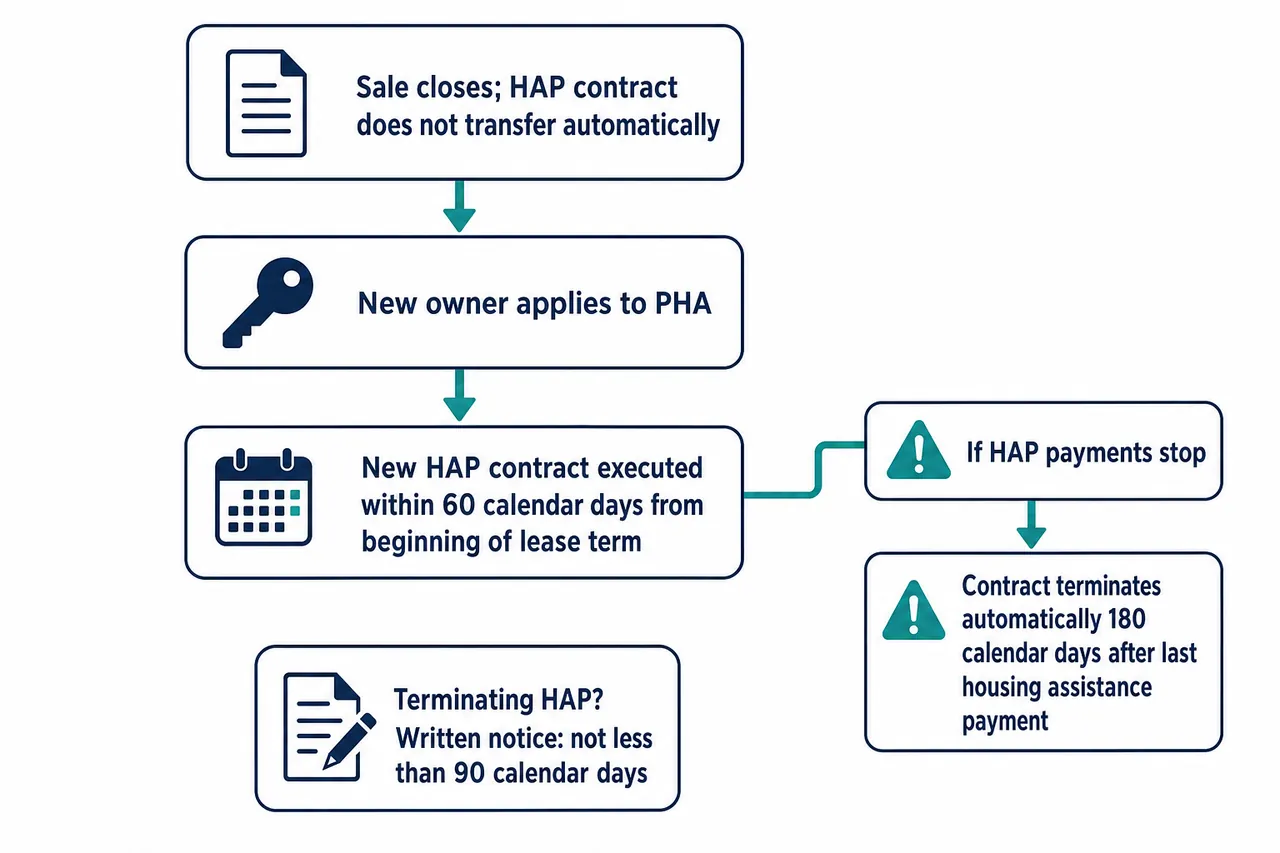
The HAP contract between you and the PHA doesn't automatically transfer to the next owner. Per 24 CFR 982.455, if HAP payments stop — say, because closing happened without a new HAP contract in place — the agreement terminates automatically 180 calendar days after the last housing assistance payment. A new owner who wants to keep Section 8 tenants needs to execute their own HAP agreement with the PHA. And you've got a tight deadline.
Per 24 CFR 982.305(c), that new HAP contract must be signed within 60 calendar days from when the lease term begins. Miss that window and the program relationship ends. The new owner loses the Section 8 payments.
Need the full picture of how all these pieces fit together? Read Selling a Section 8 Property: What You Need to Know.
Back to topHousing Quality Standards (HQS) Inspections and Their Impact on Sale
Annual Inspection Requirements
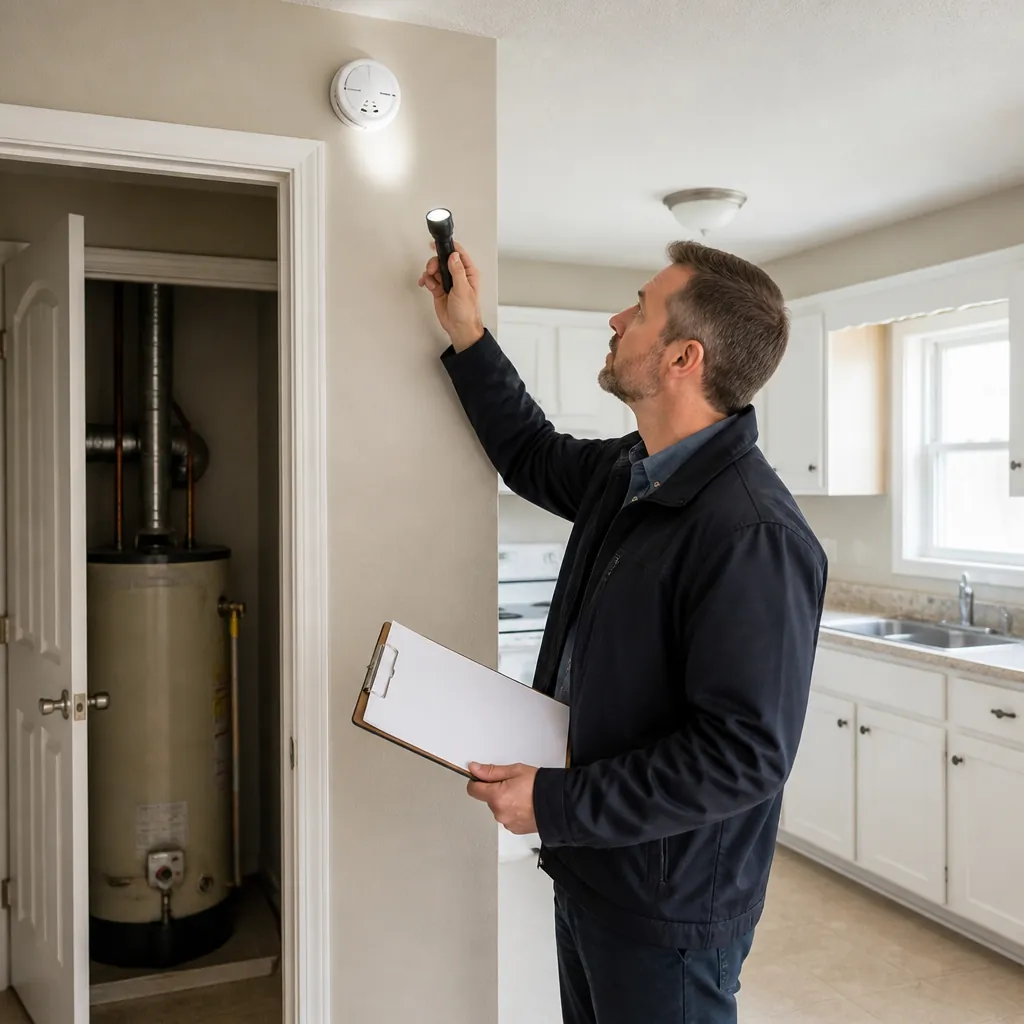
Your Section 8 unit's got to pass Housing Quality Standards (HQS) inspections run by your local PHA. At minimum, they happen once a year. The inspectors are looking at health, safety, and structural integrity — heating systems, plumbing, electrical work, smoke detectors, roof condition, sanitation. Miss an inspection or don't fix the problems within the required window? The PHA can suspend your HAP payments.

Big change coming. The NSPIRE inspection standard takes over from HQS for Housing Choice Voucher units starting February 1, 2027. If you're planning to sell in 2026 or early 2027, find out which inspection protocol your PHA's using right now and what that transition means for your compliance obligations.
How Inspection Requirements Intensify Over Time
The longer your property's been in the Section 8 program, the more scrutinized it becomes. Your PHA keeps records of every inspection. Properties with repeated failures or a pattern of slow repairs? They get moved to semi-annual inspections, quarterly inspections, sometimes worse — all depending on what your PHA decides. That aging HVAC from year one, that older water heater, those deteriorating windows that passed before — they cross into deficiency territory as they age and as standards tighten. You've owned the property for ten years or more? Don't assume you're still passing. Hire an inspector to do your own walkthrough against current HQS standards (or NSPIRE if we're past February 2027) before you list. Deferred maintenance can derail a sale mid-transaction if you're not careful.
The 30-Day Repair Requirement
An HQS inspection flags something wrong. You've typically got 30 days to fix it. Miss that deadline and the PHA suspends your HAP payments. For sellers, this matters because deferred maintenance doesn't just disappear — it stays in your property's inspection record. Buyers doing their homework will pull those records. And a pattern of repeated failures and late repairs tells any serious investor that you've neglected the property and they're inheriting future liability.
How Inspection History Affects Your Buyer Pool
Your inspection history isn't private. Buyers can request inspection reports from the PHA or negotiate access as part of due diligence. A clean inspection history is gold — it's a selling point that opens up your buyer pool. A history of repeated failures? You're stuck selling to only the most aggressive investors, and they'll demand a meaningful price discount. Fix outstanding inspection issues before you list. Don't wait until you've got an offer on the table.
Back to topThree Primary Sales Options for Section 8 Properties
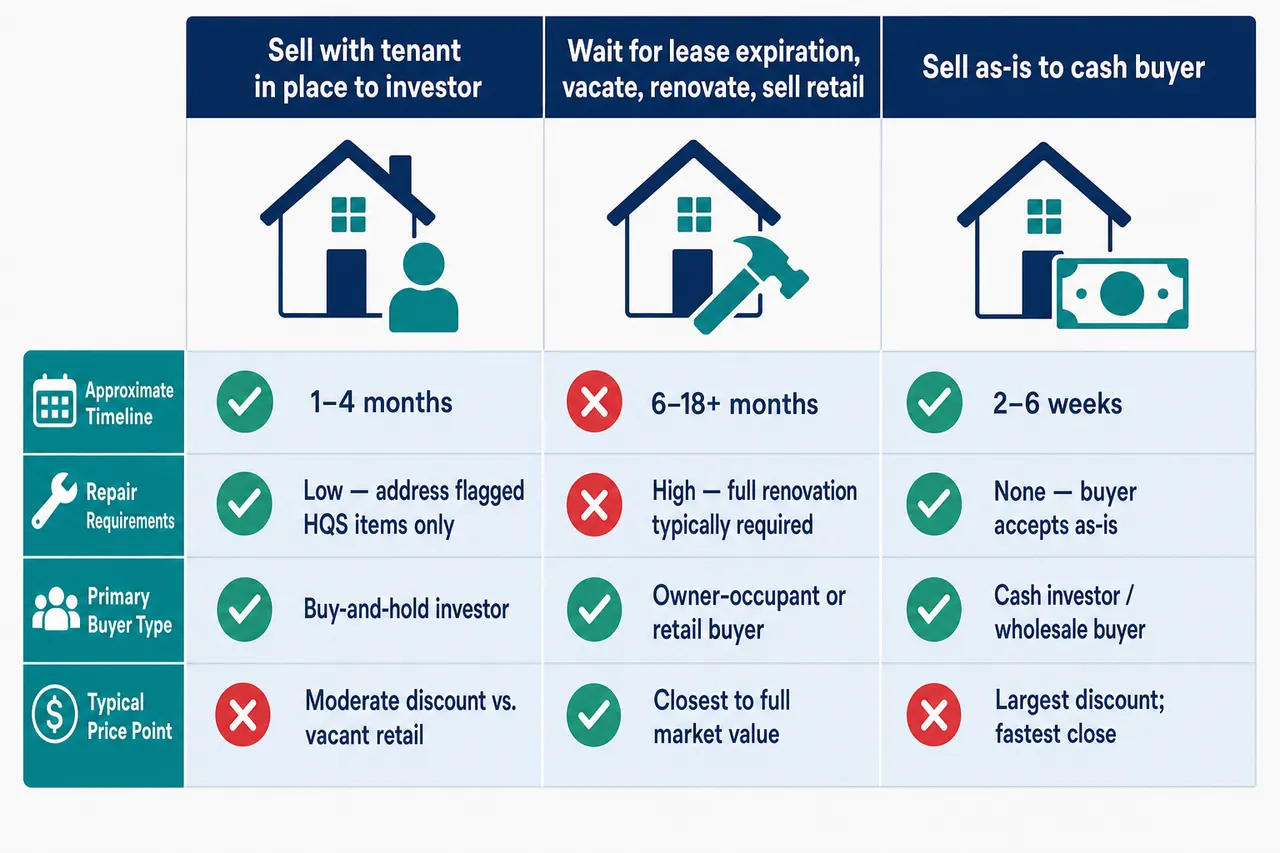
You have three realistic paths forward. Each trades off differently when it comes to timeline, effort, and what you'll likely pocket at closing. Your financial situation, your relationship with the tenant, and what's happening in your local market all play a role in which one makes sense for you.
| Selling Option | Approximate Timeline | Repair Requirements | Tenant Involvement | Primary Buyer Type | Typical Price Point |
|---|---|---|---|---|---|
| Sell with tenant in place to investor | 1–4 months | Low — address flagged HQS items only | Tenant stays; buyer assumes relationship | Buy-and-hold investor | Moderate discount vs. vacant retail |
| Wait for lease expiration, vacate, renovate, sell retail | 6–18+ months | High — full renovation typically required | Tenant vacates at lease end | Owner-occupant or retail buyer | Closest to full market value |
| Sell as-is to cash buyer | 2–6 weeks | None — buyer accepts as-is | Varies; buyer assumes situation | Cash investor / wholesale buyer | Largest discount; fastest close |
Option 1: Sell with Tenant In Place to an Investor
Most landlords find this the simplest path administratively. You market to investor buyers who know the Section 8 program inside and out. The tenant doesn't go anywhere. The lease keeps going. The new owner then works with the PHA to set up their own HAP contract—they've got 60 days to make it happen.
Investors see real value here. A Section 8 tenant means government-backed rent flowing in predictably every month. That PHA payment shows up whether the tenant lost a job or hit a rough financial patch. For buy-and-hold investors chasing steady cash flow, that's not a problem—it's the whole point. But you'll take a hit on price compared to selling an identical vacant property. The buyer's absorbing the administrative work and stepping into an existing tenant relationship, and they want compensation for that.
Option 2: Wait for Lease Expiration, Vacate, Renovate, and Sell Retail
Your lease ends soon and you're thinking about not renewing. That means the tenant leaves. Once the place is empty, you can renovate and list it to the entire retail market—including owner-occupants who'd never touch a tenant-occupied Section 8 unit. You'll get closer to full market value this way. The cost? You need renovation money and patience. And plenty of it.
Between lease expiration, the tenant moving out, the work itself, the listing period, and closing, you could easily be looking at 18 months or longer, depending on your market and what shape the property's in. One critical thing: choosing not to renew doesn't magically end your HAP contract before that lease term's over. You still have to follow all the notice and HQS rules until the tenant actually leaves. Check the notice obligations section below for the specifics.
Option 3: Sell As-Is to a Cash Buyer
Cash buyers take Section 8 properties exactly as they sit. No repairs. No renovations. No evicting anyone first. You're trading maximum price for speed and certainty. This works especially well if you're dealing with years of deferred maintenance, a tenant situation that's become a headache, an estate property, or financial pressure you can't ignore.
Back to topTenant Rights and Protections During a Sale
What Rights Section 8 Tenants Have
Section 8 tenants keep their rights when you sell. That lease stays active through its term no matter who owns the building. When a new owner takes over a tenant-occupied Section 8 property, they're stepping into your position as landlord — they're stuck honoring those lease obligations and the remaining lease term.
Federal law sets a floor: at least 30 days' notice before eviction or termination of tenancy for most voucher units, according to the CARES Act, 15 U.S.C. § 9058. And many states demand much longer notice periods. Under 24 CFR 982.310(e)(2)(ii), any eviction or termination notice you serve on the tenant must go to the PHA at the same time.
Your state might have additional protections layered on top. Check our guides for California, Florida, Colorado, Washington, Indiana, and Tennessee.
Notice Requirements and HAP Contract Termination
Opting out or terminating the HAP contract is different from just selling the property. If that's what you're doing, federal rules under 24 CFR 982.455 demand at least 90 calendar days' written notice to HUD, the housing authority, and your tenant family. This 90-day period stands on its own — it's completely separate from whatever notice your state's landlord-tenant law requires. Don't mix them up. Some states want 60 days, others 90, and some demand 120 days or more to terminate a lease — you need to verify your state's specific requirement and talk it through with a local landlord-tenant attorney.
Need the details? Read Section 8 Notice to Sell Property: Your Obligations and Timeline for specific guidance on your notice timeline.
Back to topHow Section 8 Status Affects Your Buyer Pool
Investor Buyers vs. Owner-Occupant Buyers
Own a Section 8 property with a tenant? You've just locked out owner-occupants from buying it. That's a problem because owner-occupants are the ones who typically bid the highest prices in any neighborhood. They can't live there while someone else does, and frankly, most of them don't want to deal with the PHA paperwork, inspections, and compliance rules that come with Section 8.
Investor buyers? They actually like Section 8. The government portion of the rent hits the account reliably. It won't bounce. A tenant might lose their job, but the PHA's payment doesn't stop. For investors focused on long-term cash flow—people building portfolios one steady property at a time—that predictability is worth paying a solid price, even with the annual inspections and administrative burden.
| Stakeholder | Primary Concern | Incentive Structure | Risk Tolerance | Timeline Preference |
|---|---|---|---|---|
| Seller (you) | Net proceeds and legal compliance | Maximize price, minimize liability, exit cleanly | Low — wants certainty | As fast as compliant |
| Buy-and-hold investor | Stable, government-backed cash flow | Cap rate, rent stability, inspection compliance burden | Moderate — accepts tenant and program complexity | Flexible; prefers occupied |
| Owner-occupant | Immediate possession and livability | Homeownership at or near market value | Low — avoids program complexity | Wants vacant at closing |
| Cash buyer / investor company | Acquisition at discount with minimal friction | As-is purchase, fast close, renovation upside | High — accepts deferred maintenance and tenant situations | Shortest possible |
Market Value Implications
When you sell with a Section 8 tenant in place, expect to take a haircut. These properties sell for less than the same house would fetch vacant and on the open market. How much less? That depends on your market, the tenant's history, your inspection record, and how much time is left on the lease. But the discount is real. And measurable.
What's driving it? A smaller pool of buyers. The red tape. No owner-occupants bidding. That's why you need to think hard: sell now at a discount, or wait until the lease ends, renovate, and list it vacant? The math matters here.

Steps to Prepare Your Section 8 Property for Sale
Review Your HAP Agreement
Pull your actual HAP contract right now. Read through the termination and transfer clauses carefully. Older contracts sometimes have different provisions than what current federal regulations require, so don't assume yours is standard. What does your specific agreement say about notice periods, assignment to a new owner, and what you need to do during the transition? If you don't have a copy, call your PHA — they're required to keep records and can send it to you.
Address Outstanding HQS Issues
Get your most recent HQS inspection report. Write down every deficiency that's still open. Fix these before you list the property. Why? Because outstanding repairs can jeopardize your HAP payments while the sale is happening. And investor buyers see repair-required status as a major red flag. A property in good standing signals that you've kept things up — which strengthens your negotiating position.
Gather Your Documentation Package
Investor buyers will ask for all of this anyway, so get it organized now:
- All HQS inspection reports for the past three years
- Current HAP contract and payment history
- Current lease agreement with the tenant
- Maintenance and repair records
- Utility bills and any utility allowance documentation
- Local PHA contact information and your landlord account status
Having this ready speeds up due diligence. It also shows you're organized and compliant — which works in your favor when you're negotiating.
Back to topLegal and Administrative Considerations
HAP Contract Termination at Closing
Your HAP contract doesn't just hand off to the new owner at closing. That's not how it works. The PHA has to draw up an entirely new HAP contract with whoever's taking over the property. Before you close, touch base with your PHA about their process and what paperwork they'll need from the buyer. Some PHAs have this down to a science; others ask the new owner to fill out a complete landlord application from scratch. Here's what matters: federal rules give PHAs 60 days from the lease start date to execute that new contract. If the PHA drags their feet, your buyer stops getting government rent checks — which is exactly why they'll want to factor that risk into their offer.
Housing Authority Coordination
Tell your local PHA about the sale as soon as you know it's happening. While federal regs don't technically mandate seller notification, you need to do this anyway because the process won't move without it. The PHA has to identify the new landlord, confirm they're eligible to participate, and get that HAP contract signed. And PHAs operate at the county level, and they're not all equally efficient. Some move fast; others have massive backlogs, especially if your county has a lot of Section 8 vouchers in circulation. Add PHA processing time to your closing schedule — not as an afterthought, but as a real line item.
Tenant Portability After Sale
What if the new owner doesn't want to keep Section 8 tenants once the lease is up? Depending on when the tenant started, they might be able to port their voucher elsewhere. Under 24 CFR 982.353(c), tenants can port to a different jurisdiction — but only after 12 months of tenancy from their first lease date. Miss that window, and portability gets complicated. When you're talking to tenants about the sale, they need to know where they stand on that 12-month clock.
State-Specific Variations
Federal rules are the baseline. That's it. Your state probably piled on additional protections. California's AB 1482 requires just-cause eviction standards, and individual cities there have their own rent control rules that sit on top of everything else. Washington state has its own tenant notification requirements when you list a property for sale. Florida and Indiana have different notice periods entirely. Don't assume federal guidelines are enough — work with a licensed attorney in your state to verify what you're actually required to do.
Back to topTax Implications for Section 8 Property Sellers
Selling a rental property isn't just a transaction — it's a tax event. Two big ones will hit your bottom line: depreciation recapture and capital gains tax. Here's what happens. You've claimed depreciation deductions for years. The IRS wants that money back when you sell, and they'll tax it as ordinary income up to the maximum rate. Then there's capital gains tax on anything you made above your adjusted basis.
Want to dodge those taxes? A 1031 exchange might work. You reinvest the sale proceeds into another like-kind property and defer the gain. But there's a catch with timing. You have exactly 45 days from closing to identify your replacement property, then 180 days to complete the full exchange. You'll need a qualified intermediary to handle it. The rules have conditions and exceptions we won't cover here — but your CPA should know them inside and out. Talk to a real estate tax specialist before you close, not after.
Things get messier if the property is part of an estate. The tax picture shifts significantly. Check out our Executor's Guide to Selling Estate Property for that situation. And if divorce is involved? See Selling Property in a Divorce: Legal Process and Rights.
Back to topHow to Market a Section 8 Property Effectively
Forget listing your Section 8 property on the standard MLS. That's where owner-occupants shop on Zillow—not where your actual buyers are looking. If you want results, you need to reach investors instead.
- Investment property marketplaces — platforms like Crexi, LoopNet, or investor-focused portals that attract landlords and cash buyers
- Local real estate investor associations (REIAs) — landlords who already own Section 8 properties understand the program and are your most likely buyers
- Direct outreach to property management companies — companies managing Section 8 portfolios often have clients looking to expand
- Cash buyer networks — companies and investors who specialize in as-is acquisitions
Lead with the income stream when you're marketing. That's what matters to them. Put the HAP payment amount front and center, along with the tenant's portion, the total contract rent, and the inspection compliance status. Investors buy on cash flow, not emotion. Show them the numbers right away. Don't make them dig or ask questions.
Back to topCommon Challenges and How to Address Them
Inspection-Related Issues
Open HQS deficiencies give you two paths forward. You can fix them before listing, or you can disclose them and adjust your price to match. Trying to hide known deficiencies? That's legally dangerous and won't work anyway — investor buyers will catch them during due diligence. The transparent sellers win here. When you're honest about your property's condition and show its full inspection history, buyers trust you more and the whole due diligence process moves faster.
Smaller Buyer Pool
Your pool of potential buyers is smaller. That's not failure — that's just reality, and it's actually workable.
Investor buyers and cash buyers close faster and need fewer contingencies than retail buyers would. You'd rather work with ten serious investors than fifty flaky retail buyers who back out at inspection anyway. Price your property right for the investor market and get it in front of investor channels, and suddenly that smaller pool isn't a problem anymore.
Tenant Communication
Your tenant isn't blocking the sale. They're part of it.
Tell them what's happening with the timeline, remind them about their rights, and walk them through what buyer showings actually look like. When tenants feel kept in the dark or disrespected, they make showings difficult. When they know what's coming and believe you'll protect their rights, they cooperate. Write down every agreement you make with your tenant — email works. And if you're offering cash-for-keys to get them out early, make sure it's truly voluntary, fully documented, and nothing coercive is happening.
Multiple owners or an estate complicates tenant communication even more. See our guide on Selling Inherited Property With Multiple Owners: Rights and Process for related considerations.
Back to topConclusion
Selling a Section 8 property isn't harder than selling a standard rental—it's just different. And once you understand the mechanics, you can move forward with confidence. Remember: your tenant owns the voucher, not your property. The HAP contract terminates at closing, and your buyer will need to sign a new one within 60 days. Your tenant stays protected no matter what happens. The 90-day notice requirement? That's the minimum under federal law, not the maximum.
You've got three real paths forward. Sell to an investor while your tenant's still there. Wait out the lease and market to retail buyers. Or unload the property to a cash buyer as-is. Which one works depends on your cash situation, how fast you need to move, and what shape the place is in.
Before you list anything, fix those HQS violations. Gather your paperwork. Talk to your PHA before you need them. Market to investors, not homebuyers—they understand Section 8.
Get a real estate attorney and a CPA involved before you close. The tax and legal side of this deal is personal to your situation, and no general guide can cover it all.
Back to topFrequently Asked Questions
Does a new buyer automatically take over my Section 8 HAP contract?
No. The new owner must apply with the PHA and execute a new HAP contract. Your existing HAP contract between you and the PHA doesn't transfer automatically at closing. Federal regulation requires this new contract to be executed within 60 calendar days from the start of the lease term. Miss that window? The program relationship lapses and your tenant may need to find a new qualifying unit.
Can I sell my Section 8 property while the tenant is still living there?
Yes. The lease continues through its term regardless of ownership change. You can absolutely sell with the tenant in place. The new owner steps into your role as landlord and must honor the remaining lease term. Many investor buyers actually prefer occupied Section 8 properties because they get immediate, government-backed rental income from day one.
What notice do I have to give before terminating the HAP contract?
Federal regulation under 24 CFR 982.455 requires not less than 90 calendar days written notice to the HUD field office, the housing authority, and the tenant family. But your state may require additional or longer notice under landlord-tenant law. The 90-day federal requirement and your state's lease termination requirements run independently — you must comply with both.
Will I sell my Section 8 property for less than a comparable non-Section 8 home?
Typically, yes — when selling with a tenant in place. Only investors will buy it, not owner-occupants. Add in the administrative complexity of the program, and you're looking at downward price pressure compared to vacant, retail-ready comparable properties. The discount varies by market, inspection history, and tenant situation. You can recover much of this gap by selling vacant after the lease expires and doing renovation work, but that takes time and capital.
What happens to my tenant's voucher if I sell and the new owner doesn't want to participate in Section 8?
The tenant retains their voucher — it belongs to them, not the property. If the new owner declines to establish a HAP contract and doesn't renew the lease, your tenant must find a new unit that accepts vouchers. If your tenant has completed at least 12 months of tenancy from the first lease date, they may be eligible to port their voucher to another jurisdiction under 24 CFR 982.353(c). They should contact their PHA promptly to understand their options.
Back to top