

Selling a Rental Property at a Loss: Tax Deductions and Rules

Table of Contents
- Understanding Rental Property Loss Sales
- Why Property Owners Sell Rental Properties at a Loss
- Tax Implications of Selling at a Loss
- Tax Advantages of Selling at a Loss
- Sell vs. Hold Decision Matrix
- Alternative Options to Selling at a Loss
- Steps to Optimize a Loss Property Sale
- Special Situations and Considerations
- Making the Final Decision
- Conclusion
- Frequently Asked Questions
Selling a rental property at a loss? It's not what you planned for — but it happens more often than you'd think. Here's the thing: the tax consequences are way more complicated than just writing off your loss. How long you've owned the property matters. So does the depreciation you've claimed. And your other income plays a role too. Depending on these factors, selling at a loss can actually cut your tax bill significantly, stop the bleeding on a cash-flow problem, and give you money to invest elsewhere. This guide breaks down exactly how the IRS handles these sales, which deductions you can actually claim, and what you need to think through before you sign anything.
Wondering what selling will cost? Start with our guide to seller closing costs. It breaks down every seller cost at closing, the surprises, and ways to pay less.

Understanding Rental Property Loss Sales
What Constitutes a Tax Loss on Rental Property
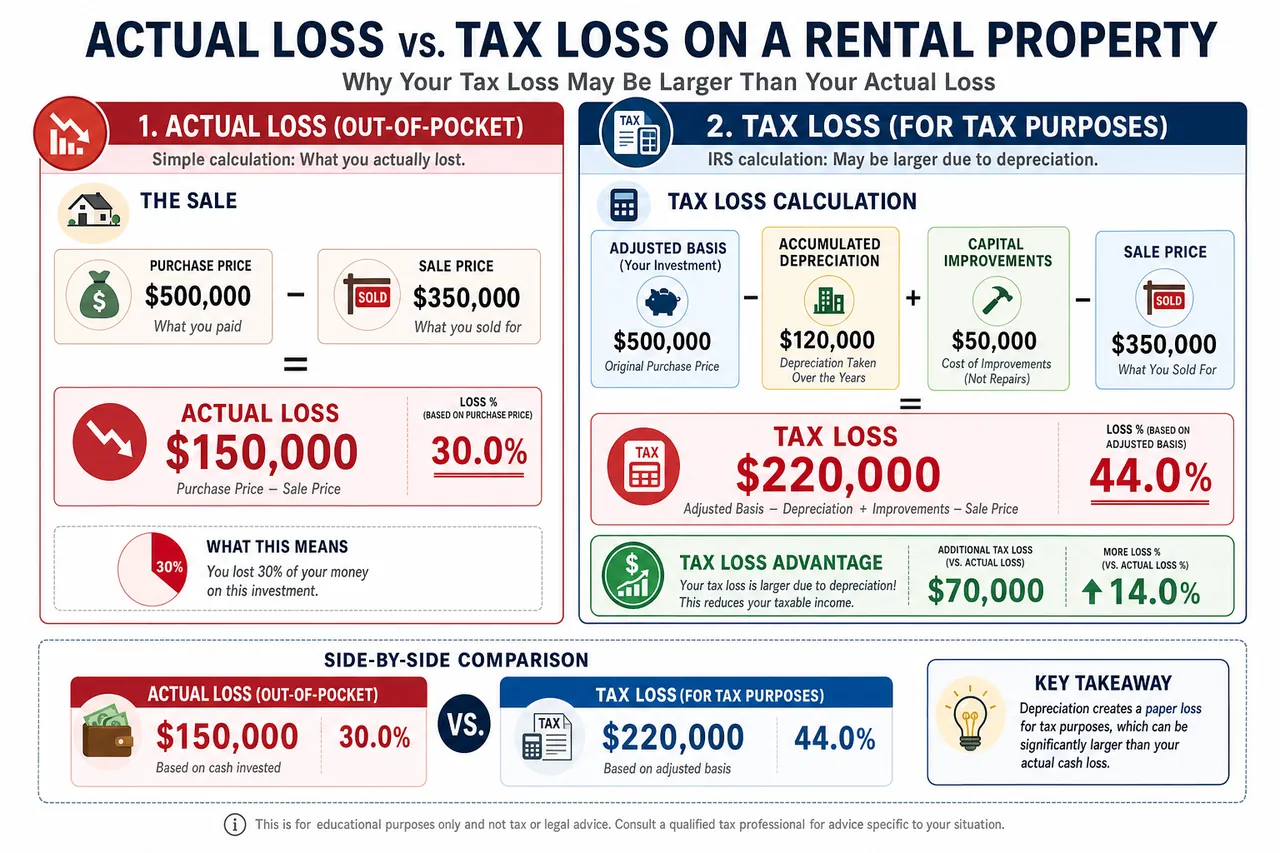
Here's the key: a tax loss happens when your amount realized (that's your sale price plus any debt relief, minus what you paid to sell) falls short of your adjusted basis in the property. And it's not as simple as checking what you paid against what you got. Your basis shifts up and down based on several adjustments over the years you owned it.

The Role of Adjusted Basis and Depreciation
Start with your original purchase price, add closing costs and any capital improvements you made — new roof, HVAC system, major renovations. Then comes the part that trips people up. Your basis gets reduced by every year of depreciation you've claimed — or were allowed to claim. The IRS has an "allowed or allowable" rule that matters enormously. Per Reed Corp Tax, even if you skipped taking depreciation deductions, the IRS will calculate your recapture as though you'd taken every dollar available. Residential rental property depreciates over 27.5 years on a straight-line basis. After several years of ownership, that depreciation reduction can be huge.
The Difference Between Actual Loss and Tax Loss
Your real financial loss doesn't always match your tax loss. Depreciation lowers your adjusted basis — which means you can sell a property for less than you originally paid and still owe taxes instead of claiming a deduction. You'd owe depreciation recapture. But here's the flip side: a property that seems to have lost value might actually generate a larger tax loss than you'd expect once you factor in selling costs and all your basis adjustments. Do the math before you list.
Back to topWhy Property Owners Sell Rental Properties at a Loss
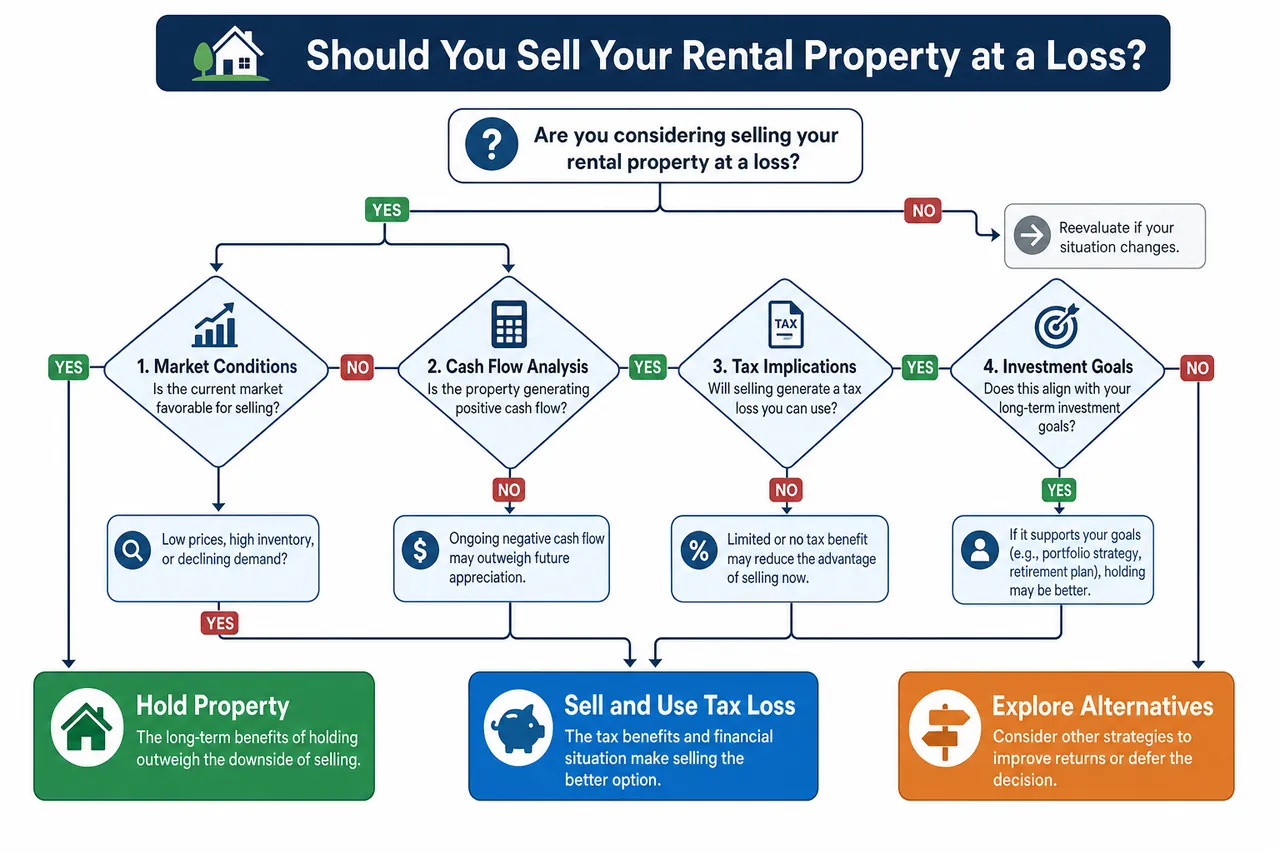
Most owners don't sell at a loss for just one reason. Understanding what's driving your decision helps you figure out your best tax strategy and next move.
- Market decline and economic changes: Your property might've cost $400,000 five years ago. Today? It's worth $350,000. Local or regional downturns hit hard, especially if you bought near the peak.
- Negative cash flow and financial strain: Empty units eat your profits. Then your property taxes jump. Your insurance goes up. The HOA bill arrives. Suddenly, holding onto the property costs more than dumping it, even at a loss.
- Changing investment goals: You moved from real estate into stocks. Or you're pivoting from residential units to commercial. Sometimes you've just got to clear out the underperforming assets.
- Property condition and deferred maintenance: That roof needs $50,000. The HVAC is shot. A buyer who can renovate might actually get more value from the property than you can sitting there stuck with it.
- Personal circumstances: Divorce. Moving states. Settling an estate. Needing cash fast. Life happens. If you're dealing with an inherited property, our guide to selling inherited property at a loss covers the specific tax rules that apply—they're different from other situations.
- Tenant management difficulties: Problem tenants drain you. Legal disputes add up. Court costs stack up. Before you sell, check out whether you need to evict tenants before selling a rental—it might actually improve your deal.
Tax Implications of Selling at a Loss

Section 1231 Losses Explained
Here's the good news: if you've owned your rental property for more than one year, it's classified as Section 1231 property. Sell it at a loss, and that loss becomes an ordinary loss — not a capital loss. Why does this matter so much? Because ordinary losses from Section 1231 property can offset your W-2 wages, self-employment income, interest, dividends, and practically any other income you earn without the restrictions that cripple capital losses. There's no annual dollar cap. But here's the flip side: if your Section 1231 transactions net out to a gain across your portfolio in any given year, those gains get taxed at the preferential long-term capital gains rates of 0%, 15%, or 20%.
Capital Loss vs. Ordinary Loss Classification
This distinction changes everything about your tax bill. A standard capital loss on investment property? You're capped at offsetting capital gains plus just $3,000 per year ($1,500 if married filing separately) of ordinary income, with leftover losses rolling forward forever. A Section 1231 loss works completely differently. It offsets ordinary income dollar-for-dollar in the year you sell. No annual limit. And property held for one year or less gets treated as ordinary income or loss anyway, so your holding period is critical.
Passive Activity Loss Limitations
Most rental activity falls under passive activity rules under IRC Section 469. That means losses can typically only offset other passive income — not your wages or business income. But don't assume you're stuck.
Two powerful exceptions exist:
- Active participant exception: Do you actually manage your rental? If you approve tenants, set rents, and authorize repairs yourself, you can deduct up to $25,000 of passive rental losses against nonpassive income. The allowance phases out as your modified AGI rises above $100,000. At $150,000 MAGI, it vanishes entirely. Married couples filing separately? You're looking at a $12,500 cap maximum; drop to $0 if you lived together at any point during the tax year.
- Real Estate Professional status: Spend more than 750 hours per year in real property trades or businesses and actively participate in them, with real estate consuming more than 50% of your total working hours? You're a real estate professional. The passive loss rules don't apply to you at all.
- Disposition of the entire interest: Sell the property outright. When you do, all suspended passive losses that couldn't be deducted in prior years become fully deductible in the year of sale. If you've been stacking up losses over several years, this can trigger a substantial deduction.
Depreciation Recapture When Selling at a Loss
This surprises most investors. You're selling at a financial loss — so you'd think the tax bill would be simple. It's not. The IRS still wants tax on depreciation recapture. Here's what happens: even if you're underwater on the sale, the portion of your gain tied to prior depreciation deductions gets taxed as "unrecaptured Section 1250 gain" at a maximum rate of 25%. Your adjusted basis (which drops when you take depreciation deductions) might be lower than your sale price. The difference — up to the total depreciation you've already taken — gets recaptured and taxed. Yes, even if you're selling below your original purchase price. Both the recapture and your overall gain or loss go on Form 4797 (Sales of Business Property), with any capital gain also flowing to Schedule D.
Net Operating Loss (NOL) Opportunities
If that Section 1231 loss is massive enough — combined with your other deductions — your taxable income could actually drop below zero. Welcome to Net Operating Loss territory. Under current tax law, you can carry NOL losses forward indefinitely (subject to an 80% of taxable income limitation each year). The details around carryback elections and which forms to file (Form 1045 or an amended return) depend on your situation. Talk to a qualified tax professional before you file.
Back to topTax Advantages of Selling at a Loss
Here's what most people miss: selling at a loss isn't just about reducing what you owe in taxes. Done right, it can trigger multiple tax benefits that compound over time.
Income Offset Comparison: Section 1231 Loss vs. Capital Loss
| Income Type | Section 1231 Loss (rental held >1 year) | Capital Loss (non-Section 1231) | Notes |
|---|---|---|---|
| W-2 Wages / Salary | Yes — full offset | Limited to $3,000/year | Section 1231 is treated as ordinary loss |
| Self-Employment Income | Yes — full offset | Limited to $3,000/year | Same ordinary income treatment |
| Long-Term Capital Gains | Yes — offsets gains first | Yes — dollar-for-dollar | Both effective; Section 1231 net gain is LTCG |
| Short-Term Capital Gains | Yes | Yes — offsets STCG first | Ordering rules apply |
| Passive Income | Yes | No (different category) | Suspended passive losses released on full disposition |
| Dividend / Interest Income | Yes — full offset | Limited to $3,000/year | Ordinary income rules apply to Section 1231 loss |
Note: This table reflects general IRS ordering rules. Consult a tax professional for your specific situation. Capital loss figures sourced from NerdWallet / IRS Publication 550.
Tax Loss Calculation: A Worked Example
Let's walk through a real scenario. You bought a rental property for $280,000, put $20,000 into improvements over eight years, and now you're selling.
| Item | Amount | Notes |
|---|---|---|
| Original Purchase Price | $280,000 | Including closing costs |
| Capital Improvements | +$20,000 | New roof, kitchen renovation |
| Accumulated Depreciation (8 years) | −$81,818 | $300,000 ÷ 27.5 years × 8 years (illustrative) |
| Adjusted Basis | $218,182 | Purchase + improvements − depreciation |
| Sale Price | $255,000 | Negotiated sale price |
| Selling Costs (commissions, fees) | −$15,300 | 6% of sale price |
| Amount Realized | $239,700 | Sale price minus selling costs |
| Taxable Gain / (Loss) | +$21,518 | Amount realized minus adjusted basis |
| Depreciation Recapture (up to 25%) | Up to $21,518 | Gain is less than depreciation taken; full gain is recaptured |
This example is illustrative only. Even though the property sold below the original purchase price of $280,000, the taxpayer owes tax on $21,518 due to depreciation reducing the adjusted basis. Numbers are rounded and hypothetical. Always calculate with a CPA.
And here's the kicker: you're paying tax on a $21,518 gain even though you sold for less than you paid. That's depreciation recapture at work. Talk to your CPA before you list the property—this is exactly the kind of situation where planning ahead saves you thousands.
Back to topSell vs. Hold Decision Matrix
| Factor | Favors Selling at a Loss | Favors Holding |
|---|---|---|
| Monthly Cash Flow | You're bleeding money every month with no realistic turnaround in sight | You're breaking even or actually making money; the market's starting to recover |
| Tax Position | You've got big capital gains sitting elsewhere that a loss here can wipe out; your income's already high | You're in the 0% capital gains tax bracket; there's nothing to offset anyway |
| Market Outlook | The local fundamentals are deteriorating. This isn't temporary—it's structural decline | This downturn feels temporary. Long-term demand signals are genuinely strong |
| Suspended Passive Losses | You've got substantial suspended losses waiting to be released when you sell | Suspended losses aren't piling up. This won't move the needle |
| Property Condition | The place needs serious work—major repairs you can't put off anymore. It's declining | It's well-maintained and in decent shape. No major expenses looming |
| Personal Liquidity | You need the capital for something that matters more or for an actual emergency | You've got cash elsewhere. Nothing urgent is forcing your hand |
| Reinvestment Opportunity | A better investment's sitting in front of you—maybe a 1031 exchange target or a business opportunity | You haven't found anything better yet. The alternatives aren't clear |
Alternative Options to Selling at a Loss

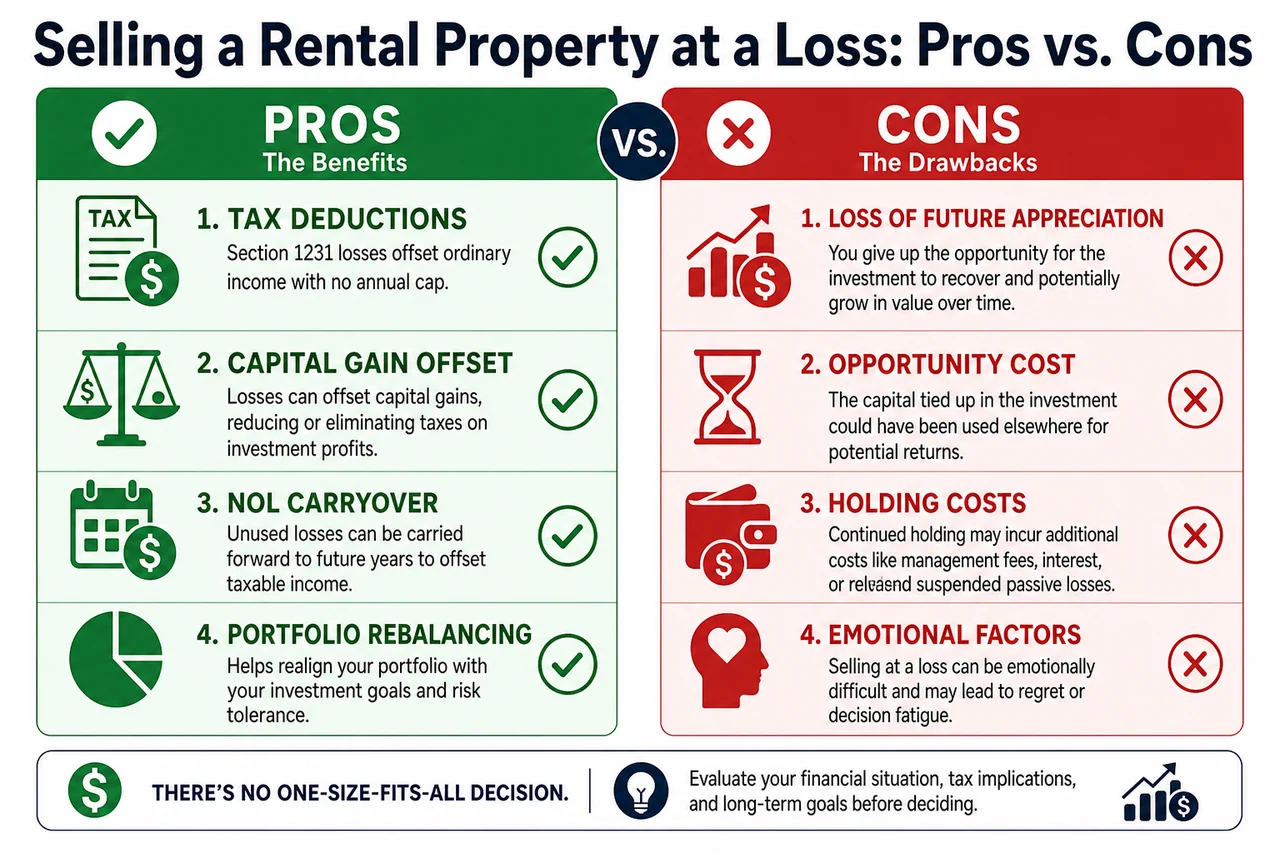
Don't rush to sell. There's a good chance one of these options aligns better with where you want to go financially.
Holding the Property Long-Term
Market dips aren't permanent. If that's what's driving your loss—not something structural about the area itself—you might recover that value by waiting it out. The bonus? You'll still get depreciation deductions year after year, which reduces the income taxes you owe on rental earnings while you hold.
Converting to Personal Use
What happens when you move into your rental? The tax treatment changes dramatically. Live there for at least two of the five years before you sell, and you could qualify for the primary residence capital gains exclusion. But here's the catch: depreciation recapture isn't covered by that exclusion, and you may lose deductions for passive losses after the conversion. Talk to a tax professional. This move needs planning.
Refinancing and Rental Rate Optimization
Is negative cash flow eating you alive? A cash-out refinance, rate-and-term refinance, or even bumping rents to market rate could completely change the numbers—no sale necessary. Get a local rental market analysis to see if you're actually charging less than comparable units in your area.
Section 1031 Like-Kind Exchange
Want out of this property but don't want your money sitting idle? A Section 1031 like-kind exchange lets you skip capital gains taxes by moving the proceeds into another real estate investment. You've got 45 calendar days to identify a replacement property and 180 calendar days to close after your current property sells. And here's something crucial: if you bought this property through a prior 1031 exchange yourself, your cost basis might already be lower than you think. That could mean your "loss" actually comes out as a taxable gain.
Back to topSteps to Optimize a Loss Property Sale
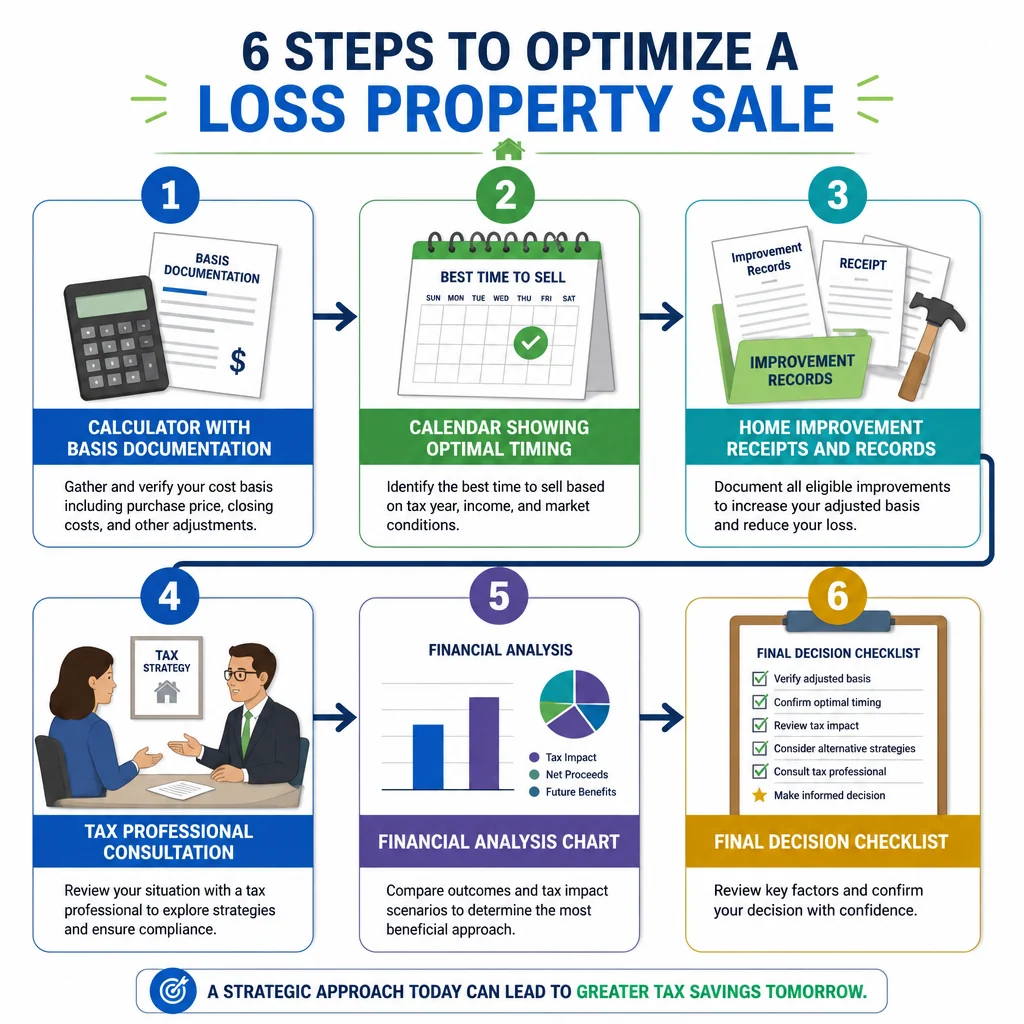
- Reconstruct your adjusted basis with documentation. Pull your original HUD-1 or closing disclosure, dig up every receipt for capital improvements you've made, and locate every Schedule E and Form 4562 depreciation schedule you've filed. Missing records? That's money left on the table.
- Calculate total accumulated depreciation — including allowable amounts you never claimed. Here's the kicker: the IRS uses the "allowed or allowable" rule. That means they'll count depreciation even if you forgot to deduct it.
- Inventory all suspended passive losses. Pull up your old returns and list every passive loss the IRS disallowed in prior years. When you sell, these become fully deductible — and this could be your biggest tax win.
- Model the tax impact before listing. Run the numbers: what's your expected sale price, adjusted basis, recapture amount, and net tax bill? Now stack that against what you'd earn if you held for another 1–3 years. Which scenario actually works for your wallet?
- Time the sale relative to your other income. Expecting a lower-income year ahead? Selling then could shrink the tax rate on any recaptured gain. Or flip it: if you're sitting on big capital gains from another investment this year, selling the rental property in the same year might offset those gains and save you real money.
- Engage a CPA or tax attorney before closing. Don't wait until after you've signed. Section 1231 classification, passive activity rules, depreciation recapture, and potential NOL generation all interact in ways that can cost or save you thousands. A tax pro can model your exact situation and spot strategies you can't fix after the deal's done.
And then there's state income tax — a whole other beast. Most states follow the federal playbook on Section 1231 losses and passive activity rules, but some don't. A handful also slap extra taxes on real estate transfers. Before you finalize anything, your CPA needs to run the numbers at both the federal and state level.
Back to topSpecial Situations and Considerations
Section 1031 Exchanges and Basis Carryover
Got your rental through a 1031 exchange? Here's the catch: your basis carries over from the old property to the new one. That means your adjusted basis might be way lower than what you actually paid. You could end up with what feels like a loss on paper, but the IRS sees it as a taxable gain instead. Always dig into the basis history before you sell—don't assume you're getting a deduction.
Conversion from Personal Residence to Rental
The moment you convert a house from your home to a rental, the IRS applies a specific rule: your tax basis for loss purposes is the lower of the property's fair market value on conversion day or your original adjusted basis. Why? The tax code won't let you turn personal losses (which are never deductible) into rental losses. And that earlier decline in value before you rented it out? You can't claim that. If you're dealing with an inherited property that later became a rental, check out our guide on selling inherited property within two years—it explains how basis gets set at inheritance.
Entity Ownership (LLC, S-Corp, Partnerships)
How your losses flow to you depends entirely on how you own the property. Partnerships and S-corporations pass losses through based on your ownership percentage and your basis in the entity itself—not the property directly. Here's what most people miss: you also need enough at-risk basis and passive activity basis to actually use those losses. Don't assume the individual-ownership rules work the same way. Get professional help with entity-held properties.
Multi-Property Portfolios
If you own multiple rentals, you can net Section 1231 gains and losses across all properties sold in the same tax year. That's your strategic opportunity. Sell a loss property in the same year as a gain property, and they offset each other—which can slash your overall tax bill significantly. Managing a portfolio with tenants across state lines? Our guides for California, Florida, Colorado, and Washington walk you through tenant obligations before you close.
High-Income Earners and the Net Investment Income Tax
If you're making solid income, watch out for the 3.8% Net Investment Income Tax (NIIT). It kicks in on net investment income above $200,000 MAGI for single filers and $250,000 for married filing jointly. But here's the thing: those thresholds don't get adjusted for inflation. A large Section 1231 loss can push your net investment income below these limits, wiping out NIIT liability entirely for the year. Most people don't even think about this bonus tax benefit.
Back to topMaking the Final Decision
Here's the thing: no tax move happens in a vacuum. You need to look at the whole picture before you decide to sell that rental property at a loss. What are your after-tax proceeds? What's the real value of keeping it — those ongoing cash flows, whether they're money in your pocket or money draining out? Factor in the risk that the property could drop even further, the capital you've got tied up there, and honestly, the headache of managing it month after month. If this property's part of an estate, your executor's got extra responsibilities to juggle. Our Executor's Guide to Selling Estate Property walks through that.
The tax upside of selling at a loss? It can be really attractive. Especially if you've got huge suspended passive losses sitting around or if Section 1231 lets you wipe out ordinary income instead. Plus you free up capital to put into something that actually performs. But here's where it gets tricky. Transaction costs add up fast. You'll owe depreciation recapture taxes. State taxes might bite you too. All of that chips away at what you actually save. Only a proper financial model — built with your accountant or tax attorney — will tell you the real answer: sell now, hold tight, or explore a 1031 exchange.
Disclaimer: This article is for informational and educational purposes only and doesn't constitute tax, legal, or financial advice. Tax laws change frequently, and individual circumstances vary widely. Always consult a qualified CPA, tax attorney, or enrolled agent before making decisions about the sale of investment property.
Back to topConclusion
Selling a rental property at a loss doesn't have to feel like just financial pain. Done right, it's actually a smart tax-planning move. Here's what matters: your adjusted basis and accumulated depreciation tell you whether you're really looking at a tax loss. Section 1231 treatment is the game-changer—it lets you offset ordinary income in ways capital losses simply can't. And those suspended passive losses? They become fully deductible when you sell. Plus, depreciation recapture can hit you with a tax bill even if you sell below what you paid originally. So what's the takeaway? Track your basis religiously, time the sale around your other income and capital gains, and partner with a tax pro. That way, you'll actually come out ahead on an otherwise tough transaction.
Back to topFrequently Asked Questions
Can I deduct a loss on the sale of a rental property against my regular wages?
Yes, you might be able to. Here's the key: if you held the property for more than one year and it qualifies as Section 1231 property, a net Section 1231 loss gets treated as an ordinary loss. That means it can offset your W-2 wages and other ordinary income—and you don't hit that annoying $3,000 annual cap that stops capital losses. But there's a catch. Passive activity loss rules might block you from deducting the loss right now if you haven't actively managed the property yourself. When you finally sell your entire interest? All those suspended passive losses come loose at once and become fully deductible that year.
What's depreciation recapture, and does it apply when I sell at a loss?
Think of depreciation recapture as the IRS's way of clawing back the tax breaks you got as a rental owner. For residential rental properties, that unrecaptured Section 1250 gain tops out at a maximum rate of 25%. Here's the tricky part: it kicks in whenever your sale price beats your adjusted basis (the original price minus all that depreciation you deducted), even if you're selling below what you paid originally. You can walk away with an economic loss and still owe taxes. And the IRS calculates recapture on depreciation you were allowed to take, even if you never actually claimed it.
Do I need to evict my tenants before selling the rental property at a loss?
Not at all. You can sell with tenants already living there. In fact, lots of buyers—especially investors—actually prefer properties that come with tenants and existing income. The rules shift depending on where your property is and what your lease says. We've detailed guides for what you need to know in Tennessee and Indiana, plus a general overview of eviction before selling if your state isn't listed.
Can a 1031 exchange help me avoid a taxable event when selling at a loss?
A 1031 exchange was built to defer capital gains taxes. So it shines when you've got a gain to shelter. But if you're sitting on an actual tax loss? Doing a 1031 exchange means you're deferring that loss (because you're carrying over a low basis) instead of claiming the deduction now. Most of the time, you're better off taking the loss immediately. Now, there's an exception: if depreciation from prior 1031 exchanges has tangled up your basis and you might actually have a gain hiding under the surface, then an exchange could still help. Just remember the timeline—you've got 45 days to identify a replacement property and 180 days to close on the sale.
What forms do I need to file when I sell a rental property at a loss?
Start with Form 4797 (Sales of Business Property). This is where you report the sale, work out your depreciation recapture, and figure out if you've got a Section 1231 gain or loss. Any leftover capital gain or loss rolls over to Schedule D and Form 8949 on your tax return. Released passive activity losses? Those go on Form 8582. And if your loss creates a Net Operating Loss, you'll need additional forms too. Bottom line: get a tax professional who knows real estate transactions to handle or review this paperwork.
Back to topMore in Taxes when you sell
- How to Avoid (or Reduce) Your Taxes When Selling a House
- Capital Gains Tax on Rental Property: How Much Will You Pay?
- Real Estate Transfer Tax: What Sellers Need to Know
- Capital Gains Tax When Selling a House: How Much Will You Owe?
See our guide: “Closing Costs for Sellers: What You'll Pay and How to Reduce Them” →

