How to Sell My House with a Lien on It: Complete Guide

Table of Contents
- Can You Sell a House With a Lien on It?
- What's a Lien?
- Types of Property Liens
- How to Find Liens on Your Property
- Step-by-Step Process to Sell With a Lien
- Options for Resolving Liens
- How Liens Are Handled at Closing
- When a Lien Exceeds Your Home's Equity
- Special Circumstances and Solutions
- Lien Negotiation: Practical Strategies
- Preventing Delays and Title Issues
- What Happens if You Ignore the Lien
- Common Misconceptions About Selling With a Lien
- The Role of Real Estate Agents and Attorneys
- Conclusion
- Frequently Asked Questions
You can sell a house with a lien on it. It happens constantly. The lien won't stop the sale itself—it just needs to get paid off before the buyer gets clean title, typically straight from your closing proceeds. If you're staring at a lien notice right now and feeling stuck, this guide breaks down every option you've got, what it'll cost, and exactly what comes next. Fair warning: this isn't legal, tax, or financial advice—talk to a licensed real estate attorney or tax pro about your specific situation.

Can You Sell a House With a Lien on It?

The Short Answer
Yes, you can sell. Most homeowners don't realize it, but liens on homes are actually pretty common. Your mortgage? That's a voluntary lien right there. When a lien exists, it means a creditor has a legal claim attached to your property. Before the buyer gets clean ownership, that claim has to be paid off—either before closing or at closing. The real takeaway: liens slow things down when you ignore them, but they're manageable when you tackle them head-on.
Why Liens Don't Stop Sales
Your title or escrow company handles this at closing. They take the sale price, pay off every lien that's recorded against the property, and hand over clean ownership to the buyer. This happens all the time—it's standard. Where you run into trouble is when your liens add up to more than you're selling for, when a lienholder digs in their heels, or when liens pop up out of nowhere late in the game. And all three of these situations have real solutions.
Dealing with more than just liens? The guide on selling a house with issues walks through other problems that can complicate a sale.
Back to topWhat's a Lien?
Definition and Legal Basis
A lien is a legal claim against your property. It acts as security for a debt you owe—to a lender, the IRS, a contractor, or a court. When you don't pay, that creditor can record a lien with your county recorder's or clerk's office. Once it's recorded, the claim shows up in the public record. Any future buyer or lender will see it immediately.

How Liens Work on Property
Once recorded, a lien attaches to your property itself—not just to you personally. You can't sell the place with a clean title while the lien is sitting there. And the lien won't freeze your property or stop you from listing it. But the debt has to go away before closing happens, either through payoff, a negotiated settlement, or court action. One more thing: liens get priority based on when they were recorded. Property tax liens, though? They usually jump to the front of the line no matter when they were filed.
Back to topTypes of Property Liens
Not all liens are created equal. The type matters because each one plays by different rules, gives you different negotiation options, and comes with its own timeline.
Voluntary Liens
You put these on your own property. When you signed those loan documents, you agreed to let the lender place a lien against your home.
- Mortgage liens (first and second mortgages)
- Home equity lines of credit (HELOCs)
At closing, these are your easiest problem to solve. You know who the lender is. You can call them today and get a payoff statement.
Involuntary Liens
Someone else put these on your property without asking your permission. Usually it's because you owe money and haven't paid.
- Federal tax liens — The IRS files a Notice of Federal Tax Lien (NFTL) when an aggregate unpaid balance reaches $10,000 under the Fresh Start Initiative. Once filed, the IRS has 10 years from the assessment date to collect (called the Collection Statute Expiration Date, or CSED).
- State and local property tax liens — These get paid before everything else. Super-priority means they cut to the front of the line, regardless of what other liens exist.
- Mechanic's liens — Contractors, subcontractors, or suppliers file these when they don't get paid for work they did or materials they supplied.
- Judgment liens — A court decided you owe money to someone else, and now they can file a lien. How long it lasts depends on your state.
- HOA liens — Your homeowners association filed this because you haven't paid dues, fines, or assessments. Want the full picture? Read our guide on selling a house with an HOA lien.
- Child support or alimony liens — A court can impose these for unpaid support. In some states, they get priority treatment similar to tax liens.
| Lien Type | Voluntary or Involuntary | Common Cause | Impact on Sale | Buyer Financing Risk |
|---|---|---|---|---|
| Mortgage (1st/2nd) | Voluntary | Home purchase or equity loan | Paid at closing; routine | Low — expected by lenders |
| Federal Tax Lien | Involuntary | Unpaid IRS balance ≥ $10,000 | Must be discharged or paid; IRS must be notified of sale | High — deal-killer for financed buyers if unresolved |
| Property Tax Lien | Involuntary | Unpaid property taxes | Super-priority; paid first from proceeds | High — lenders require payoff before closing |
| Mechanic's Lien | Involuntary | Unpaid contractor or supplier | Must be released; often negotiable | High — title insurers won't insure without release |
| Judgment Lien | Involuntary | Court-ordered debt | Paid from proceeds or negotiated down | Moderate to high depending on amount |
| HOA Lien | Involuntary | Unpaid dues or assessments | Usually negotiable; paid at closing | Moderate — depends on HOA's standing |
| Child Support Lien | Involuntary | Court-ordered support arrears | High priority; must be resolved | High — rarely negotiable |
How to Find Liens on Your Property

DIY Search Methods
Your county recorder's, assessor's, or clerk's office is your starting point. Most counties now let you search property records online—just enter your address or parcel number and you'll see every recorded document tied to your property, including liens. The IRS files federal tax liens (called NFTLs) with the county where you live, so that same county search will catch those too. Beyond your county, check your state's court and secretary of state websites for statewide lien registries, especially mechanic's liens and judgment liens. Free databases like PropertyShark can fill in gaps in your DIY search.
Professional Title Search
Want the most complete picture? Order a preliminary title report from a title company or real estate attorney. You'll spend roughly $75–$200, depending on your market and how messy the property's history is. And here's why timing matters: order it four to six weeks before you think a buyer will request their own title work. That window gives you time to tackle problems before they derail your closing. If you've got multiple creditors, disputed amounts, or federal liens hanging over the property, hiring a title search company or real estate attorney is worth every penny.
Timeline and Costs
Basic title searches come back within a few business days. Properties with complicated ownership histories take one to two weeks. That's not counting attorney review time if you hire one. Budget an additional $200–$500 or more in attorney fees for initial review, depending on your region and what actually shows up.
Back to topStep-by-Step Process to Sell With a Lien
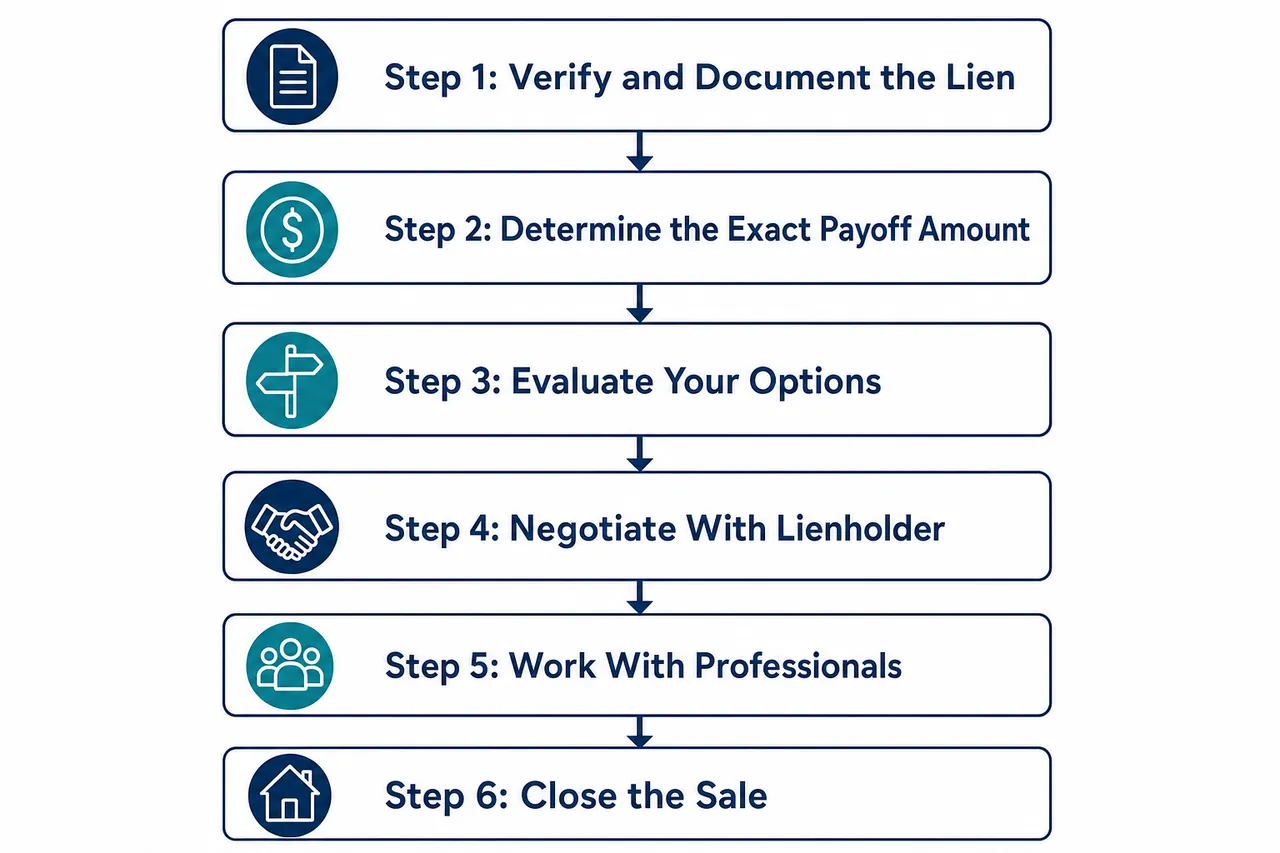
Step 1: Verify and Document the Lien
Before you list, order a preliminary title report. You can also search the county recorder's office yourself. What you're looking for: written documentation of every lien on the property. That means the lienholder's name, when it was recorded, the case or document number, and what the original amount was. Don't go by memory or what someone told you over the phone.
Step 2: Determine the Exact Payoff Amount
Call each lienholder and ask for a formal payoff statement in writing. Here's what matters: this number won't match the original lien amount. Payoff statements include accrued interest, penalties, and fees that've piled up since the lien was recorded. If you're dealing with a mortgage lender, they handle these requests all the time. The IRS? You can request a payoff through your tax pro or directly via IRS online services. Interest keeps stacking, so every month you delay, that number climbs higher.
Step 3: Evaluate Your Options
Now you know what every lienholder wants. Get a realistic number on your home's sale price — the national median existing-home sale price was $417,500 as of September 2026, per NAR, but your neighborhood could be way different. Compare your total debt against what you'll actually net from the sale. That tells you everything: do you have enough equity to clear all the liens, do you need to negotiate, or are you underwater?
Step 4: Negotiate With Lienholders
Many creditors will take a settlement. That includes judgment lien holders, mechanics lien holders, and HOA lien holders — they're often willing to accept less than the full recorded amount. Why? Because getting cash in hand right now beats chasing you for years and maybe never collecting the full amount. Get any settlement agreement in writing before closing and confirm the lienholder will file a lien release at the county recorder once you pay. Federal tax liens work differently — that's covered in the IRS section below.
Step 5: Work With Professionals
If a lien is disputed, unusually large, or involves the IRS, state tax authorities, or child support, bring in a real estate attorney. Routine lien payoffs? Your title company and real estate agent can handle those. Complex situations demand legal counsel. And loop your mortgage lender in early if your total debt is getting close to your expected sale price.
Step 6: Close the Sale
At closing, everything gets coordinated. The title or escrow company takes the purchase price, pays each lienholder directly from those proceeds in priority order, and records all the lien releases. You get what's left over. Your buyer walks away with a clear title policy. Everything shows up on the closing disclosure — no surprises.
Back to topOptions for Resolving Liens
| Option | Cost to Seller | Typical Timeline | Pros | Cons | Best For |
|---|---|---|---|---|---|
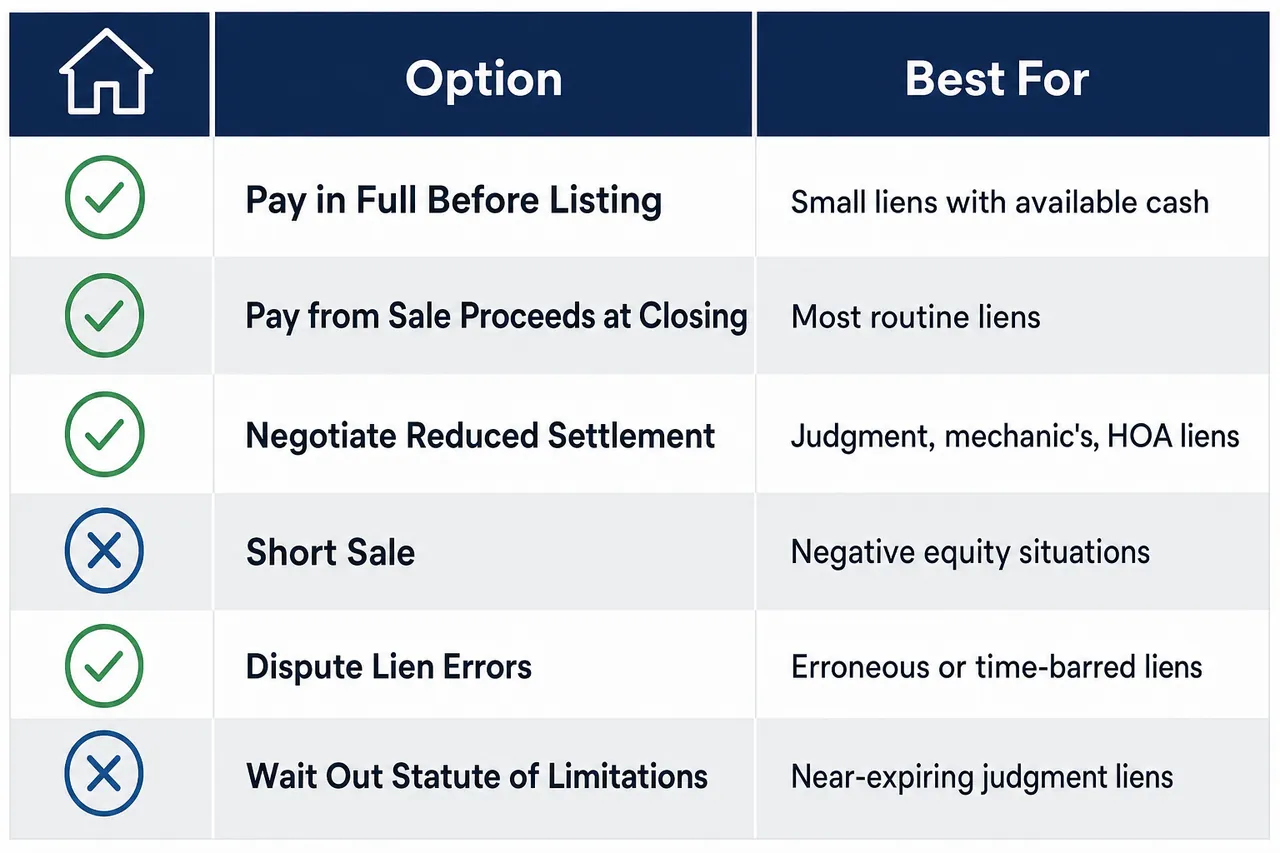
| Pay in Full Before Listing | Full lien balance + interest | Days to weeks | Cleanest title; no closing complications | Requires cash upfront | Small liens with available cash |
| Pay from Sale Proceeds at Closing | Full payoff deducted from proceeds | Coordinated with closing date | No upfront cash needed; standard process | Reduces net payout to seller | Most routine liens |
| Negotiate Reduced Settlement | Less than full balance; negotiated amount | Weeks to months | Saves money; gets lien released | Creditor must agree; not all will negotiate | Judgment, mechanic's, HOA liens |
| Short Sale | Little to nothing; lender accepts shortfall | 3–6 months typically | Avoids foreclosure; gets out of property | Damages credit; possible taxable forgiven debt | Negative equity situations |
| Dispute Lien Errors | Attorney fees | Weeks to months (court-dependent) | Can eliminate invalid liens entirely | Requires attorney; uncertain outcome | Erroneous or time-barred liens |
| Wait Out Statute of Limitations | Carrying costs during waiting period | Varies by state and lien type | Lien expires without payment | Can't sell cleanly while lien is active; debt may still exist personally | Near-expiring judgment liens |
Special Note on Federal Tax Liens
The IRS has its own playbook for tax liens. If you're selling property and the IRS has a lien on it, you can request a Certificate of Discharge that removes the lien from just that property. You or your attorney submit Form 14135 for this. Once you pay what you owe to the IRS in full, they're legally required to issue a Certificate of Release (Form 668(Z)) within 30 days. But there's another option if your total IRS debt is $25,000 or less. You may qualify to have the lien withdrawn entirely—not just released from the property—by setting up a Direct Debit Installment Agreement and filing Form 12277. And before you file anything or make a move, talk to a tax professional. These IRS processes have strict requirements that need to be handled exactly right.
Back to topHow Liens Are Handled at Closing
Your title company runs the show at closing. They dig through the title search and find every single lien that's been recorded against the property. Then they call the lienholders directly—often multiple times—to get current payoff amounts that are actually accurate, not just what was filed months ago. When closing day arrives and your purchase funds hit escrow, the title company pays off each lienholder in order of priority. You don't see a dime until they're all settled. After each one gets paid, they're legally required to file a lien release with the county recorder's office. Only when those releases are confirmed does the buyer get a clean title policy and actual ownership of the property.
Most of the time? This runs smoothly. Title professionals handle it every single day and know exactly what they're doing. But when a lienholder goes silent, refuses to agree on what's owed, or has actually shut down operations, everything stalls. That's when you need a real estate attorney stepping in to untangle it.
Back to topWhen a Lien Exceeds Your Home's Equity

Understanding Negative Equity
When all your liens combined — mortgage plus everything else — add up to more than your home will actually sell for, you're in negative equity. It's tough. But you still have options.
Short Sale Strategy
You can sell the property for less than what you owe through a short sale. The lender(s) agree to take the hit on the difference. Second lienholders and judgment creditors often jump at this because waiting around for foreclosure or trying to collect later usually nets them even less money. One critical thing: forgiven debt might count as taxable income. Before you move forward, talk to a tax professional about what the IRS currently says about debt cancellation income.
Personal Contribution and Negotiation
If the gap is small enough, pulling money from your savings to cover it at closing is usually your fastest way out. Got a bigger shortfall? Contact each lienholder separately. Junior lienholders especially — the ones holding second mortgages, HELOCs, or judgment liens — are hungry to negotiate when they know they're not getting paid in full anyway.
When Liens Are a Priority Problem
Liens don't all get paid equally. There's a legal pecking order at closing, and you need to understand it. Property tax liens eat first. Your first mortgage comes next. Everything else — second mortgages, HELOCs, judgment liens — gets paid from whatever's left over, if anything. And that's where negotiation happens. Junior lienholders who know they're walking away with pennies on the dollar? They'll often take a discounted lump sum right now instead of fighting for nothing later.
Back to topSpecial Circumstances and Solutions
Cash Offers vs. Traditional Sales
Traditional mortgage lenders won't fund a buyer's loan without clear title. That means every lien gets paid off or released before or at closing — no exceptions, no workarounds. Cash buyers play by different rules entirely. Some cash investors will actually purchase a property while liens are still attached, then handle the resolution themselves in exchange for a lower price. It's not standard practice everywhere, and you'll need airtight contract language, but this option exists. For sellers stuck with liens they can't clear before listing, a cash offer can unlock a sale that would otherwise stall. If you need money fast and don't mind a lower payout, it's worth exploring a direct cash offer — programs like KDS Homebuyers offer seller options that work alongside traditional listing paths.
Transferring or Gifting Property With a Lien
Can't transfer unencumbered ownership while a lien's recorded against it. A gift deed or quitclaim deed passes on whatever ownership stake you hold — liens included. The recipient gets the property subject to those existing claims. And creditors can still enforce them. Don't treat this as a workaround.
State-Specific Considerations
State law controls how liens work, and the rules vary dramatically from one place to another. Take homestead exemptions — they shield a portion of your home's equity from certain creditors, but the protection level depends on where you live. Florida's homestead exemption? Virtually unlimited for primary residences. Most other states? Much lower caps. Judgment liens also have different lifespans depending on your state. Some allow them to stay enforceable for just five years. Others let creditors renew them for decades. Disclosure requirements shift too. Before you list in your state, talk to a local real estate attorney or pull up your state's statutes yourself. For state-specific guidance on selling without an agent, check out the resources for Florida, California, Colorado, Washington, Tennessee, and Indiana. And if HOA liens are your concern, the guides for Florida, California, Colorado, Tennessee, and Indiana break down each state's requirements in detail.
Back to topLien Negotiation: Practical Strategies
You can negotiate a reduced lien payoff. It happens all the time in real estate transactions. Here's what works:
- Get a formal payoff statement before you make any offer. You need to know the exact number you're working against — this includes per-diem interest accrual, which keeps climbing every single day.
- Show the lienholder the full picture. Walk them through your anticipated net proceeds, which liens are ahead of theirs, and what they'll realistically get if the sale doesn't happen. Numbers persuade way better than emotional appeals.
- Offer a lump sum tied to a close date. Creditors love certainty. A concrete amount payable within your escrow period beats a vague promise to pay later.
- Get the settlement agreement in writing before closing day arrives. Make sure it spells out the exact amount, the payment date, and when the creditor must file that lien release after they receive their money.
- Bring in an attorney for large or complex disputes. If you're dealing with institutional creditors and significant amounts, an experienced lien negotiation attorney will usually get better results than you handling it solo.
Child support liens and IRS liens don't bend on the underlying debt amount — that's locked in. But the IRS does offer installment plans and discharge options as mentioned earlier. HUD-approved housing counselors (search at hud.gov) provide free guidance on certain lien situations. And watch out: any company demanding large upfront fees while promising to wipe away your liens is running a scam.
Back to topPreventing Delays and Title Issues
You can prevent most lien-related closing delays. It just takes the right steps taken early enough.
- Order a preliminary title report before you list. For $75–$200, you're buying insurance against the kind of last-minute surprise that kills a sale. It's money well spent.
- Tell your real estate agent about known liens right away. They can build lien resolution into your timeline and shape your listing strategy around it. If you hide a lien you know about, you're opening yourself up to serious legal trouble.
- Reach out to lienholders as soon as possible. Payoff statements take time. Settlement negotiations take time. IRS discharge applications? Also time. Four to eight weeks before your target closing date is actually reasonable, not excessive.
- Pick a title company that knows how to handle liens. Some companies are much better at complex lien payoffs than others. When you're vetting them, ask directly about their track record with your specific lien type.
- Loop your mortgage lender in early. When your mortgage balance plus other liens is edging up against your sale price, your lender needs to know about it from day one. They're part of this conversation whether you like it or not.
What Happens if You Ignore the Lien
Ignoring a lien won't make it disappear. What it will do is create a cascade of problems that get worse by the day.
- During the title search, the title company will spot the lien and refuse to let closing happen until it's dealt with.
- Your buyer's mortgage lender? They won't fund the loan if that lien isn't released first.
- And your buyer can simply walk away from the contract — often without any penalty at all — if you can't deliver a clean title by closing day.
- Interest and fees keep piling up on what you owe, which means resolving this later costs you significantly more than it would today.
- Some creditors — especially the IRS and your local tax authority — don't stop at liens. They can levy your bank accounts, garnish wages, or seize other assets you own.
Common Misconceptions About Selling With a Lien
- Myth: A lien legally prevents a sale. You can still sell. A lien complicates things, but it doesn't stop the transaction. What it does require is resolving the lien itself — the sale proceeds regardless.
- Myth: You must pay the full lien amount. This one trips up a lot of homeowners. Creditors holding judgment liens or mechanic's liens often negotiate. You might settle for significantly less than what's actually recorded against your property.
- Myth: The lien stays on the property after you sell. Not if you handle it correctly. A resolved lien gets released at closing, and the buyer walks away with clean title. Title insurance backs them up anyway — if somehow a lien from before the sale creates problems later, the insurance covers it.
- Myth: The lien affects your home's appraised value. An appraiser prices your home based on comparable sales and condition, not what you owe. But here's what matters: an unresolved lien weakens your negotiating power when buyers know you're desperate to close the deal.
The Role of Real Estate Agents and Attorneys
A good real estate agent spots liens early. They'll dig into the preliminary title search, talk through your pricing strategy given what you owe, and keep the title company in the loop from start to finish. But here's what agents can't do: they can't tell you whether a lien is actually valid, they can't sit down with the IRS or government creditors to negotiate, and they definitely can't fight a lien in court.
That's where an attorney comes in. You'll want one on your side if you're dealing with a disputed lien, a federal or state tax lien, a lien where nobody agrees on the amount, or multiple liens tangled up in complicated priority situations. An attorney can challenge whether a lien is legitimate, go head-to-head with creditors for you, and make sure that lien release paperwork gets filed the right way. Thinking about selling without an agent? Check out the FSBO complete guide for how to manage everything yourself — but don't cut corners on the attorney if liens are sitting on your property.
Back to topConclusion
Selling a house with a lien isn't some rare disaster. Title companies, attorneys, and experienced agents see this every single day. It's routine.
Your best defense? Find liens early through a preliminary title report. Know exactly what you owe. Call your lienholders and actually communicate with them. Then work with professionals who know how to coordinate payoffs at closing. Whether it's a second mortgage, an HOA dispute, or a federal tax lien — there's a documented path forward for each one.
And here's what actually tanks deals: ignoring the lien and hoping it disappears.
Start now with a title search. Get crystal clear on your numbers. Bring in the right professionals early. The rest becomes manageable.
Back to topFrequently Asked Questions
How long does lien resolution typically take?
The timeline depends entirely on what kind of lien you're dealing with. Mortgage payoffs? Those close in hours at settlement. HOA liens usually take one to three weeks to negotiate. A mechanic's lien dispute with no agreement in place can drag on for two to four months. Federal tax liens are their own animal—the IRS typically takes 30–60 days to discharge them, so apply well before your target closing date. If you've got any involuntary liens hanging over your property, budget at least four to six weeks of cushion into your sale timeline.
Will a lien affect my home's sale price?
Your appraised value doesn't drop because of a lien. But your negotiating power does. Buyers who see you're facing pressing lien obligations often lowball you—they know you're motivated to close fast. What actually matters is what you pocket at the end. A large lien balance eats directly into your net proceeds, even if the sale price itself is fair. Run the numbers on your total payoff obligations before you list. That tells you what floor price you actually need.
Can I sell if I don't know the lien amount yet?
You can start showing the house. But don't sign a contract with a firm closing date until you know exactly what you owe.
An unknown lien balance means you can't confirm you'll have enough cash at closing—and discovering a shortfall a week before closing is a nightmare nobody wants. Get the preliminary title report first. Request payoff statements from every lienholder. Do this before you accept an offer if you possibly can.
What if the lienholder refuses to negotiate or release the lien?
You've got options. Pay the full balance outright. Challenge the lien's validity in court if you've got grounds. For judgment liens, check whether it's approaching expiration under your state's rules—liens don't last forever. If you think a mechanic's lien was filed by mistake (happens all the time when a contractor's claim gets disputed), a real estate attorney can file a legal challenge for you. Here's the critical one: if a lienholder accepts your payment but won't file a release, that's illegal in most states. Get a court order forcing them to release it. Never walk away from this scenario—hire an attorney to enforce the release. It's your money.
Does the type of lien affect my buyer's financing?
Absolutely. Mortgage lenders demand clear title before they'll fund anything—period. Every single lien has to be gone before or at closing. That makes all liens deal-breakers for financed buyers if they're not resolved. What changes is the difficulty. A standard mortgage payoff happens automatically at closing. An IRS federal tax lien or a contested mechanic's lien? Those can take weeks or months to clear, and your buyer's loan commitment might expire while you're waiting. Cash buyers sidestep this problem entirely—they can sometimes close while lien resolution is still in progress. That's one reason cash offers matter so much when liens are part of the picture.
Back to top