Selling a House When Someone Is on Medicaid: What to Do with Proceeds

Table of Contents
- Understanding Medicaid's Home Exemption Rule
- What Happens to Sale Proceeds Under Medicaid Rules
- Strategies to Protect Home Sale Proceeds While Keeping Medicaid
- Nursing Home vs. Community-Based Care: Different Rules Apply
- The Five-Year Lookback Period and Transfer Penalties
- Medicaid's Estate Recovery Program (MERP) After Death
- Tax Implications Beyond Medicaid
- Critical Planning Steps Before Selling
- Worked Examples: How the Rules Apply in Practice
- Conclusion
- Frequently Asked Questions
Medicaid treats home sale proceeds very differently than it treats the house itself—the cash gets counted as an asset almost immediately, and that can cost you your benefits. Most states cap Medicaid assets at just $2,000 for an individual, so selling your home and depositing that money in your bank account risks suspending or terminating your coverage. But families do have legitimate ways to protect the proceeds and keep Medicaid in place if you plan ahead and get the right help.
This article is for general informational purposes only and isn't legal, tax, or financial advice. Every state runs Medicaid differently. Rules shift. And the penalties for getting it wrong—like waiting periods stretching years—can be devastating. Talk to a licensed elder law attorney and contact your state Medicaid office before you do anything.

Understanding Medicaid's Home Exemption Rule
Why the Home Is Generally Protected While You Own It
Medicaid divides your assets into two buckets: countable and exempt. Your primary residence? It's one of the biggest exempt assets you can have. As long as you, your spouse, or a qualifying dependent actually lives in the home — or you're planning to move back — Medicaid won't count it against your asset limits while you're alive. That's the protection most people rely on.
But here's what catches families off guard: the house was never an issue while someone lived there. The second it sells, everything shifts.
Home Equity Interest Limits
The exemption has a ceiling. Federal law sets both a floor and a cap on how much home equity states must protect. In 2026, the federal minimum sits at $752,000 and the federal maximum is $1,130,000. Most states stick with the federal minimum. But this is changing. Starting January 1, 2028, a new law will cap the maximum any state can exempt at $1,000,000 — and that's going to hit people in expensive housing markets hard.
California breaks the mold. Medi-Cal, as of 2026, has no equity limit on primary residence exemptions. If you need specifics for your state, check our guides on Medicaid and selling your house in California and Medicaid and selling your house in Florida.
Conditions for the Exemption
You get the exemption when at least one of these applies:
- The Medicaid recipient currently lives in the home as their primary residence.
- The recipient is temporarily absent (e.g., in a nursing facility) but has a documented intent to return.
- A spouse, child under 21, or blind or permanently disabled child of any age resides in the home.
None of those fit your situation? And the home gets sold? The exemption's gone.
Back to topWhat Happens to Sale Proceeds Under Medicaid Rules
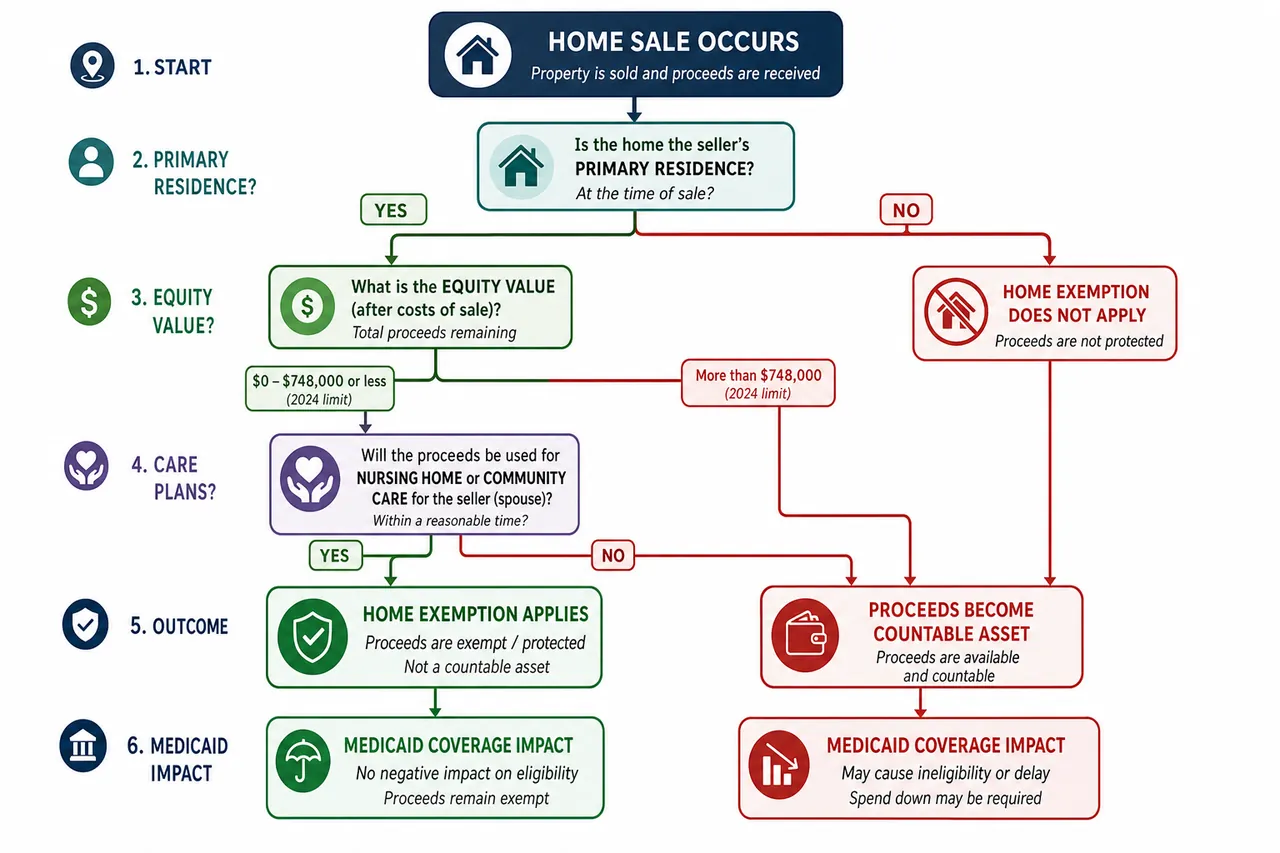
Proceeds Become Countable Assets Immediately
The second your home sale closes, you lose the exemption. That cash—whether it arrives as a check or wire transfer—becomes a countable asset the moment it hits your bank account. For most states, you can only hold $2,000 in assets and stay on long-term care Medicaid. A home selling for the September 2026 median price of $417,500? That's hundreds of thousands of dollars over the limit.

New York's 2026 limit sits at $33,038. California (Medi-Cal) allows $130,000 as of January 1, 2026. Even those higher thresholds won't cover most home sales. And if you're wondering how this ties into waiting periods, our guide on the Medicaid lookback period covers how timing matters for your house sale.
Disclosure Requirements and the End-of-Month Deadline
You're legally required to report the sale. Medicaid agencies expect to hear about asset changes within 10 days. Beyond just telling them, you've got to either spend the money on exempt items or shield it through a compliant structure by the end of the month you receive it. Miss these deadlines and you lose eligibility immediately.
And don't think Medicaid only catches this if you volunteer the information. They run public records searches on real estate transactions and dig into your assets during annual recertification. Hiding a home sale is fraud, plain and simple.
How the Sale Affects Eligibility: Temporary vs. Permanent Loss
Spend or protect those proceeds correctly within the required window? You can get Medicaid back once your assets drop below the limit again. But transfer the money to family without anything in return, and the lookback rules kick in hard. You're facing a penalty period where you won't qualify for Medicaid—and there's no maximum length on how long that penalty can last.
Back to topStrategies to Protect Home Sale Proceeds While Keeping Medicaid

Not one of these strategies works for everyone. They all come with legal prerequisites, costs, and rules that differ by state. Think of this section as talking points for your conversation with an elder law attorney—not a DIY guide you can tackle alone.
Reinvesting in a New Primary Residence
You're selling to move into a more accessible or affordable home—not heading into a nursing facility. Good news: you can often use those proceeds to buy a new primary residence, which stays exempt just like your old one did. But timing is everything. The purchase needs to close within the same reporting period, or Medicaid counts the money as an asset you own. This approach works well for people on community-based Medicaid. If you're already in a nursing facility, it won't help.
Spend-Down Planning: Exempt Expenditures
Medicaid lets you spend down extra assets on certain approved items without penalty—as long as you're paying fair market value for something real. What counts?
- Medical equipment, supplies, and services not covered by Medicaid
- Home modifications for accessibility (wheelchair ramps, grab bars, widened doorways)
- Prepaid irrevocable funeral and burial arrangements
- Paying off legitimate debts, including mortgages, credit cards, and medical bills
- Purchasing a Medicaid-compliant annuity that converts a lump sum into an income stream
Annuities are tricky. A compliant annuity must be irrevocable, non-assignable, actuarially sound, and must name the state Medicaid program as the primary beneficiary (after a surviving spouse or minor/disabled child). Get this wrong and Medicaid treats it as a disqualifying transfer. Don't try this without an elder law attorney.
Irrevocable Trusts and Pooled Trusts
An irrevocable trust—if it's properly drafted—removes assets from your control and takes them off Medicaid's radar. But there's a catch: you had to set it up and fund it before the lookback period started (typically 5 years before you apply for nursing home care). Fund an irrevocable trust with sale proceeds after you've filed a Medicaid application? That's a disqualifying transfer.
A pooled trust (pooled special needs trust) is different. A nonprofit organization manages it, and you can use it at any age. In many states, you can deposit money into a pooled trust even after filing your Medicaid application without triggering a penalty—though this varies by state. For people receiving community-based Medicaid who need to protect a large chunk of money fast, this is worth exploring.
Promissory Notes and the Gift-Loan Combination
Some states let you split the sale proceeds: gift part of it to family, then loan the rest under a formal promissory note. The gift creates a penalty period. The loan repayments give you income to cover care costs while you're waiting out that penalty. Sounds clever, but your note has to be actuarially sound, carry a reasonable interest rate, and have equal monthly payments with no deferral or forgiveness when you pass away. The penalty period itself depends on your state's average monthly nursing home cost—call your state Medicaid office or an elder law attorney to find that number. How long your family has to cover care out of pocket comes down to that one figure. Make sure your attorney confirms your state actually allows this strategy.
Comparison of Asset Protection Strategies
| Strategy | Best For | Timing Requirement | Key Risk | Complexity |
|---|---|---|---|---|
| Buy new primary residence | Community-based Medicaid recipients moving homes | Must close within same reporting period | Timing failure converts proceeds to countable asset | Moderate |
| Spend-down on exempt items | Recipients with moderate proceeds and legitimate needs | Before end of following month | Overpaying or non-compliant purchases treated as transfers | Low–Moderate |
| Medicaid-compliant annuity | Recipients needing income for ongoing care costs | Before or after application (state-specific) | Improper structure treated as disqualifying transfer | High |
| Irrevocable trust | Long-range planning before Medicaid need arises | Must be funded 5+ years before application | Useless if funded inside lookback window | High |
| Pooled trust | Community-based recipients needing quick protection | Often post-application (state-specific) | Nonprofit management fees; state rules vary widely | Moderate |
| Promissory note / gift-loan | Recipients with family willing to pay care costs during penalty | Structured carefully around application date | Family must cover care costs during full penalty period | High |
Nursing Home vs. Community-Based Care: Different Rules Apply
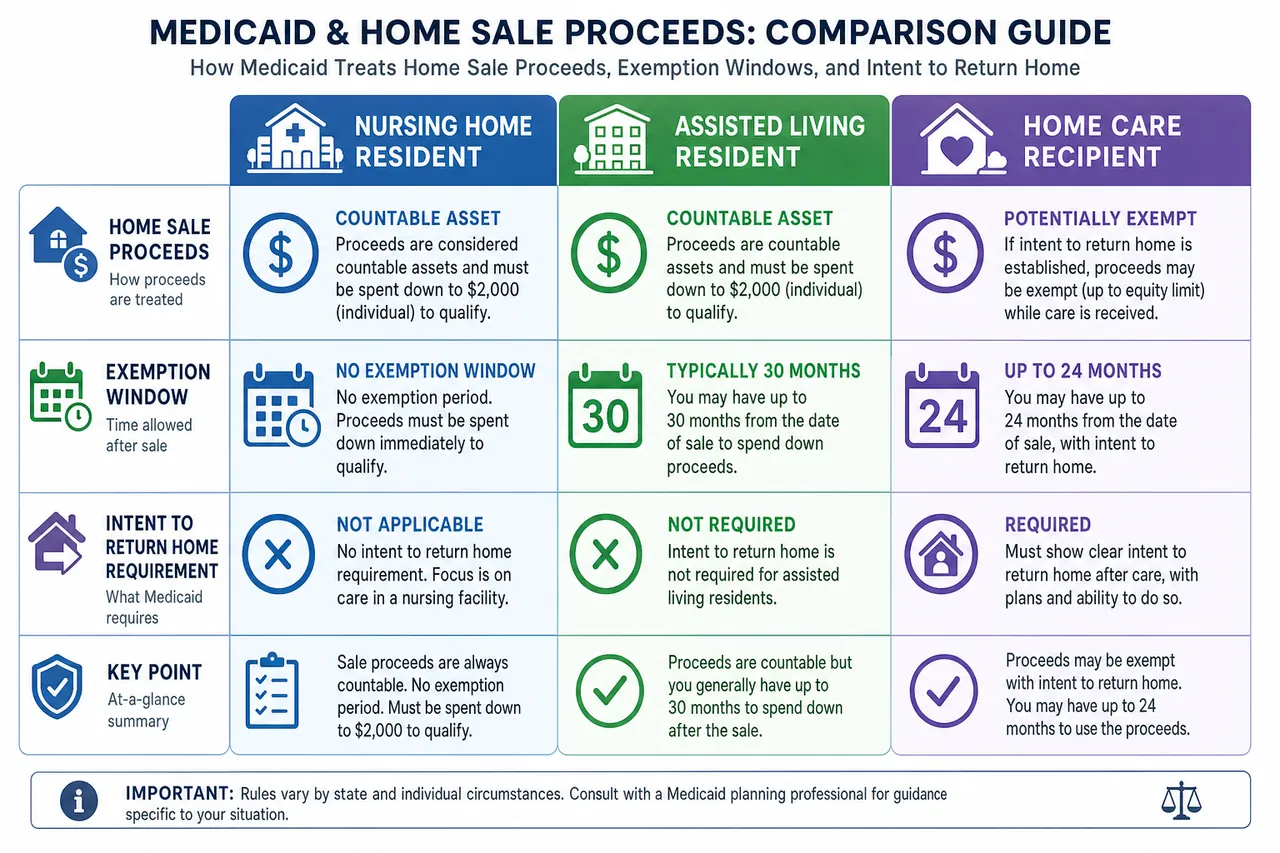
Nursing Home Residents
If someone's in a nursing facility, their home might still be exempt — but only if they've genuinely stated they want to return. And that window? Usually about six months, though your state's rules could be different. Many families file an Intent to Return Home Letter with the Medicaid agency to keep the exemption active during this time. The letter needs to be in writing. It needs to clearly say the resident plans to come back to the property. You'll want to keep it as proof. If six months pass and the resident doesn't return home, and the house hasn't sold, your state will likely start counting it as an available resource against the asset limit.
Once your family member in the nursing home decides to sell, the five-year lookback kicks in. Any money from the sale gets scrutinized. The state uses its penalty divisor — that's the average monthly cost of nursing home care where you live — to figure out how long an unpaid transfer will block Medicaid coverage.
Community-Based Care (Home Care, Assisted Living Programs)
Different rules apply if your loved one's getting community-based Medicaid benefits — home health aides, adult day programs, assisted living program payments. Asset limits and lookbacks still matter. But the numbers can vary quite a bit from nursing home rules. Some states have actually shortened the lookback period for these programs. Take California: their lookback started at zero months on January 1, 2026, and will gradually climb to 30 months by July 2028. Your state's rules might be completely different. Check our guides for Colorado, Washington, and Tennessee.
Spouse at Home: Significantly Different Rules
Now here's where things get more favorable: when one spouse is on Medicaid and the other (the "community spouse") stays in the home, the protections are much stronger. The home stays exempt as long as that community spouse lives there. It doesn't matter who owns it on paper. If you sell the house, that community spouse gets to keep substantially more money. For 2026, the Community Spouse Resource Allowance (CSRA) tops out at $162,660, so the spouse at home can hold that much in assets without hurting the Medicaid recipient's coverage. For the couple's combined limit (in most states), the institutionalized spouse's share sits at $3,000–$4,000, while the community spouse gets separate protection up to the CSRA.
When Not to Sell
Selling your home isn't always the answer.
- The recipient genuinely expects to return home and can document that intent.
- A community spouse or qualifying dependent currently lives in the home, which keeps the exemption active.
- A family member has lived there and cared for the recipient and might qualify for a caregiver exemption (see the MERP section below).
- The home's part of an estate plan that could benefit from a stepped-up cost basis when your loved one passes, cutting capital gains taxes for heirs.
The Five-Year Lookback Period and Transfer Penalties
Medicaid looks back five years. That's 60 months prior to when you apply for nursing home or home and community-based services (HCBS) waiver coverage in 49 states and D.C. Any money or assets you transfer for less than what they're actually worth during those five years? That triggers a penalty period where Medicaid won't cover your care. The penalty length depends on a straightforward calculation:
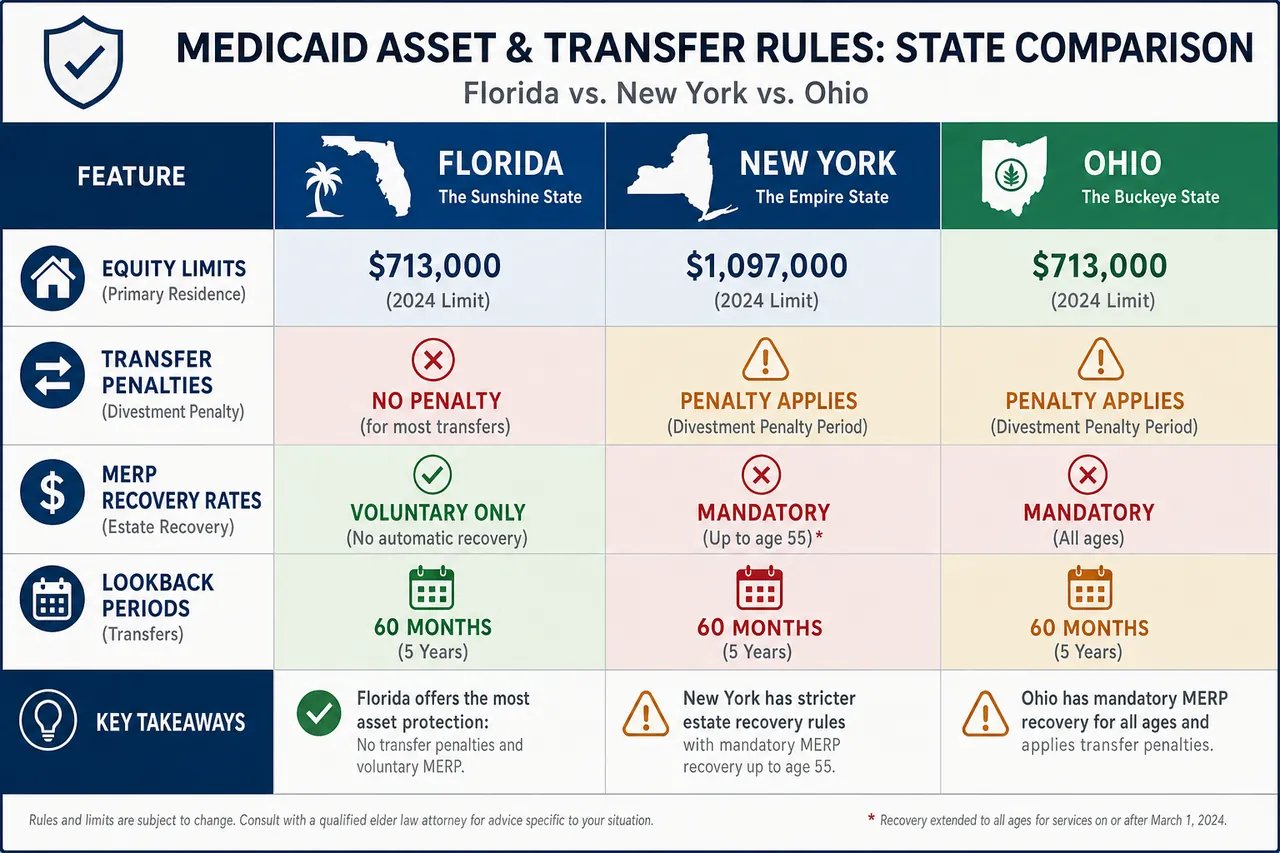
Penalty period (months) = Total uncompensated transfer amount ÷ State's average monthly nursing home cost
And here's what makes this dangerous: there's no limit on how long that penalty can last. Sell your home for $300,000 and give the proceeds to your kids? You could be looking at years of ineligibility. During those years, you're paying nursing home costs out of pocket—every single dollar. This isn't theoretical. It's one of the most common, expensive mistakes families make when handling Medicaid.
Giving away your home or its sale proceeds to family members within five years of applying for Medicaid nursing home coverage triggers this penalty, unless you qualify for a specific exception. And you need to be careful about how you title property too. Say you and your child bought a home together but your child paid nothing toward it—on paper it looks split, but for Medicaid purposes, the full value belongs to you. Claiming it's shared ownership to reduce what Medicaid counts? That's considered a gift and you'll face penalties.
Back to topMedicaid's Estate Recovery Program (MERP) After Death
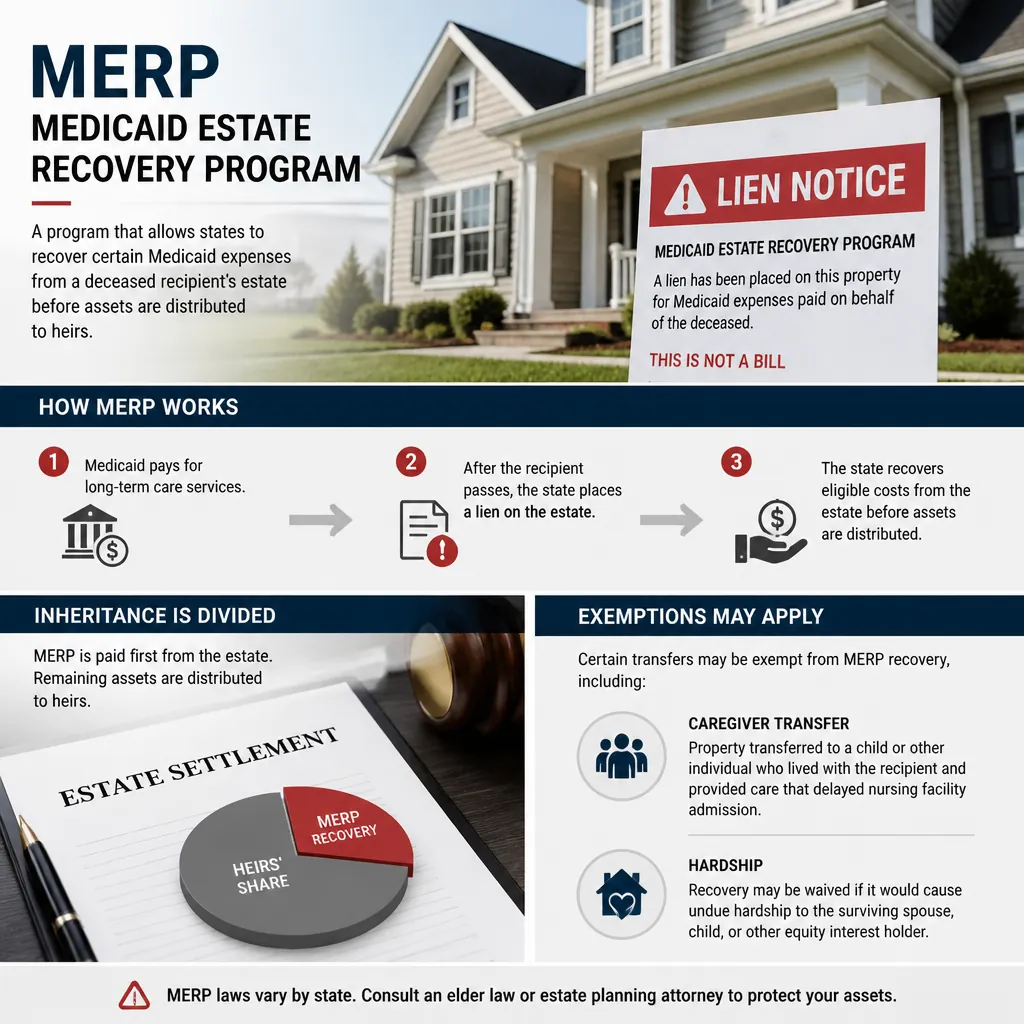
How MERP Works
That home you managed to protect while your loved one was alive? After death, it might not pass to your family without a fight. Under federal law (42 U.S.C. § 1396p(b), enacted as part of OBRA '93), states must recover what they spent on Medicaid for anyone age 55 or older who received nursing facility services, home and community-based services, hospital care, or prescription drugs. But there's a limit. The state can only recover what it actually paid — not a penny more.

Usually this happens through a lien placed on any real estate the recipient owned when they died. Did you already sell the home and carefully spend down the money according to Medicaid rules? Then there's nothing left for the state to grab from real estate. But if your relative was still on the deed when they passed, the state's lien attaches to their share of the estate.
Federal Protections: When MERP Is Blocked
The federal government does step in here. MERP recovery is prohibited if any of these people are still living:
- A surviving spouse
- A child under age 21
- A child of any age who's blind or permanently and totally disabled
Don't confuse "blocked" with "forgiven." The state just pauses its claim. Once that protected person dies, Medicaid picks up where it left off.
The Caregiver Exemption and Hardship Exceptions
Most states have carved out a caregiver child exemption — and this one matters. If an adult child lived in the parent's home for at least two years right before the parent entered a nursing facility, and that child's care actually delayed the move to a facility, the home can transfer to that child without triggering a Medicaid penalty or MERP recovery. You'll need solid proof though. Document everything: care logs, letters from the doctor saying the child's help delayed placement, lease agreements or ownership records showing they lived there. Each state sets its own requirements, so check yours.
Hardship exceptions exist too. If recovery would genuinely harm an heir — say the home is their primary residence and their only real income-producing asset — most states will listen. You have to ask formally though. Don't expect it to be automatic.
If estate recovery tangles with probate or trust planning, our guide on probate vs. trust when selling a house walks you through it. We've also got state-specific versions for Florida and California.
Medicaid During Life vs. MERP After Death: A Comparison
| Issue | While Recipient Is Living | After Recipient's Death (MERP) |
|---|---|---|
| Home status | Exempt if occupied or intent to return documented | Subject to estate recovery if on title at death |
| Sale proceeds | Become countable assets immediately upon receipt | Remaining estate assets subject to MERP lien |
| Transfer to family | Subject to 5-year lookback and penalty period | May be blocked or clawed back by MERP claim |
| Spouse protection | Community spouse retains CSRA ($162,660 max, 2026); home exempt while spouse resides there | MERP blocked while surviving spouse is alive |
| Caregiver child | Transfer may avoid penalty if caregiver exemption qualifies | May qualify for MERP exemption if criteria met |
| Hardship exception | Not applicable (transfer penalty context) | Can be requested; state-specific criteria apply |
| Recovery cap | N/A | Can't exceed total Medicaid paid on recipient's behalf |
Tax Implications Beyond Medicaid
Selling your home while on Medicaid triggers federal income tax rules that work independently from your Medicaid eligibility. If you're filing single, you can exclude up to $250,000 of capital gains from federal taxes. Married couples filing jointly get up to $500,000. But there's a catch — you need to have owned and lived in the property as your main home for at least 24 of the past 60 months before you sell.
If you've spent more than two years in a nursing facility, you probably haven't met that use requirement. A partial exclusion exists if you had to sell for health reasons, but you'll need a CPA to confirm whether you qualify. Any profit beyond your exclusion gets hit with federal long-term capital gains tax at 0%, 15%, or 20% — the rate depends on your income bracket. And don't forget about state income tax, which may apply too.
Here's what really matters: those capital gains you earn in the sale year could count as income for Medicaid purposes in certain situations. Before you close on the sale, talk to both an elder law attorney and a CPA. They need to collaborate. One set of rules won't tell you the whole story without the other.
Back to topCritical Planning Steps Before Selling
Step-by-Step Timeline
| Phase | Action | Key Deadline / Note |
|---|---|---|
| Before listing | Consult elder law attorney; review Medicaid eligibility file; confirm lookback period in your state | Don't list until strategy is determined |
| Before listing | Confirm ownership percentages match financial contributions; correct if needed | Incorrect ownership treated as a gift |
| Before listing | File Intent to Return Home Letter if nursing home resident intending to sell rather than return | Preserves exemption during transition; timing is state-specific |
| Before listing | Engage CPA to calculate capital gains exposure under IRC § 121 and applicable state rules | Partial exclusion may apply if use test not met |
| Under contract | Confirm spend-down or protection strategy is ready to execute at closing | Trust documents, annuity arrangements, or reinvestment plan must be in place |
| At closing | Direct proceeds per attorney's written instructions only | Never deposit to personal account without plan in place |
| Within 10 days of closing | Notify Medicaid agency of change in assets | Required by law in most states |
| By end of following month | All proceeds must be spent on exempt items or transferred to compliant vehicle | Exceeding asset limit beyond this point triggers ineligibility |
| Ongoing | Maintain documentation of all expenditures and trust or annuity arrangements | Required at annual recertification |
Why Early Attorney Consultation Isn't Optional
Timing matters more in Medicaid planning than almost anywhere else in personal finance. A trust set up three years ago might've protected your assets perfectly—but today it won't help you. Transfer rules shift when you move from living at home to a nursing facility. What works under one Medicaid category could trigger a penalty under another.
This is why you need an elder law attorney—not a general practice lawyer. They know your state's specific rules inside out. They can figure out which strategies are still available based on where you are in the timeline. And crucially, they'll document everything so it holds up if Medicaid scrutinizes your application.
Check out our state-specific guides for Indiana and Tennessee. You'll see how dramatically the rules change depending on where you live.
Back to topWorked Examples: How the Rules Apply in Practice
These scenarios are real-world illustrations only. They're based on the verified numbers you'll find in this article, but they don't account for rules that vary by state. Use them as a starting point for talking with your attorney—not as a guarantee of what'll happen in your case.
| Scenario | Facts | Key Issues | Possible Approaches |
|---|---|---|---|
| Single, nursing home resident | Unmarried; in nursing facility 18 months; home sells for $350,000; individual asset limit $2,000; 5-year lookback applies | The sale proceeds hit your countable assets immediately. You're $348,000 over the limit. You've got roughly one month to protect that money. | A compliant annuity, prepaid funeral costs, debt repayment, or a pooled trust can protect the remainder—but only if your attorney structures it correctly |
| Married couple, one spouse on Medicaid | Community spouse lives in home; Medicaid spouse in memory care; home sells for $417,500 (2026 median); CSRA maximum $162,660 | The community spouse—the one still at home—can keep up to $162,660 from the sale. Everything above that triggers Medicaid rules. And MERP doesn't come after the community spouse's share while they're still alive. | The community spouse takes their CSRA portion first. The excess gets protected through a compliant annuity or debt payment. Your elder law attorney needs to handle the allocation. |
| Single, community-based (home care) Medicaid | Recipient in California receiving home-based services; sells home for $600,000; Medi-Cal lookback starts at 0 months as of Jan. 1, 2026 and grows to 30 months by July 2028; no equity limit on residence | A shorter lookback window means more flexibility than you'd have in a nursing home situation. The sale proceeds are still countable assets. But California's $130,000 individual limit still applies. | Buy a new primary residence with part of the proceeds. Spend money on accessible home modifications. Put the rest in a pooled trust. The shorter lookback gives you options you wouldn't have otherwise. |
Conclusion
Selling a house when someone's on Medicaid? It's not like a regular real estate deal. The moment you sell, you're triggering a whole web of Medicaid rules — your exempt assets suddenly become countable, you've got disclosure deadlines staring you down, one wrong move means penalty periods, and after death, the state comes looking for its money back through MERP estate recovery. The real danger here is timing and documentation. A transfer that wasn't properly handled can wipe out Medicaid eligibility for years, leaving your family to somehow pay for nursing home care that costs $8,000 to $15,000 per month or more.
Let's be concrete about what matters most. Sale proceeds are countable the moment you get them. Most states want notification within 10 days. Your individual asset limit is probably $2,000 — yes, that low in most places. The five-year lookback period applies to almost every state's nursing home coverage rules. And MERP absolutely will chase recovery from your estate after you're gone unless you've got one of the recognized exceptions protecting you. Reinvestment, spend-downs, trusts, annuities, promissory notes structured the right way — these strategies all work, but only if you set them up before you list the house, not scrambling after closing day.
Call a licensed elder law attorney in your state before you do anything else. Get this sequenced right and documented properly? Your family stays financially secure. But get it wrong — even if you meant well — and you've just knocked a vulnerable person out of the care they desperately need.
Back to topFrequently Asked Questions
Does selling a house automatically disqualify someone from Medicaid?
Not automatically. But here's what happens: most states cap individual Medicaid assets at $2,000. Sell your home, and you'll likely exceed that threshold instantly. Your eligibility gets suspended until your assets drop back below the limit. If you spend those proceeds on approved exempt items or move them into a compliant legal vehicle within the required timeframe—usually by the end of the month you receive them—you can typically restore your eligibility.
Can I give the sale proceeds to my children without affecting Medicaid?
No. Not for nursing home Medicaid, anyway. When you gift proceeds within the five-year lookback period, Medicaid imposes a penalty period of ineligibility. How long? That depends on the amount transferred and your state's average monthly nursing home cost. There's no limit to how long the penalty can stretch. Some community-based Medicaid programs do have shorter lookback periods—California's currently moving from zero months toward 30 months—but gifting without proper legal structuring is risky almost everywhere. Before you transfer anything, talk to an elder law attorney.
What's the Intent to Return Home Letter and do I need one?
It's a formal statement submitted to the Medicaid agency by a nursing facility resident (or someone on their behalf) saying they plan to return home. This letter preserves your home's exempt status while you're in the facility—usually for up to six months, though it varies by state. Even if you're actually planning to sell rather than return, the letter can help during the transition period while the sale gets arranged. Have an elder law attorney draft or review it, keep it filed carefully, and submit it according to your state's rules.
Will Medicaid find out if the house is sold?
They will. Medicaid agencies run public records searches that catch real estate sales. They also require you to disclose assets at annual recertification. Trying to hide a home sale won't work—it's fraud, and the consequences are serious: criminal penalties, civil repayment demands, and permanent disqualification from Medicaid. The smart move is to plan the sale openly with an elder law attorney and protect those proceeds through legitimate channels before or immediately after closing.
What happens to the house after the Medicaid recipient dies?
If the recipient was 55 or older and received covered long-term care services, your state's Medicaid Estate Recovery Program (MERP) can file a claim against the estate for reimbursement. They'll go after up to the total amount the state paid out. But recovery is blocked if a surviving spouse is living, or if there's a child under 21, or a blind or permanently disabled child of any age. Some states also allow caregiver exemptions and hardship waivers. How much the state can actually recover depends heavily on what you've done with the title—whether you placed it in a trust, created a life estate, or used other planning structures beforehand. For more context, see our guides on probate vs. trust in Indiana and probate vs. trust in Washington.
Back to top