Selling a House in a Retirement Village: Special Rules and Considerations

Table of Contents
- The Retirement Village Sale: What Makes It Different
- Understanding the Market Before You Sell
- Capital Gains Tax: What Sellers Over 65 Need to Know
- Building Your Professional Team
- Preparing Your Home for Sale
- Marketing Your Retirement Village Home Effectively
- Navigating the Sale Process
- What to Do With the Sale Proceeds
- Alternatives to Selling: Knowing All Your Options
- Transition Planning: Moving to Senior Living
- Conclusion: A Decision Worth Taking Seriously and Taking Time With
- Frequently Asked Questions
Selling a house in a retirement village works differently than selling a regular home. You'll navigate exit fees that can eat into your profits, contract language that determines who gets capital gains, and the emotional weight of a major life transition—all at once. This guide covers the tax angles, legal pieces, practical steps, and the emotional side too, so you can sell with real clarity.
Nothing in this article is legal, tax, or financial advice. Rules vary by state, country, and individual contract. Work with a qualified elder-law attorney, CPA, and licensed financial advisor for guidance specific to your situation.
Back to topThe Retirement Village Sale: What Makes It Different
Your regular home sale follows contract law, real estate regulations, and tax code. Sell a home inside a retirement village or senior living community? You're also bound by the village's own contract—often called a Resident Agreement or Occupation Agreement—and it can drastically change what you actually pocket.

Deferred Management Fees (Exit Fees)
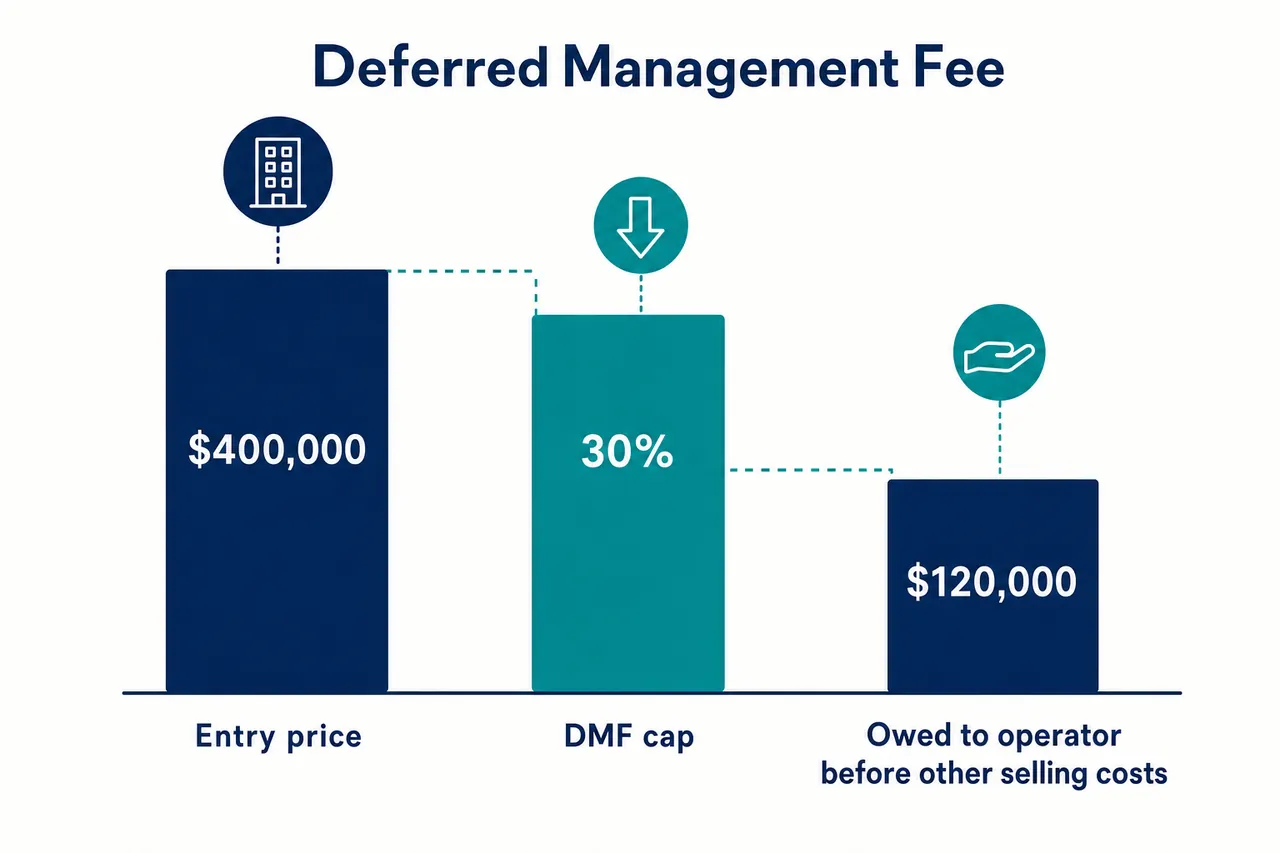
The biggest financial hit in a retirement village sale? The Deferred Management Fee (DMF)—also known as an exit fee or deferred management charge. It builds up while you live there and gets paid to the village operator when you leave or sell your place.
Australian retirement villages typically charge a DMF that accrues at 3%–6% yearly, usually hitting 25%–40% of your entry or resale price after 5–10 years. Here's a real scenario: 6% per year for five years adds up to 30% of what you paid. New Zealand residents face a typical DMF of approximately 27% of the purchase price. And in the UK? Deferred management charges on retirement village properties range from 1%–30% of the sale price.
These aren't small numbers. They're real chunks of your money gone. Say you paid $400,000 to enter a village with a 30% DMF cap—you're looking at $120,000 owed to the operator on departure, and that's before you even calculate other selling costs.
Capital Gains Sharing Clauses
And then there's the appreciation question: who gets it if the property value climbs? In many Australian retirement village contracts, the operator pockets all capital gains on resale—not you. About 63% of Australian retirement village contracts give the operator 100% of the capital gain on resale (as of 2026). Property values in your area go up? Doesn't matter. You may still receive only your original entry price (minus the DMF) instead of what the place is actually worth on the market.
Pull out your Resident Agreement before you list. Have an elder-law attorney or retirement village specialist walk through it with you. Your contract details—not general market conditions—determine what you walk away with.
Back to topUnderstanding the Market Before You Sell
Your contract terms set your net proceeds. But market conditions still matter—they shape how fast your home moves and what price you'll actually get. Spend a little time understanding where things stand before you list. It costs almost nothing, and the payoff can be substantial.
Research Current Local Real Estate Market Conditions
National median home prices are fine for context. But retirement village sales don't follow national trends. They're hyper-local. Before listing, ask your Senior Real Estate Specialist (SRES) agent for a current comparative market analysis (CMA) using recently sold units in your village or the immediately surrounding area. What should you look at? The average number of days comparable homes sit on the market. The ratio of list price to final sale price (anything below 100% means buyers are winning negotiations). And how much inventory's out there right now. A buyer's market—where there's more supply than demand—suggests you price competitively from the start. A seller's market gives you room to price higher. These conditions shift quarter to quarter, so get a fresh CMA rather than dusting off one from six months back.
Demographics and the Senior Housing Market
Americans aged 65 and older keep growing as a share of the population. That broad tailwind supports demand for senior and age-restricted housing over time. But what actually matters for your sale? Local supply of retirement village units, how many newer purpose-built communities are competing for buyers, and the financial profiles of people shopping in your price range. Your SRES agent can tell you who's actively buying in your village right now—downsizing couples, single seniors, younger age-qualifying buyers. Once you know that, you can stage, market, and price specifically for them.
Back to topCapital Gains Tax: What Sellers Over 65 Need to Know
Selling a conventional home or a retirement village property structured as direct ownership? Federal capital gains tax rules treat you the same regardless of your age. That "over-65 exemption" you might've heard about? It's been gone for decades. What you do get is the Section 121 exclusion, which applies to any qualifying seller.
The Section 121 Exclusion
Under IRC §121, you can exclude up to $250,000 of capital gain (single filers) or $500,000 (married filing jointly) for tax year 2026. The requirements are straightforward: you must have owned and used the home as your primary residence for at least 24 months (2 out of the last 5 years). And you can claim the exclusion no more than once every two years.
This is where most long-term homeowners win big. You bought your home decades ago for $150,000 and it's now worth $650,000? That's a $500,000 gain—completely wiped out by the exclusion if you're married filing jointly. But if your gain exceeds the exclusion, that excess hits your tax bill.
Tax on Gains Above the Exclusion
Anything above the §121 exclusion gets taxed at long-term capital gains rates (assuming you owned the home for more than one year). Here's what 2026 rates look like on the federal level:
| Rate | Single Filer (Taxable Income) | Married Filing Jointly (Taxable Income) |
|---|---|---|
| 0% | Up to $49,450 | Up to $98,900 |
| 15% | Up to $545,500 | Up to $613,700 |
| 20% | Over $545,500 | Over $613,700 |
If you're a high earner, there's another layer: the Net Investment Income Tax (NIIT). This 3.8% surtax kicks in on capital gains above your §121 exclusion when your modified adjusted gross income exceeds $200,000 (single) or $250,000 (married filing jointly) in 2026. Stack that on top of the highest long-term capital gains rate and you're looking at 23.8% federally. Then add your state income taxes—which vary wildly depending on where you live. Check your state's rules.
Selling a retirement village home with a lease, license, or loan-based occupancy model instead of outright ownership? The tax treatment shifts significantly. You'll need a CPA who knows retirement village structures to review your specific contract and occupancy type. Marriage or title complications involved? Our guide on selling a house after getting married: tax and title considerations can help with those issues too.
Reverse Mortgages and Other Liens
Reverse mortgage attached to your property? The entire loan balance—principal plus accrued interest—comes due the moment you sell. Same goes for tax liens, home equity lines, or mechanic's liens. Get payoff numbers from your lender and title company early. Waiting until closing to discover a surprise can tank your whole deal.
Back to topBuilding Your Professional Team
Selling a retirement village home isn't like selling a regular house. You need several professionals working together—and their roles don't overlap.
| Professional | What They Handle | Why It Matters Here |
|---|---|---|
| Senior Real Estate Specialist (SRES) | Listing, pricing, marketing, negotiation | SRES-certified agents have specialized training in senior housing transitions, retirement communities, and life-stage considerations |
| Elder-Law Attorney | Resident Agreement review, liens, estate implications, Medicaid planning | Can identify contract clauses that affect your net proceeds before you commit to selling |
| CPA / Tax Advisor | Capital gains calculation, §121 eligibility, NIIT exposure, state taxes | Ensures you don't overpay taxes or miss exclusions you're entitled to |
| Financial Advisor | Proceeds investment, retirement income planning, long-term care funding | Connects the sale to your broader retirement financial picture |
| Title Company / Conveyancer | Title search, lien payoffs, closing | Retirement village properties sometimes carry unusual title structures or encumbrances |
People make one mistake over and over—and it costs them money. They listen to generic real estate advice without getting their actual Resident Agreement reviewed by a lawyer. A standard real estate agent won't spot DMF structures or capital gain sharing clauses. Get an elder-law attorney or retirement village specialist involved before you even list the place.
Handling Family Opinions on the Sale
Your adult children will probably have opinions. Maybe strong ones. And sometimes those opinions won't match each other's. Listen to them. But here's what matters: you're the one who legally owns this property, so you're the one who decides whether and when to sell. Bring family into the conversation about facts and planning. Just be clear about who's making the final call. If there's any question about mental capacity, review or set up powers of attorney before you move forward. And don't sign anything or transfer the property without being absolutely certain you have the legal authority to do it.
Back to topPreparing Your Home for Sale

Getting a retirement village home ready to sell? Most of the prep work is the same as any other property. But there are a few things you should know that make a real difference.
Pre-Sale Inspection and Deferred Maintenance
Get a pre-sale inspection done before you list. This matters. Finding problems early means you tackle them on your own timeline—not rushing to fix things once a buyer's inspector finds them and suddenly threatens to walk away.
Older homes tend to have the same trouble spots. Roof wear, HVAC systems that need servicing, aging plumbing fixtures, outdated electrical panels, gaps in weatherproofing. These show up constantly on inspection reports. Tackle the ones that'll definitely get flagged, because buyers either demand repairs or they'll slash your asking price to cover the work themselves.
And if your place has ever dealt with flooding or water damage—which happens in certain parts of the country—you're legally required to disclose it. We've put together state guides that walk you through exactly what you owe buyers: selling a flood-damaged house generally, plus specific resources for Florida, California, and Washington. They cover what disclosure means and how to handle it strategically.
Staging to Appeal to Today's Buyers
Who's going to buy your place? You'll probably see a mix: other retirees, younger buyers in age-restricted communities who hit the qualifying age, and in open-market retirement neighborhoods, millennials and Gen X folks shopping for a different lifestyle. They all have their own preferences—but good staging works across the board.
- Declutter thoroughly. Thirty, forty, fifty years of stuff makes rooms feel cramped and pulls attention away from what actually matters about the house. Start sorting months before you list—donate items, gift them to family, arrange estate sales for the valuable pieces.
- Maximize natural light. Strip off heavy curtains, actually clean those windows, and open up spaces that've been personalized over decades. Let buyers see what they're getting.
- Neutralize décor. Fresh neutral paint? One of the best money moves you can make. Buyers need to picture their own stuff in those rooms, not yours.
- Highlight functional features. Walk-in showers, single-story layouts, wide doorways, easy-care landscaping—these appeal to buyers across every age group.
- Energy efficiency. Got newer insulation, windows, HVAC, or solar panels? Make sure these shine in your listing. Younger buyers especially think hard about utility bills.
- Professional cleaning. Do this before the photographer comes and before each showing. It's not optional.
Lead Paint Disclosure
Built before 1978? Federal law requires you to give buyers an EPA-approved lead paint disclosure form along with anything you know about lead on the property. For the full rundown on federal rules and your obligations, check out our guide on selling a house with lead paint.


Marketing Your Retirement Village Home Effectively
Pricing Strategy
Pricing requires both numbers and intuition. As of August 2026, the national median existing-home sale price hit $429,100 (NAR data), while the Census-based U.S. median stood at $393,300 as of September 2026. But these national numbers won't tell you what your home is actually worth.
Your SRES agent needs to pull a comparative market analysis (CMA) using homes that recently sold inside your village or in the immediate neighborhood. That's what matters. And here's something critical: some retirement villages let the operator control resale pricing or take a cut of your sale. Some don't. Find out which applies to your community before you sign with an agent.
Digital and Traditional Marketing
Most buyers won't set foot in your home until they've already toured it online. This is your reality now. Professional photography isn't optional—it's your first impression and often your only one.
Virtual tours using 3D technology like Matterport work especially well for retirement village sales. Why? Buyers relocating from across the country can explore your space without flying in. Older buyers with mobility issues can visit multiple times without the physical toll. Your listing description should spell out what makes this village worth buying into: the maintenance services, the community programs, the proximity to hospitals or shopping, transit access—everything.
Don't stop at online marketing. Direct mail to age-qualified prospects in your area still works. Post on community bulletin boards. Use signage if the village allows it. Your SRES agent brings referral networks built specifically for senior housing transitions, and those connections move homes.
Defining Your Unique Selling Proposition
What's actually different about this place? A corner unit with garden views? A kitchen upgraded in the last five years? Monthly maintenance fees that run $200 lower than the village two blocks over? Walking distance to a medical center?
Find two or three real, specific advantages and lead with them everywhere—your listing description, marketing materials, conversations with agents. Don't be vague. Buyers in retirement communities are comparing options carefully. Give them reasons to choose yours.
Back to topNavigating the Sale Process
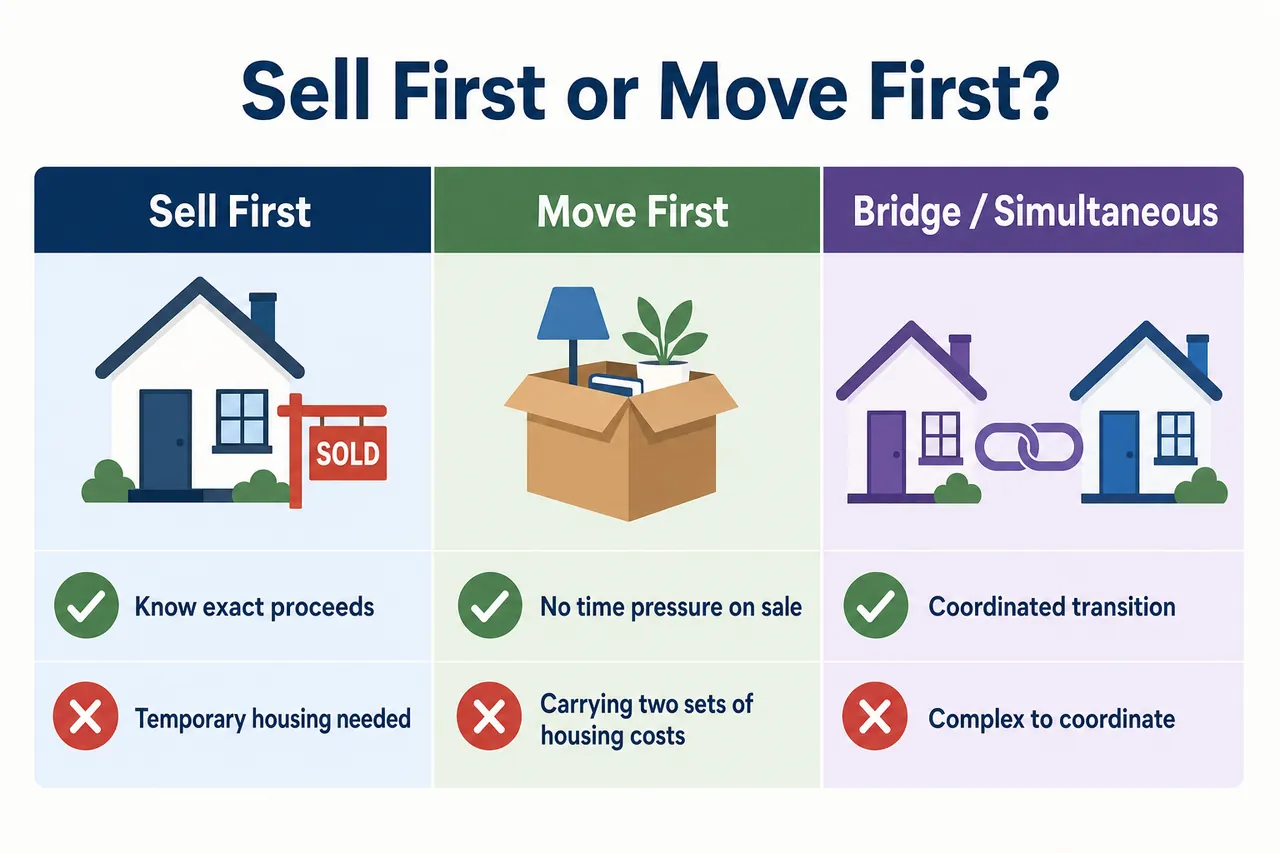
Sell First or Move First? A Practical Timeline
Timing matters enormously here. Do you sell your current home before you've locked down your next place, or do you move first and handle the sale afterward? This one decision ripples through everything that follows.
| Approach | Advantages | Risks | Best For |
|---|---|---|---|
| Sell First | Know exact proceeds; no double housing costs; stronger negotiating position on next purchase | Temporary housing needed if next residence isn't ready; time pressure on finding new home | Buyers who need sale proceeds to fund next move; those with flexible living arrangements |
| Move First | No time pressure on sale; can stage vacant home; smoother physical transition | Carrying two sets of housing costs; possible pressure to accept lower offers | Those with financial cushion; moving to assisted living where timing is health-driven |
| Bridge / Simultaneous | Coordinated transition; minimizes temporary housing | Complex to coordinate; contingencies can cause delays on both transactions | Well-organized sellers with experienced agents on both sides |
But if you're facing a health crisis that demands you move to assisted living or a care facility right now, selling first simply isn't realistic. That's why starting your plan early is so critical. Rush into a sale under time pressure, and you'll almost certainly leave money on the table.
Common Negotiation Mistakes to Avoid
Emotional exhaustion and time pressure can push sellers into some costly mistakes. These happen constantly:
- Accepting the first offer without countering. Even when you're motivated to move, a counteroffer should be automatic. Your agent can read the buyer's desperation level and tell you where you've got room to negotiate.
- Over-personalizing the negotiation. When buyers offer less than your asking price, they're not attacking your memories or the life you built there. This is money, not emotion. Respond to offers using data.
- Giving up too much on contingencies. Want to close fast? Don't waive your inspection contingency or agree to a three-day due diligence window. Those shortcuts can land you in rescission disputes or worse. Know what you're signing away before you sign it.
- Ignoring net proceeds in favor of price. Two offers at $400,000 can pencil out completely differently depending on who pays closing costs, repair credits, and loan type. Run the numbers on what you actually pocket, not the headline price.
- Rushing due to guilt or family pressure. An underpriced, panicked sale can cost you far more than paying rent for three extra months while you market properly. Unless urgent financial or health circumstances demand it, take your time.
Managing the Emotional Dimension
Selling a home where you spent decades—where you raised your kids, built a partnership, created a life—hits different. The emotional weight is real. It's legitimate. And you should acknowledge it straight on.
Then separate it from the business side. Some sellers work with a counselor or social worker alongside their real estate agent during this transition. Others rely on family to process the feelings. The goal isn't to kill the emotion—it's to prevent it from hijacking your financial decisions. Back to topWhat to Do With the Sale Proceeds
Once you subtract DMF payments, real estate commissions (currently running around 5.46%–5.70% as of 2026, though your contract will spell out the exact number), and closing costs, you're left with your net proceeds. Don't wait until the money hits your account to figure out what comes next.

- Transition costs. You'll need money set aside for movers, temporary storage, and any upgrades to your new place—think grab bars, new furniture, or accessibility changes.
- Emergency reserve. Keep enough liquid cash on hand for surprises: medical bills, care expenses, or living costs while you're figuring out your next move.
- Long-term care funding. Planning a move to assisted living? Talk to your financial advisor about how the sale proceeds fit into your long-term care strategy. And don't skip the elder-law attorney—Medicaid rules around look-back periods and asset transfers differ by state, and you need to understand your state's rules before you give away or move any money around.
- Investment allocation. Your time horizon is shorter now. A licensed financial advisor can help you match your investments to your income needs, how much risk you're comfortable taking, and how long this money needs to last.
- Tax timing. If your gain exceeds the §121 exclusion, you'll owe taxes in the year you close. Your CPA might have strategies to spread out that tax hit across your overall income picture.
Alternatives to Selling: Knowing All Your Options
Selling outright isn't your only choice. What actually makes sense for your situation?
- Renting the property. Your village contract might allow subletting—but many don't. Check your Resident Agreement first. If you can rent it out, you'll have ongoing income coming in. The catch: being a landlord in retirement means dealing with tenants, maintenance calls, and tax complications that most people don't anticipate.
- Gifting to family members. This option looks simple on the surface, but tax and Medicaid rules make it complicated. When you gift the property, your heirs inherit your cost basis instead of getting a fresh valuation at today's market value. That means they're sitting on a potentially massive capital gain if they ever sell. And Medicaid's look-back rules might flag the gift as a disqualifying transfer for benefits. Talk to an attorney before you go down this road.
- Bequest through your estate. Leave the property to your heirs in your will, and something remarkable happens: they get a stepped-up cost basis tied to the fair market value on your date of death. Years—sometimes decades—of accumulated capital gain can simply vanish. It's incredibly tax-efficient for them. The tradeoff is you don't touch the equity while you're alive.
- Aging in place with modifications. Want to stay in your community? Roll-in showers, grab bars, stair lifts, widened doorways—accessibility upgrades like these can buy you years of safe, independent living at home. Local Area Agencies on Aging have resources to help cover modification costs. Find yours at eldercare.acl.gov.
- Downsizing within the community. Many retirement villages have different unit sizes. You could move to a smaller place in the same community, cut your maintenance load and costs, and keep the social connections you've built.
Walk through each of these options with your financial advisor and family. Don't just default to selling. Make it an actual choice.
Back to topTransition Planning: Moving to Senior Living
You're selling a house and moving into a senior living community—that's a lot happening at once. Coordinating the sale with your move means juggling housing, healthcare, finances, and logistics all at the same time.
Evaluating Senior Living Community Options
Every senior living community operates differently. Before you list your house, you need to know what you're moving into—because your choice directly affects how much money you'll need from the sale and when you'll need it.
Here are the main types:
- Independent living communities. These are for active seniors who don't need daily care. You'll pay a monthly fee that covers housing, meals, and amenities. Entry costs and monthly fees swing wildly depending on location, size, and what amenities they offer—so ask each community for a full written fee schedule.
- Assisted living facilities. They help with bathing, medication management, meals, and other daily tasks. Costs run higher than independent living, and they vary significantly by state and facility. Some states have specific licensing rules that dictate what services a facility can actually provide.
- Continuing Care Retirement Communities (CCRCs). One campus, multiple levels of care—independent living, assisted living, and skilled nursing all in one place. Most require a big entrance fee upfront (some of it may come back depending on your contract) plus monthly fees. CCRC contracts come in different flavors. Before you sign anything, have an elder-law attorney review the agreement.
- Memory care communities. These specialize in Alzheimer's and dementia care. They staff more heavily and run specialized programs, which is why costs are higher.
Don't just look at the monthly number. What's actually included? What happens when your care needs change? Is the operator financially stable? Visit in person. Ask about staff turnover. Talk to people already living there or their families.
Your financial advisor can run the numbers: take your sale proceeds, subtract the realtor's commission and selling costs, and see how long that money lasts at each community's current price.
Compare what you're paying now—monthly fees, maintenance, insurance, property taxes—against what you'd pay at a new place. Many senior living communities roll everything into one monthly fee: housing, meals, activities, transportation, and varying levels of care. That single number might look steep, but it actually simplifies budgeting.
Time matters here. You don't want to pay rent or a mortgage on two places for months while waiting to close or move in. Talk to your real estate agent and the senior community about syncing your closing date with your move-in date. Many communities offer temporary housing or flexible move-in windows to help make this work.
Back to topConclusion: A Decision Worth Taking Seriously and Taking Time With
Selling a house in a retirement village ranks among the most consequential financial transactions you'll ever make. Exit fees, capital gain sharing clauses, tax considerations, and life-transition pressures converge to create something far more complex than a typical home sale. But it's absolutely manageable when you've got the right people in your corner, you understand your Resident Agreement inside and out, and you've honestly weighed every option available to you.
Start where it matters most: your contract. Call an elder-law attorney before you call a real estate agent. Talk to a CPA about your tax situation. Assemble your team first. Then build your strategy. You're not just selling a house—you're selling it on your own terms, with clarity about the numbers, and moving forward with real peace of mind.
Back to top
Frequently Asked Questions
Is there a special capital gains tax exemption for sellers over 65?
No age-based exemption exists under federal tax law. The Section 121 exclusion—$250,000 for single filers or $500,000 for married couples filing jointly (2026)—applies to any qualifying seller, regardless of how old you are. You just need to meet the ownership and use requirements. Talk to a CPA about whether you qualify for the full exclusion.
What's a Deferred Management Fee and how does it affect my sale proceeds?
A Deferred Management Fee (DMF) is a cost spelled out in your retirement village Resident Agreement. It accumulates while you live there and gets subtracted from whatever you receive when you sell or leave. The numbers vary wildly depending on where you live and which village you're in. In Australia, you're typically looking at 3%–6% per year, capped at 25%–40%. The UK ranges from 1%–30% of the sale price. Before you list, get a lawyer to review your contract and calculate exactly what you'll owe.
Can I keep the capital gains on the sale of my retirement village home?
Maybe. With a typical house, you keep any appreciation—minus taxes. But retirement village contracts often work differently. In Australia alone, about 63% of contracts give 100% of the capital gain to the village operator, not to you. And this varies by location and agreement type. Have an attorney review your Resident Agreement before you assume any price appreciation is yours to pocket.
How do I handle family disagreements about selling the family home?
Family members matter. But legally, only the owner (or owners) can decide to sell. Have clear, documented conversations with everyone involved. If you're worried about someone's ability to make this decision—whether it's cognitive capacity, power of attorney issues, or estate planning complications—nail down the legal authority first. An elder-law attorney can walk you through these conversations and confirm who actually has the right to make the call.
Should I sell before or after moving to my next residence?
Neither approach is universally better. It all hinges on your financial reserves, how soon you need to move, and what the market's doing. Selling first locks in your proceeds but might mean paying for temporary housing in the meantime. Moving first removes the pressure to rush the sale, yet you're stuck covering two properties at once. Work with your real estate agent and financial advisor to build a timeline that works for your situation. The real goal: decide deliberately instead of letting circumstances force your hand.
Back to top