What Happens to a Tenant When Rental Property Is Sold? Rights and Rules

Table of Contents
- Can You Legally Sell a Rental Property with Tenants?
- Tenant Rights When Property Is Sold
- Challenges of Selling a Tenant-Occupied Property
- Strategies for Successfully Selling with Tenants
- Traditional Sale vs. Cash Sale: A Practical Comparison
- State-Specific Notice Requirements and Tenant Protections
- Special Case: Foreclosure Sales and the PTFA
- Tax Considerations When Selling a Rented Property
- Legal Consequences of Violating Tenant Rights
- What Tenants Should Do When Their Rental Property Is Being Sold
- How Lease Terms Affect Property Marketability
- Conclusion
- Frequently Asked Questions
When a rental property is sold, tenants don't automatically lose their housing. Most of the time, your lease just transfers to the new owner—and they're legally bound to follow it until it ends. But here's what gets messy: the sale itself creates real complications for landlords and tenants alike. Know what the law actually requires on both sides, and you'll sidestep most of the fights.
This article is for general informational purposes only and isn't legal, tax, or financial advice. Landlord-tenant law varies significantly by state and even by city. Consult a licensed attorney in your jurisdiction before taking action.

Can You Legally Sell a Rental Property with Tenants?

Landlord's Right to Sell
You can sell. It doesn't matter if tenants are living in the property right now—your right to transfer ownership stays intact. That lease agreement your tenants signed? It doesn't strip away your ability to sell the property. What it does control is what happens next, after the sale closes and new ownership takes over.
Lease Transfer to the New Owner
An active fixed-term lease doesn't vanish when the deed changes hands. It travels with the property to the new owner. That person becomes the landlord and takes on every single commitment in the existing lease—same rent, same end date, same rules. They can't bump up the rent, end the lease early, or impose new conditions until that lease naturally expires. When you're selling a rental property with tenants in place, telling buyers about this upfront saves everyone headaches at closing.
Month-to-Month Tenancies Are Different
Month-to-month tenants don't have the same shield that a fixed lease provides. But they're not unprotected either. Ending a month-to-month tenancy means sending proper written notice. How much notice? That depends on your state—and it varies wildly. What you absolutely can't do in any state is just tell them to leave without following the legal notice requirements.
State-Specific Considerations
The rules shift dramatically depending on where your property sits. California, New York, Oregon, and Washington stack the deck heavily in favor of tenants. Texas and Florida give landlords much more room to maneuver. Because these rules are so different from place to place, pay close attention to the state-specific details in the sections below. Always double-check the current law with a real estate attorney or by calling your state's housing authority directly.
Back to topTenant Rights When Property Is Sold
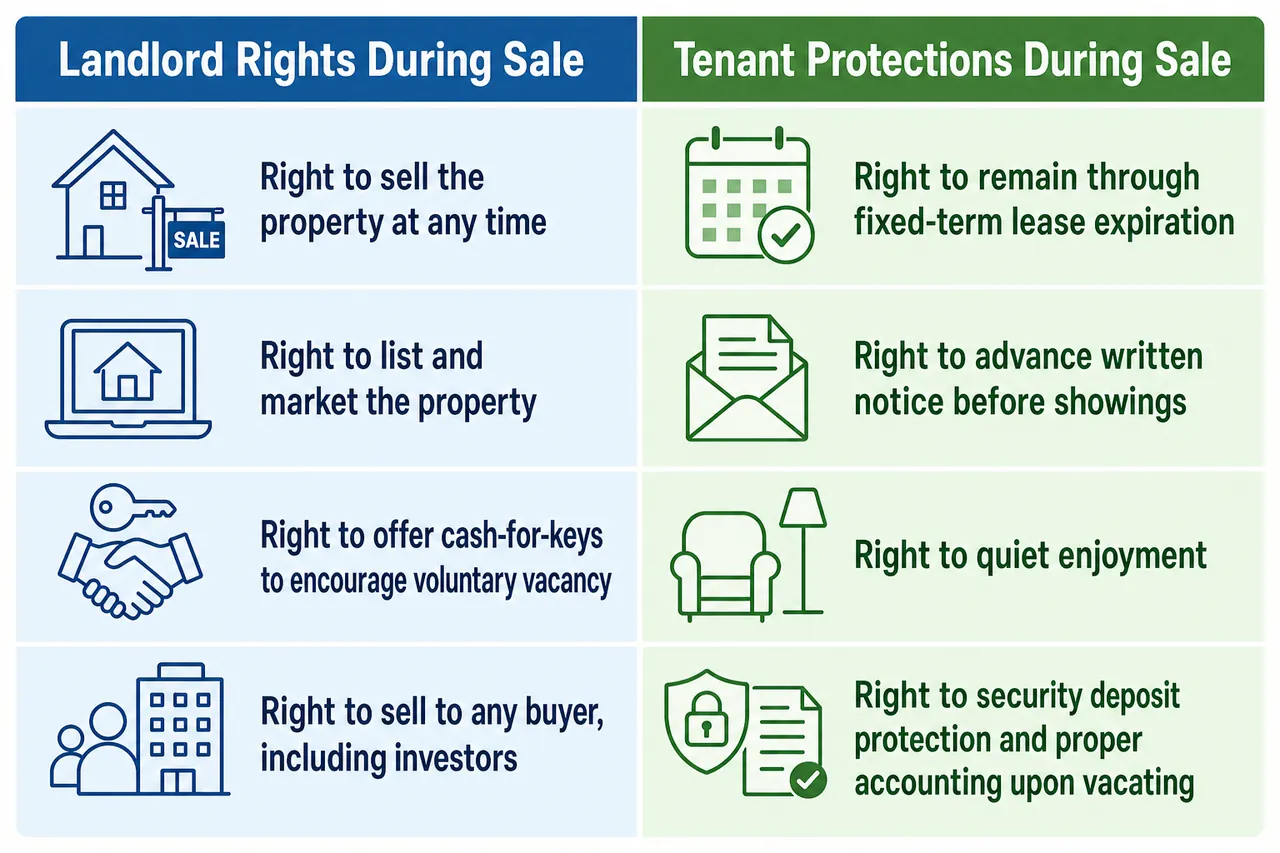

Right to Remain Through the Lease Term
You've got a signed lease running through next September? The sale doesn't touch that. Your lease is a contract, and it's legally binding on whoever owns the building. The new owner can't simply evict you because they bought the place. Your state's landlord-tenant law protects you—and "new ownership" isn't grounds for eviction under any of those laws.

Right to Quiet Enjoyment
Every tenant in the U.S. has an implied right to quiet enjoyment. It's the right to use your home without unreasonable interference. And that right doesn't disappear just because a "For Sale" sign went up. Constant unannounced showings, pressure to move out, or outright harassment from the landlord or new owner? Those are violations, and they can land the landlord in legal trouble.
Notice Requirements for Showings
24 hours is the most common minimum across U.S. states for written notice before entry. Some states require more. The landlord has to follow these rules consistently throughout the sale process, and you should expect nothing less. Entry without proper notice—unless there's a genuine emergency—breaks tenant rights in virtually every state.
Security Deposit Protections
Your security deposit doesn't vanish when ownership changes. One of two paths happens: the original landlord transfers it directly to the new owner (who then has the legal duty to return it), or the landlord returns it to you at or before closing. Either way, your deposit stays protected under the same state-law return rules that applied from day one.
Timing matters. New York gives landlords 14 days, most states allow 30 days, and Alabama, Arkansas, West Virginia, and Kentucky allow up to 60 days. California's window is 21 days. Miss the deadline? Most states penalize landlords two times the deposit amount, and states like Colorado and Arizona go up to three times. Take photos of the unit when you move in, when showings start, and when you leave. That documentation protects you.
| Landlord Rights During Sale | Tenant Protections During Sale |
|---|---|
| Right to sell the property at any time | Right to remain through fixed-term lease expiration |
| Right to list and market the property | Right to advance written notice before showings (typically 24 hours minimum) |
| Right to offer cash-for-keys to encourage voluntary vacancy | Right to quiet enjoyment—no harassment or unreasonable interference |
| Right to terminate month-to-month tenancy with proper notice | Right to same lease terms after sale—new owner can't change rent or rules mid-lease |
| Right to request tenant cooperation for showings | Right to security deposit protection and proper accounting upon vacating |
| Right to sell to any buyer, including investors | Right to legal eviction process only—no self-help removal |
Challenges of Selling a Tenant-Occupied Property

A Smaller Buyer Pool
Most traditional homebuyers—the ones who want to move in and unpack boxes after closing—will walk away from a tenant-occupied property. Personal belongings scattered around. A lived-in kitchen. Lease complications looming. It makes owner-occupant buyers nervous, and that shrinks your effective market considerably. You're looking at extended days on market, pricing pressure, or both.

Difficulty Scheduling and Conducting Showings
Your tenant's got a job. Kids to pick up. A life that doesn't bend around your showing schedule. Even the most cooperative tenants can't be available every time an interested buyer wants to walk through. Coordinating access takes more back-and-forth, and what works for your tenant might not work for the people actually trying to buy. That's how timelines get squeezed in ways you'd never see with a vacant house.
Property Presentation and Maintenance
You can't control how a tenant keeps your home. Some maintain immaculate spaces. Others don't. Cluttered rooms, pet odors, or basic neglect can tank buyer interest, even if the property itself is solid underneath. Dealing with a really difficult situation? Check out the guides on selling a problem rental property and state-specific versions for California, Florida, and Washington. They break down your options in detail.
Uncooperative Tenants
Some tenants get nervous about losing their housing. That's understandable. But it also means they might refuse showings, make themselves scarce during inspections, or just ignore your requests. It's a real operational headache. Your best move: follow notice requirements to the letter, keep everything in writing, and talk to a landlord-tenant attorney if things get rocky. Pressure tactics will only expose you to legal liability you don't need.
Limited Access for Inspections
Buyers will want inspections. Lenders will demand appraisals. Both require interior access, subject to the same notice rules as showings. When you're juggling multiple access events—especially with a tenant who's hard to pin down or unwilling to cooperate—timelines get messy fast.
Back to topStrategies for Successfully Selling with Tenants

Transparent Communication First
Start with an honest conversation. That's free, and it's your most powerful tool. Tell your tenant you're selling, walk them through what that means, and actually listen to what worries them. Tenants who feel respected? They'll cooperate with showings and keep the place in decent shape. Write everything down—no handshake agreements.
Offer a Cash-for-Keys Agreement
Need the place empty to get top dollar or attract more buyers? A cash-for-keys deal might be your answer. It's straightforward: you offer money, the tenant agrees to move out by a set date, and you both sign a written agreement. Absolutely critical—it has to be completely voluntary, never forced.
What should you pay? Think about what your tenant actually needs to relocate: first month's rent at their new place, last month, security deposit, and moving trucks. As of October 2026, the national median rent tracked by Apartment List sits at $1,384 per month. In a typical mid-market area, you're looking at $3,000–$5,000 when you factor in moving expenses. But your city's market might be completely different—adjust the number accordingly.
California AB 1482 sets a legal floor if you're doing a no-fault eviction on a covered unit (usually buildings 15+ years old). You must provide relocation assistance equal to one month's rent, due within 15 days or applied as their final month. And that's the minimum. Your voluntary offer can be more generous.
Obtain an Estoppel Certificate
Ask your tenant to sign an estoppel certificate. This document locks in the facts: when the lease started and ends, monthly rent, whether you've upheld your side, whether they're behind on anything, and how much deposit you're holding. It's essentially a truth record on that specific date.
Why does this matter? Buyers worry. An estoppel certificate stops a tenant from later claiming secret deals, rent reductions, or different amounts than what you told the buyer. The tenant's own signature limits their room to argue later. Commercial real estate deals almost always require them. Residential investor sales increasingly do too. And if you're the tenant, demand a copy of whatever you're signing—read it carefully and make sure every detail is correct before you initial it.
Target Investor and Cash Buyers
Investors buy tenant-occupied properties all the time. A rented unit with an active lease means money coming in from day one. That's exactly what they want. Market directly to them—through investor groups, cash buyer networks, and targeted outreach. You're not hiding a problem; you're offering a feature. For the full breakdown on positioning your rental for investor buyers and walking through the entire process, check out the detailed guide on selling a rental property with tenants in place.
Wait for Lease Expiration
Time is your friend if you have it. Let the lease expire naturally and you remove a huge complication. The house shows empty. You can stage it professionally. Every type of buyer sees it, not just investors. The cost? Waiting—potentially months of carrying expenses while the property sits. Run the math on what those months cost you versus what a vacant house actually sells for in your area, then decide if it's worth it.
Back to topTraditional Sale vs. Cash Sale: A Practical Comparison
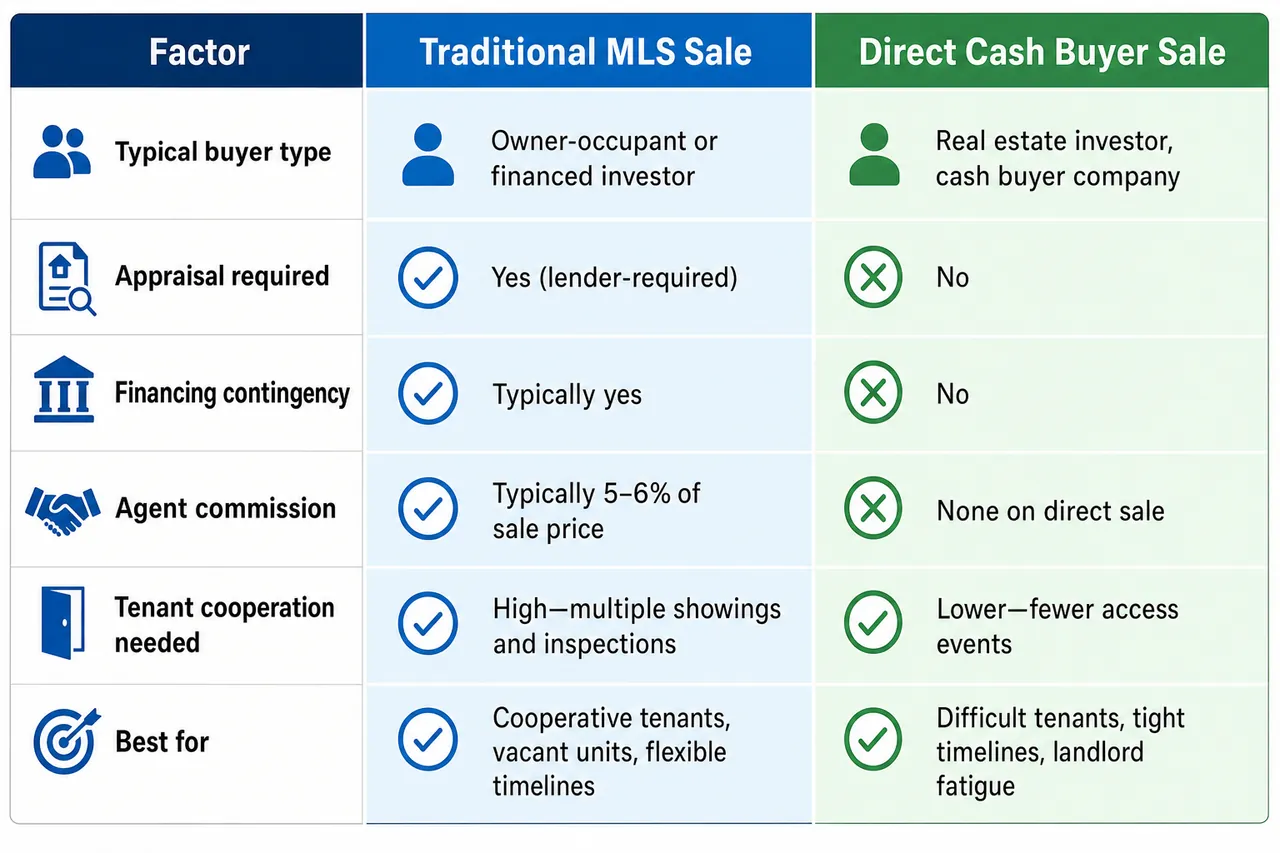
Your timeline matters. So does your tenant's willingness to cooperate. And the price you actually need to walk away with. Both paths work—but only one fits your actual situation right now.
| Factor | Traditional MLS Sale | Direct Cash Buyer Sale |
|---|---|---|
| Typical buyer type | Owner-occupant or financed investor | Real estate investor, cash buyer company |
| Typical time to close | 30–60 days (longer with tenant complications) | 7–21 days in many cases |
| Appraisal required | Yes (lender-required) | No |
| Financing contingency | Typically yes | No |
| Showing requirements | Multiple showings, open houses | Often one or two walkthrough visits |
| Agent commission | Typically 5–6% of sale price | None on direct sale |
| Price expectation | Closer to market value | Below market (discount for speed and certainty) |
| Tenant cooperation needed | High—multiple showings and inspections | Lower—fewer access events |
| Best for | Cooperative tenants, vacant units, flexible timelines | Difficult tenants, tight timelines, landlord fatigue |
Cash buyers do ask for a discount. That's the tradeoff.
But here's what actually matters: if your property needs work, your tenant won't cooperate with showings, or you're on a tight deadline, do the math on what you'd net after a traditional sale. Factor in the 5–6% commission, the extra months of carrying costs, the stress of repeated showings, and potential inspection repairs demanded by financed buyers. Sometimes a faster cash sale—even at a lower price—leaves you with more money in your pocket and your sanity intact.
Back to topState-Specific Notice Requirements and Tenant Protections
Your state's rules on notice-to-vacate can make or break your timeline—and your wallet. The table below covers major states, but keep in mind that cities like San Francisco, Los Angeles, New York City, and Seattle have their own stricter rules layered on top. You'll need to check both state law and local ordinances where your property sits.
| State | Month-to-Month Notice to Vacate | Key Additional Protections | Source / Authority |
|---|---|---|---|
| California | 30 days (<1 year tenancy); 60 days (1+ year) | AB 1482 rent caps and relocation assistance; Ellis Act 120-day notice; just-cause eviction rules for covered units | California Civil Code § 1946.2 |
| New York | 30 days (<1 yr); 60 days (1–2 yr); 90 days (2+ yr) | Rent stabilization in NYC; Housing Stability and Tenant Protection Act | Real Property Law § 226-c |
| Washington | 90 days (selling single-family residence) | Just-cause eviction requirements in many cities; city-level relocation assistance | RCW 59.18.650 |
| Maryland | 90 days (after property sold) | Montgomery County has additional local protections | MD Code, Real Property |
| New Jersey | 2 full calendar months (buyer owner-occupant) | Anti-Eviction Act provides broad just-cause protections statewide | N.J.S.A. 2A:18-61.1 |
| Oregon | 30 days (<1 yr); 90 days (1+ yr), no-fault | Statewide rent control and just-cause eviction law | ORS 90.427 |
| North Carolina | 7 days (minimum, month-to-month) | Fewer statewide tenant protections; local rules limited | NCGS § 42-14 |
| Most other states | 30 days (common minimum) | Varies; check your state housing authority | State landlord-tenant statute |
Need specifics for your state? We've got detailed guides for California, Florida, Washington, Colorado, Tennessee, and Indiana.
Back to topSpecial Case: Foreclosure Sales and the PTFA
When a property goes through foreclosure instead of a standard sale, different rules kick in. That's where the Protecting Tenants at Foreclosure Act (PTFA) comes in. Congress made it permanent in 2018, and it matters for you if you're renting a foreclosed property. The new owner has to give any legitimate tenant at least 90 days' written notice to vacate.
Your lease protects you even more. If your lease extends beyond those 90 days, you can typically stay through the entire lease term. The only exception? The new owner plans to move in themselves. Even then, you still get that 90-day minimum.
Want to understand the full picture of what happens during a foreclosure auction? Check out the guide on what happens when a house is sold at a foreclosure auction.
Back to topTax Considerations When Selling a Rented Property
Selling a rental property triggers taxes that you wouldn't face selling your primary home. Two big ones: depreciation recapture and capital gains. If you've claimed depreciation deductions over the years—and most landlords do—the IRS wants that money back when you sell. They tax it at rates set by federal law. Any profit beyond the recaptured depreciation gets hit with capital gains tax, which varies depending on whether you owned the property short-term or long-term.
Want to dodge those taxes? A 1031 exchange might work for you. It lets you roll your sale proceeds into another investment property without triggering immediate taxes. But the timelines are brutal. You've got 45 days to identify a replacement property and 180 days to close on it. You also need a qualified intermediary to handle the transaction. These rules don't bend.
Work with a CPA or tax attorney who knows real estate before you move forward. The details matter, and they're complex enough that one misstep costs real money.
Tax rates and thresholds shift with legislation, so always check current rules with a qualified tax professional before making decisions.
Back to topLegal Consequences of Violating Tenant Rights
When you skip the rules during a sale, you're exposing yourself to serious legal trouble. Here's what can happen:
- Entering without proper notice: You're opening yourself up to invasion of privacy claims. Your tenant can terminate the lease and sue you for damages.
- Attempting self-help eviction (changing locks, removing belongings, cutting utilities): Every single U.S. state prohibits this. Tenants can recover significant damages—often including punitive damages and attorney's fees—if you go this route.
- Withholding security deposit improperly: Most states will penalize you two to three times the deposit amount, plus attorney's fees. Check your state's specific rules here.
- Coercing a tenant to sign a cash-for-keys agreement: If pressure or false information was involved, that agreement won't hold up in court. You'll likely face additional liability.
- Discriminatory conduct: The Fair Housing Act applies to you no matter what. Targeting a tenant based on race, religion, disability, family status, or other protected characteristics is illegal—sale or no sale.
And if things are already tense with your tenant? Don't wait. Talk to a landlord-tenant attorney before you do anything else. The consultation fee is tiny compared to what a lawsuit will cost you.
Back to topWhat Tenants Should Do When Their Rental Property Is Being Sold
Confirm Your Lease Status in Writing
Start by asking your landlord for written confirmation of your lease terms and what they're planning to do with the property. An estoppel certificate might get handed to you—if it does, read it closely. The rent amount in that document should match what you actually pay each month. The end date should be correct. Any side deals or arrangements need to be in there too. Keep a copy for yourself.
Document Property Condition
Do a full walkthrough before any showings happen. Take photos or video of every room, every closet, every corner. Date and timestamp everything. This one step protects your security deposit and gives you proof if a damage claim shows up later. When you move out eventually, do the same thing again.
Know Your Right to Reasonable Boundaries
Your landlord has to give you advance written notice before showing the place to buyers. You get to set reasonable limits on when and how often that happens. Weekday afternoons and Saturday mornings only? That's your call. But don't just slam the door on every showing—that could breach your lease. Find the middle ground.
Communicate with the New Owner Early
The sale closes. Now what? Call the new owner right away. Ask them where your rent checks should go from now on. Set up how you'll handle maintenance requests going forward. Get written confirmation about your security deposit—who's holding it and exactly how much. The new owner steps into the old landlord's shoes legally, which means they're responsible for honoring any pending repairs or agreements that were already promised to you.
Know When to Get Legal Help
You receive a notice to vacate before your lease actually ends and there's no legal reason for it. Your landlord changes the locks or starts removing your stuff. You feel like your rights are getting trampled. That's when you need to reach out to a tenant rights organization or lawyer in your area. Most places have free or affordable legal aid services specifically for tenants in trouble.
Back to topHow Lease Terms Affect Property Marketability
Not all leases look the same to a buyer. A lease with favorable terms can actually be a selling point to investors. A problematic one? It's a dealbreaker. The tenant-occupied property's value depends heavily on these key factors:
- Time remaining on the lease: Sixty days left and you've barely got a complication. But 18 months remaining significantly limits what a buyer can do with the property.
- Rent amount relative to market: Is your tenant paying well below the current median rent in your market? Investors will factor in that discount they're accepting. If the rent's at or above market, now you've got a cash-flow asset.
- Tenant payment history: A long-term tenant who pays on time and maintains the place is a genuine asset. Document this for buyers. They want proof.
- Lease provisions: Any unusual clauses matter—pet agreements, parking arrangements, maintenance responsibilities shifted to the tenant. Disclose these clearly. Surprises after closing damage buyer relationships and can generate legal disputes.
Conclusion
Selling a rental property with tenants in place? The core rule doesn't change: existing leases transfer to the new owner. Tenant rights survive. Neither landlord nor buyer can dodge this by pretending it's not the law.
If you're the landlord, your best shot at a smooth sale comes down to four things. Talk to your tenants early. Follow every notice requirement to the letter. Target investor buyers who actually want occupied properties. And be honest about what's on the property and in those lease agreements.
You're the tenant? A sale can feel destabilizing, but don't panic. Your lease stays valid. Your deposit stays protected. You'll get proper notice before anything changes.
But here's what matters most: the rules shift depending on where you live. Your state has one set of requirements. Your city might have stricter ones. Your specific lease could add even more protections or obligations.
Before you make any big moves—whether that's listing the property or responding to a sale notice—talk to a lawyer who knows your local laws inside and out. What works in one state can get you in serious trouble in another.
Back to topFrequently Asked Questions
Can a landlord force tenants out when the property is sold?
Not a chance. When a property sells, the new owner steps into the landlord's role—and that means honoring your lease through its expiration date. Your landlord can't boot you out just because they sold the place. Getting you out before your lease ends requires a legal eviction with real grounds: you're not paying rent, you've violated the lease, or in some states, the new owner has a no-fault just-cause reason. And changing locks, tossing your stuff, or shutting off utilities? That's illegal everywhere in the country. Do that, and you're looking at significant damages awarded to you.
What happens to a security deposit when a rental property is sold?
Your deposit has to go somewhere—and it can't just vanish into the seller's pocket. Either the original landlord hands it directly to the new owner (who now owes it back to you under state law), or they return it to you at closing. That's it. Those are your only two options. After you move out, state law sets the clock for how long they have to return it. New York gives them 14 days. Some states allow 60 days, and 30 days is the standard most places. Hang onto those dates—wrongfully holding your deposit can cost a landlord two to three times what they withheld in many states.
Can the new owner raise rent immediately after buying the property?
No. Your lease protects you here. The new owner can't increase your rent while that lease is active—they're stuck with whatever terms the previous landlord agreed to, rent amount and all. Once your lease expires, though? That's when things change. Month-to-month tenants should know the new owner has to follow state notice rules before raising rent. And if you live somewhere with rent control or stabilization—parts of California, New York City, and other areas—there are additional caps on how much they can raise it, even after your lease ends.
Do tenants have to allow showings when a property is for sale?
You do have to let people in. But there's a catch: they need proper notice first, usually 24 hours in writing minimum, though some states demand more. You can't just refuse every showing—that's a lease violation. What you can do is set reasonable limits on when and how often they show up. They can't demand access at midnight on a Saturday or show up unannounced. Breaking these rules? The landlord's on the hook for violating your rights, sale or no sale.
What's an estoppel certificate and does a tenant have to sign one?
An estoppel certificate is basically a signed statement from you confirming the current lease terms: how much you pay, when it started and ends, what deposit they're holding, and whether anything's been violated or agreed to outside the lease. The buyer and their lender use it to verify everything the seller told them about your tenancy is true. Whether you're legally required to sign depends on your lease. Many commercial leases spell this out; residential ones are all over the map. If your lease has an estoppel clause and they ask you to sign, read it closely. Make sure every detail matches reality before you put your name on it, and always ask for a copy.
Back to top