

How to Sell a House With a Second Mortgage or HELOC in Indiana
Selling your home with a second mortgage or HELOC in Indiana can feel stressful and confusing. 1 You must pay off these loans at closing before you transfer the property title to someone else. Indiana law requires all liens to be satisfied before a clear title can be conveyed to a buyer.
This guide explains what happens during an Indiana real estate transaction, from requesting payoff amounts to understanding how much money you will receive after paying off your primary mortgage, line of credit, and closing costs. 3
Key Takeaways
- When you sell a house in Indiana with a second mortgage or HELOC, both loans must be paid off at closing before new owners receive the title. The title company uses sale proceeds to pay the first mortgage lender first, then pays the second lienholder.
- Only what you borrowed on your HELOC is due at closing—not your full credit limit. For example, if you owe $200,000 on your main loan and $30,000 on a HELOC for a $350,000 sale price, you pay those balances plus typical Indiana closing costs.
- If your home value covers all loans and fees, leftover funds go to you. If you are "underwater," you may need extra cash or request a short sale. About 15% of sellers see second mortgages directly reduce expected profits.
- Payoff quotes from both lenders are required before closing and usually last only 30 days. Prepayment penalties can apply—some Indiana lenders charge up to 5%, so check your loan terms early.
- Missed loan payments hurt credit and hold up sales. Divorce adds challenges since both parties remain liable until debts clear at settlement.
What Happens to a Second Mortgage or HELOC When You Sell in Indiana?

If you have a home equity loan or line of credit, your lender will need to be paid off when you sell. Indiana title companies ensure both the primary lender and the second lienholder receive payment from the sale proceeds. Liens recorded with the county recorder's office—whether in Marion County, Hamilton County, or Boone County—establish the payment priority at closing.
Lien hierarchy: First mortgage paid first, then second mortgage/HELOC
Liens on your Indiana property follow a strict payment order at closing based on their recording date with the county recorder. The primary mortgage gets paid first from home sale proceeds, since it holds the top position in lien priority.
After the first mortgage lender receives full repayment, the title company moves to pay off any second mortgages or home equity lines of credit (HELOCs) registered against your home.
For example, if you sell a house in the Indianapolis metro area for $350,000 with a $200,000 balance on your main loan and $30,000 owed on a HELOC, sale funds pay off the main loan before anything goes toward the HELOC.
Indiana title companies handle this process during real estate transactions to ensure all financial obligations tied to the property are cleared before transferring title to new buyers.
Payoff requirements at closing: a simple Indiana example
Suppose you sell your Indianapolis home for $350,000. You have a primary mortgage balance of $100,000 and a HELOC balance of $40,000. At closing, the Indiana title company uses sale proceeds to pay off your main mortgage first—sending $100,000 directly to your primary lender—then pays the $40,000 HELOC balance to that lender.
After these payoffs, you have $210,000 remaining before closing costs. Indiana closing costs typically run 8% to 10% of the sale price, covering agent commissions, title insurance, and any outstanding property taxes due at the time of transfer. That means roughly $28,000 to $35,000 more in deductions.
Only what you drew on the HELOC is due—not the full available credit limit. Indiana title companies coordinate all payouts so both loans are cleared before any remaining funds reach you.
Step-by-Step Process for Selling with a Second Mortgage or HELOC in Indiana

Selling your house with a HELOC or second loan in Indiana involves clear steps. Your Indiana title company will guide the closing process and ensure all outstanding balances are paid to both lenders at settlement.
Request payoff quotes from both lenders
Request written payoff statements from both your primary mortgage lender and your HELOC provider at least one month before closing. These statements are typically valid for only 30 days, so timing matters. The payoff amount will include the principal balance, accrued interest, and any prepayment penalties—which can range from 2% to 5% of the loan amount.
Indiana title companies and closing attorneys need current payoff quotes to ensure all financial obligations are settled during the home sale. If you feel overwhelmed by paperwork and deadlines, consult a qualified Indiana mortgage professional or real estate attorney before reaching out to your lenders.
Calculate equity and factor in Indiana closing costs
To find your net equity, subtract the payoffs for your first and second mortgage or HELOC from your sale price, then subtract closing costs. Indiana sellers should also account for the state's property tax proration, which is calculated at closing based on the current year's assessed taxes. Indiana does not impose a state-level real estate transfer tax, which can slightly reduce your cost burden compared to some other states.
Many sellers in areas like Carmel or Fishers overestimate their equity because they forget agent commissions or prorated property taxes that appear at settlement. Using a Home Sale and Net Proceeds Calculator helps avoid surprises. The title company confirms these figures before you sign final closing paperwork.
Understand how the Indiana title company coordinates payoffs
The Indiana title company acts as a central coordinator during your home sale closing. It gathers official payoff quotes from all lienholders—your primary mortgage and any home equity loan or HELOC—and confirms each lender's outstanding balance for accuracy.
Payoffs for first-lien mortgages happen first; second loans are paid next. The title company deducts all required loan repayments directly from sale proceeds and wires funds to creditors. Any remaining equity after paying off both loans and covering closing costs is disbursed to you. This process ensures buyers receive a clear title free of old liens recorded with the Indiana county recorder's office.
Equity Scenarios When Selling with a HELOC in Indiana
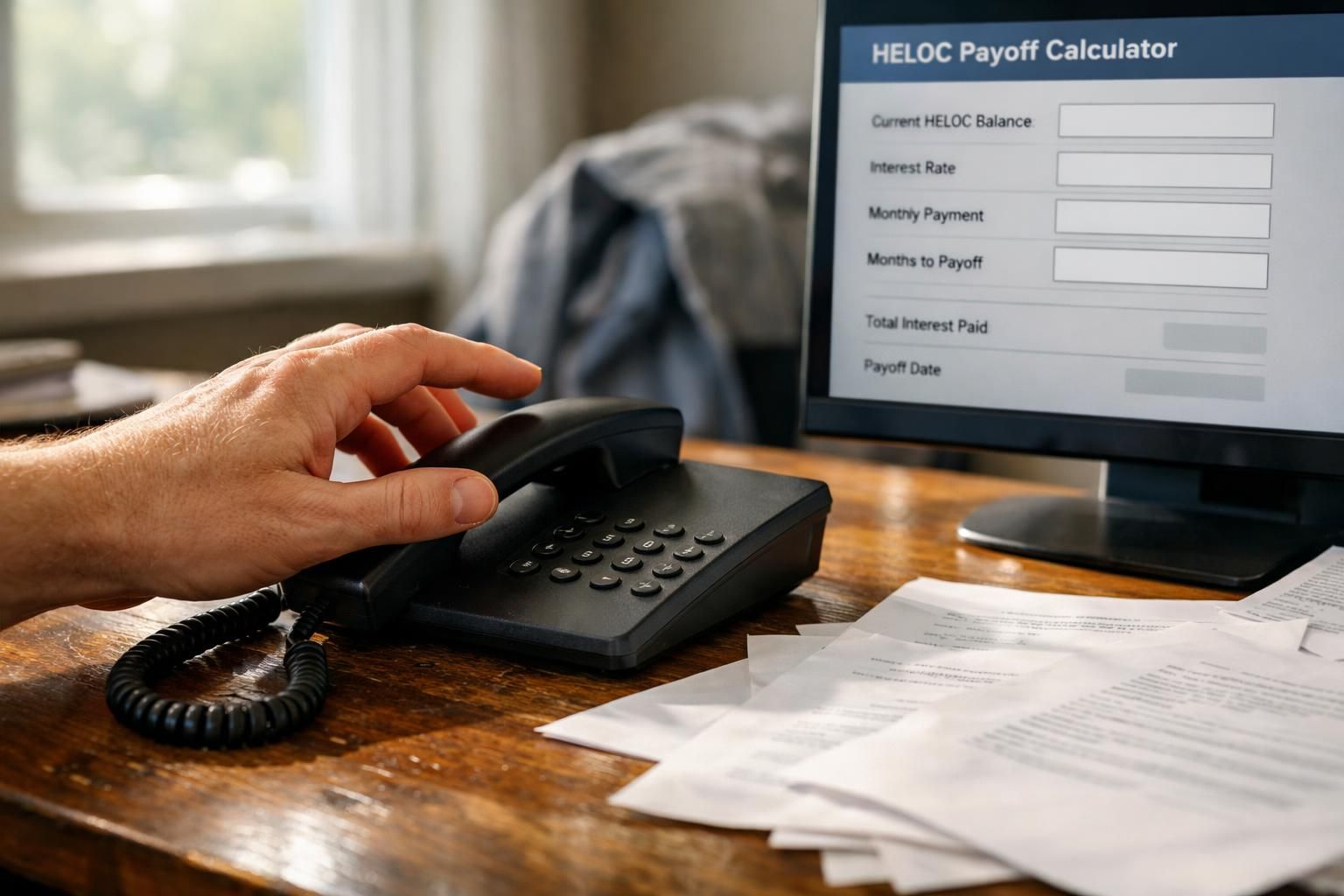
Your home equity shapes your options at closing, especially when a HELOC stands as a second lien. Understanding potential gaps and how payoff affects your proceeds helps you plan for any financial obligations.
Scenario A: Enough equity to cover loans and costs
If your home value exceeds the combined balances of your primary mortgage, HELOC, and closing costs, you have sufficient equity. For example, if your Noblesville property sells for $375,000 and total outstanding loans add up to $270,000 with another $20,000 in closing costs, you can pay all financial obligations at closing and keep the remaining funds.
Using a HELOC for pre-sale improvements can make sense here. Minor kitchen renovations recoup about 85% of their cost, while bathroom upgrades return roughly 70%. 2 Professionally staged homes sell faster and can bring meaningfully higher offers—even after paying every lienholder involved.
Scenario B: Short on equity—options to cover the gap
A shortfall at closing means you must cover the gap with your own funds—savings, a personal loan, or by increasing monthly repayments before listing to reduce the balance you owe by closing day. Some Indiana sellers also wait for local market conditions to improve before listing.
Bridge loans are another temporary option. Paying off these debts may also improve your credit score in future transactions. Work with your Indiana real estate agent and title company for guidance tailored to your situation and local market conditions.
Scenario C: Underwater—the short sale option in Indiana
If your home value falls below the total owed on your first mortgage and HELOC, you have negative equity. In Indiana, a traditional sale often cannot pay off all debts after closing costs. For example, if you owe $300,000 between both loans but can only sell for $265,000, there is a $35,000 shortfall.
A short sale may provide relief. Your primary mortgage lender must approve the arrangement before listing; your HELOC lender may also need to consent. Under Indiana law, lenders may pursue a deficiency judgment for any unpaid balance remaining after a short sale, so consult an Indiana real estate attorney before proceeding. Short sales take longer to close than typical transactions due to extra lender approvals and paperwork.
Special Situations to Consider

What if the HELOC is open but unused?
An open but unused HELOC does not increase your payoff amount. You only need to repay the outstanding balance plus any accrued interest—not the full credit limit. If you have a $0 balance and no drawn funds, you owe nothing beyond possible account closure fees specified by your lender.
Your Indiana title company will confirm with your bank that the account is closed with no outstanding balances before completing the transaction. Request an official payoff statement to verify there are no remaining charges. Closing even an unused HELOC can help improve your debt-to-income ratio for future financing.
Home equity loans vs. HELOCs: key differences
Home equity loans provide a lump sum with a fixed interest rate and predictable monthly payments—similar to a second mortgage. HELOCs work more like a revolving line of credit with variable rates; you pay only on what you have drawn during the draw period, typically 10 years.
Both must be settled at closing when you sell your Indiana property. Only what you have used on a HELOC is due—not the full line amount. For example, if your HELOC limit is $50,000 but you have only drawn $20,000, you repay that $20,000 plus accrued interest and any applicable early repayment penalties.
Missed payments and divorce-related challenges in Indiana
Missed payments on a second mortgage or HELOC can seriously complicate an Indiana home sale. Late payments damage your credit score, may trigger collection actions, and could prompt a lender to begin foreclosure proceedings under Indiana law—making it much harder to sell for fair market value. Any unpaid balances will surface during the title search and must be cleared before closing.
Divorce brings additional complexity when both spouses are named on a home loan or HELOC. Even with an Indiana divorce decree from an Indiana Superior Court or Circuit Court, both individuals remain liable for financial obligations until full repayment occurs at closing or through refinancing. If one spouse intends to keep the home, a refinance is typically required as part of the buyout. Indiana lenders may pursue deficiency judgments against either party if sale proceeds do not cover what is owed. Coordination between your Indiana attorney, real estate agent, and title company is essential to avoid delays in transferring ownership.
Actionable Next Steps

How to get payoff amounts and contact lenders
Call each lender directly and request a formal payoff statement for both your primary mortgage and your HELOC or home equity loan. Lenders will calculate your outstanding balance, add accrued interest, and list any prepayment penalties. Expect payoff quotes to remain valid for about 30 days.
Your Indiana title company or closing attorney will also contact lenders during the closing process, but having current statements on hand speeds things up. Keep copies of all responses in case questions arise about balances owed before transferring title.
Questions to ask your Indiana real estate agent or attorney
Ask your agent or Indiana real estate attorney to explain all closing costs and legal fees associated with paying off a second mortgage or HELOC. Request details on prepayment penalties and find out how the title company confirms every lien is paid at closing.
Ask about any property tax liens or HOA dues and how Indiana's property tax proration affects your proceeds. Confirm whether any outstanding balances remain after closing costs and how negative equity would affect your final numbers. Clear communication prevents surprises, especially in today's Indiana housing market.
Simple calculation worksheet to estimate Indiana proceeds
Use this formula to estimate your net proceeds:
Sale Price − First Mortgage Payoff − Second Mortgage/HELOC Payoff − Closing Costs = Net Proceeds
For example: You sell your Indianapolis home for $350,000. You owe $200,000 on the first mortgage and $30,000 on a HELOC. Estimated closing costs are $25,000 (including agent commissions, title fees, and prorated Indiana property taxes). Your estimated net proceeds are $95,000 before any repair credits or additional fees.
Indiana does not impose a state transfer tax, which is worth noting when comparing costs with sellers in neighboring states. A Home Sale and Net Proceeds Calculator can automate these figures, but always consult a qualified Indiana real estate professional for a final estimate based on your specific situation and local market conditions. 3
FAQs
1. What happens to my HELOC or home equity loan when I sell my Indiana home?
You must pay off any outstanding balance during the closing process. The Indiana title company uses your home sale proceeds to settle these debts before you receive any funds.
2. Can I sell an Indiana house if I have negative equity?
If you owe more than your home's current market value, selling may require a short sale where the lender agrees to accept less than what you owe. Indiana lenders may pursue a deficiency judgment for any remaining unpaid balance, so consult an Indiana real estate attorney before proceeding.
3. Are there prepayment penalties for paying off a HELOC early in Indiana?
Some Indiana lenders charge prepayment penalties for closing a home equity loan or line of credit ahead of schedule. Check your loan documents and Truth in Lending statement for details about possible fees before listing your home.
4. How do Indiana closing costs affect my proceeds when selling with two mortgages?
Indiana closing costs—including title insurance, settlement charges, and prorated property taxes—are deducted from the funds used to repay both your primary and secondary loans, reducing your net proceeds.
5. Does Indiana have a real estate transfer tax that affects sellers with a HELOC?
Indiana does not impose a state-level real estate transfer tax, which can benefit sellers compared to some other states. However, county-level fees and recording costs still apply when liens are released at closing.
6. Does having a second mortgage affect Indiana capital gains tax on my home sale?
Federal capital gains exclusions ($250,000 for single filers, $500,000 for married couples filing jointly) apply if you meet the IRS ownership and use tests—regardless of whether a HELOC is involved. Indiana also taxes capital gains as ordinary income at the state rate. Consult a tax professional for advice specific to your situation.
References
- ^ https://www.consumerscu.org/blog/selling-a-home-when-you-have-a-heloc-or-home-equity-loan (2025-09-15)
- ^ https://www.academybank.com/article/selling-your-home-use-a-heloc-to-prepare (2025-01-17)
- ^ https://www.guildmortgage.com/mortgage-calculators/home-sale-calculator/
- ^ https://www.homelight.com/blog/how-to-sell-a-house-with-a-second-mortgage/ (2023-10-30)
If you are an Indiana homeowner dealing with a second mortgage or HELOC and want a straightforward path to closing, KDS Homebuyers can help. We buy houses directly from Indiana homeowners for cash—no agent commissions, no lengthy negotiations, and no waiting on lender approvals. Visit kdshomebuyers.net today for a free, no-obligation cash offer and see how much you could walk away with after all your liens are settled.
