

Property Tax Proration at Closing: How It Works for Sellers in Indiana
You might wonder if you will get money back after paying your full Indiana property tax bill in the spring, only to close on your home sale in June. Property tax proration at closing is a standard part of Indiana real estate transactions handled by the title company or closing attorney.
This post explains how proration works in Indiana, using clear steps and examples to help you understand your credits or debits. 1 Keep reading to learn how Indiana property taxes are fairly split during the closing process. 3
Key Takeaways
- Property tax proration ensures sellers pay only for taxes covering the days they own the home. If you sell on June 15 with a $3,000 annual tax bill, your share covers January 1 to June 14.
- Indiana title companies or closing attorneys handle all proration calculations. These amounts appear as credits or debits on your Closing Disclosure statement under "Other Costs."
- Indiana property taxes are paid in arrears on a roughly 18-month delay — May 10 and November 10 are the two annual due dates. This affects how proration is calculated and who gets credited at closing.
- Use this formula: Daily Tax Rate = Annual Tax ÷ 365; Seller's Share = Daily Rate × Days Owned; Buyer's Share = Daily Rate × Remaining Days. Example: $3,000 ÷ 365 ≈ $8.22/day; seller with 165 days owes about $1,356.
- Indiana's homestead deduction and other exemptions lower your taxable assessed value and can affect final proration amounts. Always confirm your exemption status with your county assessor before closing.
What Property Tax Proration Means

Property tax proration makes sure you only pay your fair share of property taxes based on how long you own the home. Indiana title companies and closing attorneys handle these calculations to keep real estate transactions fair for both parties.
Define proration as the fair division of taxes based on ownership dates.
Proration means dividing property taxes fairly between you and the buyer based on ownership dates. The title company or closing attorney calculates your seller's share based on how many days you owned the home during the tax year.
For example, if you sell your Indianapolis-area home on June 15th with a $3,000 annual tax bill, you are responsible for taxes from January 1st through June 14th. The buyer takes over for the rest of the year. 1
Think of proration like splitting a restaurant bill by what each person ordered rather than cutting it in half. You only pay property taxes covering your actual period of ownership.
Indiana uses a calendar year for property tax purposes. The state bills in arrears — meaning taxes due in 2025 cover the 2024 tax year — so your title company will use the most current available tax bill and adjust accordingly. 1
Use a simple analogy like splitting a restaurant bill.
Think about paying a restaurant bill with friends — each person covers only what they consumed. Property tax proration at closing works the same way.
You pay property taxes only for the days you owned your Indiana home, and the buyer pays from the date they take ownership. No one pays more than their fair share. 2
Indiana title companies use this method to prevent disputes and keep the settlement statement transparent. Your time as owner before closing day determines your exact share — just like itemizing a group dinner ensures everyone pays only for what they ordered.
How Proration Works Step-by-Step

An Indiana title company or closing attorney will calculate property tax proration using your actual closing date and the county tax bill. Their step-by-step process ensures you pay only your share, whether you have paid taxes ahead or still owe a balance.
Walk through calculations with an example ($3,000 annual tax, June 15th sale date).
Property tax proration can seem confusing, but breaking the numbers down makes it clear. Here is how you figure out the seller's share using a real Indiana example.
- Start with the annual property tax bill: $3,000.
- Divide $3,000 by 365 days to get the daily rate — about $8.22 per day.
- If your home closes on June 15th, you are responsible for property taxes from January 1st through June 14th.
- That covers 165 days of seller ownership.
- Multiply 165 days × $8.22 = $1,356.30 as your share.
- The buyer's share runs from June 15th through December 31st — the remaining 200 days.
- 200 days × $8.22 = $1,644 for the buyer.
- Because Indiana bills in arrears, the current year's taxes may not yet be assessed. Your title company will typically use the prior year's bill as an estimate and note the proration is subject to adjustment.
- If taxes have not been paid for your ownership period, the amount is deducted from your sale proceeds at settlement as a debit.
- All figures appear on your closing disclosure statement prepared by the title company or closing attorney.
Explain both scenarios: seller paid taxes in advance or hasn't yet.
Indiana's arrears-based tax system means sellers most often owe a credit to the buyer at closing rather than receiving one. Here is how each scenario plays out:
- Because Indiana taxes for the current year are not due until the following spring, sellers typically have not yet paid taxes for the year they are selling in — this means you will owe a debit at closing covering your ownership period.
- If you paid the spring installment (due May 10) covering the prior tax year, that payment does not overlap with the current proration calculation and does not generate a credit.
- For example, closing June 15th with an estimated $3,000 annual tax bill: your share for 165 days is $1,356.30, deducted from your proceeds. 3
- The buyer receives this credit so they can cover the full bill when it comes due the following May and November.
- In the less common case where taxes were prepaid or overpaid, the title company will credit the seller for any unused portion on the closing disclosure.
- Your title company will verify payment status with the county treasurer's office — Marion County, Hamilton County, and Boone County each maintain their own records.
Provide a simple formula for reference.
Use this simple formula for Indiana property tax proration at closing:
Daily Tax Rate = Annual Property Tax ÷ 365
Seller's Share = Daily Rate × Days Owned Before Closing
Buyer's Share = Daily Rate × Days After Closing Through Year-End
Example: $3,000 annual tax, closing June 15th. Daily rate = $8.22. Seller owned 165 days → $1,356.30. Buyer gets remaining 200 days → $1,644.
Indiana title companies use these formulas to produce the credits and debits on your settlement statement. Because Indiana taxes are billed in arrears, the title company typically uses the most recent available assessed value and tax rate and notes that a reproration may be needed once final bills are issued.
Who Calculates and Handles This

An Indiana title company or closing attorney figures out the property tax proration for you. These calculations appear on your official closing disclosure statement before the sale is finalized.
Explain the role of title companies or closing attorneys in proration.
Indiana title companies act as neutral third parties in the real estate transaction. They pull tax data from the county assessor and treasurer — whether in Marion County, Hamilton County, or elsewhere — and apply a daily rate calculation to determine each party's share.
If you paid taxes in advance, the title company credits you for the buyer's portion. If taxes remain unpaid for your ownership period, funds are deducted from your proceeds so both sides are treated fairly.
Closing attorneys in Indiana review settlement statements for issues like delinquent taxes, ending exemptions, or complicated sales involving estates or divorce. The title company may also hold funds in escrow to cover estimated unpaid taxes until final bills are confirmed. You see all proration amounts clearly on the final closing disclosure alongside other closing costs.
Reassure readers it's reflected on the closing disclosure statement.
You will see property tax proration listed on your Closing Disclosure in Section L under "Other Costs." This section clearly shows credits and debits for taxes already paid or still owed.
For a Noblesville-area home sale closing June 15th with a $3,000 annual tax bill, your share is calculated through the closing date. Because Indiana bills in arrears, this typically appears as a debit from your proceeds — a credit to the buyer so they can cover the future tax bill.
All financial adjustments pass through the title company or closing attorney before your net proceeds are released. Review these numbers with your closing professional to confirm they align with your county's records and payment schedule.
Credits vs. Debits for Sellers
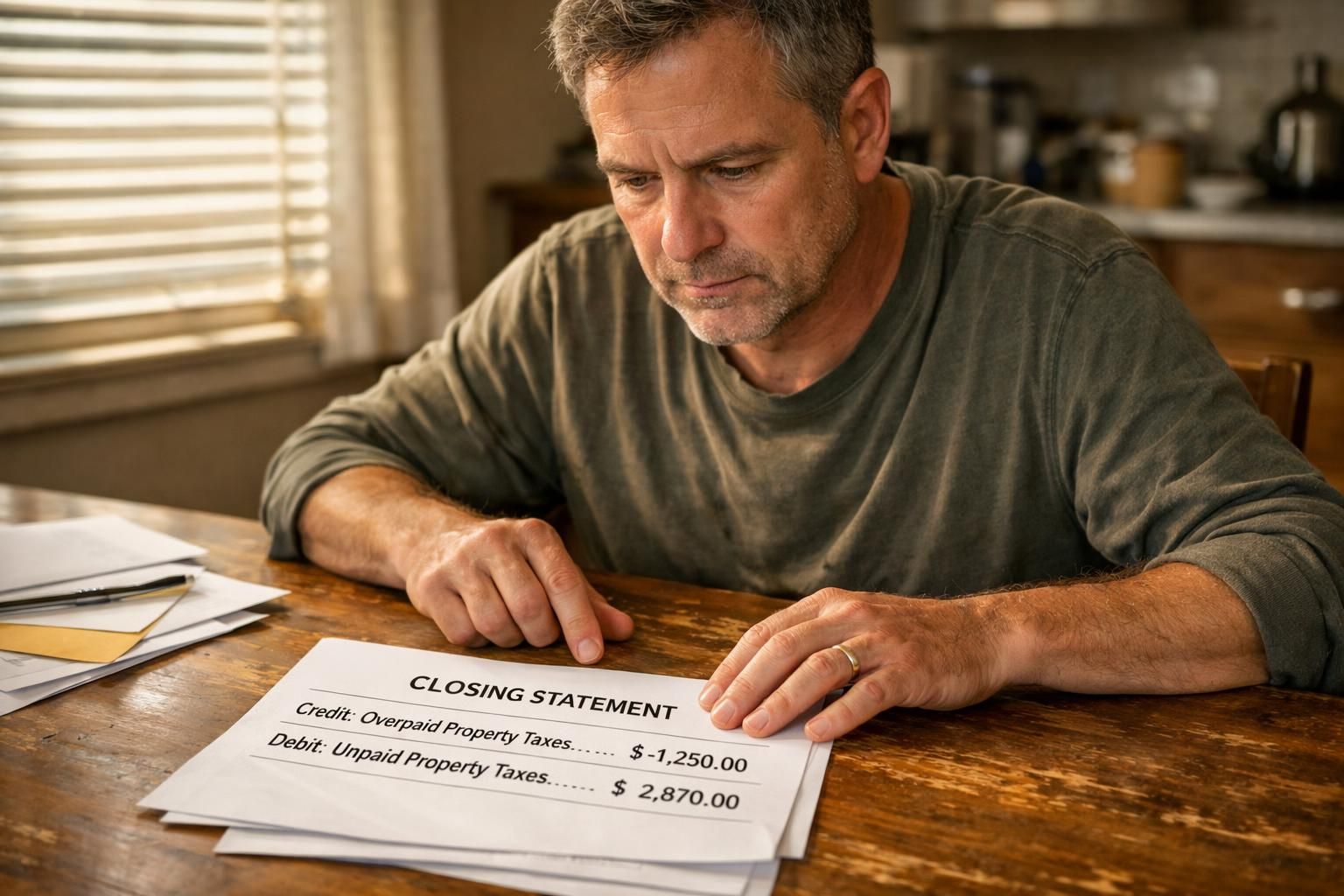
In Indiana, sellers most commonly owe a debit at closing because property taxes are paid in arrears. If you have already paid more than your share in a specific situation, you will receive a credit instead.
Clarify when sellers get a credit versus owe money.
Indiana sellers typically owe a debit at closing because current-year taxes will not be billed until the following spring. Your title company deducts your share of unpaid current-year taxes from your proceeds, which the buyer then uses to pay the bill when it comes due.
You may receive a credit if you overpaid a prior installment or if your county's billing cycle creates a situation where you have prepaid beyond your ownership period. Both credits and debits appear on the final settlement statement and are itemized by the title company for accuracy. 4
Use clear examples to illustrate both situations.
Scenario 1 — Debit (most common in Indiana): You close June 15th. Annual taxes are estimated at $3,000. You have not yet paid any current-year taxes because they are not due until next May. Your 165-day share = $1,356.30, deducted from your proceeds as a debit. The buyer gets a corresponding credit.
Scenario 2 — Credit (less common): You paid $8,400 in taxes earlier in the year covering a period that extends past your closing date. Your title company calculates the unused portion — say July 15 through December 31 — and credits you back approximately $4,487. This appears as a negative (credit) on your settlement statement.
Proration ensures you pay only for the period you actually owned the home, protecting both you and the buyer from overpaying.
Indiana-Specific Rules and Variations

Indiana has its own tax calendar, payment schedule, and exemption rules that directly affect proration at closing. Understanding these details helps you avoid surprises on your settlement statement.
Indiana tax calendar and payment schedule.
Indiana property taxes are paid in arrears on a roughly 18-month delay and are due in two installments each year — May 10 and November 10. Taxes billed in spring 2025 cover the 2024 tax year. This means when you sell your home in 2025, the current year's taxes (2025) have not yet been billed or paid, and your seller's debit at closing covers your share of those future taxes.
Indiana also has a 1% circuit breaker cap, which limits property taxes on owner-occupied homes to 1% of assessed value, 2% for other residential property, and 3% for commercial. This cap can significantly lower annual tax bills compared to states like New Jersey or Illinois and affects your prorated amount.
Property taxes in Indiana vary by county. Marion County (Indianapolis), Hamilton County (Carmel, Fishers, Noblesville), and Boone County (Lebanon) each have their own rates set by local taxing units including cities, townships, school districts, and libraries. Your title company will pull the specific rate for your parcel from county records.
Indiana homestead deduction and other exemptions.
Indiana offers a homestead deduction that reduces the assessed value of your primary residence for tax purposes — currently a standard deduction of up to $48,000 or 60% of assessed value, whichever is less, plus a supplemental deduction. This deduction lowers your annual tax bill and therefore lowers the prorated amount calculated at closing.
The homestead deduction ends when you sell. The new owner must apply for their own exemption. Your proration is based on your assessed value with your exemptions applied; the buyer's future tax bill may be higher once exemptions are recalculated after the sale.
Other Indiana exemptions — including those for seniors, veterans, and persons with disabilities — also affect assessed value and should be confirmed with your county assessor before closing to ensure accurate proration.
How the closing date impacts Indiana calculations.
The closing date sets the exact cutoff for dividing annual property taxes. In Indiana, because taxes are paid in arrears, sellers almost always owe the buyer a credit for the portion of the current year they owned the home. Closing earlier in the year means a larger seller debit; closing later in the year means a smaller one.
Timing relative to the May 10 and November 10 due dates also matters. If you close shortly after making a May 10 payment, your title company will verify exactly what tax period that payment covered before finalizing proration figures.
Special Situations
Certain situations can complicate proration in Indiana. Talk to your title company or a real estate attorney about any unique circumstances before closing day.
Discuss delinquent taxes, ending exemptions, and escrow account balances.
If Indiana property taxes are delinquent at closing, the title company will pay them from your settlement funds. Penalties and interest also come out of your proceeds. Indiana counties charge interest on overdue taxes, so delinquencies can add up quickly — your title company may hold additional funds in escrow to cover potential liabilities.
Exemptions like the homestead deduction end with the sale. This does not affect your proration for the current year, but the buyer's future tax bills may increase once the county reassesses without your exemption in place.
If you have a mortgage with an escrow account for property taxes, that balance is handled through your mortgage payoff — it is not applied directly to proration. Any surplus in your escrow account is typically refunded to you by your lender after closing.
Disclose any pending tax appeals or assessment protests to your buyer. Indiana allows property owners to appeal their assessed value through the county Property Tax Assessment Board of Appeals (PTABOA), and an open appeal can affect final settlement numbers.
What Indiana Sellers Should Prepare
Get your paperwork organized before heading to closing. Contact your Indiana title company or real estate attorney with questions about property taxes, escrow balances, or exemptions tied to your home.
Checklist for Indiana sellers.
- Collect your most recent Indiana property tax bills — both spring and fall installments — to confirm your annual tax amount.
- Verify whether your May 10 or November 10 installments are current and fully paid, or if any balance remains delinquent with the county treasurer.
- Confirm which exemptions are active on your account — homestead deduction, senior exemption, veteran's deduction — since these affect your prorated amount.
- Ask your county assessor's office (Marion, Hamilton, Boone, or your local county) whether any assessment appeals are pending that could affect your tax bill.
- Contact your mortgage lender to confirm your escrow account balance for property taxes; this balance will be included in your payoff figure, not used for proration.
- Ask your title company to show you the proration calculation and confirm it matches the county treasurer's most current tax record.
- If your sale involves an estate, trust, or inherited property, consult a real estate attorney familiar with Indiana probate and tax procedures before closing.
Proration Ensures Fairness — and Indiana Professionals Handle It for You
Understanding Indiana's property tax proration process gives you confidence going into closing. Title companies and real estate attorneys across the state handle these calculations every day, applying the correct county rates, deductions, and arrears-based adjustments so you and the buyer each pay a fair share.
Indiana's May 10 and November 10 payment schedule, circuit breaker caps, and homestead deductions all play a role in your final numbers — but your closing professional will account for all of them. You do not need to calculate everything yourself; you just need to know what to expect.
If managing closing details feels overwhelming, KDS Homebuyers works with Indiana homeowners to make the process straightforward. Visit kdshomebuyers.net to request a free cash offer and find out how a direct sale can simplify proration, reduce closing costs, and get you to the finish line faster.
FAQs
1. What is property tax proration at closing and how does it affect Indiana sellers?
Property tax proration splits the year's property taxes between seller and buyer based on the closing date. Because Indiana bills in arrears, sellers typically owe a debit at closing covering their portion of current-year taxes that have not yet been billed.
2. When are Indiana property taxes due?
Indiana property taxes are due in two installments — May 10 and November 10 each year. These payments cover the prior tax year, so current-year taxes are not yet billed at the time most home sales close.
3. Who calculates proration in an Indiana real estate transaction?
The title company or closing attorney handles all proration calculations using county assessor and treasurer records. They determine the daily rate, count ownership days, and post the result as a credit or debit on your closing disclosure statement.
4. Does Indiana's homestead deduction affect proration?
Yes. The homestead deduction lowers your assessed value and annual tax bill, which reduces the prorated amount calculated at closing. The deduction ends once you sell, so the buyer's future tax bill may be higher after they apply for their own exemptions.
5. What happens if I have delinquent property taxes in Indiana at closing?
Your title company will pay any delinquent Indiana property taxes — including penalties and interest — directly from your settlement proceeds before you receive your net payout. Make sure to disclose any unpaid balances early in the process.
6. Does having a mortgage escrow account change how proration works?
Your escrow account balance is included in your mortgage payoff amount at closing — it is not applied directly to proration. Any surplus in your escrow account is typically refunded by your lender after the loan is paid off.
References
- ^ https://www.mrei.co.uk/post/tax-proration-definition-how-it-works-and-example (2025-05-18)
- ^ https://info.courthousedirect.com/blog/bid/214724/what-is-property-tax-proration (2018-06-13)
- ^ https://www.ownup.com/learn/first-home-loan/property-taxes-at-closing-who-bears-the-burden/ (2024-06-30)
- ^ https://thedres.com/real-estate-closing-credits-and-debits-explained-a-comprehensive-guide/
