

How to Deal with the Stress of Selling Your House: Practical Tips

Table of Contents
- Why Selling a Home Causes Stress
- Understanding Common Emotions During Home Sales
- Practical Stress Management Strategies
- Emotional Detachment Techniques
- Working With the Right Real Estate Agent
- Managing the Home Selling Process Stage by Stage
- Special Circumstances: Selling During Life Changes
- When Stress Becomes Overwhelming
- Expedited Selling: Reducing Stress Through Speed
- Self-Care and Wellness During Home Sale
- Conclusion: Moving Through the Stress to the Other Side
- Frequently Asked Questions
Selling a home is right up there with divorce, job loss, and losing a loved one. It's that stressful. A 2022 Zillow survey found something striking: 36% of sellers actually cried at least once during the process, and nearly 65% described the whole thing as stressful. Are you losing sleep over offers? Anxious about showings? Grieving the memories attached to your space? You're not overreacting — not even a little. Learning how to deal with stress of selling house is a real skill you can develop. And here's what matters: both your emotions and the actual process can be managed with the right approach. This guide walks you through everything — from understanding the psychology of letting go to concrete coping strategies at each stage, self-care routines that actually work, and alternative selling options that could take a lot of pressure off your shoulders.

Why Selling a Home Causes Stress
Home-selling anxiety isn't irrational. It's a predictable response to something genuinely high-stakes and emotionally loaded. Before we tackle the stress itself, let's look at where it actually comes from.
The Emotional Attachment to Your Home
Your home is where you raised your kids. You hosted holidays there. You cried there during hard times and built a version of yourself within those walls. It's not just square footage and a mortgage payment.
Neuroscience research shows something striking: your brain processes the loss of a home the same way it processes losing a relationship. The same regions that register grief and identity threat light up. When you sell, you're voluntarily dismantling something central to who you are — and that takes a real emotional toll.
Financial Uncertainty and Market Conditions
Few financial decisions carry higher stakes than selling a home. The fears are legitimate: underpricing, missing market peaks, watching rates change while your listing sits month after month. According to the National Association of Realtors, homes in 2023 spent an average of 25 days on market.
But that average hides the real story. Some sellers close in days. Others wait months. And that unpredictability? It creates chronic low-grade anxiety that wears you down over time.
Lack of Control Over the Process
You can stage your home beautifully. Price it correctly. And still sit at the mercy of a buyer who gets cold feet, a lender who delays, or an appraiser who comes in low. Your timeline depends on buyers, agents, inspectors, and title companies — all moving at their own pace. For people who manage stress by maintaining control, this dependence feels deeply unsettling.
Timeline Pressures and Uncertainty
Got a job relocation with a hard start date? A divorce decree with a court deadline? Financial pressure demanding fast action? Timeline pressure compounds every other stressor.
Even without an external deadline, the open-ended nature of "we don't know when this will sell" creates its own particular brand of dread.
Back to topUnderstanding Common Emotions During Home Sales
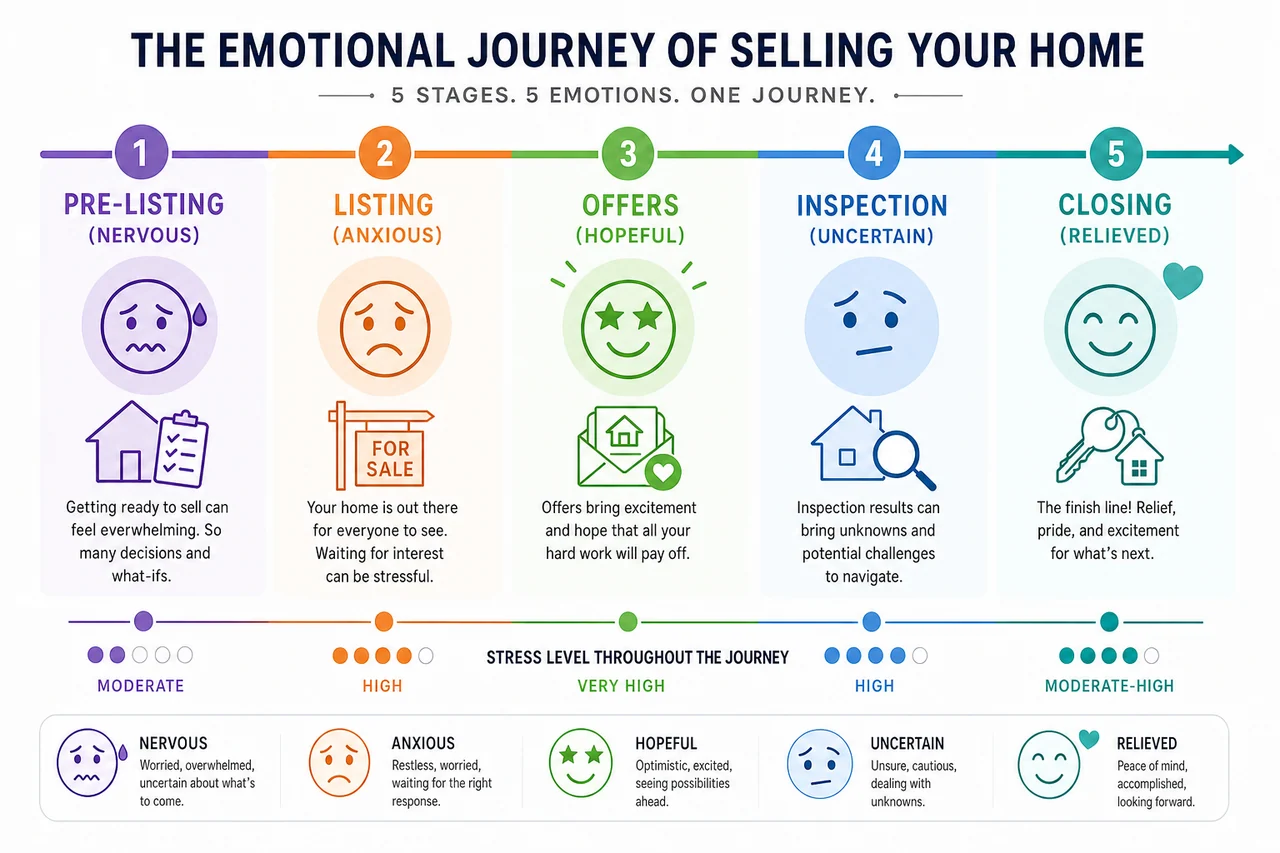
Here's something backed by clinical research: naming your emotions actually reduces stress. When you can put a word to what you're feeling, you stop the emotional flooding that clouds your judgment and makes it harder to make good decisions about your home sale.
Grief and Loss of Letting Go
Your grief about selling is legitimate. It's not weakness or sentimentality — it's real loss. You'll pack up your kid's bedroom and feel it. You'll walk through an empty hallway one last time and get hit with nostalgia. Even when the sale goes perfectly, you might hesitate handing over those keys. These reactions are completely normal.
Anxiety About the Unknown
Anxiety spikes during the waiting. After you list. During negotiations. While you're sitting around waiting for inspection results. Your brain hates uncertainty, so it fills the gap with worst-case scenarios — you know, the catastrophizing spiral. But recognizing it ("There I go again, imagining the worst because I don't have real information") can help you break the cycle before it takes over.
Frustration With Slow or Fast Sales
Both extremes create stress. That's the frustrating paradox.
A slow sale brings constant worry — is something wrong with the house? Will you cover your costs? Your anxiety compound daily. But a fast sale comes with its own pain points: multiple offers arriving at once can freeze you with indecision, fear that you're leaving money on the table, and the disorienting feeling that everything's spinning out of control before you're ready.
Sadness and Nostalgia
Sadness and nostalgia get glossed over because you're supposed to stay practical and move forward. Don't do that. Give yourself real moments to reflect on what this house meant to you without letting those feelings derail the process. Genuine acknowledgment is healthier than bottling it up — emotional suppression has a way of exploding at the worst possible moment.
If you're a highly sensitive person — someone who processes sensory details more deeply, a trait psychologist Dr. Elaine Aron has extensively researched — you might find a home sale's emotional weight feels magnified compared to everyone else's experience. You may need more intentional breaks between showings, stronger support systems, and explicit permission to feel your feelings without judgment. That's valid, and you deserve to honor what you need.
Back to topPractical Stress Management Strategies
Now that you understand where your stress is coming from, let's build a practical toolkit to handle it. You'll address both the emotional weight and the logistical details.
Set Clear and Realistic Expectations
Accurate information is one of the most powerful stress-reduction tools you have. Ask your agent to pull a CMA — a Comparative Market Analysis — so you can see what comparable homes in your area actually sold for. This gives you a real sense of what "normal" looks like for your market. When you know whether you're in a buyer's or seller's market, what homes typically stay on the market, and what buyers at your price point actually want, you stop imagining worst-case scenarios. Things unfold more or less as predicted, and that predictability alone cuts stress dramatically.
Focus on What You Can Control
Stop burning energy on things you can't change. The table below shows you exactly where your attention matters:
| Within Your Control | Outside Your Control |
|---|---|
| Listing price and pricing strategy | Buyer financing falling through |
| Home presentation, staging, and cleanliness | Current interest rate environment |
| Quality of listing photos and marketing | Appraiser's valuation |
| Responsiveness to offers and counteroffers | How quickly buyers decide to make offers |
| Disclosure accuracy and documentation | Local market inventory changes |
| Choice of real estate agent or selling method | Inspector findings (structural surprises) |
| Your own emotional preparation and support system | Neighbor activity and neighborhood perception |
| Timeline flexibility (when possible) | Economic news affecting buyer confidence |
Create a Memory Archive Before Selling
Before you strip the personality out of your home for showings, do this: document what it actually means to you. Walk through every room with your phone and record yourself talking about the memories — the dent in the door from moving day, the pencil marks tracking your kid's growth on the kitchen wall, the garden you planted in year two. Print a few photos and toss them in a box. Your brain needs a formal goodbye. This ritual significantly reduces the grief that hits hardest at closing.
Develop a Timeline and Checklist
Ambiguity feeds anxiety. Structure kills it.
Break the selling process into phases with specific tasks and target dates. Use a simple spreadsheet or project management app — whatever you'll actually look at — to track pre-listing work, showing schedules, offer deadlines, inspection timelines, and closing logistics. When you're checking items off a list, your nervous system genuinely relaxes. You can see progress.
Establish Self-Care Routines
This isn't optional. Sleep deprivation amplifies emotional reactivity by up to 60%, according to research from UC Berkeley's Sleep and Neuroimaging Lab. During the selling period, you need consistent sleep schedules, regular meals, and at least 30 minutes of physical activity daily. And here's the thing: stress hormones like cortisol drop measurably with exercise — it's one of the few anxiety interventions with solid research backing it up. Don't skip this.
Back to topEmotional Detachment Techniques
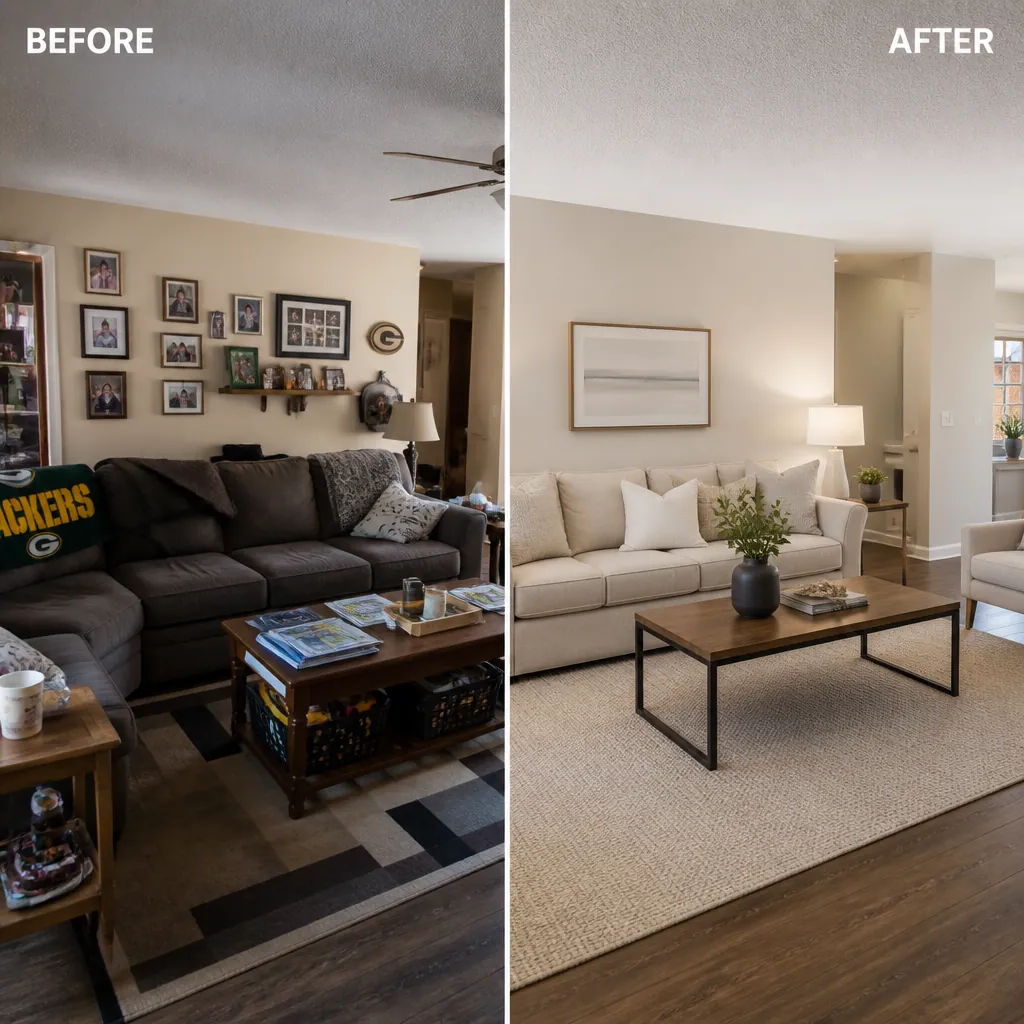
You don't have to stop caring about your home to sell it well. What you're really doing is shifting your relationship with it—protecting your wellbeing while actually getting better results with buyers.
Depersonalize Your Space Early
Start removing personal photos, children's artwork, religious items, and highly personal décor weeks before you list. Not the day before—weeks. This gives you time to adjust psychologically, and it matters. A home that photographs better is a home that sells faster. Here's the thing: buyers need to see themselves in your space. They can't do that when your family's story is all over every wall and shelf.
Shift Your Mindset From Owner to Vendor
Real estate pros call this thinking of your home as a product instead of a personal space. But it's not about denying what you feel. It's about creating distance between your emotions and your business decisions. When someone criticizes your kitchen tile, that's feedback about a product—not a judgment about you or your taste.
Prepare for Multiple Viewings and Showings
Build a pre-showing routine. Make the bed. Light a candle. Leave.
A set sequence of tasks does two things: it prepares your home and it prepares you mentally. You're creating a ritual that says this is normal, this is manageable. And don't stay nearby during showings—not in the house, not in your car. That just cranks up the emotional intensity.
Reframe the Sale as Progress
Stop thinking about what you're leaving behind. Instead, deliberately focus on what comes next. A smaller space you can actually maintain. Money in your pocket. A fresh start in a new city. Relief from a difficult chapter. Future-oriented thinking is backed by research as a genuine resilience strategy. Write down three specific things you're looking forward to after this sale closes. Read them on the days when everything feels overwhelming.
Back to topWorking With the Right Real Estate Agent

Your real estate agent makes or breaks how stressed you'll be during this whole process. And it's not just about the final sale price — it's about your sanity every single day. A bad match can turn an already tough situation into absolute chaos. The right agent? They give you certainty, real information, and someone genuinely in your corner.
Why Agent Selection Matters for Stress
Here's what experienced agents actually do: they tell you the truth about timelines. They manage your expectations on pricing and offers without sugarcoating things. They handle all those logistical details that would otherwise land on your shoulders. Low appraisals. Failed inspections. Buyers who get cold feet. They've been through it. They know the moves.
And because they've seen it before, they stay calm when things get messy. That calmness? It's contagious. Your anxiety drops because someone competent has already handled situations that would terrify you.
Communication Expectations and Frequency
Don't sign anything until you've talked about how often you need to hear from your agent. Do you want daily check-ins? Weekly summaries? Do you prefer text or email? A solid agent will work your way, not theirs.
Feeling in the loop is one of the best stress killers available. But here's what happens when your agent goes quiet: your brain fills that silence with worst-case scenarios. That's torture you don't need.
Building Trust and Transparency
Trust comes from small wins that add up. Your agent says they'll send you feedback by Friday. They do it. They say it again next week — and deliver again. After a few rounds, your nervous system finally settles down between updates.
Look for an agent with a track record of follow-through. Sales volume alone doesn't tell you anything. Reliability does.
Using Professional Services to Reduce Burden
Professional staging. Professional photography. Professional marketing. These aren't just window dressing to sell faster — they're about getting stuff off your plate.
When you're not managing the presentation yourself, you get your mental energy back. You need that energy for everything else this process throws at you. For people in complicated situations, platforms like KDS Homebuyers' seller programs bring multiple selling paths — direct cash offer, iBuyer, agent listing, and more — into one conversation. No more exhausting research into every single option separately.
Back to topManaging the Home Selling Process Stage by Stage
Selling a home hits different at every turn. Each phase brings its own emotional weight—and if you're unprepared, that weight compounds fast. But here's the good news: knowing what's coming and having a plan for each stage cuts the surprise stress in half.
| Stage | Typical Stress Level | Common Concerns | Recommended Coping Strategies |
|---|---|---|---|
| Pre-Listing Preparation | Moderate | Is the home ready? Am I pricing correctly? Will it sell? | Checklists, memory archiving, agent consultation, self-care baseline |
| Active Listing / Showings | High | Strangers in my home, judgmental buyers, lack of offers | Pre-showing routines, leaving home during viewings, scheduled check-ins with agent |
| Offer Period / Negotiations | Very High | Lowball offers, multiple offer confusion, fear of making wrong decision | Agent guidance, set decision timeline, avoid catastrophizing |
| Inspection and Appraisal | High | Unexpected issues discovered, deal falling through, costs | Prepare emotionally for findings, have contingency plan, focus on solutions |
| Closing / Final Steps | Moderate-High | Last-minute delays, emotional finality, logistics of moving | Closure rituals, memory walk-through, celebration planning, moving support |
The middle stretch—showings and negotiations—is where stress peaks hardest. And then something shifts. As you move toward closing, momentum builds and the finish line gets clearer. The intensity doesn't last forever. That alone is worth remembering when things feel overwhelming.
Back to topSpecial Circumstances: Selling During Life Changes
Life doesn't pause for real estate transactions. Your home sale might happen in the middle of a divorce, a death in the family, a job relocation, or a major health crisis. These situations add emotional weight that standard selling advice just doesn't account for.

Selling Due to Divorce or Separation
Two people with conflicting interests. A legally charged process. Now add the need to make joint decisions about pricing, timing, and offers. That's the reality of divorce-related home sales. Communication breakdowns between co-sellers are one of the leading causes of deal failures in these situations. Consider engaging a mediator or a real estate attorney who specializes in divorce transactions.
If communication has broken down entirely, some sellers find that a direct cash offer simplifies everything by removing extended negotiation timelines.
Relocating for Job or Family
Relocation sales are defined by urgency. And urgency compresses the emotional processing that normally happens gradually. You may not have time to grieve the home thoughtfully because you're simultaneously packing, finding housing in a new city, managing a job transition, and potentially moving children to new schools.
Build deliberate emotional pauses into your schedule, even brief ones. This matters. Without them, delayed grief often surfaces months later when you're already settled.
Downsizing or Major Life Transitions
Downsizing carries a particular weight — finality. It's often driven by retirement, children leaving home, or health changes. You're selling not just a home but a chapter of life that's definitively ending.
If you're helping a parent through this process, resources like how to sell your elderly parent's home can provide specific, compassionate guidance for navigating that additional layer of complexity.
Selling an Inherited Property
Grief and paperwork. That's what inherited properties combine — grief over a loved one's death mixed with the practical demands of managing and selling a home you may not have expected to own.
You might feel guilty about selling ("it feels disloyal"). There could be conflict among family members about what to do with the property. And overwhelm at the practical tasks involved — that's real too. Acknowledge these feelings as legitimate. Then recognize this: selling a property isn't a betrayal of the person who left it to you.
Back to topWhen Stress Becomes Overwhelming
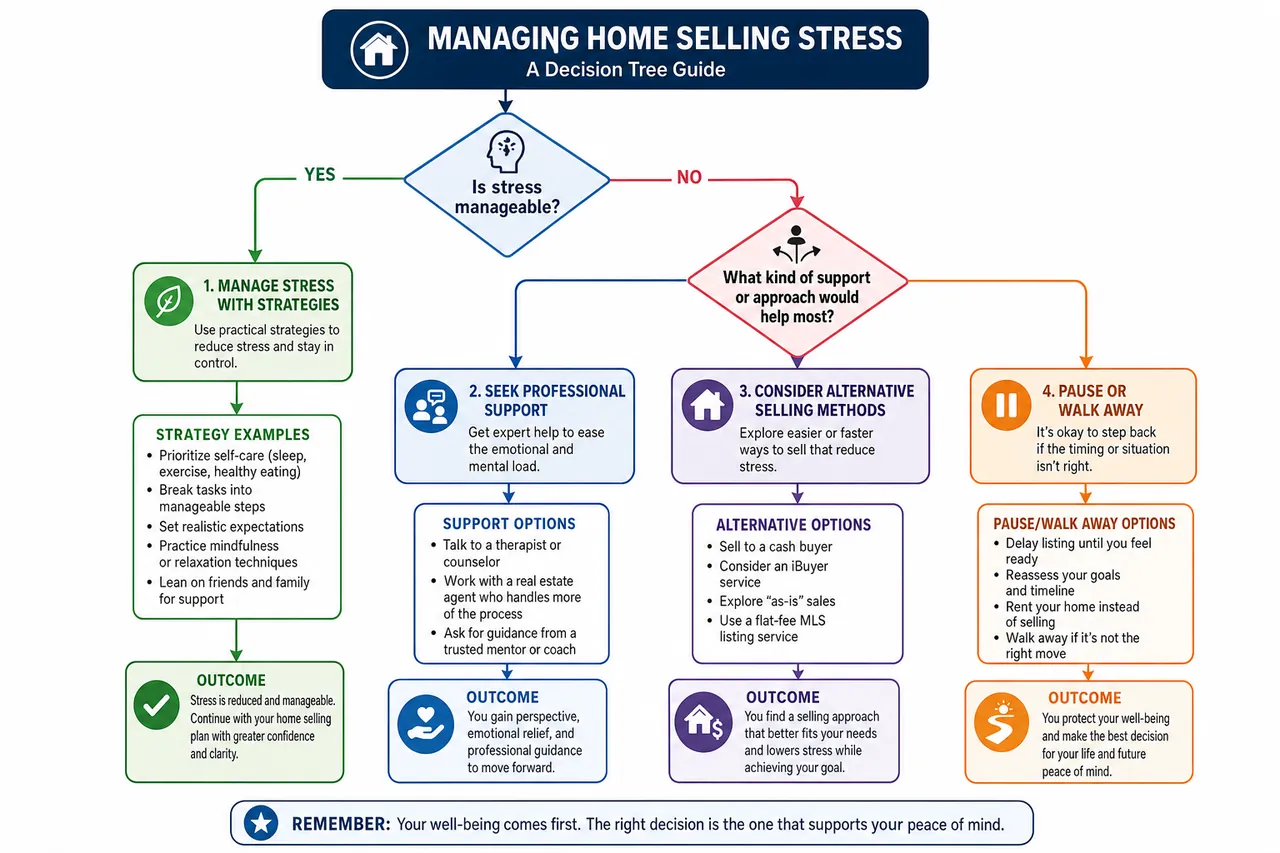
Selling a home is genuinely stressful. But there's a real difference between normal selling stress and something that's crossed into clinical territory. Do you know which side you're on?
| Symptom Category | Normal Range | Concerning Level | Seek Help If... |
|---|---|---|---|
| Sleep | Occasional difficulty falling asleep | Chronic insomnia or exhaustion | Sleeping less than 5 hours for 2+ weeks |
| Mood | Sadness, irritability, worry | Persistent hopelessness or numbness | Inability to feel pleasure or function normally |
| Physical Symptoms | Tension headaches, mild fatigue | Chest tightness, panic attacks | Recurring panic symptoms or physical illness |
| Decision-Making | Difficulty with specific choices | Paralysis on all decisions | Unable to move forward at all despite support |
| Relationships | Increased friction with household members | Significant relationship deterioration | Isolation or major conflict that persists |
Seeking Professional Mental Health Support
Your stress indicators are showing up consistently in the "concerning" or "seek help" columns? That's the moment to call a licensed therapist or counselor. And I mean this directly — it's not weakness. It's the smart move.
Cognitive behavioral therapy (CBT) has solid research backing it for anxiety management. You don't need months of sessions either. Even a few appointments during your most intense weeks can give you tools that actually work, tools that let you cope way better than you could before.
Considering Alternative Selling Methods
Traditional selling is brutal. Open houses. Showings every weekend. Months of waiting around while buyers get financing approved. And the whole time, your stress just compounds.
If that path is making things worse for your mental health, stop. Look at working with a cash home buying company instead. You get no showings. No contingencies hanging over your head. No financing delays. Closing happens in days, not months. The catch? You'll typically walk away with less than market value. But plenty of sellers find that trade worth it — the emotional relief alone justifies the smaller check.
When to Walk Away or Pause
Sometimes the right answer isn't to push harder. It's to stop.
A health crisis hits. Family emergency. The selling process is actually hurting your mental health. Any of those situations means you take the house off the market. Temporarily or longer — whatever you need. The market isn't going anywhere. Your wellbeing? That's what matters most.
Back to topExpedited Selling: Reducing Stress Through Speed
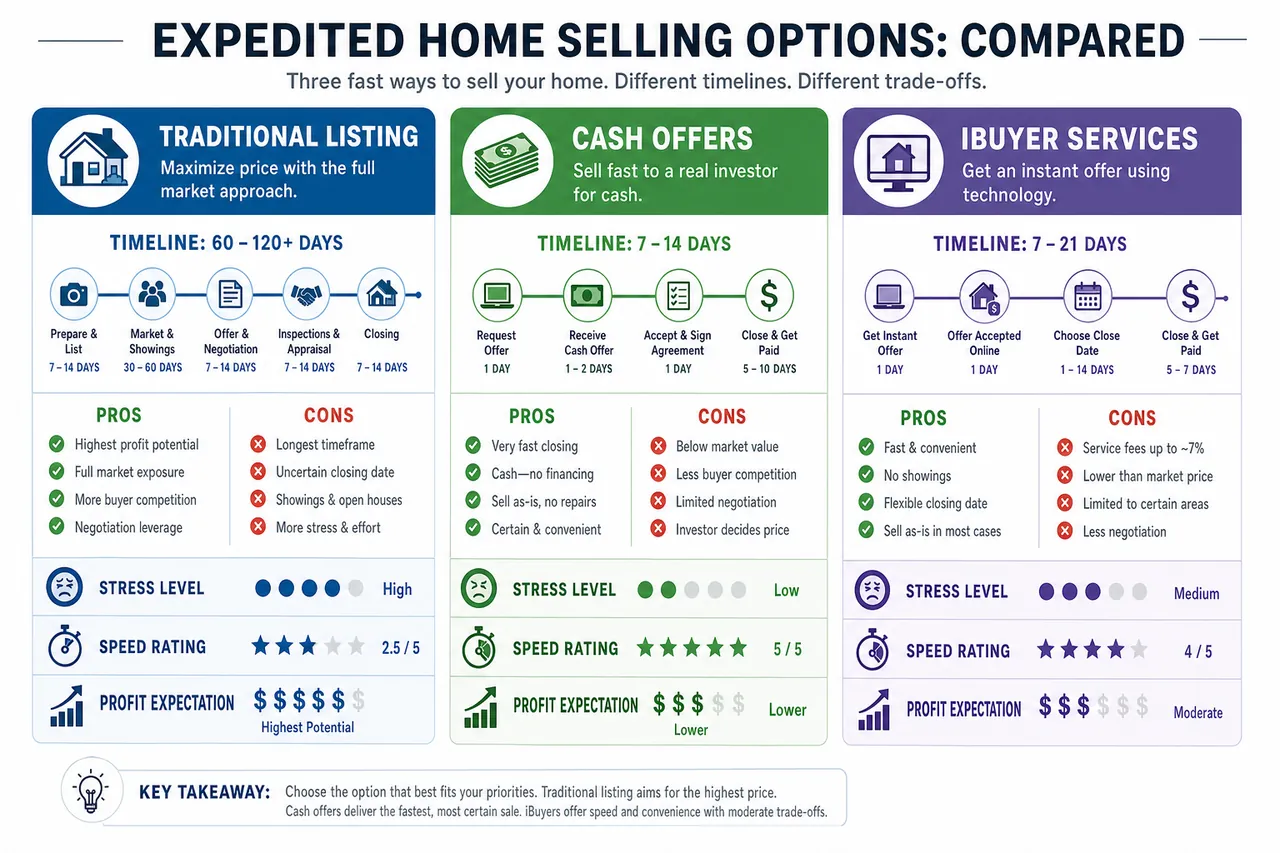
Here's what most people miss: speed is actually a stress-management tool. A 14-day closing? It's intense but it's over. Compare that to six months of dragging uncertainty, and you're looking at cumulative stress that eats away at you in ways a short sprint never will.
| Selling Method | Typical Timeline | Stress Level | Financial Outcome | Effort Required |
|---|---|---|---|---|
| Traditional Agent Sale | 30–90+ days | Moderate-High (prolonged) | Highest potential net | High (showings, staging, negotiations) |
| Flat-Fee MLS | 30–90+ days | Moderate-High (self-managed) | High (saves commission) | Very High (seller handles most tasks) |
| iBuyer | 7–30 days | Low-Moderate (short, certain) | Moderate (service fees apply) | Low (minimal prep required) |
| Cash Home Buyer | 7–21 days | Low (fastest, most certain) | Below market (discount for speed) | Very Low (sell as-is) |
Yes, a cash sale costs you money. An iBuyer takes a cut. But think about what an extended process actually costs you — not just the carrying costs and potential price drops, but your peace of mind and mental health during months of uncertainty. And if you're dealing with something complicated like selling a house with a septic system, a cash buyer changes everything. You sell as-is. No inspections. No disclosure nightmares for specialty systems. Just a clean exit.
Back to topSelf-Care and Wellness During Home Sale

Selling a home isn't a spa day situation. You're dealing with sustained, real stress that takes a physiological and psychological toll — which means you need actual practices to stay functional, not just bubble baths once a week.
Sleep and Rest Prioritization
Your sleep schedule is non-negotiable. Don't check listing metrics, offer portals, or real estate apps within an hour of bedtime. Reading a disappointing showing report at 11pm spikes your cortisol, which destroys your sleep architecture and amplifies anxiety the next day. That's just biology.
If anxiety's keeping you awake, try 4-7-8 breathing. Inhale for 4 counts, hold for 7, exhale for 8. Research shows it actually works as a rapid nervous system downregulator.
Physical Activity and Exercise
A 30-minute walk reduces cortisol levels and improves your mood for up to 12 hours. During active listings and negotiation phases — the most intense selling periods — scheduling daily movement is one of the highest-return investments you can make in your own stability. It doesn't have to be formal exercise: walking the neighborhood, gardening, or an at-home workout all deliver measurable benefit.
Social Support and Communication
Isolation amplifies stress. So be explicit with your support network. Tell them specifically what you need: someone to listen, help packing boxes, or to watch the kids during a showing. People who care about you will help — but they need concrete requests, not vague stress signals.
Selling with a partner? Establish regular check-ins specifically about the home sale. Keep these separate from your general relationship conversations. Home-sale decisions are high stakes, and communication breakdowns between partners are common and damaging. A structured space for selling-specific talks prevents those discussions from seeping into everything else.
Mindfulness and Stress-Relief Practices
Even brief mindfulness practices deliver measurable relief. A 2018 study in JAMA Internal Medicine found that an 8-week mindfulness program cut anxiety symptoms by 38%. You don't need a full program. A 10-minute guided meditation before showings or three minutes of slow breathing before reviewing an offer can meaningfully shift your physiological state right before a high-stakes moment.
Managing 'Hanger' and Exhaustion
This gets overlooked constantly.
Don't make major selling decisions — accepting offers, choosing between buyers, agreeing to inspection credits — when you're hungry, exhausted, or emotionally depleted. These states impair judgment in demonstrable ways. An offer arrives at 9pm after a brutal showing day? It's almost always fine to sleep on it and respond the next morning within your decision window. A good agent will manage buyer expectations.
Back to topConclusion: Moving Through the Stress to the Other Side
Selling a home is hard. Really hard. You can't eliminate the stress entirely — and honestly, that's not the goal here. What matters is moving through it with enough support, self-awareness, and practical strategy that you don't get overwhelmed or make decisions you'll regret later. The emotions you're feeling? They're completely legitimate. This process demands a lot. But here's the thing: you're also capable of navigating it.
Start by identifying your specific stressors. Name what you're feeling. Figure out which stage of the process you're actually in right now. Build yourself a checklist. Establish a self-care routine that you'll actually stick to. Choose your selling path deliberately instead of just drifting into the default option. And lean hard on your support network — don't try to do this alone.
If the traditional market process is genuinely unsustainable for you, alternatives exist. You could pursue an expedited cash sale. You could explore programs that bring every option to the table in one conversation. Choosing a faster path isn't failure — it's sound decision-making when your situation calls for it.
Most sellers look back on this period with relief. Often with pride, too. You managed one of the most complex, emotional transactions most people ever face. That deserves credit — during the process and long after it's done.
Back to topFrequently Asked Questions
How long does the stress of selling a house typically last?
Weeks two through eight hit hardest. That's when your house is actively on the market and you're juggling offers and negotiations. Once those offers start rolling in, things usually feel a little lighter. But here's what catches people off guard: the emotional weight can stick around for months after you close, especially if you've lived there for decades or you're selling during a tough life moment. Building closure into the process helps. A final walk-through. A photo album of memories. Maybe even a small celebration. These things let you actually process the move instead of just moving on.
Is it normal to cry or feel grief when selling your home?
Absolutely. Zillow's research shows 36% of sellers cried during the process — and that's just the ones who admitted it. Your home isn't just a building. It's where your kids took their first steps, where you hosted holidays, where you built a life. When you lose that space, your brain grieves it the same way it grieves other losses. Don't push those feelings down. Let yourself feel them. You'll actually move through the process faster and make better decisions when you're not fighting your own emotions the whole time.
What's the fastest way to reduce stress during a home sale?
Get accurate information. Seriously. Uncertainty is what kills you — not the actual difficulty of selling. Ask your agent for a Comparative Market Analysis. Set up a regular communication schedule with your selling team so you're not wondering what's happening. Write down a timeline with specific tasks for each week. These concrete steps attack anxiety right at the root. They work better than any stress-relief technique you'll try after the worry has already taken over.
Can selling to a cash buyer really reduce stress?
It can — but there's a real price tag. Cash buyers and iBuyers skip the worst parts: months on the market, endless showings, financing falls through, back-and-forth negotiations that drag on forever. You could close in 14 days. That's tight, but at least it's done. The catch? You'll typically pocket 5–15% less than you'd make in a traditional sale under normal conditions. Sometimes that trade-off is absolutely worth it. If you're hemorrhaging money on carrying costs, facing foreclosure, or the stress is genuinely harming your health, the math works differently. Only you know if that financial hit is worth buying your peace of mind back.
Should I tell my real estate agent I'm stressed?
Tell them. Be specific about it. You don't need to dump your whole emotional history on them, but say something like: "Uncertainty is eating at me — can we do weekly update calls even if nothing's changed?" or "Multiple offers stress me out — can you walk me through each one step by step?" That's the kind of information an experienced agent actually needs to help you. They've guided hundreds of sellers through this. They know what stress looks like. They can adjust how they work with you once they know what you need.
Back to top
