Selling a House With a Tenant in California: Rights and Process

Table of Contents
- Can You Sell a House With a Tenant in California?
- California Tenant Protection Laws You Must Follow
- Notice Periods: What the Law Actually Requires
- Lease Type Matters: Fixed-Term vs. Month-to-Month
- Three Strategies for Selling With Tenants in Place
- Pros and Cons of Selling a Tenant-Occupied Property
- Special Considerations for Section 8 Properties
- Managing Showings and Tenant Access Rights
- Step-by-Step Process for Selling With a Tenant
- Negotiating Early Termination and Cash-for-Keys
- Marketing a Tenant-Occupied Property
- Tax Implications and Financial Planning
- AB 1482 Exemption: What Landlords Often Miss
- Conclusion
- Frequently Asked Questions
Yes, you can sell a house with a tenant living in it. California law doesn't let the sale itself terminate a lease or give you grounds to evict without cause. The buyer steps into your shoes—they take on your landlord duties and must respect every tenant protection California's laws guarantee. This guide breaks down what you need to know legally, what options you actually have, and exactly how to move forward without running afoul of the rules.
This article is general information only and doesn't substitute for legal, tax, or financial advice from a professional. Landlord-tenant rules shift from city to city and county to county across California. Before you serve any notices or make moves to end a tenancy, talk to a licensed California landlord-tenant attorney. Same goes for a CPA if you're weighing the tax side of selling a rental property.

Can You Sell a House With a Tenant in California?
Yes—you can absolutely sell a tenant-occupied property in California. It's completely legal. When you transfer the title, that doesn't end the lease. And here's what matters most: your desire to sell isn't a valid reason to evict under California law. Civil Code § 1946.2 is clear about this. The property sale doesn't appear on the list of allowable eviction reasons under AB 1482. The new owner takes over your position as landlord and must respect every term of that existing lease until it expires or gets properly terminated.
But there's a critical step you can't skip. Within 15 days of taking title, California law requires the new owner to give written notice to the tenant. This notice must include the new owner's or manager's name, their contact address, and rent payment instructions. Civil Code § 1962 spells this out. Miss that deadline? You're looking at legal headaches. Add this to your closing checklist right now.
Back to topCalifornia Tenant Protection Laws You Must Follow
AB 1482: Just-Cause Eviction and the 12-Month Threshold
If your tenant has continuously and lawfully occupied a unit for 12 months, California's Tenant Protection Act of 2019 (AB 1482, codified at Civil Code § 1946.2) steps in. You can't evict them without a specified "just cause." The law splits these into two buckets: "at-fault" reasons like nonpayment, lease violations, or criminal activity, and "no-fault" reasons such as owner move-in, substantial remodel, or withdrawal from the rental market. And wanting to sell? That's not on the list.
AB 1482 got updated by AB 1529, which took effect January 1, 2026. It's currently scheduled to sunset on January 1, 2030. Got a tenant under 12 months? The just-cause rules don't apply yet—but they will. Count your days carefully.
Single-Family Home Exemption—and Why It Isn't Automatic
Single-family homes and certain condos can skip AB 1482's just-cause and rent-cap rules. But the exemption doesn't happen by itself. You need to have delivered the statutory written notice of exemption to your tenant before the tenancy started or during it. No notice delivered? You've lost the exemption for that tenancy, period—even if the property would normally qualify. Not sure if you served it correctly? Talk to an attorney before you assume you're in the clear.
Relocation Assistance for No-Fault Terminations
Ending a tenancy for no-fault reasons costs you money. If you terminate an AB 1482-covered tenancy because of owner move-in or withdrawal from the rental market, you owe the tenant relocation assistance equal to one month's rent—or you can waive their final month's rent instead. Pay it within 15 calendar days of serving notice.
Owner move-in evictions have extra teeth under SB 567 (starting April 1, 2024). The owner or family member claiming the move-in must actually live in the unit within 90 days after the tenant leaves and stay there as a primary residence for at least 12 consecutive months. These aren't technicalities. Break them and you're facing real liability.
Local Ordinances Can Be More Protective
Los Angeles, San Francisco, Oakland, San Jose, and dozens of other cities have their own rent control or just-cause rules that go beyond what AB 1482 requires. Some cover properties AB 1482 lets you exempt. Some demand bigger relocation payments. Some tighten the screws on owner move-in evictions even further. Check your city and county ordinances before you rely on state law alone. The Corona mobilehome park ordinance is a perfect example—it's hyper-local but it fundamentally reshapes how you handle that property type. When you're unsure, treat local rules as your baseline. Never assume state law is enough.
Back to topNotice Periods: What the Law Actually Requires
How long you've lived there changes everything. California law—specifically Civil Code § 1946.1, updated by SB 1103 starting January 1, 2025—sets different notice periods depending on your tenancy length.
| Tenant Occupancy Duration | Minimum Termination Notice | AB 1482 Just-Cause Required? | Relocation Assistance (No-Fault) |
|---|---|---|---|
| Under 12 months (month-to-month) | 30 days | No (AB 1482 not yet triggered) | Not required under AB 1482 |
| 12 months or more (month-to-month) | 60 days | Yes | 1 month's rent within 15 days of notice |
| Section 8 / foreclosure situation | 90 days | Yes (additional HAP rules apply) | Check local rules; HAP terms govern |
| Fixed-term lease (any duration) | N/A — lease runs to end date | Yes if 12+ months occupied | Required if no-fault termination sought before end date |
Lease Type Matters: Fixed-Term vs. Month-to-Month
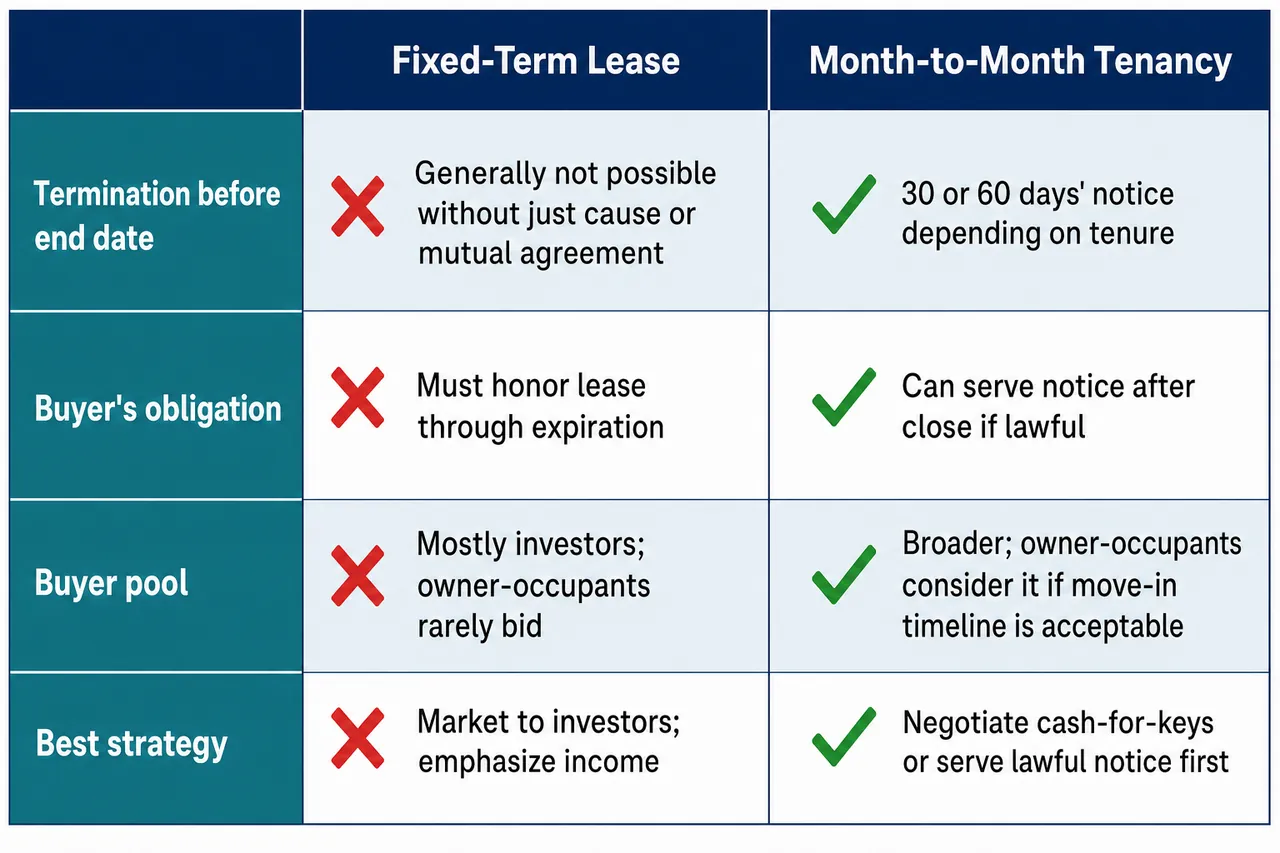
Your tenant's lease type is one of the most consequential facts in deciding how and when to sell. Got a fixed-term lease—say, a one-year agreement running through June 2027? That tenant has the contractual and statutory right to remain in occupancy through the lease end date regardless of who owns the property. The new buyer steps into that obligation. This dramatically narrows your buyer pool to investors willing to wait or who want the rental income.
Month-to-month tenancies offer more flexibility, but notice periods and just-cause requirements still apply. The critical variable is tenure—how long has this tenant actually been living there?
Properties where the lease ends soon (or where you're on a month-to-month with a short notice window) attract a meaningfully broader set of buyers. And that matters for your bottom line. The longer a buyer must wait before taking possession or re-leasing at market rent, the steeper the discount they'll demand. You might actually improve your outcome by waiting until a long lease gets closer to expiration—but you'll need to weigh that against your carrying costs, taxes, and how urgently you need to move on.
| Fixed-Term Lease | Month-to-Month Tenancy | |
|---|---|---|
| Termination before end date | Generally not possible without just cause or mutual agreement | 30 or 60 days' notice depending on tenure |
| Buyer's obligation | Must honor lease through expiration | Can serve notice after close if lawful |
| Buyer pool | Mostly investors; owner-occupants rarely bid | Broader; owner-occupants consider it if move-in timeline is acceptable |
| Impact on sale price | Steeper discount (longer time to occupancy) | Moderate discount depending on notice period |
| Best strategy | Market to investors; emphasize income | Negotiate cash-for-keys or serve lawful notice first |
For a broader look at how lease status affects your options, see our guide on Selling a House with Tenants: Laws, Process, and Options.
Back to topThree Strategies for Selling With Tenants in Place

You've got three realistic options once you know where you stand legally. Which one works best depends on your lease, how long your tenant's been there, how fast you need to move, and how much equity you're sitting on.
Strategy 1: Sell Occupied to an Investor
Investors actually want what you have. If your tenant pays reliably and signed a long-term lease, that's a performing rental asset—exactly the kind of property many investors are hunting for right now. You keep collecting rent all the way to closing, skip the costs of fixing up the place, and avoid the whole mess of forcing someone out.
But you're shrinking your buyer pool. Tenant-occupied properties sell for less in California than vacant, move-in-ready comparables. How much less? It shifts based on your market, what the lease says, whether the tenant's cooperative, and how long the buyer has to wait before they can take over—but expect a real hit to your sale price. The fewer months left on the lease, the smaller the discount. A lease with years remaining? You're looking at a steeper cut than a month-to-month arrangement where the buyer can serve notice immediately after closing.
Strategy 2: Negotiate Cash-for-Keys
You offer money. The tenant leaves. That's the gist of cash-for-keys—a voluntary deal where you pay moving costs, return their deposit, or hand over a lump sum in exchange for them vacating by an agreed date. Write it down: move-out date, payment amount, the condition the property needs to be in, and language releasing both sides from future claims.
This costs less than dragging someone through eviction court (filing fees, attorney bills, months of waiting). And it opens your door to owner-occupants once the place is empty, which expands who can buy. The critical part: you can't pressure or threaten the tenant. If the agreement isn't genuinely voluntary, it's worthless in court.
Strategy 3: Serve Lawful Notice and Pay Relocation Assistance
Got an AB 1482-covered unit and a qualifying no-fault reason—say, you or family actually moving in? You can serve notice and pay relocation assistance. The catch is real: you must actually occupy the property within 90 days, stay there at least 12 months, and hand over the assistance within 15 days of notice. Miss any of these steps and you're facing serious legal trouble. Only use this path if the conditions genuinely apply and you've got a lawyer guiding you through it.
| Sell Occupied (Investor) | Cash-for-Keys | Lawful No-Fault Notice | |
|---|---|---|---|
| Typical timeline | Can list immediately | Negotiation + 30–90 days | 60–90+ days (notice period) before listing vacant |
| Buyer pool | Investors only | Investors and owner-occupants | Full market once vacant |
| Cost | Lowest upfront cost | Negotiated payment to tenant | 1 month's rent relocation assistance + legal fees |
| Tenant cooperation needed? | For showings only | Yes—must be voluntary | Not required, but helpful |
| Best for | Long-term lease, cooperative tenant | Month-to-month, motivated seller | Genuine owner move-in need; AB 1482-covered unit |
Pros and Cons of Selling a Tenant-Occupied Property
You'll face real trade-offs when you sell with a tenant still living there. Let's look at both sides honestly so you can pick the right strategy.
Advantages
- Rental income continues while you're marketing and right up until closing. You're not bleeding money on an empty house.
- Reduced make-ready costs: if your tenant keeps the place reasonably clean, you might skip the repainting, deep cleaning, and staging altogether.
- Investor appeal: investors love a performing rental with a stable tenant and solid rent history. It's a turnkey investment for the right buyer.
- Government-backed income stability: does your tenant have a Housing Choice Voucher (Section 8)? That guaranteed HAP payment history is gold to investors who care about payment certainty.
Disadvantages
- Dramatically reduced buyer pool: owner-occupants won't touch it. They want to move in, not inherit your tenant. That means you're really only selling to investors.
- Price reduction: tenant-occupied properties in California routinely sell below vacant, owner-ready comparables. The discount depends on your market, the lease terms, and how cooperative the tenant is—longer remaining lease terms usually mean bigger price hits—so budget for a meaningful reduction and adjust your expectations now.
- Showing friction: tenants have privacy rights and notice requirements (details below). An uncooperative tenant? They can tank showing frequency, tank first impressions, or leave the home looking terrible when buyers walk through.
- Deferred maintenance: years of tenant occupancy often mean surprise repairs pop up during inspections—issues that tank offers or become disclosure headaches. Check out our guides on selling a house with water damage and selling a house with an old or damaged roof if that's your situation.
- Buyer uncertainty: even after you close, the new owner has to manage an existing tenant. Some buyers just won't take that on.
Special Considerations for Section 8 Properties
Selling a Section 8 property adds real complexity. The Housing Assistance Payments (HAP) contract ties the housing authority directly to you as the landlord. Once you sell, that contract doesn't automatically transfer to the new owner—the housing authority has to approve it, and the buyer needs to qualify as a new landlord participant first.
Notifying the Housing Authority
You must notify your Public Housing Authority (PHA) the moment you decide to sell. This isn't optional paperwork you can skip. The buyer can't just take over HAP payments without the PHA's blessing and signing new agreements. If they want to keep collecting those payments after closing, they'll need to get approved and execute documents with the PHA before or right after the sale closes.
HQS Inspections and Deferred Maintenance
Every year, Section 8 properties face Housing Quality Standards (HQS) inspections. That deferred maintenance sitting in your basement or lurking in the walls? It's not just annoying—it's a deal-killer. Buyers know this. They'll request the most recent HQS inspection report and use any failed items to justify lower offers. Your best move is pulling that inspection now, fixing what you can, and pricing the remaining repairs into your asking price upfront.
Market Position for Section 8 Properties
Not every investor wants a Section 8 property. The ones who do are usually cash buyers running the numbers differently than retail homebuyers would. Many of them calculate offers as a percentage of after-repair value (ARV)—meaning they're already subtracting repair costs, compliance work, and time delays. That percentage varies wildly depending on your market, your property's condition, and local demand. Talk to Section 8 investors in your area right now to get realistic numbers instead of guessing.
And be prepared to wait. These properties sit on the market longer than vacant homes or conventionally-rented units do. Build extra time into your sale timeline.
Your best shot at selling isn't posting on the regular MLS and hoping. Instead, reach out directly to investor networks, landlord associations, and cash buyer groups in your area. They move faster and know exactly what they're looking for.
Want to understand tenant rights on the buyer's side of things? Read Selling a House With a Tenant: Tenant Rights and Sale Options.
Back to topManaging Showings and Tenant Access Rights

California Civil Code § 1954 is what governs this. You need to give tenants at least 24 hours' advance notice before showing the property to prospective buyers—and that notice period is presumed reasonable under the law. Write it down whenever you can.

Once you've handed the tenant a written notice that you're selling, here's what changes: you can give oral notice by phone or in person for showings during a 120-day window from when you served that written notice. This saves you from having to formally notify them in writing every single time. Active listing periods become much easier to manage.
What If the Tenant Refuses Access?
Tenants have the legal right to exclusive use and quiet enjoyment—you can't just walk in whenever you want. If someone repeatedly refuses reasonable showing requests that follow § 1954, start documenting everything. Write down each request, when you made it, and how they responded. After that, talk to a landlord-tenant attorney about where you stand legally, which might mean asking a court to step in. Never lock them out, shut off the utilities, or take matters into your own hands—those moves are illegal, full stop.
And honestly? The easiest path forward is building a working relationship early on. Tenants who know your timeline, feel treated with respect, and aren't blindsided by showings will usually cooperate. Give more notice than the minimum when you can. Be flexible about scheduling. Acknowledge that having strangers walk through their home is disruptive. That matters.
Back to topStep-by-Step Process for Selling With a Tenant
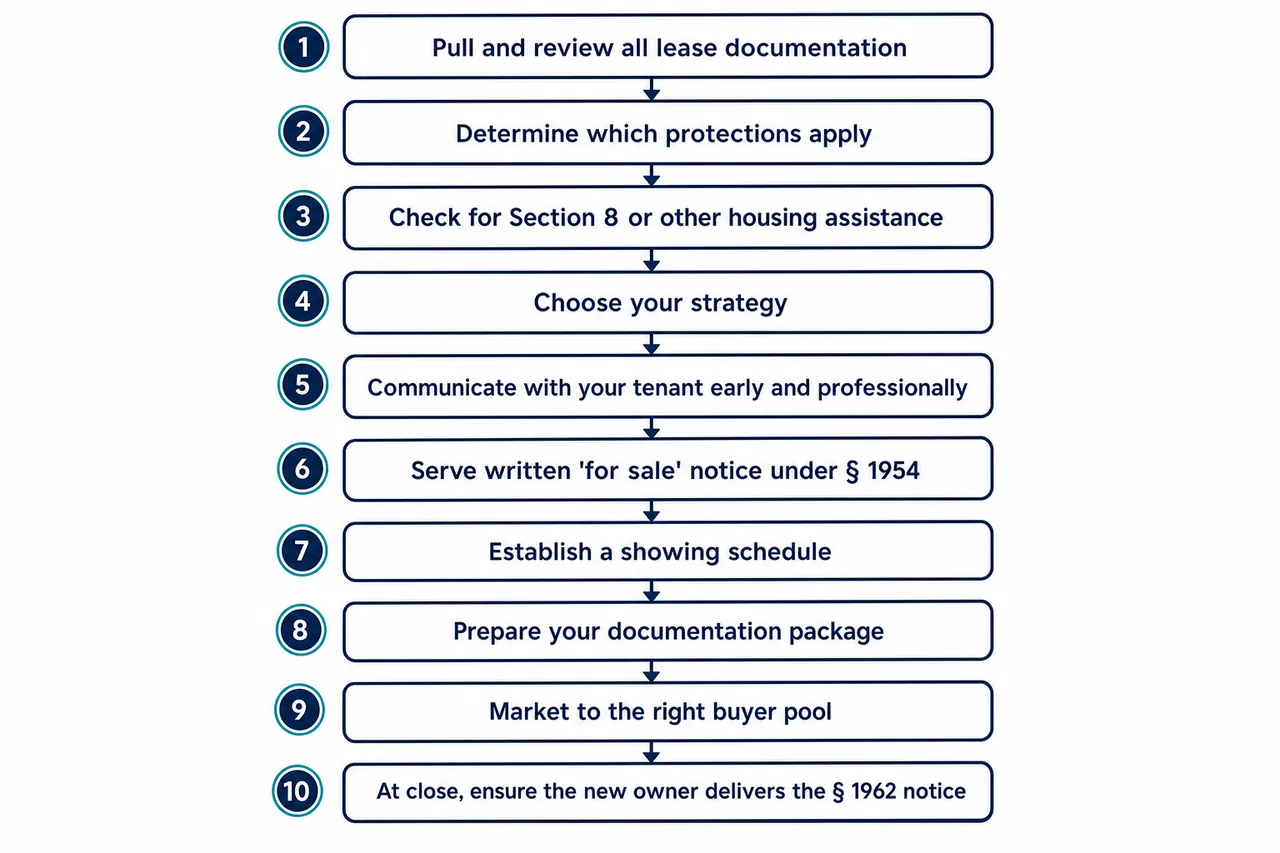
- Pull and review all lease documentation. You need to know the lease type (fixed-term or month-to-month), the end date if it's fixed-term, what they're paying each month, and when they moved in. That move-in date matters—it tells you whether you've crossed the 12-month AB 1482 threshold.
- Determine which protections apply. Does AB 1482 protect your tenant? Was the single-family exemption notice properly delivered? Do local ordinances give your tenant more rights than state law does? Don't guess on this one. If you're uncertain, verify it with an attorney.
- Check for Section 8 or other housing assistance. Your tenant might have a voucher. If they do, contact the PHA early—they'll tell you what the sale process demands from you and from the buyer.
- Choose your strategy. You can sell to an investor who'll keep the tenant in place, negotiate cash-for-keys to get them out voluntarily, or serve lawful no-fault notice if you qualify. Timeline and cost differ significantly depending on which path you take.
- Communicate with your tenant early and professionally. Tell them you're selling before the listing hits the market. Walk them through the showing process, explain their rights, and set clear expectations. When you're honest upfront, most tenants cooperate.
- Serve written "for sale" notice under § 1954 so you establish the 120-day window for oral showing notices.
- Establish a showing schedule. Coordinate with your tenant on times that work for them, respect the 24-hour notice rule, and show the property when it looks its best.
- Prepare your documentation package. Gather the lease, rent payment history, HAP payment records if applicable, the most recent HQS inspection report if applicable, and any correspondence with the tenant. Investors expect all of this.
- Market to the right buyer pool. Lead with the income story—how much rent they're paying, that they pay on time, how long they've been there. Be transparent about what the lease says and what tenant rights exist. Investors doing their due diligence will find out everything anyway; unexpected surprises kill deals.
- At close, ensure the new owner delivers the § 1962 notice to the tenant within 15 days of taking title.
For a detailed look at disclosure obligations and timeline management during the sale process, see Selling a House with Tenants: Rights, Disclosure, and Timeline.
Back to topNegotiating Early Termination and Cash-for-Keys
Cash-for-keys works best when both you and the tenant benefit from an early exit. You offer money. They agree in writing to leave by a set date and keep the place in decent shape. You pay once they hand over the keys and the unit meets those conditions.
Three things make this legally solid and actually workable:
- Voluntariness: The tenant has to say yes on their own. Any coercion—hinting you won't renew their lease, threatening slower maintenance, or implying a bad reference—can blow up the whole deal and land you in legal trouble.
- Written documentation: Get everything down in writing: move-out date, payment amount and when they get it, what condition the unit needs to be in, key return, and that both sides release each other from future claims. Have a lawyer draft or look over this agreement.
- Practical incentives: Moving costs, the full security deposit back (even with minor wear), or a flat payment all work. How much to offer depends on how long they've lived there, what comparable rentals cost in your area, and whether cash-for-keys saves you more money than fighting an eviction.
- Compare costs: A California court eviction—even uncontested—means filing fees, attorney costs, sheriff fees, and months when your property sits empty and unlisted. Cash-for-keys is almost always cheaper and faster if the tenant's willing to talk.
And once they're out? You can sell to the full market now, including owner-occupants who typically pay more than they would for an occupied place.
Back to topMarketing a Tenant-Occupied Property
Selling a tenant-occupied property? You're not marketing to families. You're marketing to investors. And that changes everything about how you present the property.
- Lead with the income story: Put the monthly rent, lease expiration date, and how long the tenant's been there right at the top of your listing. Investors scan for numbers first.
- Document rent payment history: A clean rent roll matters. Show it upfront—consistent on-time payments are what investors actually want to see.
- Disclose lease terms completely: Don't hide anything. Investors need to know exactly what they're buying, including every lease clause and tenant protection. Buried terms discovered during due diligence kill deals or slash prices.
- Highlight government-backed income if applicable: Does your tenant have a Housing Choice Voucher? The HAP payment is federally guaranteed. That's real selling power for investors who care about payment certainty.
- Provide a current appraisal or broker price opinion (BPO): Investors will run their own numbers anyway, but a credible baseline stops them from lowballing and smooths negotiations.
- Target the right channels: Investor networks, real estate investment associations, cash buyer platforms, and landlord groups work better than Zillow or Redfin for occupied properties.
Asbestos in the walls? Lead paint on the trim? Plumbing that needs work? Disclose it upfront and price it accordingly. See our guides on selling a house with asbestos and selling a house with lead paint for California-specific disclosure requirements.
Back to topTax Implications and Financial Planning
Selling a rental property in California hits differently than selling your primary home—the tax consequences are steeper and more complicated. At the statewide existing single-family median of $886,760 as of October 2026, you're looking at serious tax exposure on appreciated rental property. You really need a CPA who specializes in real estate. The rules are intricate, and at California's price points, every percentage point matters.
Capital Gains and Depreciation Recapture
When you sell a rental property, you owe federal capital gains tax on the profit—that's the sale price minus your adjusted cost basis. Hold it longer than a year? The federal long-term capital gains rate kicks in. But here's what trips people up: California taxes capital gains as ordinary income at the state level, with no special rate break. And depreciation you've claimed over the years gets "recaptured" and taxed separately at the federal level. These two tax hits together can wipe out a huge chunk of your proceeds. Run the actual numbers with a CPA before you sign anything with an agent.
1031 Exchange Consideration
Planning to reinvest into another investment property? A 1031 exchange under IRC § 1031 might let you defer both capital gains tax and depreciation recapture—but only if you follow the rules exactly. You need a qualified intermediary. You have 45 days to identify replacement property after closing. You have 180 days to complete the entire exchange. Miss either deadline and you lose the deferral. If you're even thinking about a 1031 exchange, bring in a qualified intermediary and CPA before you close. Don't wait until after. The structure has to be in place upfront.
When you close your sale matters too—timing it in the right tax year makes a difference. And if a tenant's moving out affects whether you can claim the property as a primary residence for the two-year exclusion, that's another variable to hash out with your tax professional.
Back to topAB 1482 Exemption: What Landlords Often Miss
Most landlords misunderstand the single-family home exemption from AB 1482. Your property might qualify—but that protection only kicks in if you gave your tenant specific written notice beforehand. The notice has to include exact statutory language that tells the tenant the property is exempt from AB 1482's just-cause eviction rules and rent caps.
Did the previous owner deliver that notice? If you just bought the property, don't guess. Pull any documents the tenant got when they first moved in and check. No notice means you're stuck following AB 1482 even if the property technically qualifies for the exemption. This oversight trips up a lot of landlords who inherit a tenancy through purchase—and it matters enormously when you're ready to sell and want to terminate the lease. For the full picture on managing this, check out How to Sell a House With Tenants Still Living In It in California.
Back to topConclusion
Selling a house with a tenant in California is doable. But it demands careful legal groundwork before you list. Here's what matters most: the lease survives the sale and transfers to the buyer. The sale itself isn't grounds to evict. Notice periods and relocation assistance depend on how long the tenant's been there and whether AB 1482 applies. Local rules often require more than state law allows.
You've got three main paths. Sell occupied to an investor. Negotiate a cash-for-keys deal. Or serve lawful no-fault notice. Each costs differently, takes different time, and has different legal strings attached.
The lease matters more than you might think. A short lease or month-to-month tenancy? You'll attract more buyers and lose less value. A long-term lease with years left? Your buyer pool shrinks fast, and so does your sale price.
Pick the strategy that actually fits your life. Document everything. Talk to your tenant respectfully. And before you serve any notice—work with a California landlord-tenant attorney who knows these rules inside out.
Your success depends on what you do now. Pull those lease documents. Confirm AB 1482 status. Check your city and county ordinances. Talk to a CPA about the tax side. Early prep either gets your sale closed smoothly or leaves you buried in legal headaches.
Back to top
Frequently Asked Questions
Can I end a month-to-month tenancy with 30 days' notice to sell my house?
The answer hinges on tenure. Under Civil Code § 1946.1, tenants occupying the unit for less than 12 months can be terminated with 30 days' written notice. But if your tenant's been there 12 months or longer, you'll need to provide at least 60 days' notice, and AB 1482's just-cause rules kick in—meaning "I'm selling" alone won't cut it. You need a legitimate reason. And don't forget: local ordinances in your city might demand even longer notice periods, so verify what your municipality requires before you serve anything.
Must I pay relocation assistance when selling a rental property in California?
You don't owe it in every situation. However, if the unit falls under AB 1482 and you're terminating for a no-fault reason like owner move-in or exiting the rental market, you must pay one month's rent as relocation assistance within 15 calendar days of delivering the notice. Different story if you're selling to an investor who plans to keep the tenant on board—no termination gets served, so no relocation assistance obligation exists yet.
What happens if the tenant has a fixed-term lease when I sell?
Your buyer steps into your shoes and inherits the lease as-is. The property transfers subject to the existing fixed-term lease, and the tenant has every right to stay through the lease end date. You can't evict them because ownership changed hands. This reality shrinks your buyer pool significantly—most will be investors—and it'll drag down your sale price. Buyers will deduct the months or years they'll have to wait before accessing the unit or resetting the rent.
Can I sell to an investor who will keep the tenant in place?
Absolutely. And honestly, it's often your cleanest option when you've got a long-term lease or an AB 1482-protected tenant. The investor knows exactly what they're buying into, the lease rolls over seamlessly, and the tenant's situation doesn't budge. Under Civil Code § 1962, the new owner must contact your tenant within 15 days of closing with their contact details and payment instructions. For you as the seller, it eliminates all the legal headaches around termination and usually gets you to closing faster.
If I do an owner move-in eviction, how long must I actually live there?
SB 567 changed the rules starting April 1, 2024. You or a qualifying family member must move in within 90 days of the tenant vacating and stay for at least 12 consecutive months as your primary residence. Miss these marks and you're looking at serious liability exposure to the former tenant. Owner move-in evictions aren't a shortcut to selling—they're a legal commitment with real personal consequences if you don't follow through.
Back to top