

How to Create a Bidding War for Your Home: Strategy Guide

Table of Contents
- What's a Bidding War and Why It Matters for Sellers
- Pre-Listing Preparation: Setting the Foundation
- Pricing Strategy to Spark Competition
- Marketing and Exposure Tactics
- Creating Urgency and Artificial Scarcity
- Handling Multiple Offers Like a Pro
- Negotiating and Selecting the Best Offer
- Advanced Tactics to Amplify Bidding War Potential
- Market-Specific Considerations
- Conclusion: Building a Bidding War Worth Winning
- Frequently Asked Questions
A bidding war can turn an ordinary home sale into a windfall. You're looking at a final sale price that's 5% to 20% above asking. Contingencies get eliminated. You're suddenly in the driver's seat. But here's the thing — bidding wars don't just happen. They're engineered through deliberate pricing strategy, surgical marketing, and precise timing. This guide breaks down exactly how to spark a bidding war for your home, what can go wrong, and how to evaluate the offers that come in so you walk away with the best possible outcome — not just the highest number on paper.
What's a Bidding War and Why It Matters for Sellers
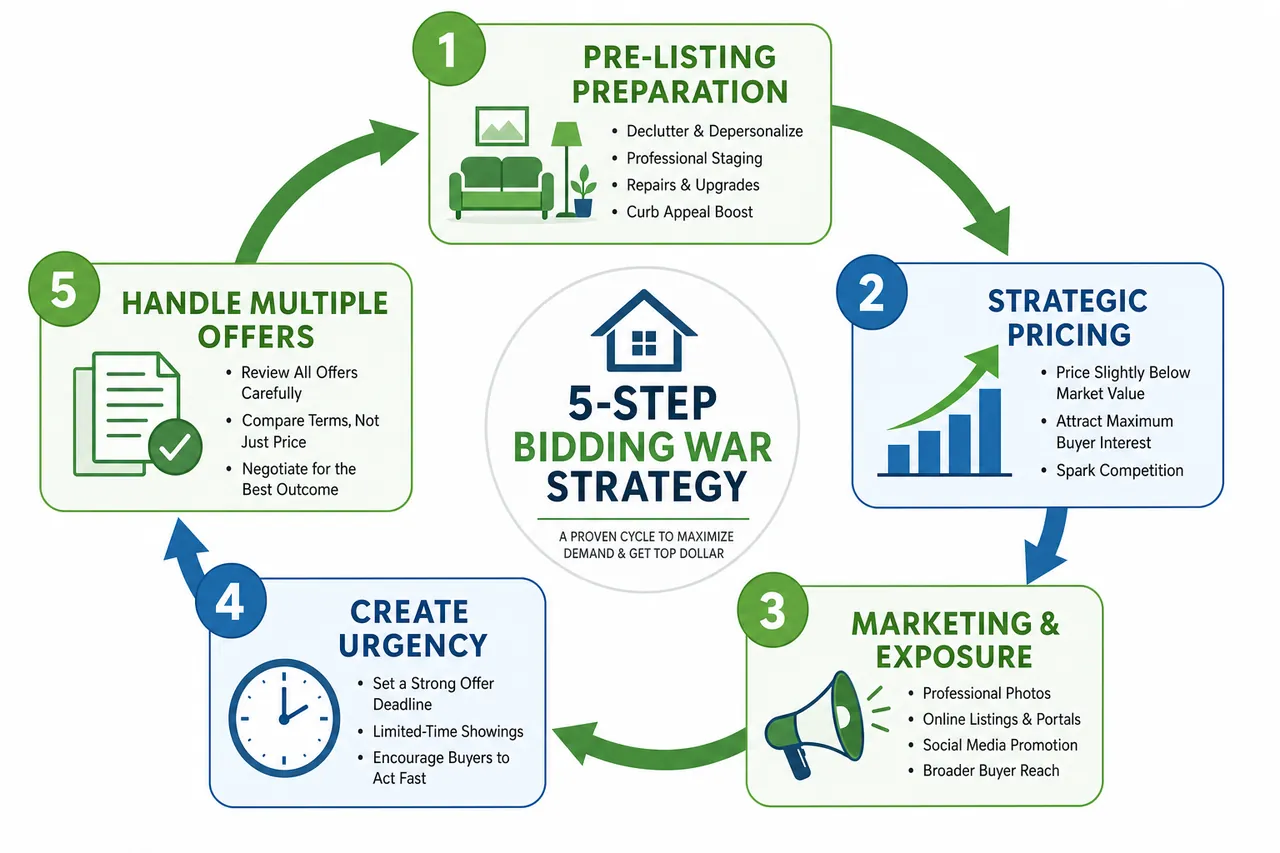
How Bidding Wars Work in Real Estate
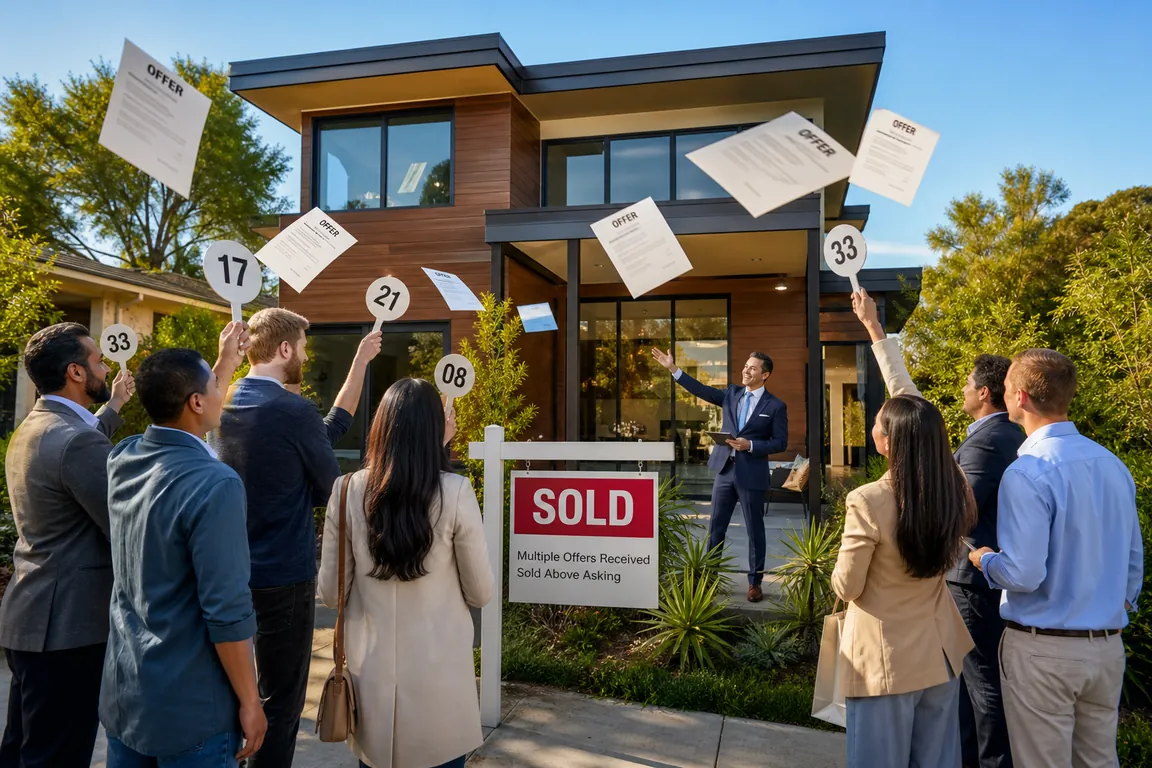
Multiple buyers. One property. That's when things get interesting. A bidding war erupts when two or more buyers submit competing offers on the same home, and the sale price climbs above what was originally listed. It's not like a typical negotiation between one seller and one buyer — instead, you get an auction-like environment where buyers have to outbid each other to actually close the deal. The National Association of Realtors found that during peak seller's markets, more than 50% of homes sold above list price. That's the real power of competitive bidding at work.
Why Sellers Should Want a Bidding War
Yes, you'll make more money. That's the obvious win. But there's more to it than just price.
When multiple offers come in at once, you're suddenly in control. You can demand shorter inspection windows, waived appraisal contingencies, flexible closing dates, and bigger earnest money deposits. Buyers competing against each other are also more motivated to actually follow through. They know another buyer is waiting in the wings, so they're less likely to get cold feet or file frivolous repair requests after the inspection.
Before you list your home, calculate what equity you actually have. Understanding how to calculate your home equity before selling gives you a realistic baseline to work from — and helps you figure out whether a bidding war outcome actually moves the needle on your financial situation.
Market Conditions That Create Bidding Wars
Not all markets support bidding wars. They happen when inventory is tight (less than 3 months of supply), buyers are hungry, and mortgage rates haven't scared away half the buyer pool. In a balanced market or buyer's market, the same strategies that spark competition in a hot market can backfire and leave your home languishing unsold. Understanding what's actually happening in your local market before you make any moves? That's non-negotiable.
| Market Indicator | Bidding War Likely | Bidding War Unlikely |
|---|---|---|
| Months of Inventory | Under 3 months | Over 5 months |
| Average Days on Market | Under 14 days | Over 45 days |
| List-to-Sale Price Ratio | 100%+ | Below 96% |
| Buyer Demand Index | High (multiple showings/day) | Low (fewer than 3/week) |
| Interest Rate Environment | Below 6.5% (broader buyer pool) | Above 7.5% (constrained affordability) |
Pre-Listing Preparation: Setting the Foundation

Partner with an Experienced Real Estate Agent
Bidding wars don't run themselves. You need someone who's actually managed multiple-offer situations before—not an agent who treats every sale like it's their first rodeo. When you're interviewing agents, ask the tough questions: "How many of your recent listings received multiple offers? What was the average over-ask percentage?" An agent with real skin in the game will have a pre-built offer management process, solid relationships with buyer's agents, and the negotiation instincts to play competing buyers against each other ethically and effectively.
Make Strategic Pre-Listing Repairs and Improvements
Not all repairs move the needle. Your goal? Eliminate buyer objections before they even walk through the door, not to renovate yourself into a price bump you won't recover. Focus on what buyers actually see and care about: fresh interior paint (average ROI: 107%), updated light fixtures, refinished hardwood floors, and a thorough deep clean. And here's the real power move—spend $300–$500 on a pre-listing inspection. You'll catch problems yourself rather than watching buyers use inspection findings to renegotiate after you've already accepted their offer.
Stage and Photograph Your Home Professionally
Staged homes sell for 1% to 5% more and spend 33% less time on market, according to the Real Estate Staging Association. That's not opinion—that's data. Professional staging, whether your furniture stays or goes, shows buyers a lifestyle, not just a bunch of rooms and square footage. But here's what really matters in today's market: professional photography. Listings with professional photos get 118% more online views than amateur shots, according to Redfin. In competitive markets, people shortlist homes online before they ever step foot inside. Your photos are your first chance—sometimes your only chance—to get them in the door.
| Pre-Listing Task | Estimated Cost | Average ROI | Timeline |
|---|---|---|---|
| Fresh Interior Paint | $1,500–$4,000 | 107% | 1–2 weeks |
| Professional Staging | $1,000–$3,500 | 150–200% | 1–3 days |
| Professional Photography | $200–$500 | High (drives showing volume) | Half day |
| Landscaping/Curb Appeal | $500–$2,500 | 100–150% | 1–3 days |
| Pre-Listing Inspection | $300–$500 | Prevents renegotiation losses | Half day |
| Hardwood Floor Refinishing | $1,000–$2,500 | 147% | 2–4 days |
Pricing Strategy to Spark Competition
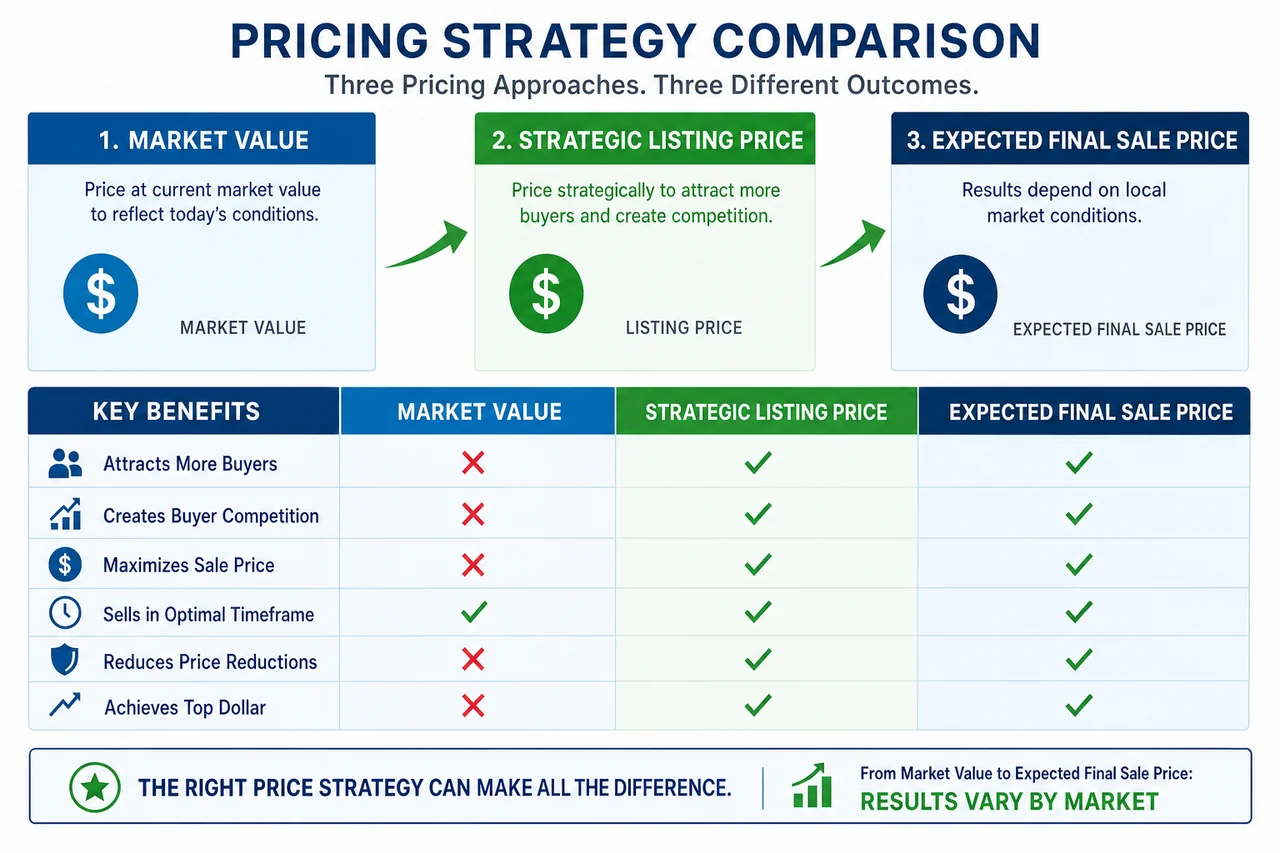
Price Your Home Strategically to Attract Multiple Offers
Pricing is everything. It's the single most powerful lever you've got for generating competitive offers. Here's the counterintuitive part: listing slightly below market value — typically $5,000 to $15,000 under a realistic appraisal — actually creates urgency. Buyers see fair pricing (or even attractive pricing) and they act fast. They come in at or above asking instead of lowballing. And this approach works particularly well in hot markets where homes are moving quickly.

Want a deeper framework for setting the right price? Check out our full seller's pricing guide. Living in a specific state? We've got tailored guidance for California, Florida, Colorado, and Washington home sellers.
Intentional Underpricing: What It's and When to Use It
This isn't desperation. Intentional underpricing is a deliberate strategy. It works best when your market has low inventory and high demand — because buyers respond to perceived value with real urgency. The catch: if demand's weaker than you thought, you might simply sell at that lower price. Before you commit to this approach, your agent needs to run the numbers on absorption rates (how fast comparable homes are selling). Never underprice so aggressively that buyers question the home's condition. A price that looks too good to be true raises red flags, not bidding wars.
Timing and Price Adjustments
Your listing goes live. Seven days pass in a normal market. You've gotten fewer than 10 showings. That's a signal something's wrong — the price, the marketing reach, or the home's presentation. Don't sit tight for 30 days. Act within the first two weeks. A smart price reduction early in the listing period brings a second wave of buyer interest. Waiting too long lets "days on market" damage your credibility with buyers. If you're selling in Tennessee or Indiana, where price sensitivity runs higher, pull up our Tennessee pricing guide and Indiana pricing guide for region-specific benchmarks.
Back to topMarketing and Exposure Tactics

Create Marketing Hype Before Your Listing Goes Live
Here's what actually works: bidding wars don't start when your home hits the MLS. They start before. Run a pre-listing campaign for 5 to 10 days before your official go-live date. This builds real anticipation. Interested buyers can plan their first showing visit for the opening weekend without scrambling. Your agent needs to email their buyer database, post "Coming Soon" content across social media, and alert other agents in your area about what's coming. When buyers know a good home is arriving soon, they show up ready to compete.
Use Multi-Channel Listing Promotion
The MLS listing alone won't cut it. Your property needs to appear on Zillow, Realtor.com, Redfin, and your agent's brokerage website within hours of going live. And that's just the start. Targeted Facebook and Instagram ads pull in more buyers. Google display campaigns keep your home visible. Email marketing to local buyer agents expands your pool even further. Think about it this way: the more qualified people seeing your listing, the higher your odds of multiple offers happening at the same time. That's what triggers real competition.
Host Strategic Open Houses and Broker Previews
A broker preview matters more than you'd think. This is an open house exclusively for buyer's agents—not the public. When agents personally see a well-maintained home with solid fundamentals, they bring their clients proactively. Schedule your broker preview 1–2 days before you open to the public. Then compress the public open house into a tight window: Saturday and Sunday, 1–4 PM. Don't drag showings out over two weeks. Here's why this works: when buyers see other buyers walking through your home at the same time, FOMO kicks in. Suddenly their offer improves.
Back to topCreating Urgency and Artificial Scarcity
Set Strategic Offer Deadlines
Want multiple offers at once? Set a formal offer deadline. Most sellers use 5 to 7 days after listing. Here's what you'll do: announce in the MLS remarks and listing description that all offers get reviewed on a specific date — something like "Offers due Monday, [date], at 5 PM." This creates real competition. Buyers know others are bidding too, so they come in stronger on day one. You'll skip weeks of back-and-forth negotiation that kills momentum. Just make sure your deadline isn't crazy short. Buyers need time to see the house and get financing pre-approval. Too tight a window and qualified buyers walk.
Overlap Showings to Highlight Buyer Competition
Schedule showings back-to-back in 30-minute windows instead of spreading them across the whole day. When the next buyer walks in and sees someone leaving, they get it immediately — other people want this house too. And they'll bid accordingly. This isn't sneaky. It's smart scheduling. Then pair it with honest feedback: if your agent gets multiple showing requests on the same day, let interested buyers' agents know significant interest exists. Don't share offer details. Just say "we've had strong activity."
Control Information Flow to Heighten Demand
You can legally tell buyers about competition. In most states, sellers and their agents can say multiple offers exist — just don't reveal what's actually in those offers. That's the line. Tell the truth strategically. If you've truly gotten strong early interest and expect multiple bids by the deadline, say so. It's factually accurate and it lights a fire under fence-sitters.
Back to topHandling Multiple Offers Like a Pro

Evaluating Offers Beyond Price
When multiple offers land on your table, don't just grab the biggest number. That's the temptation, but it's wrong. Offer quality is way more complex than that. A $450,000 cash offer with no contingencies could be worth far more than a $465,000 offer that's financed, includes a home sale contingency, requires an appraisal, and won't close for 60 days. Which one gets you to the finish line faster? Which one actually closes? Use a structured scorecard and evaluate each offer objectively.
| Evaluation Factor | Offer A | Offer B | Offer C |
|---|---|---|---|
| Offer Price | $450,000 | $465,000 | $455,000 |
| Financing Type | Cash | Conventional (20% down) | FHA (3.5% down) |
| Appraisal Contingency | Waived | Present | Present |
| Inspection Contingency | Informational only | Standard (10-day) | Standard (10-day) |
| Home Sale Contingency | None | None | Present |
| Earnest Money Deposit | 3% ($13,500) | 2% ($9,300) | 1% ($4,550) |
| Closing Timeline | 21 days | 30 days | 45–60 days |
| Overall Risk Level | Low | Moderate | High |
Understanding Contingencies and Their Impact
Contingencies are basically legal escape hatches. They let buyers walk away without losing their deposit if specific things don't work out. As a seller, you need to understand that every single contingency is a risk you're taking on. The big three? Financing contingencies (the buyer's loan gets denied), inspection contingencies (the buyer finds problems and wants repairs or money back), and appraisal contingencies (the house appraises for less than what they're offering). In competitive markets, buyers often drop or loosen these contingencies to win. But here's the thing — when a buyer waives the inspection, it doesn't mean your house is problem-free.
It means they're taking on the risk. And that's important because it also means they can't come back later asking for renegotiations over discovered issues.
| Contingency Type | What It Means for Sellers | Risk Level | When Waiving Is Reasonable |
|---|---|---|---|
| Financing Contingency | Deal can fall through if buyer loses loan approval | High | When buyer has strong pre-approval and large down payment |
| Appraisal Contingency | Buyer can exit if home appraises below offer price | Moderate–High | Cash offers or buyers who commit to covering appraisal gap |
| Inspection Contingency | Buyer can request repairs or credits | Moderate | Pre-inspected homes with disclosed condition reports |
| Home Sale Contingency | Deal contingent on buyer selling their home first | Very High | Almost never recommended in competitive markets |
Managing Escalation Clauses
Here's something you'll see in hot markets: escalation clauses. A buyer uses this to automatically bump their offer up when there's competition, by a set amount, until they hit their maximum. Picture it like this — "We're offering $450,000, and we'll beat any other offer by $2,500 up to a maximum of $475,000." Good for buyers? Absolutely. But you've got to be smart about it. Your agent needs to ask for proof of that competing offer before the escalation kicks in. And pay attention to that maximum number. It tells you exactly how far that buyer will go, which changes how you negotiate with everyone else interested in your property.
Back to topNegotiating and Selecting the Best Offer
Red Flags in Offers That Seem Too Good to Be True
An offer that's way over asking with no contingencies from a buyer you can't verify? That's a red flag. Request proof of funds right away if they're offering cash. For financed offers, don't settle for a pre-qualification letter — you need the full pre-approval letter, the lender's name, and the loan officer's direct contact information. Skip this step and you might find yourself 30 days into escrow with a buyer who can't actually close.
That's the nightmare scenario. Your home's off the market, you've lost time and momentum, and you might not get the same price if you relist.
Handling Low Appraisal Scenarios
Bidding wars push prices up fast. But appraisals often come in lower than what you and the buyer agreed to — and most sellers don't see this coming. If the buyer has an appraisal contingency, they can walk away or ask you to drop the price. You lose.
That's why you should prioritize offers that include an appraisal gap guarantee. What is that? It's a promise from the buyer to cover the difference between the appraised value and your offer price, up to a certain amount, straight from their pocket. This puts the appraisal risk on them instead of you. Your deal stays solid.
Back to topAdvanced Tactics to Amplify Bidding War Potential
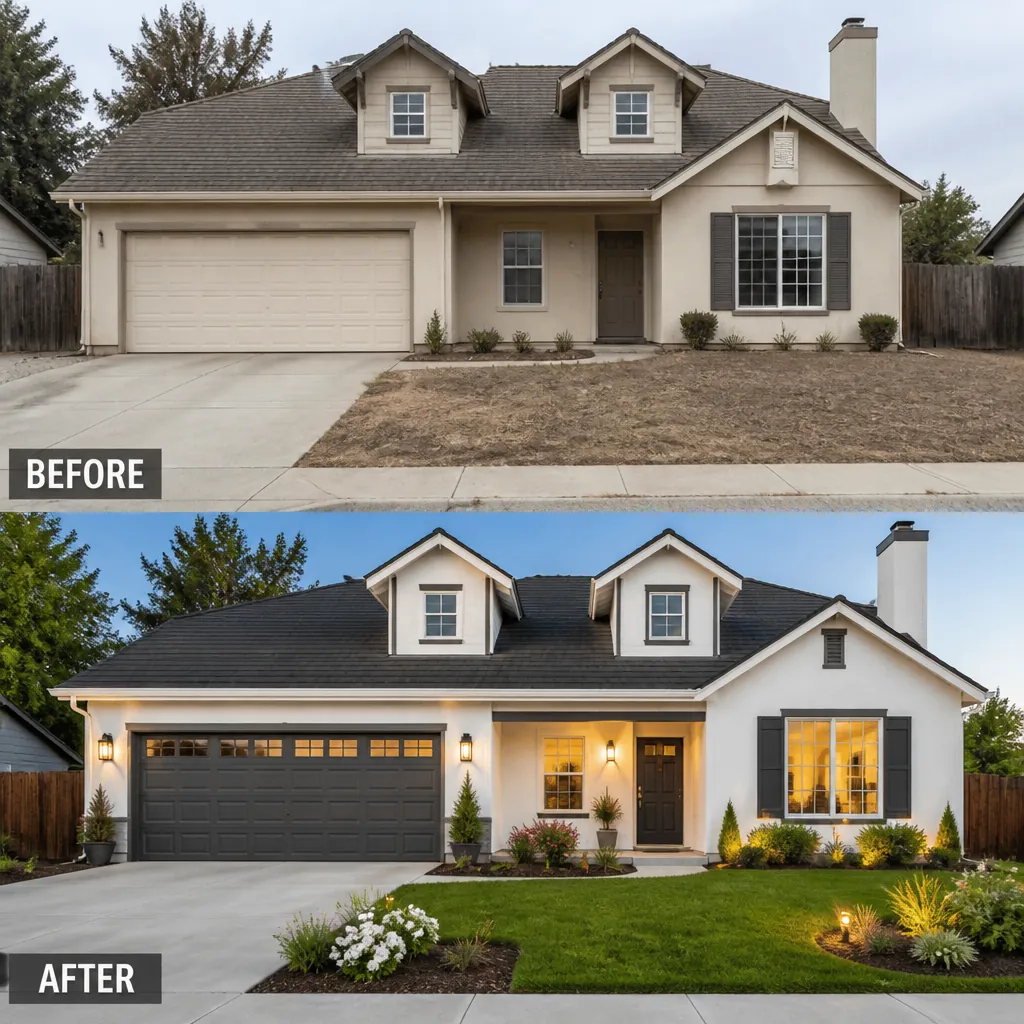
Use Curb Appeal and First Impressions
Buyers make up their minds fast. You've got seconds before they form an opinion about your home. That means landscaping, fresh exterior paint, a clean driveway, and a welcoming front door aren't just nice-to-haves — they're doing the psychological work of priming buyers to see value. Here's the thing: a buyer who feels good walking up to your front door enters in a positive frame of mind. They're already predisposed to perceive value before they've even stepped inside. And if you spend $500–$2,500 on curb appeal improvements? You're likely to recover multiples of that investment in your actual offer price.
Time Your Listing Strategically
When you list matters just as much as where. Thursday listings generate the most showings — buyers plan weekend tours and haven't had time to overthink. Spring (March–May) pulls the strongest buyer demand nationally, though your region might have a different peak. Don't list right before major holidays, school start weeks, or local events that pull attention away from homes. In competitive markets, a one-week timing shift can be the difference between three offers and ten.
Common Mistakes That Kill Bidding Wars
- Overpricing from the start: Even strong markets won't save you from a price that's clearly above value. Buyers just move on.
- Leaving the home occupied during showings: Your presence makes buyers uncomfortable and cuts viewing time short.
- Declining early offers to "wait for more": That strong early offer you turned down? You might end up with something weaker instead.
- Poor listing photos: This is the #1 reason buyers skip properties online. There's no good reason to use smartphone photos when professional shots pay for themselves.
- Failing to disclose known defects: Non-disclosure creates post-close legal liability and can unravel deals after they're accepted.
Market-Specific Considerations
When Bidding Wars Are Realistic in Your Market
Here's the thing: bidding war strategy doesn't work everywhere. Your market matters more than anything else. If you've got more than 5 months of inventory sitting around or homes are averaging over 45 days on the market, you need to throw out the playbook above and start fresh. Underpricing in a slow market? That's how you leave money on the table.
Your agent's take on what's actually happening in your neighborhood — not what CNN says about the national market — should shape everything you do. That aggressive strategy crushing it in a tight urban market? It'll backfire in a rural area where you've got three buyers instead of thirty.
What to Do If Bidding Wars Don't Materialize
You've launched the listing. You've done everything right. And then crickets — one offer, or nothing at all.
Listen to what the market's telling you. The price might be too high. Maybe the home itself has a presentation problem that's turning people away. Or external factors are at play: interest rates just jumped, the local factory laid people off, or it's January and nobody's moving. But here's what matters: you need to sell, and waiting for conditions to shift isn't a strategy.
A direct cash sale to a buyer like KDS Homebuyers could be your answer. You trade some potential upside for certainty and speed. And if you're facing foreclosure, divorce, or urgent financial pressure, that trade-off has real value — even if it doesn't show up in a price comparison spreadsheet.
Back to topConclusion: Building a Bidding War Worth Winning
Sparking a bidding war isn't about luck. It takes real work — smart pricing, solid marketing, and careful management of competing offers. Here's what actually moves the needle: start by getting an honest read on your local market, then invest in the stuff that makes buyers excited to tour your home. Find an agent who's done this before and knows the playbook.
When offers start rolling in, don't fixate on the highest number. Look at the whole picture instead. What are the terms? Can the buyer actually get financing through, or are they borderline? How many contingencies are there? These details separate deals that close from deals that fall apart at the last second.
And here's the thing — if your market isn't producing multiple offers, that's okay. Recognize it early. Adjust your approach rather than waiting around for a bidding war that might never happen.
The real win? It's not the biggest offer number. It's the combination of price, terms, and certainty that actually puts the most cash in your pocket when you sign at closing.
Back to topFrequently Asked Questions
How do I know if my market can support a bidding war?
Three numbers matter most. Is your area sitting on less than 3 months of inventory? Are comparable homes selling in under 14 days? And here's the big one — are homes regularly fetching over 100% of asking price? If you're seeing that list-to-sale price ratio climb above 100%, you're in bidding war territory. Your listing agent should pull a comparative market analysis that covers all three before you even think about going this route.
Is intentional underpricing risky?
Absolutely. But let's be real about when it works and when it doesn't. In a hot market with hungry buyers, pricing just below value can spark a bidding frenzy that pushes your final sale well past market value. In a slower market? You might get exactly one offer at that lower price you already cut. That's it.
Before you commit to underpricing, sit down with your agent and validate the strategy against current absorption rates. Check out our seller's pricing guide for a detailed framework on making this call.
What should I do if the home appraises below the winning bid?
Here's what usually happens: the buyer has an appraisal contingency in their contract, and suddenly you're negotiating a price cut, splitting the gap, or watching them walk away entirely. Not fun. The real protection? Lock in an appraisal gap guarantee as part of the accepted offer terms — before you agree to anything.
And then there's cash. Cash buyers don't deal with appraisals at all, which is why their offers command a premium in competitive markets — even when the number on the check is technically lower.
How do escalation clauses affect my negotiating position?
Escalation clauses do simplify the bidding process. But here's the catch: they also show your hand. Once you see that a buyer will go up to $X, your leverage with that specific buyer disappears.
Your agent can flip this around strategically. Know a buyer's ceiling? Go back to the non-escalation offer and tell them you've got competing bids. That information often prompts a higher, cleaner offer. Just remember — never share the actual terms of one offer with another buyer. But confirming that competing offers exist? That's fair game and usually smart strategy.
Can I pursue a bidding war strategy and still sell quickly?
Yes. Honestly, bidding wars often close faster than traditional sales.
Set a 5–7 day offer deadline and you're reviewing bids within your first week on market. See a strong offer coming in early? Your agent can immediately call for "best and final" from interested parties instead of waiting for the formal deadline. Most competitive sales close within 21–30 days once an offer's accepted — especially when buyers have already waived or shortened contingencies to beef up their bids.
Back to top
