

Transfer on Death Deed: How to Avoid Probate on Your House in Colorado
You may worry that your house will get stuck in probate after you pass away. 1 A transfer on death deed lets you name a beneficiary for your real estate so it can skip the court process entirely. 2 Colorado is one of the states that recognizes this powerful estate planning tool. In this post, you will learn how a Transfer on Death Deed (TODD) works in Colorado, what the law requires, and how to protect your loved ones from lengthy probate delays. 3
Key Takeaways
- Colorado recognizes Transfer on Death Deeds under the Colorado Revised Statutes. You name a beneficiary for your home so it passes to them without probate, avoiding months of court delays and costs that can reach 3%–7% of your estate's value. Recording fees at your county clerk and recorder's office typically run $13–$20 per page.
- A Colorado TODD is fully revocable at any time before death. You keep complete control and can update or revoke the deed if life changes — divorce, remarriage, or new heirs — without the beneficiary's consent.
- Colorado does not have a state estate tax or inheritance tax, but federal estate tax still applies to estates above the federal exemption threshold. A TODD does not shield the property from existing liens or mortgages.
- Beneficiaries claim title by filing an Affidavit of Survivorship along with the death certificate at the county clerk and recorder's office — no probate court involvement required.
- Common mistakes include failing to record the deed before death, naming minor children directly as beneficiaries, and forgetting to update the deed after major life events. Regular reviews keep your plan current.
What Is Probate and Why Avoid It?

Probate is the legal process by which a court supervises the transfer of a deceased person's assets, settles debts, and confirms heirs. In Colorado, probate cases are handled by the District Court in the county where the deceased lived. Colorado offers informal, formal, and supervised probate — but even informal probate takes time and money that your family could avoid with proper planning.
Time delays, court costs, and emotional burden
Colorado probate can last anywhere from a few months to well over a year depending on estate complexity and whether disputes arise. Court filing fees, personal representative fees, and attorney costs add up quickly, often consuming 3%–7% of the estate's total value. 1
If you own real property in multiple states, ancillary probate must be opened in each state separately — adding more time and expense. Colorado probate filings are also public record, meaning your family's financial details become visible to anyone who searches the court file.
Tools like a Transfer on Death Deed can spare your loved ones from these burdens during an already difficult time.
Probate timeline vs. TODD transfer in Colorado
| Aspect | Colorado Probate Process | Transfer on Death Deed (TODD) |
|---|---|---|
| How Title Transfers | District Court approves transfer after legal steps | Beneficiary files Affidavit of Survivorship and death certificate at county recorder |
| Timeline | Several months to over a year; delays common | Typically completed within weeks |
| Costs | Court fees, attorney fees, possible appraisal fees | Minimal — mainly county recording fees |
| Privacy | Public record in Colorado District Court | Recorded in county property records; no public court case |
| Emotional Impact | Added stress during grieving; multiple hearings possible | Simplified process; family moves forward quickly |
How a Transfer on Death Deed (TODD) Works in Colorado
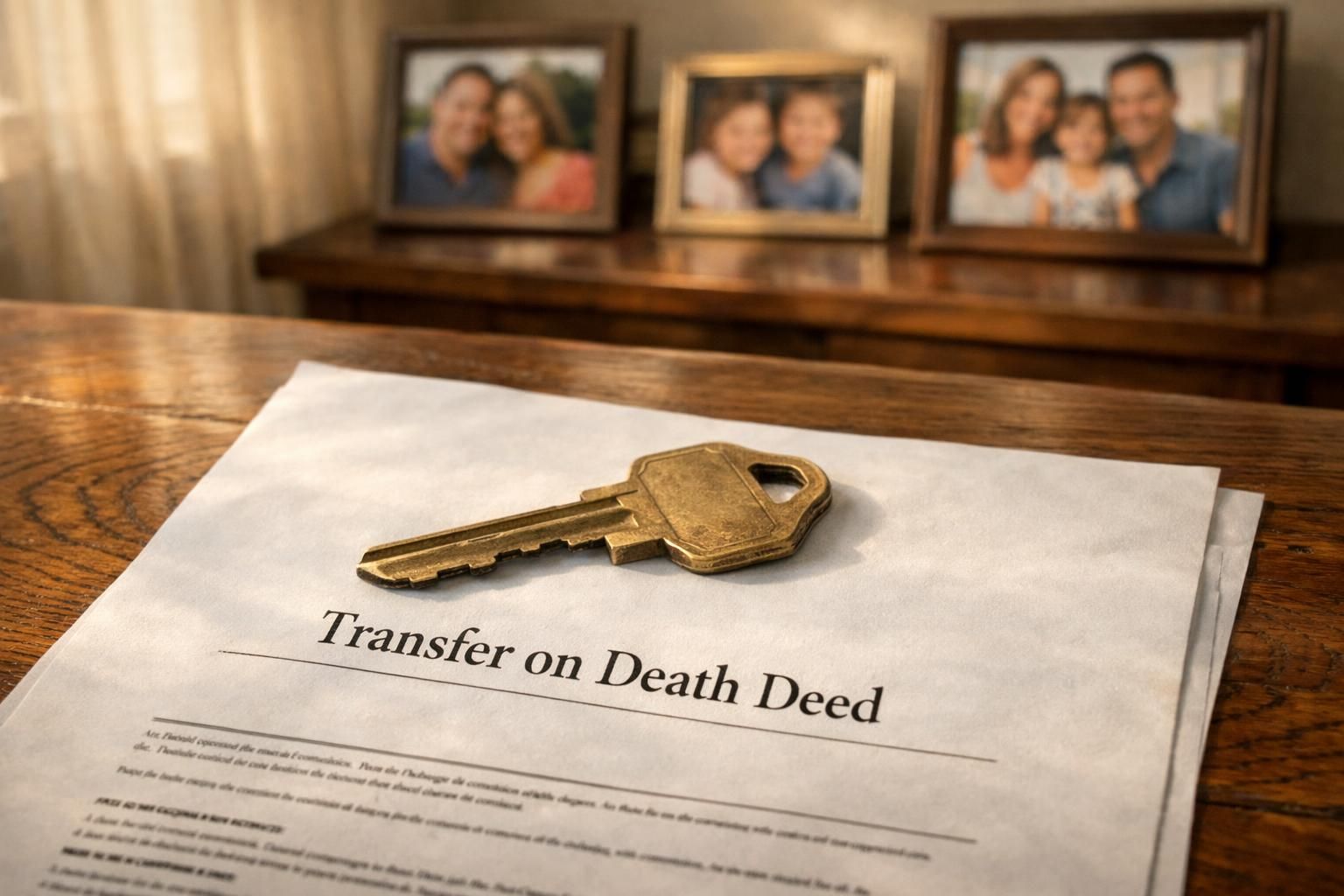
Colorado law authorizes Transfer on Death Deeds, allowing homeowners to name a beneficiary who receives real property automatically upon the owner's death — without going through probate. The deed must be properly prepared and recorded during the owner's lifetime to be valid.
Recorded during the owner's lifetime
You must record your TODD with the county clerk and recorder in the Colorado county where your property is located while you are still alive. 2 Recording fees in Colorado counties typically range from $13 to $20 per page. Denver, Jefferson, Arapahoe, and El Paso counties all accept these filings at their respective recorder's offices.
If the deed is not recorded before your death, it is invalid and your home will likely pass through probate instead.
Revocable until death
A Colorado TODD gives you complete flexibility. You can revoke or update it at any time by recording a new TODD or a formal revocation with the same county clerk and recorder. Simply destroying a paper copy does not cancel a deed that has already been recorded.
Under Colorado law, divorce will automatically revoke a former spouse named as beneficiary on a TODD, similar to how beneficiary designations on other accounts are handled after dissolution of marriage.
Automatic transfer with a death certificate
After the owner passes, the beneficiary claims title by filing an Affidavit of Survivorship along with a certified copy of the death certificate at the county clerk and recorder's office. This clears title without any court involvement. 3
If no named beneficiary survives the owner by at least 120 hours (five days), the TODD fails and the property passes through the estate. Naming an alternate beneficiary helps prevent this outcome.
Owner retains full control during their lifetime
Recording a TODD does not give the beneficiary any current rights to your property. You can still sell, refinance, take out a new mortgage, or change beneficiaries at any time without the named beneficiary's consent. 3 The deed only takes effect the moment you pass away and a valid death certificate is filed.
Key Benefits of a TODD in Colorado
Avoids probate delays and costs
Colorado probate costs can easily run into thousands of dollars when you factor in filing fees, personal representative compensation, and attorney charges. A TODD bypasses Colorado's District Court process entirely, saving your heirs both time and money. Setting up a TODD typically costs under $500 — far less than probate fees that can reach 3%–7% of your estate's value.
You can name multiple beneficiaries and specify each person's share, ensuring the right people receive your property quickly and without court delays.
Maintains privacy
Colorado probate filings become part of the public court record in the District Court. A TODD avoids any court proceeding after your death, so sensitive financial and property details stay out of the public eye. The deed is recorded in county property records during your lifetime, but no probate case follows your passing.
Simpler than a trust
Creating a revocable living trust in Colorado requires ongoing administration, trustee appointments, and asset re-titling. A TODD accomplishes similar probate-avoidance goals for your real estate without those ongoing requirements. Attorney-prepared TODDs generally cost between $200 and $500, while a trust often costs significantly more. There are no yearly filings or management duties attached to a recorded TODD.
Flexibility to change beneficiaries
Life changes — marriages, divorces, births, and deaths all affect who you want to inherit your home. A Colorado TODD lets you update your beneficiary designation at any time by recording a new deed. 4 No complex legal proceedings are needed; you simply complete a new form and record it at the county clerk and recorder's office.
Limitations and Considerations

Doesn't avoid estate taxes or liens
Colorado does not impose a state estate tax or inheritance tax, which is a significant advantage for Colorado homeowners. However, federal estate tax still applies if your total estate exceeds the federal exemption threshold (over $13 million in 2024). 2
A TODD also does not erase existing liens, mortgages, or judgment liens attached to the property. Your beneficiaries inherit the property subject to those encumbrances and must address those debts to clear title. Creditors with valid claims against the estate may also have rights against the transferred property under Colorado law.
Potential complications with multiple beneficiaries
When you name multiple beneficiaries on a Colorado TODD, you should clearly specify each person's percentage share. If co-beneficiaries disagree about what to do with the property — selling versus keeping it, for example — disputes can arise that may require legal resolution. 5
If one beneficiary does not survive you by 120 hours, their share does not transfer under the TODD. Naming alternate beneficiaries protects against this gap. Joint tenants can only transfer their own interest through a TODD; other co-owners' interests are unaffected unless they file their own deed.
Colorado-specific considerations
Colorado's TODD statutes are part of the Colorado Revised Statutes governing nonprobate transfers. Always verify current requirements with a Colorado real estate attorney or your county clerk and recorder's office, as procedural details can change. The deed must include a legal description of the property matching county records, and the owner must be at least 18 years old and of sound mind when signing.
Practical Steps to Create a TODD in Colorado

Research Colorado requirements
Colorado recognizes Transfer on Death Deeds under state law governing nonprobate transfers. Confirm current requirements with your county clerk and recorder — Denver, El Paso, Jefferson, and Arapahoe counties all have recorder's offices where you file the deed. Check that the legal description on your TODD exactly matches what is in your current deed and county records. Review any existing deed of trust or mortgage tied to the property, since these remain in place after the TODD transfer.
Decide on beneficiaries
You may name individuals, trusts, charities, or other organizations as beneficiaries. Use full legal names and addresses to prevent confusion. Name alternate beneficiaries in case your primary choice does not survive you by 120 hours. Avoid naming minor children directly — Colorado courts will need to appoint a guardian or conservator to manage the property on a minor's behalf, creating the very court involvement you were trying to avoid.
Sign, notarize, and record the deed properly
Sign the TODD yourself — a power of attorney cannot be used for this step. Sign in front of a notary public. Then record the deed at the county clerk and recorder's office in the Colorado county where the property is located. This must happen while you are still alive. Recording fees in Colorado generally run $13–$20 per page. The deed is invalid and your home may go through probate if it is not recorded before your death.
Common Mistakes to Avoid
Failing to record the deed
An unrecorded TODD has no legal effect in Colorado. Even a perfectly drafted deed sitting in a desk drawer will not transfer your property outside of probate. File the completed deed at the appropriate county recorder's office promptly after signing and notarizing it. Verify the recording was completed and keep a copy of the stamped, recorded deed with your estate planning documents.
Naming minors as beneficiaries
Colorado law does not allow minors to hold title to real property directly. If you name a child under 18, the court will need to appoint a conservator to manage the property — adding expense and delay. Instead, name an adult custodian under Colorado's Uniform Transfers to Minors Act, or direct the property to a trust established for the child's benefit.
Forgetting to update after life changes
Colorado law automatically revokes a former spouse's beneficiary designation on a TODD following divorce, but other life changes — a beneficiary's death, new family members, changed relationships — do not automatically update your deed. Review your TODD after any major life event and record an updated deed or formal revocation if your intentions have changed. This simple step prevents your home from unexpectedly falling into probate or passing to the wrong person.
Understanding Probate in Colorado: An Overview
In Colorado, probate is administered through the District Court in the county where the deceased was domiciled. Colorado follows the Uniform Probate Code, offering three levels of probate: informal, formal, and supervised. Even informal probate — the least intensive — requires filing with the court, publishing notices to creditors, and waiting for a creditor claim period to close before distributing assets. 6
If you own real estate in Colorado and another state, ancillary probate must be opened in each state. A TODD eliminates this burden for the Colorado property. Colorado probate records are public, exposing your family's financial details to anyone who searches the court file. Proactive use of a TODD protects privacy and keeps the focus on your chosen beneficiaries rather than the court system.
Conclusion
A Transfer on Death Deed is one of the most straightforward ways Colorado homeowners can protect their real estate from the delays, costs, and public exposure of probate. You keep full ownership and control during your lifetime, retain the freedom to change beneficiaries at any time, and give your loved ones a clear, fast path to inheriting your home. Colorado's lack of a state estate tax makes this tool even more attractive for local homeowners.
Review your estate plan, confirm Colorado's current recording requirements with your county clerk and recorder, and work with a Colorado real estate attorney to get your TODD properly prepared, signed, and filed.
If you are facing a property that is already in probate, dealing with an inherited home, or simply need to sell quickly without the hassle of the open market, KDS Homebuyers can help. Visit kdshomebuyers.net for a free, no-obligation cash offer on your Colorado home.
FAQs
1. Does Colorado recognize Transfer on Death Deeds?
Yes. Colorado authorizes Transfer on Death Deeds under its statutes governing nonprobate transfers. The deed must be signed, notarized, and recorded with the county clerk and recorder in the county where the property is located before the owner's death.
2. Is there a state estate tax in Colorado that a TODD can help avoid?
Colorado does not have a state estate tax or inheritance tax. However, federal estate tax applies to estates above the federal exemption threshold. A TODD helps avoid probate but does not eliminate federal tax obligations or existing liens on the property.
3. How does a beneficiary claim property under a Colorado TODD?
After the owner's death, the beneficiary files an Affidavit of Survivorship and a certified copy of the death certificate with the county clerk and recorder's office. No probate court action is required, and title transfers directly to the beneficiary.
4. Can I change or revoke my TODD in Colorado?
Yes. You can revoke or update a Colorado TODD at any time before death by recording a new deed or a formal revocation with the same county recorder. Divorce automatically revokes a former spouse named as beneficiary under Colorado law.
5. Will my heirs receive a stepped-up tax basis when inheriting through a TODD?
Yes. Property inherited through a Transfer on Death Deed generally qualifies for a stepped-up basis equal to the property's fair market value at the date of the owner's death. This can significantly reduce capital gains taxes if the beneficiary later sells the home.
References
- ^ https://www.lifegenlawgroup.com/5-reasons-to-avoid-probate-and-how-to-do-it/ (2025-02-28)
- ^ https://www.rouletlaw.com/faqs/transfer-on-death-deed-a-simple-way-to-avoid-probate-.cfm
- ^ https://nysba.org/new-york-now-allows-transfer-on-death-deeds-but-should-you-use-them/ (2024-12-10)
- ^ https://www.americanbar.org/content/dam/aba/publications/probate_property_magazine/v24/02/2010_aba_rpte_pp_v24_2_mar_apr_horn_gary.pdf
- ^ https://www.goodwinlaw.com/en/insights/publications/2023/01/01_20-transfer-on-death-designations-potential (2023-01-20)
- ^ https://california-elder-law.com/blog/how-to-avoid-probate-with-a-transfer-on-death-deed/ (2025-04-10)
