

Taxes on Selling an Inherited House: What You'll Owe in Washington

Losing a loved one is hard enough without worrying about taxes on selling an inherited house. One key fact: most people don't owe huge amounts because the property's value resets to its fair market price at the time of inheritance. 1 This guide explains what Washington heirs need to know—from stepped-up basis rules to Washington's capital gains tax—so you can avoid confusion and costly mistakes. 2
Key Takeaways
- The IRS uses a stepped-up basis for inherited houses. Your cost basis becomes the fair market value at the owner's death. You only pay capital gains tax on profit above that amount.
- Federal estate tax usually does not apply unless the estate exceeds $13.61 million per person in 2024. Washington State has its own estate tax with a much lower threshold of $2.193 million.
- Inherited property sales always qualify for long-term capital gains rates (0%, 15%, or 20%) at the federal level, regardless of how quickly you sell. Washington's 7% state capital gains tax may apply if your total gains exceed $262,000 in a year.
- The primary residence exclusion ($250,000 single; $500,000 married) rarely applies to inherited homes unless the heir both owns and lives there for two of the five years before selling.
- Keep all records: get a professional appraisal at the date of death, save receipts for repairs and sale costs, and consult a Washington estate planning attorney—especially with multiple heirs or complex estates.
Understanding inherited property taxes can feel overwhelming during an already difficult time.
Selling an inherited house in Washington can trigger taxable income at both the federal and state level. Most heirs do not owe taxes until they actually sell, but capital gains tax may apply depending on the home's value at sale. Federal estate taxes generally only affect estates above $13.61 million, but Washington's state estate tax kicks in at $2.193 million—catching many Seattle and Bellevue area families off guard given high local property values.
Washington also has no general state income tax, but it does have a 7% capital gains excise tax on long-term gains above the annual threshold. Consulting a financial advisor or estate planning attorney familiar with Washington tax law early in the process helps reduce surprises and keeps your tax liability under control.
The Stepped-Up Basis Concept
The IRS resets your cost basis to the home's fair market value at the owner's date of death. This rule can greatly reduce your capital gains tax when you sell inherited property in Washington.
How the tax basis resets to the property's fair market value at the date of death.
If you inherit property in Washington, your tax basis resets to the fair market value (FMV) on the decedent's date of death under Internal Revenue Code Section 1014. For example, if your grandmother bought her Tacoma home in 1985 for $60,000 and it was worth $500,000 when she passed in 2023, your new cost basis is $500,000.
As an heir, you only pay capital gains taxes on increases above this stepped-up basis. If you sell for $515,000, your taxable gain is just $15,000 rather than the full appreciation since 1985. Executors may choose an alternate valuation date up to six months later using IRS Form 706. Getting a professional appraisal at the time of death is essential—it supports accurate reporting and helps avoid audit issues down the road.
Example: Grandma bought the house for $60k in 1985, worth $500k at her death in 2023, sold for $515k—you owe tax on $15k, not $440k.
The stepped-up basis shields you from capital gains tax on decades of appreciation. The IRS only counts profit above the new basis as taxable income. For Washington heirs dealing with high-value real estate in markets like Seattle or Bellevue, this rule is especially valuable. Always check IRS Publication 551 or work with a financial advisor for guidance on your specific situation.
Capital Gains Tax Rates

Capital gains tax on inherited property uses federal rates of 0%, 15%, or 20% based on your taxable income and filing status. Washington heirs must also consider the state's capital gains excise tax.
Federal rates: 0%, 15%, or 20%, depending on income.
You pay capital gains tax on the profit from selling inherited property, not the full sale price. For 2024, single filers with taxable income under $47,025 pay 0% federal capital gains tax. The 15% rate applies up to $518,900 for singles or $583,750 for married couples filing jointly. Above those limits, the rate is 20%. High earners may also owe an additional 3.8% Net Investment Income Tax if individual income exceeds $200,000 or joint filers exceed $250,000.
Washington State Capital Gains Excise Tax
Washington enacted a 7% capital gains excise tax on long-term gains above $262,000 (adjusted annually for inflation). This tax applies to gains from the sale of assets including real estate in certain circumstances. However, sales of real property are generally excluded from Washington's capital gains tax—meaning the sale of an inherited home typically does not trigger the state excise tax. That said, gains from other inherited assets like stocks or investment accounts may be subject to it if your total gains exceed the threshold. Work with a Washington tax professional to confirm how these rules apply to your specific estate.
Inherited property is always treated as long-term.
The IRS always treats inherited property as having a long-term holding period, regardless of how quickly you sell. Even if you sell the inherited home the week after you receive it, your sale qualifies for long-term capital gains rates—never the higher short-term rates. This rule applies under IRS Publication 559 and provides meaningful savings for heirs who need to sell quickly to settle an estate.
Primary Residence Exclusion

Why the exclusion typically doesn't apply to inherited homes.
The primary residence exclusion usually does not apply to inherited homes. The IRS requires that you both own and live in the house as your main home for at least two of the five years before selling. Most heirs in Washington do not move into an inherited property, so they cannot claim the $250,000 (single) or $500,000 (married filing jointly) exclusion under 26 U.S. Code Section 121.
The stepped-up basis provides the primary tax protection instead. For most Washington heirs, especially those inheriting homes in high-appreciation areas like Seattle or Bellevue, the stepped-up basis will significantly reduce or eliminate any taxable gain at sale.
Exception if the heir moves in for at least 2 of the past 5 years.
If you inherit a Washington home and make it your primary residence for at least two of the five years before selling, you may qualify for the IRS home sale exclusion. You must meet both the ownership and use tests. Keep documentation such as utility bills and tax returns with your address as proof. This exception can meaningfully reduce your federal capital gains tax liability if you sell a high-value home in a competitive market like Spokane or the greater Seattle area.
Washington State Estate Tax
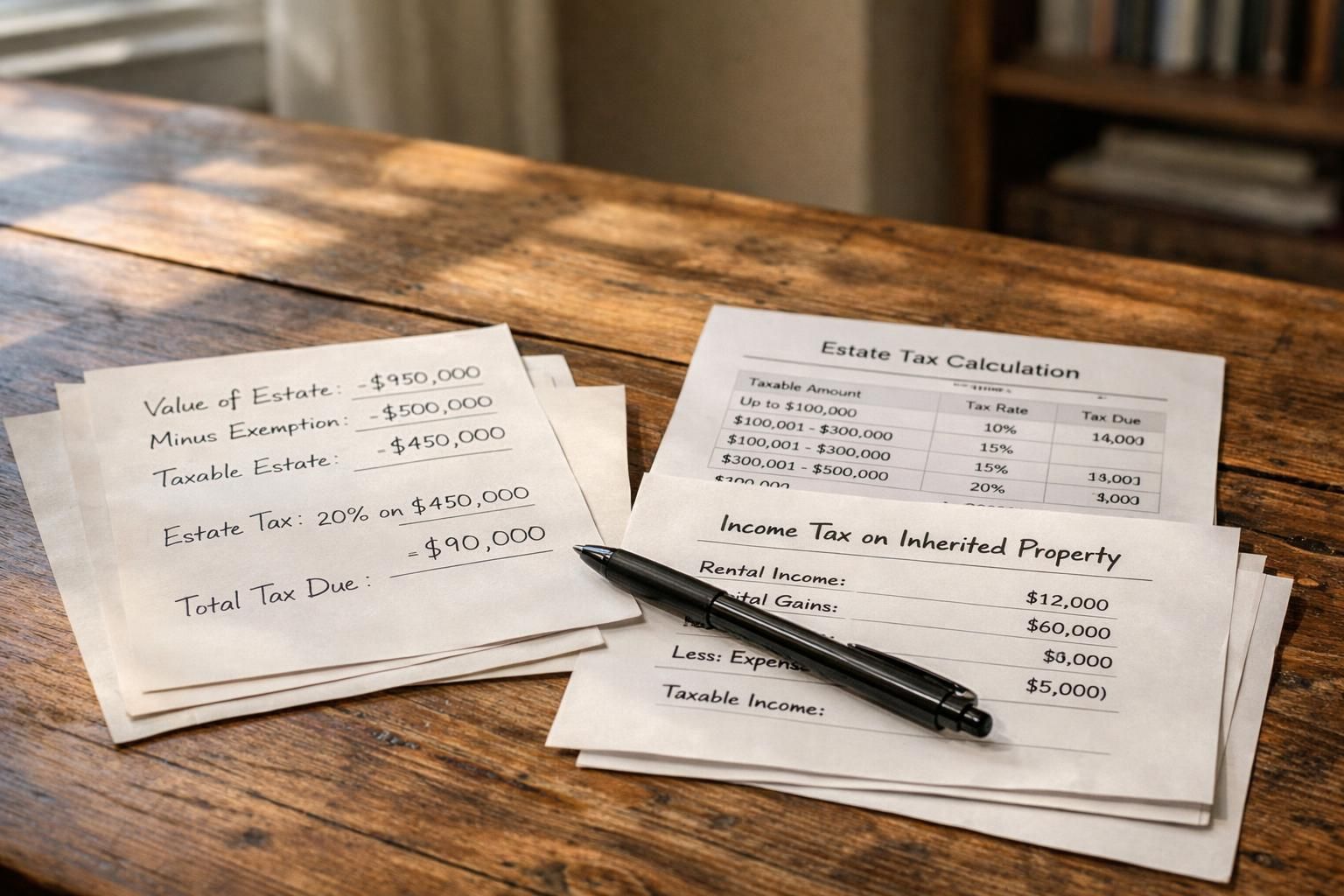
Washington's estate tax threshold is $2.193 million—far below the federal limit.
Washington is one of only a handful of states with its own estate tax, and it has one of the lowest thresholds in the country. As of 2024, estates valued above $2.193 million must file a Washington State estate tax return with the Washington Department of Revenue. The tax rates range from 10% to 20% on the taxable portion above the exemption.
This threshold matters significantly for heirs in high-cost markets. A family home in Seattle's Capitol Hill neighborhood or on the Eastside can easily push an estate above the filing threshold. The Washington estate tax is paid by the estate before assets pass to heirs, but it can reduce what you ultimately receive.
Surviving spouses can use a marital deduction to defer Washington estate tax. Qualified family-owned business interests and farms may also qualify for special deductions under state law. An estate planning attorney familiar with Washington's estate tax rules is essential for estates that may be near or above the threshold.
Federal estate tax exemption is $13.61 million.
Federal estate tax only applies if the total estate value exceeds $13.61 million per person in 2024 (or $27.22 million for married couples). The vast majority of estates will not owe federal estate tax. If an estate does exceed this limit, IRS Form 706 must be filed. The estate pays the tax before heirs receive anything, so most individuals inheriting property will not face this tax directly.
Estates may still need to file returns.
Even if no estate tax is owed, estates may need to file both a federal return (if gross value exceeds the threshold) and a Washington State estate tax return if the estate exceeds $2.193 million. Executors also file Form 8971 and Schedule A to report asset basis to heirs. Accuracy is crucial—overstating basis can trigger IRS penalties. Work with a qualified estate attorney or CPA in Washington to ensure all filings are complete and timely.
Washington Has No Inheritance Tax

Washington does not have a state inheritance tax. Only six states currently charge an inheritance tax: Iowa, Kentucky, Maryland, Nebraska, New Jersey, and Pennsylvania. Washington is not among them, so heirs in Olympia, Tacoma, or anywhere else in the state do not owe inheritance tax on what they receive.
However, Washington does have a real estate excise tax (REET) that applies to property sales. When you sell an inherited home, REET is owed based on the sale price. The rate is graduated: 1.1% on the first $525,000, 1.28% up to $1.525 million, 2.75% up to $3.025 million, and 3% above that. This is typically paid by the seller at closing and should be factored into your net proceeds calculation.
Multiple Heirs and Tax Implications
If you inherit a Washington home with siblings or other co-heirs, each person receives their own stepped-up basis proportionate to their share. For example, three siblings inheriting equally each receive one-third of the new fair market value as their individual basis.
Each heir reports their share of sale proceeds and any taxable gain on their own federal tax return using Schedule D (Form 1040) and Form 8949. Deduct selling expenses—including agent commissions, title fees, and Washington's REET—from gross proceeds before calculating taxable gain. Keep records organized and consider a written co-heir agreement early in the process to avoid delays and disputes at tax time.
Deductions You Can Claim
You can reduce your taxable gain by deducting allowable selling costs and improvements made after inheriting the property. Real estate commissions, title insurance, escrow fees, attorney fees, the Washington REET paid at closing, and required repairs or staging costs all lower your net gain. Capital improvements made after inheriting—such as a new roof or updated kitchen—also add to your basis and reduce taxable profit. 2 Keep every receipt and invoice; routine maintenance does not qualify, but capital improvements do.
Timing Considerations
The tax year in which you sell determines when you report your gain. If you close in December 2024, you report the gain on your 2024 federal return due in April 2025. If your profit is substantial, estimated tax payments may be required to avoid IRS penalties. Washington has no state income tax, but if any portion of your gains triggers the state capital gains excise tax, you'll file a Washington capital gains tax return separately with the Department of Revenue by April 15 of the following year. A tax professional can help you determine whether quarterly estimated payments are needed and plan the timing of your sale accordingly.
Special Situations
Inherited rental properties and depreciation recapture.
If you inherit a rental property in Washington, your depreciation schedule resets to the stepped-up fair market value at the date of death. You do not inherit the prior owner's depreciation history. Any depreciation you claim after inheriting the property will be subject to depreciation recapture tax—taxed at up to 25% under IRS Section 1250 rules—when you eventually sell. Keep clear records of your new basis and all post-inheritance depreciation claimed. IRS Publication 527 explains these rules in detail.
Selling below the stepped-up basis (capital loss treatment).
If you sell an inherited Washington property for less than its stepped-up basis—which can happen when market conditions shift quickly—you may have a deductible capital loss, but only if the property was used for investment or business, not as a personal residence. You can deduct up to $3,000 per year against ordinary income, with any excess carrying forward. Report losses on Schedule D (Form 1040). Only declines in value after the date of inheritance count toward this loss.
Options for Selling Your Inherited Washington Home
Consider your options before selling. Listing with a real estate agent works well if the home is in good condition and you want full market value. A cash buyer can speed the process significantly—helpful when heirs need to settle debts, resolve disputes, or close an estate quickly without months of showings and negotiations.
Washington's probate process is administered through the Superior Court in the county where the decedent lived—King County Superior Court for Seattle estates, Pierce County for Tacoma, and so on. Washington allows simplified probate procedures for smaller estates, and the state's "nonintervention will" process can give executors broad authority to sell property without court approval at every step. An estate attorney can clarify which process applies to your situation.
If multiple heirs are involved, align on the plan early. Each heir has their own stepped-up basis and tax obligations, so clear communication prevents surprises at closing.
Conclusion
Selling an inherited home in Washington involves federal capital gains rules, Washington's estate tax, the real estate excise tax, and potentially the state capital gains excise tax for non-real-estate assets. The stepped-up basis is your most powerful protection against a large tax bill. Get a professional appraisal, document every expense, and work with a Washington estate planning attorney or CPA to navigate the details correctly.
Key action items: get a professional appraisal, keep receipts, consult a Washington tax professional, and consider a cash buyer if traditional selling is too complicated.
Start with a professional appraisal at the date of death to establish your stepped-up basis. Save every receipt for repairs, improvements, and selling costs. Consult a tax professional familiar with both federal rules and Washington's estate tax and REET requirements. If the probate and listing process feels overwhelming—especially with multiple heirs or an estate near Washington's $2.193 million estate tax threshold—a cash buyer can simplify and speed up the sale significantly.
If you've inherited a home in Washington and want a straightforward path forward, KDS Homebuyers purchases inherited properties directly for cash, in any condition. Visit kdshomebuyers.net to request a free, no-obligation cash offer and get answers from a team that understands the unique challenges Washington heirs face.
FAQs
1. What taxes might I owe when selling an inherited property in Washington?
You may owe federal capital gains tax on profit above your stepped-up basis. Washington's real estate excise tax (REET) applies to the sale price. If the estate exceeded $2.193 million, Washington estate tax may have been owed before you received the property.
2. How does the stepped-up basis reduce my tax liability?
Your cost basis resets to the home's fair market value at the date of death. If you sell soon after inheriting, little or no gain may exist above that basis, significantly reducing or eliminating federal capital gains tax.
3. Does Washington have an inheritance tax?
No. Washington does not impose an inheritance tax on heirs. However, Washington does have a state estate tax that applies to estates above $2.193 million, paid by the estate before assets are distributed.
4. Does Washington's 7% capital gains tax apply to selling an inherited home?
Generally, no. Sales of real property are excluded from Washington's capital gains excise tax. However, gains from inherited stocks or other investment assets may be subject to it if your total gains exceed the annual threshold. Consult a Washington tax professional to confirm your specific situation.
5. Should I consult an attorney before selling an inherited Washington home?
Yes. A Washington estate planning attorney can help you navigate probate in the appropriate Superior Court, understand REET obligations, and minimize both federal and state tax exposure—especially important given Washington's low estate tax threshold.
6. Are there ways to lower my taxable gain from selling an inherited house?
Yes. Deduct eligible selling costs (commissions, title fees, REET paid at closing) and capital improvements made after inheriting. Proper documentation of these expenses reduces your net taxable gain. A financial advisor or CPA can help identify all available deductions.
