

Taxes on Selling an Inherited House: What You'll Owe in Tennessee

Losing a loved one is hard enough without worrying about taxes on selling an inherited house. One key fact: most people don't owe huge amounts because the property's value resets to its fair market price at the time of inheritance. 1 This guide covers what Tennessee heirs need to know — from stepped-up basis rules to state-specific tax considerations — so you can avoid confusion and costly mistakes. 2
Key Takeaways
- The IRS uses a stepped-up basis for inherited houses. Your cost basis becomes the fair market value at the owner's death. You only pay capital gains tax on profit above that amount.
- Federal estate tax generally does not apply unless the estate exceeds $13.61 million per person in 2024. Most Tennessee heirs will not owe federal estate taxes.
- Tennessee does not impose a state inheritance tax or a state estate tax — both were repealed. However, you may still owe federal capital gains tax and should be aware of Tennessee's real estate transfer tax.
- Inherited property always qualifies for long-term capital gains rates (0%, 15%, or 20%) regardless of how quickly you sell after inheriting.
- Keep all records: get a professional appraisal at date of death, save receipts for repairs and selling costs, and consult a Tennessee estate planning attorney or CPA — especially with multiple heirs.
Understanding inherited property taxes can feel overwhelming during an already difficult time.
Selling an inherited house in Tennessee can trigger taxable income even if you never expected it. Most heirs do not owe taxes until they actually sell, but you could face capital gains tax depending on the home's value and your income. Federal estate taxes typically only impact estates greater than $13.61 million as of 2024, and Tennessee eliminated its own state estate tax in 2016 and its inheritance tax in 2015 — giving Tennessee heirs a real advantage compared to residents of many other states. Still, proper planning early helps reduce surprises and keeps your tax liability under control.
The Stepped-Up Basis Concept
The IRS resets your cost basis to the home's fair market value at the owner's date of death. This rule can greatly reduce your capital gains tax when you sell inherited property anywhere in Tennessee — from a Nashville suburb to a rural property in East Tennessee.
How the tax basis resets to the property's fair market value at the date of death.
If you inherit property, your tax basis resets to the fair market value (FMV) as of the decedent's date of death under Internal Revenue Code Section 1014. For example, if your grandmother bought her Memphis home in 1980 for $50,000 and it was worth $300,000 when she passed away in 2023, your new cost basis is $300,000 — not $50,000.
As an heir, you only pay capital gains taxes on increases above this stepped-up basis. If you sell for $310,000, your taxable gain is just $10,000 rather than the full $260,000 of appreciation since original purchase. Executors may also choose an alternate valuation date up to six months later using IRS Form 706. Getting a professional appraisal at the date of death is critical to documenting FMV accurately and avoiding audit risk down the road.
Example: Grandma bought the house for $50k in 1980, worth $300k at her death in 2023, sold for $310k — you owe tax on $10k, not $260k.
Suppose you inherit a Knoxville home your grandmother purchased for $50,000 in 1980. At her death in 2023, the stepped-up basis becomes $300,000. If you sell for $310,000, your taxable gain is only $10,000. The IRS counts as taxable income just the profit above the new stepped-up basis — not the full appreciation since 1980. Always refer to IRS Publication 551 or consult a Tennessee CPA if you need more guidance.
Capital Gains Tax Rates

Capital gains tax on inherited property uses federal rates of 0%, 15%, or 20% based on your taxable income and filing status. Tennessee does not impose its own state capital gains tax on the sale of real estate, which is a meaningful benefit for Tennessee heirs.
Overview of federal tax rates: 0%, 15%, or 20%, depending on income.
You pay capital gains tax only on the profit from selling inherited property, not the full sale price. If you file as single with taxable income below $47,025 in 2024, or as a married couple below $94,050, you owe no federal capital gains tax. Many people fall into the 15% bracket up to $518,900 (single) or $583,750 (married filing jointly). Above those limits, the top federal rate is 20%. High earners may also face an extra 3.8% Net Investment Income Tax if individual income exceeds $200,000 or joint filers exceed $250,000. Use Form 1040 to report these amounts.
Inherited property is always treated as long-term — even if you sell immediately.
The IRS always treats inherited property as having a long-term holding period regardless of how soon you sell. Even if you sell the house the week after inheriting it, your sale qualifies for long-term capital gains rates — 0%, 15%, or 20% — under IRS Publication 559. You never pay short-term capital gains rates on inherited real estate. This benefit often eases the financial burden during estate settlement by keeping your potential tax liability lower than many people fear.
Primary Residence Exclusion

Why the exclusion typically doesn't apply to inherited homes.
The primary residence exclusion usually does not work for inherited homes. The IRS requires that you both own and live in the house as your main home for at least two of the five years before selling. Most people who inherit a house do not move in, so they cannot use the $250,000 (single filer) or $500,000 (married filing jointly) exclusion. Instead, you rely on the stepped-up basis to limit your taxable gain. 1 A Tennessee estate planning attorney can walk you through the specific rules for your situation.
Exception if the heir moves in for at least 2 of the past 5 years.
If you inherit a house and make it your primary Tennessee residence for at least two out of the five years before selling, you may qualify for the IRS home sale exclusion under 26 U.S. Code Section 121. This allows you to exclude up to $250,000 of capital gains if single, or $500,000 if married filing jointly. You need strong documentation — utility bills, tax returns showing your address — to support this claim. Meeting these requirements can eliminate capital gains tax liability on gains above your stepped-up basis.
Estate Taxes vs. Income Taxes
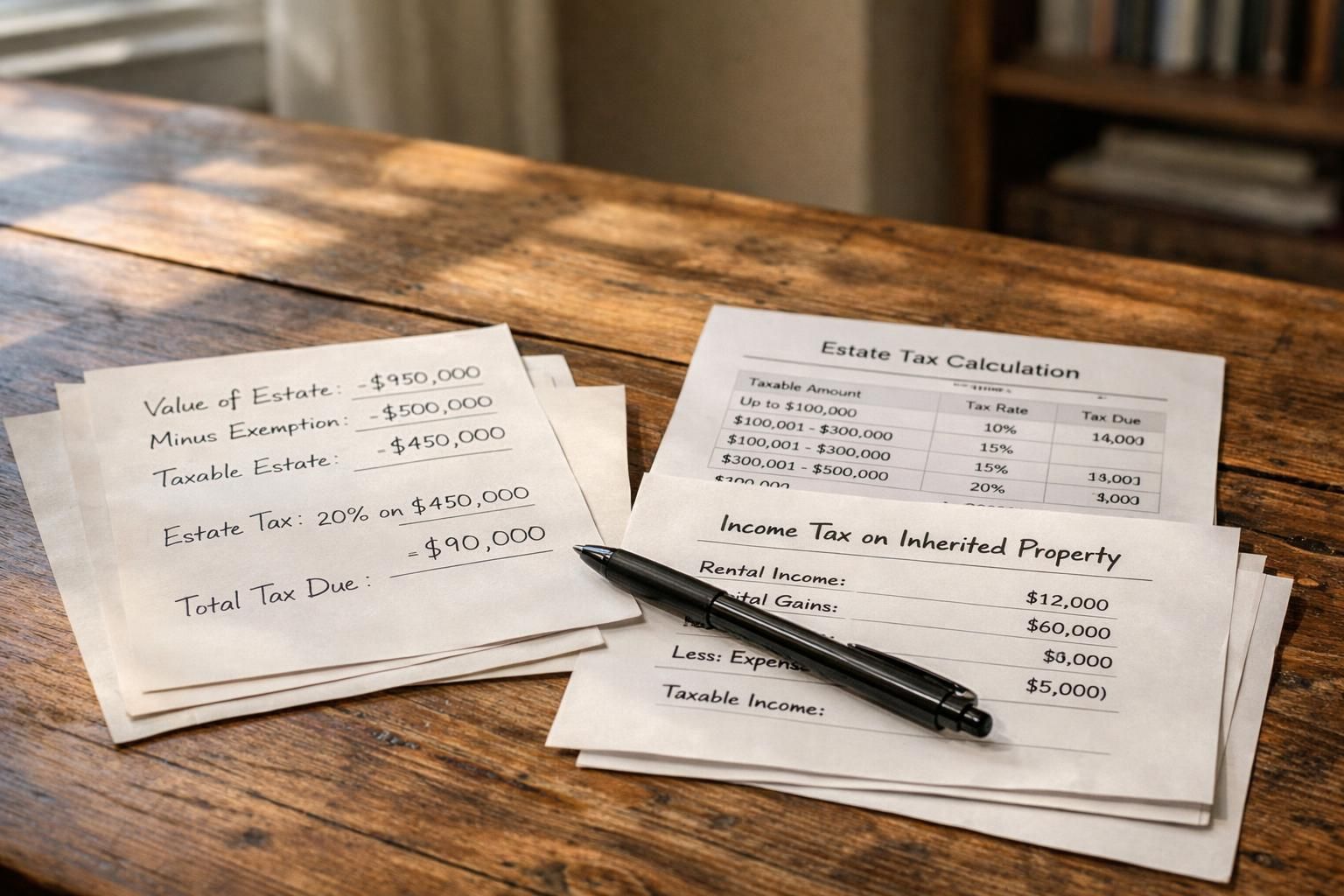
Federal estate tax exemption is $13.61 million in 2024.
Federal estate tax only applies if the total estate value exceeds $13.61 million per person in 2024 — or $27.22 million for married couples. Only about 0.1% of estates owe federal estate tax due to this high threshold. If an estate exceeds the limit, Form 706 must be filed and tax paid on the amount above the exemption before heirs receive their share.
Tennessee has no state estate or inheritance tax.
Tennessee is one of the more favorable states for heirs. Tennessee's inheritance tax was fully repealed effective January 1, 2016, and the state estate tax was also eliminated. This means Tennessee heirs face no state-level estate or inheritance tax — only potential federal estate tax on very large estates. Estates may still need to file federal returns and possibly IRS Form 8971 with Schedule A to report the basis of inherited assets if the estate was large enough to require Form 706. Consult a Tennessee estate attorney or CPA to confirm filing obligations for the specific estate.
Tennessee-Specific Tax Considerations

No state inheritance tax or state capital gains tax in Tennessee.
Tennessee does not tax capital gains on the sale of real estate as part of state income tax — Tennessee eliminated its broad income tax on investment income (the Hall Income Tax) effective January 1, 2021. Combined with no inheritance tax and no state estate tax, Tennessee heirs are in a significantly better position than heirs in states like Maryland, Pennsylvania, or California. Your primary tax exposure when selling an inherited Tennessee home is federal capital gains tax.
Tennessee real estate transfer tax.
Tennessee does impose a real estate transfer tax when property is conveyed. The state transfer tax is generally $0.37 per $100 of the purchase price (with a small additional county portion in most counties, bringing it closer to $0.37–$0.50 per $100 depending on the county). For a $300,000 sale, the transfer tax is typically in the range of $1,100–$1,500. This is a relatively modest cost but should be factored into your net proceeds when calculating your taxable gain. Transfer tax is usually paid at closing and deducted as a selling expense. Check with your closing attorney or title company in Memphis, Nashville, Chattanooga, or wherever the property is located for the exact local rate.
Tennessee property taxes and the assessment process.
While the estate is being settled, property taxes continue to accrue. Tennessee property is assessed by county assessors of property, and taxes are collected by county trustees. If property taxes are delinquent at the time of sale, they must be paid from sale proceeds at closing. Property taxes paid after you inherit the home may be deductible on your federal return — keep payment records to support this deduction.
Multiple Heirs and Tax Implications
If you inherit a Tennessee property with siblings or other family members, each heir typically receives their own stepped-up basis for their share. Tennessee probate courts — at the county chancery or circuit court level — oversee estate administration when disputes arise or when formal probate is required.
Each heir receives their own stepped-up basis.
Each heir gets a stepped-up basis proportional to their inherited share. With three siblings, each receives one-third of the fair market value at date of death as their cost basis. The IRS requires this to be reported using Schedule A to Form 8971. Each heir reports their own portion of capital gains on their individual federal return using Schedule D (Form 1040) and Form 8949.
How to handle splitting proceeds and tax obligations.
Proceeds must be divided by ownership percentage. For example, if three siblings sell a Chattanooga home for $310,000 with a $300,000 stepped-up basis, each reports one-third of the $10,000 gain — about $3,333 each. Deduct selling expenses like agent commissions, title fees, and closing costs from gross proceeds before calculating taxable income. Keep all documentation organized. Disputes among heirs can delay tax filings and, in Tennessee, may require mediation or court involvement through the probate court in the county where the property is located.
Deductions You Can Claim
You can reduce your taxable gain by deducting legitimate selling costs and post-inheritance improvements. These strategies help Tennessee heirs keep more of their proceeds.
Selling costs, improvements made after inheriting, and property taxes paid.
Deductible selling costs include real estate commissions, title insurance, escrow and attorney fees, the Tennessee transfer tax, recording fees, required repairs for buyers, and appraisal costs. Keep receipts or invoices for every expense.
Capital improvements made after inheriting — such as a new roof, HVAC replacement, or kitchen renovation — increase your cost basis and reduce your taxable gain. 2 Routine maintenance and repairs do not qualify. Property taxes paid after inheritance may also be deductible on your federal return. Always save proof of payments for tax season.
Timing Considerations
The tax year in which you close the sale determines when you report capital gains. If you close in December 2024, you report the gain on your 2024 federal return due in April 2025. If your gain is large, estimated quarterly tax payments may be required to avoid IRS penalties. A Tennessee CPA or estate planning attorney can help you project your liability and meet all deadlines.
Special Situations
Inherited rental properties and depreciation recapture.
If you inherit a rental property in Tennessee, you receive a new stepped-up basis and begin a fresh depreciation schedule from that value. Any depreciation you claim after inheritance is subject to depreciation recapture tax — taxed at up to 25% under IRS Section 1250 rules — when you eventually sell. Keep detailed records of your new basis and all post-inheritance depreciation. IRS Publication 527 covers these rules in full.
Selling below the stepped-up basis (capital loss treatment).
If you sell an inherited Tennessee property for less than its stepped-up basis, you may have a deductible capital loss — but only if the property was used for investment or business purposes, not as a personal residence. You can deduct up to $3,000 per year in capital losses against ordinary income, with any excess carried forward. File these details on Schedule D (Form 1040) and maintain documentation of the FMV at the date of inheritance and the final sale price.
Exploring Options for Selling Your Inherited Tennessee Home
Before selling, consider your options. Listing with a licensed Tennessee real estate agent works well if the home is in good condition and you want full market value. If the property needs significant repairs, if heirs disagree, or if settling estate debts quickly is a priority, a cash buyer can close much faster — sometimes in a matter of days — without the delays of traditional listing, inspections, or financing contingencies.
Some heirs also explore donating the property to a charitable organization for potential tax advantages, or renting it temporarily while the estate is settled. Whatever path you choose, discuss proceeds and tax liability early among all heirs, and work with a qualified Tennessee estate planning attorney or CPA to minimize your overall taxable gain and avoid surprises.
Conclusion
Tennessee heirs have meaningful advantages: no state inheritance tax, no state estate tax, and no state capital gains tax on real estate. Your primary exposure is federal capital gains tax on gains above the stepped-up basis, plus the relatively modest Tennessee transfer tax at closing. With good documentation, professional advice, and the right selling strategy, most heirs can manage this process without an overwhelming tax burden.
Key action items: get a professional appraisal, keep receipts, consult a Tennessee tax professional, and explore cash buyers if traditional selling is too complicated.
Start with a professional appraisal to establish your stepped-up basis at the date of death. Keep every receipt for repairs, improvements, and selling expenses — these records protect you if the IRS reviews your reported gain. Consult a Tennessee CPA or estate planning attorney before making decisions, especially in multi-heir situations. If the standard sale process is too stressful or the property needs work, explore cash buyers who can purchase inherited Tennessee properties quickly and as-is, helping you close the estate and move forward.
FAQs
1. Does Tennessee have an inheritance tax?
No. Tennessee fully repealed its inheritance tax effective January 1, 2016, and eliminated its state estate tax as well. Tennessee heirs owe no state inheritance or estate tax, though federal estate tax may apply to very large estates exceeding $13.61 million in 2024.
2. Will I owe capital gains tax when selling an inherited house in Tennessee?
You may owe federal capital gains tax on any gain above the stepped-up basis. Tennessee does not impose a separate state capital gains tax on real estate sales, so your exposure is at the federal level only — at rates of 0%, 15%, or 20% depending on your income.
3. What is the stepped-up basis and how does it help me?
The stepped-up basis resets your cost basis to the property's fair market value at the owner's date of death. This eliminates tax on all appreciation that occurred before you inherited the property, often dramatically reducing what you owe when you sell.
4. Are there any Tennessee-specific taxes I should know about when selling?
Tennessee imposes a real estate transfer tax at closing — generally around $0.37 per $100 of sale price at the state level, plus a small county portion. This is typically a few hundred to a couple thousand dollars depending on the sale price and county, and is deductible as a selling expense.
5. What if multiple heirs inherit a Tennessee property?
Each heir receives a stepped-up basis proportional to their share and reports their portion of any capital gain individually. Disputes among heirs may involve Tennessee probate court. A Tennessee estate attorney can help coordinate the sale and ensure proceeds and tax obligations are divided correctly.
6. Should I consult a professional before selling?
Yes. A Tennessee estate planning attorney or CPA can confirm your stepped-up basis, identify all deductible expenses, and help you plan the timing of the sale to minimize your federal tax liability. This is especially important when multiple heirs are involved or the estate is complex.
References
- ^ https://www.wsj.com/buyside/personal-finance/financial-advisors/selling-inherited-property
- ^ https://ttlc.intuit.com/community/investments-and-rental-properties/discussion/improvements-made-to-an-inherited-property-prior-to-selling-it-can-i-deduct-these/00/2862767
If you've inherited a home in Tennessee and want to sell it quickly without the stress of repairs, showings, or a lengthy closing process, KDS Homebuyers can help. Visit kdshomebuyers.net to request a free, no-obligation cash offer and get clear answers about your next steps.
