

How to Price Your Home Using Comps: A Seller's Guide

Table of Contents
- What Are Real Estate Comps and Why They Matter
- Key Factors Used When Selecting Comparable Properties
- Step-by-Step Guide to Finding Accurate Comps
- Making Adjustments to Comps Like a Professional
- Using Comps for Sellers vs. Buyers
- The Comparative Market Analysis (CMA) Process
- Common Pricing Mistakes to Avoid
- When to Hire a Professional Appraiser
- Expert Tips for Finding the Most Accurate Comps
- Conclusion: Getting Your Price Right From Day One
- Frequently Asked Questions
Getting your home's price right from the start? That's probably the biggest lever you have as a seller. Price it too high and the listing languishes on the market while potential buyers scroll past. Go too low and you're practically handing money back to the buyer. So how do you nail it? The answer is learning how to price your home right by using house comps — the same data-driven method that professional agents and certified appraisers use to set accurate prices every single day. This guide walks you through how comps actually work, where to dig them up, how to adjust for the differences between homes, and which mistakes to sidestep so you don't leave cash on the table like so many sellers do.

What Are Real Estate Comps and Why They Matter
Definition of Comparable Properties
In real estate, "comps" is shorthand for comparable sales. These are homes that recently sold and look a lot like yours — same neighborhood, similar square footage, built around the same time, in comparable condition. Here's the simple truth: if a house nearly identical to yours sold for $375,000 three months ago two blocks over, that tells you exactly what buyers are paying right now.
And comps aren't guesses or estimates. They're actual closed transactions pulled straight from public records and the Multiple Listing Service (MLS). That's real data. No speculation.
Who Uses Real Estate Comps — and Why
Everyone in the market relies on comps. Listing agents use them to help you figure out what price actually makes sense. Buyer's agents check them before their clients make an offer. Licensed appraisers depend on them for the formal valuations that mortgage lenders require. You might even pull them yourself online these days to get a sense of your home's value before you talk to anyone.
But here's what matters most if you're selling: comps directly impact your wallet. Get the price right — supported by solid comparable sales — and serious buyers show up fast. You'll spend fewer days on the market and have real leverage when negotiating. Miss it, and you're leaving money on the table or watching your home sit.
Local markets vary wildly. Check our Seller's Pricing Guide for California, our Seller's Pricing Guide for Florida, or our Seller's Pricing Guide for Colorado for what's actually happening in your area.
Back to topKey Factors Used When Selecting Comparable Properties
Just because a house sold recently in your zip code doesn't mean it's a valid comp for yours. You need to filter through several overlapping criteria to find the right ones. Here's a checklist to verify before you include any property in your analysis.

| Selection Criteria | Recommended Standard | Why It Matters |
|---|---|---|
| Distance from subject property | Within 0.5–1 mile (urban/suburban); up to 5 miles (rural) | Neighborhood character, school district, and micro-market conditions vary block by block |
| Sale recency | Sold within the last 90 days; extend to 6 months only if inventory is low | Older sales may not reflect current market conditions or interest rate shifts |
| Square footage | Within 10–15% of subject property's gross living area | Price-per-square-foot varies significantly at different size thresholds |
| Bedroom/bathroom count | Same or ±1 bedroom/bathroom | Buyers search by bed/bath count; mismatched comps skew buyer pool assumptions |
| Property type | Same type (single-family, condo, townhome) | Different property types have fundamentally different buyer pools and pricing dynamics |
| Lot size | Within 20–25% for suburban/rural properties | Outdoor space significantly impacts perceived value, especially for families |
| Age of construction | Built within 10–15 years of subject property | Older homes may have different systems, finishes, and deferred maintenance profiles |
| Condition | Similar overall condition (move-in ready vs. fixer) | Condition gaps require monetary adjustments; extreme gaps make comparisons unreliable |
Here's the thing most people miss: how recent your comps actually are. Imagine mortgage rates jump 75 basis points over six months. A sale from eight months back? It's potentially way off base for what your home's worth today. You've got to hunt down the freshest data available. And when you list each comp, note what the rate environment looked like when it sold.
Back to topStep-by-Step Guide to Finding Accurate Comps
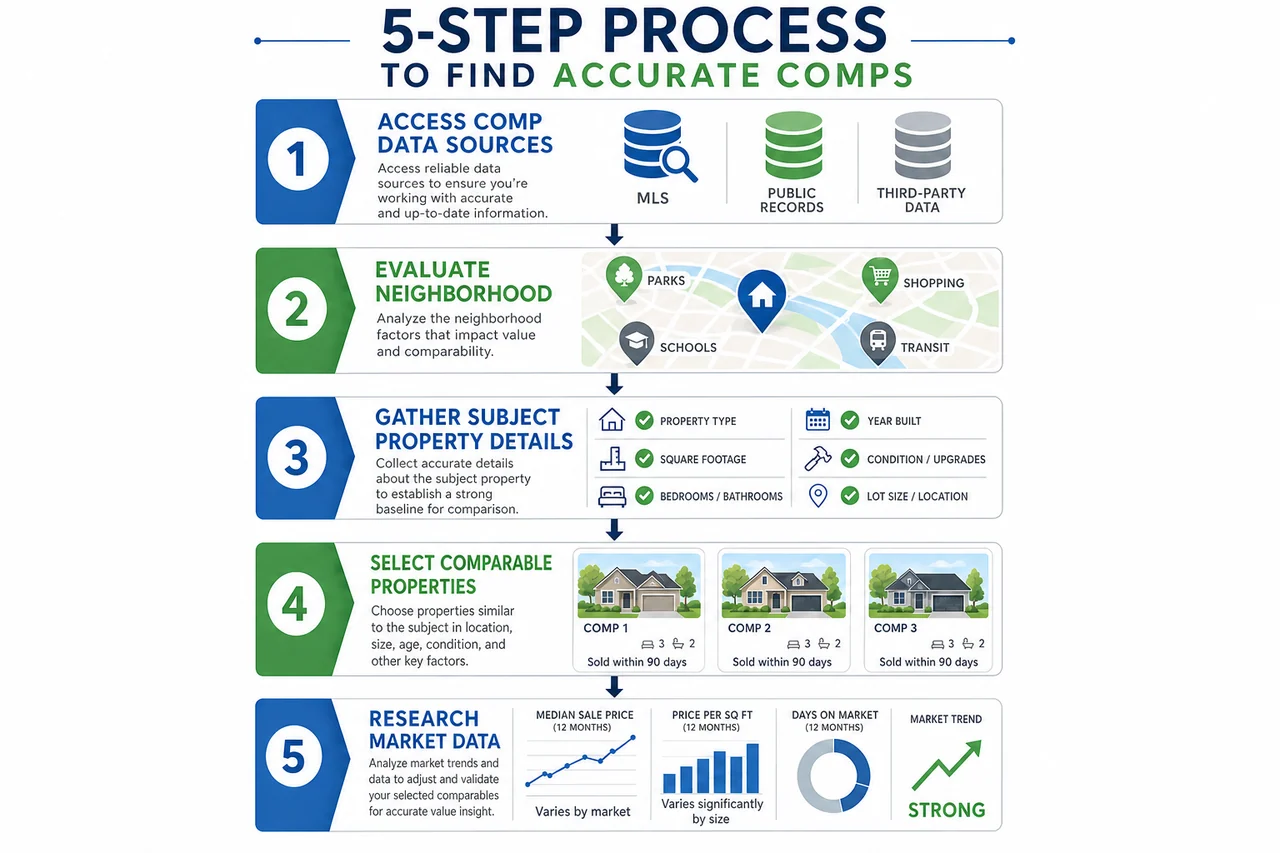
Where to Access Comp Data
Start with the Multiple Listing Service (MLS) — it's got the most complete and verified transaction data out there. Got a licensed agent? They'll pull a full comp report for you in minutes. If you're flying solo, here are some solid public options that'll get you partway there:
- Zillow — Shows sold homes and its "Zestimate," but those automated estimates can swing 5–10% or more when your market doesn't have much data
- Redfin — Most people consider this the most accurate free tool; it pulls straight from MLS data in most areas
- Realtor.com — Good for double-checking your numbers; accuracy depends on where you live
- County assessor's website — Public records showing sale prices, square footage, and lot size; this is your verification weapon
- PropStream or CoreLogic — These are what investors and appraisers actually use; you'll pay a subscription, but you're getting professional-grade accuracy
How to Pull Reliable Comps: A Practical Sequence
- Document your subject property thoroughly. You need exact square footage (gross living area only—don't count the garage or unfinished basement), bedroom and bathroom count, lot size, year built, garage spaces, and anything that makes it special or different.
- Set your search radius. In suburban areas, start with 0.5 miles. Only expand it if you're not finding at least 3 qualifying sales within the past 90 days.
- Filter by recency. Ninety days is your baseline. If your market's sluggish, you can stretch to 6 months, but understand those older sales need a market condition adjustment.
- Apply property filters. Match the property type, bedroom count (within one bedroom either way), and square footage (give or take 15%).
- Aim for 3–6 solid comps. Research consistently shows that 3 to 6 well-matched comparables produce reliable value ranges. Less than 3? You're dealing with noise. More than 8? You're probably including properties that don't really belong in your analysis.
- Verify data against county records. Compare your MLS findings with public records and catch those data entry mistakes, especially square footage errors that can throw everything off.
Making Adjustments to Comps Like a Professional
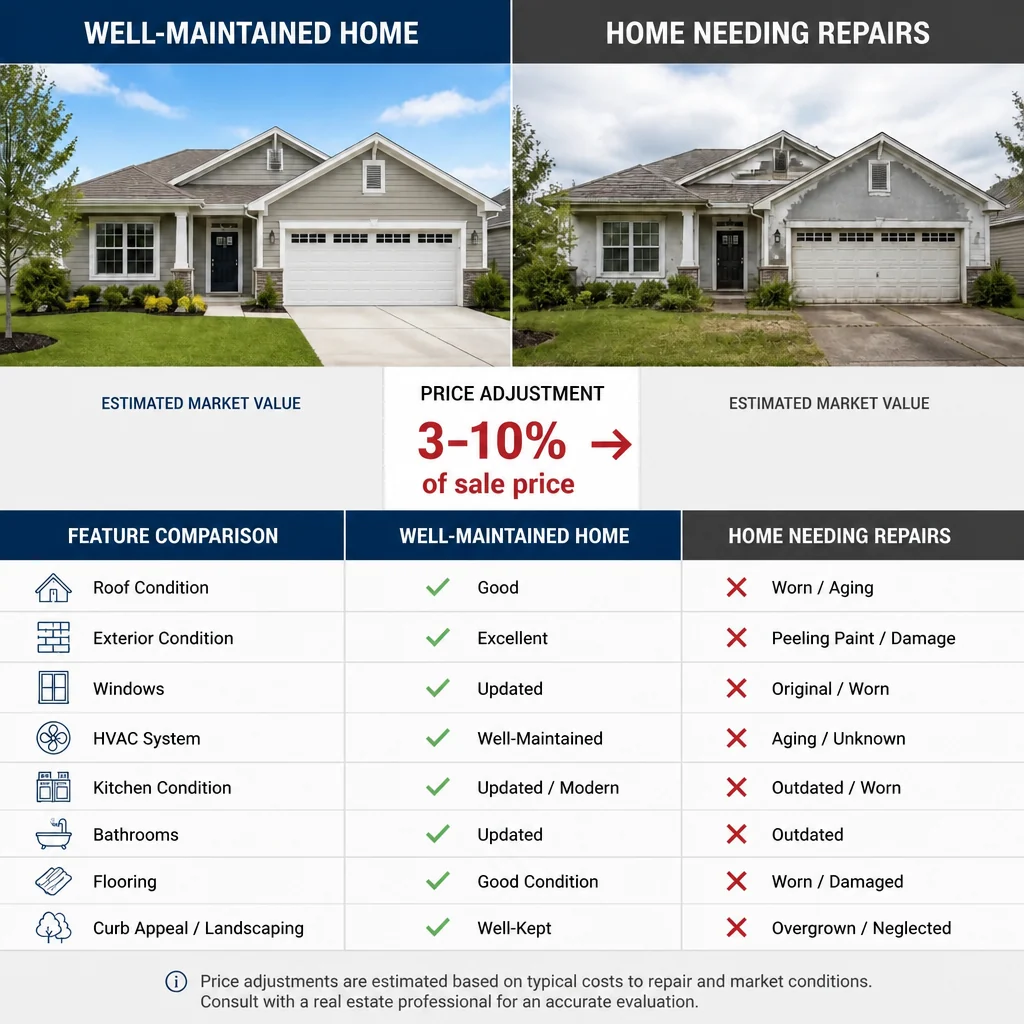
You're not going to stumble across a comp that's identical to your property. That's the reality. So professional appraisers and experienced agents make monetary adjustments to account for differences between comparable sales and your home. Here's the core principle: if a comp has something your home doesn't, you subtract value. If your home has something the comp doesn't, you add value. Simple as that.
| Adjustment Category | Typical Adjustment Range | Notes |
|---|---|---|
| Square footage (per sq ft) | $50–$200 per sq ft depending on market | Calculate local price-per-sq-ft from comps; apply to size difference |
| Additional bedroom | $5,000–$25,000 | Higher in tight urban markets; lower in rural areas |
| Additional full bathroom | $8,000–$20,000 | Half-bath adjustments typically 50–60% of full bath value |
| Garage (per space) | $5,000–$15,000 | Attached vs. detached matters; climate affects value |
| Condition (updated vs. dated) | 3–10% of sale price | Document specific updates (kitchen remodel, HVAC replacement, roof age) |
| Pool | $10,000–$40,000 | Varies widely by climate; pools add less value in northern markets |
| Lot size premium | $1–$5 per sq ft of lot | Highly location-dependent; verify with local comps |
| View or location premium | 2–10% of sale price | Waterfront, golf course, or mountain views command significant premiums |
| Market condition (time adjustment) | 0.5–2% per month in appreciating markets | Apply when comp is older than 60 days in a fast-moving market |
Here's a critical rule that appraisers follow religiously: don't let any single adjustment exceed 10% of the comp's sale price, and keep your total adjustments under 25% across the board. And if you're pushing past that 25% threshold? Your comp probably isn't comparable enough to trust.
Back to topUsing Comps for Sellers vs. Buyers
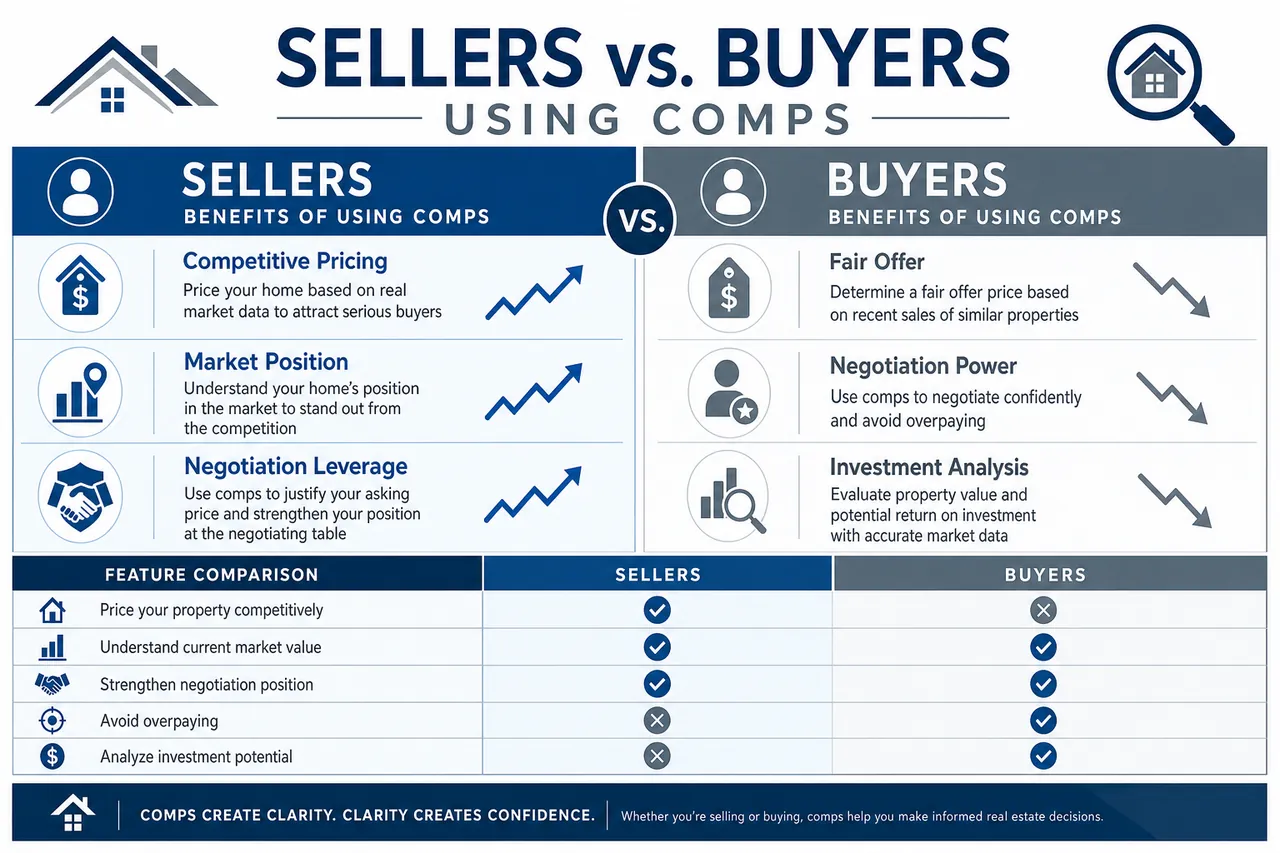
How Sellers Should Use Comps
Here's what matters: price competitively. Not too high, not too low. Pull your adjusted comp values and find the range — let's say $340,000 to $365,000. Now position your home within that range based on condition and features.
Is your place updated and move-in ready? Price near the top. Does it need work or have outdated systems? The middle or lower portion of that range will pull in more buyers and get you offers faster.
And don't skip this step: think about how your home looks before listing. Our home staging tips matter more than you'd think. Buyers use condition as one of their biggest adjustment factors when comparing homes.
How Buyers Use Comps
Buyers use comps as a shield. They're trying not to overpay.
Smart buyers pull the same comps the listing agent used and cross-check the asking price. If comps say $355,000 but the listing's at $389,000, that's a 9.6% premium. The bank's appraiser will catch that gap — and it creates real problems for everyone involved. But here's the flip side: buyers also spot underpriced listings this way and can move fast on genuine deals.
Market Timing and Positioning
Don't rely only on old comps. In a seller's market, where inventory's tight and demand is hot, those 90-day-old comps are already behind. Prices are climbing and buyers are competing with each other.
Switch gears in a buyer's market. Too much inventory, not enough buyers — and recent comps might show prices dropping. List at the top of your range here, and you could be sitting for months.
Check your local market indicators alongside comp data. Look at months of supply, days on market, and list-to-sale ratios. You'll get the complete picture. State-specific guidance is available in our Indiana seller's pricing guide, Tennessee seller's pricing guide, and Washington state seller's pricing guide.
Back to topThe Comparative Market Analysis (CMA) Process
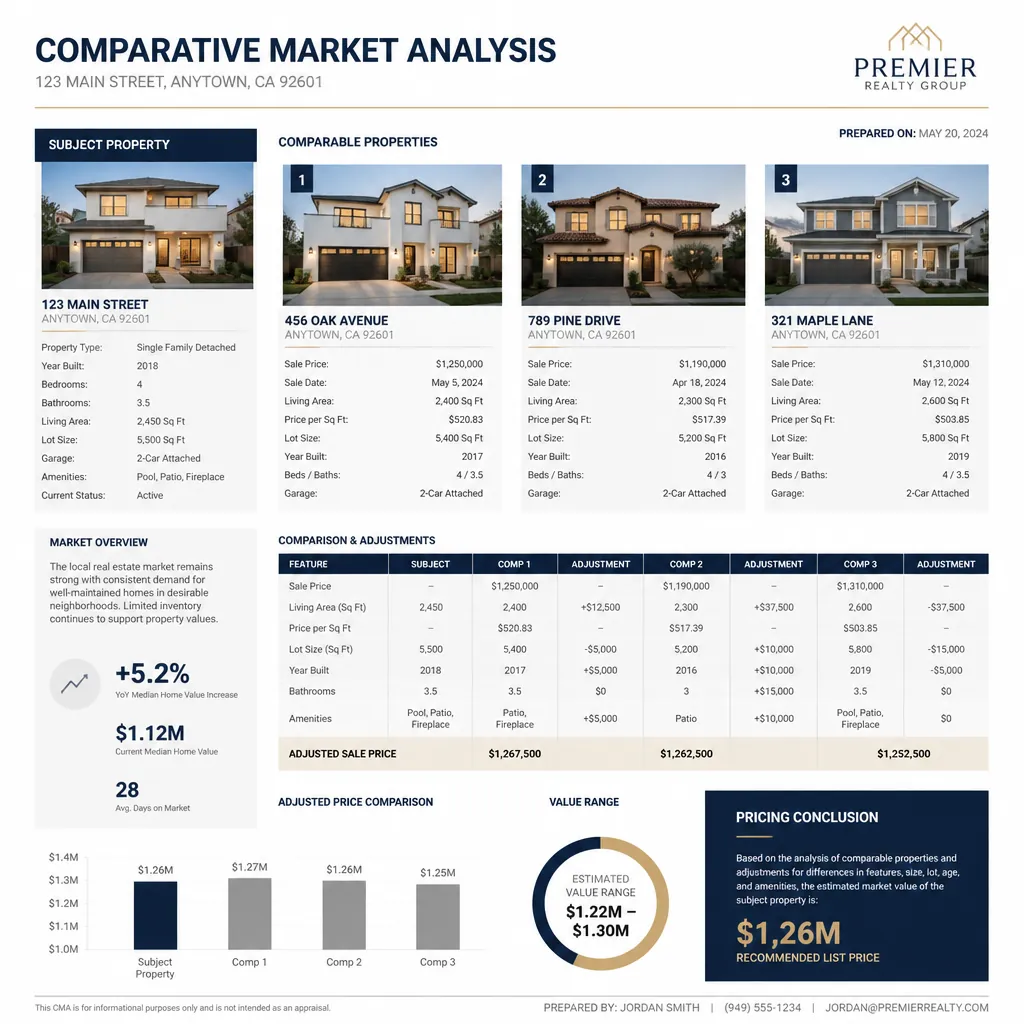
Your listing agent will prepare a Comparative Market Analysis (CMA) — it's the document that shows you what your home's actually worth. You'll see active listings (what's competing with yours right now), pending sales (the market's current pulse), and sold comps (the real proof of value). Want to know if your agent's giving you solid advice? Understanding how a CMA works is your best defense.
For sellers who want a CMA paired with additional options from the start, working through KDS's vetted agent network gives access to a full set of seller programs — including renovation funding, a leaseback option, and a cash-purchase backstop — all in a single initial conversation.
CMA vs. Appraisal: Key Differences
Here's the thing: a CMA from your real estate agent isn't legally binding. It's a recommendation. An appraisal is completely different. A state-certified appraiser follows strict USPAP (Uniform Standards of Professional Appraisal Practice) rules and delivers a defensible market value that mortgage lenders actually trust. CMAs take days and cost you nothing. Appraisals run $300–$700 but they carry real legal and financial weight.
Want the full picture on pricing? Check out our Seller's Pricing Guide.
Building a Strong CMA
- Gather 3–6 sold comps within 90 days and 1 mile
- Note 2–4 active listings as competitive context
- Make documented adjustments for each difference
- Calculate an adjusted value for each comp
- Average or weight the adjusted values to derive a price range
- Recommend a listing price based on seller goals (speed vs. maximum return)
Common Pricing Mistakes to Avoid
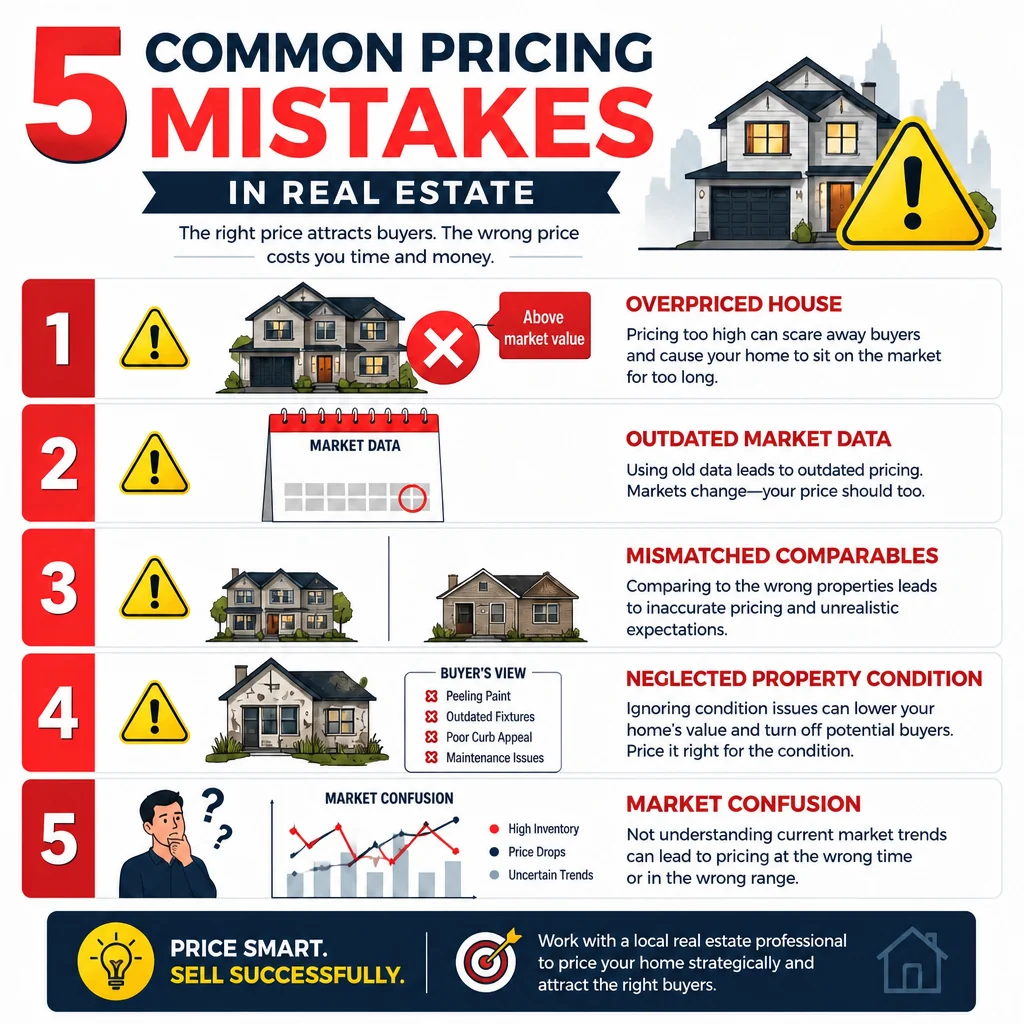
You probably know that comp data exists. The problem? Most sellers still get the pricing wrong anyway, and it costs them thousands. Let's look at the mistakes that hurt you the most:
- Overpricing based on emotional value. What you paid for the house doesn't matter. Neither does that $40,000 kitchen renovation or what you need to walk away with. Buyers only care about what comparable homes sold for — that's it.
- Using active listings as comps. Here's the thing: active listings are just asking prices. They're what sellers *hope* to get, not what people actually pay. Only closed sales tell you the real story.
- Using stale comps without time adjustments. A home that sold nine months ago? That's probably useless in a shifting market. You need fresher data or a market condition adjustment to account for how things have changed.
- Selecting comps from different neighborhoods. A highway, a school district line, or an HOA boundary can mean thousands of dollars in value difference. Don't assume two homes in the same town are comparable just because they're geographically close.
- Ignoring days on market data. Sold in 8 days? That's strong demand at that price. But 60+ days on the market? That's a red flag about whether buyers will actually pay what you're asking.
- Over-relying on automated valuation models (AVMs). Zillow's Zestimate is a starting point, sure. But tools like these can't see your recent upgrades, the actual condition of your roof, or neighborhood quirks that matter to local buyers. Always double-check with real comparable sales data.
And here's what Zillow's research shows: homes priced more than 10% above market value take 3–4 times longer to sell than correctly priced homes. They often end up selling for even less because repeated price cuts make buyers suspicious. That's the opposite of what you want.
Back to topWhen to Hire a Professional Appraiser
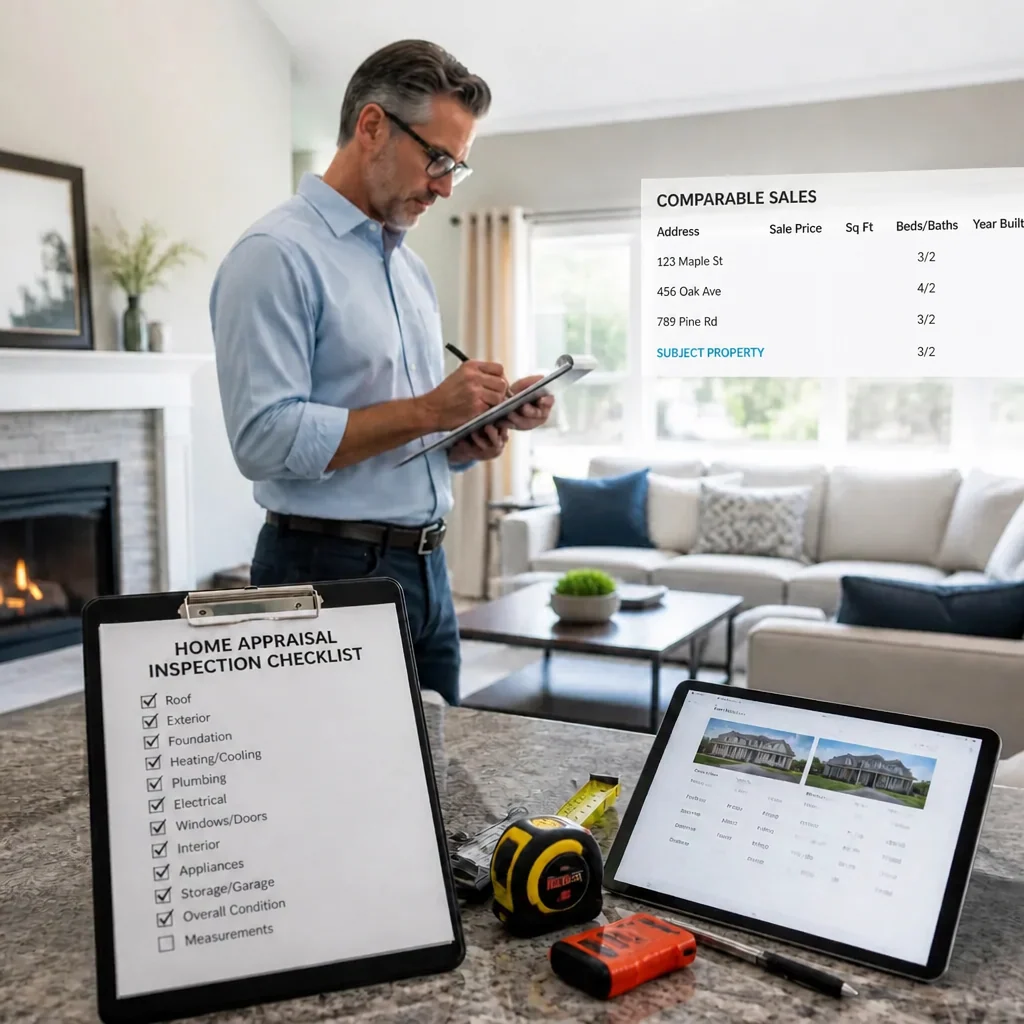
You can do a lot with DIY comp analysis. But it's got limits. A certified appraiser steps in to protect you from both underpricing your home and getting tangled up in costly disputes later on.
| Factor | DIY Comp Analysis | Professional Appraisal |
|---|---|---|
| Cost | Free to low-cost (online tools) | $300–$700 (complex properties up to $1,500+) |
| Time to complete | 1–3 hours | 3–7 business days |
| Data accuracy | Moderate; dependent on user skill | High; USPAP-compliant methodology |
| Legal standing | None | Accepted by lenders, courts, and estate attorneys |
| Best for | Initial pricing research, listing preparation | Estate sales, divorce, tax appeals, unique properties, pre-listing confidence |
| Handles unique properties? | Poorly — few valid comps available | Yes — appraisers use cost and income approaches when comps are scarce |
Here's when you really need a pro: your property is truly one-of-a-kind. Maybe it's a custom build on rural acreage with a historical designation. Or you're dealing with an estate sale or divorce settlement where you need documentation that'll hold up in court. And if comparable sales have been thin in your area, an appraiser can work around that problem using cost and income approaches that DIY tools just can't do.
A pre-listing appraisal sends a powerful signal to serious buyers: your price is backed by numbers. That confidence actually reduces negotiation friction down the road.
Back to topExpert Tips for Finding the Most Accurate Comps
Want to sharpen your comp analysis beyond the basics? Here's what experienced agents and appraisers actually do.
Cross-Reference Multiple Data Sources
Start with your county assessor's office. Then cross-check with Redfin or the MLS. Verify square footage against public records. You'd be surprised how often data entry errors slip through — a misrecorded bedroom count or inflated square footage can throw off your entire analysis without you even knowing it.
Account for Seasonal Patterns
Real estate markets aren't flat year-round. Homes sold in peak spring and summer months typically command 3–5% more than identical homes sold in winter. It's a real pattern, not a coincidence. If your comp sold in November and you're listing in April, a modest upward seasonal adjustment might make sense. And if you're selling in a slow season? Don't price like it's spring fever time.
Watch the List-to-Sale Price Ratio
This single metric tells you everything about your local market's temperature. Is it above 100%? Buyers are bidding up — your comp-derived value might actually be a floor, not a ceiling. Below 97%? Buyers have options and they know it. Expect to negotiate.
Consider How Technology Is Changing Comp Analysis
AI-powered tools are getting sharper. Redfin's Estimate and newer CoreLogic platforms use machine learning to factor in market trends, property condition signals from listing photos, and neighborhood-level micro-data. They can't replace human judgment for complex or unusual properties. But they're increasingly useful as a sanity check. Use them as a second opinion — not your primary source.
Understand Price Per Square Foot — and Its Limits
Price per square foot (PPSF) is a quick, handy metric. But it gets misused constantly. Here's why: PPSF isn't linear. Smaller homes typically have a higher PPSF than larger homes in the same neighborhood because fixed costs (lot, kitchen, bathrooms) get spread over fewer square feet. Always compare PPSF within a narrow size band. Otherwise you're comparing apples to something that isn't even fruit.
Back to topConclusion: Getting Your Price Right From Day One
Here's the thing: knowing how to price your home using house comps might be the single most valuable skill you develop as a seller. You're not hunting for some magic number. Instead, you're building a defensible price range that's grounded in actual transaction data, making honest adjustments for what makes your home different, and then positioning your listing strategically based on your own timeline and goals.
Here's what this looks like in practice:
- Select 3–6 truly comparable sold properties within 90 days and 1 mile
- Verify data accuracy through multiple sources including county records
- Make documented adjustments for size, condition, features, and market timing
- Identify your adjusted value range and position within it based on market conditions
- Review active listings as competitive context — not as comps
- Revisit your pricing every 2–3 weeks if your home isn't attracting offers
Your property is one-of-a-kind? Your market barely has recent sales to work with? The financial stakes feel enormous? That's when a professional appraisal becomes worth every penny. And if you need state-specific guidance, we've got detailed breakdowns for California, Florida, Colorado, Indiana, Tennessee, and Washington.
One last thing to lock in your head: a home priced right that sells in two weeks almost always nets you more money than an overpriced home that sits for two months and finally sells under pressure.
Back to topFrequently Asked Questions
How many comps do I need to price my home accurately?
You'll want 3 to 6 comparable sales for solid footing. Drop below 3 and one quirky outlier can throw off your entire price estimate. Go beyond 6 or 8 and you're probably stretching the definition of "comparable"—which just muddies the picture. In slower markets where recent sales are hard to find, expand your search radius or go back further in time. Just be clear about why you did it.
How recent do comps need to be?
Within 90 days is your target. That's what appraisers prefer when they're working for lenders, though technically they'll accept 6 months. But here's the catch: if your market is moving fast—prices climbing or falling week to week—even a 3-month-old comp needs a time adjustment to stay relevant. The older the comp, the shakier it gets as evidence.
Can I use a pending sale as a comp?
Pending sales are useful for seeing where things are heading. But don't let them replace actual closed sales in your analysis. Why? Because pending deals fall through. Inspections kill them. Appraisals come in low. The buyer and seller renegotiate and land on a totally different number. Stick with closed, verified transactions as your foundation.
What if there are no good comps near my home?
Rural properties, custom builds, and homes with weird features hit this problem all the time. You've got options. Expand your radius outward and adjust for location. Stretch your time window backward and adjust for market shifts. Pull in a similar property type as reference. Or—and this is the smartest move for truly unique homes—hire a certified appraiser who can blend the sales comparison approach with the cost approach or income approach. For anything unusual, professional appraisal beats DIY guessing.
Does Zillow's Zestimate count as a comp?
No. It's an automated valuation estimate built on algorithms, not actual market data. Sure, it's gotten better over the years, but it can miss by 5–10% or more—especially if your home's had recent upgrades, has distinctive features, or sits in a thin market. Use it as a rough ballpark number. Never use it as proof of your home's real value.
Back to top
