

How to Choose the Best Offer for Your House: Beyond Price

Table of Contents
- Understanding Your Priorities Before Evaluating Offers
- Key Components of a Strong Offer
- Market Conditions and Competitive Positioning
- Beyond Price: Non-Financial Offer Strengths
- Financial and Legal Considerations
- Comparing Multiple Offers Strategically
- Emotional Detachment and Rational Decision-Making
- Negotiation Strategies and Counteroffers
Receiving multiple offers on your home feels exciting. Then reality hits — picking the wrong one could cost you thousands of dollars, months of wasted time, or a deal that collapses right before closing. Here's what most sellers get wrong: they chase the highest number. But experienced real estate professionals will tell you that the highest offer is frequently not the best offer. What actually matters? A complex web of financial terms, contingency risks, buyer reliability signals, and personal priorities that go far beyond the purchase price. This guide walks you through every dimension of offer evaluation. You'll get a practical comparison framework. And you'll make the most rational, well-informed decision possible — even when emotions are running high.

Understanding Your Priorities Before Evaluating Offers
Most sellers wait for offers to arrive—then panic. Without knowing what you actually want, you'll make decisions based on gut feelings rather than strategy. And emotion almost always leads you wrong. Figure out your priorities before your home hits the market.
Define Your Must-Haves vs. Nice-to-Haves
Start by separating what you absolutely need from what would be nice. Is a specific closing date non-negotiable? Maybe you've already signed a lease elsewhere or your kids are mid-semester in school. Or maybe you can be flexible on timing if the price lands right. Write this down now—before you list.
Your must-haves might include:
- Minimum net proceeds after agent commissions, closing costs, and outstanding mortgage balance
- A closing date within a specific range
- No contingency for the buyer to sell their existing home
- A buyer with demonstrated financing approval (not just pre-qualification)
Nice-to-haves? A rent-back agreement that gives you extra time after closing. A buyer flexible about which personal property stays. When you separate these categories, you won't accidentally trade away something essential to get something you just kind of wanted.
Set Your Minimum Acceptable Price
Calculate your walk-away number with precision before a single offer shows up. Start with what you owe on your mortgage. Then subtract your agent's commission (typically 5–6% of sale price) and closing costs (usually 1–3% on your side). Factor in repair credits, moving expenses, and anything else that cuts into your proceeds. Now you have a concrete minimum net proceeds figure—and you'll know it's real.
Let's say your home lists at $350,000. You owe $180,000 on the mortgage. Your total selling costs run about $24,500 (7% of sale price). That means your minimum net proceeds before any profit is $204,500. Any offer that doesn't clear that number—after you account for concessions, credits, and all the fine print—gets rejected. Period. The headline price doesn't matter if the net result doesn't work for you.
Identify Timeline Flexibility
Closing timeline mismatches kill deals more often than you'd think. You need 45 days to close. The buyer wants 21 days. That structural conflict causes way more pain than the difference between two competing prices ever could. But flip it around: a buyer offering 90 days with a rent-back provision could save you thousands in temporary housing costs.
Document your ideal closing window, your acceptable range, and your hard limits right now. Tell your agent before you start reviewing offers so they can flag timeline conflicts the moment they appear.
Back to topKey Components of a Strong Offer
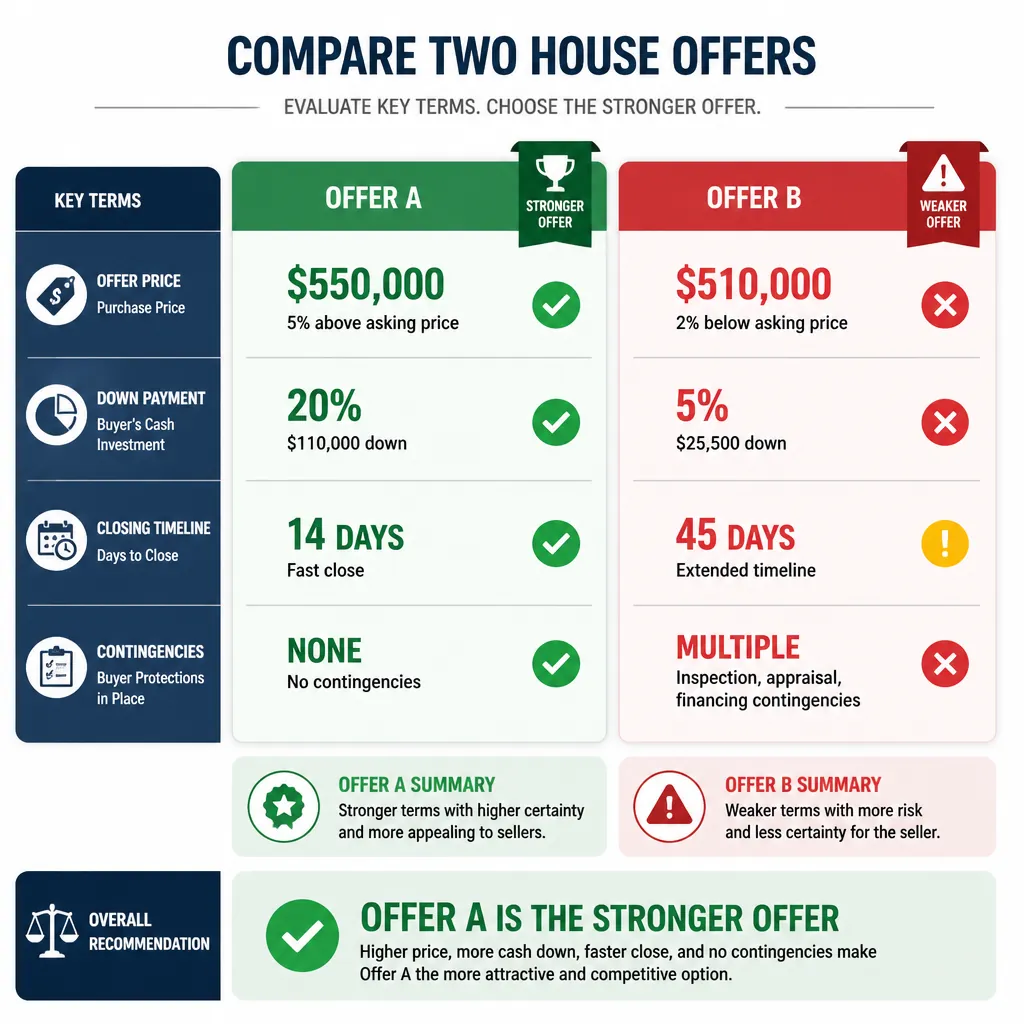
A purchase offer runs dozens of pages with dozens of terms. But here's what matters: only a handful of those components actually determine whether an offer is solid or shaky. Learning to spot what really counts is essential if you want to evaluate offers accurately.
Price and Financial Terms
The purchase price? That's just the starting line. Two offers at identical prices can be worth wildly different amounts of actual money to you. One buyer might request $12,000 in closing cost credits, a $5,000 repair allowance, and a home warranty. Another might ask for nothing. These differences add up fast.
You need to calculate your estimated net proceeds from each offer — not just look at the headline number. A $340,000 offer with no concessions will put more cash in your pocket than a $355,000 offer loaded with buyer requests. Do the math on every single offer.
Down Payment and Earnest Money
A buyer's down payment size tells you something crucial about their finances and whether their loan will actually close. If a buyer's putting 20% or more down, their financing is solid. A buyer with only 3.5% down on an FHA loan? That's riskier territory. Why? Because appraisals often come in lower than expected. A buyer with real equity cushion can cover the gap. A buyer with almost nothing down might walk away instead.
And earnest money deposit (EMD) matters just as much. Standard earnest money runs 1–3% of the purchase price in most markets. A buyer who puts down 5% or more? They're showing they're serious. A $500 EMD on a $400,000 home tells you something very different — that's not a credible commitment. Remember: earnest money is on the line if the buyer backs out without a valid contingency. Higher EMD means higher accountability.
Financing Type and Pre-Qualification Status
Cash is king. It's fast. It's certain. Conventional loans rank second. But government-backed loans (FHA, VA, USDA) come with extra appraisal layers and strict property standards that can derail sales, especially on older homes.
Don't assume pre-qualification means anything real. It's based on information the buyer told the lender — basically a rough estimate. Pre-approval is different. A lender actually verifies income, assets, credit, and employment. And a fully underwritten pre-approval (sometimes called a TBD)? Even better. Ask your agent to dig into the buyer's actual financial documentation before you take any offer seriously.
Contingencies and Their Impact
Contingencies are deal-killers waiting to happen. They're conditions the buyer needs satisfied before closing. Inspection contingencies. Appraisal contingencies. Financing contingencies. Sale-of-buyer's-home contingencies. Each one introduces risk and delays.
The rule is simple: fewer contingencies, shorter timelines, stronger offer. But don't confuse a strong offer with a reckless one. A buyer who waives every single contingency without serious cash backing? That's actually a warning sign, not confidence. You want contingencies written tight and specific, with short windows to resolve issues.
How aggressively you can push back on contingencies depends on what the market looks like right now.
Back to topMarket Conditions and Competitive Positioning
Here's something critical: the same offer that seems weak in a hot seller's market could actually be solid in a slow buyer's market. Your local context matters far more than you'd think. Before you evaluate any offer, you need to understand what's actually happening in your neighborhood right now.
Analyze Current Market Dynamics
When inventory drops below 3 months of supply relative to buyer demand, you're in a seller's market. And that changes everything. You can push back on price, demand waived contingencies, and expect earnest money deposits of 3–5% or higher. Flip to a buyer's market — that's 6+ months of inventory — and the tables turn completely. Now contingency waivers are rare. Demanding them might just scare off your only reasonable buyer.
Your agent can pull the exact months of supply for your neighborhood, along with average days on market for comps and the list-to-sale price ratio. These local numbers beat national statistics every time, since they show what's actually happening where you live.
Assess Competition from Other Offers
Multiple offers? You're in a strong position. But if you've had minimal showings and just one offer after a month on market, that's a different story — and you need to be honest about it. Don't fall into the trap of using weak competition to justify holding out for terms that simply won't materialize, especially if buyer activity is dropping rather than heating up.
Evaluate Days on Market and Listing History
Each day your home sits without an accepted offer chips away at your leverage.
Buyers and agents watch days on market closely. Properties that linger are assumed to have problems — even if the real culprit was just bad timing. After 30 days without an accepted offer in a normal market, you should seriously reconsider your expectations about how strong an offer you'll get.
And if you've already dropped the price once, that history is public. Buyers see it, and they'll come in harder with lowball offers. Knowing where you stand with listing freshness helps you understand how firm you can actually be on offer terms.
| Market Condition | Inventory Level | Days on Market (Avg) | Contingency Expectations | Earnest Money Standard | Price Negotiation Power |
|---|---|---|---|---|---|
| Strong Seller's Market | <2 months supply | <14 days | Often waived or limited | 3–5%+ | Very High — expect over-ask offers |
| Mild Seller's Market | 2–3 months supply | 14–30 days | Inspection typically remains | 2–3% | High — at or near ask price |
| Balanced Market | 3–6 months supply | 30–60 days | Standard contingencies expected | 1–2% | Moderate — some concessions likely |
| Buyer's Market | 6+ months supply | 60–90+ days | Full contingencies are standard | 1% or less | Low — price reductions likely needed |
Beyond Price: Non-Financial Offer Strengths
Here's what most sellers don't realize until they've lived through a failed deal: the strongest offers rarely hinge on price alone. In fact, experienced sellers — the ones who've watched deals collapse or dragged on forever — often tell you that non-financial factors mattered far more than they expected.
Closing Timeline and Flexibility
Your closing date can be worth serious money. Picture this: you've already bought your next home, and closing happens in 45 days. A buyer offering to close in 30 days? That forces you into a hotel or short-term rental for two weeks — roughly $2,000–$5,000 out of pocket. But an offer closing in 60 days might align perfectly with your timeline. That's real savings. Don't overlook it.
And then there's the rent-back agreement. This is where the seller stays in the home as a paying tenant after closing. Say a buyer offers $5,000 less but throws in a 30-day rent-back at reasonable rates. Run the numbers. Depending on what you'd otherwise pay for temporary housing, you might come out ahead.
Seller Accommodations and Contingency Waiving
When a buyer waives the inspection contingency, they're accepting real risk — and giving you something valuable in return. It kills the chance of post-inspection renegotiations or a deal falling apart. In competitive markets, everyone expects this. In a balanced market? It's a major boost to your offer.
An appraisal contingency waiver goes even further. Some buyers include an appraisal gap guarantee — meaning they'll cover the difference between the appraised value and purchase price out of their own pocket, up to a certain amount. That removes your biggest worry: the deal collapsing because the home didn't appraise.

This matters especially if you're selling something unconventional or hard to value — like an inherited house in bad condition. Traditional appraisals often come in lower than you'd hoped in those situations.
Buyer Profile and Reliability
Owner-occupants and investors operate in totally different worlds. The owner-occupant is emotionally attached to your home — it's where they're going to live. They'll fight to make that deal close. Investors, meanwhile? They bring cash and speed, sure, but they're also more likely to walk if the post-inspection numbers don't work. Neither type is automatically "better," but knowing who's buying tells you something crucial about your deal's risk.
Local buyers have already chosen your area. Out-of-state buyers? They might still be shopping between markets. Ask your agent whether the buyer actually walked through the home or just looked at virtual tours. In-person visits almost always signal serious intent.
Back to topFinancial and Legal Considerations
Hidden beneath every offer is a layer of financial and legal detail. Miss this stuff, and the deal can collapse—or worse, cost you money.
Financing Stability Assessment
Not all pre-approvals are created equal. A buyer's financing strength falls along a spectrum. Pre-qualification based on what the buyer tells the lender? That's the weakest. Then comes a basic lender letter with a credit check. Standard pre-approval means the lender actually verified income and assets. And fully underwritten? The lender's already dug through all the paperwork.
Here's what you need to do: ask your agent for the actual pre-approval letter and call the lender directly. Don't email. Don't rely on the buyer's word. Confirm the approval is real and ask about the buyer's current application status.
And don't sleep on the lender's reputation. A buyer working with a reputable local lender your agent knows? Much safer bet. Compare that to an online discount lender in another state—hard to reach, slow closings, known for delays. That's a red flag masquerading as a good deal.
| Financing Type | Reliability Score | Typical Close Time | Appraisal Requirements | Property Condition Requirements | Best For Sellers When... |
|---|---|---|---|---|---|
| All Cash | ★★★★★ | 14–21 days | None required | Minimal | Speed and certainty are top priorities |
| Conventional (20%+ down) | ★★★★☆ | 30–45 days | Standard | Standard | Home is in good condition, normal sale |
| Conventional (5–19% down) | ★★★☆☆ | 30–45 days | Standard + PMI | Standard | Seller's market with strong buyer credentials |
| VA Loan | ★★★☆☆ | 40–50 days | VA appraisal (strict) | Property must meet MPR standards | Home is move-in ready, seller supports veterans |
| FHA Loan | ★★☆☆☆ | 45–60 days | FHA appraisal (strict) | High — health & safety requirements | Home is updated; limited other offers |
| USDA Loan | ★★☆☆☆ | 50–60+ days | USDA appraisal (strict) | High — similar to FHA | Rural property with limited buyer pool |
Appraisal and Inspection Contingencies
Here's the scenario: you accept a $400,000 offer with a standard appraisal contingency. The home appraises at $380,000. Now what? You're either renegotiating or the deal dies. That's real risk, especially if you've priced aggressively or the market's climbing.
But an offer with an appraisal gap clause changes everything. If the buyer agrees to cover up to $20,000 between the appraisal and the offer price, you're protected. That protection has genuine value.
The inspection contingency lets buyers negotiate repairs or credits after a professional inspection, or walk away entirely. It's the most commonly used contingency and the biggest source of post-contract headaches. When you're comparing offers, don't just ask whether an inspection contingency exists. Ask about the details: how long is the inspection period? Is there a dollar cap or limit on what repairs the buyer can request?
| Contingency Type | Risk Level | Typical Timeline | Impact if Triggered | When Waiving Makes Sense |
|---|---|---|---|---|
| Home Inspection | Medium-High | 7–14 days | Renegotiation or deal exit | Home is newly renovated or as-is sale |
| Appraisal | Medium | 14–21 days | Price renegotiation or deal exit | Cash offer or buyer has gap coverage |
| Financing | Medium-High | 21–30 days | Deal exit with EMD return | Cash offer only |
| Sale of Buyer's Home | Very High | 30–90+ days | Deal exit if home doesn't sell | Avoid unless no alternatives exist |
| Title | Low | Per escrow timeline | Deal delay or exit | Rarely waived — standard protection |
| HOA Document Review | Low-Medium | 5–10 days | Buyer exit if HOA issues found | Non-HOA properties only |
Escalation Clauses and Competing Offers
An escalation clause sounds like it should help you. The buyer says they'll beat any competing offer by, say, $2,500, up to a maximum of $375,000 on their $350,000 base offer. It encourages commitment and can drive the price higher without you issuing counter-offers.
But there's a catch. It telegraphs the buyer's ceiling price to you and potentially other buyers. It can create legal tangles when multiple offers come in. And sometimes buyers attach unfavorable contingencies to the escalated part of their offer.
If you get an escalation clause, don't just accept it. Have an attorney review the specific language first. The devil's in the details.
Back to topComparing Multiple Offers Strategically
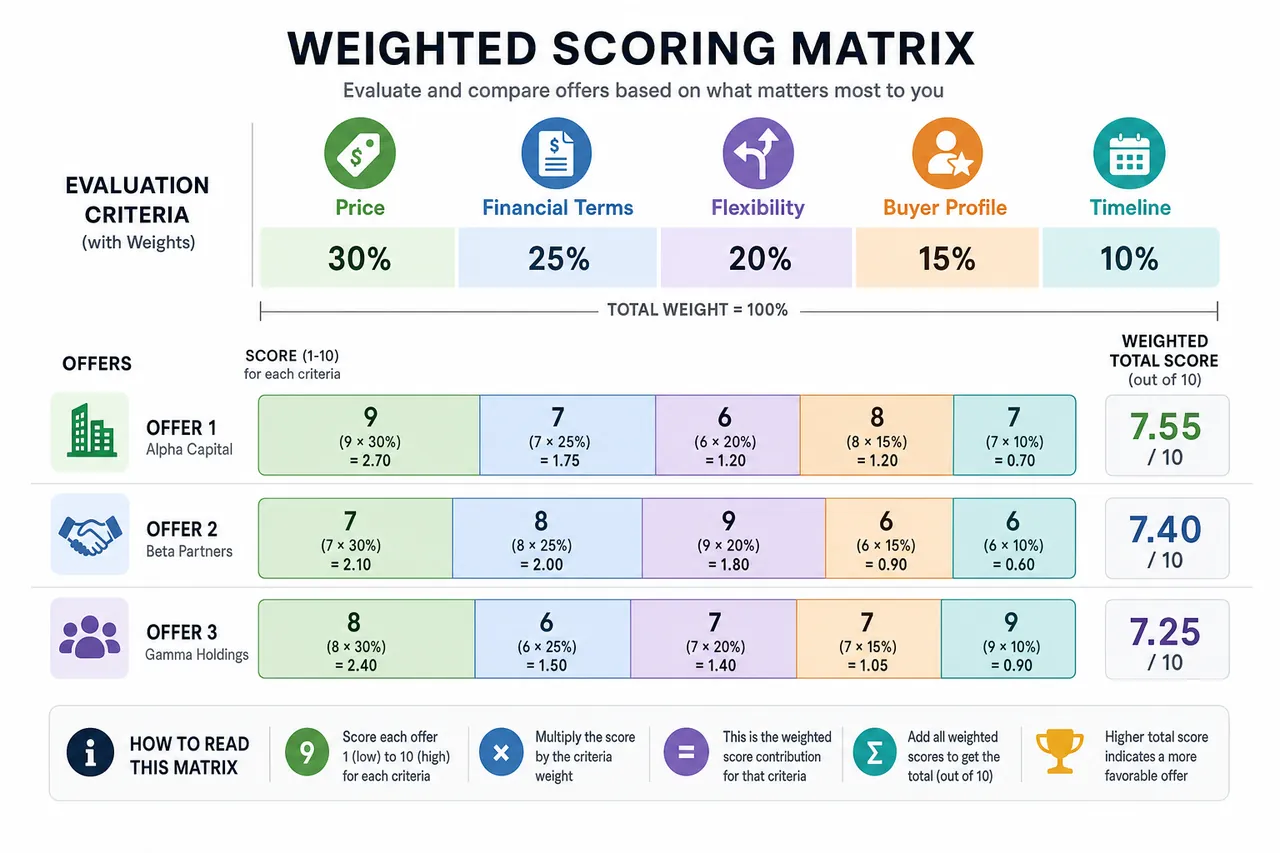
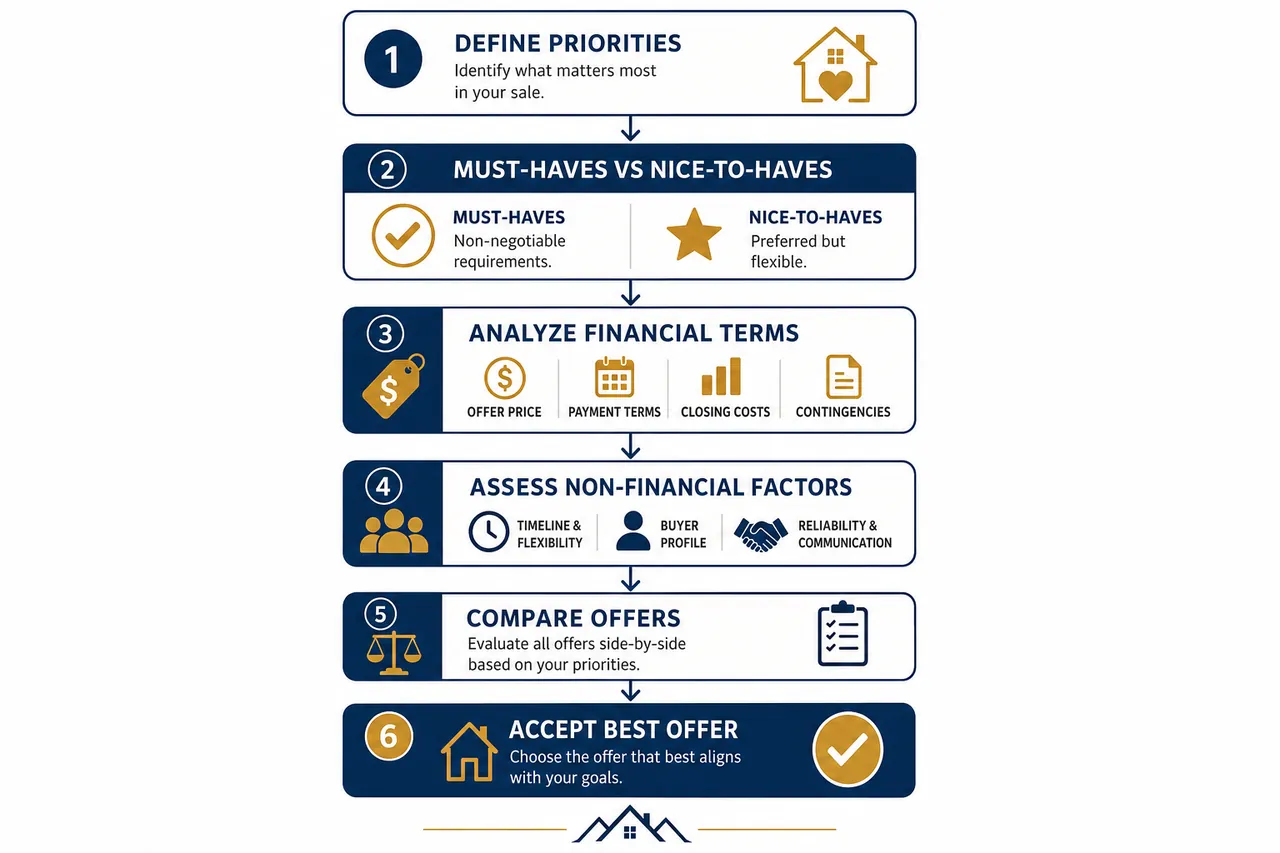
Got multiple offers on the table? That's great — but now comes the hard part. You're no longer deciding yes or no on one offer. Instead, you're wading through several complex documents, trying to figure out which one actually serves you best. It's exciting and overwhelming at the same time. The good news? A structured framework cuts through all that noise and lets you compare apples to apples.

Creating an Offer Comparison Framework
Start by building a comparison matrix. List every significant offer term in a row, then put each offer in its own column. This simple move makes it instantly obvious which factors differ and why they matter.
Here's what you need to track:
- Offer price
- Requested closing cost credits or concessions
- Net proceeds to seller (calculated)
- Earnest money amount and percentage
- Down payment and financing type
- Pre-approval status (type and lender)
- Inspection contingency (waived / limited / full)
- Appraisal contingency (waived / gap coverage / full)
- Financing contingency (waived / full)
- Home sale contingency (yes / no)
- Proposed closing date
- Rent-back terms (if applicable)
- Personal property requests
- Other notable terms
| Factor | Offer A | Offer B | Offer C | Your Priority Weight |
|---|---|---|---|---|
| Purchase Price | $385,000 | $392,000 | $375,000 (cash) | High |
| Closing Cost Credits | $0 | $8,000 | $0 | High |
| Net Proceeds (Est.) | $358,950 | $356,440 | $352,500 | High |
| Earnest Money | $7,700 (2%) | $3,920 (1%) | $18,750 (5%) | Medium |
| Financing Type | Conventional (20% down) | FHA (3.5% down) | Cash | High |
| Inspection Contingency | Standard (10 days) | Standard (14 days) | Waived | Medium |
| Appraisal Contingency | $10K gap coverage | Full contingency | Waived (cash) | High |
| Financing Contingency | 21 days | 30 days | Waived (cash) | High |
| Closing Date | 45 days | 60 days | 21 days | Medium |
| Home Sale Contingency | No | Yes | No | Very High |
Here's what most people miss: Offer B looks bigger at $392,000, but subtract that $8,000 closing cost credit and you're down to $356,440 in net proceeds. Offer A at $385,000 puts $358,950 in your pocket — and the financing is way stronger. Now look at Offer C. The $375,000 cash deal nets only $352,500, but what if you're in a time crunch? If you're dealing with an inherited house in Florida where the estate needs money fast, those 24 fewer days and guaranteed closing might be worth $6,450.
Weighted Scoring System for Complex Offers
When two or three offers are neck and neck, numbers can help you decide. This is where weighted scoring shines. You assign a weight from 1 to 10 for each factor based on what matters to you. Then you score each offer 1 to 5 on that factor. Multiply the weight by the score, add them all up, and the highest number wins.
Say closing speed is make-or-break for you. Weight it 9. The all-cash offer closes in 21 days — that's a 5. So: 9 × 5 = 45 points just on speed. The conventional buyer wants 45 days, which earns a 3. That's 9 × 3 = 27 points. Do this across every factor and the math does the talking. You're not going with your gut. You're making a choice you can explain and defend.
Red Flags and Deal Breakers
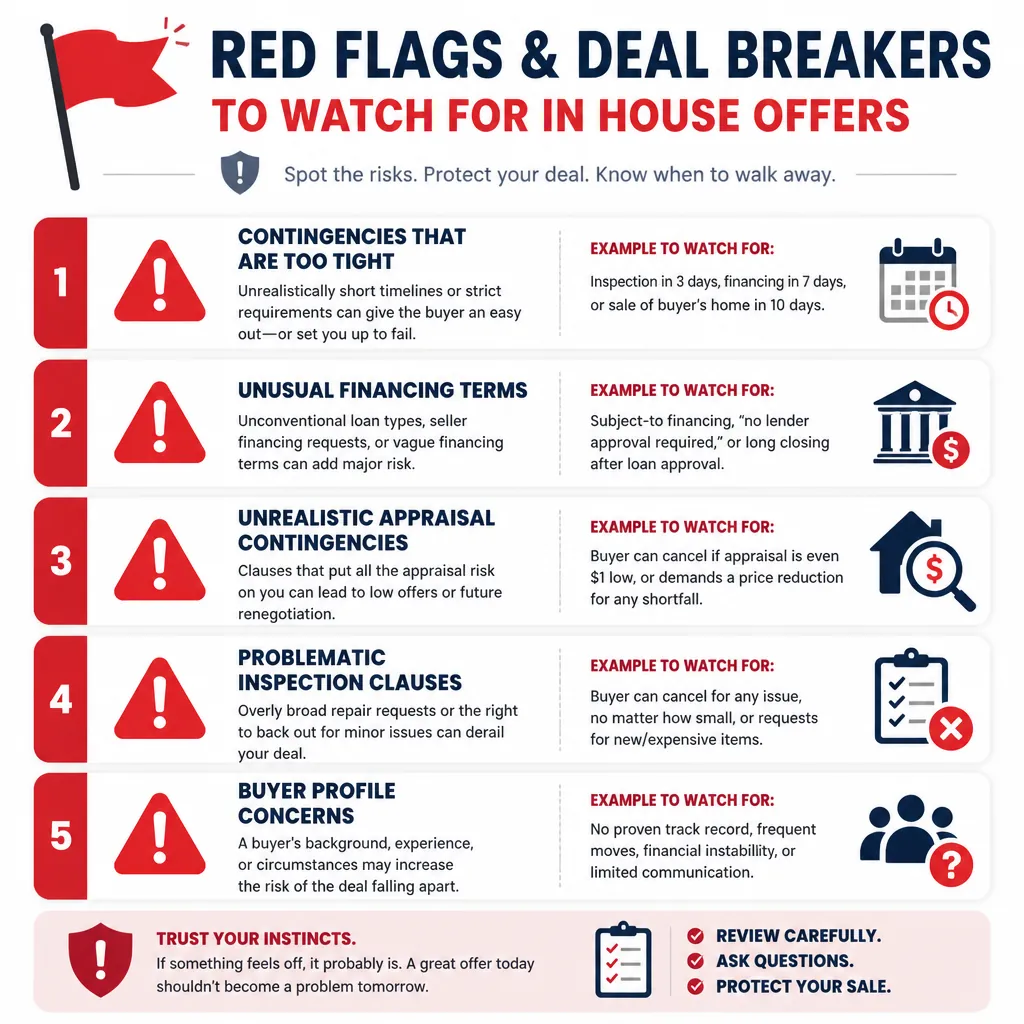
Some offer elements are poison pills. They should scare you no matter what the price tag says. Here's what to watch:
- Home sale contingency: The buyer's closing depends on them selling their own home. You're now stuck holding your breath about someone else's transaction. This is the riskiest contingency out there and you should avoid it unless you've got absolutely no other choice.
- Unusually short inspection periods: Three days to inspect? That's barely enough time for a walk-through. The buyer might be setting up to demand major repairs after that window closes.
- Unverified or informal pre-qualification: A letter saying "we pre-qualify this buyer for $400,000" with no lender name, loan type, or verification? That's not worth the paper it's printed on.
- Very low earnest money: Less than 0.5% on a typical residential sale means the buyer isn't seriously committed. Flag it and dig deeper.
- Excessive personal property requests: When buyers want appliances, furniture, mowers, sheds, and everything else, they're either padding the deal or setting up post-inspection leverage. Either way, it's a problem.
And here's something critical: if you're selling a property in a state with unique legal quirks — like an inherited home in Colorado with probate considerations — pay special attention to any contingency language tied to legal issues. Get your attorney to review those terms before you accept anything.
Back to topEmotional Detachment and Rational Decision-Making

Selling your home ranks among the most emotionally charged financial decisions you'll ever make. And it's not hard to see why. You've got years of memories wrapped up in those walls, your identity tied to the space, plus serious money on the line. Here's the thing: sellers who recognize their emotions and actively manage them make far better decisions than those who either pretend feelings don't exist or let them take over.
Separating Emotion from Logic
You'll face predictable emotional traps. A buyer writes a heartfelt letter about how much they love your home — and you feel drawn to them. An offer comes in that seems insulting. You hold out because this price should validate what the house means to you.
But here's where your pre-offer framework saves you. Remember those criteria you established before any offers arrived? Your minimum acceptable price. Your timeline. Your priority list. When an offer makes you feel good but misses your numbers, go back to the framework. When an offer stings but actually hits your financial target, go back to the framework. Your emotions are telling you something real — but they shouldn't be making your decision.
One more thing: be careful about personal letters from buyers. They can actually create Fair Housing Act complications when you're weighing offers.
When to Walk Away
Sometimes rejecting an offer is the right call. Sometimes it costs you thousands.
The difference? Data versus hope. Walking away because an offer falls short of your calculated minimum net proceeds makes sense. Walking away because you're convinced a better offer is coming — with no evidence — that's hope talking, not strategy.
Let's say your home's been listed 60+ days in a balanced market. You get an offer that's 4% below asking. Don't guess whether waiting another month brings something better. Instead, ask: what does your agent's data actually show? Look at comparable sales. Check showing traffic and inquiry numbers. Those facts should guide your decision, not your optimism.
Trust Your Research Over First Impressions
That first reaction to an offer usually fixates on one thing: the price. Don't fall for it. You need to see all the terms before you form any real opinion.
Offer B's $7,000 higher price might vanish the moment you read the fine print. There's a home sale contingency in there. The earnest money is below market. The FHA financing has strict appraisal requirements that could tank the deal. Build your full comparison matrix before you decide how you feel about either offer and let the numbers do the talking.
Back to topNegotiation Strategies and Counteroffers
You've got more power here than you might think. Accepting an offer exactly as written? That's rarely your best move. Most deals involve at least one round of back-and-forth negotiation, and knowing your options puts you firmly in control of what happens next.

