

How to Split Home Equity in a Divorce in California
You may feel worried about splitting equity in divorce and what that means for your financial future. Home equity is the difference between your home's current market value and the mortgage balance you owe. 1 This guide explains how California courts divide home equity, what options you have, and which state-specific legal rules may affect you. 2 Discover smart ways to protect your share during this difficult time. 3
Key Takeaways
- Home equity is the difference between your home's current market value and the remaining mortgage balance. If a Los Angeles property appraises at $900,000 with a $500,000 mortgage, the equity is $400,000. California courts treat this as a primary marital asset in divorce.
- California is a community property state, which means marital assets — including home equity — are generally split 50/50 under the California Family Code.
- Main options include one spouse buying out the other through refinancing, selling the home and dividing proceeds, co-owning temporarily with a delayed sale, or trading other assets like retirement accounts to offset an equity stake.
- Accurate valuation is critical. Get a licensed appraisal rather than relying on online estimates like Zillow or Redfin, especially in volatile California markets.
- Married couples may exclude up to $500,000 in capital gains when selling a primary residence before divorce finalizes — this drops to $250,000 per person afterward. California also taxes capital gains as ordinary income, so timing your sale matters significantly. Consult a divorce attorney or CPA familiar with California tax law.
Understanding Home Equity

Home equity represents how much of your home you truly own versus what is still owed on the mortgage. In California's high-value real estate markets — from San Diego to the Bay Area — this number can be substantial and often becomes the largest asset in a divorce settlement.
Definition: Current market value minus what's owed
You find your equity by subtracting what you still owe on your mortgage from the current market value of your property. 1 For example, if a real estate appraisal puts your Sacramento home at $650,000 and your remaining mortgage balance is $350,000, your home equity stands at $300,000.
Liens, second mortgages, or home equity lines of credit (HELOCs) can reduce this figure. California courts treat home equity as part of the community property marital estate, meaning both spouses generally hold an equal ownership interest in equity accumulated during the marriage.
Example calculation of home equity
Suppose your home in Los Angeles appraises for $800,000 and the outstanding mortgage balance is $500,000. Subtracting the mortgage from the market value gives you $300,000 in home equity. Under California's community property rules, each spouse is typically entitled to $150,000 of that amount.
For another scenario, a San Diego property valued at $600,000 with a $200,000 loan leaves $400,000 in equity — or $200,000 per spouse in a straightforward community property split. Courts may also consider how much a home appreciated during the marriage versus before it, especially if one spouse owned the home prior to the wedding. 2
Equity division typically begins with an updated appraisal or a Comparative Market Analysis (CMA) from a licensed appraiser or real estate agent. If no mortgage remains, dividing equity becomes more straightforward, though California law still requires proper documentation and a clear settlement agreement.
Legal Frameworks for Dividing Home Equity

California is a community property state. The California Family Code governs how marital assets are divided, and a divorce attorney familiar with California family law can help you navigate your specific situation.
California community property: 50/50 split
Under California law, all assets and debts acquired during the marriage are community property and must be divided equally. This includes home equity built up while you were married, regardless of whose name appears on the deed or mortgage.
If you purchased your home before marriage, only the equity that accumulated during the marriage is typically subject to the 50/50 split. Any down payment made with pre-marital or inherited funds may qualify as separate property — but you must document these contributions clearly. California courts apply strict tracing rules to separate commingled assets.
Even if only one spouse's name is on the title, the other spouse retains community property rights to equity earned during the marriage. Consulting a California family law attorney is essential to understand how these rules apply to your specific property and mortgage situation.
Separate property vs. community property in California
Not all home equity is automatically split 50/50. California distinguishes between community property and separate property. Equity that existed before marriage, or that came from an inheritance or gift kept separate from marital funds, may be classified as separate property.
However, if separate and community funds were mixed — for example, if you used a pre-marital down payment but both spouses paid the mortgage from joint income — the home may become partially or fully community property. This commingling of assets can be complex to untangle and often requires detailed financial tracing with help from a divorce attorney or forensic accountant.
| Property Type | Definition in California | Division Rule |
|---|---|---|
| Community Property | Assets and debts acquired during marriage | Equal 50/50 split |
| Separate Property | Assets owned before marriage, or received as inheritance/gift and kept separate | Returned to original owner |
| Commingled Property | Separate and community funds mixed together | Requires tracing; may be partially or fully community property |
Main Options for Splitting Home Equity

Each path for dividing home equity carries unique pros and cons, often shaped by your mortgage balance, credit profile, and California's competitive real estate market conditions.
One spouse buys out the other
One spouse refinances the home to pay out the other's share of equity. For example, if your San Francisco home has a market value of $1,200,000 and you owe $400,000 on the mortgage, there is $800,000 in equity. Under community property rules, each spouse is entitled to $400,000. The staying spouse would need to refinance and pull out enough cash to pay the departing spouse their share.
California mortgage lenders will require you to qualify for a new loan based on credit score, income, and debt-to-income ratios. Many California divorce agreements give 60–90 days to complete a buyout refinance. If the staying spouse cannot qualify for financing alone, selling may become the only realistic option.
A quitclaim deed is commonly used in California to transfer title from both spouses to one, but it should only be signed after the refinance is complete to avoid remaining on the mortgage.
Sell the home and divide the proceeds
Selling the home provides a clean break and eliminates ongoing joint financial obligations. After paying off the mortgage, closing costs, real estate agent commissions, and any applicable taxes, you divide the remaining proceeds per your divorce settlement agreement.
In California, expect total selling costs of roughly 8 to 10 percent of the sale price. On a $700,000 home, that could mean $56,000 to $70,000 in costs before dividing what remains. 3 A traditional home sale typically takes 60 to 90 days in most California markets, though high-demand areas like Los Angeles can move faster.
Selling before your divorce is finalized may allow both spouses to claim the larger $500,000 married couple capital gains exclusion under federal law. Keep in mind that California taxes capital gains as ordinary income at the state level, which can significantly increase your total tax liability depending on your income bracket.
Co-own temporarily (delayed sale)
Some California couples choose to retain joint ownership after divorce — often to allow children to remain in the family home until the school year ends or until a child reaches a certain age. Under this arrangement, both spouses remain on the mortgage and title, sharing responsibility for payments, property taxes, and maintenance.
Any co-ownership arrangement should be written into the divorce decree with clear terms about who pays what, how disputes are resolved, and what triggers the eventual sale or buyout. California family courts can enforce these agreements, but vague language often leads to future litigation. Work with your attorney to draft specific, enforceable terms.
Offset with other assets
If one spouse wants to keep the home but cannot refinance, you can offset the equity share with other marital assets. For example, if your spouse is entitled to $150,000 in home equity, you might transfer an equivalent amount from a 401(k), investment account, or other community property asset instead.
Accurate valuation of all assets is critical. Retirement account transfers in divorce typically require a Qualified Domestic Relations Order (QDRO) in California to avoid tax penalties. A California divorce attorney or certified divorce financial analyst (CDFA) can help structure these exchanges properly and ensure the final agreement holds up in court. 3
Valuation Process for the Home
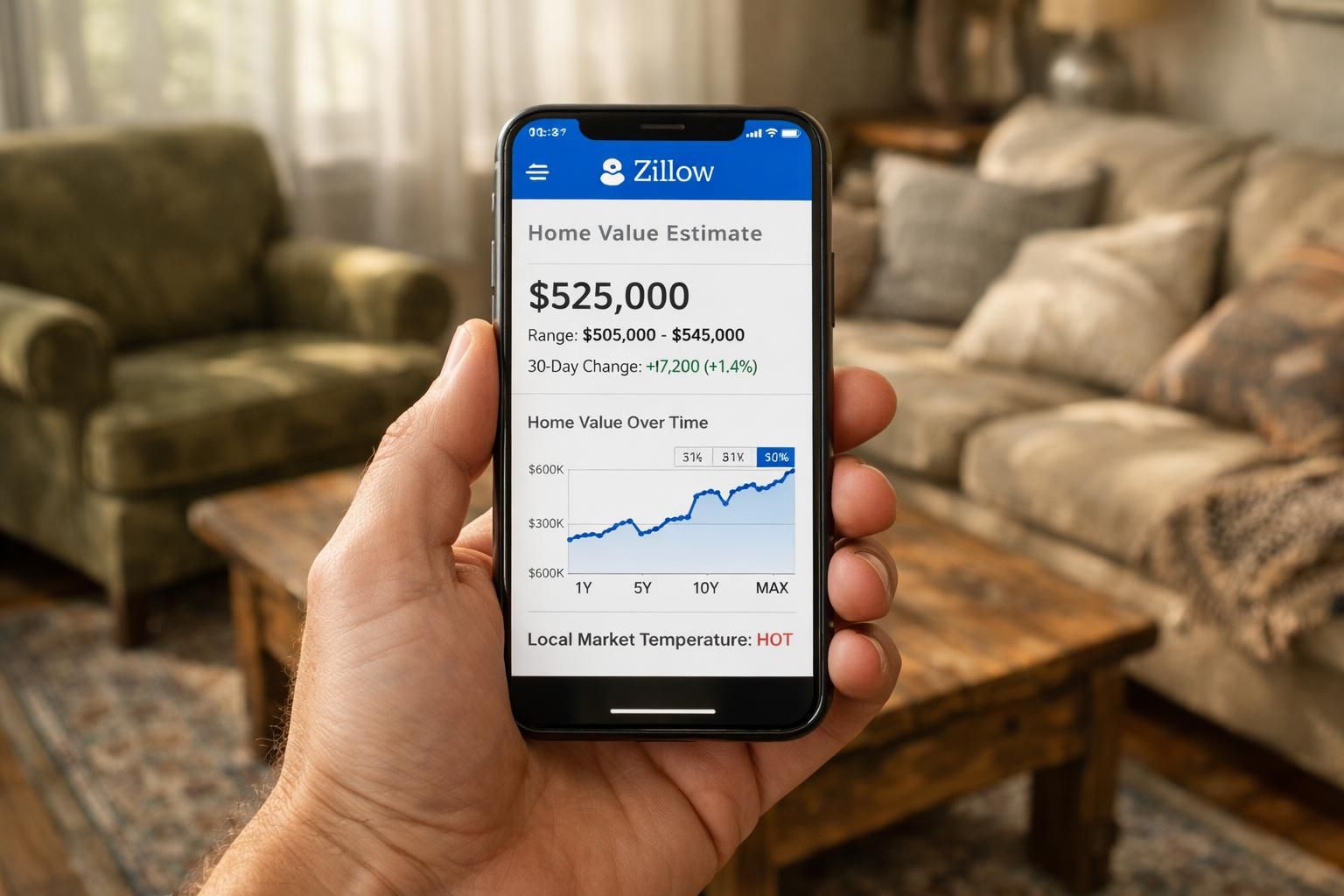
California's real estate market is among the most variable in the country. Getting an accurate, defensible valuation is essential before negotiating any equity split.
Appraisal vs. online estimates
A professional home appraisal from a licensed California appraiser is the most reliable way to establish value for divorce purposes. 4 Lenders require a formal appraisal for any refinance or buyout loan, and California courts often rely on appraiser testimony when value is disputed.
Online tools like Zillow or Redfin provide quick estimates but can miss unique features, recent renovations, or micro-market shifts that affect value in neighborhoods across Sacramento, Los Angeles, or the Bay Area. These tools are useful for setting initial expectations but should not be used as the basis for a legally binding settlement.
Handling disagreements on value
If you and your spouse disagree on the home's value, each party may hire a separate licensed appraiser. When the two appraisals differ significantly, California courts may order a third independent appraisal or require mediation. 5
California Superior Courts handle divorce property disputes, and judges have broad discretion to weigh evidence including appraisal reports, tax records, and improvement receipts. Mediation is strongly encouraged in California family law cases and can resolve valuation disputes faster and at lower cost than litigation.
Tax Considerations

California has its own tax rules layered on top of federal requirements. Both state and federal tax implications can significantly affect how much you keep from a home sale during divorce.
Federal capital gains exclusion and California income tax
Federally, married couples can exclude up to $500,000 in capital gains from the sale of a primary residence. Once divorced, each individual may only exclude up to $250,000. Selling before the divorce is finalized can help both spouses benefit from the larger exclusion.
California does not have a separate capital gains tax rate — it taxes capital gains as ordinary income at rates up to 13.3%, the highest state income tax rate in the country. This means a large home sale gain in California can result in a significant state tax bill even if federal taxes are minimized. Timing your sale and consulting with a California CPA is strongly recommended. 6
Timing of sale and basis adjustments
To maximize your IRS capital gains exclusion, you and your spouse must have owned and lived in the home as your primary residence for at least two of the last five years. Selling before the divorce decree is entered can preserve the $500,000 married couple exclusion. 7
Track all documented improvement costs, agent commissions, and closing expenses — these increase your adjusted cost basis and reduce taxable gains. Keep receipts and bank statements for every significant repair or renovation. A California CPA can help you calculate the correct basis and structure the transaction to minimize both federal and state tax exposure.
Special Situations to Consider
Some California divorces involve additional complexity — particularly in high-cost markets where mortgages are large and property values can shift quickly.
Underwater mortgages
If your mortgage balance exceeds your home's current market value, you have negative equity and nothing to split. Both spouses remain responsible for the debt until a resolution is reached. Options include a short sale with lender approval, a loan modification, or in some cases, foreclosure.
California is a non-recourse state for purchase money mortgages, meaning lenders generally cannot pursue a deficiency judgment against you after a foreclosure or short sale on a purchase loan. However, refinanced loans or HELOCs may carry different protections. Consult a California divorce attorney before making any decisions about an underwater property. 8
Deferred maintenance or home improvements
Deferred maintenance can reduce appraised value and lower sale proceeds, directly affecting each spouse's equity share. Cash buyers typically offer 70 to 85 percent of after-repair value when significant repairs are needed. Document all past improvements with receipts, permits, and contractor records — California courts may credit "sweat equity" contributions as well.
Separate property contributions or inheritances
If you used pre-marital savings or inherited funds for a down payment, that portion may qualify as your separate property under California law. You must trace and document those contributions clearly — California courts apply strict evidentiary standards. If separate funds were mixed with community property income over the years, reclaiming them becomes far more difficult without detailed financial records and professional help. 2
Role of Professionals in the Process
California's community property laws are detailed and can be complex to apply in real-world situations. Working with the right professionals protects your financial interests throughout the process.
Mediators, divorce attorneys, and financial advisors
- California family law attorneys understand the California Family Code and can ensure all property disclosures, valuations, and settlement terms meet court requirements.
- Mediators help both spouses reach agreement on equity division without going to court — California courts strongly encourage mediation before litigation in family law cases.
- A Certified Divorce Financial Analyst (CDFA) can model long-term financial outcomes from different division scenarios, including tax impacts under California's income tax structure.
- Licensed California appraisers provide defensible valuations accepted by lenders and courts, particularly important in high-value markets like Los Angeles or San Francisco.
- A CPA familiar with California tax law can guide timing decisions around the home sale to minimize both state and federal tax liability.
- Real estate agents with divorce experience can provide updated CMAs, coordinate showings during a contentious sale, and help both parties navigate a listing professionally.
Action Steps for Dividing Home Equity in California
Gather mortgage balance and property value
Start by collecting your most recent mortgage statement and any documentation of HELOCs, liens, or second mortgages. Request a professional appraisal from a licensed California appraiser, or ask your real estate agent for a Comparative Market Analysis. If you and your spouse disagree on value, obtain separate appraisals from different licensed professionals. Gather all receipts for major improvements, as these affect your home's adjusted basis and appraised value.
Consult a California family law attorney
California's community property rules apply specific legal standards to marital assets, separate property claims, and debt allocation. An experienced California family law attorney can review your financial disclosure requirements under the California Family Code, identify separate property claims, and ensure your settlement agreement is enforceable. California requires both spouses to complete and exchange full financial disclosures — called Preliminary and Final Declarations of Disclosure — before any settlement is finalized. 9
Explore all division options carefully
Compare buyout refinancing, a traditional sale, delayed co-ownership, and asset offsets before committing to any path. Factor in current California mortgage rates, your individual tax exposure, and the realistic timeline for each option. All agreed terms must be incorporated into your final divorce judgment to be legally binding and enforceable by California courts.
Conclusion
Dividing home equity in a California divorce involves community property law, state tax rules, and one of the country's most complex real estate markets. Taking the time to get an accurate appraisal, understand your legal rights, and work with qualified California professionals can make a significant difference in your outcome. Fair solutions do exist — with the right guidance, you can protect your financial interests and move forward with confidence.
If selling your home is part of your divorce plan, KDS Homebuyers can help. We buy houses directly from homeowners for cash, with no repairs, no agent commissions, and no lengthy closing timelines. Visit kdshomebuyers.net to request a free, no-obligation cash offer and take the next step toward a fresh start.
FAQs
1. How does California divide home equity in a divorce?
California is a community property state, so home equity accumulated during the marriage is generally split 50/50. Equity that existed before the marriage or came from separate property sources may not be subject to equal division, but you must document those contributions carefully.
2. How do I determine my home's value for a California divorce settlement?
Start with a professional appraisal from a licensed California appraiser. Subtract any remaining mortgage balance and liens from the appraised value to calculate available equity. Avoid relying solely on online estimates, which can be inaccurate in California's variable markets.
3. Can one spouse keep the house after a California divorce?
Yes. One spouse can buy out the other's community property share by refinancing the mortgage and pulling out enough equity to pay the departing spouse. The buying spouse must qualify for the new loan independently, and a quitclaim deed is typically used to transfer sole title after refinancing is complete.
4. Are there California-specific tax issues when selling a home in divorce?
Yes. California taxes capital gains as ordinary income at rates up to 13.3%. Combined with federal capital gains tax, a large gain on a California home sale can result in a substantial tax bill. Selling while still married may preserve the $500,000 federal exclusion, but consult a California CPA to plan appropriately.
5. What happens if our California home has negative equity during divorce?
If you owe more than the home is worth, there is no equity to divide. Both spouses remain liable for the mortgage debt. California's non-recourse laws may limit lender claims after a foreclosure or short sale on a purchase money mortgage, but refinanced loans may be treated differently. Speak with a California attorney before taking action.
References
- ^ https://www.pencefirm.com/how-do-you-divide-equity-in-a-home-when-divorcing/ (2024-11-12)
- ^ https://digitalcommons.law.uga.edu/cgi/viewcontent.cgi?article=1946&context=fac_artchop
- ^ https://www.bankrate.com/home-equity/how-is-home-equity-split-in-divorce/ (2025-06-20)
- ^ https://www.divorcelendingassociation.com/library/determining-the-value-of-real-property-in-divorce.cfm
- ^ https://digitalcommons.pace.edu/cgi/viewcontent.cgi?article=1947&context=plr
- ^ https://www.journalofaccountancy.com/issues/2013/apr/20126248/ (2013-03-31)
- ^ https://papers.ssrn.com/sol3/Delivery.cfm/SSRN_ID2364374_code680143.pdf?abstractid=1920795&mirid=1 (2011-09-11)
- ^ https://papers.ssrn.com/sol3/Delivery.cfm/SSRN_ID2888907_code488916.pdf?abstractid=2352266&mirid=1
- ^ https://www.colesorrentino.com/dividing-marital-property-new-yorks-equitable-distribution-law/ (2024-11-13)
