

Deed in Lieu of Foreclosure: How It Works and When to Use It in Washington

Falling behind on your mortgage payments in Washington can feel overwhelming. A deed in lieu of foreclosure lets you give the property back to your lender voluntarily, which may help you avoid the lengthy foreclosure process. 1 This guide explains how a deed in lieu works in Washington, when it makes sense to use it, and what steps you need to take. 2
Key Takeaways
- A deed in lieu of foreclosure lets you hand your home back to the lender when you cannot pay your mortgage. It typically causes less credit damage—around 50–125 points—compared to 200–300 points for a full foreclosure. 3
- Washington is a non-judicial foreclosure state, meaning most foreclosures move through a trustee sale process rather than the courts. A deed in lieu bypasses this entirely and stays out of public court records.
- You must show genuine financial hardship, attempt to sell first, have no major property damage or unresolved junior liens, and provide documents such as tax returns and bank statements. Most lenders require at least 90 days of missed payments under FHA guidelines.
- Washington's anti-deficiency statutes offer strong protections. Under Washington law, lenders generally cannot pursue a deficiency judgment after a trustee's sale on a purchase-money deed of trust for a residential property. Always confirm these protections apply to your specific loan in writing.
- Forgiven mortgage debt over $600 may count as taxable income under IRS Form 1099-C rules. Washington has no state income tax, but federal tax liability may still apply. Consult a tax professional and a HUD-approved housing counselor before deciding.
What Is a Deed in Lieu of Foreclosure?
A deed in lieu of foreclosure lets you transfer your home's ownership to the mortgage lender when you can no longer make payments. This voluntary agreement can help you avoid Washington's non-judicial trustee sale process, which—while faster than judicial foreclosure in states like New York—still carries serious consequences for your credit and finances. 1
In Washington, most home loans are secured by a deed of trust rather than a traditional mortgage. Your lender accepts the property title subject to any existing claims or liens, which may include a second deed of trust or a mechanic's lien. If approved, the arrangement usually releases you from further obligation on your mortgage debt unless another agreement is reached during the transaction.
Many lenders also offer moving assistance—sometimes called "cash for keys"—to ease your transition. Unlike a trustee sale, a deed in lieu stays out of public court records and typically causes less damage to your credit score. This solution works best when both parties want to minimize loss; you avoid deficiency judgment exposure while the lender gains control of the property more quickly than through formal foreclosure proceedings.
Step-by-Step Process of a Deed in Lieu of Foreclosure

You can take clear steps to request a deed in lieu from your loan servicer in Washington. Title searches, deed of trust agreements, and fair market analyses all play a key role.
Identifying financial hardship and missed payments
Most lenders require at least 90 days of missed payments before considering a deed in lieu. Lenders look for proof of genuine, ongoing hardship—not a temporary setback. If your home is "underwater" (you owe more than its current market value, which can fluctuate significantly in Seattle, Tacoma, or Spokane markets), that may be an early signal to seek help.
Gather recent tax returns, pay stubs, and bank statements. If you are self-employed, include profit and loss statements. Washington lenders may also request evidence that your property was listed for sale for at least 90 days before agreeing to a deed in lieu.
Communicating with the lender
Contact your loan servicer as soon as you anticipate trouble. Put your request in writing, clearly describing your hardship and the terms you are seeking. Your lender should respond with its conditions for accepting the deed in lieu. Ask directly whether the agreement will release you from any remaining mortgage balance or whether a deficiency claim remains possible under your specific loan type.
In Washington, most residential deed of trust loans carry strong anti-deficiency protections, but commercial loans or second liens may differ. Expect the process to take 90 to 180 days from application to completion.
Submitting an application
Gather a hardship letter, recent tax returns, bank statements, pay stubs, and a summary of monthly income and expenses. 2 Submit everything to the lender's loss mitigation department. Most lenders also require proof that you attempted to sell the home first—listing agreements, buyer offers, or documentation of time on market. Include a property value report from a licensed Washington appraiser or a Broker Price Opinion (BPO). 1
Property valuation and negotiation
The lender will order a BPO or appraisal to compare your home's current value against the outstanding loan balance. Washington's real estate markets vary widely—a home in Bellevue or Seattle may hold its value better than one in a rural Eastern Washington county, which affects the lender's willingness to accept the deed in lieu.
Any junior liens—second deeds of trust, HELOCs, or unpaid property taxes—must be resolved before the lender will proceed. The settlement agreement should clearly state whether the lender forgives the remaining balance or waives further collection. Some lenders cover transfer costs or offer relocation funds if equity exists.
Signing the deed and transferring ownership
You will meet with the lender—typically at a Washington title company or escrow office—to sign the voluntary deed transfer. Once all parties execute the documents, the lender records the new deed with the county auditor's office (Washington's equivalent of a recorder of deeds), which vests title in the lender and releases the deed of trust lien.
After recording, the lender should issue a written confirmation that your obligation under the original deed of trust has ended. Review every detail with a Washington real estate attorney before signing, since errors can affect your tax liability or credit standing.
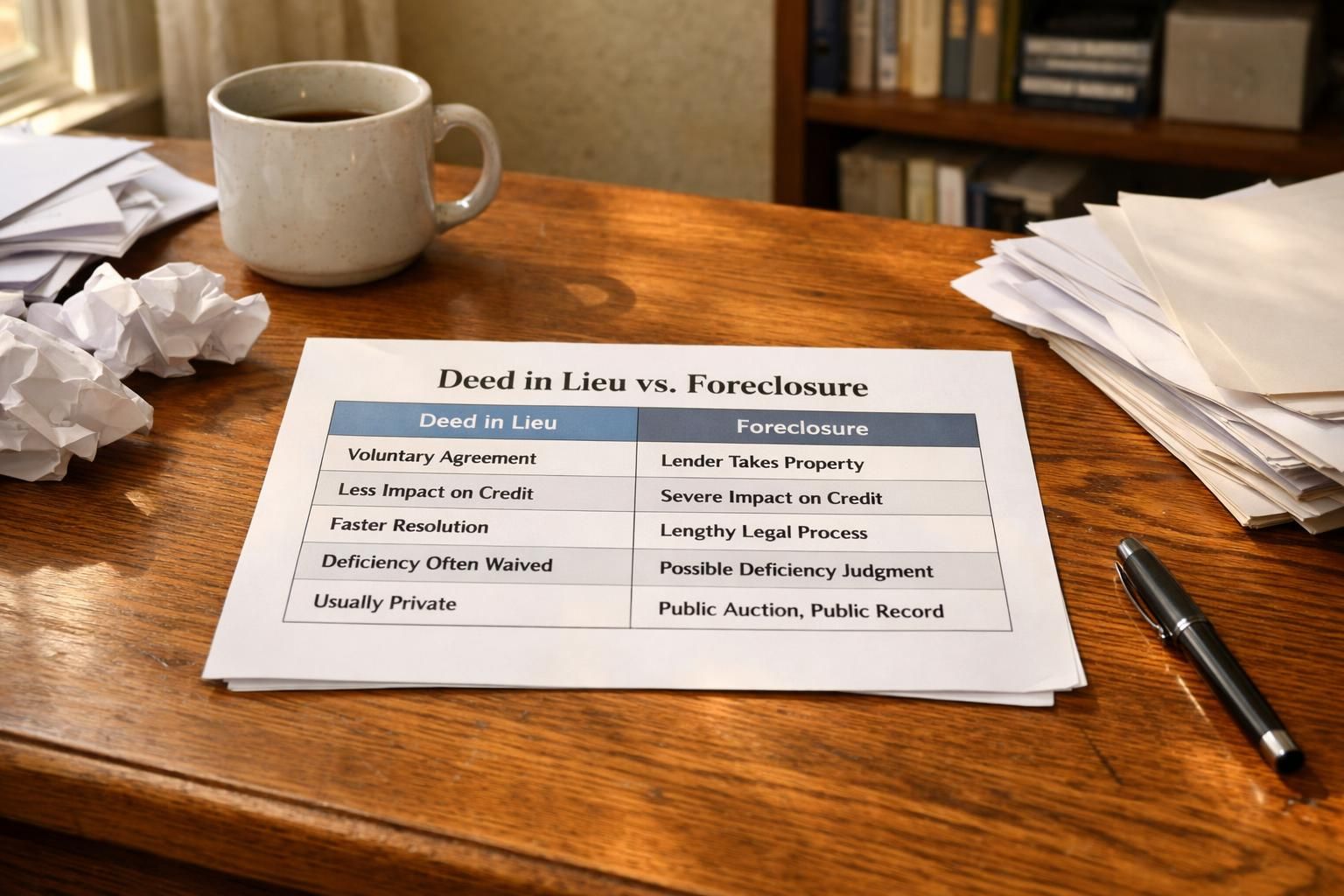
Deed in Lieu vs. Foreclosure: Key Differences
Credit score impact
A deed in lieu typically drops your credit score 50 to 125 points, while a full foreclosure can cut it by 200 to 300 points. 3 A deed in lieu stays on your credit report for about four years; a foreclosure remains for seven years. You may qualify for a conventional loan again in two to four years after a deed in lieu, compared to a longer wait following a completed foreclosure.
Timeline comparison
Washington's non-judicial trustee sale process is already one of the faster foreclosure tracks in the country—typically running about 190 days from the notice of default to the trustee's sale. A deed in lieu can still be faster, usually completed in 90 to 180 days, and avoids the public notice requirements that come with a Washington trustee sale.
Deficiency judgment possibilities
Washington law provides strong anti-deficiency protections for homeowners. For most residential properties secured by a deed of trust, lenders cannot pursue a deficiency judgment after a trustee's sale. These protections generally extend to deed in lieu situations, especially for purchase-money loans on a primary residence—but the exact scope depends on your loan type and how the agreement is written. Always get a written waiver of any deficiency claim and have a Washington real estate attorney review it before you sign.
Public record implications
Washington trustee sales require public notices filed with the county auditor and published in a local newspaper, making foreclosures visible to employers, landlords, and future lenders. 3 A deed in lieu is a private transaction between you and your lender. While the deed transfer itself is recorded, it does not carry the stigma of a public foreclosure notice, which can help protect your reputation during future rental applications or employment background checks.
Eligibility Requirements for a Deed in Lieu of Foreclosure

Washington lenders typically require: 4
- Documented, ongoing financial hardship (job loss, illness, divorce, or similar)
- At least 90 days of missed mortgage payments and evidence that loan modification or refinancing failed
- No major property damage, code violations, or unresolved repairs
- A BPO or appraisal confirming current market value
- Clear title—no unresolved junior liens, second deeds of trust, or unpaid property taxes
- Proof the property was listed for sale for at least 90 days without a successful buyer (FHA guidelines)
When to Consider and When to Avoid a Deed in Lieu

Consider a deed in lieu if your home is underwater, you have exhausted loan modification and forbearance options, and you cannot afford to continue making payments. This option works especially well if the lender agrees in writing to release you from any remaining balance. Washington's anti-deficiency protections are already strong, but getting an explicit written waiver adds another layer of security.
Avoid a deed in lieu if:
- Unresolved junior liens exist—lenders will likely reject the offer until all claims are cleared.
- Your home has significant equity; selling outright could put cash in your pocket rather than forfeiting it to the bank.
- You qualify for an FHA-backed loan modification or Washington State Housing Finance Commission assistance programs that could let you keep your home.
- The property needs major repairs; many lenders will decline deeds for homes in poor condition due to resale concerns.
Always consult with a Washington real estate attorney and a HUD-approved housing counselor before deciding. If other debts complicate your situation, speak with a bankruptcy attorney familiar with Washington courts.
Deficiency Judgments and Tax Implications in Washington
Washington's anti-deficiency statutes generally prevent lenders from pursuing a deficiency judgment on residential properties secured by a deed of trust after a trustee's sale or a deed in lieu transaction. 5 However, second liens, commercial loans, or loans that do not qualify as purchase-money debt may carry different rules. Always confirm in writing that your specific agreement includes a full release of liability.
On the tax side, Washington has no state income tax, which removes one layer of concern. However, federal rules still apply: if your lender forgives more than $600 in mortgage debt, the IRS treats it as taxable income and will issue a Form 1099-C. Consult a tax professional about whether any exclusions—such as the primary residence insolvency exclusion—apply to your situation.
If you are considering a deed in lieu while also facing bankruptcy, note that courts may review the transfer as a preferential or fraudulent conveyance if completed within 90 days of filing (or one year for insiders) under federal bankruptcy law. Seek legal advice before proceeding if bankruptcy is also on the table.
Alternatives to Deed in Lieu of Foreclosure
Short sale
A short sale lets you sell your Washington home for less than you owe, with lender approval. 6 You must submit a loss mitigation package including a hardship letter, financial statements, and proof of income. Lenders often take weeks or months to decide, and the home typically must be listed for at least 90 days. Confirm in writing whether the lender waives any deficiency—Washington law offers protections, but a written waiver eliminates ambiguity. Canceled debt may still trigger federal tax consequences, so consult a tax professional. 6
Loan modification
A loan modification changes your payment terms—lowering your interest rate, extending the loan term, or setting up a forbearance period. Washington homeowners may also access programs through the Washington State Housing Finance Commission. You must provide proof of hardship, income, and expenses. Lenders are not required by law to approve every request, but a successful modification can stop foreclosure and protect your credit score.
Forbearance
Forbearance lets you pause or reduce payments during a short-term hardship. FHA and other federally backed loan programs offer structured forbearance plans, typically lasting three to twelve months. Missed payments must be repaid later—either in a lump sum or through a repayment schedule. 7 This is not a permanent fix, but it can buy time while you explore other solutions.
Chapter 13 bankruptcy
Chapter 13 bankruptcy allows you to propose a three-to-five-year repayment plan and can halt Washington trustee sale proceedings through an automatic stay. It works best for homeowners with regular income who want to keep their homes. Bankruptcy stays on your credit report for up to ten years, but many homeowners find it easier to rebuild after Chapter 13 than after a completed foreclosure. Consult a Washington bankruptcy attorney before taking this step.
Selling to a cash buyer
Selling to a cash buyer can help you avoid foreclosure entirely if you need a quick exit. Cash buyers typically purchase homes in as-is condition, which means no costly repairs or staging. Closings can happen in as little as 7 to 14 days—far faster than waiting for mortgage approval. The trade-off is usually a below-market offer, but you avoid further credit damage, public trustee sale notices, and potential deficiency complications. 8 This option works best if your home carries enough equity to cover your remaining loan balance. 9
Actionable Next Steps for Washington Homeowners
- Contact your lender as soon as you miss—or anticipate missing—payments. Washington's non-judicial foreclosure process can move quickly once a notice of default is filed.
- Gather financial documents: pay stubs, tax returns, and bank statements. These are required for any hardship application.
- Write a clear hardship letter explaining why you cannot continue making payments.
- Ask about all alternatives: loan modification, forbearance, short sale, and deed in lieu. Washington homeowners may also qualify for state-level housing assistance programs.
- Request a written deficiency waiver. Washington law is generally protective, but an explicit written release removes all doubt.
- Confirm that the deed in lieu agreement covers your total mortgage debt before signing anything.
- Contact a HUD-approved housing counselor for free guidance on your options.
- Consult a Washington real estate attorney before agreeing to any settlement terms.
- Talk with a tax professional about potential federal tax liability on forgiven debt—Washington's lack of a state income tax helps, but federal rules still apply.
- Evaluate any "cash for keys" offer from your lender; relocation funds can ease the transition out of your home.
- Review all documents carefully for language confirming full release from personal liability before signing.
- Keep copies of every communication, letter, and signed agreement related to your case.
Conclusion
Facing the loss of your home in Washington is stressful, but a deed in lieu of foreclosure can provide a faster, more private path than a trustee sale. Washington's anti-deficiency protections offer real relief, and the absence of a state income tax simplifies some of the tax concerns. That said, every situation is different—speak with your lender early, work with a Washington real estate attorney, and consult a HUD-approved housing counselor before you decide.
If you need to move quickly and want to explore selling your home for cash before things go further, KDS Homebuyers buys houses directly from Washington homeowners in any condition. Visit kdshomebuyers.net to request a free, no-obligation cash offer and learn how we can help you avoid foreclosure on your timeline.
FAQs
1. What is a deed in lieu of foreclosure and how does it work in Washington?
A deed in lieu lets you voluntarily transfer your property to the lender to settle your mortgage debt, bypassing Washington's non-judicial trustee sale process entirely.
2. How does a deed in lieu compare with a short sale or loan modification in Washington?
A loan modification adjusts your payment terms so you can stay in your home. A short sale requires selling for less than you owe. A deed in lieu transfers ownership directly to the lender when those options are not available or have failed.
3. Will my credit score be affected?
Yes, but typically less than a full foreclosure. Most homeowners see a drop of 50–125 points versus 200–300 points for a completed trustee sale. A deed in lieu also clears your credit report faster than a foreclosure. 3
4. Can I use a deed in lieu if I have a second deed of trust or HELOC?
Unresolved junior liens usually disqualify you unless all lienholders agree to release their claims. This is one of the most common reasons lenders reject deed in lieu applications in Washington.
5. Should I get legal advice before accepting a deed in lieu offer in Washington?
Absolutely. A Washington real estate attorney can clarify your anti-deficiency protections, review the agreement for a full liability release, and help you avoid unexpected tax or legal consequences.
References
- ^ https://www.consumerfinance.gov/ask-cfpb/what-is-a-deed-in-lieu-of-foreclosure-en-291/
- ^ https://www.nar.realtor/financing-credit/deed-in-lieu-of-foreclosure
- ^ https://residentialequitypartners.com/foreclosure-vs-deed-in-lieu-which-is-the-better-option/
- ^ https://www.nycbar.org/get-legal-help/article/real-property-law/residential-mortgage-loan-foreclosure-in-new-york/deed-in-lieu/
- ^ https://academic.oup.com/rfs/article/24/9/3139/1571250?login=true
- ^ https://www.nolo.com/legal-encyclopedia/deed-lieu-vs-short-sale.html
- ^ https://www.huduser.gov/portal/Publications/pdf/alt.pdf
- ^ https://scholarship.law.upenn.edu/cgi/viewcontent.cgi?article=1410&context=jbl
- ^ https://www.justia.com/foreclosure/alternatives-to-foreclosure/short-sales-and-deeds-in-lieu-of-foreclosure/
