

Deed in Lieu of Foreclosure: How It Works and When to Use It in Tennessee
Falling behind on your mortgage payments can feel overwhelming and stressful. A deed in lieu of foreclosure lets you give the property back to your lender, which may help you avoid a long foreclosure process. 1 This guide explains how a deed in lieu works under Tennessee law, when it makes sense to use it, and what steps you need to take. Find out if this option fits your situation before making tough decisions about your home.
Key Takeaways
- A deed in lieu of foreclosure lets you voluntarily transfer your home's title to the lender when you cannot keep up with mortgage payments. This usually stops the formal foreclosure process and causes less credit score damage—dropping it by about 50–125 points, compared to 200–300 points for a full foreclosure. 3
- Tennessee is a non-judicial foreclosure state, meaning lenders can foreclose relatively quickly—sometimes in as few as 60 days—using a power-of-sale clause. A deed in lieu sidesteps this process entirely and keeps the transaction out of public court records.
- You must prove financial hardship, attempt to sell your home first, have no major property damage or junior liens, and provide documentation such as tax returns and bank statements. Most lenders require at least 90 days of missed payments before considering a deed in lieu under FHA guidelines.
- Tennessee is a recourse state, meaning lenders may pursue a deficiency judgment for the unpaid balance after a deed in lieu unless they specifically agree in writing to waive that right. Always confirm this in your settlement agreement.
- Forgiven mortgage debt over $600 may count as taxable income under IRS Form 1099-C rules. Tennessee has no state income tax on wages, but forgiven debt could still trigger federal tax liability. Consult a real estate attorney or HUD-approved housing counselor before proceeding.
What Is a Deed in Lieu of Foreclosure?

A deed in lieu of foreclosure is a voluntary agreement in which you transfer your home's title directly to the mortgage lender to satisfy your debt and avoid the lengthy foreclosure process. 1 In Tennessee, because foreclosure typically proceeds non-judicially through a power-of-sale clause in the deed of trust, the process can move fast—but it still leaves a serious public record and severely damages your credit. A deed in lieu offers a quieter, faster alternative.
If your lender approves, this arrangement generally releases you from further mortgage obligation, unless otherwise stated in the agreement. Many lenders also offer "cash for keys" relocation assistance to ease your transition. Because the deed in lieu is handled privately rather than through Tennessee's foreclosure sale process, it causes significantly less credit and reputational damage than a public foreclosure auction.
Step-by-Step Process of a Deed in Lieu of Foreclosure

You can take clear steps to request a deed in lieu from your loan servicer. Title searches, mortgage agreements, and fair market analyses all play a key role in this process.
Identifying financial hardship and missed payments
Most lenders require at least 90 days of missed payments before considering a deed in lieu. Lenders look for proof of genuine, ongoing hardship—not a temporary setback. If your home is "underwater," meaning you owe more than the current market value, that can be an early indicator to seek help.
Gather recent tax returns, pay stubs, and bank statements. If you are self-employed, include profit and loss statements. The lender may also require evidence that your property was listed for sale for at least 90 days. In markets like Memphis or Knoxville, where home values can vary widely by neighborhood, an accurate appraisal is especially important for demonstrating the gap between what you owe and what the property is worth.
Communicating with the lender
Contact your mortgage servicer in writing as soon as possible. Clearly explain your financial hardship and the terms you are seeking. Lenders expect a voluntary, good-faith request free from duress. Ask specifically whether the deed in lieu will fully discharge your mortgage debt or whether a deficiency judgment remains possible under Tennessee law.
Because Tennessee allows lenders to pursue deficiency judgments, confirming this in writing up front is critical. Expect the process from application to completion to take between 90 and 180 days.
Submitting an application
Prepare a complete application package that includes a hardship letter, recent tax returns, bank statements, pay stubs, and a summary of your monthly income and expenses. 2 Submit this to the lender's loss mitigation department along with documentation of your attempts to sell the property, such as listing agreements and any purchase offers received. Include a property value report from an appraiser or a Broker Price Opinion (BPO). A thorough submission speeds up the lender's review.
Property valuation and negotiation
Your lender will order a BPO or full appraisal to confirm the home's current market value relative to your outstanding debt. Any junior liens—such as a second mortgage, HELOC, or unpaid property taxes recorded with the county—must be resolved before the lender will accept the deed. Tennessee requires clear title for the transfer to proceed.
Negotiate the settlement agreement carefully. Confirm whether the lender will forgive the remaining mortgage balance or reserve the right to seek a deficiency. Sometimes lenders cover transfer costs or offer relocation assistance if equity exists, but this is not guaranteed.
Signing the deed and transferring ownership
Once terms are agreed upon, you and the lender sign the legal documents—typically at a title company or real estate attorney's office in Tennessee. You voluntarily convey the property deed to the lender, and once recorded with the county register of deeds, the lender holds full title.
After recording, the lender should issue a satisfaction of mortgage confirming your obligation has ended, provided that was part of the agreement. Review every document with a Tennessee real estate attorney before signing, because mistakes can affect your tax liability and credit recovery timeline.
Deed in Lieu vs. Foreclosure: Key Differences in Tennessee
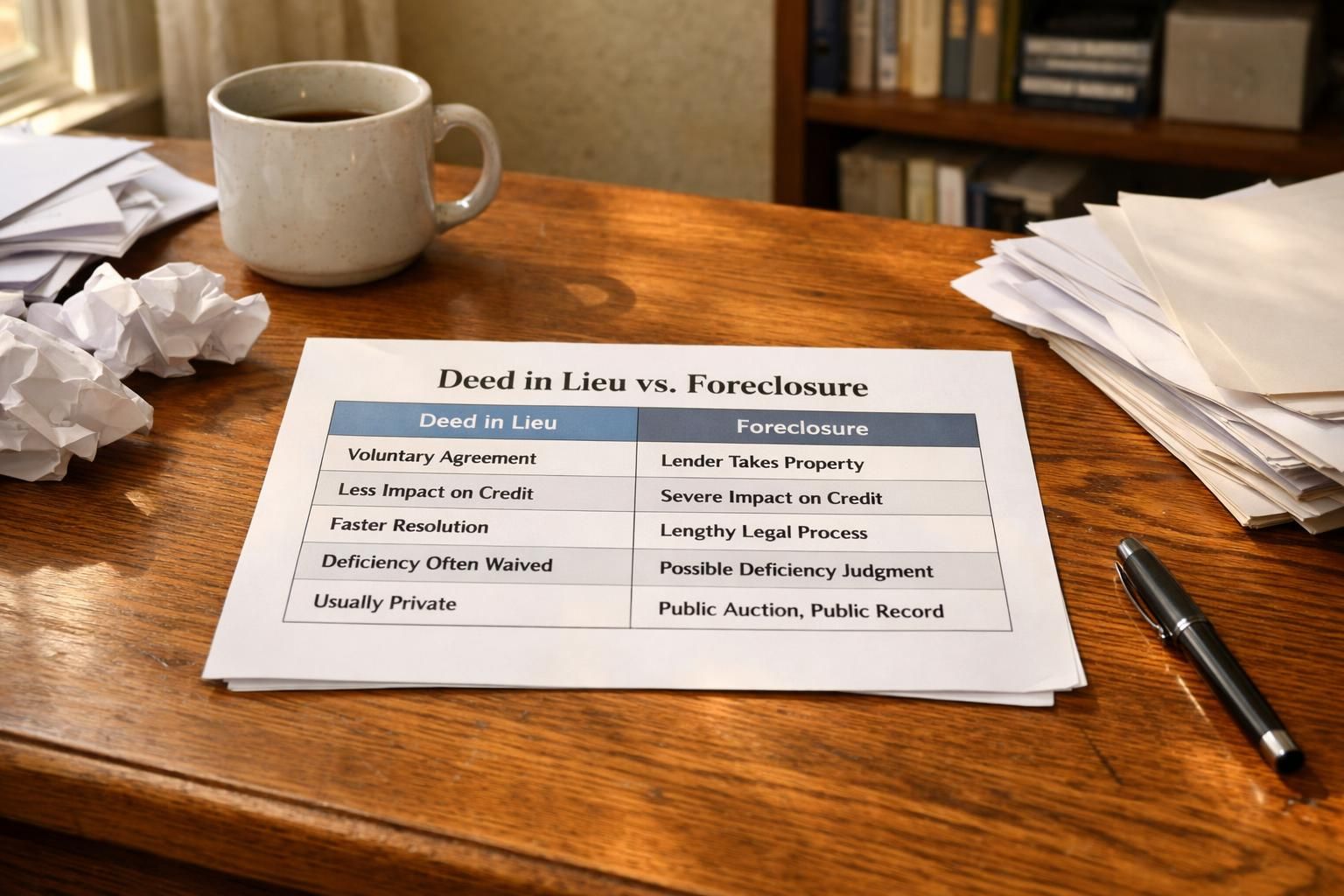
Credit score impact
A deed in lieu typically causes a credit score drop of 50–125 points, while a full foreclosure can cut your score by 200–300 points. 3 A deed in lieu stays on your credit report for about four years; a foreclosure remains for seven. With a deed in lieu, you may qualify for a conventional mortgage again in two to four years, or an FHA loan in three years—much sooner than after a foreclosure.
Timeline comparison
Tennessee's non-judicial foreclosure process can move in as little as 60 days once the lender files a notice of default, but the full process—including required advertising and sale—commonly takes several months. A deed in lieu, by contrast, typically resolves in 90 to 180 days from application and avoids court proceedings and public auction notices entirely.
Deficiency judgment possibilities in Tennessee
Tennessee is a recourse state. If your home's value is less than the outstanding mortgage balance at the time of transfer, your lender can pursue a deficiency judgment for the difference unless they contractually waive that right. Always request a written deficiency waiver as part of your deed in lieu agreement. Without this language in the settlement, you could remain liable for the shortfall even after surrendering the property.
Public record implications
Tennessee foreclosures proceed through a trustee's sale that is advertised publicly—typically in a local newspaper for several weeks—and the sale becomes part of the public record. This means employers, landlords, and future lenders can find this information easily. A deed in lieu, while the recorded deed transfer is technically a public record, does not carry the same stigma as a foreclosure sale notice and does not appear in court records. 3
Eligibility Requirements for a Deed in Lieu of Foreclosure

Lenders require documented ongoing financial hardship. Missing several mortgage payments and failing at loan modification or refinancing usually needs to come first. 4 Your home must be free of major property damage, code violations, or unresolved repairs that would make it difficult to resell.
The lender will order a BPO or appraisal to confirm current market value. Your title must be clean—no second mortgage, unpaid mechanic's liens, or delinquent property taxes recorded with the county that would block a clean transfer. Most lenders also want proof the home was listed for sale for at least 90 days with no successful buyer, consistent with FHA guidelines.
When to Consider and When to Avoid a Deed in Lieu

Consider a deed in lieu if your home is underwater, you have exhausted loan modification and forbearance options, and you cannot afford monthly payments. This option is particularly relevant in Tennessee because the non-judicial foreclosure process can move quickly, leaving you less time to act. If the lender agrees in writing to waive a deficiency judgment, you can walk away without further financial exposure.
Avoid a deed in lieu if you have unresolved junior liens or delinquent property taxes—Tennessee lenders will typically reject the offer until these are cleared. If your home has significant equity, selling it outright gives you money back rather than surrendering everything to the bank. Homeowners who qualify for FHA or USDA loan modification programs may benefit more from keeping their homes through adjusted payment plans. Also avoid proceeding if the property is in poor condition, as many lenders will refuse the deed if the home needs major repairs.
Deficiency Judgments and Tax Implications in Tennessee
Because Tennessee is a recourse state, lenders can pursue a deficiency judgment after a deed in lieu if the property's value falls short of the mortgage balance—unless the settlement agreement explicitly waives this right. 5 Always negotiate a written deficiency waiver before signing the deed transfer documents.
On the tax side, if your lender forgives more than $600 in mortgage debt, the IRS will issue a Form 1099-C and treat the forgiven amount as taxable income. Tennessee does not impose a state income tax on wages or investment income (the Hall Income Tax was fully repealed as of 2021), so forgiven debt does not trigger a separate state tax bill—but it may still increase your federal taxable income for the year. Consult a tax attorney to determine whether any federal exclusions apply to your situation, such as the insolvency exclusion.
Tennessee also imposes a real estate transfer tax, generally paid at closing, though in a deed in lieu transaction the parties should clarify in writing who is responsible for this cost. A deed in lieu can also face scrutiny in bankruptcy proceedings if completed within 90 days before filing a Chapter 7 or Chapter 11 case, as courts may review it as a preferential transfer under federal bankruptcy law.
Alternatives to Deed in Lieu of Foreclosure
Short sale
A short sale lets you sell your home for less than you owe, with lender approval. 6 You must submit a loss mitigation package including a hardship letter, income documentation, and financial statements. In active markets like Nashville or Chattanooga, you may find buyers more quickly, but the lender still controls approval. Confirm whether the lender will waive the deficiency in writing, and be aware that forgiven debt may carry federal tax consequences.
Loan modification
Loan modification changes your mortgage terms—lowering the interest rate, extending the loan term, or setting up a forbearance period. Lenders require proof of hardship and full financial documentation. A successful modification can prevent foreclosure entirely and preserve your credit score. Government-backed programs through FHA, VA, or USDA may offer additional options depending on your loan type.
Forbearance
Forbearance temporarily pauses or reduces your mortgage payments during a short-term hardship such as job loss or illness. A typical plan lasts three to twelve months. 7 Missed payments are not forgiven—they must be repaid later through a lump sum or repayment plan. If hardship continues beyond the relief period, your lender may suggest a modification or other alternative.
Chapter 13 bankruptcy
Chapter 13 bankruptcy allows you to propose a three-to-five-year repayment plan approved by the federal bankruptcy court, which can stop a Tennessee foreclosure immediately through an automatic stay. This option suits homeowners with regular income who want to keep their home and catch up on arrears over time. Consult a Tennessee bankruptcy attorney to understand how this interacts with a potential deed in lieu.
Selling to a cash buyer
Selling to a cash buyer can help you avoid foreclosure quickly, especially if you are facing Tennessee's fast non-judicial foreclosure timeline. Cash buyers purchase properties as-is, and closings can happen in as few as 7 to 14 days—far faster than a traditional sale or lender approval process. 8 If your home has equity, a cash sale may put money back in your pocket rather than surrendering everything to the lender. This approach gives you more control over the outcome compared to a short sale or deed in lieu. 9
Foreclosure Avoidance Strategies for Tennessee Homeowners
Act quickly if you start missing mortgage payments. Tennessee's non-judicial foreclosure process moves faster than most states, so early communication with your lender is critical. Work with a HUD-approved housing counselor for free guidance, and consider consulting a Tennessee real estate attorney before signing any agreement. Confirm that any deed in lieu or settlement agreement contains a written deficiency waiver. Federal programs through FHA and the Homeowner Assistance Fund provide additional resources. Keep copies of all communications and signed documents to protect yourself from future disputes.
Actionable Next Steps for Tennessee Homeowners
- Contact your lender as soon as you anticipate trouble making payments. Tennessee's foreclosure timeline is short, so early action matters.
- Gather financial documents including pay stubs, tax returns, and bank statements for your hardship application.
- Write a clear hardship letter explaining why you cannot continue making mortgage payments.
- Request information on alternatives including short sale, loan modification, and forbearance before committing to a deed in lieu.
- Ask for a written deficiency waiver. Tennessee lenders can pursue a deficiency unless they agree in writing to waive it. 1
- Confirm the deed in lieu agreement covers your total mortgage debt before signing any documents.
- Consult a HUD-approved housing counselor for free advice on Tennessee-specific programs and options.
- Hire a Tennessee real estate attorney to review all settlement terms before you sign.
- Talk with a tax professional about federal tax liability on any forgiven debt, and confirm whether any exclusions apply to your situation.
- Evaluate "cash for keys" relocation assistance if offered by your lender.
- Keep copies of all correspondence, agreements, and signed documents related to your case.
Conclusion
Facing the potential loss of your home in Tennessee is difficult, but a deed in lieu of foreclosure can offer a faster, more private alternative to the foreclosure process. Weigh your options carefully, confirm deficiency waiver language in writing, and consult both a Tennessee real estate attorney and a tax professional before finalizing any agreement. Taking action early gives you the best chance to protect your credit, your finances, and your family's future.
If you need to sell your Tennessee home quickly to avoid foreclosure, KDS Homebuyers purchases houses directly for cash—as-is, with no repairs required. Visit kdshomebuyers.net to request a free, no-obligation cash offer and explore your options today.
FAQs
1. What is a deed in lieu of foreclosure and how does it work in Tennessee?
A deed in lieu of foreclosure lets a Tennessee homeowner voluntarily transfer property title to the lender to satisfy mortgage debt and avoid the non-judicial foreclosure process. The lender accepts the deed instead of proceeding with a trustee's sale.
2. How does a deed in lieu compare with a short sale or loan modification in Tennessee?
A loan modification adjusts your payment terms so you keep the home. A short sale requires selling below the mortgage balance with lender approval. A deed in lieu transfers ownership directly when other options have been exhausted or are not feasible.
3. Will my credit score be affected by a deed in lieu in Tennessee?
Yes, your credit score will drop—typically 50 to 125 points—but this is significantly less damage than a full foreclosure, which can reduce your score by 200 to 300 points. 3
4. Can a Tennessee lender pursue a deficiency judgment after a deed in lieu?
Yes. Tennessee is a recourse state, and lenders can seek a deficiency judgment for the unpaid balance unless they contractually waive that right in the settlement agreement. Always get this waiver in writing.
5. Should I get legal advice before accepting a deed in lieu offer in Tennessee?
Absolutely. A Tennessee real estate attorney can review deficiency language, transfer tax responsibilities, and any potential tax consequences. A HUD-approved housing counselor can also provide free guidance tailored to your situation.
References
- ^ https://www.consumerfinance.gov/ask-cfpb/what-is-a-deed-in-lieu-of-foreclosure-en-291/
- ^ https://www.nar.realtor/financing-credit/deed-in-lieu-of-foreclosure
- ^ https://residentialequitypartners.com/foreclosure-vs-deed-in-lieu-which-is-the-better-option/
- ^ https://www.nycbar.org/get-legal-help/article/real-property-law/residential-mortgage-loan-foreclosure-in-new-york/deed-in-lieu/
- ^ https://academic.oup.com/rfs/article/24/9/3139/1571250?login=true
- ^ https://www.nolo.com/legal-encyclopedia/deed-lieu-vs-short-sale.html
- ^ https://www.huduser.gov/portal/Publications/pdf/alt.pdf
- ^ https://scholarship.law.upenn.edu/cgi/viewcontent.cgi?article=1410&context=jbl
- ^ https://www.justia.com/foreclosure/alternatives-to-foreclosure/short-sales-and-deeds-in-lieu-of-foreclosure/
